Social psychology
Introduced| English | Meaning |
|---|---|
| conformity/kənˈfɔːmɪti/ | Changing one's behaviour or expressed beliefs to align with a group or its perceived expectations. |
| fundamental attribution error/ˌfʌndəˈmentl ətrɪˈbjuːʃn ˈerə/ | The tendency to overemphasise personal characteristics and underestimate situational influences when explaining others' behaviour. |
| cognitive dissonance/ˈkɒɡnɪtɪv ˈdɪsənəns/ | An aversive state associated with inconsistency among relevant beliefs or between belief and action, which can motivate attempts to reduce that inconsistency. |
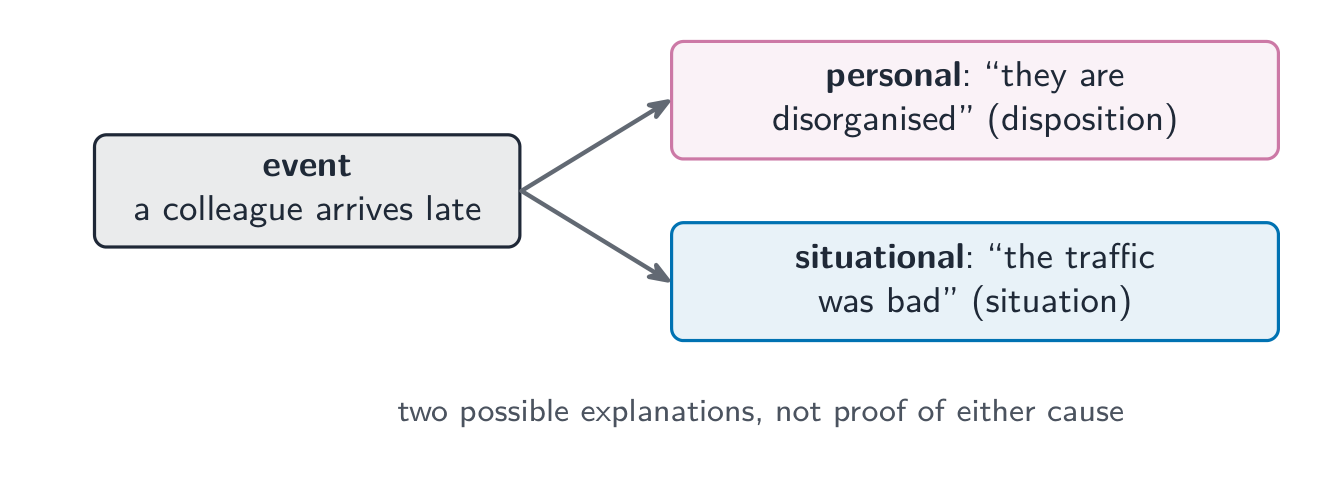
Their character, my traffic?
- Imagine someone explains a classmate's lateness as “disorganised” but their own lateness as “traffic”. This illustrates a possible difference in explanation; it does not show that everyone makes this comparison or identify the actual cause of either delay.
- Social psychology examines attribution, conformity 从众, obedience, attitudes and group processes. Ask what people did, what reasons are reported and which comparison supports the explanation.
Attribution terms describe different questions
- A dispositional explanation concerns the person; a situational explanation concerns circumstances. The fundamental attribution error 基本归因错误 describes underweighting situational constraints when inferring others' dispositions. A self-serving pattern credits oneself for success while explaining failure externally.
- The actor–observer hypothesis proposes relatively more situational explanations for one's own actions and more personal explanations for others'. A large meta-analysis did not support a broad, context-free asymmetry. Do not treat this shorthand as a law or assume every personal explanation is mistaken.
Match each attribution label with its usual description, without treating it as a universal rule.
Difficulty 2/5 · 140 coins + a small bonus on first completion today
The labels concern related but distinct comparisons. The actor–observer shorthand has important empirical limits; a vignette illustrates a description rather than proving a general bias.
The actor–observer hypothesis is a context-free law that every person applies to all actions.
Difficulty 1/5 · 100 coins + a small bonus on first completion today
A broad unconditional asymmetry is not supported by the cited meta-analysis. Context, comparison and the kind of behaviour matter.
Kelley: compare people, targets and occasions
- In the covariation model, consensus concerns how others respond to the same target; distinctiveness concerns whether this person responds similarly to other targets; consistency concerns the response to this target across occasions. The three comparisons are not synonyms.
- The model predicts how patterns of information guide attribution. High consistency alone does not select a cause; examine the other comparisons and the evidence available. Covariation in observations is not equivalent to a controlled causal experiment.
Worked comparison. Many people laugh at a particular comedian (high consensus). One person laughs mainly at this comedian (high distinctiveness) and does so repeatedly (high consistency). Within the model, this pattern favours an attribution to the target rather than simply to a person who laughs at everything. It still does not exclude every alternative explanation.
Which comparison most directly concerns consensus in Kelley’s model?
Difficulty 1/5 · 100 coins + a small bonus on first completion today
Consensus compares people; distinctiveness compares targets for the person; consistency compares occasions for that person–target relation.
Separate acceptance, information and authority
- Normative influence concerns gaining acceptance or avoiding rejection; informational influence concerns treating others as evidence about what is correct. Following the same crowd could involve either motive, or both. Behaviour alone may not identify the motive.
- Obedience concerns responding to an authority's instruction. A direct instruction is different from matching peers, but the processes can overlap. State what the vignette says rather than inferring private belief, approval or motivation from compliance alone.
Worked distinction. A person copies an answer because they think classmates understand the problem: informational influence. A person privately thinks the answer is wrong but agrees to avoid rejection: normative influence. If only “copied the answer” is reported, the reason remains unknown.
What influence is actually described?
Distinguish normative influence, informational influence and obedience.
In an unfamiliar place, a person follows others toward an exit because they believe the others know the correct route. The stated reason most directly illustrates
Difficulty 1/5 · 100 coins + a small bonus on first completion today
The reason explicitly treats others as information. Following a crowd without a stated reason would not by itself distinguish informational from normative influence.
Observing someone copy a group answer, without any other evidence, uniquely identifies a normative motive.
Difficulty 1/5 · 100 coins + a small bonus on first completion today
Acceptance, accuracy, authority or several processes could matter. The behaviour alone does not identify the motive.
Keep classic-study conditions and denominators
- Asch's 1955 report describes agreement with a misleading unanimous majority on 36.8% of the relevant line selections. This is a proportion of judgments under those conditions, not the percentage of people who always conform. A supporting dissenter reduced conformity; the effect depended on the variation.
- In Milgram's published 1963 laboratory condition, 26 of 40 male volunteers continued to the maximum 450-volt switch, giving 65%. The learner was a confederate and received no such shocks. This describes behaviour in that deceptive procedure, not a universal obedience rate or proof that participants approved of harm. Distress and deception also raise ethical questions.
In Asch’s reported supporting-partner variation, a dissenter increased conformity to the misleading majority.
Difficulty 1/5 · 100 coins + a small bonus on first completion today
A supporting partner reduced conformity in the reported variation. Different dissent arrangements and changes over trials should not be collapsed into one universal percentage.
What does the 36.8% result in the stated Asch report describe?
Difficulty 1/5 · 100 coins + a small bonus on first completion today
The unit is a judgment under the reported conditions, not a fixed type of person or a general human rate.
In the stated 1963 condition, 26 of 40 participants reached the maximum switch. What percentage is this?
Difficulty 2/5 · 140 coins + a small bonus on first completion today
26/40 × 100 = 65%. This is the participant proportion for that condition.
Dissonance: distinguish ratings from mechanism
- Cognitive dissonance 认知失调 is an aversive state associated with inconsistency among relevant beliefs or between belief and action, which can motivate attempts to reduce that inconsistency. In Festinger and Carlsmith's 1959 procedure, participants performed dull tasks; paid groups then described them positively to another person.
- The 1-dollar group's later enjoyment rating was higher than the 20-dollar group's. This fits an insufficient-external-justification account under the study conditions. The observed group difference is not a direct measurement of every participant's private process or proof that low rewards always change attitudes.

Means from the enjoyment question in Table 1, on a −5 to +5 scale. Each analysed condition had 20 participants. No uncertainty intervals are shown; the graph alone does not identify a unique psychological mechanism.
In Festinger and Carlsmith’s reported 1959 analysed conditions, which group gave the highest mean rating of task enjoyment?
Difficulty 1/5 · 100 coins + a small bonus on first completion today
The one-dollar group had the highest reported enjoyment mean. This supports the study’s predicted group pattern, not proof of every individual’s private mechanism.
Using the reported enjoyment means, 1.35 for the one-dollar group and −0.05 for the twenty-dollar group, what is the observed difference, first group minus second, in rating points?
Difficulty 2/5 · 140 coins + a small bonus on first completion today
1.35 − (−0.05) = 1.40 rating points. This group difference is not a direct measure of every participant’s private process.
Attitudes and behaviour need matching scope
- A broad attitude and one specific action need not correspond closely. Compare the target, action, context and time: a general view about the environment is different from a stated intention to cycle to work tomorrow.
- Strong, accessible attitudes can be useful predictors, but opportunity, habits, competing goals and social constraints matter. Observing one action does not reveal a stable attitude with certainty, and an observed association does not alone establish causal direction.
Worked limit. A person supports cleaner transport but drives because no suitable public route is available. The action does not by itself prove the attitude was insincere. Examine the specific choice and available alternatives.
Audience effects and collective effort differ
- Social facilitation accounts predict that others' presence can strengthen dominant responses, sometimes improving simple or well-practised performance and impairing difficult or unfamiliar performance. Task demands, evaluation and the setting matter; an audience does not guarantee improvement.
- Social loafing is reduced individual effort in a collective task relative to a suitable comparison. Identifiability, task value and whether one's contribution seems necessary can affect it. Lower group output can also reflect coordination problems, so output loss alone does not prove lower motivation.
Worked distinction. A practised typist becomes faster while watched: an audience-performance pattern. Several people work hard but duplicate each other's work and produce little: a possible coordination loss. Do not label every low-output group as loafing.
Doing a well-practised task better when watched is social ____.
Difficulty 1/5 · 100 coins + a small bonus on first completion today
The described improvement while watched fits social facilitation. Audience effects depend on the task, setting and response being measured; they are not always beneficial.
Low collective output proves that individuals reduced their effort.
Difficulty 1/5 · 100 coins + a small bonus on first completion today
Coordination loss, unequal resources or task differences can lower output. Social loafing requires evidence about individual effort relative to a suitable comparison.
Group decisions can shift in different ways
- Group polarisation is a shift toward a more extreme version of the group's initial average tendency. It can mean a stronger cautious position as well as a riskier one. It does not mean the group necessarily splits into two camps, nor that every discussion polarises.
- Groupthink concerns concurrence-seeking that interferes with critical evaluation, such as suppressing dissent or ignoring alternatives. Agreement alone is insufficient evidence of it. Examine how evidence, disagreement and alternatives were handled, not merely whether the final decision was unanimous.
Which group-process description fits?
Distinguish the measured process and avoid automatic causal conclusions.
Helping depends on the outcome and setting
- Bystander research often finds a lower probability of intervention by a particular individual when other witnesses are present. Ambiguity, shared responsibility, danger, relationships and support from others can change the pattern. More witnesses does not guarantee that no one helps.
- Distinguish the probability that one witness helps from the probability that at least one person helps in the whole event. Counts of helpers, speed of response and effective assistance are also different outcomes. A claim about one denominator cannot automatically answer all these questions.
Worked evidence check. A report counts whether any witness intervened at each event. That can address event-level helping. It cannot, without individual-level information and a suitable comparison, establish each witness's probability of helping or prove one universal group-size effect.
A field report records whether at least one witness helped at each event. It concludes that each individual becomes less likely to help whenever group size increases. Identify the outcome mismatch and explain what further evidence is needed.
The measured outcome is any helping at the event level, while the conclusion concerns a particular individual’s probability. Individual participation and suitable comparisons across group sizes are needed, with attention to danger, available opportunities, witness relationships and other differences. More witnesses can change individual and event-level outcomes differently; the event measure alone does not prove a universal effect.
Recap
- Separate dispositional explanations, situational explanations and evidence of bias.
- Identify the reported motive or instruction before naming an influence process.
- State study conditions, measurement units and denominators.
- Keep an observed rating difference distinct from its proposed mechanism.
- Group effects are conditional patterns, not automatic outcomes.
- conformity: Alignment with a group's responses, norms or expectations.
- fundamental attribution error: Underweighting situational constraints when explaining others' behaviour through dispositions.
- cognitive dissonance: An aversive state associated with inconsistent relevant cognitions, which can motivate attempts to reduce the inconsistency.
A person publicly agrees with a group. A report concludes that the person privately changed belief, has a permanently conformist personality, and would obey any authority because of the classic studies’ percentages. Explain three unsupported inferences.
Public agreement does not reveal whether belief changed or whether the reason was acceptance, information or another influence. One constrained action does not establish a permanent disposition. Rates from particular judgment trials or one obedience condition do not determine this individual’s response in every context, and conformity is not identical to obedience. Examine motives, instructions, repeated evidence and relevant comparisons.