Social cognition, attribution and social influence
Scope and prerequisites
Supported GRE topic 20 (SO.1). Use the overview measurement lesson VI when interpreting research evidence. Existing official questions are traced in bank_review_form.yaml; original tasks below are not ETS items.
Concepts and method
fundamental attribution error 基本归因错误: Over-attributing others' behaviour to disposition while neglecting the situation. normative influence 规范性影响: Conforming to gain acceptance or avoid rejection, distinct from informational influence.
Attribution assigns causes to behaviour: internal (dispositional) or external (situational). The fundamental attribution error over-uses dispositional explanations for others, and the actor-observer asymmetry reverses this for ourselves. Correspondent inference asks when an act reveals a trait: freely chosen, unexpected or low-consensus acts are the most informative.
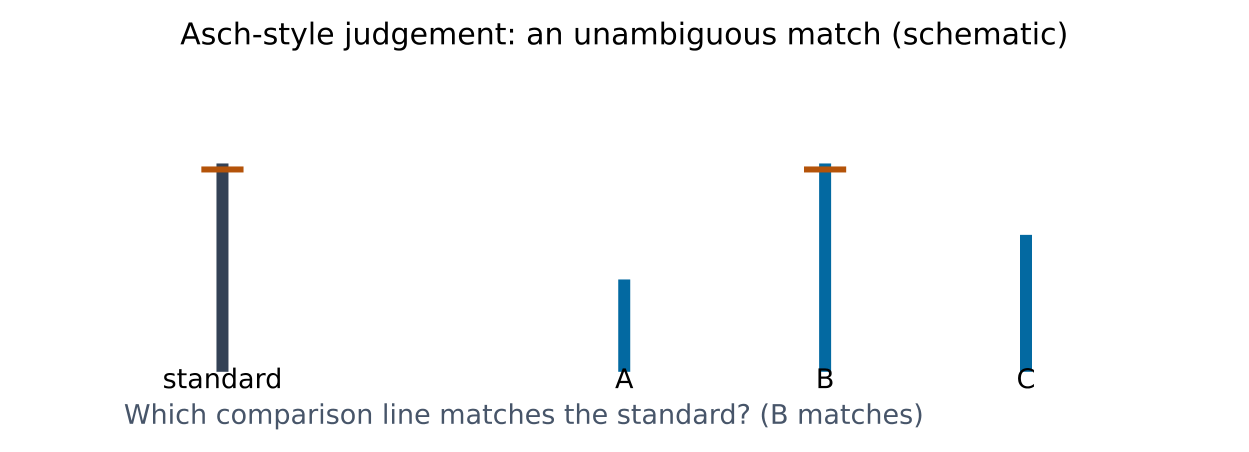
Influence comes in two kinds: normative influence is conforming to be accepted; informational influence is accepting others' behaviour as evidence about reality. Asch's line studies showed conformity to a unanimous majority on unambiguous judgements; Milgram's obedience studies showed destructive compliance with an authority. Conformity falls sharply with one dissenting partner.
Cognitive dissonance is the tension from holding inconsistent cognitions, reduced by changing attitudes or justifications; with insufficient external justification, people internalise the behaviour. Persuasion follows the elaboration likelihood model: the central route (arguments) produces durable change when audiences can and will think; the peripheral route (cues, attractiveness) is fragile.
Self-evaluation processes include self-affirmation (restoring worth in an unaffected domain after a threat), self-verification (seeking confirming feedback), self-monitoring (adjusting self-presentation) and the self-serving bias (success internal, failure external). Excitation transfer lets residual arousal from one event intensify a later emotional reaction.
Attribution distinguishes situational and dispositional explanations. Informational influence treats others as evidence; normative influence concerns acceptance. Obedience involves an authority's direction. An attitude includes evaluative components, while an action also depends on opportunity, incentives and constraints. A mechanism needs discriminating evidence: public agreement alone cannot uniquely identify private belief.
Worked reasoning
Screaming at a friend after a parking ticket is excitation transfer: residual arousal intensifies the later anger. Reminding yourself of a strength after a comparison threat is self-affirmation. Agreeing with a unanimous group on an obvious line length is normative conformity. A vague appeal working only when the audience is distracted is peripheral-route persuasion.
A student copies a group's route choice because they believe the group knows the campus. How does this differ from copying to avoid ridicule?
Believing the group has useful knowledge fits informational influence. Avoiding ridicule fits normative influence. The same outward action can arise through different mechanisms. Anonymity, uncertainty and private accounts may help distinguish them in an ethically approved task.
Independent transfer
A late student is called lazy, but the bus stopped unexpectedly. Build a better attribution and name what remains unknown.
Attempt independently, then use the matching skill sheet solution.
Review and source limits
Avoid this error: Do not merge conformity and obedience (peer pressure versus authority), or call every dispositional inference an error; the error is neglecting the situation, not using traits at all. Teaching scope comes from teaching.yaml and the source/key/crop review in bank_review_form.yaml. Detailed current diagnostic criteria require an authenticated manual; neither historical ETS practice nor this educational reference certifies them.