Language structure, perception and acquisition
Scope and prerequisites
Supported GRE topic 18 (LG.1). Use the overview measurement lesson VI when interpreting research evidence. Existing official questions are traced in bank_review_form.yaml; original tasks below are not ETS items.
Concepts and method
morpheme 语素: The smallest meaning-bearing unit of language. syntax 句法: The rules governing how words combine into phrases and sentences.
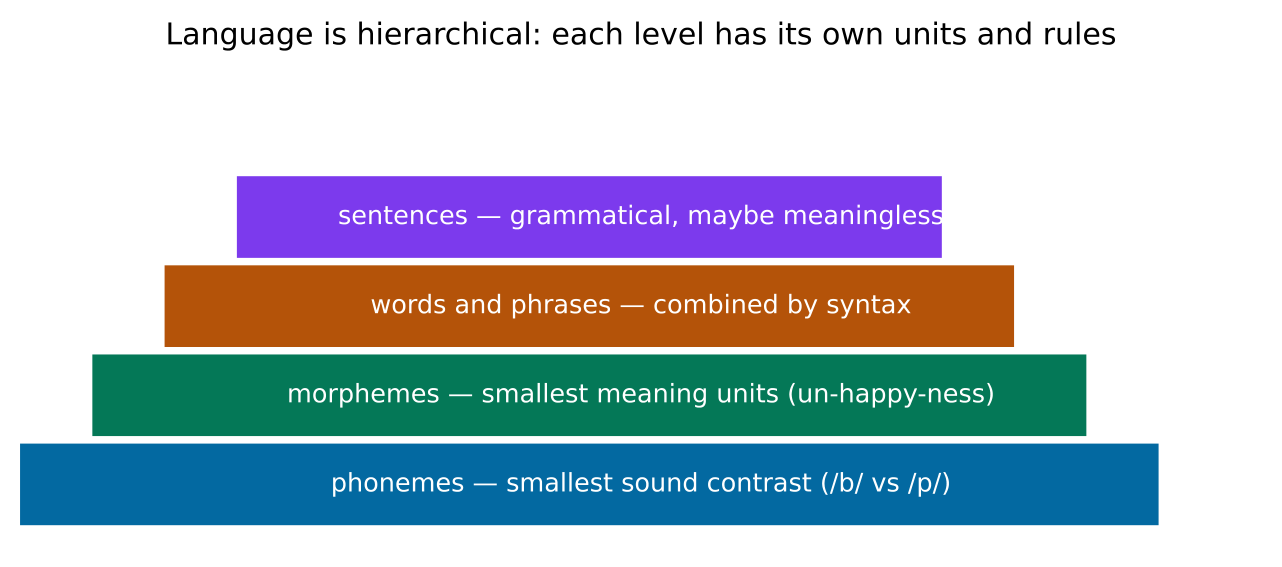
Language is hierarchical. Phonemes are the smallest sound units that distinguish meaning (/b/ versus /p/); morphemes are the smallest meaning-bearing units (un-happy-ness has three); syntax governs how words combine into phrases and sentences; semantics concerns meaning. A sentence can be grammatical yet meaningless — syntax and semantics are separable.
Speech perception is categorical: continuous acoustic variation is heard as discrete phonemes, so a sound between /b/ and /p/ is reported as one or the other. Listeners segment a continuous stream using transitional probabilities and knowledge, not audible gaps between words.
Reading links print to sound and meaning. Skilled readers use both a grapheme-to-sound route (sounding out) and a direct whole-word route for familiar words; dyslexia research separates phonological decoding deficits from surface patterns. Eye-movement studies show reading is a series of fixations and saccades, not smooth gliding.
Bilingualism research separates language proficiency from general intelligence: balanced bilinguals show executive-control practice effects, while subtractive schooling can harm both languages. Second-language learning declines with age of onset, especially for pronunciation and grammar, without a single sharp critical cut-off.
Phonemes distinguish sound categories; morphemes carry meaning. Syntax concerns organization of words; semantics concerns meaning; pragmatics concerns use in context. A grammatical sentence can be unusual in meaning. Children's rule-based errors can show productive generalization rather than exact copying. Both learning opportunities and biological constraints matter; a single error cannot decide every language-acquisition theory.
Worked reasoning
Un-happy-ness is three morphemes but the spoken form has more phonemes than syllables. A sound midway between /b/ and /p/ is heard as clearly one or the other — categorical perception. Colourless green ideas sleep furiously is grammatical but meaningless, separating syntax from semantics.
A child says walked correctly and then says goed. What does the second form suggest about learning, and what would be an overclaim?
Goed applies a productive past-tense pattern to an irregular verb, consistent with overregularization. The child is doing more than repeating every form exactly. This does not prove that input or reinforcement never matters or that one complete theory has been established. Examine patterns across forms and development.
Independent transfer
Explain how a message can have correct syntax but be misunderstood because of context, using an original example.
Attempt independently, then use the matching skill sheet solution.
Review and source limits
Avoid this error: Counting morphemes by letters or syllables, or treating word boundaries in speech as physically present; segmentation is inferred by the listener. Teaching scope comes from teaching.yaml and the source/key/crop review in bank_review_form.yaml. Detailed current diagnostic criteria require an authenticated manual; neither historical ETS practice nor this educational reference certifies them.