Memory systems, processes and forgetting
Scope and prerequisites
Supported GRE topic 17 (ME.1). Use the overview measurement lesson VI when interpreting research evidence. Existing official questions are traced in bank_review_form.yaml; original tasks below are not ETS items.
Concepts and method
working memory 工作记忆: The limited active system holding and manipulating a few chunks for seconds. proactive interference 前摄干扰: Older learning disrupting the retention of newer material.
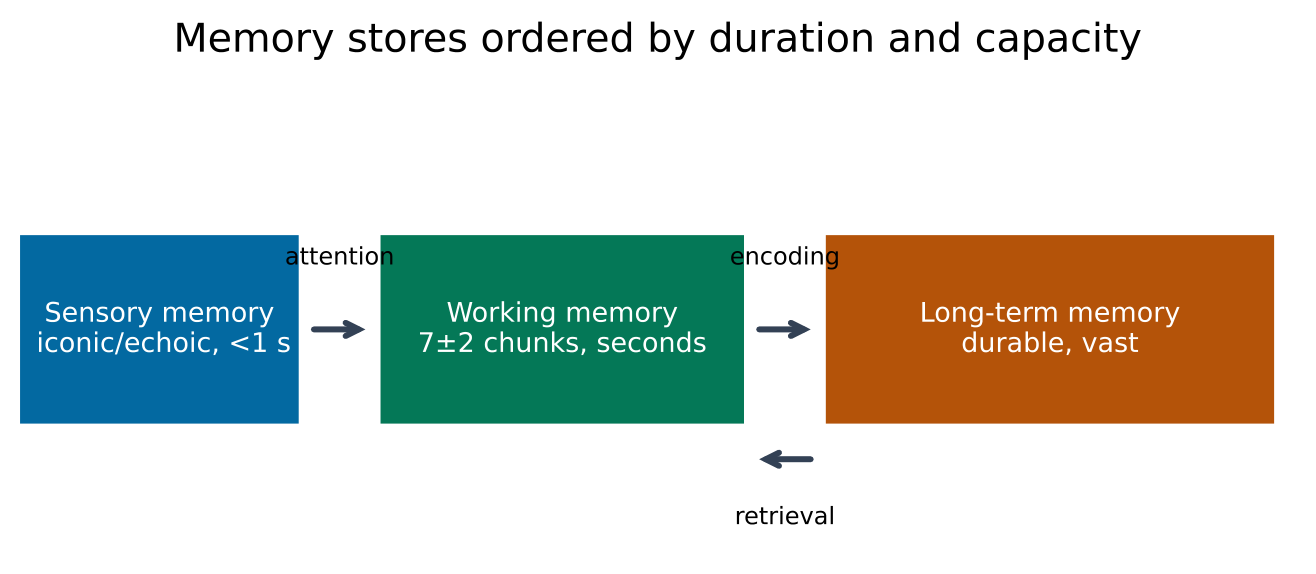
The modal model orders stores by duration. Sensory memory holds a brief, nearly complete trace — iconic for vision, echoic for hearing — and a mask within 200–300 ms destroys it. Short-term or working memory holds a few chunks for seconds; Miller's classic estimate is 7±2 chunks, and rehearsal keeps material active. Long-term memory is durable and effectively unlimited.
Working memory is more than a short store: Baddeley's model has a central executive with a phonological loop for speech-like material and a visuospatial sketchpad for images. Chunking recodes items into familiar units, expanding effective capacity without expanding the store.
Long-term memory divides by content and awareness. Episodic memory is personal events; semantic memory is facts and knowledge; procedural memory is skills. Implicit memory shows in performance without deliberate recall (priming, skills); explicit memory is deliberate recall or recognition. A person can show priming for material they cannot consciously recollect.
Forgetting has identifiable mechanisms. Proactive interference is old learning disrupting new; retroactive interference is new learning disrupting old. Retrieval failure follows encoding specificity: cues matching the encoding context restore recall. The serial position curve (primacy and recency) separates long-term from immediate-store contributions.
Sensory stores briefly retain modality-specific input. Working memory maintains and processes a limited amount; chunking changes the effective units. Long-term explicit memory includes episodic events and semantic knowledge; implicit effects include skills and priming. Forgetting may involve interference or retrieval failure, so a failed free-recall test cannot uniquely identify decay. The familiar seven-plus-or-minus-two span is a historical estimate under particular tasks, not a universal working-memory capacity.
Worked reasoning
A masked letter array is lost within 300 ms — sensory memory. Remembering a phone number by 3-4 digit chunks uses chunking in working memory. Recognising a face without recalling the meeting is implicit memory. After learning French then Spanish, French vocabulary intrudes into Spanish recall: proactive interference.
Old account passwords make a new password harder to recall. Later the new password disrupts recall of the old one. Name each direction.
Old interfering with new is proactive interference; new interfering with old is retroactive interference. Name the target and the interfering material before applying the label. The case does not show that either memory has been erased.
Independent transfer
A person improves at a motor task but cannot recall the training session. What distinction fits, and why is one case not proof of a fully isolated system?
Attempt independently, then use the matching skill sheet solution.
Review and source limits
Avoid this error: Treating working memory as a single box, or calling every memory failure decay; interference and cue-dependent retrieval failure account for most exam cases. Teaching scope comes from teaching.yaml and the source/key/crop review in bank_review_form.yaml. Detailed current diagnostic criteria require an authenticated manual; neither historical ETS practice nor this educational reference certifies them.