Thinking, problem solving and intelligence
Introduced 5:48
Thinking, problem solving and intelligence
In 1983 Amos Tversky and Daniel Kahneman described Linda: 31, single, outspoken and very bright, a philosophy graduate who cared about discrimination and…
English narration · English and 中文 subtitles you can switch
In this lesson
| English | Meaning |
|---|---|
| heuristic/hjuːˈrɪstɪk/ | A practical shortcut or rule of thumb used to solve a problem or make a decision without guaranteeing an optimal or correct result. |
| prototype/ˈprəʊtəʊtaɪp/ | A mental representation of the most typical example of a category. |
| functional fixedness/ˈfʌŋkʃənl ˈfɪkstnəs/ | Difficulty seeing alternative uses for an object beyond its familiar function. |
A plausible description is not a probability
- Suppose a fictional town has many more farmers than librarians. A bookish description may resemble a librarian, but resemblance alone does not tell you the probability of that occupation.
- Heuristics 启发式 are shortcuts that can be useful. The task is to recognise what information a shortcut uses, what it omits and whether the evidence supports the resulting judgement.
Concepts, schemas and scripts organise information
- A prototype 原型 represents a typical category member. A familiar bird such as a robin may be judged more typical than a penguin, but typicality depends on experience and is not the rule defining every category member.
- Schemas organise knowledge; scripts represent familiar event sequences. Both help interpretation and memory, but can also lead a person to fill in expected details that were not actually present.
Identify the cue used by the shortcut
- An applicable, correct algorithm followed properly solves its specified task; its guarantee depends on those conditions. A heuristic offers a useful shortcut without that general guarantee. Availability uses ease of recall; representativeness uses resemblance to a category or prototype.
- Anchoring pulls estimates towards an initial value. Framing changes a judgement when equivalent outcomes are described differently. A vivid example, a category resemblance, a starting number and a change in wording are different cues.

This illustration uses invented proportions to show a possible judgement pattern. It is not a demographic survey or a calculation of a conditional probability.
Which heuristic or bias?
Distinguish ease of recall, resemblance, starting values and equivalent wording.
People prefer a treatment with “90% survival” over one with “10% mortality”. This is
Difficulty 1/5 · 100 coins + a small bonus on first completion today
Equivalent outcomes, different descriptions.
Heuristics are errors by definition.
Difficulty 1/5 · 100 coins + a small bonus on first completion today
Heuristics are shortcuts that can be useful. They do not guarantee a correct solution, and a particular use may ignore relevant information.
Which statement about an algorithm is most defensible?
Difficulty 1/5 · 100 coins + a small bonus on first completion today
The guarantee depends on correctness, proper execution and the stated problem/input conditions.
Count matching cases before computing a probability
- In a worked fictional example, there are 20 librarians and 80 farmers. The description fits 80% of the librarians and 20% of the farmers, so 16 people in each group match it.
- Among the 32 matching people, 16 are librarians, so the probability is $16/32=0.5$. Use the matching group as the denominator, rather than all 100 residents or the 80% figure alone.
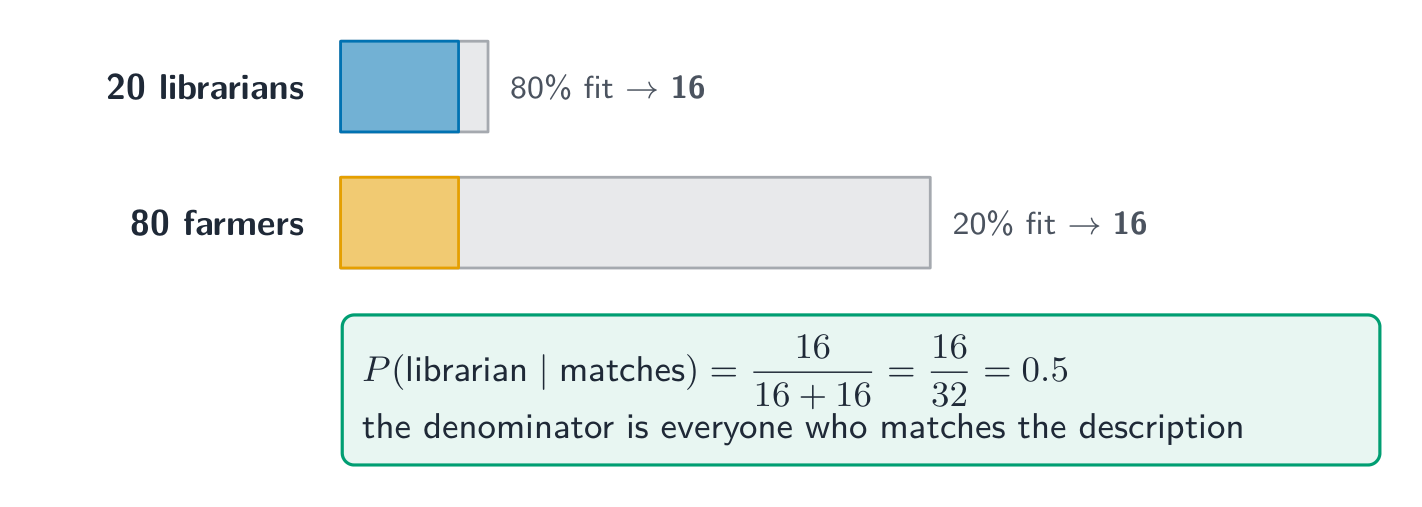
The same description can have a different predictive value in another population. You need both the base rates and the rate at which each group fits the evidence. Neither “always follow the stereotype” nor “always choose the larger group” is a valid general probability rule.
A town has 20 librarians and 200 farmers. The description fits 80% of librarians and 10% of farmers. Probability someone who fits is a librarian (three decimal places)?
Difficulty 2/5 · 140 coins + a small bonus on first completion today
Librarians who fit: 0.8 × 20 = 16. Farmers who fit: 0.1 × 200 = 20. P(librarian | fits) = 16 / (16 + 20) ≈ 0.444. Ignoring the base rate of many more farmers leads people to overestimate it.
In the worked example, 16 librarians and 16 farmers match a description. What is the denominator for the probability that a randomly selected matching person is a librarian?
Difficulty 1/5 · 100 coins + a small bonus on first completion today
Conditioning on matching restricts the reference group to all matching people, from either occupation.
Separate two obstacles to problem solving
- Functional fixedness 功能固着 restricts an object to its familiar use. In the candle problem, seeing a box only as a container makes it harder to see that it could serve as a shelf.
- A mental set repeats a previously successful approach even when a different approach would work better. Means–end analysis, working backwards and using a relevant analogy can help, but their usefulness depends on the problem and the accuracy of the analogy.
Failing to see a matchbox as a possible shelf is functional ____.
Difficulty 1/5 · 100 coins + a small bonus on first completion today
Objects stuck in their usual role.
Match each obstacle to the most direct example.
Difficulty 2/5 · 140 coins + a small bonus on first completion today
Fixedness concerns an object’s familiar function; mental set concerns a habitual problem-solving approach.
Test a belief instead of protecting it
- Confirmation bias involves selectively seeking, interpreting or remembering evidence that supports a belief. Reading only favourable articles is one example; giving opposing evidence an unfairly stricter standard is another.
- A stronger test asks what observation would count against the claim and applies comparable quality standards to both supporting and conflicting evidence. Seeking a counterexample does not mean automatically believing every contrary report.
A heuristic is not an error by definition. Nor does attaching a bias label prove that a conclusion is false: a person may reach a correct answer with weak reasoning. Evaluate the information and reasoning as well as the answer.
Test the belief or protect it?
Distinguish selective confirmation from a fair search for evidence.
Avoiding confirmation bias means automatically accepting every report that disagrees with you.
Difficulty 1/5 · 100 coins + a small bonus on first completion today
Seek potential refutation, but judge both supporting and conflicting evidence using comparable quality standards.
Intelligence theories make different proposals
- Spearman's general factor $g$ concerns shared variation across cognitive tasks. Cattell distinguished fluid reasoning from crystallised knowledge. Gardner proposed multiple intelligences; Sternberg proposed analytic, creative and practical aspects.
- These are different theoretical frameworks with different evidence and measurement approaches, not four interchangeable proven lists. A test score describes performance under stated conditions and needs validity evidence for the use being proposed.
Match each theorist with a view of intelligence.
Difficulty 2/5 · 140 coins + a small bonus on first completion today
These are the theorists’ associated proposals. Matching the labels does not imply equal empirical support or identical measurement methods.
Evaluate a judgement and improve the method
- A student estimates an event's frequency from one vivid news story, then searches only for articles supporting that estimate.
- Identify the two distinct reasoning problems. Propose better frequency evidence and a fair way to test the student's belief without assuming that every opposing article is reliable.
A student estimates how common an event is from one vivid news story and then reads only articles supporting that estimate. Identify the two different problems and propose a stronger approach.
Ease of recalling the vivid story can drive availability-based judgement; the one-sided search illustrates confirmation bias. Use appropriate frequency data from a defined population and period, then seek potentially conflicting evidence and assess all sources with comparable quality standards. A vivid story is not a representative frequency estimate.
State the missing information
-
Identify the cue: recall, resemblance, starting value, wording or selective evidence.
-
For conditional probability, count people who fit the evidence in every group before dividing by the total number who fit.
-
Distinguish an object's familiar function from a repeated solution method. Treat intelligence scores and theories according to their claims, methods and evidence.
-
heuristic: A shortcut strategy that reduces the work needed to make a judgement or solve a problem, without guaranteeing success.
-
prototype: A typical category representation used when judging or recognising members.
-
functional fixedness: Difficulty seeing alternative uses for an object beyond its familiar function.
Someone argues that the larger occupation group must always be the more likely source of a person matching a description. Explain what is missing from that rule.
Group sizes are base rates, but the probability also depends on how often each group matches the description. Count matching members in every group, then divide the matches from the group of interest by all matches. Strong evidence can change the conclusion; simply choosing the larger group is not a universal conditional-probability rule.
What went wrong? Only the site team sees this.