Skip to content

Energy

AQA GCSE PhysicsTopic 1

Video lesson for this topic Open the video page
22:08

Topic 1: Energy

Why it matters. In 1845 James Prescott Joule, the son of a brewer from Salford near Manchester, built a small copper tank of water with a paddle wheel inside.…

English narration · English and 中文 subtitles you can switch

1.1

Energy: stores, transfers and resources

Why it matters. In 1845 James Prescott Joule, the son of a brewer from Salford near Manchester, built a small copper tank of water with a paddle wheel inside. Falling weights turned the paddles, and the churned water warmed by only a fraction of a degree, which Joule measured with a thermometer he could read to about one two-hundredth of a degree. In June 1849 he reported to the Royal Society in London that the work done by a weight of 772 pounds falling one foot would warm one pound of water by one degree Fahrenheit. Mechanical work and heating were two ways of moving the same thing. That thing is energy 能量, and the rule Joule helped to establish, that energy is never created or destroyed, is the most useful idea in physics.

In this unit you will:

  • describe how energy is stored and transferred when a system changes;
  • calculate kinetic, elastic potential and gravitational potential energy, and energy changes from heating;
  • calculate power and efficiency, and explain how to reduce wasted energy;
  • compare the energy resources used for transport, electricity and heating.

AQA GCSE Physics (8463), topic 4.1 Energy, examined on Paper 1. It includes required practical 1 (specific heat capacity) and, for GCSE Physics only, required practical 2 (thermal insulators). Content marked (HT) is Higher tier only. The exam gives you a Physics Equations Sheet 物理公式表 with some equations; the others in this unit you must learn.

Vocabulary Train
English
energy/ˈenədʒi/
Physics Equations Sheet/ˈfɪzɪks ɪˈkweɪʒnz ʃiːt/
1.1

Energy stores and systems

Syllabus

Energy stores and systems (AQA 8463 statement 4.1.1.1).

  1. A system is an object or group of objects; when a system changes, the way energy is stored changes.
  2. Describe all the changes in the way energy is stored for: an object projected upwards; a moving object hitting an obstacle; an object accelerated by a constant force; a vehicle slowing down; bringing water to the boil in an electric kettle.
  3. Calculate changes in energy when a system is changed by heating, by work done by forces, and by work done when a current flows.
  4. Use calculations to show on a common scale how the overall energy in a system is redistributed when the system is changed.

Source: Cambridge International syllabus

A system 系统 is an object, or a group of objects, that you choose to study. When a system changes, energy moves from one of its energy stores 能量储存 to another.

Roller-coaster cars running down a curved track, with a tall hill behind
At the top of the hill the cars have a full gravitational potential store; it empties into the kinetic store as they speed down.
Store Energy is stored when… Example
kinetic an object moves a rolling ball
gravitational potential an object is raised in a gravitational field water behind a dam
elastic potential an object is stretched or squashed a drawn bow
thermal (internal) an object is hot warm soup
chemical substances can react food, petrol, a battery
nuclear atomic nuclei can change uranium fuel
electrostatic charges attract or repel a charged cloud
magnetic magnets attract or repel two fridge magnets
Eight energy stores, each with an example; heating and work transfer energy between them.
The eight energy stores, with an example of each.

Transfers. Energy moves between stores in four ways: mechanically (a force does work), electrically (a current flows), by heating 加热 (because of a temperature difference) and by radiation (light, infrared or sound waves). So you can calculate changes caused by heating, by work done by forces 力做的功 and by work done when a current flows 电流做的功 (topic 4.2). "Electrical" is a way of transferring energy, not a store.

Describing a change. Always say which store empties and which store fills.

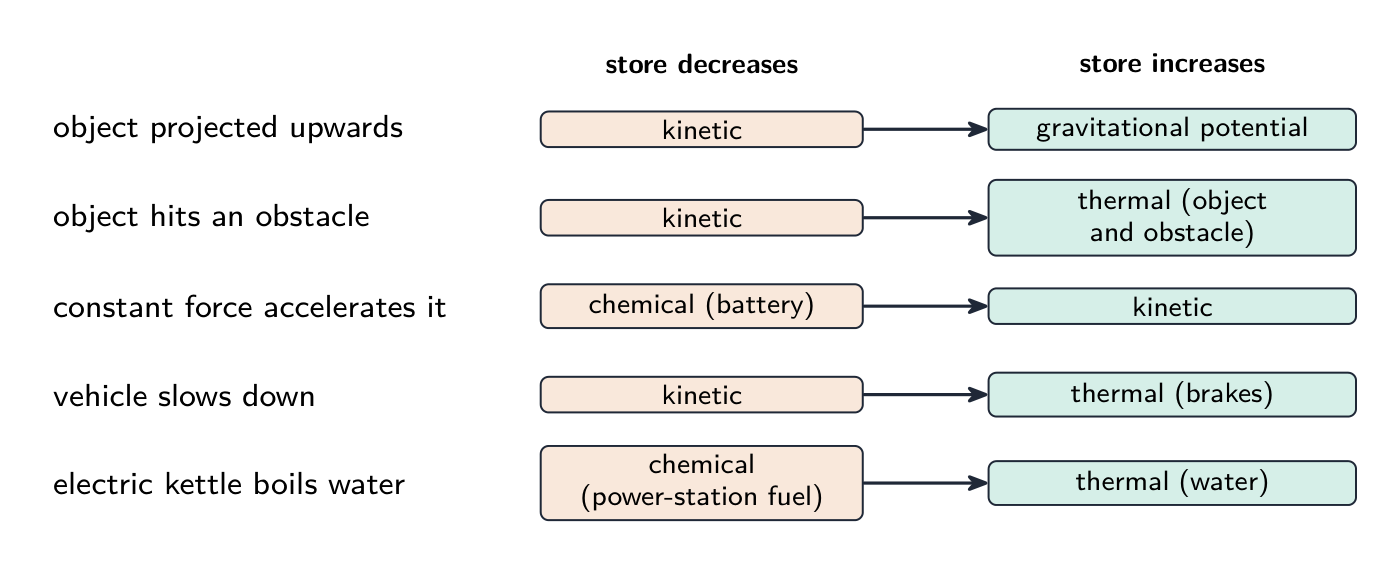
  • A ball thrown upwards: its kinetic store empties and the gravitational potential store fills. At the top, it stops for an instant.
  • A car hitting a wall: the kinetic store empties; the thermal stores of the car and wall fill, and some energy is carried away by sound.
  • A battery-powered toy car speeding up: the chemical store of the battery empties; the kinetic store of the car fills.
  • A car braking: the kinetic store empties; the thermal store of the brakes fills.
  • An electric kettle boiling water: energy is transferred electrically from the mains to the thermal store of the water.
Five situations, each with the store that decreases and the store that increases; an object projected upwards, kinetic to gravitational potential; hitting an obstacle, kinetic to thermal; a constant force, chemical to kinetic; a vehicle slowing, kinetic to thermal of the brakes; a kettle, chemical fuel to thermal of the water
In each change, one store empties and another fills.

Sankey diagrams. A Sankey diagram 桑基图 shows energy transfers with arrows whose widths are drawn to scale. The input arrow splits into a useful output and wasted outputs. The output widths always add up to the input width, because energy is conserved.

Sankey diagram for a motor: 100 J in, 80 J useful kinetic energy out and 20 J to thermal stores, with widths drawn to scale.
The width of each arrow, not its length, shows the energy.

Worked example 1. A motor is supplied with 100 J and transfers 80 J to the kinetic store of a fan. The rest heats the motor and the air. Find the wasted energy and the widths of the Sankey arrows. Wasted energy $= 100 - 80 = 20$ J. The arrows are in the ratio $100 : 80 : 20 = 5 : 4 : 1$, so if the input is 5 cm wide, the useful arrow is 4 cm and the wasted arrow 1 cm. Only the widths show the energy, not the lengths.

Vocabulary Train
English
system/ˈsɪstəm/
energy stores/ˈenədʒi stɔːz/
heating/ˈhiːtɪŋ/
work done by forces/wɜːk dʌn baɪ ˈfɔːsɪz/
work done when a current flows/wɜːk dʌn wen ə ˈkʌrənt fləʊz/
Sankey diagram/ˈsæŋki ˈdaɪəɡræm/
1.2

Calculating energy changes

Syllabus

Changes in energy (AQA 8463 statement 4.1.1.2).

  1. Calculate the kinetic energy of a moving object using Ek = 0.5 m v^2.
  2. Calculate the elastic potential energy stored in a stretched spring using Ee = 0.5 k e^2, assuming the limit of proportionality has not been exceeded.
  3. Calculate the gravitational potential energy gained by an object raised above ground level using Ep = m g h, with the value of g given.
  4. Chain these equations to find a transferred quantity (for example spring energy to speed, or cord energy to height).

Source: Cambridge International syllabus

Use mass in kg, speed in m/s, height and extension in m, and the value of $g$ given in the question.

$$E_k = \tfrac{1}{2} m v^2 \qquad E_p = m g h \qquad E_e = \tfrac{1}{2} k e^2$$
  • $E_k$ is kinetic energy 动能 in J; $m$ is mass in kg; $v$ is speed in m/s.
  • $E_p$ is gravitational potential energy 重力势能 in J; $h$ is the change in height in m; $g$ is the gravitational field strength 重力场强度 in N/kg (9.8 N/kg on Earth).
  • $E_e$ is elastic potential energy 弹性势能 in J; $k$ is the spring constant 劲度系数 in N/m; $e$ is the extension 伸长量 in m.

You must learn the first two; the equation for $E_e$ is on the equations sheet.

Extension is the increase in length: stretched length minus original length. The equation for $E_e$ works only while the spring has not gone past its limit of proportionality 比例极限. Because $e$ is squared, doubling the extension makes the stored energy four times as big.

A force–compression graph for a spring, a straight line through the origin with gradient k; the area under the line up to the compression x0 is shaded and labelled as one half F0 x0, the elastic potential energy stored
The energy stored in a spring is the area under its force–compression graph: $\tfrac{1}{2} F_{0} x_{0}$, which equals $\tfrac{1}{2} k x_{0}^{2}$

Worked example 2. A spring is 10 cm long. It is stretched to 22 cm, and $k = 50$ N/m. Find the energy stored. Extension $e = 22 - 10 = 12$ cm $= 0.12$ m. Then $E_e = \tfrac12 \times 50 \times 0.12^2 = 0.36$ J. If the extension were doubled to 0.24 m, the energy would be $4 \times 0.36 = 1.44$ J.

Worked example 3. The spring in example 2 launches a 0.020 kg toy plane horizontally. Assume all the elastic potential energy becomes kinetic energy. Find the launch speed.

$$v = \sqrt{\frac{2 E_k}{m}} = \sqrt{\frac{2 \times 0.36}{0.020}} = \sqrt{36} = 6.0 \text{ m/s}$$

In a real launch, some energy is transferred to thermal stores, so the speed is a little less.

A block moving at speed v hits a spring against a wall; at greatest compression x the block is momentarily at rest and its kinetic energy one half m v squared is stored as elastic potential energy one half k x squared
Kinetic energy and elastic potential energy exchange through a spring.

Worked example 4. A 240 kg pod is fired upwards by two stretched cords. Each cord acts like a spring with $k = 735$ N/m and extension 8.0 m. Taking $g = 9.8$ N/kg, find the greatest height the pod could reach.

  • Energy in one cord: $E_e = \tfrac12 \times 735 \times 8.0^2 = 23\,520$ J.
  • Two cords: $2 \times 23\,520 = 47\,040$ J.
  • If all of this becomes gravitational potential energy: $h = \dfrac{E_p}{m g} = \dfrac{47\,040}{240 \times 9.8} = 20$ m.

The real height is lower because air resistance acts on the pod, so some energy is transferred to the thermal store of the surroundings instead of the gravitational potential store.

A 240 kilogram pod held by two stretched cords, each with k equals 735 newtons per metre and extension 8.0 metres, beside two equal energy bars of 47,040 joules, elastic before and gravitational after in the ideal model, giving h equals 20 metres; air resistance makes the real height smaller
If no energy is dissipated, all the elastic potential energy becomes gravitational potential energy.
Vocabulary Train
English
kinetic energy/kɪˈnetɪk ˈenədʒi/
gravitational potential energy/ˌɡrævɪˈteɪʃənl pəˈtenʃl ˈenədʒi/
gravitational field strength/ˌɡrævɪˈteɪʃənl fiːld streŋθ/
elastic potential energy/ɪˈlæstɪk pəˈtenʃl ˈenədʒi/
spring constant/sprɪŋ ˈkɒnstənt/
extension/ekˈstenʃn/
limit of proportionality/ˈlɪmɪt ɒv prəˌpɔːʃəˈnælɪti/
Watch lesson
1.3

Specific heat capacity

Syllabus

Energy changes in systems (AQA 8463 statement 4.1.1.3; also 4.3.2.2).

  1. Calculate the amount of energy stored in or released from a system as its temperature changes using dE = m c d(theta).
  2. State the definition of specific heat capacity and use its unit, J/kg C.
  3. Rearrange the equation to find mass, specific heat capacity or temperature change, converting kJ to J first.
  4. Required practical 1: describe the investigation to determine the specific heat capacity of one or more materials, including measuring energy supplied, insulating the block and evaluating errors.

Source: Cambridge International syllabus

When a substance is heated, the energy in its thermal store increases and its temperature rises:

$$\Delta E = m\, c\, \Delta\theta$$

$\Delta E$ is the change in thermal energy in J, $m$ the mass in kg and $\Delta\theta$ the temperature change in °C. The specific heat capacity 比热容 $c$ is the energy needed to raise the temperature of 1 kg of a substance by 1 °C, in J/kg °C. This equation is on the equations sheet.

Water has a high specific heat capacity, about 4200 J/kg °C; copper's is about 385 J/kg °C. So if 1 kg of each gains 4200 J, the water warms by 1.0 °C but the copper by $4200 \div 385 = 10.9$ °C.

Two bars of temperature rise for 1 kg of each material gaining 4200 J; water rises 1.0 degree and copper about 10.9 degrees
Same mass, same energy: the material with the lower c heats up more.

Worked example 5. A 2.0 kg metal block gains 26 kJ of thermal energy, and its temperature rises from 22 °C to 50 °C. Find $c$. Convert the energy: 26 kJ = 26 000 J. The temperature change is $50 - 22 = 28$ °C.

$$c = \frac{\Delta E}{m\,\Delta\theta} = \frac{26\,000}{2.0 \times 28} = 464 \text{ J/kg °C} \approx 460 \text{ J/kg °C}$$

Worked example 6. A small volume of air, mass $2.60 \times 10^{-8}$ kg, gains 0.0130 J. Its specific heat capacity is 1.01 kJ/kg °C. Find its temperature rise. Convert: $c = 1010$ J/kg °C. Then

$$\Delta\theta = \frac{\Delta E}{m c} = \frac{0.0130}{2.60 \times 10^{-8} \times 1010} = 495 \text{ °C}$$

This is the rise, not the final temperature.

Required practical 1: specific heat capacity.

  1. Measure the mass of a metal block on a balance, and wrap it in insulation.
  2. Put an electric heater in one hole and a thermometer in the other, with a drop of water for good thermal contact.
  3. Connect the heater to a joulemeter, or to a power supply with an ammeter in series and a voltmeter across the heater, so that power $P = VI$.
  4. Record the starting temperature, switch on, and record the temperature and energy supplied (or the time, so $E = Pt$) every minute for 10 minutes.
  5. Plot temperature against energy supplied, and use the straight part of the graph. Calculate $c = \dfrac{\Delta E}{m\,\Delta\theta}$.
An insulated metal block of mass m with two holes: one holds an electric heater connected to a joulemeter, the other a thermometer; c equals P t divided by m delta T
Energy in from the joulemeter, temperature rise from the thermometer: $c = Pt/(m\,\Delta T)$
Required practical 1: an insulated metal block with an immersion heater and a thermometer in its two holes; the power supply, ammeter and heater are in series and the voltmeter is across the heater.
Required practical 1: ammeter in series with the heater, voltmeter across it; insulation reduces energy transfer to the surroundings.

The insulation reduces energy transferred to the surroundings. Some energy always escapes, so the block gains less energy than was supplied. Its temperature rise is then smaller than it should be, and the calculated value of $c$ is too high.

Worked example 7. A 1.0 kg block is supplied with 6000 J and should warm by 12 °C, so $c = \frac{6000}{1.0 \times 12} = 500$ J/kg °C. Because energy escapes, a student records only a 10 °C rise, giving $c = \frac{6000}{1.0 \times 10} = 600$ J/kg °C. A smaller temperature rise gives a value of $c$ that is too high.

Vocabulary Train
English
specific heat capacity/spəˈsɪfɪk hiːt kəˈpæsɪti/
1.4

Power

Syllabus

Power (AQA 8463 statement 4.1.1.4).

  1. Define power as the rate at which energy is transferred or the rate at which work is done.
  2. Use power = energy transferred / time and power = work done / time.
  3. State that an energy transfer of 1 joule per second is equal to a power of 1 watt.
  4. Give examples that illustrate the definition of power, such as comparing two electric motors that both lift the same weight through the same height but one does it faster.

Source: Cambridge International syllabus

Power 功率 is the rate at which energy is transferred, or the rate at which work is done. A more powerful 功率强的 motor lifts the same load through the same height in less time.

$$P = \frac{E}{t} \qquad P = \frac{W}{t}$$

$P$ is power in watts, $E$ energy transferred in J, $W$ the work done 做的功 in J and $t$ the time in s. A transfer of 1 J per second is a power of 1 watt 瓦特 (W). Learn both equations.

The same work W done in time t gives power P; done in half the time t/2 it gives power 2P
The same work done in less time means more power.
A waterfall: water falling further each second transfers energy at a greater rate

Prefixes: 1 kW = 1000 W, 1 MW = $10^6$ W, 1 GW = $10^9$ W.

Worked example 8. Motors A and B each lift a 20 kg load through 2.0 m ($g = 10$ N/kg). A takes 2.0 s and B takes 4.0 s. Both gain $E_p = 20 \times 10 \times 2.0 = 400$ J. So $P_A = \frac{400}{2.0} = 200$ W and $P_B = \frac{400}{4.0} = 100$ W. A does the same work in half the time, so its power is twice as big.

Worked example 9. A 60.0 kg athlete runs up stairs with a vertical height of 175 cm in 1.40 s ($g = 9.8$ N/kg). Convert the height: 1.75 m. $E_p = 60.0 \times 9.8 \times 1.75 = 1029$ J, so the useful power is $P = \frac{1029}{1.40} = 735$ W. The athlete's body transfers more energy than this, because some heats the body.

Worked example 10. A power station has an output power of 500 MW. Find the energy it transfers in one hour. $E = P t = 5.00 \times 10^8 \times 3600 = 1.8 \times 10^{12}$ J.

Vocabulary Train
English
power/ˈpaʊə/
powerful/ˈpaʊəfl/
work done/wɜːk dʌn/
watt/wɒt/
1.5

Conservation and dissipation of energy

Syllabus

Conservation and dissipation of energy (AQA 8463 statement 4.1.2.1).

  1. State that energy can be transferred usefully, stored or dissipated, but cannot be created or destroyed.
  2. Describe, with examples, energy transfers in a closed system showing there is no net change to the total energy.
  3. Describe how energy is dissipated in system changes so that it is stored in less useful ways.
  4. Explain ways of reducing unwanted energy transfers, including lubrication and thermal insulation.
  5. Use the idea that the higher the thermal conductivity of a material, the higher the rate of energy transfer by conduction across it, and describe how the rate of cooling of a building depends on the thickness and thermal conductivity of its walls.
  6. Required practical 2 (physics only): investigate the effectiveness of different materials as thermal insulators and the factors that affect the thermal insulation properties of a material.

Source: Cambridge International syllabus

Energy can be transferred usefully, stored or dissipated 耗散, but it cannot be created or destroyed. Dissipated energy is often called wasted energy; it is stored in less useful ways, usually in the thermal store of the surroundings.

In a closed system 封闭系统, no energy enters or leaves, so the total energy stays the same.

Worked example 11. A ball is held above the floor with 20 J of gravitational potential energy. Ignore air resistance.

Stage Gravitational potential / J Kinetic / J Thermal / J
held still 20 0 0
part way down 5 15 0
after it stops bouncing 0 0 20

The total is 20 J at every stage. In the end the energy is in the thermal stores of the ball, the floor and the air.

Explaining a smaller answer. If a real height, speed or temperature is less than you calculated, say three things: what caused it (air resistance, friction or heating of the surroundings); that some energy was transferred to thermal stores; so less energy reached the useful store.

Reducing unwanted transfers.

  • Lubrication 润滑 with oil or grease reduces friction between moving parts, so less energy is dissipated by heating.
  • Thermal insulation 热绝缘 reduces energy transfer by heating. A material with a lower thermal conductivity 热导率 transfers energy more slowly. For a house, the rate of cooling is lower if the walls are thicker and if they are made of a material with a lower thermal conductivity.

Required practical 2 (physics only): thermal insulators.

  1. Pour the same volume of hot water into a beaker, put on a lid, and wrap the beaker in one layer of a material such as newspaper, bubble wrap or cotton wool.
  2. Record the temperature every minute for 15 minutes.
  3. Repeat with other materials of the same thickness, keeping the volume of water, starting temperature, beaker and lid the same.
  4. Then repeat with different numbers of layers of one material.

The best insulator gives the smallest fall in temperature over the same time.

Temperature of hot water against time for zero, two and six layers of newspaper.
Cooling curves for zero, two and six layers of newspaper (AQA GCSE Physics Required Practical Handbook, sample results).

Worked example 12. In AQA's sample results, water with no newspaper cooled from 85 °C to 57 °C in 15 minutes, with two layers from 86 °C to 62 °C, and with six layers from 86 °C to 66 °C. The falls are $85 - 57 = 28$ °C, $86 - 62 = 24$ °C and $86 - 66 = 20$ °C. More layers gave less cooling. The run with no newspaper started 1 °C cooler, so a fair test should use the same starting temperature every time.

Three bars of the temperature fall in 15 minutes from the AQA readings, 28 degrees with no newspaper, 24 with two layers and 20 with six layers
Temperature falls in 15 minutes: more layers, less cooling.

Worked example 13. One beaker, wrapped in 20 mm of cotton wool, cooled from 90 °C to 75 °C in 10 minutes; another, wrapped in 2 mm of foil, cooled from 80 °C to 70 °C. Can we say which material is the better insulator? No. Both the material and the thickness changed, and so did the starting temperature. Use the same thickness and starting temperature, change only the material, and repeat.

Vocabulary Train
English
dissipated/ˈdɪsɪpeɪtɪd/
closed system/kləʊzd ˈsɪstəm/
Lubrication/ˌluːbrɪˈkeɪʃn/
Thermal insulation/ˈθɜːml ˌɪnsjuːˈleɪʃn/
thermal conductivity/ˈθɜːml kɒndəkˈtɪvɪti/
1.6

Efficiency

Syllabus

Efficiency (AQA 8463 statement 4.1.2.2).

  1. Calculate energy efficiency using efficiency = useful output energy transfer / total input energy transfer.
  2. Calculate efficiency using efficiency = useful power output / total power input.
  3. Use efficiency values as a decimal or as a percentage.
  4. (HT only) Describe ways to increase the efficiency of an intended energy transfer.

Source: Cambridge International syllabus

Efficiency 效率 tells you what fraction of the input energy is transferred usefully:

$$\text{efficiency} = \frac{\text{useful output energy transfer}}{\text{total input energy transfer}} \qquad \text{efficiency} = \frac{\text{useful power output}}{\text{total power input}}$$

You must learn both. Efficiency can be a decimal or a percentage, and it can never be more than 1 (100%). It has no unit.

Of the total energy input, a thick arrow shows the useful output and a thinner arrow the energy wasted as heat; efficiency is the useful output divided by the total input
Only part of the input energy becomes useful output; the rest is dissipated, usually by heating.

Worked example 14. A lamp takes in 4.0 W and has an efficiency of 0.85. Useful light output $= 0.85 \times 4.0 = 3.4$ W. The other $4.0 - 3.4 = 0.6$ W heats the surroundings.

Worked example 15. Two lifting machines each take in 2000 W. Machine A gives a useful output of 1700 W and machine B 1500 W. Efficiency of A $= \frac{1700}{2000} = 0.85 = 85\%$; efficiency of B $= \frac{1500}{2000} = 0.75 = 75\%$.

Worked example 16. Two ways of storing energy are compared. Method A heats 100 kg of water, storing 33 600 kJ, but 40% is wasted. Method B pumps 100 kg of water up a mountain, storing 490 kJ, and 25% is wasted. A transfers $0.60 \times 33\,600 = 20\,160$ kJ usefully; B transfers $0.75 \times 490 = 367.5$ kJ. B is more efficient, but A gives far more useful energy for each 100 kg, and B needs high mountains.

(HT) Increasing efficiency. Reduce wasted transfers: lubricate moving parts, insulate hot objects, and streamline moving vehicles. For the same input, more energy then reaches the useful store.

Explore

Same energy split, different power

Account for the 600 J input as 420 J useful and 180 J other transfers. Compare durations: efficiency stays 70%, while useful power changes.

Vocabulary Train
English
efficiency/ɪˈfɪʃənsi/
Watch lesson
1.7

National and global energy resources

Syllabus

National and global energy resources (AQA 8463 statement 4.1.3).

  1. Describe the main energy sources available for use on Earth: fossil fuels (coal, oil and gas), nuclear fuel, bio-fuel, wind, hydroelectricity, geothermal, the tides, the Sun and water waves.
  2. Distinguish between renewable and non-renewable energy resources, using the definition that a renewable resource is one that is being (or can be) replenished as it is used.
  3. Compare ways that different energy resources are used: transport, electricity generation and heating.
  4. Understand why some energy resources are more reliable than others.
  5. Describe the environmental impact arising from the use of different energy resources.
  6. Explain patterns and trends in the use of energy resources.
  7. Consider environmental issues arising from the use of energy resources and discuss why dealing with them involves political, social, ethical or economic considerations.

Source: Cambridge International syllabus

The main energy resources are fossil fuels 化石燃料 (coal, oil and gas), nuclear fuel 核燃料, bio-fuel, wind, hydroelectricity, geothermal, the tides, the Sun and water waves. We use them for transport, electricity generation and heating.

A renewable 可再生的 resource is one that is being, or can be, replaced as it is used. Fossil fuels and nuclear fuel are non-renewable 不可再生的: they will run out.

A row of tall white wind turbines standing in the sea under a blue sky
Wind turbines transfer energy from the kinetic store of moving air electrically to the grid.
Resource Reliable? Main environmental effects
coal, oil, gas yes, while fuel lasts carbon dioxide (global warming); sulfur dioxide (acid rain)
nuclear yes no carbon dioxide when generating; radioactive waste
bio-fuel yes carbon dioxide when burned, partly taken in again as crops grow; needs land
wind no, depends on wind noise and changed landscapes
solar no, none at night needs large areas and materials
hydroelectric yes dams flood valleys and destroy habitats
geothermal yes, in few places few; needs suitable sites
tides yes, at predictable times affects habitats in estuaries
waves no, depends on the weather affects coastal habitats

Renewable resources do not burn fuel, but building them still uses materials and energy, and some are not available all the time. Decisions about energy also depend on cost, politics and what people want, not only on science.

Worked example 17. A nuclear power station generated electricity for 92% of a 365-day year. How many days was that? $0.92 \times 365 = 335.8$, so about 336 days.

Worked example 18. A country's electricity came from fossil fuels and renewables. In year A it used 80 TWh from fossil fuels and 20 TWh from renewables; in year B, 90 TWh and 60 TWh. The fossil share fell from $\frac{80}{100} = 80\%$ to $\frac{90}{150} = 60\%$, but the energy from fossil fuels rose by 10 TWh, so emissions from fossil fuels did not fall.

Worked example 19. A clinic needs electricity all night. Solar panels give none at night, so they would need batteries or a backup supply. A gas generator works at night, but releases carbon dioxide. A good answer compares reliability, cost and environmental effects.

Vocabulary Train
English
fossil fuels/ˈfɒsl ˈfjuːəlz/
nuclear fuel/ˈnjuːklɪə ˈfjuːəl/
renewable/rɪˈnjuːəbl/
non-renewable/nɒn rɪˈnjuːəbl/
1.7

Sources for this lesson

  • AQA, GCSE Physics (8463) specification, section 4.1 Energy, and the Required practical handbook (sample results for practical 2).
  • J. P. Joule, "On the mechanical equivalent of heat", Philosophical Transactions of the Royal Society, 140 (1850), read 21 June 1849.
  • AQA, GCSE Physics Paper 1 Higher, June 2024, questions 1, 2, 6 and 8 (adapted).
1.7

Common errors

  • Calling "electrical" a store. It is a way of transferring energy.
  • Using the stretched length instead of the extension in $E_e = \tfrac12 k e^2$.
  • Forgetting to square the speed or the extension.
  • Using the final temperature instead of the temperature change in $\Delta E = m c \Delta\theta$.
  • Leaving time in minutes, mass in grams or energy in kJ.
  • Saying energy is "lost" or "used up" without saying where it goes.
  • Giving an efficiency greater than 1 or 100%.
  • Saying renewable resources are always available.
1.7

Key terms

  • Energy store: a way energy is held, such as kinetic, thermal or chemical.
  • System: the object or group of objects being studied.
  • Specific heat capacity: the energy needed to raise 1 kg of a substance by 1 °C.
  • Power: the rate of energy transfer, in watts.
  • Dissipated energy: energy stored in less useful ways, usually thermal.
  • Efficiency: useful output divided by total input.
  • Renewable resource: an energy resource that is replaced as it is used.
1.7

Check yourself

  1. Name the store that empties and the store that fills when a car brakes.
  2. A 0.50 kg cart moves at 4.0 m/s. Calculate its kinetic energy.
  3. A 2.0 kg book is lifted 1.5 m ($g = 9.8$ N/kg). Calculate the gain in gravitational potential energy.
  4. How much energy warms 0.50 kg of water by 20 °C? ($c = 4200$ J/kg °C)
  5. A motor takes in 5.0 J in 2.0 s and gives the cart 4.0 J. Calculate the input power and the efficiency.
  6. Why does the measured specific heat capacity come out too high in required practical 1?
  7. Give one advantage and one disadvantage of wind power.

Answers: 1. The kinetic store empties; the thermal store of the brakes fills. 2. $\tfrac12 \times 0.50 \times 4.0^2 = 4.0$ J. 3. $2.0 \times 9.8 \times 1.5 = 29.4$ J. 4. $0.50 \times 4200 \times 20 = 42\,000$ J. 5. $\frac{5.0}{2.0} = 2.5$ W; $\frac{4.0}{5.0} = 0.80$ (80%). 6. Some energy heats the surroundings, so the temperature rise is smaller than it would be, and $c = \frac{\Delta E}{m \Delta\theta}$ is too big. 7. Advantage: renewable, no carbon dioxide while generating; disadvantage: unreliable when the wind drops (or noise, changed landscape).

Was this helpful?

More topics in AQA GCSE Physics

Log in or create account

IGCSE, A-Level & AP