Skip to content

Waves

AQA GCSE Physics · Topic 6

Video lesson for this topic Open the video page
19:08

Topic 6: Waves

Why it matters. In 1887, in a lecture room in Karlsruhe, Germany, Heinrich Hertz made sparks jump across a small gap in an electric circuit. A few metres away…

English narration · English and 中文 subtitles you can switch

6.1

Waves: sound, light and the electromagnetic spectrum

Why it matters. In 1887, in a lecture room in Karlsruhe, Germany, Heinrich Hertz made sparks jump across a small gap in an electric circuit. A few metres away, a loop of wire with its own tiny gap began to spark as well, although nothing connected the two. Hertz had made and detected radio waves, invisible waves that travel at the speed of light, just as James Clerk Maxwell had predicted twenty years earlier. Hertz thought his discovery had no practical use. On 12 December 1901, Guglielmo Marconi sat in a hut on Signal Hill in Newfoundland, Canada, holding an earphone connected to a wire held up by a kite. He heard three faint clicks, the letter S in Morse code, sent by radio from Cornwall in England, more than 3000 km across the Atlantic. Radio, television, mobile phones, Wi-Fi and satellite navigation all grew from those sparks.

In this unit you will:

  • describe transverse and longitudinal waves, and use the wave equation;
  • measure the speed of waves in water and in a solid;
  • describe the electromagnetic spectrum, its uses and its dangers, and investigate infrared radiation;
  • (physics only) explain reflection, sound, ultrasound and seismic waves, lenses, colour and black body radiation.

AQA GCSE Physics (8463), topic 4.6 Waves, examined on Paper 2. It includes required practicals 8 (waves), 9 (reflection and refraction, physics only) and 10 (infrared radiation). Reflection, sound, waves for detection, lenses, colour and black body radiation are in GCSE Physics only. Content marked (HT) is Higher tier only. You must learn $v = f \lambda$; $T = \frac{1}{f}$ and the magnification equation are on the equations sheet.

6.1

Transverse and longitudinal waves

Syllabus

Waves in air, fluids and solids (AQA 8463 statements 4.6.1.1-4.6.1.2, RP8).

  1. Describe the difference between transverse and longitudinal waves with examples.
  2. Describe evidence that the wave, not the material, travels.
  3. Use amplitude, wavelength, frequency and period; apply period = 1/frequency and wave speed = frequency x wavelength.
  4. Describe methods to measure the speed of sound in air and of ripples on water.
  5. Required practical 8: measure frequency, wavelength and speed in a ripple tank and in a solid.
  6. (Physics only) Relate velocity, frequency and wavelength changes when sound passes between media.

Source: Cambridge International syllabus

Waves transfer energy from one place to another without transferring matter.

  • In a transverse 横波 wave, the oscillations are at right angles to the direction the wave travels. Examples: ripples on water, waves on a string, and all electromagnetic waves.
  • In a longitudinal 纵波 wave, the oscillations are in the same direction as the wave travels. Sound waves in air are longitudinal. They have compressions 密部, where the particles are close together, and rarefactions 疏部, where they are spread out.
Transverse wave on a rope (particle vibrates up and down; wavelength crest to crest; amplitude rest to crest) and longitudinal wave on a slinky (coils vibrate left and right; compressions and rarefactions; wavelength compression to compression).
A transverse wave on a rope and a longitudinal wave on a slinky, with compressions and rarefactions.

It is the wave that travels, not the water or air. A ball floating on a pond bobs up and down as ripples pass, but it does not move across the pond with them.

Vocabulary Train
English
transverse/trænsˈvɜːs/
longitudinal/ˌlɒŋɡɪˈtjuːdɪnl/
compressions/kəmˈpreʃnz/
rarefactions/ˌreərɪˈfækʃnz/
6.1

Properties of waves and the wave equation

Syllabus

Waves in air, fluids and solids (AQA 8463 statements 4.6.1.1-4.6.1.2, RP8).

  1. Describe the difference between transverse and longitudinal waves with examples.
  2. Describe evidence that the wave, not the material, travels.
  3. Use amplitude, wavelength, frequency and period; apply period = 1/frequency and wave speed = frequency x wavelength.
  4. Describe methods to measure the speed of sound in air and of ripples on water.
  5. Required practical 8: measure frequency, wavelength and speed in a ripple tank and in a solid.
  6. (Physics only) Relate velocity, frequency and wavelength changes when sound passes between media.

Source: Cambridge International syllabus

  • The amplitude 振幅 is the maximum displacement of a point on the wave from its undisturbed position.
  • The wavelength 波长 is the distance from a point on one wave to the equivalent point on the next wave, such as crest to crest.
  • The frequency 频率 is the number of waves passing a point each second, in hertz (Hz).
  • The period 周期 is the time for one complete wave to pass a point.
A wave with the wavelength, amplitude, crest and trough labelled
The parts of a wave: wavelength, amplitude, crest and trough.
$$T = \frac{1}{f} \qquad v = f \lambda$$

$T$ is the period in s, $f$ is frequency in Hz, $v$ is wave speed in m/s and $\lambda$ is wavelength in m. The wave speed is the speed at which energy is transferred through the medium.

Worked example 1. A water wave has a frequency of 2.0 Hz and a wavelength of 0.35 m. Its speed is $v = 2.0 \times 0.35 = 0.70$ m/s, and its period is $T = \frac{1}{2.0} = 0.50$ s.

Worked example 2. A sound wave of frequency 4.0 kHz travels at 330 m/s. Convert: 4000 Hz. $\lambda = \frac{v}{f} = \frac{330}{4000} = 0.083$ m (2 s.f.).

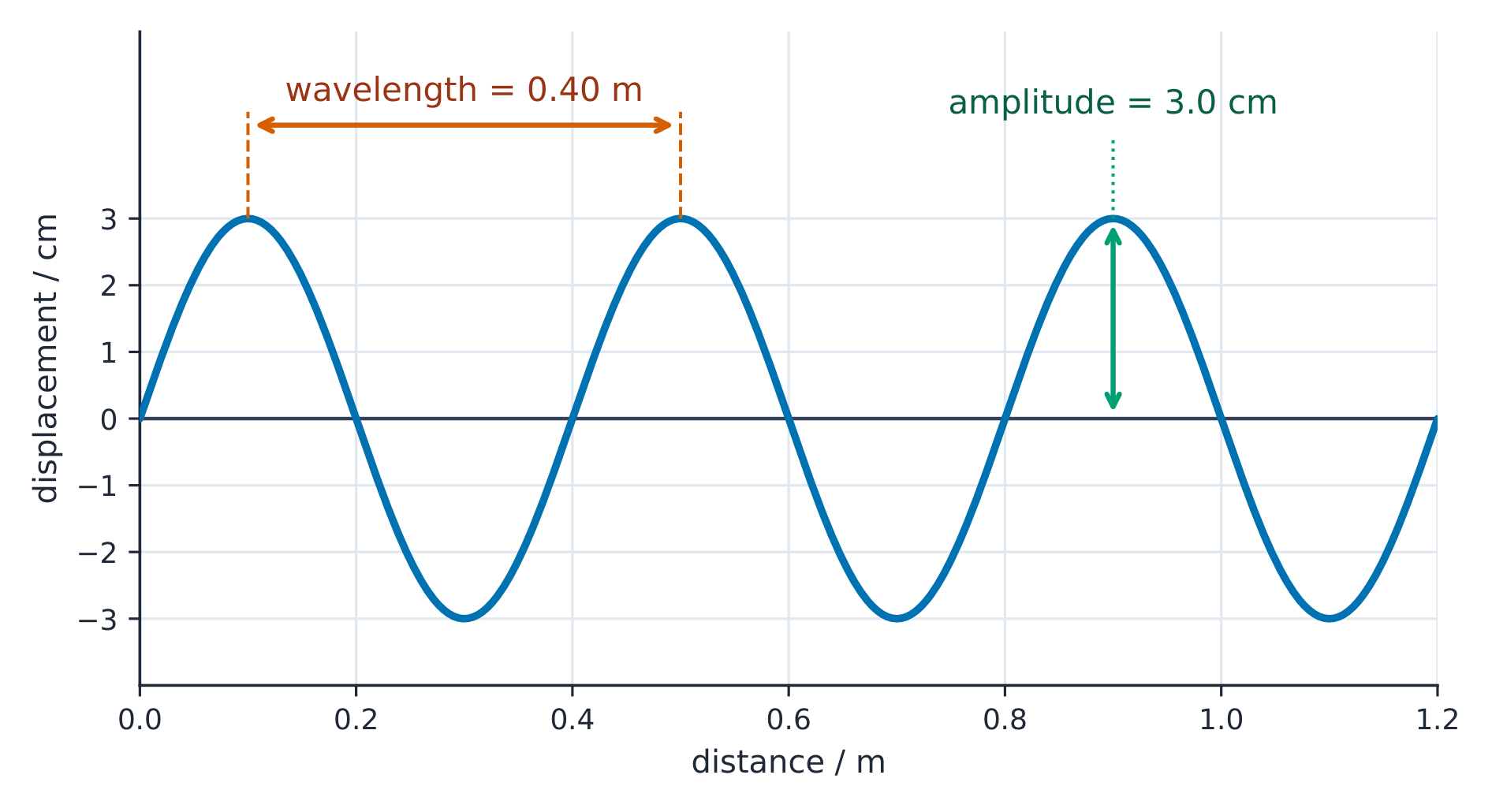
Worked example 3. The graph shows a water wave at one instant, and 5 waves pass a point every 2.0 s.

Displacement against distance for a wave: three complete waves between 0 and 1.2 m, crests at 3.0 cm and troughs at −3.0 cm. A double arrow between the crests at 0.10 m and 0.50 m marks the wavelength, 0.40 m; a double arrow from the axis up to the crest at 0.90 m marks the amplitude, 3.0 cm
Wavelength is measured crest to crest; amplitude is measured from the rest position to a crest.
  • Three complete waves fit in 1.20 m, so $\lambda = \frac{1.20}{3} = 0.40$ m.
  • The amplitude, from the rest position to a crest, is 3.0 cm. The height from crest to trough, 6.0 cm, is twice the amplitude.
  • $f = \frac{5}{2.0} = 2.5$ Hz, so $v = 2.5 \times 0.40 = 1.0$ m/s.

Required practical 8: measuring wave speeds.

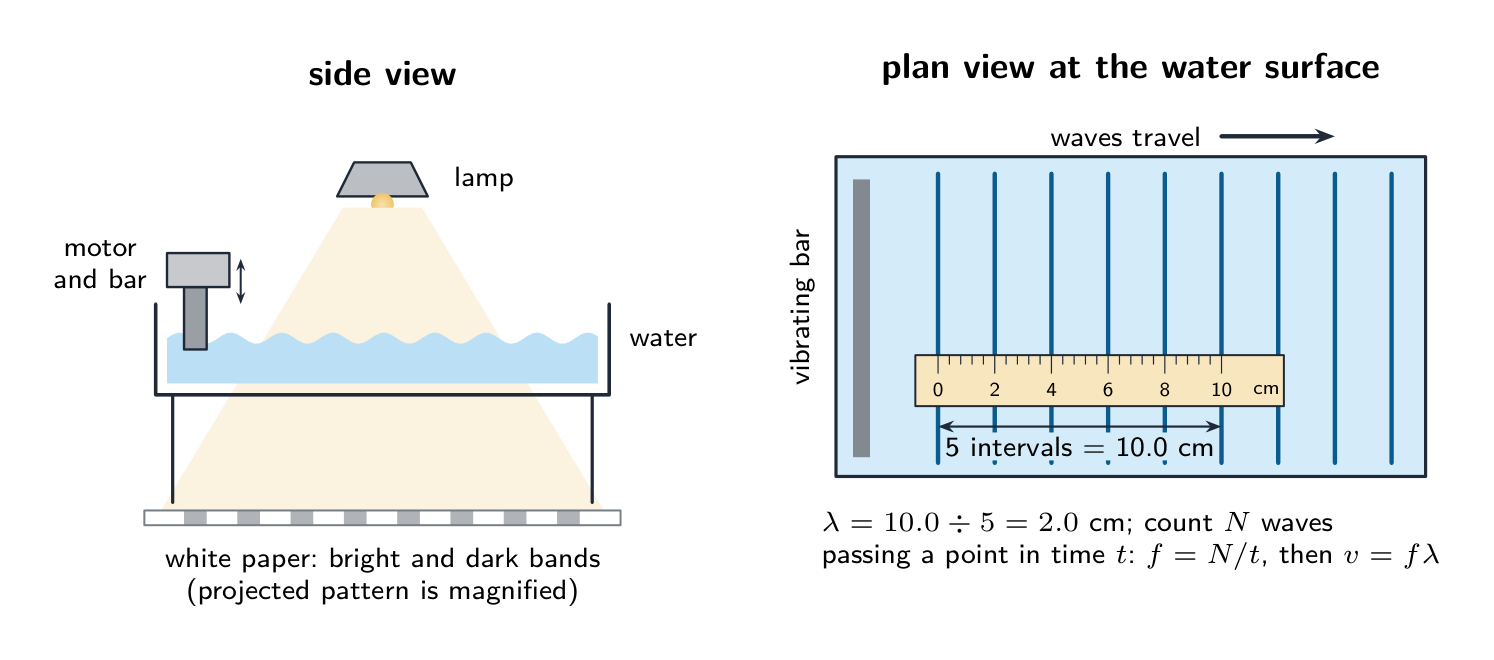
  • Waves on water: set up a ripple tank with a motor-driven bar, and a lamp above that makes a pattern of the waves on paper below. Measure the length of several waves together and divide by the number of waves to find the wavelength. Count the waves passing a point in 10 s to find the frequency, then use $v = f \lambda$.
  • Waves on a string: stretch a string over a pulley with a hanging mass, and make it vibrate with a vibration generator. Change the frequency until you see a clear wave that does not move along the string. Each loop is half a wavelength. Read the frequency from the signal generator and use $v = f \lambda$.
Required practical 8: side view of a ripple tank with a lamp above, a motor-driven bar making straight ripples and bright and dark bands projected on paper below; plan view at the water surface with a ruler spanning 5 crest-to-crest intervals of 10.0 cm, so the wavelength is 2.0 cm
Required practical 8: a ripple tank, and the wave pattern measured with a ruler across 5 wavelengths.

Worked example 4. In a ripple tank, 5 complete waves measure 10.0 cm, so $\lambda = 2.0$ cm $= 0.020$ m. If the frequency is 12 Hz, $v = 12 \times 0.020 = 0.24$ m/s.

Worked example 5. A 1.2 m string vibrating at 50 Hz shows 3 loops. Each loop is half a wavelength, so $\lambda = \frac{2 \times 1.2}{3} = 0.80$ m, and $v = 50 \times 0.80 = 40$ m/s.

Speed of sound in air. Stand 100 m from a large wall, make a sharp sound and time the echo. Worked example 6. The echo arrives after 0.60 s. The sound travels to the wall and back, 200 m, so $v = \frac{200}{0.60} = 330$ m/s (2 s.f.).

Explore

Same frequency, different wavelength

At 5 Hz, speeds of 2.0 and 1.5 m/s give wavelengths of 0.40 and 0.30 m. Compare linked snapshots across a stationary boundary while keeping the source frequency shared.

Vocabulary Train
English
amplitude/ˈæmplɪtjuːd/
wavelength/ˈweɪvleŋθ/
frequency/ˈfriːkwənsi/
period/ˈpɪərɪəd/
6.2

Reflection (physics only)

Syllabus

Reflection, sound and detection waves, physics only (AQA 8463 statements 4.6.1.3-4.6.1.5, RP9).

  1. Construct ray diagrams for reflection at a surface; describe absorption and transmission at interfaces.
  2. Required practical 9: investigate reflection by different surfaces and refraction by different substances.
  3. (HT) Describe sound conversion to vibrations of solids, the ear, and the 20 Hz to 20 kHz human hearing range.
  4. (HT) Explain ultrasound imaging by partial reflection at boundaries, and seismic P-wave/S-wave exploration.

Source: Cambridge International syllabus

When a wave reaches the boundary between two materials, it can be reflected, absorbed or transmitted.

  • Specular reflection 镜面反射 happens at a smooth surface, such as a mirror: all the light is reflected in one direction.
  • Diffuse reflection 漫反射 happens at a rough surface, such as paper: the light is scattered in many directions.

To draw a ray diagram for reflection, draw the normal at right angles to the surface where the ray hits it. The angle of incidence equals the angle of reflection; both are measured from the normal.

Reflection at a mirror: the angles are measured from the normal.
Reflection ray diagram with the normal, angle of incidence and angle of reflection.

Required practical 9 (physics only): reflection and refraction. Shine a narrow ray of light from a ray box at a plane mirror. Mark the incident and reflected rays with crosses, draw them with a ruler, draw the normal and measure the angles with a protractor. Then shine the ray into a glass block, and trace the ray as it enters and leaves, to measure the angles of incidence and refraction. Repeat with blocks of other materials. Do this in a darkened room, and take care because the ray box gets hot.

Vocabulary Train
English
specular reflection/ˈspekjʊlə rɪˈflekʃn/
diffuse reflection/dɪˈfjuːz rɪˈflekʃn/
6.2

Sound and detection (physics only, HT)

Syllabus

Reflection, sound and detection waves, physics only (AQA 8463 statements 4.6.1.3-4.6.1.5, RP9).

  1. Construct ray diagrams for reflection at a surface; describe absorption and transmission at interfaces.
  2. Required practical 9: investigate reflection by different surfaces and refraction by different substances.
  3. (HT) Describe sound conversion to vibrations of solids, the ear, and the 20 Hz to 20 kHz human hearing range.
  4. (HT) Explain ultrasound imaging by partial reflection at boundaries, and seismic P-wave/S-wave exploration.

Source: Cambridge International syllabus

Sound waves can travel through solids, liquids and gases. When sound reaches your ear, it makes the eardrum vibrate. The vibrations pass through small bones to the inner ear, which sends signals to the brain. This works only for a limited range of frequencies: humans can hear from about 20 Hz to 20 kHz. When sound passes from air into another medium, its speed and wavelength change, but its frequency stays the same.

Ultrasound is sound with a frequency above 20 kHz, too high for humans to hear. When ultrasound reaches a boundary between two materials, some of it is reflected. The time taken for the echo to return gives the distance to the boundary. Ultrasound is used for scanning unborn babies, because it is not ionising and so is safer than X-rays, and to find cracks inside metal objects.

An ultrasound machine screen showing a fan-shaped grey scan of a 20-week fetus in profile
An ultrasound scan of an unborn baby: each bright point is an echo from a boundary between tissues.

Worked example 7. Ultrasound travels at 1500 m/s in body tissue. An echo returns after 0.000 040 s. The pulse travels to the boundary and back, so the depth is $\frac{1500 \times 0.000\,040}{2} = 0.030$ m, or 3.0 cm.

Echo sounding. Ships send sound pulses down to the seabed and time the echoes. Worked example 8. Sound travels at 1500 m/s in sea water, and an echo returns after 0.40 s. Depth $= \frac{1500 \times 0.40}{2} = 300$ m.

Seismic waves. Earthquakes produce P-waves, which are longitudinal and can travel through solids and liquids, and S-waves, which are transverse and cannot travel through liquids. Detectors around the world find that S-waves do not reach the side of the Earth opposite an earthquake. This shows that the Earth has a liquid outer core. Studying seismic waves gave the first evidence for the Earth's layered structure, which nobody can see directly.

6.3

Electromagnetic waves

Syllabus

Electromagnetic waves (AQA 8463 statements 4.6.2.1-4.6.2.4).

  1. Describe EM waves as transverse, forming a continuous spectrum, all at the same speed in vacuum or air.
  2. Recite the order of the spectrum from radio to gamma in wavelength and frequency.
  3. Give uses of each band and (HT) explain their suitability.
  4. State the hazards of ultraviolet, X-rays and gamma rays; interpret radiation dose data.
  5. (HT) Explain how substances absorb, transmit, refract or reflect EM waves differently with wavelength; construct refraction ray and wavefront diagrams.

Source: Cambridge International syllabus

Electromagnetic (EM) waves are transverse waves that transfer energy from a source to an absorber. They form a continuous spectrum, and they all travel at the same speed in a vacuum or in air: $3 \times 10^8$ m/s. In order of decreasing wavelength and increasing frequency:

$$\text{radio} \to \text{microwaves} \to \text{infrared} \to \text{visible light} \to \text{ultraviolet} \to \text{X-rays} \to \text{gamma rays}$$

Our eyes detect only visible light, a very small part of the spectrum.

The EM spectrum from radio to gamma: frequency rises and wavelength falls along the strip, with a typical wavelength and the main uses of each band.
The electromagnetic spectrum: frequency increases and wavelength decreases from radio waves to gamma rays.

Worked example 9. A radio station broadcasts at 100 MHz. Its wavelength is $\lambda = \frac{3 \times 10^8}{100 \times 10^6} = 3.0$ m.

EM wave Uses Why it is suitable
radio waves television and radio they travel long distances and can be reflected by the atmosphere
microwaves satellite communications, cooking they pass through the atmosphere; water in food absorbs them
infrared electric heaters, cooking, infrared cameras all warm objects emit it, and absorbing it warms things
visible light fibre optic communications it reflects along inside glass fibres
ultraviolet energy-efficient lamps, sun tanning it makes some substances glow (fluoresce)
X-rays and gamma rays medical imaging and treatment they pass through soft tissue; X-rays are absorbed by bone

Dangers. Ultraviolet waves can make skin age early and increase the risk of skin cancer. X-rays and gamma rays are ionising radiation: they can cause mutations in genes and lead to cancer. The risk of harm is measured as radiation dose, in sieverts (1000 mSv = 1 Sv).

(HT) How EM waves are made and absorbed. Oscillations in electrical circuits produce radio waves. When radio waves are absorbed by a wire, they can create an alternating current with the same frequency as the radio wave. Changes in atoms can produce or absorb EM waves over a wide range of frequencies, and changes in the nucleus of an atom produce gamma rays.

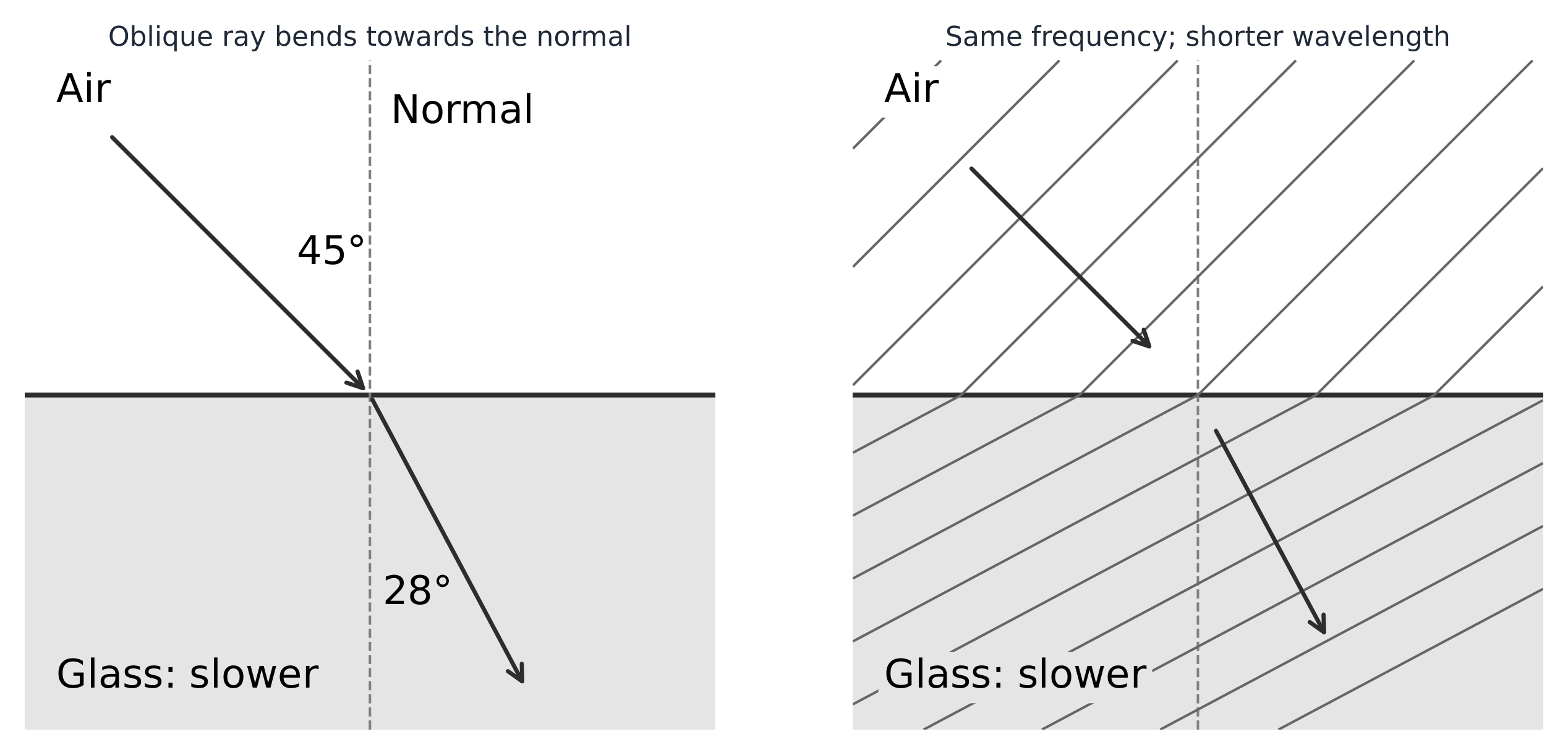
(HT) Refraction. Different substances may absorb, transmit, refract or reflect EM waves in different ways, depending on the wavelength. Refraction happens because the wave changes speed when it enters a new material. A ray entering glass at an angle slows down and bends towards the normal. On a wavefront diagram, the wavefronts are closer together in the material where the wave is slower. A ray that hits the boundary along the normal does not change direction.

Refraction shown as a ray and as wavefronts.
Refraction as a ray bending towards the normal, and as wavefronts bunching in the slower medium.

Required practical 10: infrared radiation. Fill a Leslie cube, a metal cube with differently coloured faces (matt black, shiny black, matt white, shiny silver), with hot water. Point an infrared detector at each face from the same distance, and record the readings. The matt black face emits the most infrared and the shiny silver face the least. To compare absorption, put identical cans with different surfaces the same distance from a heater and measure how much the temperature of the water inside each rises in the same time. Matt black surfaces are the best absorbers as well as the best emitters.

Watch lesson
6.4

Lenses (physics only)

Syllabus

Lenses and visible light, physics only (AQA 8463 statements 4.6.2.5-4.6.2.6).

  1. Construct ray diagrams for convex and concave lenses; distinguish real and virtual images.
  2. Use magnification = image height / object height as a unitless ratio.
  3. Explain colour by differential reflection and absorption; filters by transmission; specular vs diffuse reflection.

Source: Cambridge International syllabus

A lens forms an image by refracting light.

  • A convex 凸透镜 lens makes parallel rays of light converge (come together) at the principal focus. The distance from the lens to the principal focus is the focal length. A convex lens can form a real or a virtual image.
  • A concave 凹透镜 lens makes parallel rays spread out, as if they came from a principal focus behind the lens. A concave lens always forms a virtual, upright, smaller image.

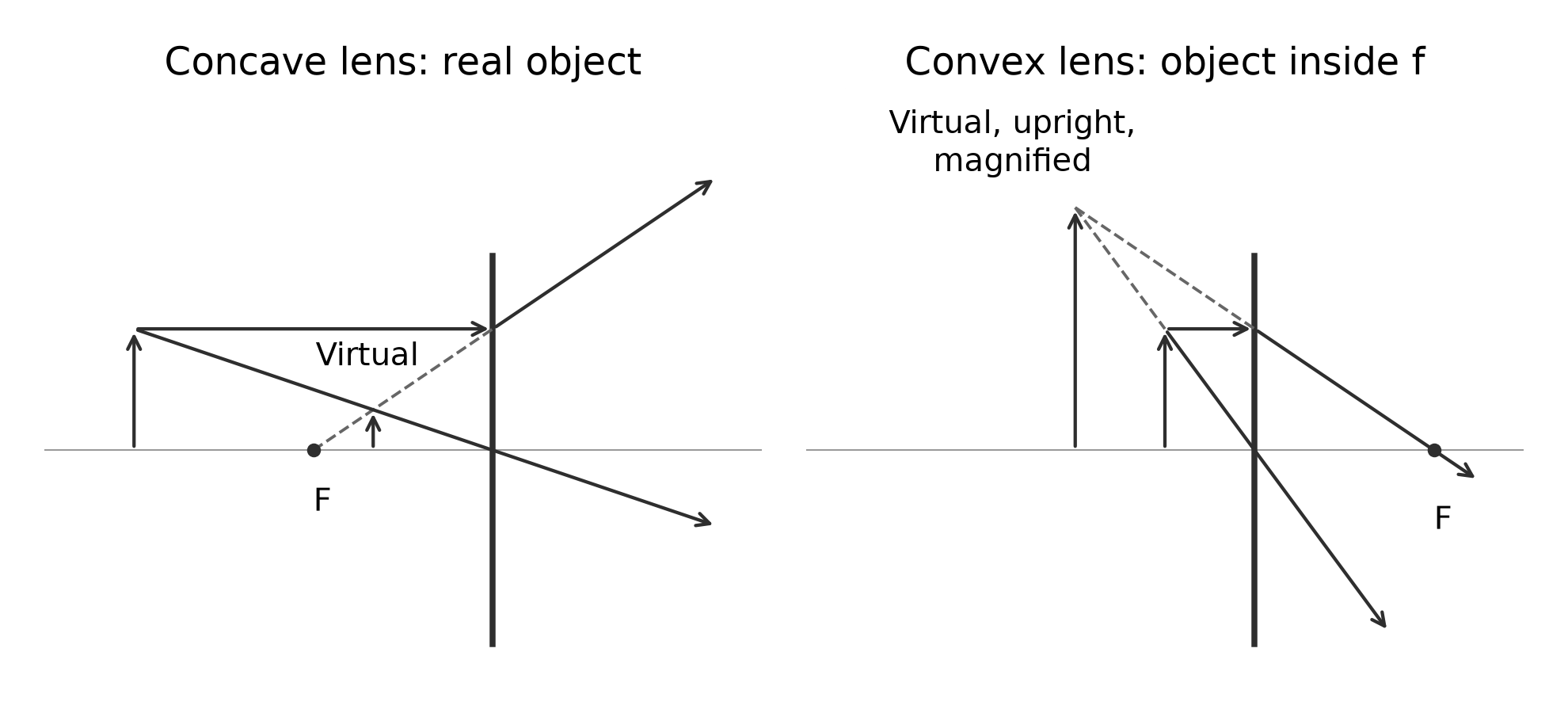
Drawing a ray diagram. Use two rays from the top of the object. A ray parallel to the principal axis refracts through the principal focus (convex lens) or appears to come from it (concave lens). A ray through the centre of the lens goes straight on. The image is where the rays meet. A virtual image is where the rays only appear to come from, so draw the extensions as dashed lines.

A convex lens ray diagram forming a real inverted image.
Two virtual-image constructions; dashed lines are backward extensions.
Virtual images: concave lens with a real object, and convex lens with an object inside its focal length.
$$\text{magnification} = \frac{\text{image height}}{\text{object height}}$$

Magnification is a ratio, so it has no unit. Use the same unit for both heights.

Worked example 10. An object 5.0 mm tall forms an image 20 mm tall. Magnification $= \frac{20}{5.0} = 4.0$.

Vocabulary Train
English
convex/kɒnˈveks/
concave/kɒnˈkeɪv/
Watch lesson
6.4

Visible light and colour (physics only)

Syllabus

Lenses and visible light, physics only (AQA 8463 statements 4.6.2.5-4.6.2.6).

  1. Construct ray diagrams for convex and concave lenses; distinguish real and virtual images.
  2. Use magnification = image height / object height as a unitless ratio.
  3. Explain colour by differential reflection and absorption; filters by transmission; specular vs diffuse reflection.

Source: Cambridge International syllabus

Each colour in the visible spectrum has its own narrow band of wavelengths and frequencies. Red light has the longest wavelength, and violet the shortest.

A narrow beam of white light entering a glass prism and fanning out into a bright band of rainbow colours on a black background
White light entering a glass prism spreads into the colours of the spectrum.
  • An opaque object reflects some wavelengths and absorbs the rest. A red apple looks red because it reflects red light and absorbs the other colours. A white object reflects all wavelengths equally; a black object absorbs them all.
  • Colour filters absorb some wavelengths and transmit others. A red filter transmits only red light.
  • Transparent and translucent objects transmit light.

Worked example 11. A red book is seen through a green filter. Explain why it looks black. The book reflects only red light. The green filter absorbs red light, so no light from the book reaches the eye.

Watch lesson
6.5

Black body radiation (physics only)

Syllabus

Black body radiation, physics only (AQA 8463 statements 4.6.3.1-4.6.3.2).

  1. State that all bodies emit and absorb infrared radiation, more when hotter.
  2. Define a perfect black body as complete absorber and best emitter.
  3. Relate intensity and wavelength distribution of emission to temperature.
  4. (HT) Explain constant temperature as balanced absorption and emission, and apply to the Earth's temperature factors.

Source: Cambridge International syllabus

All bodies, whatever their temperature, emit and absorb infrared radiation. The hotter a body is, the more infrared radiation it emits in a given time.

A perfect black body absorbs all the radiation that hits it; it does not reflect or transmit any. Because a good absorber is also a good emitter, a perfect black body is the best possible emitter.

The intensity and wavelength distribution of the radiation a body emits depend on its temperature. As the temperature increases, the body emits more radiation at every wavelength, and the peak moves to a shorter wavelength. That is why a piece of metal glows red, then orange, then white as it gets hotter.

Radiation emitted at each wavelength by a hotter and a cooler body.
A hotter body emits more radiation at every wavelength, and its peak is at a shorter wavelength.

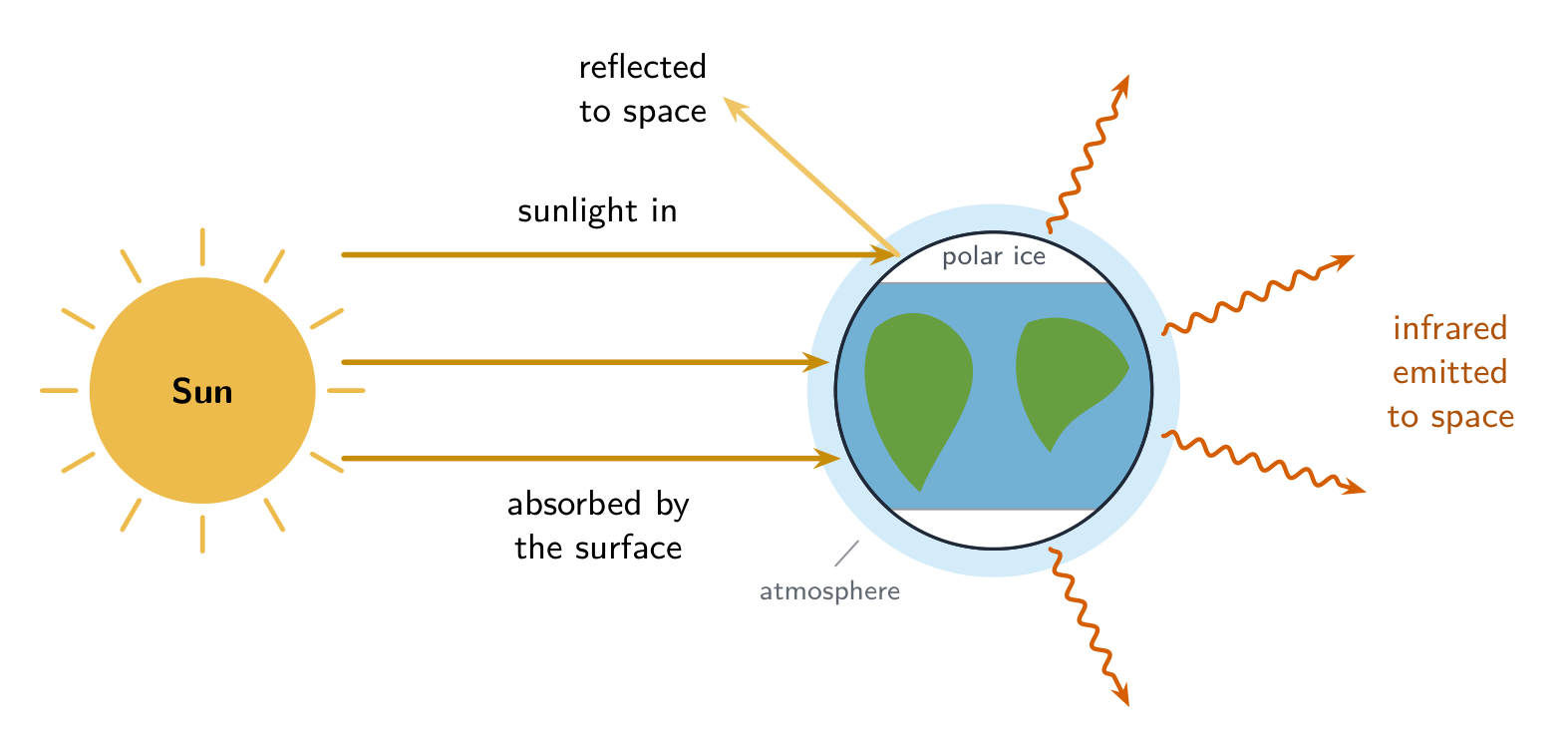
(HT) Temperature and radiation. A body at constant temperature absorbs radiation at the same rate as it emits it. If it absorbs radiation faster than it emits it, its temperature rises. The temperature of the Earth depends on many factors, including how fast light and infrared radiation are absorbed and emitted by its surface and atmosphere, and how much is reflected back into space, for example by ice.

Sunlight reaches the Earth; polar ice reflects some back to space, the surface absorbs the rest, and the warm Earth emits infrared to space.
The Earth's radiation balance: absorbed, reflected and emitted radiation.
6.5

Sources for this lesson

  • AQA, GCSE Physics (8463) specification, section 4.6 Waves, and the Required practical handbook (practicals 8, 9 and 10).
  • H. Hertz, Electric Waves (London, 1893), English translation of his papers of 1887 to 1890; Marconi Society, account of the first transatlantic radio signal, 12 December 1901.
  • AQA, GCSE Physics Paper 2 Higher, June 2023 to June 2025 (wave graph, ripple tank and lens questions, adapted).
6.5

Common errors

  • Saying the material travels with the wave; waves transfer energy, and particles only oscillate.
  • Measuring amplitude from crest to trough; it is from the rest position to a crest.
  • Forgetting to convert kHz to Hz or MHz to Hz.
  • Saying refraction changes the frequency; the speed and wavelength change.
  • Measuring angles from the surface instead of from the normal.
  • Saying higher-frequency EM waves travel faster; all travel at the same speed in a vacuum.
  • Giving magnification a unit.
  • Saying a red filter turns light red; it absorbs the other colours.
6.5

Key terms

  • Transverse wave: oscillations at right angles to the direction of travel.
  • Longitudinal wave: oscillations along the direction of travel.
  • Wavelength: the distance from one point on a wave to the same point on the next.
  • Frequency: the number of waves passing a point each second.
  • Electromagnetic spectrum: the family of transverse waves from radio to gamma rays.
  • Refraction: the change of direction of a wave as its speed changes at a boundary.
  • Perfect black body: an object that absorbs all the radiation that hits it.
6.5

Check yourself

  1. Give one example each of a transverse and a longitudinal wave.
  2. A wave has a frequency of 25 Hz and a wavelength of 0.12 m. Calculate its speed and its period.
  3. List the electromagnetic spectrum from longest to shortest wavelength.
  4. Why are X-rays dangerous?
  5. Describe how to measure the wavelength of water waves in a ripple tank.
  6. (Physics only) Why is ultrasound used for scanning unborn babies instead of X-rays?
  7. (Physics only) An image is 36 mm tall and the object is 12 mm tall. Calculate the magnification.

Answers: 1. Transverse: water ripples or light; longitudinal: sound. 2. $v = 25 \times 0.12 = 3.0$ m/s; $T = \frac{1}{25} = 0.04$ s. 3. Radio, microwaves, infrared, visible, ultraviolet, X-rays, gamma rays. 4. They are ionising, so they can damage genes and cause cancer. 5. Measure the length of several waves in the pattern with a ruler and divide by the number of waves. 6. Ultrasound is not ionising, so it does not damage cells. 7. $\frac{36}{12} = 3.0$.

Was this helpful?

More topics in AQA GCSE Physics

Log in or create account

IGCSE, A-Level & AP