Skip to content

Particle model of matter

AQA · GCSE · Physics · Topic 3

3.1

The particle model: matter from the inside

Why does a metal spoon sink while a huge ship floats? Why does sweat cool you down? Both answers live in the particle model. This reference covers AQA GCSE Physics 8463, topic 4.3 Particle model of matter.

How the exam treats this topic:

  • Paper 1 (4.1–4.4) carries this topic. The equations $\rho = m/V$, $\Delta E = mc\Delta\theta$, $E = mL$ and $pV = \text{constant}$ are all printed on the enclosed sheet.
  • Pressure in gases and doing work on a gas are physics only (work on a gas also Higher Tier).
  • You must interpret heating and cooling graphs that include changes of state.
  • You must distinguish specific heat capacity from specific latent heat — a favourite one-mark check.
3.1

Density of materials

Syllabus

Density of materials (AQA 8463 statement 4.3.1.1).

  1. Use density = mass / volume with the units kg/m3 and g/cm3, converting between them.
  2. Use the particle model to explain the different states of matter and the differences in density between them.
  3. Recognise and draw simple diagrams that model solids, liquids and gases.
  4. Required practical 5: determine the densities of regular and irregular solid objects and liquids, using dimensions, a balance and a displacement technique.

Source: Cambridge International syllabus

$$\rho = \frac{m}{V}$$
  • $\rho$ density 密度 in kg/m³; $m$ mass in kg; $V$ volume in m³.
  • Common trap: g/cm³ must become kg/m³ before substituting. $1\ \text{g/cm}^3 = 1000\ \text{kg/m}^3$ (multiply by 1000: a cm³ is a millionth of a m³ and a gram is a thousandth of a kg).

The particle model explains the states of matter:

The particle arrangement in a solid, a liquid and a gas.
Pattern, contact, spacing.
State Particle arrangement Particle motion Density trend
solid packed in a fixed pattern, touching vibrate about fixed positions highest
liquid touching, but free to slide past each other random motion, no fixed shape slightly lower than solid
gas far apart, random fast, random, straight lines between collisions much lower
  • Solids and liquids have similar densities because their particles are similarly packed; a gas is mostly empty space.
  • Ice is unusual: water expands on freezing, so ice is slightly less dense than water.

Worked example. A ring has mass 9.46 g and volume 0.44 cm³. Find its density in kg/m³.

  • Convert both first: $m = 9.46\ \text{g} = 9.46\times10^{-3}\ \text{kg}$; $V = 0.44\ \text{cm}^3 = 4.4\times10^{-7}\ \text{m}^3$.
    $$\rho = \frac{m}{V} = \frac{9.46\times10^{-3}\ \text{kg}}{4.4\times10^{-7}\ \text{m}^3} = 21\,500\ \text{kg/m}^3$$

Required practical 5: density

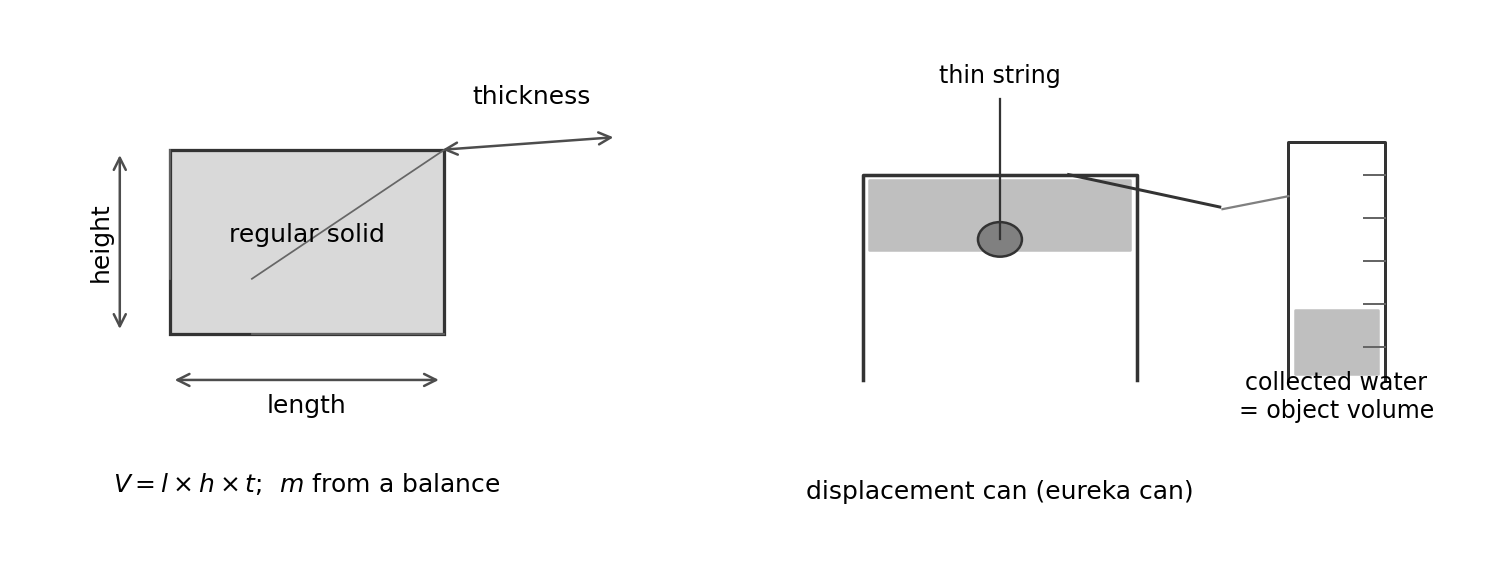
Measuring density: a rectangular block measured with a ruler, and an irregular object lowered into a displacement (eureka) can.
Regular shapes from dimensions; irregular shapes by displacement.
  • Regular solid: measure length, width and thickness with a ruler (or micrometer/Vernier callipers), multiply for $V$; find $m$ on a balance; $\rho = m/V$.
  • Irregular solid: fill a displacement (eureka) can to the spout, wait for dripping to stop, lower the object in on thin string; the volume of water collected in a measuring cylinder equals the object's volume.
  • Liquid: find the mass of an empty measuring cylinder, then the mass with a known volume inside; subtract for $m$.
  • Accuracy points: read the measuring cylinder at eye level on a flat surface (avoid parallax); use thin string so it displaces almost no water; repeat and average.
Vocabulary Train
English
density/ˈdensɪti/
3.2

Changes of state and internal energy

Syllabus

Changes of state and internal energy (AQA 8463 statements 4.3.1.2-4.3.2.1).

  1. Describe melting, freezing, boiling, evaporating, condensing and sublimating, and state that mass is conserved.
  2. Explain that changes of state are physical changes which recover the original properties when reversed.
  3. Define internal energy as the total kinetic and potential energy of all the particles in a system.
  4. Explain that heating either raises the temperature or produces a change of state.

Source: Cambridge International syllabus

When a substance melts, freezes, boils, evaporates, condenses or sublimates 升华:

  • Mass is conserved — the number of particles does not change.
  • Changes of state are physical changes 物理变化: reverse the change and the material recovers its original properties. (A chemical change makes new substances; melting does not.)

Internal energy 内能 is the total kinetic and potential energy of all the particles that make up a system. Heating a system increases the particles' energy, and that energy goes one of two ways:

  1. it raises the temperature — the particles' kinetic energy grows;
  2. it produces a change of state — the particles' potential energy grows as bonds break; the temperature stays constant.
Vocabulary Train
English
internal energy/ɪnˈtɜːnl ˈenədʒi/
physical changes/ˈfɪzɪkl ˈtʃeɪndʒɪz/
sublimates/ˈsʌblɪmeɪts/
3.3

Specific heat capacity and temperature changes

Syllabus

Specific heat capacity and temperature changes (AQA 8463 statement 4.3.2.2).

  1. Use dE = m c d(theta) for temperature changes, with the value of c interpreted per kilogram per degree Celsius.
  2. Interpret the specific heat capacity in particle terms.
  3. Solve for energy, mass, specific heat capacity or temperature change with unit conversions.

Source: Cambridge International syllabus

While the temperature changes, the energy needed follows (also met in topic 1):

$$\Delta E = m\,c\,\Delta\theta$$

Specific heat capacity 比热容 $c$ (J/kg °C) is the energy needed to raise the temperature of one kilogram by one degree Celsius. It measures how hard it is to warm the substance — from the particle view, how much energy its particles store per degree of kinetic energy rise.

Worked example. 0.030 kg of olive oil ($c = 1800$ J/kg °C) warms from 21 °C to 96 °C.

  • Temperature change first: $\Delta\theta = 96 - 21 = 75$ °C.
    $$\Delta E = mc\Delta\theta = 0.030 \times 1800 \times 75 = 4050\ \text{J}$$

The RP1 method, error analysis and percentage-difference work are covered on sheet 1.3 — the same equation, the same practical.

Vocabulary Train
English
specific heat capacity/spəˈsɪfɪk hiːt kəˈpæsɪti/
3.4

Specific latent heat and heating graphs

Syllabus

Specific latent heat and heating graphs (AQA 8463 statement 4.3.2.3).

  1. Use energy for a change of state = mass x specific latent heat (E = mL).
  2. Define specific latent heat and distinguish fusion from vaporisation.
  3. Interpret heating and cooling graphs that include changes of state.
  4. Distinguish specific heat capacity from specific latent heat.

Source: Cambridge International syllabus

While a substance changes state, its temperature stops rising even though energy keeps flowing in. The energy needed is called latent heat 潜热:

$$E = mL$$
  • $E$ energy for the change of state in J; $m$ mass that changes state in kg; $L$ specific latent heat 比潜热 in J/kg.
  • Specific latent heat is the energy needed to change the state of one kilogram of a substance with no change of temperature.
  • Fusion 熔化: solid to liquid. Vaporisation 汽化: liquid to vapour. Vaporisation is much larger than fusion — breaking free of the liquid completely takes more energy than loosening a solid.
A heating graph: temperature rises, plateaus at the melting point, rises again, plateaus at the boiling point, rises as steam.
Read the plateaus as changes of state.

Reading the graph:

  • Rising sections: energy goes into kinetic energy — the temperature climbs ($\Delta E = mc\Delta\theta$).
  • Flat sections: energy goes into potential energy — the state is changing ($E = mL$). The longer the plateau, the more mass changed state.
  • Cooling graphs are the mirror image: flat while the substance freezes or condenses, releasing latent heat.

Distinguishing the two (a credited 1–2 mark check): specific heat capacity involves a temperature change; specific latent heat involves a change of state at constant temperature.

Worked example. A heater supplies 0.0075 kW... (keep units honest) — a 30 W heater runs for 11 minutes and boils off $6.6\times10^{-3}$ kg of water. Find $L$.

  • Convert: $E = Pt = 30\ \text{W} \times 660\ \text{s} = 19\,800$ J.
    $$L = \frac{E}{m} = \frac{19\,800\ \text{J}}{6.6\times10^{-3}\ \text{kg}} = 3.0\times10^6\ \text{J/kg}$$
Vocabulary Train
English
latent heat/ˈleɪtənt hiːt/
specific latent heat/spəˈsɪfɪk ˈleɪtənt hiːt/
Fusion/ˈfjuːʒn/
Vaporisation/ˌveɪpəraɪˈzeɪʃn/
3.5

Particle motion in gases

Syllabus

Particle motion in gases (AQA 8463 statement 4.3.3.1).

  1. Describe gas molecules as in constant random motion.
  2. Relate the temperature of a gas to the average kinetic energy of its molecules.
  3. Explain gas pressure in terms of molecular collisions with the container walls.
  4. Explain qualitatively how the pressure of a fixed volume of gas changes with temperature.

Source: Cambridge International syllabus

The molecules of a gas are in constant random motion. Its temperature is related to the average kinetic energy of the molecules: hotter gas, faster particles.

Gaseous pressure from the particle model (each clause earns credit):

Gas molecules colliding with the container walls make pressure; compressing the gas raises it.
Collisions at right angles to the wall.
  1. the moving molecules collide with the container walls;
  2. each collision exerts a force at right angles to the wall;
  3. pressure is force per unit area — the total of many tiny collisions spread over the wall.

Temperature up (constant volume) → pressure up: the molecules move faster on average, so they hit the walls more often and harder (larger force each impact), so the force per unit area rises.

3.6

Pressure in gases (physics only)

Syllabus

Pressure in gases and work done on a gas, physics only (AQA 8463 statements 4.3.3.2-4.3.3.3).

  1. Use pressure x volume = constant for a fixed mass of gas at constant temperature.
  2. Calculate the new pressure or volume when either changes.
  3. Use the particle model to explain how increasing the volume of a gas decreases its pressure.
  4. (HT only) Explain how doing work on a gas increases its internal energy and can raise its temperature, for example in a bicycle pump.

Source: Cambridge International syllabus

A gas can be compressed or expanded by pressure changes. For a fixed mass of gas at constant temperature:

$$pV = \text{constant}$$
  • $p$ pressure in pascals, Pa; $V$ volume in m³.
  • Before/after form: $p_1V_1 = p_2V_2$.

The particle explanation of each direction:

  • Volume up → pressure down (constant temperature): the same number of molecules spread over a larger wall area collide less often, so force per unit area falls.
  • Volume down → pressure up: molecules hit a smaller area more often.

Worked example. A syringe holds 50 cm³ of air at 100 kPa. It is compressed to 20 cm³ at constant temperature.

  • Convert or keep consistent: volumes in cm³ cancel; pressures must be consistent.
    $$p_1V_1 = p_2V_2 \quad\Rightarrow\quad p_2 = \frac{100\ \text{kPa} \times 50}{20} = 250\ \text{kPa}$$
3.6

Doing work on a gas (physics only, Higher Tier)

Syllabus

Pressure in gases and work done on a gas, physics only (AQA 8463 statements 4.3.3.2-4.3.3.3).

  1. Use pressure x volume = constant for a fixed mass of gas at constant temperature.
  2. Calculate the new pressure or volume when either changes.
  3. Use the particle model to explain how increasing the volume of a gas decreases its pressure.
  4. (HT only) Explain how doing work on a gas increases its internal energy and can raise its temperature, for example in a bicycle pump.

Source: Cambridge International syllabus

Work is the transfer of energy by a force. Compressing a gas — doing work on it — increases the gas's internal energy, which can raise its temperature.

The credited chain (bicycle pump): pushing the pump's handle does work on the trapped gas → energy is transferred to the gas's particles → their average kinetic energy rises → the temperature of the gas increases (the pump feels warm).

The reverse is true too: a gas expanding does work on its surroundings and cools.

3.6

Checklist before you call this topic done

  • Convert g/cm³ to kg/m³, and cm³ to m³, before using $\rho = m/V$.
  • Describe RP5 for regular solids, displacement and liquids, with accuracy points.
  • State that mass is conserved in changes of state and that they are physical changes.
  • Define internal energy as total kinetic plus potential energy of the particles.
  • Choose between $\Delta E = mc\Delta\theta$ (temperature changes) and $E = mL$ (state changes).
  • Read heating graphs: rising = kinetic energy, plateau = latent heat.
  • Explain gas pressure from wall collisions; use $pV =$ constant with consistent units.
  • (physics only, HT) Explain why doing work on a gas raises its temperature.

More topics in AQA · GCSE · Physics

Log in or create account

IGCSE, A-Level & AP