Skip to content

Space physics — physics only (4.8)

AQA · GCSE · Physics · Topic 8

8.1

Space physics: the biggest picture

Stars are born, burn and die; galaxies race away from each other; and the light they send us carries the news. This reference covers AQA GCSE Physics 8463, topic 4.8 Space physics.

How the exam treats this topic:

  • The whole topic is physics only, sitting on Paper 2.
  • The three orbital-motion statements are HT only (circular orbits, changing velocity at constant speed, stable-orbit radius changes).
  • Facts must be exact: the life-cycle sequence, the fusion story of the elements, and the red-shift chain.
8.1

Our solar system and the Sun

Syllabus

Our solar system and the life cycle of stars, physics only (AQA 8463 statements 4.8.1.1-4.8.1.2).

  1. Describe the solar system: one star, eight planets, dwarf planets and natural satellites; part of the Milky Way.
  2. Explain the Sun's formation from a nebula pulled together by gravity, and the fusion equilibrium of a main-sequence star.
  3. Describe the life cycles of a Sun-sized star and of a much more massive star.
  4. Explain how fusion processes produce the naturally occurring elements and how a supernova forms and distributes elements heavier than iron.

Source: Cambridge International syllabus

The solar system: one star (the Sun), eight planets, the dwarf planets orbiting the Sun, and natural satellites (moons) orbiting planets. Our solar system is a small part of the Milky Way galaxy.

The Sun's formation: a cloud of dust and gas (a nebula 星云) was pulled together by gravitational attraction. As it collapsed:

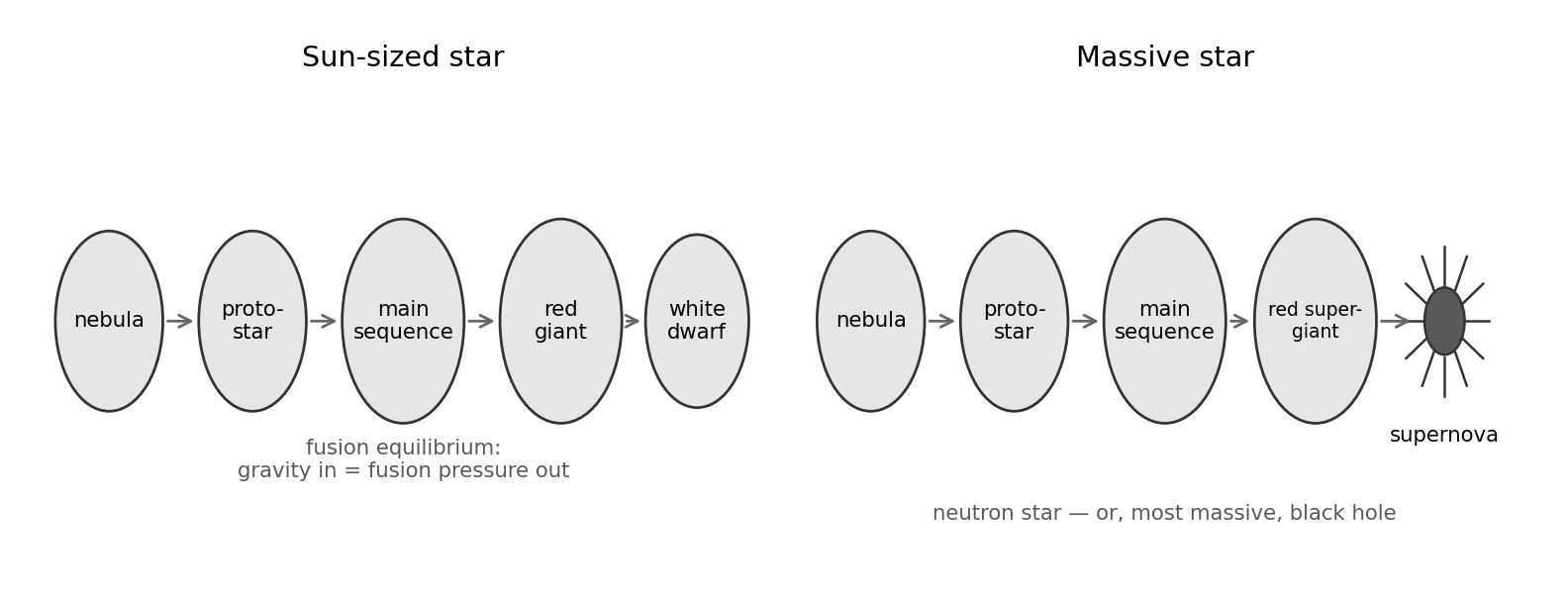
The life cycles of a Sun-sized star and a massive star from nebula to remnant.
  1. the dense centre heated until fusion began — a star lit;
  2. fusion's outward pressure balances gravity's inward pull — an equilibrium that lasts the star's main-sequence life.
Vocabulary Train
English
nebula/ˈnebjʊlə/
8.1

The life cycle of a star

Syllabus

Our solar system and the life cycle of stars, physics only (AQA 8463 statements 4.8.1.1-4.8.1.2).

  1. Describe the solar system: one star, eight planets, dwarf planets and natural satellites; part of the Milky Way.
  2. Explain the Sun's formation from a nebula pulled together by gravity, and the fusion equilibrium of a main-sequence star.
  3. Describe the life cycles of a Sun-sized star and of a much more massive star.
  4. Explain how fusion processes produce the naturally occurring elements and how a supernova forms and distributes elements heavier than iron.

Source: Cambridge International syllabus

The life cycle is determined by the star's size.

Sun-sized star: nebula → protostar → main sequence (fusion of hydrogen; equilibrium) → red giant (hydrogen runs out; helium and heavier elements fuse; the star swells) → white dwarf (fusion stops; the core shrinks and cools) → eventually a black dwarf.

Massive star (much more massive than the Sun): nebula → protostar → main sequence → red supergiant → supernova 超新星 (explosion) → neutron star, or — for the most massive — a black hole.

Where the elements come from (a favourite sequence):

  • Fusion in stars makes elements up to iron.
  • Elements heavier than iron form in a supernova.
  • The supernova distributes the elements throughout the universe — the stuff of planets and people.
Vocabulary Train
English
supernova/ˌsuːpəˈnəʊvə/
8.2

Orbital motion and satellites

Syllabus

Orbital motion, natural and artificial satellites, physics only (AQA 8463 statement 4.8.1.3).

  1. Describe gravity as the force maintaining circular orbits of planets and satellites.
  2. Describe the similarities and distinctions between planets, their moons and artificial satellites.
  3. (HT only) Explain qualitatively how circular orbits involve changing velocity but unchanged speed.
  4. (HT only) Explain how a stable orbit must change radius when the speed changes.

Source: Cambridge International syllabus

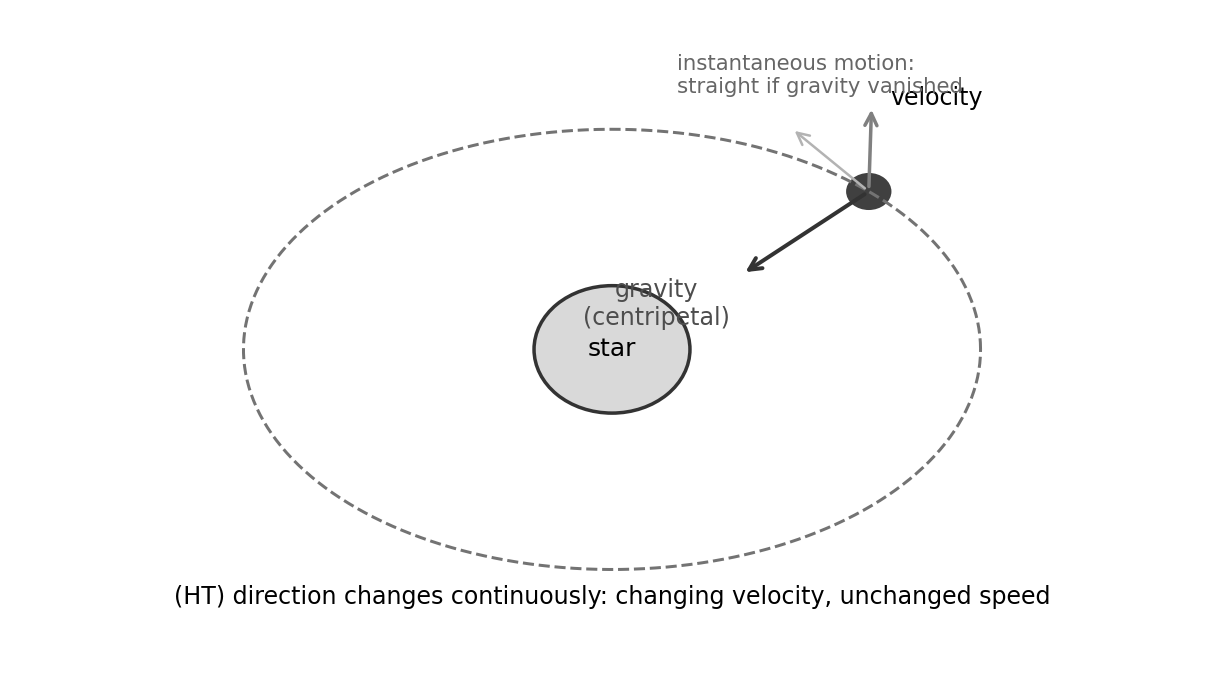
Gravity provides the centripetal force keeping planets and satellites in circular orbits.

A circular orbit with gravity as the centripetal force and velocity at a tangent.
  • Planets: orbit the Sun. Moons: natural satellites orbiting planets. Artificial satellites: made by us, orbiting the Earth. All held by gravity, and distinguished only by what they orbit and who made them.
  • (HT) A circular orbit has changing velocity but unchanged speed — velocity is a vector, and the direction changes continuously; the gravitational force acts at right angles to the motion, changing direction but not speed.
  • (HT) For a stable orbit at a different speed, the radius must change: move faster and the orbit must be smaller (or the star pulls you off course); move slower and it must be larger.
8.3

Red-shift and the Big Bang

Syllabus

Red-shift, physics only (AQA 8463 statement 4.8.2).

  1. Describe red-shift as an observed increase in wavelength of light from most distant galaxies.
  2. State the link between distance, recession speed and the size of the red-shift.
  3. Explain how red-shift is evidence for an expanding universe and the Big Bang theory.
  4. Describe how observations, including the 1998 supernova results, lead to theories, and name current unknowns such as dark matter and dark energy.

Source: Cambridge International syllabus

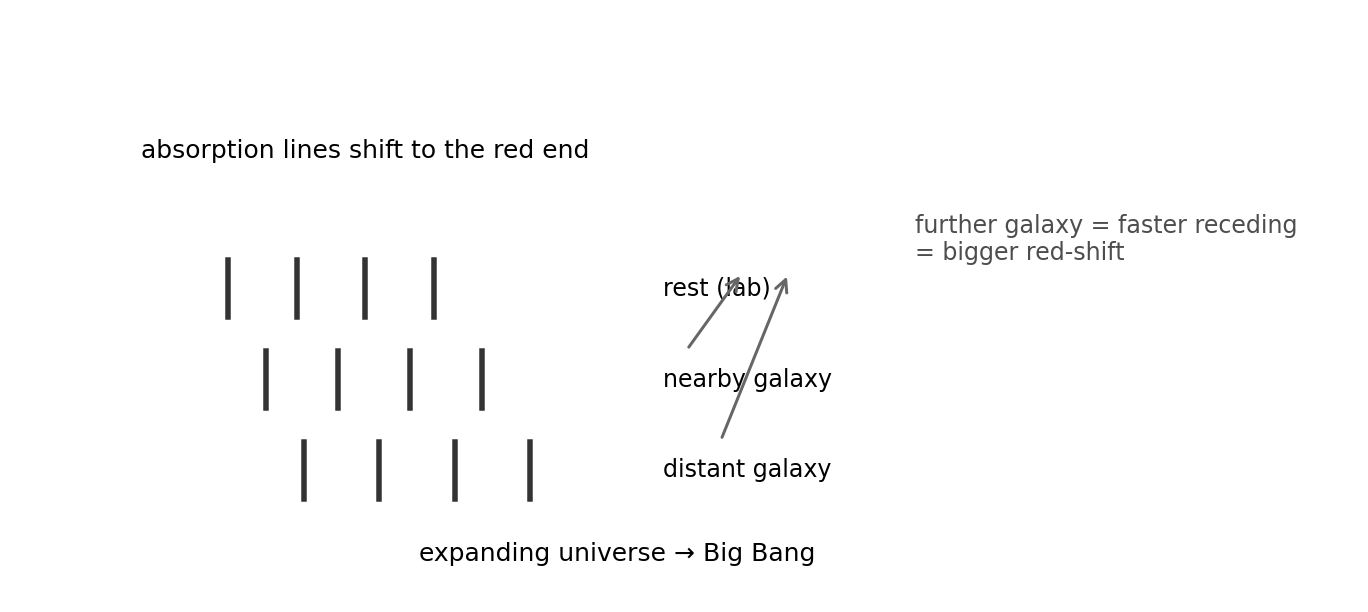
Light from most distant galaxies shows an increase in wavelength — a shift towards the red end: red-shift 红移.

Spectral lines shifted further to the red for more distant galaxies.
  • The further away the galaxy, the faster it is receding and the bigger the red-shift.
  • Red-shift means the universe is expanding. Played backwards, everything was once in a very small, extremely hot and dense region — the Big Bang.

The credited chain: observed red-shift → galaxies receding → further = faster → space itself expanding → Big Bang. And the scientific-method point: observations (red-shift surveys, and since 1998 supernovae showing galaxies receding ever faster) are the evidence from which the theory is built; much remains unknown, e.g. dark matter and dark energy.

Vocabulary Train
English
red-shift/red ʃɪft/
8.3

Checklist before you call this topic done

  • List the solar system's contents and the Sun's formation from a nebula by gravity.
  • Draw or order both life cycles; state where every element forms.
  • Explain orbits with gravity; (HT) explain changing velocity at constant speed and radius changes for stable orbits.
  • State the red-shift chain and its Big Bang conclusion, the 1998 supernova observation, and one open unknown.

More topics in AQA · GCSE · Physics

Log in or create account

IGCSE, A-Level & AP