Original teaching practice. Read one pattern, cover its model and try the questions before checking the separate answer section. Examples adapted from Chinese Grammar Wiki (AllSet Learning, CC BY-NC-SA) retain the course-reference provenance.
Place + Verb + (ongoing -ing)着 + Noun (existential)
Describing a room
- You are writing to a friend about your new flat and want to say what is in it.
- 墙上to hang or suspend (from a…挂(ongoing -ing)着一张map地图。 — "There's a map hanging on the wall."
Place + Verb + (ongoing -ing)着 + (number + MW) + Noun
- Place + Verb + (ongoing -ing)着 + Noun describes what is in a place and how it is there: hanging, lying, standing, sitting.
- The place comes first, with no at / in在: table桌子上放(ongoing -ing)着one / a一本书.
table桌子on上lie放(state)着a一本book书。

People and things
- doorway门口station站(ongoing -ing)着很多person人。 — "There are lots of people standing at the door."
- 书上to write写(ongoing -ing)着he / him他(modifier / structural particle)的name (of a person or thing)名字。 — "His name is written on the book."
the door门口stand站(state)着many很多people人。
Place first, specific verb
- Do not start with at / in在: 墙上to hang or suspend (from a…挂(ongoing -ing)着一张to draw画, not at / in在墙上to hang or suspend (from a…挂(ongoing -ing)着一张to draw画.
- The noun is usually new and unspecific (一张, 很多): table桌子上放(ongoing -ing)着one / a一本书, not table桌子上放(ongoing -ing)着那本书.
Versus to have / there is有
- 墙上to have / there is有一张map地图 just says a map exists there.
- 墙上to hang or suspend (from a…挂(ongoing -ing)着一张map地图 also shows the way it is there (hanging); it paints the scene.
wall墙on上there is有a一张map地图。
Recap
- Place + Verb + (ongoing -ing)着 + Noun = there is … (lying / hanging / standing) in a place.
- Place first, no at / in在; the noun is usually new (一张, 很多). to have / there is有 only says it exists.
Practise this pattern step by step.
want / think / miss想 + QW + then / just就 + QW (whatever you like)
You choose
- You take a visiting friend to dinner and want her to order anything she likes.
- you你want / think / miss想variant of 吃吃what什么then / just就variant of 吃吃what什么。 — "Eat whatever you like."
want / think / miss想 + QW + then / just就 + Verb + same QW
- (Subject) want / think / miss想 + Verb + QW, then / just就 + Verb + same QW = do whatever / wherever / whenever you want.
- The same question word appears twice, and the same verb usually repeats: want / think / miss想to go去where哪儿then / just就to go去where哪儿.
you你want想go去where哪儿then就go去there哪儿。

With what什么, where哪儿, what什么time时候, who谁
- you你what什么time时候to have time (to do sth)有空,then / just就what什么time时候to come来。 — "Come whenever you're free."
- who谁want / think / miss想to go去who谁to go去。 — "Whoever wants to go can go."
whoever谁wants想go去that person谁goes去。
Same word twice
- Use the same question word in both halves: want / think / miss想variant of 吃吃what什么then / just就variant of 吃吃what什么, not want / think / miss想variant of 吃吃what什么then / just就variant of 吃吃which哪个.
- This is a statement, not a question: no (yes/no ?)吗 and no question mark.
Versus as one wishes随便
- as one wishes随便 = "as you like" on its own: A: variant of 吃吃what什么? B: as one wishes随便。
- The QW…QW pattern says exactly what is free to choose: want / think / miss想to buy买how many / how much多少then / just就to buy买how many / how much多少 — "Buy as many as you want."
want想buy买how many多少then就buy买that many多少。
Recap
- want / think / miss想 + V + QW,then / just就 + V + same QW = do whatever/wherever/whenever you want.
- Same question word twice; it is a statement, not a question.
Practise this pattern step by step.
Question Word + all / both都 (every / all)
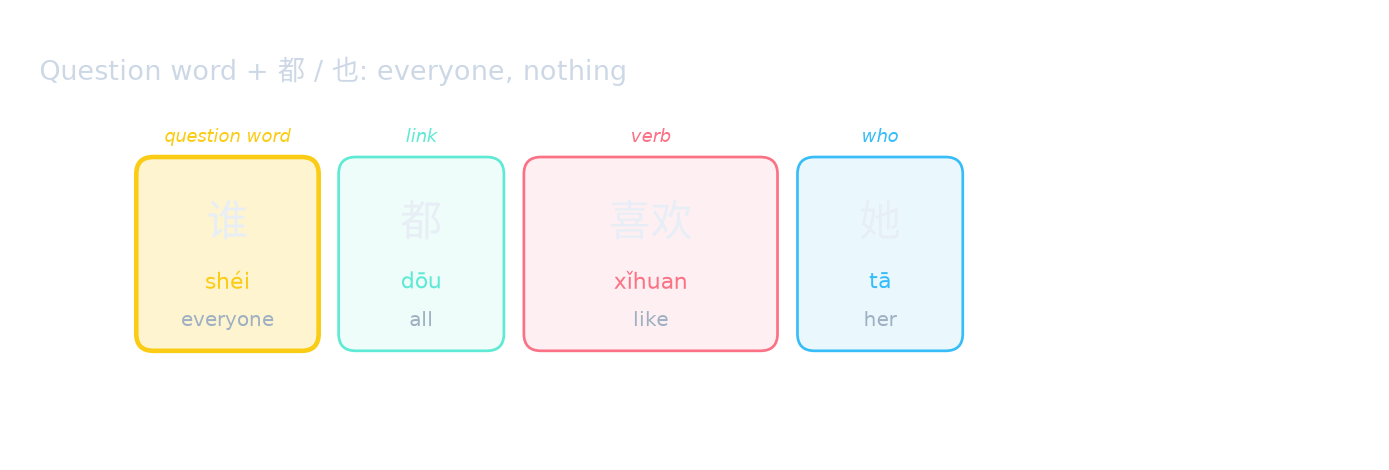
Everyone likes her
- A new teacher has just started at your school, and every student is talking about her.
- who谁all / both都to like喜欢she / her她。 — "Everyone likes her."
Question word + all / both都 / also也
- QW + all / both都 + Verb = every-, any-: who谁all / both都 (everyone), what什么all / both都 (everything), where哪儿all / both都 (everywhere).
- The question word goes before all / both都 and the verb, not after the verb.
I我anything什么all都eat吃。
With not不 / not / haven't没: nobody, nothing, nowhere
- he / him他what什么also也not / haven't没variant of 说说。 — "He didn't say anything."
- weekend周末I / me我where哪儿all / both都unexpectedly不想to go去。 — "I don't want to go anywhere this weekend."
he他anything什么(at all)也not没say说。
Word order
- The QW moves before all / both都 / also也: I / me我what什么all / both都variant of 吃吃, not I / me我variant of 吃吃what什么all / both都.
- In the negative, also也 and all / both都 both work: what什么also也unexpectedly不想variant of 吃吃 / what什么all / both都unexpectedly不想variant of 吃吃.
With a noun: which哪 + MW + Noun + all / both都
- which哪个 / which哪to plant种 + noun + all / both都 = any of them: which哪个vegetable菜all / both都to be fond of eating好吃 — "Every dish is delicious."
- what什么time时候all / both都can / may可以 — "Any time is fine."
every哪个dish菜all都delicious好吃。
Recap
- QW + all / both都 + Verb = every-/any-: who谁all / both都, what什么all / both都, where哪儿all / both都, what什么time时候all / both都.
- QW + also也/all / both都 + not不/not / haven't没 = no-one, nothing, nowhere. The QW comes before all / both都.
Practise this pattern step by step.
more and more越来越 (more and more)
The city keeps changing
- You go back to your hometown after five years: more cars, more tall buildings, more people.
- I / me我(modifier / structural particle)的hometown家乡more and more越来越pretty漂亮(completed / change)了。 — "My hometown is getting more and more beautiful."
more and more越来越 + Adjective
- Subject + more and more越来越 + Adj (+ (completed / change)了) = "more and more …": a quality keeps growing over time.
- (completed / change)了 at the end is common because the sentence reports a change: weather天气more and more越来越cold冷(completed / change)了。
the weather天气more and more越来越cold冷了。

Feelings and abilities that grow
- Feeling verbs fit too: I / me我more and more越来越to like喜欢this这个city城市(completed / change)了。 — "I like this city more and more."
- So do verbs of ability with an object: he / him他more and more越来越can / will会to prepare a meal做饭(completed / change)了。 — "He is getting better and better at cooking."
I我more and more越来越like喜欢this这个city城市了。
One degree word only
- No degree / adjective linker很 or very非常 after more and more越来越: more and more越来越good好, not more and more越来越degree / adjective linker很good好.
- more and more越来越 comes after the subject and before the adjective: he / him他more and more越来越high高, not more and more越来越he / him他high高.
more and more越来越 versus to exceed越…to exceed越…
- more and more越来越 has one quality that grows with time.
- to exceed越 A to exceed越 B links two things: the more A, the more B: 雨越down下to exceed越see 大夫大 — "The rain is getting heavier and heavier (the longer it rains)."
the rain雨the more越falls下the more越heavy大。
Recap
- more and more越来越 + Adj (+ (completed / change)了) = more and more …, a change over time.
- Bare adjective after it, no degree / adjective linker很; feeling verbs such as to like喜欢 also work.
Practise this pattern step by step.
Question words as “some- / any-”
Do you want anything?
- Your friend is going to the shop and offers to bring something back for you.
- you你want / will / need要买点儿what什么(yes/no ?)吗? — "Do you want to buy anything?" Here what什么 means "anything", not "what".
Question word + (yes/no ?)吗 = something / anything
- In a (yes/no ?)吗 question, a question word becomes indefinite: what什么 = anything, who谁 = anyone, where哪儿 = anywhere.
- you你to go去where哪儿(completed / change)了(yes/no ?)吗? — "Did you go anywhere?" (compare you你to go去where哪儿(completed / change)了? — "Where did you go?")
you你want想eat吃anything什么吗?

In negatives and guesses
- I / me我unexpectedly不想variant of 吃吃what什么。 — "I don't really want to eat anything."
- With as if好像 or maybe / possible可能: he / him他as if好像to have / there is有what什么matter事。 — "He seems to have something on his mind."
he他seems好像have有something什么matter事。
(yes/no ?)吗 changes the meaning
- you你to buy买what什么? asks "What are you buying?"; you你to buy买what什么(yes/no ?)吗? asks "Are you buying anything?"
- not不 + Verb + what什么 is a mild "not much / nothing in particular", weaker than what什么all / both都not不.
Versus QW + all / both都
- I / me我what什么all / both都unexpectedly不想variant of 吃吃 = "I don't want to eat anything at all" (total).
- I / me我unexpectedly不想variant of 吃吃what什么 = "I don't feel like eating anything in particular" (softer).
I我anything什么(at all)都not不want想eat吃。
Recap
- In (yes/no ?)吗 questions, negatives and guesses, a QW = some-/any-: what什么 = anything, who谁 = anyone.
- not不 + V + what什么 is soft; what什么all / both都not不 is total.
Practise this pattern step by step.
in order to为了 (in order to / for the sake of)
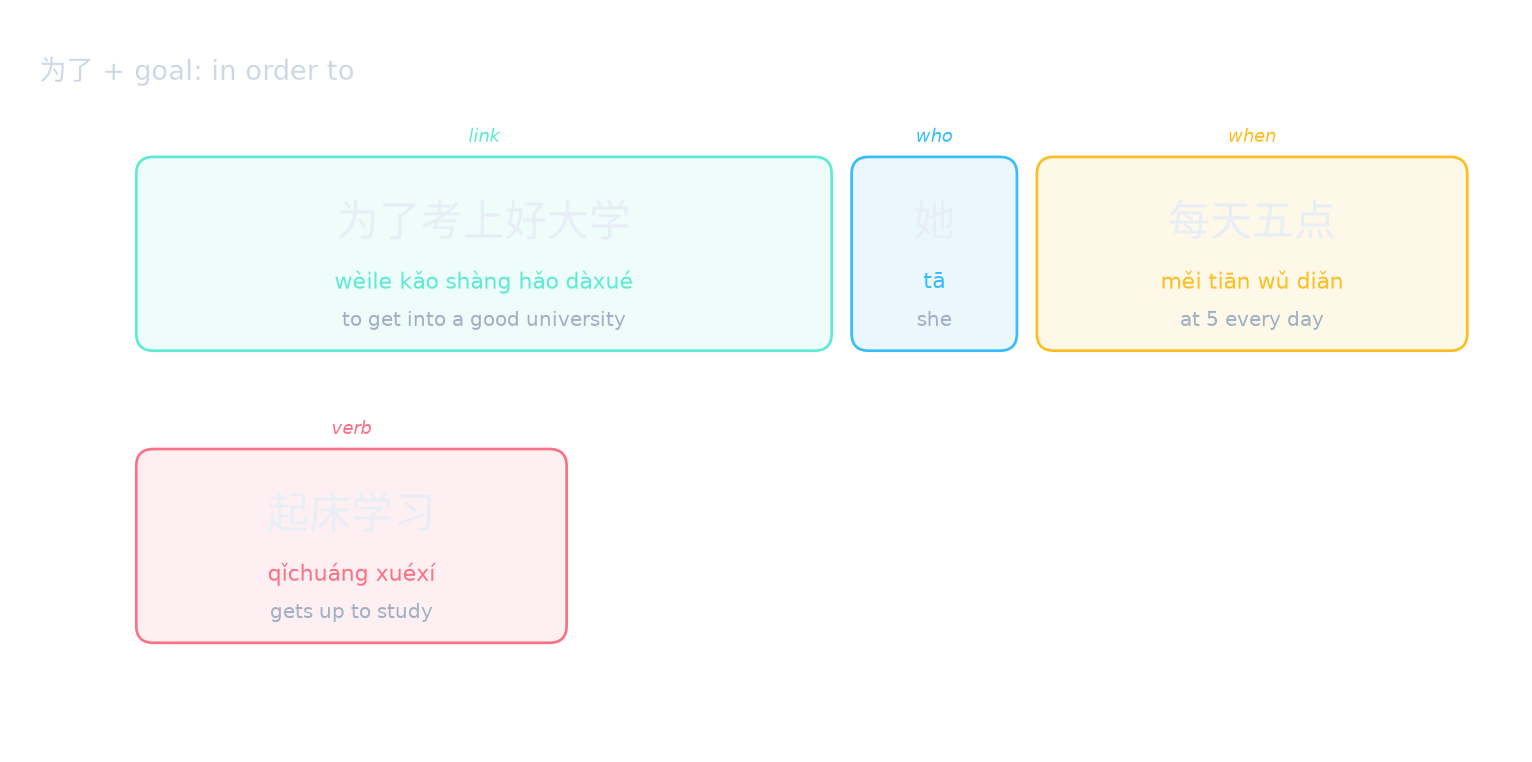
Why so early?
- Your roommate gets up at five every morning during the exam season.
- in order to为了to pass a university…考上good好university大学,she / her她every day每天五点to get out of bed起床to learn学习。 — "In order to get into a good university, she gets up at five every day to study."
in order to为了 + goal,action
- in order to为了 + goal = "in order to, for the sake of"; it usually starts the sentence, then the action follows.
- The goal can be a verb phrase or a noun: in order to为了health健康, in order to为了child孩子.
for为了health健康,he他every day每天runs跑步。
to be / is是in order to为了 to explain a reason
- 我学Chinese language中文to be / is是in order to为了to go去China中国to work工作。 — "I'm learning Chinese so that I can work in China."
- to be / is是in order to为了 comes after the action and states the purpose.
I我learn学Chinese中文is是in order to为了go to去China中国work工作。
Purpose, not cause
- in order to为了 gives a goal; for a cause, use because因为: because因为to rain下雨,I / me我not / haven't没to go去, not in order to为了to rain下雨.
- In careful speech, put in order to为了 first or use to be / is是in order to为了 after the action: he / him他every day每天to run跑步to be / is是in order to为了health健康.
in order to为了 versus because因为
- in order to为了 looks forward to a goal: in order to为了to save money省钱,I / me我oneself自己to prepare a meal做饭 — "To save money, I cook myself."
- because因为 looks back at a cause: because因为not / haven't没coin钱,I / me我oneself自己to prepare a meal做饭 — "Because I have no money, I cook myself."
because因为have no没money钱,I我myself自己cook做饭。
Recap
- in order to为了 + goal,action = in order to …; action + to be / is是in order to为了 + goal explains the purpose.
- in order to为了 = a goal ahead; because因为 = a cause behind.
Practise this pattern step by step.
Practice without the models
Place + Verb + (ongoing -ing)着 + Noun (existential)
0605.1 Complete: “There's a cat lying on the bed.” 床上to recline躺…………一只cat猫。
0605.2 Which sentence is correct?
- A. 墙上to hang or suspend (from a…挂(ongoing -ing)着一张to draw画。
- B. 墙上to hang or suspend (from a…挂一张to draw画(ongoing -ing)着。
- C. 一张画挂(ongoing -ing)着墙上。
- D. at / in在墙上to hang or suspend (from a…挂(ongoing -ing)着一张to draw画。
0605.3 Build: “There are lots of people standing at the door.”
Arrange all chunks: 很多 / station站(ongoing -ing)着 / doorway门口 / person人。
0605.4 墙上to hang or suspend (from a…挂(ongoing -ing)着一张map地图 says how the map is there, not only that it exists.
True or false? Explain or repair the statement.
0605.5 You are writing to a friend about your new flat and want to say what is in it. Close the examples. Say a Mandarin response, then write it in Chinese. Explain briefly in English what the lesson’s pattern adds. Compare with the model, then change one detail and try again.
Write or say your own response before reading the key.
want / think / miss想 + QW + then / just就 + QW (whatever you like)
0606.1 Complete: “Buy whatever you want.” you你want / think / miss想to buy买what什么then / just就to buy买…………。
0606.2 Which says “Sit wherever you like.”?
- A. you你where哪儿want / think / miss想to sit坐then / just就to sit坐。
- B. you你want / think / miss想to sit坐where哪儿then / just就to sit坐what什么。
- C. you你want / think / miss想to sit坐where哪儿then / just就to sit坐where哪儿(yes/no ?)吗?
- D. you你want / think / miss想to sit坐where哪儿then / just就to sit坐where哪儿。
0606.3 Build: “Whoever wants to go can go.”
Arrange all chunks: who谁 / to go去。 / who谁 / want / think / miss想to go去
0606.4 want / think / miss想to buy买how many / how much多少then / just就to buy买how many / how much多少 means “buy as many as you want”.
True or false? Explain or repair the statement.
0606.5 You take a visiting friend to dinner and want her to order anything she likes. Close the examples. Say a Mandarin response, then write it in Chinese. Explain briefly in English what the lesson’s pattern adds. Compare with the model, then change one detail and try again.
Write or say your own response before reading the key.
Question Word + all / both都 (every / all)
0607.1 Complete: “Everyone knows him.” who谁…………to know认识he / him他。
0607.2 Which says “I don't want to eat anything.”?
- A. what什么I / me我unexpectedly不想all / both都variant of 吃吃。
- B. I / me我unexpectedly不想variant of 吃吃what什么all / both都。
- C. I / me我all / both都what什么unexpectedly不想variant of 吃吃。
- D. I / me我what什么all / both都unexpectedly不想variant of 吃吃。
0607.3 Build: “He didn't say anything.”
Arrange all chunks: variant of 说说。 / what什么 / also也not / haven't没 / he / him他
0607.4 which哪个vegetable菜all / both都to be fond of eating好吃 means “every dish is delicious”.
True or false? Explain or repair the statement.
0607.5 A new teacher has just started at your school, and every student is talking about her. Close the examples. Say a Mandarin response, then write it in Chinese. Explain briefly in English what the lesson’s pattern adds. Compare with the model, then change one detail and try again.
Write or say your own response before reading the key.
more and more越来越 (more and more)
0110.1 Complete: “Your Chinese is getting better and better.” you你(modifier / structural particle)的Chinese language中文…………good好(completed / change)了。
0110.2 Which sentence is correct?
- A. thing东西degree / adjective linker很more and more越来越expensive贵(completed / change)了。
- B. thing东西more and more越来越expensive贵(completed / change)了。
- C. more and more越来越thing东西expensive贵(completed / change)了。
- D. thing东西more and more越来越degree / adjective linker很expensive贵(completed / change)了。
0110.3 Build: “I like this city more and more.”
Arrange all chunks: this这个city城市(completed / change)了。 / more and more越来越 / I / me我 / to like喜欢
0110.4 more and more越来越 links two different things, as in “the more you practise, the better you get.”
True or false? Explain or repair the statement.
0110.5 You go back to your hometown after five years: more cars, more tall buildings, more people. Close the examples. Say a Mandarin response, then write it in Chinese. Explain briefly in English what the lesson’s pattern adds. Compare with the model, then change one detail and try again.
Write or say your own response before reading the key.
Question words as “some- / any-”
0608.1 What does you你weekend周末to go去where哪儿(completed / change)了(yes/no ?)吗? mean?
- A. Did you go anywhere at the weekend?
- B. You went everywhere at the weekend.
- C. Why didn't you go out at the weekend?
- D. Where did you go at the weekend?
0608.2 Complete: “Did anyone call me?” to have / there is有…………to / for / give给I / me我to make a telephone call打电话(yes/no ?)吗?
0608.3 Build: “Do you want to eat anything?”
Arrange all chunks: what什么 / want / think / miss想variant of 吃吃 / you你 / (yes/no ?)吗?
0608.4 I / me我unexpectedly不想variant of 吃吃what什么 is stronger than I / me我what什么all / both都unexpectedly不想variant of 吃吃.
True or false? Explain or repair the statement.
0608.5 Your friend is going to the shop and offers to bring something back for you. Close the examples. Say a Mandarin response, then write it in Chinese. Explain briefly in English what the lesson’s pattern adds. Compare with the model, then change one detail and try again.
Write or say your own response before reading the key.
in order to为了 (in order to / for the sake of)
0609.1 Complete: “To save money, I cook myself.” …………to save money省钱,I / me我oneself自己to prepare a meal做饭。
0609.2 Which word fits? “Because it rained, the match was cancelled.” ____to rain下雨,competition (sports etc)比赛to cancel取消(completed / change)了。
- A. so / therefore所以
- B. to be / is是in order to为了
- C. because因为
- D. in order to为了
0609.3 Build: “I'm learning Chinese so that I can work in China.”
Arrange all chunks: to work工作。 / to go去China中国 / 我学Chinese language中文 / to be / is是in order to为了
0609.4 in order to为了 looks forward to a goal, because因为 looks back at a cause.
True or false? Explain or repair the statement.
0609.5 Your roommate gets up at five every morning during the exam season. Close the examples. Say a Mandarin response, then write it in Chinese. Explain briefly in English what the lesson’s pattern adds. Compare with the model, then change one detail and try again.
Write or say your own response before reading the key.
Answers and explanations
Place + Verb + (ongoing -ing)着 + Noun (existential)
0605.1 (ongoing -ing)着
Place + Verb + (ongoing -ing)着 + noun.
0605.2 A. 墙上to hang or suspend (from a…挂(ongoing -ing)着一张to draw画。
The place starts the sentence, without at / in在.
0605.3 doorway门口station站(ongoing -ing)着很多person人。
Place + Verb + (ongoing -ing)着 + noun.
0605.4 True.
to hang or suspend (from a…挂(ongoing -ing)着 shows it is hanging; to have / there is有 would only say it exists.
0605.5 One possible response: 墙上to hang or suspend (from a…挂(ongoing -ing)着一张map地图。
Check meaning and form:
- My response conveys a message that fits the opening situation.
- I can explain the meaning of the pattern, rather than only naming it.
- Do not start with at / in在: 墙上to hang or suspend (from a…挂(ongoing -ing)着一张to draw画, not at / in在墙上to hang or suspend (from a…挂(ongoing -ing)着一张to draw画.
- The noun is usually new and unspecific (一张, 很多): table桌子上放(ongoing -ing)着one / a一本书, not table桌子上放(ongoing -ing)着那本书.
- I tried a second response with a name, time, place, or description changed.
This is supported productive practice. Compare meaning and structure; your answer need not copy the model. A partner or teacher must hear the spoken response to comment on pronunciation.
want / think / miss想 + QW + then / just就 + QW (whatever you like)
0606.1 what什么
The same question word repeats.
0606.2 D. you你want / think / miss想to sit坐where哪儿then / just就to sit坐where哪儿。
want / think / miss想 + V + where哪儿,then / just就 + V + where哪儿, as a statement.
0606.3 who谁want / think / miss想to go去who谁to go去。
QW + want / think / miss想 + V, QW + V.
0606.4 True.
how many / how much多少 repeats: as much/many as you want.
0606.5 One possible response: you你want / think / miss想variant of 吃吃what什么then / just就variant of 吃吃what什么。
Check meaning and form:
- My response conveys a message that fits the opening situation.
- I can explain the meaning of the pattern, rather than only naming it.
- Use the same question word in both halves: want / think / miss想variant of 吃吃what什么then / just就variant of 吃吃what什么, not want / think / miss想variant of 吃吃what什么then / just就variant of 吃吃which哪个.
- This is a statement, not a question: no (yes/no ?)吗 and no question mark.
- I tried a second response with a name, time, place, or description changed.
This is supported productive practice. Compare meaning and structure; your answer need not copy the model. A partner or teacher must hear the spoken response to comment on pronunciation.
Question Word + all / both都 (every / all)
0607.1 all / both都
QW + all / both都 + verb = every-.
0607.2 D. I / me我what什么all / both都unexpectedly不想variant of 吃吃。
QW + all / both都 + not不 + verb.
0607.3 he / him他what什么also也not / haven't没variant of 说说。
Subject + QW + also也 + not / haven't没 + verb.
0607.4 True.
which哪个 + noun + all / both都 = any/every one of them.
0607.5 One possible response: who谁all / both都to like喜欢she / her她。
Check meaning and form:
- My response conveys a message that fits the opening situation.
- I can explain the meaning of the pattern, rather than only naming it.
- The QW moves before all / both都 / also也: I / me我what什么all / both都variant of 吃吃, not I / me我variant of 吃吃what什么all / both都.
- In the negative, also也 and all / both都 both work: what什么also也unexpectedly不想variant of 吃吃 / what什么all / both都unexpectedly不想variant of 吃吃.
- I tried a second response with a name, time, place, or description changed.
This is supported productive practice. Compare meaning and structure; your answer need not copy the model. A partner or teacher must hear the spoken response to comment on pronunciation.
more and more越来越 (more and more)
0110.1 more and more越来越
more and more越来越 + Adj + (completed / change)了 reports a growing change.
0110.2 B. thing东西more and more越来越expensive贵(completed / change)了。
thing东西more and more越来越expensive贵(completed / change)了 is right: more and more越来越 goes after the subject and takes a bare adjective. Adding degree / adjective linker很 (more and more越来越degree / adjective linker很expensive贵, degree / adjective linker很more and more越来越expensive贵) is wrong, and more and more越来越 cannot come before the subject.
0110.3 I / me我more and more越来越to like喜欢this这个city城市(completed / change)了。
Subject + more and more越来越 + feeling verb + object + (completed / change)了.
0110.4 False.
That is to exceed越 A to exceed越 B. more and more越来越 has one quality that grows over time.
0110.5 One possible response: I / me我(modifier / structural particle)的hometown家乡more and more越来越pretty漂亮(completed / change)了。
Check meaning and form:
- My response conveys a message that fits the opening situation.
- I can explain the meaning of the pattern, rather than only naming it.
- No degree / adjective linker很 or very非常 after more and more越来越: more and more越来越good好, not more and more越来越degree / adjective linker很good好.
- more and more越来越 comes after the subject and before the adjective: he / him他more and more越来越high高, not more and more越来越he / him他high高.
- I tried a second response with a name, time, place, or description changed.
This is supported productive practice. Compare meaning and structure; your answer need not copy the model. A partner or teacher must hear the spoken response to comment on pronunciation.
Question words as “some- / any-”
0608.1 A. Did you go anywhere at the weekend?
With (yes/no ?)吗, where哪儿 becomes “anywhere”.
0608.2 who谁
In a (yes/no ?)吗 question, who谁 = anyone (someone有人 also works).
0608.3 you你want / think / miss想variant of 吃吃what什么(yes/no ?)吗?
QW + (yes/no ?)吗 = anything?
0608.4 False.
what什么all / both都not不 is the total negative; not不…what什么 is softer.
0608.5 One possible response: you你want / will / need要买点儿what什么(yes/no ?)吗?
Check meaning and form:
- My response conveys a message that fits the opening situation.
- I can explain the meaning of the pattern, rather than only naming it.
- you你to buy买what什么? asks "What are you buying?"; you你to buy买what什么(yes/no ?)吗? asks "Are you buying anything?"
- not不 + Verb + what什么 is a mild "not much / nothing in particular", weaker than what什么all / both都not不.
- I tried a second response with a name, time, place, or description changed.
This is supported productive practice. Compare meaning and structure; your answer need not copy the model. A partner or teacher must hear the spoken response to comment on pronunciation.
in order to为了 (in order to / for the sake of)
0609.1 in order to为了
in order to为了 + goal, then the action.
0609.2 C. because因为
Rain is a cause, not a goal, so because因为.
0609.3 我学Chinese language中文to be / is是in order to为了to go去China中国to work工作。
Action + to be / is是in order to为了 + goal.
0609.4 True.
That is the key difference.
0609.5 One possible response: in order to为了to pass a university…考上good好university大学,she / her她every day每天五点to get out of bed起床to learn学习。
Check meaning and form:
- My response conveys a message that fits the opening situation.
- I can explain the meaning of the pattern, rather than only naming it.
- in order to为了 gives a goal; for a cause, use because因为: because因为to rain下雨,I / me我not / haven't没to go去, not in order to为了to rain下雨.
- In careful speech, put in order to为了 first or use to be / is是in order to为了 after the action: he / him他every day每天to run跑步to be / is是in order to为了health健康.
- I tried a second response with a name, time, place, or description changed.
This is supported productive practice. Compare meaning and structure; your answer need not copy the model. A partner or teacher must hear the spoken response to comment on pronunciation.