Skip to content · ⁨コンテンツへスキップ⁩

Kinematics · ⁨運動学⁩

AP Physics C: Mechanics · ⁨AP物理学C:力学⁩ · Topic 1 · ⁨トピック 1⁩

View Slides · ⁨查看幻灯片⁩ Train · ⁨練習する⁩
Video lesson for this topic · ⁨このトピックのビデオレッスン⁩ Open the video page · ⁨動画ページを開く⁩
7:31

運動学

ロケットが発進する。毎秒、エンジンがより強く燃焼するため、加速度は増し続ける。最初の…

English narration · English + 中文 subtitles burned in · ⁨英語ナレーション・英語+中文字幕 burning-in⁩

1.1

Scalars and Vectors · ⁨スカラーとベクトル⁩

Syllabus · ⁨シラバス⁩
English

Learning Objective 1.1.A: Describe a scalar or vector quantity using magnitude and direction, as appropriate.

  • 1.1.A.1 Scalars are quantities described by magnitude only; vectors are quantities described by both magnitude and direction.
  • 1.1.A.2 Vectors can be visually modeled as arrows with appropriate direction and lengths proportional to their magnitude.
  • 1.1.A.3 Distance and speed are examples of scalar quantities, while position, displacement, velocity, and acceleration are examples of vector quantities.
  • 1.1.A.4 Vectors can be expressed in unit vector notation or as a magnitude and a direction.
    • 1.1.A.4.i Unit vector notation can be used to represent vectors as the sum of their constituent components in the $x$-, $y$-, and $z$-directions, denoted by $\hat{i}$, $\hat{j}$, and $\hat{k}$, respectively.
      • Equation: $\vec{r} = \left( A\hat{i} + B\hat{j} + C\hat{k} \right)$
    • 1.1.A.4.ii The position vector of a point is given by $\vec{r}$, and the unit vector in the direction of the position vector is denoted $\hat{r}$.
    • 1.1.A.4.iii A resultant vector is the vector sum of the addend vectors' components.
      • Equation: $\vec{C} = \vec{A} + \vec{B}$
      • Equation: $\vec{C} = \left( A_x + B_x \right)\hat{i} + \left( A_y + B_y \right)\hat{j}$
  • 1.1.A.5 In a given one-dimensional coordinate system, opposite directions are denoted by opposite signs.
日本語

学習目標 1.1.A: 適切な場合、大きさおよび方向を用いてスカラーまたはベクトルの物理量を説明する。

  • 1.1.A.1 スカラーは大きさのみで記述される物理量であり、ベクトルは大きさと方向の両方で記述される物理量である。
  • 1.1.A.2 ベクトルは、適切な方向を持ち、長さが大きさに比例した矢印として視覚的にモデル化できる。
  • 1.1.A.3 距離と速さはスカラーの例であり、位置、変位、速度、加速度はベクトルの例である。
  • 1.1.A.4 ベクトルは単位ベクトル表記法、あるいは大きさ・方向として表現できる。
    • 1.1.A.4.i 単位ベクトル表記法は、ベクトルを $x$-, $y$-, $z$-方向への構成要素の和として表すのに使用でき、それぞれ $\hat{i}$, $\hat{j}$, $\hat{k}$ で表される。
      • 数式: $\vec{r} = \left( A\hat{i} + B\hat{j} + C\hat{k} \right)$
    • 1.1.A.4.ii 点の位置ベクトルは $\vec{r}$ で与えられ、位置ベクトルの方向の単位ベクトルは $\hat{r}$ で表される。
    • 1.1.A.4.iii 合成ベクトルは、加算ベクトルの成分の和である。
      • 数式: $\vec{C} = \vec{A} + \vec{B}$
      • 数式: $\vec{C} = \left( A_x + B_x \right)\hat{i} + \left( A_y + B_y \right)\hat{j}$
  • 1.1.A.5 与えられた一次元の座標系において、反対方向は反対符号で表される。
Source: College Board AP Course and Exam Description · ⁨出典: College Board AP コースおよび試験説明書⁩

English

Kinematics 运动学 describes motion. Two kinds of quantity:

  • A scalar 标量 has only size (magnitude 大小): distance, speed, mass, time.
  • A vector 矢量 has magnitude and direction: displacement, velocity, acceleration, force.

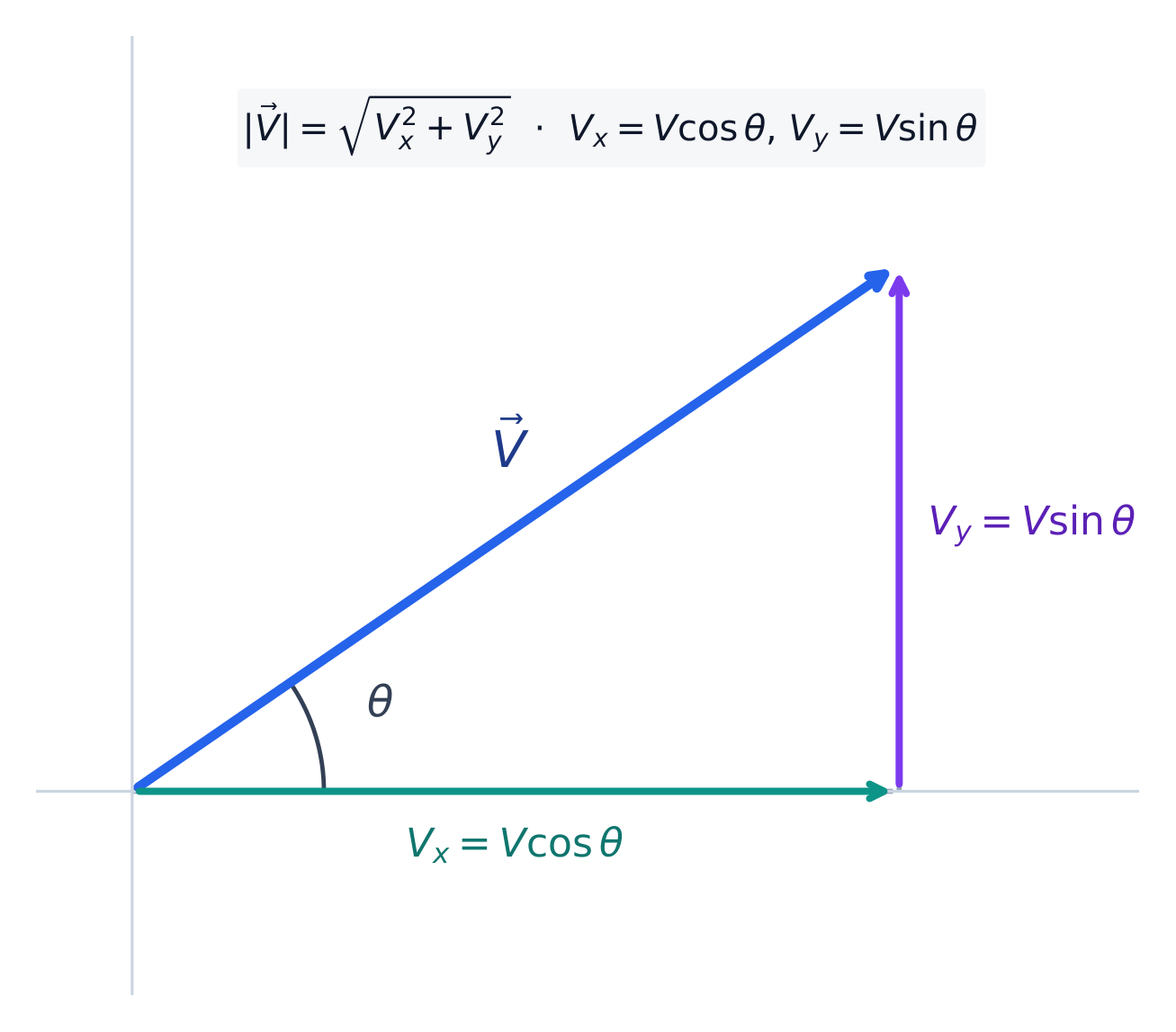
In this calculus-based course you resolve vectors into components 分量 and add them component by component; a vector's magnitude is $\sqrt{v_x^2+v_y^2+\cdots}$. Physics C also writes vectors with unit vectors 单位矢量: $\vec{v}=v_x\hat{i}+v_y\hat{j}$, where $\hat{i}$ and $\hat{j}$ are directions of length one along $x$ and $y$ – handy because calculus can then act on each component separately.

日本語

運動学は運動を記述する。2種類の物理量がある:

  • スカラーは大きさのみ(絶対値)を持ち、距離、速さ、質量、時間が該当する。
  • ベクトルは大きさと方向を持つ:変位、速度、加速度、力。

この微分積分を用いるコースでは、ベクトルを成分に分解し、成分ごとに足し算を行う;ベクトルの大きさ(magnitude)は $\sqrt{v_x^2+v_y^2+\cdots}$ である。Physics C ではまた、単位ベクトルを用いてベクトルを表す:$\vec{v}=v_x\hat{i}+v_y\hat{j}$ 、ここで $\hat{i}$ と $\hat{j}$ は ⟨$x$⟩ と ⟨$y$⟩ 方向の長さ1の方向を示す – これにより、微分積分を各成分に対して個別に行うことができるので便利である。

ベクトルをx成分とy成分に分解する図
ベクトルをx成分とy成分に分解する
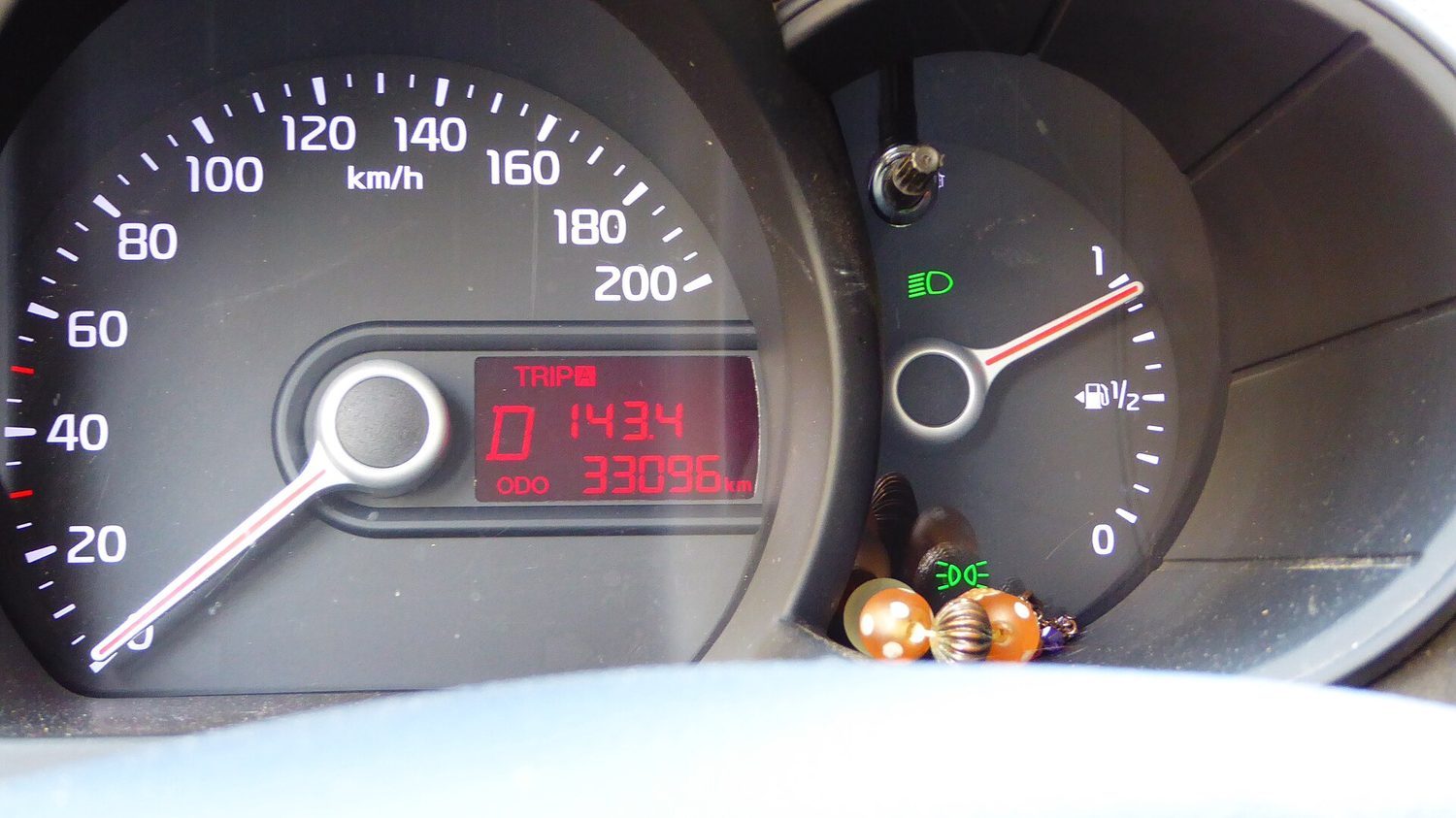
自動車のスピードメーター:速さは速度の大きさ(スカラー)である — 運動のスカラー率
Explore · ⁨探索⁩

Explore the dot product · ⁨内積を調べる⁩

Drag the components of $\vec{A}$ and $\vec{B}$. The dot product $\vec{A}\cdot\vec{B}=A_xB_x+A_yB_y$ reaches zero exactly when the two vectors are perpendicular — the geometry behind $\cos\theta$. · ⁨$\vec{A}$と$\vec{B}$の成分をドラッグする。内積$\vec{A}\cdot\vec{B}=A_xB_x+A_yB_y$が零になるのは、2つのベクトルが直交した時だけである。これが$\cos\theta$の幾何学的意味である。⁩

Vocabulary · ⁨語彙⁩ Train · ⁨練習する⁩
English 日本語
magnitude/ˈmæɡnɪtjuːd/ 大きさ
vector/ˈvektə/ ベクトル
components/kəmˈpəʊnənts/ コンポーネント
unit vectors/ˈjuːnɪt ˈvektəz/ 単位ベクトル
derivatives/dɪˈrɪvətɪvz/ 導関数
average velocity/ˈævrɪdʒ vəˈlɒsɪti/ 平均速度
instantaneous velocity/ˌɪnstənˈteɪnɪəs vəˈlɒsɪti/ 瞬間速度
free fall/friː fɔːl/ 自由落下
reference frame/ˈrefrəns freɪm/ 座標系
relative motion/ˈrelətɪv ˈməʊʃn/ 相対運動
1.2

Displacement, Velocity, and Acceleration · ⁨変位、速度、加速度⁩

Syllabus · ⁨シラバス⁩
English

Learning Objective 1.2.A: Describe a change in an object's position.

  • 1.2.A.1 When using the object model, the size, shape, and internal configuration are ignored. The object may be treated as a single point with extensive properties such as mass and charge.
  • 1.2.A.2 Displacement is the change in an object's position.
    • Equation: $\Delta x = x - x_0$

Learning Objective 1.2.B: Describe the average velocity and acceleration of an object.

  • 1.2.B.1 Averages of velocity and acceleration are calculated considering the initial and final states of an object over an interval of time.
  • 1.2.B.2 Average velocity is the displacement of an object divided by the interval of time in which that displacement occurs.
    • Equation: $\vec{v}_{\text{avg}} = \dfrac{\Delta \vec{x}}{\Delta t}$
  • 1.2.B.3 Average acceleration is the change in velocity divided by the interval of time in which that change in velocity occurs.
    • Equation: $\vec{a}_{\text{avg}} = \dfrac{\Delta \vec{v}}{\Delta t}$
  • 1.2.B.4 An object is accelerating if either the magnitude and/or direction of the object's velocity are changing.
  • 1.2.B.5 Calculating average velocity or average acceleration over a very small time interval yields a value that is very close to the instantaneous velocity or instantaneous acceleration.

Learning Objective 1.2.C: Describe the instantaneous position, velocity, and acceleration of an object as a function of time.

  • 1.2.C.1 As the time interval used to calculate the average value of a quantity approaches zero, the average value of that quantity approaches the value of the quantity at that instant, called the instantaneous value.
    • 1.2.C.1.i Instantaneous velocity is the rate of change of the object's position, which is equal to the derivative of position with respect to time.
      • Equation: $\vec{v} = \dfrac{d\vec{r}}{dt}$
      • Equation: $v_x = \dfrac{dx}{dt}$
    • 1.2.C.1.ii Instantaneous acceleration is the rate of change of the object's velocity, which is equal to the derivative of velocity with respect to time.
      • Equation: $\vec{a} = \dfrac{d\vec{v}}{dt}$
      • Equation: $a_x = \dfrac{dv_x}{dt}$
  • 1.2.C.2 Time-dependent functions and instantaneous values of position, velocity, and acceleration can be determined using differentiation and integration.
日本語

学習目標 1.2.A: 物体の位置の変化を説明する。

  • 1.2.A.1 物体モデルを使用する場合、大きさ、形状、内部構成は無視される。物体は質量や電荷などの広延的な性質を持つ一点として扱うことができる。
  • 1.2.A.2 変位とは、物体の位置の変化のことである。
    • 式: $\Delta x = x - x_0$

学習目標 1.2.B: 物体の平均速度および平均加速度を説明する。

  • 1.2.B.1 速度および加速度の平均値は、ある時間区間における物体の初期状態と最終状態を考慮して計算される。
  • 1.2.B.2 平均速度とは、物体の変位を、その変位が生じる時間区間で割ったものである。
    • 式: $\vec{v}_{\text{avg}} = \dfrac{\Delta \vec{x}}{\Delta t}$
  • 1.2.B.3 平均加速度とは、速度の変化量を、その速度変化が生じる時間区間で割ったものである。
    • 式: $\vec{a}_{\text{avg}} = \dfrac{\Delta \vec{v}}{\Delta t}$
  • 1.2.B.4 物体の速度の大きさと/または方向が変わっている場合、その物体は加速している。
  • 1.2.B.5 非常に短い時間区間における平均速度または平均加速度を計算すると、瞬間速度または瞬間加速度に非常に近い値が得られる。

学習目標 1.2.C: 時間の関数としての物体の瞬間的な位置、速度、加速度を説明する。

  • 1.2.C.1 物理量の平均値を求める時間間隔がゼロに近づくにつれ、その物理量の平均値は、その瞬間の物理量の値である瞬間値に近づく。
    • 1.2.C.1.i 瞬間速度とは、物体の位置の変化率であり、位置を時間で微分したものに等しい。
      • 数式: $\vec{v} = \dfrac{d\vec{r}}{dt}$
      • 数式: $v_x = \dfrac{dx}{dt}$
    • 1.2.C.1.ii 瞬間加速度とは、物体の速度の変化率であり、速度を時間で微分したものに等しい。
      • 数式: $\vec{a} = \dfrac{d\vec{v}}{dt}$
      • 数式: $a_x = \dfrac{dv_x}{dt}$
  • 1.2.C.2 時間の関数としての位置、速度、加速度の瞬間値は、微分と積分を用いて求めることができる。

Source: College Board AP Course and Exam Description · ⁨出典: College Board AP コースおよび試験説明書⁩

English
Projectile motion is two independent motions

Because motion can change continuously, define the rates as derivatives 导数:

$$v=\frac{dx}{dt},\qquad a=\frac{dv}{dt}=\frac{d^2x}{dt^2}.$$
Reversing this, integrate to recover velocity and position:
$$v(t)=v_0+\int_0^t a\,dt,\qquad x(t)=x_0+\int_0^t v\,dt.$$
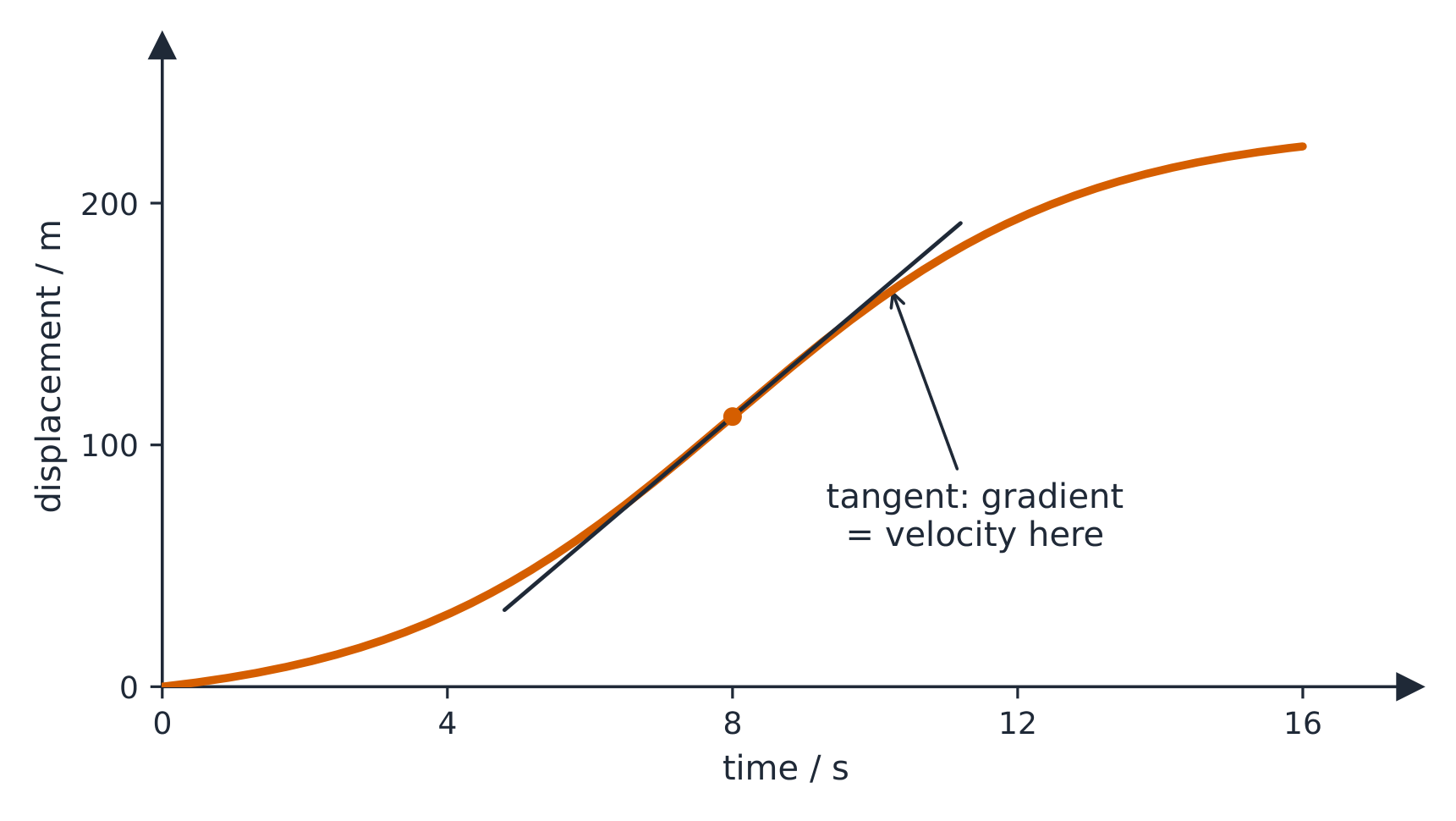
Distinguish the average from the instantaneous: average velocity 平均速度 is $\Delta x/\Delta t$ over an interval, while instantaneous velocity 瞬时速度 is the derivative at one moment – the slope of the tangent line, and what a speedometer shows.

For constant acceleration these give the familiar kinematic equations ($v=v_0+at$, $x=x_0+v_0t+\tfrac12at^2$, $v^2=v_0^2+2a\,\Delta x$). The most important constant-$a$ case is free fall 自由落体: near Earth's surface every object, heavy or light, accelerates downward at $g=9.8\ \text{m/s}^2$ once air resistance is negligible. When $a$ or $v$ varies with time, use the integrals directly.

Worked example. A particle moves with $x(t)=2t^3-3t^2$ (metres). Differentiate for velocity and acceleration:

$$v=\frac{dx}{dt}=6t^2-6t,\qquad a=\frac{dv}{dt}=12t-6.$$
At $t=2\ \text{s}$, $v=24-12=12\ \text{m/s}$ and $a=24-6=18\ \text{m/s}^2$. This calculus link – not just the constant-$a$ formulas – is what distinguishes Physics C.

Worked example. A particle starts from rest at the origin with $a(t)=6t$. Integrate: $v=\int 6t\,dt=3t^2$ and $x=\int 3t^2\,dt=t^3$. At $t=2\ \text{s}$, $v=12\ \text{m/s}$ and $x=8\ \text{m}$.

日本語
投射運動は2つの独立した運動である

運動は連続的に変化するため、変化率を導関数として定義する:

$$v=\frac{dx}{dt},\qquad a=\frac{dv}{dt}=\frac{d^2x}{dt^2}.$$
これを逆操作すると、積分によって速度と位置が復元できる:
$$v(t)=v_0+\int_0^t a\,dt,\qquad x(t)=x_0+\int_0^t v\,dt.$$
平均と瞬間を区別する:平均速度は区間$\Delta x/\Delta t$における変化率であり、瞬間速度はある一点での導関数(接線の傾き、スピードメーターが表示する値)である。

一定の加速度の場合、これらは一般的な運動学方程式($v=v_0+at$, $x=x_0+v_0t+\tfrac12at^2$, $v^2=v_0^2+2a\,\Delta x$)を与える。最も重要な一定$a$のケースは自由落下である。地球表面付近では空気抵抗が無視できる場合、重い物体も軽い物体もすべて下方へ$g=9.8\ \text{m/s}^2$の加速度で運動する。$a$または$v$が時間に依存して変化する場合、積分式をそのまま用いる。

** worked example.** 粒子が$x(t)=2t^3-3t^2$(メートル)で動く。微分して速度と加速度を求める:

$$v=\frac{dx}{dt}=6t^2-6t,\qquad a=\frac{dv}{dt}=12t-6.$$
$t=2\ \text{s}$において、$v=24-12=12\ \text{m/s}$および$a=24-6=18\ \text{m/s}^2$となる。この微積分との関連性——単なる一定$a$の公式だけでなく——がPhysics Cの特徴である。

** worked example.** 粒子が原点から静止状態で$a(t)=6t$で動き始める。積分して:$v=\int 6t\,dt=3t^2$および$x=\int 3t^2\,dt=t^3$。$t=2\ \text{s}$において、$v=12\ \text{m/s}$および$x=8\ \text{m}$となる。

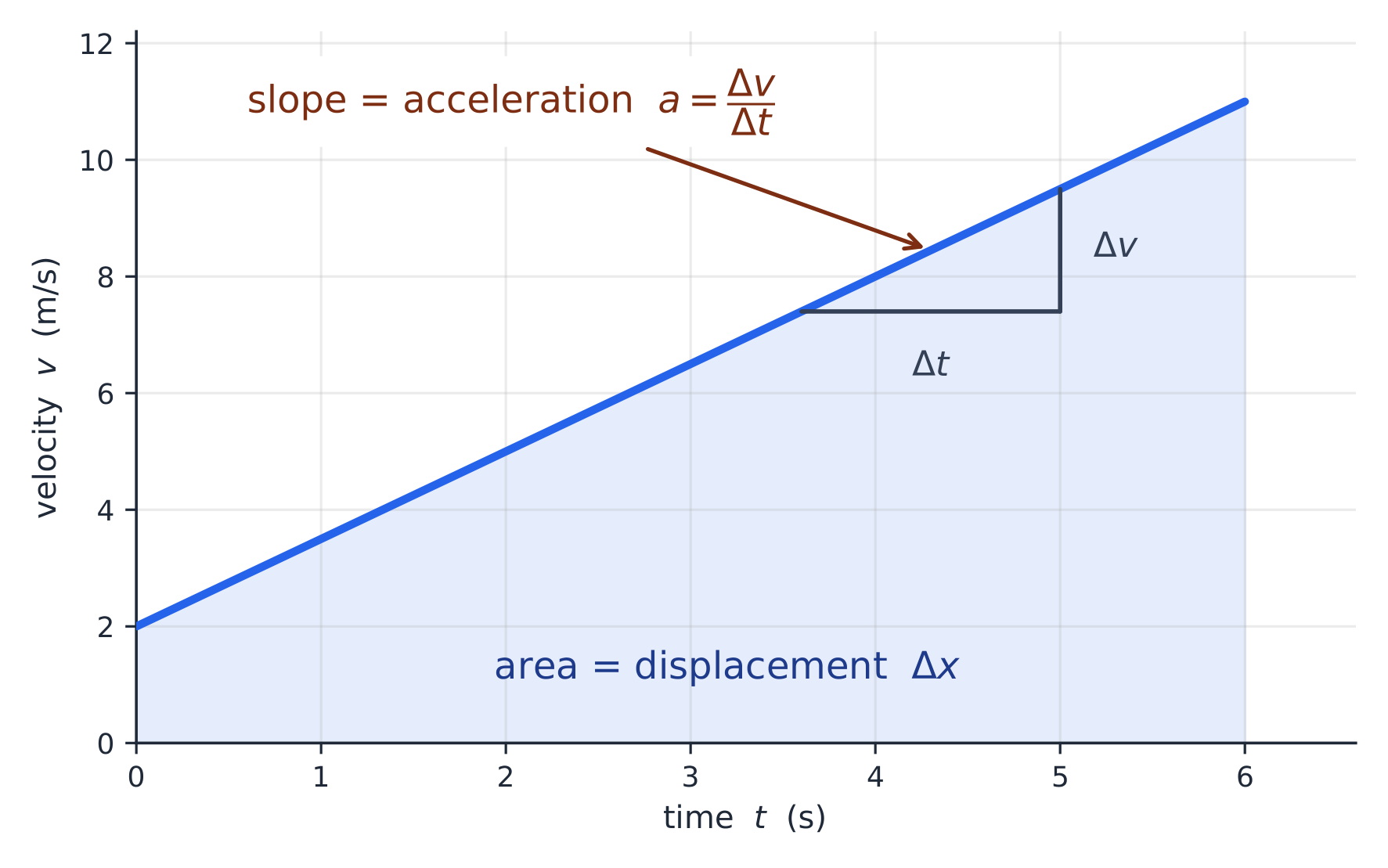
速度-時間グラフにおいて、勾配は加速度、面積は変位を表す
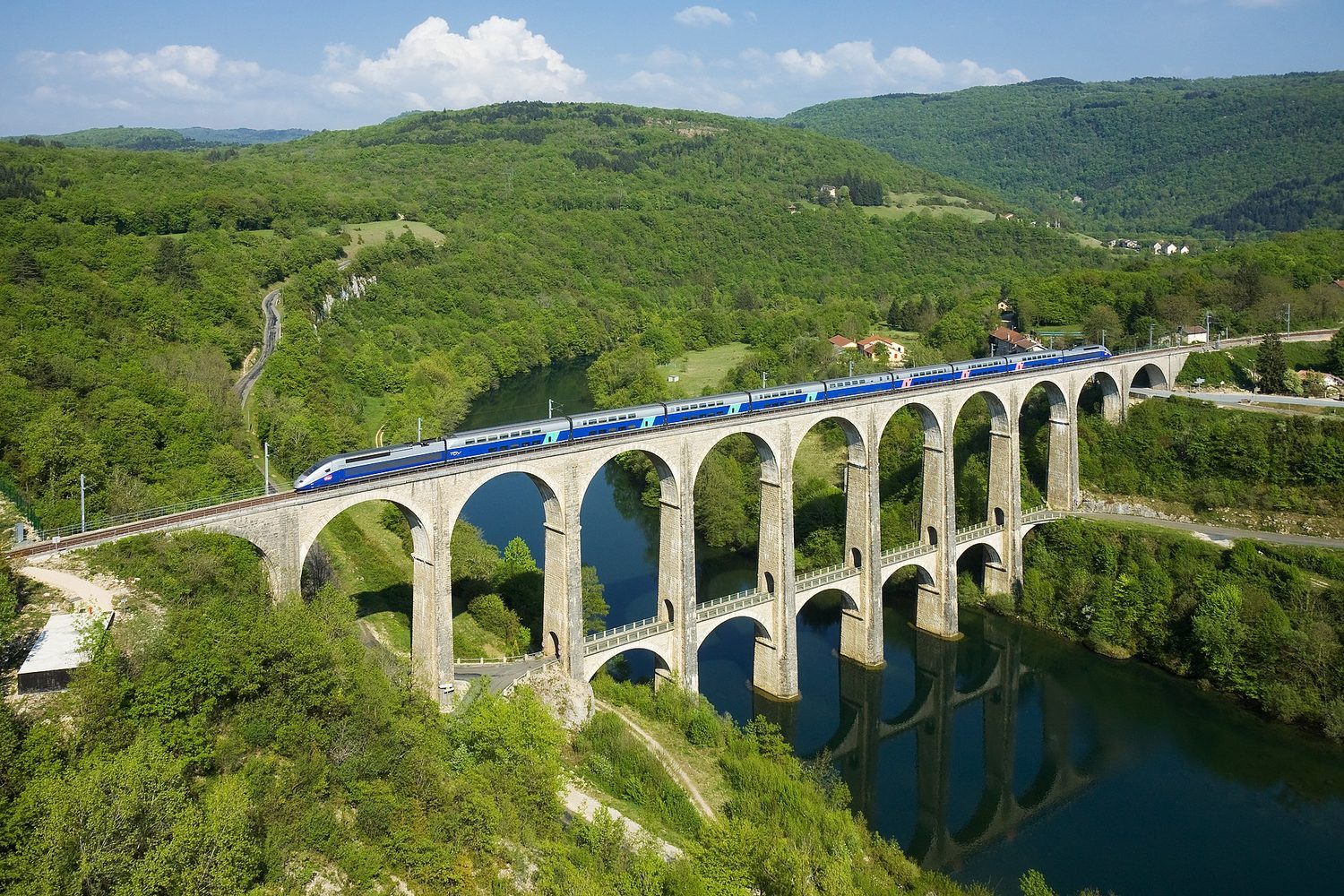
高速鉄道:運動学は時間に対する変位、速度、加速度を記述する
Vocabulary · ⁨語彙⁩ Train · ⁨練習する⁩
English 日本語
Kinematics/ˌkɪnɪˈmætɪks/ 運動学
scalar/ˈskeɪlə/ スカラー
1.3

Representing Motion · ⁨運動の表現⁩

Syllabus · ⁨シラバス⁩
English

Learning Objective 1.3.A: Describe the position, velocity, and acceleration of an object using representations of that object's motion.

  • 1.3.A.1 Motion can be represented by motion diagrams, figures, graphs, equations, and narrative descriptions.
  • 1.3.A.2 For constant acceleration, three kinematic equations can be used to describe instantaneous linear motion in one dimension:
    • Equation: $v_x = v_{x0} + a_x t$
    • Equation: $x = x_0 + v_{x0} t + \dfrac{1}{2} a_x t^2$
    • Equation: $v_x^2 = v_{x0}^2 + 2a_x \left( x - x_0 \right)$
    • Note: The equations above are written to indicate motion in the $x$-direction, but these equations can be used in any single dimension as appropriate.
  • 1.3.A.3 Near the surface of Earth, the vertical acceleration caused by the force of gravity is downward, constant, and has a measured value approximately equal to
    • Equation: $a_g = g \approx 10 \ \text{m/s}^2$.
  • 1.3.A.4 Graphs of position, velocity, and acceleration as functions of time can be used to find the relationships between those quantities.
    • 1.3.A.4.i An object's instantaneous velocity is the rate of change of the object's position, which is equal to the slope of a line tangent to a point on a graph of the object's position as a function of time.
      • Equation: $v_x = \dfrac{dx}{dt}$
    • 1.3.A.4.ii An object's instantaneous acceleration is the rate of change of the object's velocity, which is equal to the slope of a line tangent to a point on a graph of the object's velocity as a function of time.
      • Equation: $a_x = \dfrac{dv_x}{dt}$
    • 1.3.A.4.iii The displacement of an object during a time interval is equal to the area under the curve of a graph of the object's velocity as a function of time (i.e., the area bounded by the function and the horizontal axis for the appropriate interval).
      • Equation: $\Delta x = \displaystyle\int_{t_1}^{t_2} v_x(t) \ dt$
    • 1.3.A.4.iv The change in velocity of an object during a time interval is equal to the area under the curve of a graph of the acceleration of the object as a function of time.
      • Equation: $\Delta v_x = \displaystyle\int_{t_1}^{t_2} a_x(t) \ dt$

Boundary statement: AP Physics C: Mechanics and AP Physics C: Electricity and Magnetism expects that for all situations in which a numerical quantity is required for g, the value $g \approx 10 \ \text{m/s}^2$ will be used. However, students will not be penalized for correctly using the more precise commonly accepted values of $g = 9.81 \ \text{m/s}^2$ or $g = 9.8 \ \text{m/s}^2$.

日本語

学習目標 1.3.A: 物体の運動の表現を用いて、物体の位置、速度、加速度を説明する。

  • 1.3.A.1 運動は、運動図、図、グラフ、数式、および物語による記述で表現できる。
  • 1.3.A.2 一定加速度の場合、一次元の瞬間的な直線運動を記述するために3つの運動方程式可以使用する:
    • 式: $v_x = v_{x0} + a_x t$
    • 式: $x = x_0 + v_{x0} t + \dfrac{1}{2} a_x t^2$
    • 式: $v_x^2 = v_{x0}^2 + 2a_x \left( x - x_0 \right)$
    • 注記:上記の式は $x$ 方向への運動を示すために書かれているが、適切な単一次元での運動にも使用できる。
  • 1.3.A.3 地球表面付近では、重力による垂直方向の加速度は下向きであり一定で、測定値は約以下に等しい
    • 式: $a_g = g \approx 10 \ \text{m/s}^2$。
  • 1.3.A.4 位置、速度、加速度を時間の関数として表したグラフを用いて、それらの物理量の間の関係を見つけることができる。
    • 1.3.A.4.i 物体の瞬間速度とは、物体の位置の変化率であり、これは時刻を関数とする物体の位置のグラフ上の点に接する直線の傾きに等しい。
      • 数式: $v_x = \dfrac{dx}{dt}$
    • 1.3.A.4.ii 物体の瞬間加速度とは、物体の速度の変化率であり、これは時刻を関数とする物体の速度のグラフ上の点に接する直線の傾きに等しい。
      • 数式: $a_x = \dfrac{dv_x}{dt}$
    • 1.3.A.4.iii 時間区間における物体の変位は、時刻を関数とする物体の速度のグラフの曲线下の面積に等しい(すなわち、適正な区間における関数と水平軸で囲まれた面積)。
      • 数式: $\Delta x = \displaystyle\int_{t_1}^{t_2} v_x(t) \ dt$
    • 1.3.A.4.iv 時間区間における物体の速度の変化量は、時刻を関数とする物体の加速度のグラフの曲线下の面積に等しい。
      • 数式: $\Delta v_x = \displaystyle\int_{t_1}^{t_2} a_x(t) \ dt$

境界文:AP Physics C: Mechanics および AP Physics C: Electricity and Magnetism では、g の数値量が必要なすべての状況において、値 $g \approx 10 \ \text{m/s}^2$ が用いられることを期待している。しかし、学生がより精密な一般的に受け入れられている値 $g = 9.81 \ \text{m/s}^2$ や $g = 9.8 \ \text{m/s}^2$ を正しく使用した場合には減点されない。

Source: College Board AP Course and Exam Description · ⁨出典: College Board AP コースおよび試験説明書⁩

English

Move fluently between description, graph, table, and equation:

  • On a position–time graph, the slope ($dx/dt$) is velocity.
  • On a velocity–time graph, the slope is acceleration and the area ($\int v\,dt$) is displacement.
  • On an acceleration–time graph, the area ($\int a\,dt$) is the change in velocity.

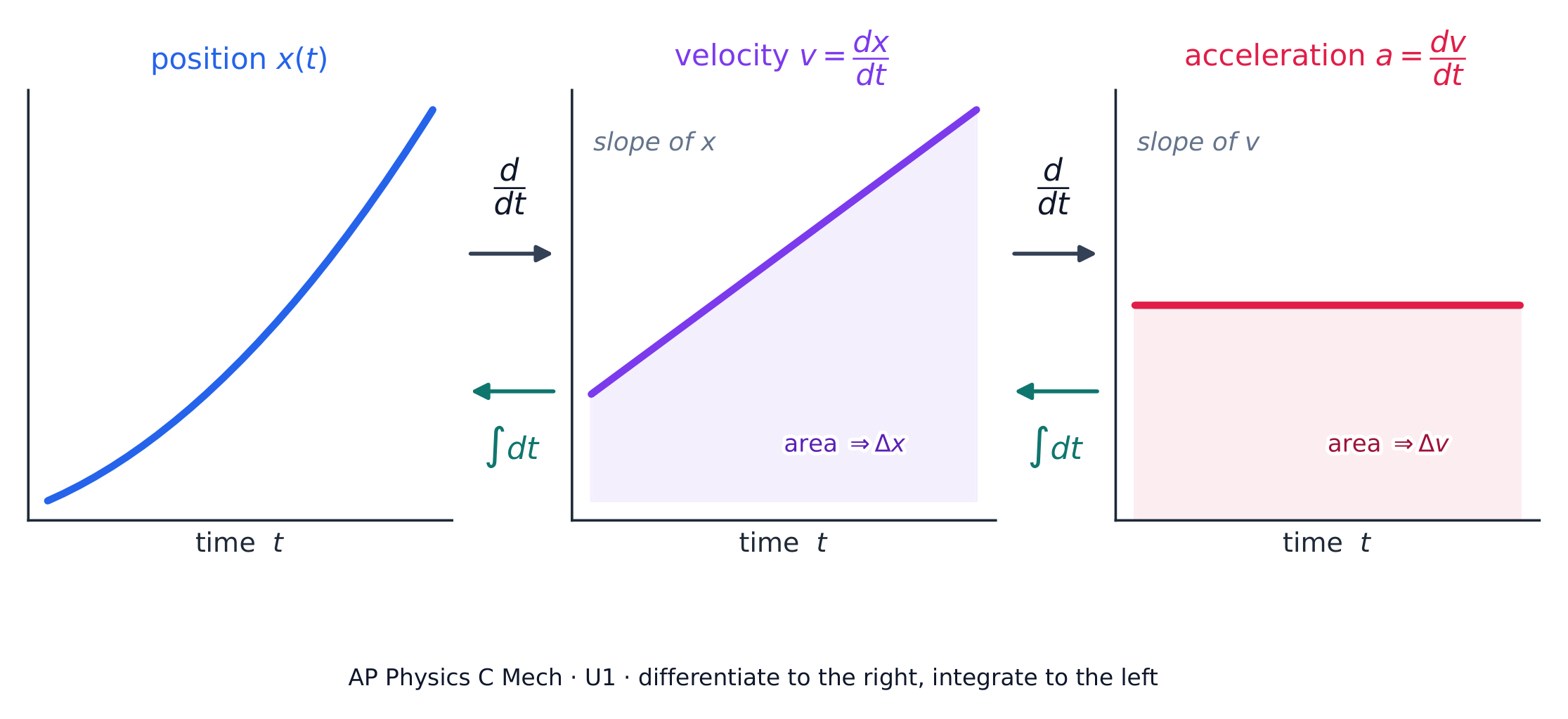
Slopes are derivatives; areas are integrals – the two are inverse operations here.

日本語

記述、グラフ、表、数式の間の円滑な切り替えができるようにする:

変位-時間グラフ:任意の瞬間における傾きは速度である
  • 位置-時間グラフにおいて、傾き($dx/dt$)は速度である。
  • 速度-時間グラフにおいて、傾きは加速度であり、面積($\int v\,dt$)は変位である。
  • 加速度-時間グラフにおいて、面積($\int a\,dt$)は速度の変化量である。

傾きは導関数であり、面積は積分である——これらはここでは互いに逆演算の関係にある。

位置、速度、加速度は微分によって結びついている
Explore · ⁨探索⁩

Explore the velocity–time graph · ⁨速度-時間グラフを探索する⁩

Change the start velocity and acceleration. The slope of a $v$–$t$ line is the acceleration $a=\tfrac{dv}{dt}$, and the area underneath is the displacement $\Delta x=\int v\,dt$ — slope and area are the graphical faces of the derivative and the integral. · ⁨初期速度と加速度を変化させる。$v$–$t$グラフの傾きは加速度$a=\tfrac{dv}{dt}$を表し、曲線下の面積は変位$\Delta x=\int v\,dt$を表す。傾きと面積は微分と積分の図形的表現である。⁩

1.4

Reference Frames and Relative Motion · ⁨参照系と相対運動⁩

Syllabus · ⁨シラバス⁩
English

Learning Objective 1.4.A: Describe the reference frame of a given observer.

  • 1.4.A.1 The choice of reference frame will determine the direction and magnitude of quantities measured by an observer in that reference frame.

Learning Objective 1.4.B: Describe the motion of objects as measured by observers in different inertial reference frames.

  • 1.4.B.1 Measurements from a given reference frame may be converted to measurements from another reference frame.
  • 1.4.B.2 The observed velocity of an object results from the combination of the object's velocity and the velocity of the observer's reference frame.
    • 1.4.B.2.i Combining the motion of an object and the motion of an observer in a given reference frame involves the addition or subtraction of vectors.
    • 1.4.B.2.ii The acceleration of any object is the same as measured from all inertial reference frames.

Boundary statement: Unless otherwise stated, the frame of reference of any problem may be assumed to be inertial.

日本語

学習目標 1.4.A: 特定の観測者の基準系を説明する。

  • 1.4.A.1 参照系を選択することで、その参照系に居る観測者によって測定される物理量の方向と大きさが決定される。

学習目標 1.4.B: 異なる慣性参照系に居る観測者によって測定された物体の運動を説明する。

  • 1.4.B.1 特定の参照系からの測定値は、他の参照系からの測定値に変換できる。
  • 1.4.B.2 物体の観測速度は、物体自身の速度と観測者の参照系の速度との合成によって生じる。
    • 1.4.B.2.i 与えられた参照系における物体の運動と観測者の運動を合成するには、ベクトルの加算または減算を行う。
    • 1.4.B.2.ii いかなる物体の加速度も、すべての慣性参照系から測定すると同一である。

境界声明: 別段の指定がない限り、いかなる問題の参照系も慣性系であると仮定してよい。

Source: College Board AP Course and Exam Description · ⁨出典: College Board AP コースおよび試験説明書⁩

English

All motion is relative to a reference frame 参考系. Combine velocities by vector addition: $\vec{v}_{A/C}=\vec{v}_{A/B}+\vec{v}_{B/C}$. This handles boats crossing rivers and passengers on moving vehicles – relative motion 相对运动 problems. Read the subscripts as a chain: "A relative to B" plus "B relative to C" gives "A relative to C".

Worked example. A boat that moves at $4.0\ \text{m/s}$ in still water heads straight across a river flowing at $3.0\ \text{m/s}$. Relative to the ground the boat moves at $\sqrt{4.0^2+3.0^2}=5.0\ \text{m/s}$, angled downstream. If the river is $80\ \text{m}$ wide, the crossing still takes $t=\dfrac{80}{4.0}=20\ \text{s}$ – only the across-stream component crosses the river; the current just carries the boat $60\ \text{m}$ downstream.

日本語

すべての運動は座標系に対して相対的である。速度の合成はベクトル加法で行う:$\vec{v}_{A/C}=\vec{v}_{A/B}+\vec{v}_{B/C}$。これは川を渡る船や移動中の乗り物に搭乗する乗客の——相対運動の問題に対応する。添字を鎖のように読む:“A relative to B” に “B relative to C” を加えると “A relative to C” となる。

** worked example.** 静水中で $4.0\ \text{m/s}$ の速度で動く船が、流速 $3.0\ \text{m/s}$ の川にまっすぐ向かっている。地面に対する船の速度は $\sqrt{4.0^2+3.0^2}=5.0\ \text{m/s}$ で、下流向きに傾いている。川幅が $80\ \text{m}$ の場合、渡河には依然として $t=\dfrac{80}{4.0}=20\ \text{s}$ かかる——横方向成分だけが川を渡るだけであり、流れは単に船を下流へ $60\ \text{m}$ 運ぶだけである。

1.5

Motion in Two or Three Dimensions · ⁨2次元または3次元における運動⁩

Syllabus · ⁨シラバス⁩
English

Learning Objective 1.5.A: Describe the motion of an object moving in two or three dimensions.

  • 1.5.A.1 Motion in two or three dimensions can be analyzed using one-dimensional kinematic relationships if the motion is separated into components.
  • 1.5.A.2 Velocity and acceleration may be different in each dimension and may be nonuniform.
  • 1.5.A.3 Motion in one dimension may be changed without causing a change in a perpendicular dimension.
  • 1.5.A.4 Projectile motion is a special case of two-dimensional motion that has zero acceleration in one dimension and constant, nonzero acceleration in the second dimension.

Boundary statement: AP Physics C: Mechanics only expects students to quantitatively analyze the motion of an object in two dimensions. AP Physics C: Electricity and Magnetism expects students to also qualitatively describe the motion of a particle in three dimensions.

日本語

学習目標 1.5.A: 二つまたは三つの次元で運動する物体の運動を説明する。

  • 1.5.A.1 運動を成分に分解できる場合、二つまたは三つの次元の運動は一次元の運動学的関係を用いて解析できる。
  • 1.5.A.2 各次元における速度や加速度は異なり、非一様である可能性がある。
  • 1.5.A.3 一次元の運動を変化させても、直交する次元には変化が生じない。
  • 1.5.A.4 投射運動は、ある次元で加速度がゼロであり、第二の次元で一定かつ非ゼロの加速度を持つ、二つの次元の運動の特殊ケースである。

境界文:AP Physics C: Mechanics では、学生が二次元における物体の運動を定量的に解析することを期待するのみである。AP Physics C: Electricity and Magnetism では、学生が三次元における粒子の運動を定性的に説明することも期待する。

Source: College Board AP Course and Exam Description · ⁨出典: College Board AP コースおよび試験説明書⁩

English

In two or three dimensions, position is a vector $\vec{r}(t)=\langle x(t),y(t),z(t)\rangle$, and velocity and acceleration are its successive derivatives – each component handled independently.

Worked example. $\vec{r}(t)=\big(2t^2\big)\hat{i}+\big(4t-t^3\big)\hat{j}$ (metres). Differentiating each component: $\vec{v}=4t\,\hat{i}+(4-3t^2)\,\hat{j}$ and $\vec{a}=4\,\hat{i}-6t\,\hat{j}$. At $t=1\ \text{s}$: $\vec{v}=4\hat{i}+1\hat{j}$, so the speed is $\sqrt{17}\approx4.1\ \text{m/s}$ – no new physics, just one derivative per component.

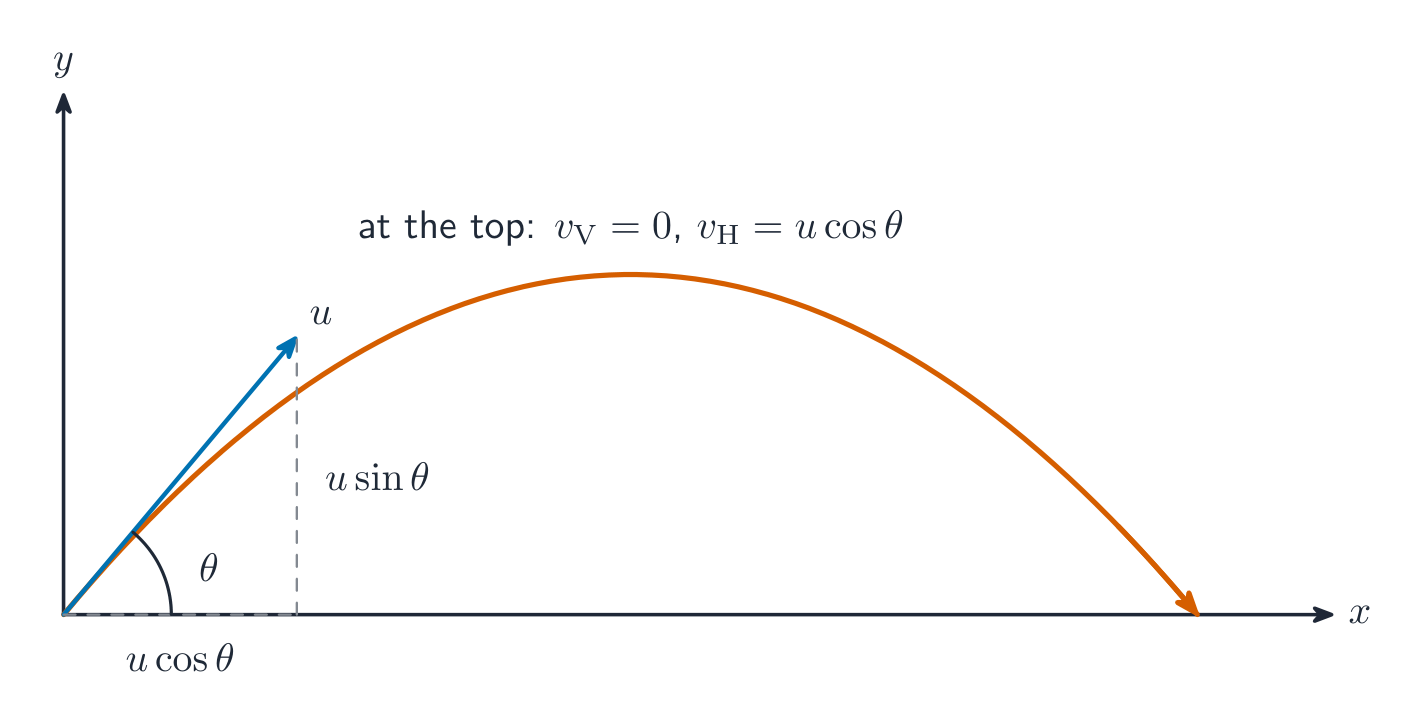
For projectile motion 抛体运动, horizontal and vertical motions are independent, linked only by time $t$: horizontally $a_x=0$ (constant velocity), vertically $a_y=-g$. The path is a parabola. This component method extends to any two-dimensional motion where the accelerations along each axis are known.

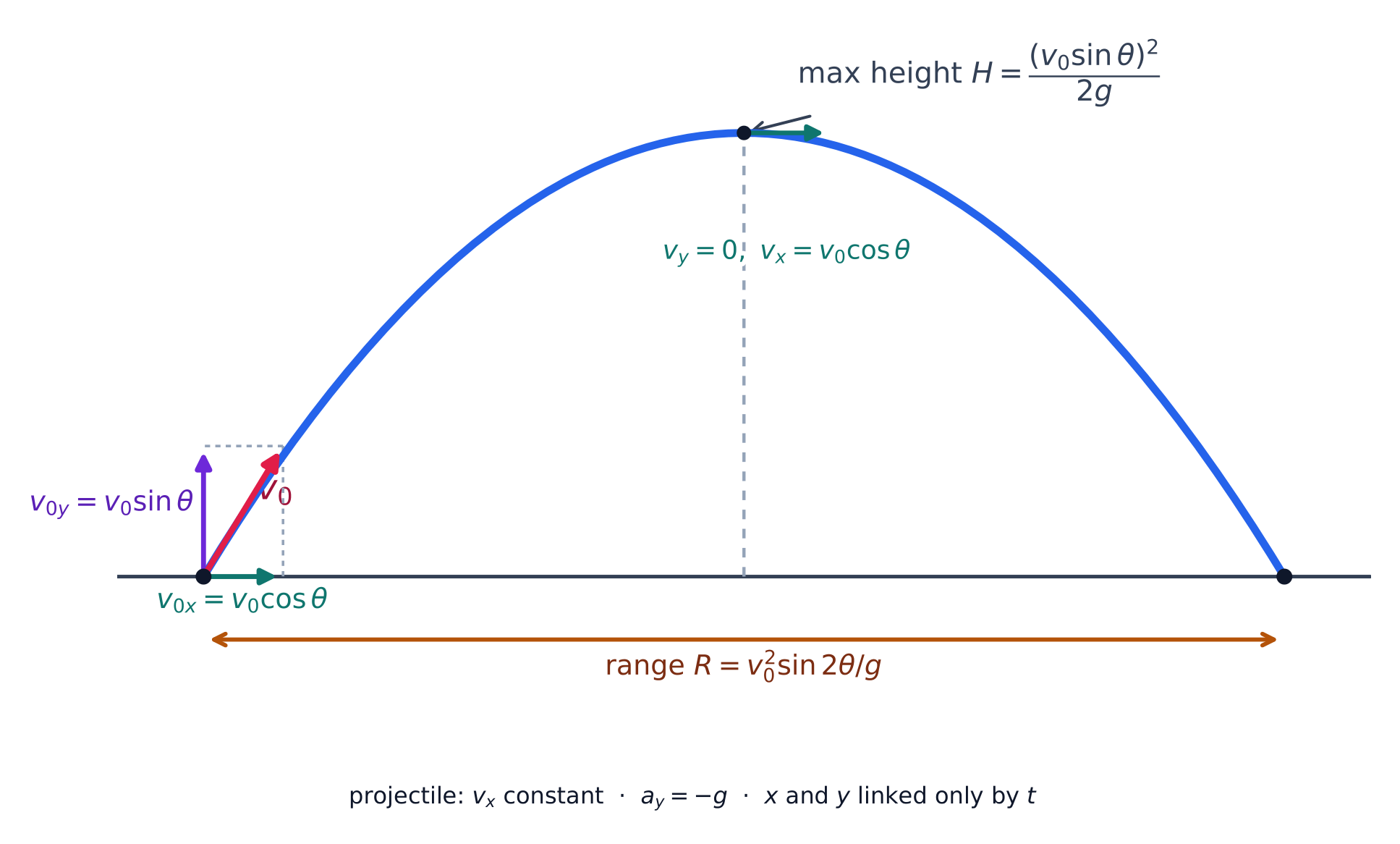
Worked example. A ball is launched at $20\ \text{m/s}$, $30^{\circ}$ above the horizontal ($g=9.8\ \text{m/s}^2$). The components are $v_{0x}=20\cos30^{\circ}=17.3\ \text{m/s}$ and $v_{0y}=20\sin30^{\circ}=10\ \text{m/s}$. The vertical motion sets the time: total flight $=\dfrac{2v_{0y}}{g}=\dfrac{20}{9.8}=2.0\ \text{s}$, maximum height $=\dfrac{v_{0y}^2}{2g}=5.1\ \text{m}$, and range $=v_{0x}\times2.0=35\ \text{m}$.

日本語

2次元または3次元では、位置はベクトラ ⟨$\vec{r}(t)=\langle x(t),y(t),z(t)\rangle$⟩ であり、速度と加速度はその逐次微分である——各成分は独立して扱う。

** worked example.** ⟨$\vec{r}(t)=\big(2t^2\big)\hat{i}+\big(4t-t^3\big)\hat{j}$⟩(メートル)。各成分を微分すると:$\vec{v}=4t\,\hat{i}+(4-3t^2)\,\hat{j}$ および $\vec{a}=4\,\hat{i}-6t\,\hat{j}$。$t=1\ \text{s}$ において:$\vec{v}=4\hat{i}+1\hat{j}$ であるため、速さは $\sqrt{17}\approx4.1\ \text{m/s}$ ——新しい物理法則ではなく、各成分ごとに1回の微分を行うだけである。

斜めに発射された投射体:水平方向と垂直方向の運動は独立している

** projectile motion** においては、水平方向と垂直方向の運動は互いに独立しており、時間 $t$ によってのみ結びついている。水平方向では $a_x=0$ (一定速度)、垂直方向では $a_y=-g$ 。軌道は放物線を描く。この成分分解法は、各軸に沿った加速度が既知であるあらゆる2次元運動に拡張される。

** worked example.** 球を $20\ \text{m/s}$ の初速度で、水平面から $30^{\circ}$ の角度($g=9.8\ \text{m/s}^2$)で発射した。成分は $v_{0x}=20\cos30^{\circ}=17.3\ \text{m/s}$ と $v_{0y}=20\sin30^{\circ}=10\ \text{m/s}$ である。垂直方向の運動が時間を決定し、全飛行時間は $=\dfrac{2v_{0y}}{g}=\dfrac{20}{9.8}=2.0\ \text{s}$ 、最大高度は $=\dfrac{v_{0y}^2}{2g}=5.1\ \text{m}$ 、飛翔距離は $=v_{0x}\times2.0=35\ \text{m}$ となる。

角度で発射された投射物の速度成分、最大高度、および飛翔距離
Explore · ⁨探索⁩

Explore projectile motion · ⁨投射運動を探索する⁩

Fire the projectile, then vary the angle and speed. The horizontal motion is steady while gravity acts only downward — together they trace a parabola. Find the angle that gives the greatest range (it peaks near $45^\circ$), and try the Moon. · ⁨投射体を発射し、角度と速度を変化させよ。水平運動は一定であり、重力は下向きにのみ働く。これらを合わせると放物線を描く。最大の射程を与える角度を見つけよ($45^\circ$付近で最大となる)、月面でも試してみよ。⁩

Vocabulary · ⁨語彙⁩ Train · ⁨練習する⁩
English 日本語
projectile motion/prəˈdʒektaɪl ˈməʊʃn/ 投射運動
1.5

Exam tips · ⁨試験対策⁩

English
  • Resolve every vector into components before adding — never add magnitudes at an angle directly.
  • On Physics C you are expected to use calculus: velocity is $\vec v=\tfrac{d\vec r}{dt}$ and acceleration $\vec a=\tfrac{d\vec v}{dt}$; reverse with integration.
  • Carry and check units and treat direction with signs (choose a positive axis and stick to it).
  • Use the dot product for work-type quantities and the cross product for torque and angular momentum.
  • Sketch the vectors — a diagram catches sign and direction errors the algebra hides.
日本語
  • 加算する前に必ずベクトラを成分に分解し、角度で直接大きさを足さないこと。
  • Physics C では 微積分 を用いることが求められる:速度は $\vec v=\tfrac{d\vec r}{dt}$ 、加速度は $\vec a=\tfrac{d\vec v}{dt}$ であり、逆操作は積分による。
  • 単位を常に持ち運び確認し、方向は符号で扱う(正の軸を設定してそれに従う)。
  • 仕事のような量には内積を、トルクや角運動量には外積を用いる。
  • ベクトラを描く——図示すれば、代数計算では見逃されがちな符号や方向の誤りが見つかる。

Interactive lessons on this topic · ⁨このトピックのインタラクティブ授業⁩

Work through it step by step, with instant-check exercises. · ⁨一歩ずつ進め、即時チェック付きの問題で学習します。⁩

Past Papers · ⁨過去問⁩

More topics in AP Physics C: Mechanics · ⁨AP物理学C:力学⁩ · ⁨AP Physics C: Mechanics · ⁨AP物理学C:力学⁩ の他のトピック⁩

Log in or create account · ⁨ログインまたはアカウント作成⁩

IGCSE, A-Level & AP