Skip to content · ⁨コンテンツへスキップ⁩

Market Failure and the Role of Government · ⁨市場の失敗と政府の役割⁩

AP Microeconomics · ⁨AP 経済学⁩ · Topic 6 · ⁨トピック 6⁩

View Slides · ⁨查看幻灯片⁩ Train · ⁨練習する⁩
Video lesson for this topic · ⁨このトピックのビデオレッスン⁩ Open the video page · ⁨動画ページを開く⁩
8:21

市場の失敗と政府の役割

この工場を見てください。ある人がその製品を購入し、別の人が製造のために報酬を受け取っています。双方が価格に満足しています。しかし、排気ガスは価格に含まれていません。…

English narration · English + 中文 subtitles burned in · ⁨英語ナレーション・英語+中文字幕 burning-in⁩

6.1

Socially Efficient and Inefficient Market Outcomes · ⁨社会的に効率的かつ非効率な市場 outcomes⁩

Syllabus · ⁨シラバス⁩
English

Enduring Understanding (POL-2): Perfectly competitive markets allocate resources efficiently, but imperfect competition often results in market inefficiencies.

Learning Objective POL-2.A: a. Define social efficiency. b. Explain (using graphs where appropriate) why resource allocation in perfectly competitive markets is socially efficient.

  • POL-2.A.1 The optimal quantity of a good occurs where the marginal benefit of consuming the last unit equals the marginal cost of producing that last unit, thus maximizing total economic surplus.
  • POL-2.A.2 The market equilibrium quantity is equal to the socially optimal quantity only when all social benefits and costs are internalized by individuals in the market. Total economic surplus is maximized at that quantity. [See also PRD-3 and POL-3.]

Learning Objective POL-2.B: Explain (using graphs where appropriate) how private incentives can lead to actions by rational agents that are socially undesirable (inefficient) market outcomes.

  • POL-2.B.1 Rational agents can pursue private actions to exploit or exercise market characteristics known as market power.
  • POL-2.B.2 Rational agents make optimal decisions by equating private marginal benefits and private marginal costs that can result in market inefficiencies.
  • POL-2.B.3 Policymakers use cost-benefit analysis to evaluate different actions to reduce or eliminate market inefficiencies.
  • POL-2.B.4 Market inefficiencies can be eliminated by designing policies that equate marginal social benefit with marginal social cost.

Learning Objective POL-2.C: a. Explain equilibrium allocations in imperfect markets relative to efficient allocations (using graphs where appropriate) and why these markets are inefficient. b. Calculate (using graphs where appropriate) the deadweight loss resulting from the production of a non-efficient quantity.

  • POL-2.C.1 Equilibrium allocations can deviate from efficient allocations due to situations such as monopoly; oligopoly; monopolistic competition; negative and positive externalities in production or consumption; asymmetric information; and insufficient production of public goods.
  • POL-2.C.2 Producing any non-efficient quantity results in deadweight loss.
日本語

持続的認識(POL-2): 完全競争市場は資源を効率的に配分しますが、不完全競争はしばしば市場の非効率性を招きます。

学習目標 POL-2.A: a. 社会的効率を定義する。 b. 完全競争市場における資源配分がなぜ社会的に効率的なのかを説明する(適切な場合、グラフを使用して)。

  • POL-2.A.1 最適数量とは、最終単位の消費による限界便益がその最終単位の生産による限界コストと等しくなる点であり、これにより総経済余剰が最大化されます。
  • POL-2.A.2 市場均衡数量が社会的に最適な数量と一致するのは、すべての社会的便益とコストが市場内の個人によって内部化される場合のみです。その数量において総経済余剰は最大化されます。[PRD-3 および POL-3 も参照]。

学習目標 POL-2.B: private incentives が合理的なエージェントによる社会的に望ましくない(非効率的な)市場 outcomes を引き起こすことを説明する(適切な場合、グラフを使用して)。

  • POL-2.B.1 合理的なエージェントは、市場力と呼ばれる市場特徴を利用したり行使したりするためにprivate actionsを追求することがあります。
  • POL-2.B.2 合理的エージェントは、私的限界便益と私的限界費用が等しくなることで最適意思決定を行いますが、これにより市場の非効率性が生じることがあります。
  • POL-2.B.3 政策立案者は、市場の非効率性を低減または排除するための異なる行動を評価するために、コストベネフィット分析を用います。
  • POL-2.B.4 社会限界便益と社会限界費用が等しくなるように政策を設計することで、市場の非効率性は排除されます。

学習目標 POL-2.C: a. 不完全市場における均衡配分が効率的な配分に対してどのように異なるか(適切な場合、グラフを使用して)説明し、なぜこれらの市場が非効率であるかを説明する。 b. 非効率な数量の生産によって生じる無谓損失を計算する(適切な場合、グラフを使用して)。

  • POL-2.C.1 独占、寡占、差別化競争、生産または消費における負の外部性および正の外部性、非対称情報、公共財の不足生産などの状況により、均衡配分は効率的な配分から逸脱することがある。
  • POL-2.C.2 非効率な数量のいずれかの生産は、無谓損失を生じる。

Source: College Board AP Course and Exam Description · ⁨出典: College Board AP コースおよび試験説明書⁩

English

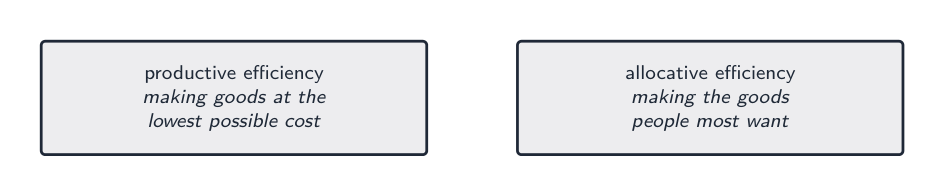
A market outcome is socially efficient 社会有效率 when it maximizes total surplus – when the marginal social benefit equals the marginal social cost of the last unit. Perfect competition reaches this on its own. But sometimes markets fail to, producing too much or too little. This is market failure 市场失灵, and it is the main economic justification for government action.

日本語

市場 outcome が社会的に効率的であるとは、総余剰を最大化しているときであり、最終単位の限界社会便益が限界社会コストに等しいときである。完全競争はこれに独自に到達する。しかし、時折市場はこの状態に到達できず、過剰または不足を生むことがある。これを市場の失敗といい、政府介入の主な経済的根拠となる。

生産的効率性は最低コスト;配分的効率性は人々の望むものを作ること
6.2

Externalities · ⁨外部不利益・正の外部性⁩

Syllabus · ⁨シラバス⁩
English

Enduring Understanding (POL-3): Private incentives can fail to account for all socially relevant considerations.

Learning Objective POL-3.A: a. Define externalities. b. Explain (using graphs where appropriate) how in the presence of externalities, private markets do not take into consideration social costs or social benefits.

  • POL-3.A.1 The socially optimal quantity of a good occurs where the marginal social benefit of consuming the last unit equals the marginal social cost of producing that last unit, thus maximizing total economic surplus.
  • POL-3.A.2 Externalities are either positive or negative and arise from lack of well-defined property rights and/or high transaction costs.
  • POL-3.A.3 In the presence of externalities, rational agents respond to private costs and benefits and not to external costs and benefits.
  • POL-3.A.4 Rational agents have the incentive to free ride when a good is non-excludable.

Learning Objective POL-3.B: Explain (using graphs where appropriate) how public policies address positive or negative externalities.

  • POL-3.B.1 Policies that address positive or negative externalities include taxes/subsidies, environmental regulation, public provision, the assignment of property rights, and the reassignment of property rights through private transactions.
日本語

持続的な理解 (POL-3): 私的なインセンティブは、社会的に重要なすべての考慮事項を十分に反映できないことがある。

学習目標 POL-3.A: a. 外部性を定義する。 b. 外部性が存在する場合、私的市場が社会費用や社会便益を考慮しない理由を説明する(適切な場合、グラフを使用して)。

  • POL-3.A.1 財の社会的に最適な数量は、最終単位の消費における社会限界便益がその最終単位の生産における社会限界費用と等しい地点で達成され、これにより経済的正味利益が最大化される。
  • POL-3.A.2 外部性は、正の外部性と負の外部性の両方があり、明確に定義された財産権の欠如および/または高い取引コストによって生じる。
  • POL-3.A.3 外部性が存在する場合、合理的なエージェントは、外部費用や外部便益ではなく、私的費用と私的便益に応答する。
  • POL-3.A.4 財が排他的でない場合、合理的なエージェントにはフリーライダーを行うインセンティブがある。

学習目標 POL-3.B: 公共政策が正の外部性または負の外部性をどう解決するかを説明する(適切な場合、グラフを使用して)。

  • POL-3.B.1 正の外部性または負の外部性を処理する政策には、税・補助金、環境規制、公的供給、財産権の割当て、および私的取引による財産権の再割当てが含まれる。

Source: College Board AP Course and Exam Description · ⁨出典: College Board AP コースおよび試験説明書⁩

English
Negative externalities

An externality 外部性 is a cost or benefit that falls on a third party not involved in the transaction – so the private decision-makers ignore it.

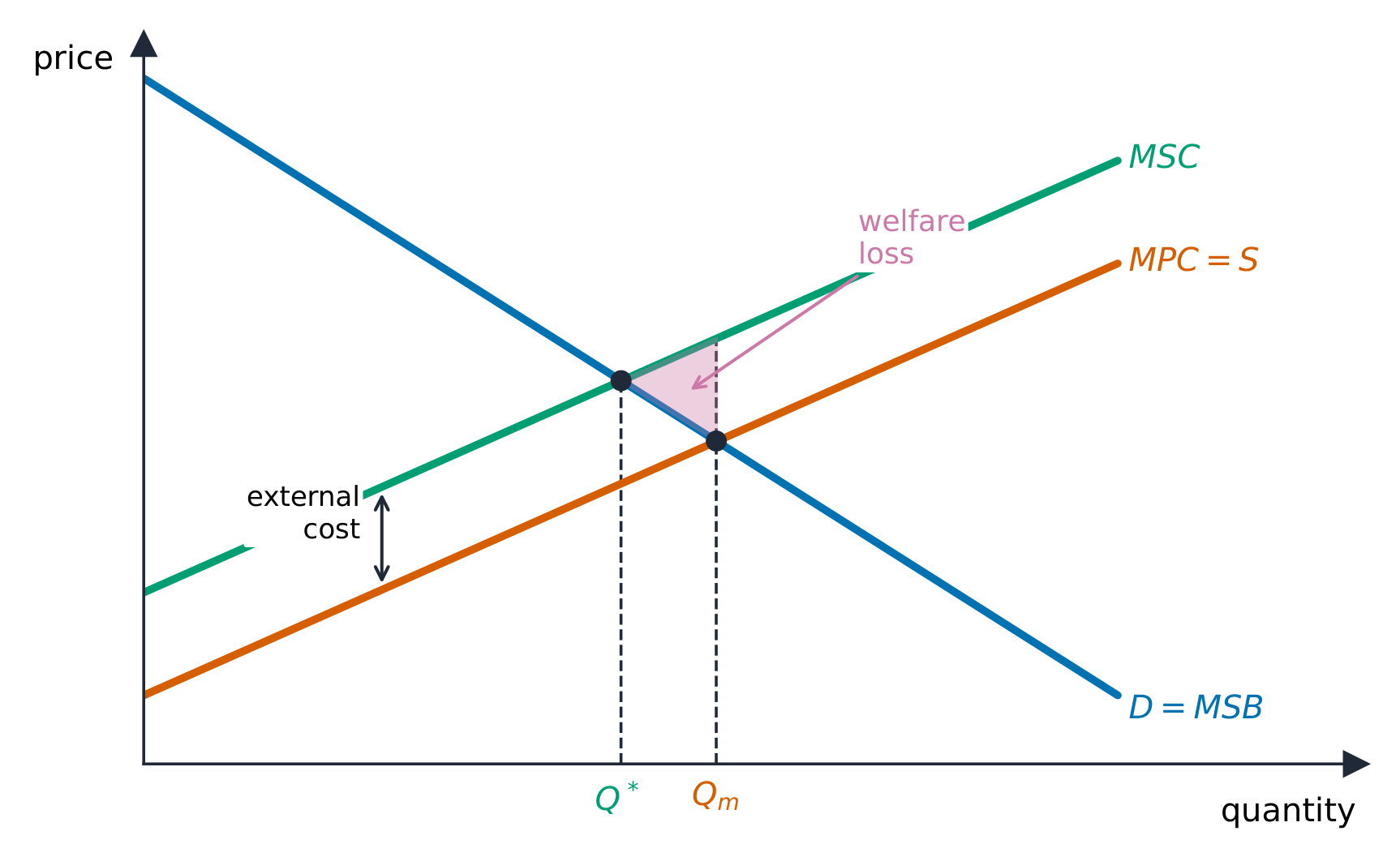
  • A negative externality 负外部性 (pollution) means marginal social cost > marginal private cost. The market over-produces; the deadweight loss is a triangle. Fixes: a Pigovian tax 庇古税 or regulation to make producers "internalize" the cost (shifting private cost up to social cost).
  • A positive externality 正外部性 (vaccination, education) means marginal social benefit > marginal private benefit. The market under-produces. Fixes: a subsidy to consumers or producers.
  • Coase theorem 科斯定理: if property rights are clear and bargaining is costless, private parties can solve an externality themselves – but that is rare with many people involved.

Worked example. A factory's private marginal cost of a chemical is $\$8$ per unit, but each unit also dumps $\$3$ of pollution on neighbors, so the marginal social cost is $\$11$. Ignoring the $\$3$, the market over-produces. A Pigovian tax of exactly $\$3$ per unit raises the firm's private cost to $\$11$ – now equal to the social cost – so the firm cuts output to the efficient quantity and the externality is "internalized."

Exam skill: identify whether an externality is positive or negative, show on a graph that private and social curves diverge, mark the deadweight loss, and name the correcting tax or subsidy.

日本語
たばこ:外部不利益により私的市場が社会的に効率的なoutcomeに到達しない可能性がある
負の外部性

外部不利益(または外部性)とは、取引に関与していない第三者に負担や便益が及ぶことであり、したがって私的な意思決定者はそれを無視する。

負の外部性:市場は過剰生産を行い、福祉損失をもたらす
  • 負の外部性(汚染)とは限界社会コスト > 限界私的コストを意味する。市場は過剰生産を行うため、無谓損失は三角形となる。解決策:ピゴヴィア税や規制によって生産者にコストを「内部化」させ(私的コストを社会的コストまで上方へシフトさせる)。
  • 正の外部性(ワクチン、教育)とは限界社会便益 > 限界私的便益を意味する。市場は過少生産を行う。解決策:消費者または生産者に対する補助金。
  • コアーズ定理:財産権が明確で交渉にコストがかからない場合、私的当事者自身が外部性を解決できる – しかし、多くの人が関わるケースではこれは稀である。
車の列が詰まり、立ち往生している街路
混雑は負の外部性である:各ドライバーが他のすべてのドライバーに価格で回収されないコストを負担している

** worked example.** 工場の化学物質の私的限界コストは$\$8$ per unit, but each unit also dumps $\$3$の近隣への汚染を含み、したがって限界社会コストは$\$11$. Ignoring the $\$3$であり、市場は過剰生産を行う。ピゴヴィア税を正確に$\$3$ per unit raises the firm's private cost to $\$11$課す** – 今や社会的コストと等しくなる – ことで、企業は生産量を効率的な数量まで削減し、外部性は「内部化」される。

試験スキル: 外部性が正か負かを特定し、グラフ上で私的曲線と社会的曲線が分かれることを示し、無谓損失を标记し、是正税または補助金の名称を挙げる。

Industrial pollution: a negative externality where social cost exceeds private cost
産業廃棄物による汚染:社会的コストが私的コストを上回る外部不経済
Explore · ⁨探索⁩

A market with an externality · ⁨外部不経済が存在する市場⁩

An externality makes private cost differ from social cost, so the free-market quantity is inefficient. See the deadweight loss and how a tax or subsidy corrects it. · ⁨外部不経済により private cost が social cost と異なり、自由市場での生産量は非効率となる。死の損失と、税や補助金による修正方法を確認せよ。⁩

Vocabulary · ⁨語彙⁩ Train · ⁨練習する⁩
English 日本語
socially efficient/ˈsəʊʃəli ɪˈfɪʃənt/ 社会的に効率的
market failure/ˈmɑːkɪt ˈfeɪlɪə/ 市場の失敗
externality/ekˈstɜːnælɪti/ 外部不経済
negative externality/ˈneɡətɪv ekˈstɜːnælɪti/ 負の外部不経済
Pigovian tax/pɪˈɡəʊvɪən tæks/ ピグヴィアン税
positive externality/ˈpɒzɪtɪv ekˈstɜːnælɪti/ 正の外部不経済
Coase theorem/kəʊs ˈθɪərəm/ コーズ定理
rivalry/ˈraɪvəlri/ 競合
excludability/eksˌkluːdəˈbɪlɪti/ 排他性
private good/ˈpraɪvət ɡʊd/ 私的財
public good/ˈpʌblɪk ɡʊd/ 公共財
free-ride/friː raɪd/ フリーライダー
Common resources/ˈkɒmən rɪˈzɔːsɪz/ 共有資源
tragedy of the commons/ˈtrædʒədi ɒvðə ˈkɒmənz/ 共用地の悲劇
Antitrust laws/ˌæntɪˈtrʌst lɔːz/ 独占禁止法
per-unit tax/pɜː ˈjuːnɪt tæks/ 単位税
lump-sum tax/lʌmp sʌm tæks/ 固定税
lump-sum subsidy/lʌmp sʌm ˈsʌbsɪdi/ 固定補助金
income distribution/ˈɪŋkʌm ˌdɪstrɪˈbjuːʃn/ 所得分配
6.3

Public and Private Goods · ⁨公共財と私的財⁩

Syllabus · ⁨シラバス⁩
English

Enduring Understanding (POL-3): Private incentives can fail to account for all socially relevant considerations.

Learning Objective POL-3.C: a. Define whether goods are rival and/or excludable. b. Explain how the nature of rival and/or excludable goods influences the behavior of individuals and groups.

  • POL-3.C.1 Private goods are rival and excludable, and public goods are non-rival and non-excludable.
  • POL-3.C.2 Due to the free rider problem, private individuals usually lack the incentive to produce public goods, leaving government as the only producer.
  • POL-3.C.3 Governments sometimes choose to produce private goods, such as educational services, and to allow free access to them.
  • POL-3.C.4 Some natural resources are, by their nature, non-excludable and rival and therefore open access. Private individuals inefficiently overconsume such resources.
日本語

持続的な理解 (POL-3): 私的なインセンティブは、社会的に重要なすべての考慮事項を十分に反映できないことがある。

学習目標 POL-3.C: a. 財が競合的であり、かつ/または排他的かどうかを定義する。 b. 競合的および/または排他的な財の性質が個人や集団の行動にどのような影響を与えるかを説明する。

  • POL-3.C.1 私人財は競合的かつ排他的であり、公共財は非競合的かつ非排他的である。
  • POL-3.C.2 フリーライダー問題のため、私人は通常、公共財を生産するインセンティブを持たず、政府だけが唯一の生産者となる。
  • POL-3.C.3 政府は sometimes、教育サービスのような私人財を生産することを抉择し、それらへの無料アクセスを認める。
  • POL-3.C.4 一部の天然資源は、その性質上、非排他的で競合的であるため、自由アクセス型である。私人はこれらの資源を非効率に過剰に消費する。

Source: College Board AP Course and Exam Description · ⁨出典: College Board AP コースおよび試験説明書⁩

English

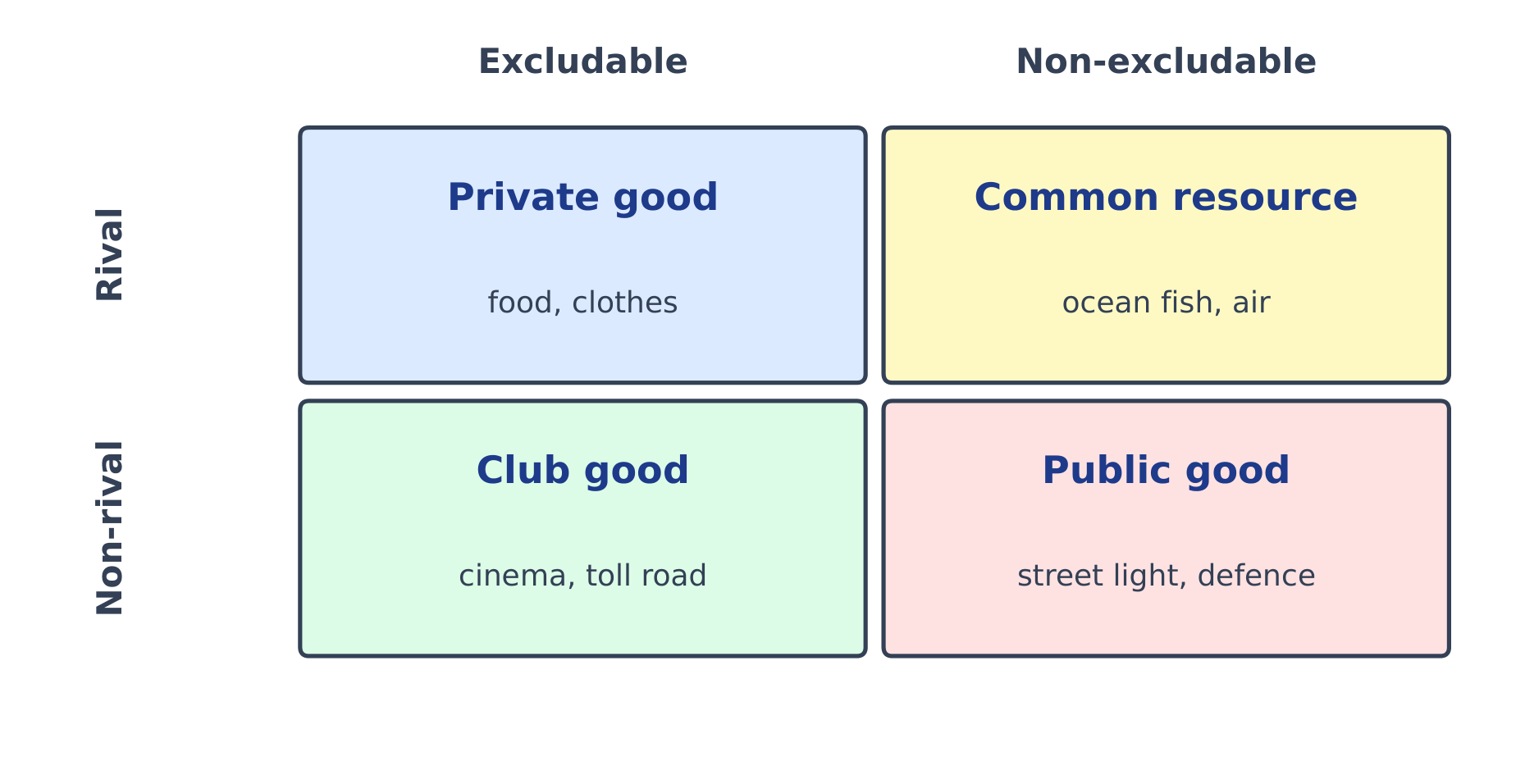
Goods differ along two traits: rivalry 竞争性 (does one person's use reduce another's?) and excludability 排他性 (can non-payers be kept out?).

  • A private good 私人物品 is rival and excludable (a sandwich) – markets handle these well.
  • A public good 公共物品 is non-rival and non-excludable (national defense, a lighthouse). Because non-payers cannot be excluded, people free-ride 搭便车 – enjoy it without paying – so markets under-provide it, and government usually supplies it.
  • Common resources 公共资源 are rival but non-excludable (ocean fish); over-use ruins them – the tragedy of the commons 公地悲剧.
日本語

財は2つの特性に基づいて分類される:競合性(一人の使用が他者の使用を減少させるか?)と排除可能性(未納者を取り除けるか?)。

競合性と排除可能性に基づく財の分類
競合性と排除可能性に基づく財の分類
  • 私的財は競合的かつ排除可能である(サンドイッチなど)– これらは市場が適切に扱う。
  • 公共財は非競合的かつ非排除的である(国防、灯台)。未納者を排除できないため、人々はフリーライダーとなり(支払いせずに享受する)、市場はこれを過少供給するため、通常は政府が提供する。
  • 共有資源は競合的だが非排除的である(海洋魚類);過度な使用により破綻する – コモンズの悲劇。
6.4

The Effects of Government Intervention in Different Market Structures · ⁨異なる市場構造における政府介入の影響⁩

Syllabus · ⁨シラバス⁩
English

Enduring Understanding (POL-4): In imperfect markets, well-designed government policy can reduce waste.

Learning Objective POL-4.A: a. Define government policy interventions in imperfect markets. b. Explain (using graphs where appropriate) how government policies can alter market outcomes in perfectly and imperfectly competitive markets. c. Calculate (using data from a graph or table as appropriate) changes in market outcomes resulting from government policies in perfectly competitive and imperfectly competitive markets.

  • POL-4.A.1 Per-unit taxes and subsidies affect the total price consumers pay, net price firms receive, equilibrium quantity, consumer and producer surpluses, deadweight loss, and government revenue or cost. The impact of change depends on the price elasticity of demand and supply.
  • POL-4.A.2 Lump-sum taxes and lump-sum subsidies do not change either marginal cost or marginal benefit; only fixed costs will be affected.
  • POL-4.A.3 Binding price ceilings and floors affect prices and quantities differently depending on the market structures (perfect competition, monopoly, monopolistic competition, and monopsony) and the price elasticities of supply and demand.
  • POL-4.A.4 Government intervention in imperfect markets can increase efficiency if the policy correctly addresses the incentives that led to the market failure.
  • POL-4.A.5 Government can use price regulation to address inefficiency due to monopoly.
  • POL-4.A.6 A natural monopoly will require a lump-sum subsidy to produce at the allocatively efficient quantity.
  • POL-4.A.7 Governments use antitrust policy in an attempt to make markets more competitive.
    • Exclusion statement: A graph of inefficiency and policy due to collusion is beyond the scope of the course and the AP Exam.
日本語

持続的な理解 (POL-4): 不完全市場において、適切に設計された政府政策は浪費を削減できる。

学習目標 POL-4.A: a. 不完全市場における政府政策の介入を定義する。 b. 政府政策が完全競争市場および不完全競争市場における市場成果をどう変化させるかを説明する(適切な場合、グラフを使用して)。 c. 完全競争市場および不完全競争市場における政府政策による市場成果の変化を計算する(適切な場合、グラフまたは表からのデータを使用して)。

  • POL-4.A.1 単位あたりの税および補助金は、消費者が支払う総価格、企業が受け取る純価格、均衡数量、消費者余剰および生産者余剰、無谓損失、および政府収入または支出に影響を与える。その影響の程度は需要および供給の価格弾力性によって決まる。
  • POL-4.A.2 定額税および定額補助金は、限界費用または限界便益を変化させず、固定コストのみが影響を受ける。
  • POL-4.A.3 実効的な価格上限および下限は、市場構造(完全競争、独占、差別化競争、 monopsony)および供給および需要の価格弾力性に応じて、価格および数量に異なる影響を与える。
  • POL-4.A.4 不完全市場における政府介入は、政策が市場の失敗を引き起こしたインセンティブを適切に解決した場合、効率性を向上させることができる。
  • POL-4.A.5 政府は、独占による非効率性を処理するために価格規制を使用できる。
  • POL-4.A.6 自然独占は、配置効率のある数量を生産するために定額補助金を必要とする。
  • POL-4.A.7 政府は、市場をより競争的にするために反トラスト政策を使用する。
    • 除外文: コールージョンによる非効率性と政策のグラフは、課程およびAP試験の範囲外である。

Source: College Board AP Course and Exam Description · ⁨出典: College Board AP コースおよび試験説明書⁩

English

Government tools change outcomes differently by structure:

  • Regulating a monopoly's price toward $P=MC$ can increase efficiency (unlike a price control in a competitive market, which creates shortage/surplus).
  • Antitrust laws 反垄断法 break up or block anti-competitive mergers and collusion.
  • Taxes and subsidies shift output toward the socially efficient quantity when externalities are present.

The key insight: the same policy can help or hurt efficiency depending on whether the market was already efficient (competitive) or already failing (monopoly, externality).

Per-unit vs lump-sum. A per-unit tax 从量税 adds to marginal cost, so it shifts supply up, raises price, cuts quantity, and creates deadweight loss. A lump-sum tax 定额税 (a fixed charge like a licence fee) does not change marginal cost or marginal benefit, so in the short run the profit-maximising price and quantity are unchanged – only the firm's profit falls; in the long run it changes entry and exit. For a natural monopoly, regulating price down to $P=MC$ (allocatively efficient) forces a loss, so a lump-sum subsidy 定额补贴 is needed to keep it producing that efficient quantity.

日本語

政府の手段は構造によってoutcomeを変化させる:

  • 独占の価格を$P=MC$方向に規制することは効率性を高めることができる(完全競争市場における価格規制が不足や余剰を生むのと異なり)。
  • 反独占法は競争阻害的な合併や collusion を解体または阻止する。
  • 税金と補助金は外部性が存在する場合、生産量を社会的に効率的な数量へシフトさせる。

重要な洞察:同じ政策でも、市場がすでに効率的(完全競争)であったか、すでに失敗している(独占、外部性)かによって、効率性に寄与するか損なうかが変わる。

単価税と一括税。 単価税は限界原価を増加させるため、供給曲線を上方へシフトさせ、価格を上げ、生産量を減らし、死weight損失を生じさせる。一括税(許可料のような固定負担金)は限界原価や限界便益を変化させない。したがって短期間では利益最大化の価格と生産量は変更されない——企業の利益が減少するのみであり、長期においてこそ参入・退出に影響を与える。天然独占の場合、価格を$P=MC$(配分効率性)まで規制すると赤字となるため、その効率的な生産量を引き続き維持するためには一括補助金が必要である。

6.5

Inequality · ⁨不平等⁩

Syllabus · ⁨シラバス⁩
English

Enduring Understanding (POL-5): Market outcomes can result in income inequality.

Learning Objective POL-5.A: Define measures of economic inequality in income and wealth.

  • POL-5.A.1 Income levels and poverty rates vary greatly both across and within groups (e.g., age, gender, race) and countries.
  • POL-5.A.2 The Lorenz curve and Gini coefficient are used to represent the degree of inequality in distributions and to compare distributions across different countries, policies, or time periods.
    • Exclusion statement: Drawing the Lorenz curve and calculating Gini coefficients are beyond the scope of the course and the AP Exam.

Learning Objective POL-5.B: Explain sources of income and wealth inequality.

  • POL-5.B.1 Each factor of production receives the value of its marginal product, which can contribute to income inequality.
  • POL-5.B.2 Sources of income and wealth inequality include differences in tax structures (progressive and regressive tax structures), human capital, social capital, inheritance, effects of discrimination, access to financial markets, mobility, and bargaining power within economic and social units (firms, labor unions, and families).
日本語

持続的な理解 (POL-5): 市場の成果は所得の不平等をもたらすことがある。

学習目標 POL-5.A: 所得および資産における経済的不平等の尺度を定義する。

  • POL-5.A.1 所得レベルおよび貧困率は、グループ間およびグループ内(例:年齢、性別、人種)、国間でも大きく異なる。
  • POL-5.A.2 ロレンツ曲線とジニ係数は、分布における不平等の程度を表し、異なる国、政策、または時期の分布を比較するために用いられる。
    • 除外事項: ロレンツ曲線の描画およびジニ係数の計算は、本コースおよびAP試験の対象外である。

学習目標 POL-5.B: 所得・資産格差の原因を説明する。

  • POL-5.B.1 各生産要因はその限界生産価値を得るが、これが所得格差の一因となることがある。
  • POL-5.B.2 所得・資産格差の原因には、税制の違い(累進的・逆進的税制)、人的資本、社会的資本、相続、差別の影響、金融市場へのアクセス、移動性、経済・社会単体内(企業、労働組合、家庭)での交渉権などがある。

Source: College Board AP Course and Exam Description · ⁨出典: College Board AP コースおよび試験説明書⁩

English

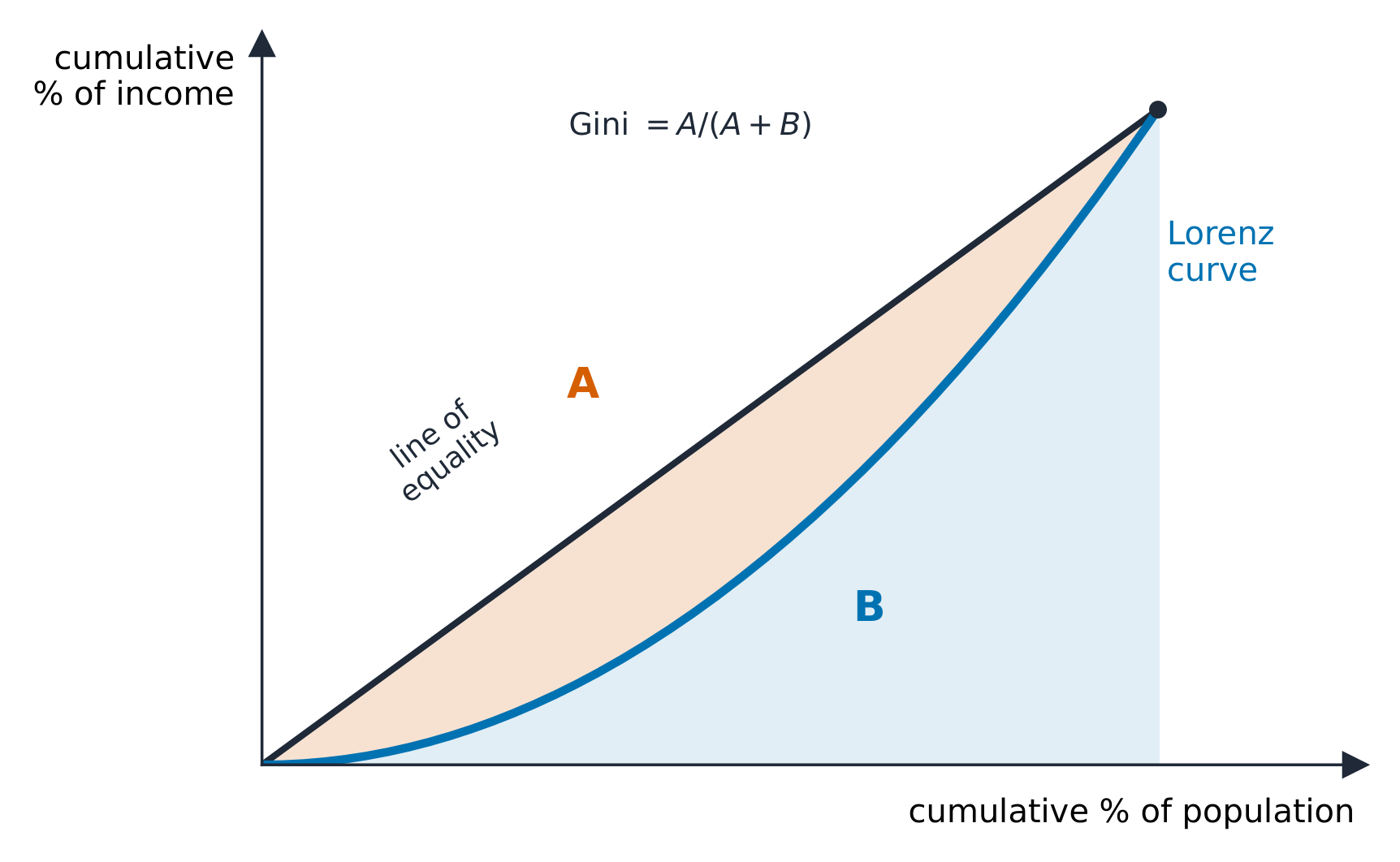
Markets reward productivity, but the resulting income distribution 收入分配 can be very unequal. Economists measure it with the Lorenz curve 洛伦兹曲线 (share of income against share of population; the further it bows from the 45° line, the more unequal) and the Gini coefficient 基尼系数 (0 = perfect equality, 1 = perfect inequality).

Worked example. Suppose the poorest $20\%$ of households earn just $5\%$ of income, while the richest $20\%$ earn $50\%$. Under perfect equality each $20\%$ would earn exactly $20\%$, so the Lorenz curve would be the $45°$ line. Because the bottom fifth is well below $20\%$ and the top fifth well above, the curve bows far beneath the diagonal – a large gap that means a high Gini coefficient and substantial inequality.

Sources of inequality include differences in human capital 人力资本 (skills, education), inheritance, and discrimination. Governments redistribute through progressive taxes 累进税 (higher rates on higher incomes) and transfer payments 转移支付 (welfare, subsidies). There is a debated efficiency–equity trade-off 效率与公平权衡: redistribution can reduce work incentives, so societies balance fairness against the size of the total pie.

日本語

市場は生産性を報いるが、結果として生じる所得分配は非常に不均等になり得る。経済学者はローレンツ曲線(所得の割合対人口の割合;45°線からの湾曲が大きければ大きいほど不平等)、およびジニ係数(0=完全平等、1=完全不平等)を用いてこれを測定する。

ローレンツ曲線とジニ係数は所得の不平等を測定する

** worked example.** 最下位 $20\%$ の世帯の収入が $5\%$ である一方、最上位 $20\%$ の世帯の収入が $50\%$ であると仮定します。完全平等であれば、各 $20\%$ は正確に $20\%$ を稼ぐため、ロレンツ曲線は $45°$ 線となります。下位五分の一が $20\%$ よりもはるかに低く、上位五分の一がはるかに高いため、曲線は対角線のはるかに下方へ大きく湾曲しています。この大きな乖離は、ジニ係数が高いことを意味し、著しい不平等を示しています。

不平等の要因には、人間資本(スキル、教育)の違い、相続、差別が含まれる。政府は累進税制(所得が高いほど税率が高い)および給付金(福祉、補助金)を通じて所得を再配分する。効率性と公平性のトレードオフは議論の的となっており、再配分は労働意欲を低下させる可能性があるため、社会は公平さと総所得の規模とのバランスを取り合う必要がある。

隣り合う資産と貧困:市場だけでは大きな所得格差の解消に至らない可能性
Explore · ⁨探索⁩

Measure inequality with a Lorenz curve · ⁨ローレンツ曲線を用いて不平等度を測定する⁩

A Lorenz curve plots cumulative income against cumulative population; the further it bows from the diagonal, the more unequal — summarised by the Gini coefficient. · ⁨ローレンツ曲線は cumulative income を cumulative population に対してプロットしたもので、対角線からの逸脱が大きくなるほど不平等度が高い——これをジニ係数で要約する。⁩

Vocabulary · ⁨語彙⁩ Train · ⁨練習する⁩
English 日本語
Lorenz curve/ˈlɒrənts kɜːv/ ローレンツ曲線
Gini coefficient/ˈdʒiːni ˌkəʊɪˈfɪʃənt/ ジニ係数
human capital/ˈhjuːmən ˈkæpɪtl/ 人的資本
progressive taxes/prəˈɡresɪv ˈtæksɪz/ 累進税制
transfer payments/ˈtrænsfɜː ˈpeɪmənts/ 給付金
efficiency–equity trade-off/ɪˈfɪʃənsi ˈekwɪti treɪd ɒf/ 効率と公平性のトレードオフ
6.5

Exam tips · ⁨試験対策⁩

English
  • A negative externality makes the market over-produce; correct with a Pigovian tax equal to the external cost. A positive externality under-produces; correct with a subsidy.
  • A public good is non-rival and non-excludable, so free-riding leads markets to under-provide it.
  • Classify goods by rivalry and excludability; common resources (rival, non-excludable) suffer the tragedy of the commons.
  • The same policy can help or hurt efficiency depending on whether the market was already efficient or failing.
  • Measure inequality with the Lorenz curve and Gini coefficient (0 = equality, 1 = inequality).
日本語
  • 負の外部性は市場の過剰生産をもたらすため、外部コストに等しいピグー税によって是正される。正の外部性は過少生産をもたらすため、補助金によって是正される。
  • 公共財は非競合的かつ非排除的であるため、フリーライダーにより市場による供給が不足する。
  • 財を競合性と排除性で分類する。共通資源(競合的・非排除的)は「共同の悲劇」に直面する。
  • 市場がすでに効率的であったか失敗していたかによって、同じ政策が効率性に寄与するか損なうか決まる。
  • ローレンツ曲線とジニ係数を用いて不平等を測定する(0=平等、1=不平等)。

Interactive lessons on this topic · ⁨このトピックのインタラクティブ授業⁩

Work through it step by step, with instant-check exercises. · ⁨一歩ずつ進め、即時チェック付きの問題で学習します。⁩

Past Papers · ⁨過去問⁩

More topics in AP Microeconomics · ⁨AP 経済学⁩ · ⁨AP Microeconomics · ⁨AP 経済学⁩ の他のトピック⁩

Log in or create account · ⁨ログインまたはアカウント作成⁩

IGCSE, A-Level & AP