Skip to content · ⁨コンテンツへスキップ⁩

Long-Run Consequences of Stabilization Policies · ⁨安定化政策の長期の影響⁩

AP Macroeconomics · ⁨AP マクロ経済学⁩ · Topic 5 · ⁨トピック 5⁩

View Slides · ⁨查看幻灯片⁩ Train · ⁨練習する⁩
Video lesson for this topic · ⁨このトピックのビデオレッスン⁩ Open the video page · ⁨動画ページを開く⁩
8:29

安定化政策の長期の影響

政府は景気後退を素早く終えたいと思っている。支出を増やし、税を減らし、中央銀行は借入を安価にする。成功する——生産量が増加し、雇用が戻ってくる。…

English narration · English + 中文 subtitles burned in · ⁨英語ナレーション・英語+中文字幕 burning-in⁩

5.1

Fiscal and Monetary Policy in the Short Run · ⁨短期における財政政策と金融政策⁩

Syllabus · ⁨シラバス⁩
English

Enduring Understanding (POL-1): Fiscal and monetary policy have short-run effects on macroeconomic outcomes.

Learning Objective POL-1.F: Explain (using graphs as appropriate) the effects of combined fiscal and monetary policy actions.

  • POL-1.F.1 A combination of expansionary or contractionary fiscal and monetary policies may be used to restore full employment when the economy is in a negative (i.e., recessionary) or positive (i.e., inflationary) output gap.
  • POL-1.F.2 A combination of fiscal and monetary policies can influence aggregate demand, real output, the price level, and interest rates. [For additional details on fiscal and monetary policy actions and how to demonstrate their effects graphically, see LO POL-1.A and LO POL-1.D.]
日本語

永続的理解 (POL-1): 財政政策と金融政策は、マクロ経済の成果に短期的な影響を与える。

学習目標 POL-1.F: (図を用いて必要に応じて)財政政策および金融政策の併用による効果を説明する。

  • POL-1.F.1 経済がマイナス(すなわち景気後退)またはプラス(すなわちインフレ)の_output gap_にある場合に、完全雇用を取り戻すために、拡張的または緊縮的な財政政策および金融政策の組み合わせが用いられることがある。
  • POL-1.F.2 財政政策および金融政策の組み合わせは、総需要、実質生産額、物価水準、および金利に影響を与えることができる。[財政政策および金融政策の措置に関する追加の詳細、およびその効果を図示する方法については、LO POL-1.A および LO POL-1.D を参照のこと]

Source: College Board AP Course and Exam Description · ⁨出典: College Board AP コースおよび試験説明書⁩

English

Both policies work by shifting AD in the short run. Fiscal policy 财政政策 changes government spending or taxes; monetary policy 货币政策 changes the money supply and thus the interest rate. They can work together (both expansionary to fight a deep recession) or be mixed (e.g. loose fiscal + tight monetary). In the short run, expansionary policy raises output and the price level and lowers unemployment; contractionary policy does the reverse.

日本語
議事堂の建屋:政府が支出と税を財政政策の手段として用いる

両政策とも短期においてADをシフトさせることで機能します。財政政策は政府支出または税を変化させ、金融政策は通貨供給量を変化させて結果として利子を変化させます。これらは連携して機能することもあります(深刻な景気後退に対して双方拡張的に) or 混合されることもあります(例:緩い財政政策+締まる金融政策)。短期において、拡張的政策は生産と物価水準を上げ、失業率を下げる一方で、縮減政策はその逆の効果をもたらします。

Explore · ⁨探索⁩

Use policy to shift aggregate demand · ⁨政策を使って総需要をシフトさせる⁩

In the short run, fiscal (spending/taxes) and monetary (interest-rate) policy shift aggregate demand, moving real GDP and the price level along short-run aggregate supply. · ⁨短期において、財政政策(支出・税)および金融政策(金利)は総需要を変化させ、実質GDPと物価水準を短期総供給曲線上へと移動させる。⁩

5.2

The Phillips Curve · ⁨フィリップス曲線⁩

Syllabus · ⁨シラバス⁩
English

Enduring Understanding (MOD-3): The Phillips curve model is used to represent the relationship between inflation and unemployment and to illustrate how macroeconomic shocks affect inflation and unemployment.

Learning Objective MOD-3.A: a. Define (using graphs as appropriate) the short-run Phillips curve and the long-run Phillips curve. b. Explain (using graphs as appropriate) short-run and long-run equilibrium in the Phillips curve model.

  • MOD-3.A.1 The short-run trade-off between inflation and unemployment can be illustrated by the downward-sloping short-run Phillips curve (SRPC).
  • MOD-3.A.2 An economy is always operating somewhere along the SRPC.
  • MOD-3.A.3 The long-run relationship between inflation and unemployment can be illustrated by the long-run Phillips curve (LRPC), which is vertical at the natural rate of unemployment.
  • MOD-3.A.4 Long-run equilibrium corresponds to the intersection of the SRPC and the LRPC.
  • MOD-3.A.5 Points to the left of long-run equilibrium represent inflationary gaps, while points to the right of long-run equilibrium represent recessionary gaps.

Learning Objective MOD-3.B: Explain (using graphs as appropriate) the response of unemployment and inflation in the short run and in the long run.

  • MOD-3.B.1 Demand shocks correspond to movement along the SRPC.
  • MOD-3.B.2 Supply shocks correspond to shifts of the SRPC.
  • MOD-3.B.3 Factors that cause the natural rate of unemployment to change will cause the LRPC to shift.
日本語

持続的理解 (MOD-3): フィリップス曲線モデルは、インフレと失業の関係を表し、マクロ経済ショックがインフレおよび失業に与える影響を説明するために用いられる。

学習目標 MOD-3.A: a. (図を用いて必要に応じて)短期フィリップス曲線および長期フィリップス曲線を定義する。 b. (図を用いて必要に応じて)フィリップス曲線モデルにおける短期均衡および長期均衡を説明する。

  • MOD-3.A.1 インフレと失業の短期におけるトレードオフは、右下がりの短期フィリップス曲線(SRPC)によって説明される。
  • MOD-3.A.2 経済は常にSRPCのどこかに位置して稼働している。
  • MOD-3.A.3 インフレと失業の長期における関係は、自然失業率で垂直となる長期フィリップス曲線(LRPC)によって説明される。
  • MOD-3.A.4 長期均衡は、SRPCとLRPCの交点に対応する。
  • MOD-3.A.5 長期均衡点の左側にある点はインフレギャップを、右側にある点は景気後退ギャップを表す。

学習目標 MOD-3.B: (図を用いて必要に応じて)短期および長期における失業とインフレの反応を説明する。

  • MOD-3.B.1 デマンド・ショックはSRPC上での移動に対応する。
  • MOD-3.B.2 サプライ・ショックはSRPCのシフトに対応する。
  • MOD-3.B.3 自然失業率の変化をもたらす要因は、LRPCをシフトさせる。

Source: College Board AP Course and Exam Description · ⁨出典: College Board AP コースおよび試験説明書⁩

English
The short-run Phillips curve

The Phillips curve 菲利普斯曲线 shows the short-run trade-off between inflation and unemployment:

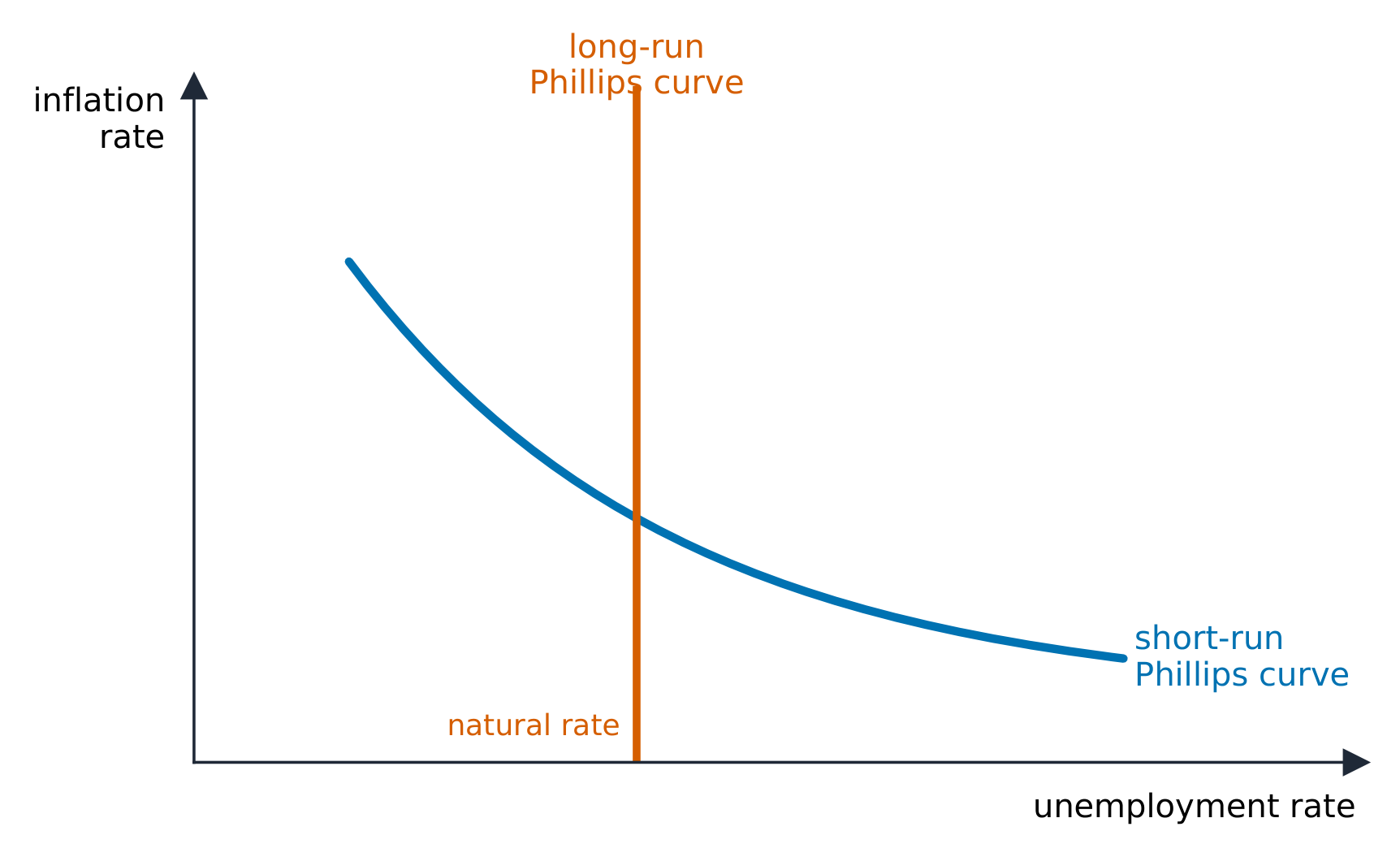
  • The short-run Phillips curve (SRPC) 短期菲利普斯曲线 slopes downward – lower unemployment comes with higher inflation. It is the mirror image of AD-AS: a rightward AD shift moves the economy up-left along the SRPC (less unemployment, more inflation).
  • The long-run Phillips curve (LRPC) 长期菲利普斯曲线 is vertical at the natural rate of unemployment 自然失业率 – the counterpart of vertical LRAS. In the long run there is no trade-off: policy changes inflation, not unemployment.
  • A supply shock shifts the SRPC (a negative shock moves it right – worse inflation and unemployment, i.e. stagflation). A change in expected inflation also shifts the SRPC.

Exam skill: link the AD-AS and Phillips graphs – a recessionary gap in AD-AS corresponds to a point on the SRPC to the right of the natural rate; know what shifts SRPC versus moves along it.

日本語
短期フィリップス曲線

フィリップス曲線は、インフレと失業の間の短期のトレードオフを示します:

短期と長期のフィリップス曲線
短期と長期のフィリップス曲線
  • 短期フィリップス曲線(SRPC)は右下がりです – 失業率が低いほどインフレ率が高くなります。これはAD-ASの鏡像です。ADが右へシフトすると、経済はSRPC上を左上方向へ移動し(失業減少、インフレ増加)、短期フィリップス曲線に沿って動きます。
  • 長期フィリップス曲線(LRPC)は自然失業率において垂直です – 垂直なLRASに対応するものです。長期においてはトレードオフは存在せず、政策はインフレを変化させるだけで、失業には影響しません。
  • サプライ・ショックはSRPCをシフトさせます(ネガティブ・ショックは右へシフト – インフレおよび失業が悪化する、つまりスタグフレーション)。期待インフレの変化もまたSRPCをシフトさせます。

試験対策スキル: AD-ASとフィリップスのグラフをリンクさせる – AD-ASにおける景気後退ギャップは、自然失業率の右側にあるSRPC上の点に対応することを理解していること。SRPCをシフトさせる要因と、SRPC上を移動させる要因を区別できること。

Vocabulary · ⁨語彙⁩ Train · ⁨練習する⁩
English 日本語
Fiscal policy/ˈfɪskl ˈpɒlɪsi/ 財政政策
monetary policy/ˈmʌnɪtəri ˈpɒlɪsi/ 金融政策
Phillips curve/ˈfɪlɪps kɜːv/ フィリップス曲線
short-run Phillips curve (SRPC)/ʃɔːt rʌn ˈfɪlɪps kɜːv/ 短期フィリップス曲線(SRPC)
long-run Phillips curve (LRPC)/lɒŋ rʌn ˈfɪlɪps kɜːv/ 長期フィリップス曲線(LRPC)
natural rate of unemployment/ˈnætʃərəl reɪt ɒv ʌnemˈplɔɪmənt/ 自然雇用量の地点で垂直である
quantity theory of money/ˈkwɒntɪti ˈθɪəri ɒv ˈmʌni/ 貨幣量説
hyperinflation/ˌhaɪpərɪnˈfleɪʃn/ ハイパーインフレ
budget deficit/ˈbʌdʒɪt ˈdefɪsɪt/ 予算赤字
surplus/ˈsɜːpləs/ 余剰を生む
national debt/ˈnæʃənl det/ 国債
5.3

Money Growth and Inflation · ⁨通貨増加速とインフレ⁩

Syllabus · ⁨シラバス⁩
English

Enduring Understanding (POL-3): There are long-run implications of monetary and fiscal policy.

Learning Objective POL-3.A: a. Explain (using graphs as appropriate) how inflation is a monetary phenomenon. b. Define the quantity theory of money. c. Calculate the money supply, velocity, the price level, and real output using the quantity theory of money.

  • POL-3.A.1 Inflation (deflation) results from increasing (decreasing) the money supply at too rapid of a rate for a sustained period of time.
  • POL-3.A.2 When the economy is at full employment, changes in the money supply have no effect on real output in the long run.
  • POL-3.A.3 In the long run, the growth rate of the money supply determines the growth rate of the price level (inflation rate) according to the quantity theory of money.
日本語

持続的理解 (POL-3): 金融政策および財政政策には長期にわたる帰結がある。

学習目標 POL-3.A: a. 適宜なグラフを使用して、インフレが貨幣的な現象である理由を説明せよ。 b. 通貨数量説を定義せよ。 c. 通貨数量説を用いて、通貨供給量、流通速度、物価水準、および実質生産量を計算せよ。

  • POL-3.A.1 インフレ(デフレ)は、持続的に货币供給量が過剰に増加(減少)することによって生じる。
  • POL-3.A.2 経済が完全雇用の状態にある場合、長期において货币供給量の変化は実質生産量に影響を与えない。
  • POL-3.A.3 通貨数量説によれば、長期において货币供給量の成長率は物価水準の成長率(インフレ率)を決定する。

Source: College Board AP Course and Exam Description · ⁨出典: College Board AP コースおよび試験説明書⁩

English

In the long run, inflation is a monetary phenomenon. The quantity theory of money 货币数量论 states $M\times V = P\times Y$ (money supply $\times$ velocity $=$ price level $\times$ real output). With velocity $V$ and real output $Y$ roughly stable in the long run, growth in the money supply translates almost one-for-one into inflation. Printing money faster than the economy grows raises the price level, not real output – the root of high inflation and, in the extreme, hyperinflation 恶性通货膨胀.

Worked example. Suppose the money supply grows $8\%$ per year while real output $Y$ grows $3\%$ and velocity $V$ is stable. Rearranging $M\times V=P\times Y$ into growth rates, inflation $\approx 8\%-3\%=5\%$. The $5\%$ of money growth not matched by extra output simply becomes higher prices.

日本語

長期において、インフレは貨幣的な現象 である。貨幣数量説 は $M\times V = P\times Y$ (貨幣供給 $\times$ 流通速度 $=$ 物価水準 $\times$ 実質生産量)と述べる。長期において流通速度 $V$ と実質生産量 $Y$ が概ね安定している場合、貨幣供給 の成長はほぼ1対1で インフレ に転換される。経済成長よりも速く紙幣を印刷することは、実質生産ではなく物価水準を上げるものであり、これが高インフレの根源であり、極端な場合は 超级通胀(ハイパーインフレ) となる。

計算例。 仮に貨幣供給が年率 $8\%$ で成長し、実質生産 $Y$ が $3\%$ 成長し、流通速度 $V$ が安定しているとする。$M\times V=P\times Y$ を成長率に書き換えると、インフレ $\approx 8\%-3\%=5\%$ 。extra outputで補完されない $5\%$ の貨幣成長分は、単に物価上昇となるのみである。

より多くの通貨が商品を追う: 持続的な通貨供給量の増加は時間とともに物価水準を上げる傾向がある
Explore · ⁨探索⁩

Link money growth to inflation · ⁨通貨増加率とインフレの関係を調べる⁩

The quantity theory $MV=PY$: with output and velocity roughly fixed, the price level moves in proportion to the money supply — too much money chasing the same goods is inflation. · ⁨数量説 $MV=PY$: 生産量と流通速度が概ね一定である場合、物価水準は通貨供給量に比例して変動する。同じ商品に対して通貨が多すぎる状態がインフレである。⁩

5.4

Government Deficits and the National Debt · ⁨政府赤字と国家債務⁩

Syllabus · ⁨シラバス⁩
English

Enduring Understanding (POL-3): There are long-run implications of monetary and fiscal policy.

Learning Objective POL-3.B: a. Define the government budget surplus (deficit) and national debt. b. Explain the issues involved with the burden of the national debt.

  • POL-3.B.1 The government budget surplus (deficit) is the difference between tax revenues and government purchases plus transfer payments in a given year.
  • POL-3.B.2 A government adds to the national debt when it runs a budget deficit.
  • POL-3.B.3 A government must pay interest on its accumulated debt, thus increasing the national debt and increasingly forgoing using those funds for alternative uses. [See also LO POL-3.C on crowding out.]
日本語

持続的理解 (POL-3): 金融政策および財政政策には長期にわたる帰結がある。

学習目標 POL-3.B: a. 政府予算の黒字(赤字)および国家債務を定義せよ。 b. 国家債務の負担に関する問題点を説明せよ。

  • POL-3.B.1 政府予算の黒字(赤字)とは、特定の年における税収と、政府による購買および給付金との差額である。
  • POL-3.B.2 政府が予算赤字を計上すると、国家債務が増加する。
  • POL-3.B.3 政府は蓄積された債務に対して利息を支払う必要があり、その結果、国家債務が増加し、同時に代替用途にその資金を使用できなくなる程度が高まる。[なお、crowding outに関するLO POL-3.Cも参照のこと。]

Source: College Board AP Course and Exam Description · ⁨出典: College Board AP コースおよび試験説明書⁩

English

A budget deficit 预算赤字 occurs when government spending exceeds tax revenue in a year (a surplus 盈余 is the reverse). The accumulated total of past deficits is the national debt 国债. Deficits are financed by borrowing – selling government bonds – which adds to the debt and to future interest payments. Persistent deficits raise concerns about crowding out and the burden of servicing the debt.

日本語

予算赤字 は、ある年の政府支出が税収を上回った場合に発生する(剰余金 はその逆)。過去の赤字の蓄積総額が 国家債務 である。赤字は 借入 ——政府債の発行——によって資金調達され、これは債務の増加と将来の利子支払いの増大をもたらす。持続的な赤字は、crowding out(挤出効果)や債務償還の負担に関する懸念を生む。

債券市場と株式市場: 政府の借入は貸出可能資金の争奪戦となり、民間投資を押し出すことがある
Vocabulary · ⁨語彙⁩ Train · ⁨練習する⁩
English 日本語
Crowding out/ˈkraʊdɪŋ aʊt/ クラウディングアウト
Economic growth/ˌiːkəˈnɒmɪk ɡrəʊθ/ 経済成長
physical capital/ˈfɪzɪkl ˈkæpɪtl/ 実体資本
human capital/ˈhjuːmən ˈkæpɪtl/ 人的資本
technology/tekˈnɒlədʒi/ 技術
productivity/ˌprɒdəkˈtɪvɪti/ 生産性を引き上げる
property rights/ˈprɒpəti raɪts/ 財産権
5.5

Crowding Out · ⁨Crowding Out(挤出効果)⁩

Syllabus · ⁨シラバス⁩
English

Enduring Understanding (POL-3): There are long-run implications of monetary and fiscal policy.

Learning Objective POL-3.C: a. Define crowding out. b. Explain (using graphs as appropriate) how fiscal policy may cause crowding out.

  • POL-3.C.1 When a government is in budget deficit, it typically borrows to finance its spending.
  • POL-3.C.2 A loanable funds market model can be used to show the effect of government borrowing on the equilibrium real interest rate and the resulting crowding out of private investment. [See MKT-4]
  • POL-3.C.3 Crowding out refers to the adverse effect of increased government borrowing, which leads to decreased levels of interest-sensitive private sector spending in the short run.
  • POL-3.C.4 A potential long-run impact of crowding out is a lower rate of physical capital accumulation and less economic growth as a result.
日本語

持続的理解 (POL-3): 金融政策および財政政策には長期にわたる帰結がある。

学習目標 POL-3.C: a. Crowding outを定義せよ。 b. 適宜グラフを使用して、財政政策がcrowding outを引き起こす仕組みを説明せよ。

  • POL-3.C.1 政府が予算赤字となる場合、通常は支出を財源とするために借入を行う。
  • POL-3.C.2 貸出可能資金市場モデルを用いることで、政府の借入が均衡実質利子率に与える影響と、それに伴う民間投資の Crowding out を示すことができます。[MKT-4を参照]
  • POL-3.C.3 Crowding outとは、政府の借入増加による悪影響を指し、短期において利子感応型民间部門の支出水準が低下することを意味する。
  • POL-3.C.4 Crowding outの潜在的な長期的影响として、物理資本の蓄積率が低下し、経済成長が減速することが挙げられる。

Source: College Board AP Course and Exam Description · ⁨出典: College Board AP コースおよび試験説明書⁩

English

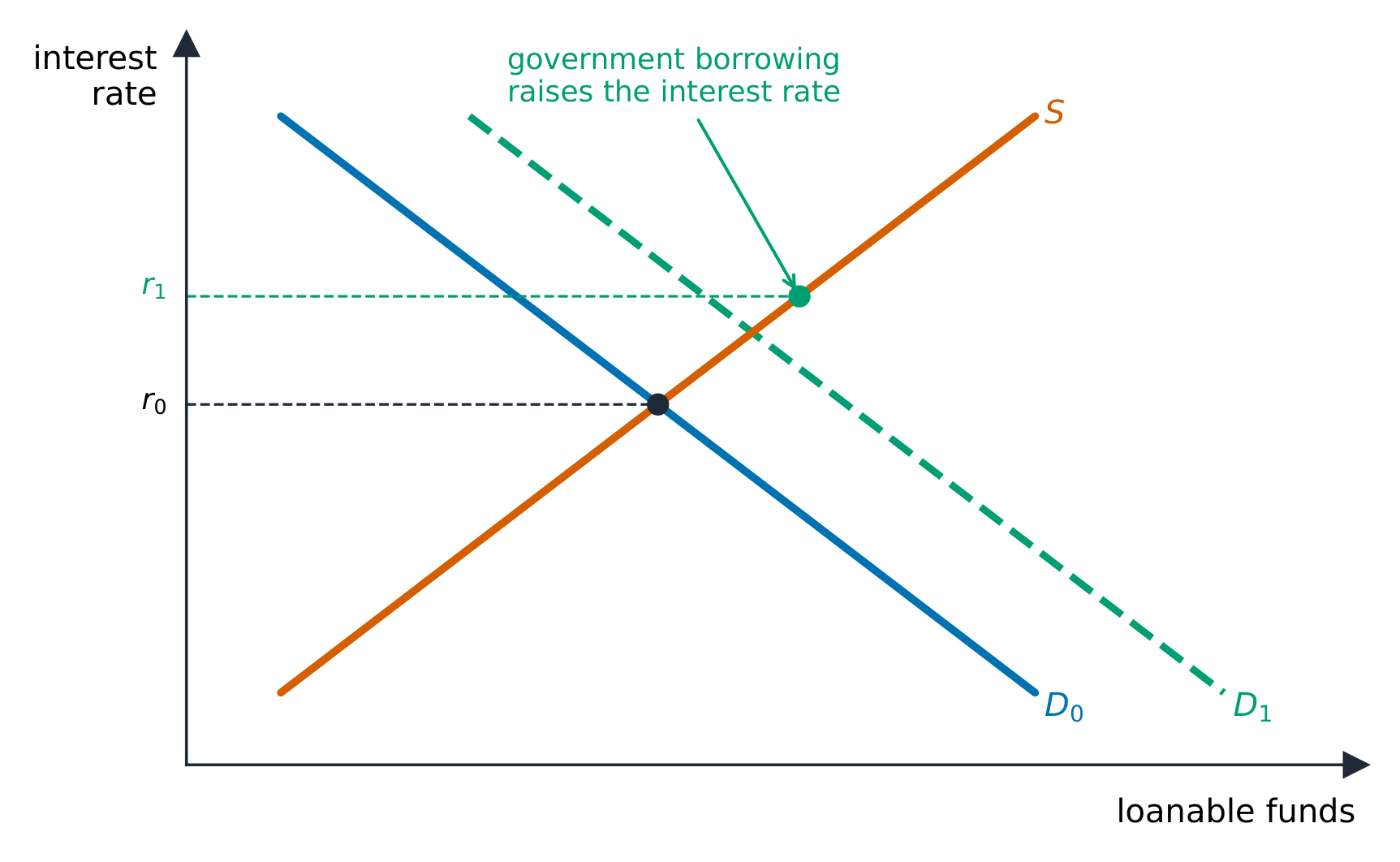
Crowding out 挤出效应 is the main long-run cost of deficit-financed fiscal policy. When the government borrows heavily, it increases the demand for loanable funds, raising the real interest rate. Higher rates reduce private investment (and interest-sensitive consumption). So expansionary fiscal policy partly cancels itself: the AD boost is offset by weaker investment. Worse, less investment today means a smaller capital stock and slower long-run growth.

Exam skill: show crowding out on the loanable funds graph – government borrowing shifts demand right, the real interest rate rises, and private investment falls.

Worked example. A government borrows $\$500$ billion to finance a deficit. On the loanable funds market this shifts the demand for funds right, pushing the real interest rate up (say from $3\%$ to $4\%$). At the higher rate firms scale back investment – perhaps by $\$150$ billion – so the net boost to AD is smaller than the $\$500$ billion, and the lost investment slows long-run growth.

日本語

Crowding out は、赤字財源による財政政策の主要な長期的コストである。政府が大量に借入すると、貸出可能資金への需要 を増やし、実質利子率 を引き上げる。高い利子率は 民間投資 (および利子感応型消費)を減少させる。したがって、拡張的財政政策は部分的に相殺され、ADの拡大は投資の弱化によって相殺される。さらに、今日の投資の減少は、資本ストックの縮小と 長期的な成長の鈍化 につながる。

政府の借入は金利を上げ、民間投資を挤出する

試験技能: 貸出可能資金 グラフ上で crowding out を示す——政府の借入は需要曲線を右に移動させ、実質利子率が上昇し、民間投資が減少する。

計算例。 政府が $\$500$ billion to finance a deficit. On the loanable funds market this shifts the demand for funds right, pushing the real interest rate up (say from $3\%$ to $4\%$). At the higher rate firms scale back investment – perhaps by $\$150$ 十億ドルを借り入れ、ADへの純増加分が $\$500$ 十億ドルより小さくなるため、投資の減少が長期成長を鈍化させる。

5.6

Economic Growth · ⁨経済成長⁩

Syllabus · ⁨シラバス⁩
English

Enduring Understanding (MEA-2): The economy fluctuates between periods of expansion and contraction in the short run, but economic growth can occur in the long run.

Learning Objective MEA-2.B: a. Define measures and determinants of economic growth. b. Explain (using graphs and data as appropriate) the determinants of economic growth. c. Calculate (using graphs and data as appropriate) per capita GDP and economic growth.

  • MEA-2.B.1 Economic growth can be measured as the growth rate in real GDP per capita over time.
  • MEA-2.B.2 Aggregate employment and aggregate output are directly related because firms need to employ more workers in order to produce more output, holding other factors constant. This is captured by the aggregate production function.
  • MEA-2.B.3 Output per employed worker is a measure of average labor productivity.
  • MEA-2.B.4 Productivity is determined by the level of technology and physical and human capital per worker.
  • MEA-2.B.5 The aggregate production function shows that output per capita is positively related to both physical and human capital per capita.
日本語

持続的理解 (MEA-2): 短期間では経済は伸縮期を繰り返すが、長期的には経済成長が可能である。

学習目標 MEA-2.B: a. 経済成長の指標および要因を定義せよ。 b. 適宜グラフおよびデータを使用して、経済成長の要因を説明せよ。 c. 適宜グラフおよびデータを使用して、一人当たりGDPおよび経済成長を計算せよ。

  • MEA-2.B.1 経済成長は、時間経過に伴う一人当たり実質GDPの成長率として測定できる。
  • MEA-2.B.2 総雇用と総生産量は密接に関係している。なぜなら、他の要因を一定とした場合、企業はより多くの生産物を製造するために労働者を多く雇用する必要があるからである。この関係性は総生産関数によって表される。
  • MEA-2.B.3 雇用者一人当たりの生産量は、平均労働生産性の指標である。
  • MEA-2.B.4 生産性は、技術レベルおよび労働者一人あたりの物理資本・人的資本の水準によって決定される。
  • MEA-2.B.5 総生産関数は、一人当たり生産量が一人あたり物理資本および一人あたり人的資本と正の相関があることを示している。

Source: College Board AP Course and Exam Description · ⁨出典: College Board AP コースおよび試験説明書⁩

English

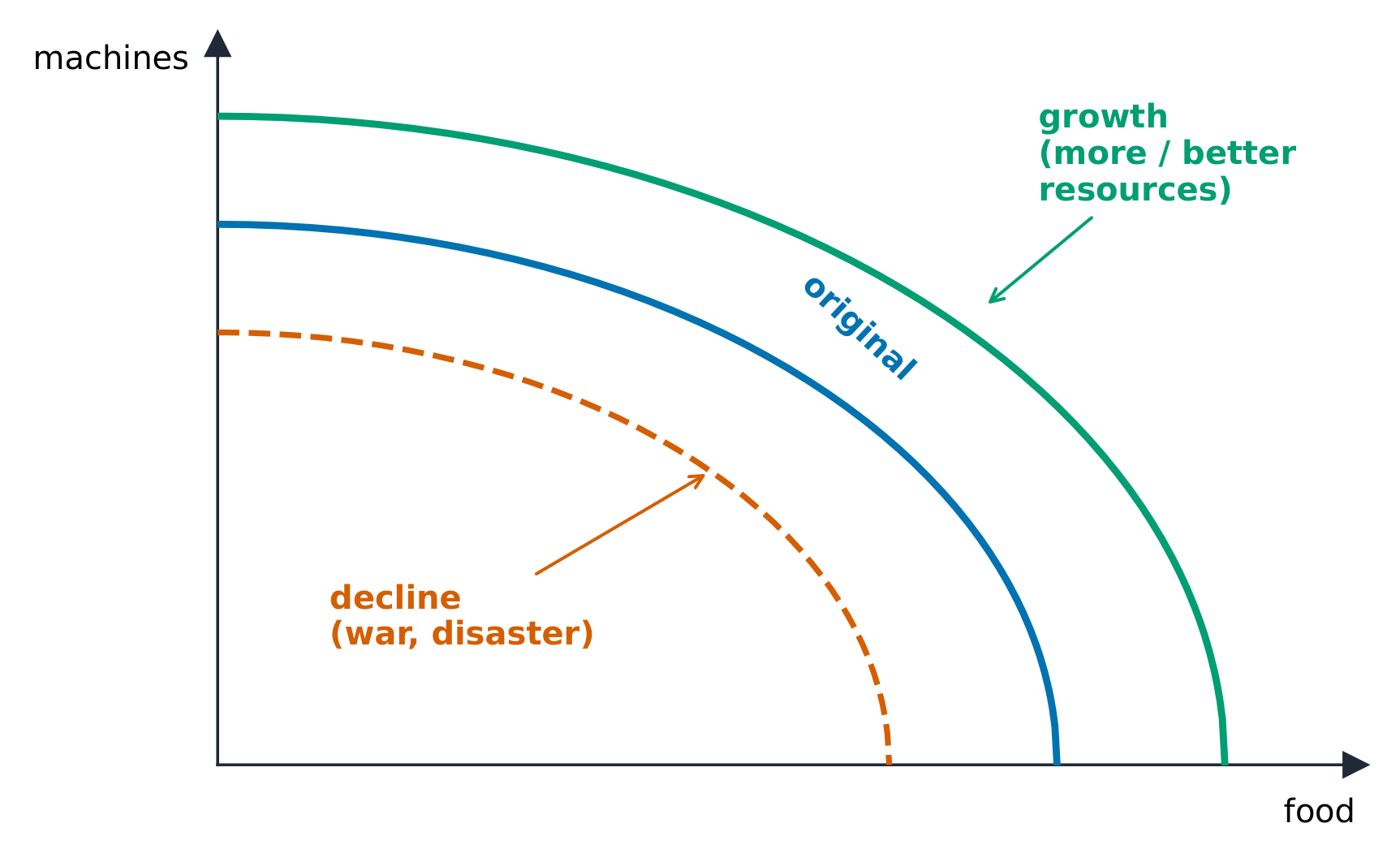
Economic growth 经济增长 is a sustained rise in real GDP per capita – the true source of higher living standards. It comes from more or better resources and is shown as a rightward shift of LRAS (and an outward shift of the PPC). Its main drivers:

  • physical capital 实物资本 (more tools and machines per worker),
  • human capital 人力资本 (education, skills, health),
  • technology 技术 and innovation,
  • productivity 生产率 (output per worker) growth, the deepest driver.
日本語

経済成長 は、一人当たり実質GDP の持続的な上昇であり、生活水準向上の真の源泉である。それはより多くまたはより良い資源から生まれ、LRASの右方シフト (およびPPCの外側シフト)として表される。主な駆動力は以下の通り:

経済成長は生産可能性境界曲線を外側にシフトさせる
  • 物質資本 (労働者あたりの道具や機械の増加)、
  • 人的資本 (教育、スキル、健康)、
  • 技術 とイノベーション、
  • 生産性 (労働者あたりの産出量)の成長、これが最も深い駆動力である。
Explore · ⁨探索⁩

Economic growth pushes the frontier out · ⁨経済成長が Frontier を外側へ押し出す⁩

Economic growth — more resources, better technology — shifts the whole production possibilities frontier outward, letting the economy produce more of everything. · ⁨経済成長 — 資源の増加、技術の向上 — は生産可能性 Frontier全体を外側へシフトさせ、経済があらゆるもののより多い生産を可能にする。⁩

5.7

Public Policy and Economic Growth · ⁨公共政策と経済成長⁩

Syllabus · ⁨シラバス⁩
English

Enduring Understanding (POL-4): Authorities and organizations institute policies that affect economic growth.

Learning Objective POL-4.A: a. Explain (using graphs as appropriate) public policies aimed at influencing long-run economic growth. b. Define supply-side fiscal policies.

[For a description of economic growth and information about how to show it graphically, see LO MEA-2.B, LO MOD-1.B, and LO MOD-2.I]

  • POL-4.A.1 Public policies that impact productivity and labor force participation affect real GDP per capita and economic growth.
  • POL-4.A.2 Government policies that invest in infrastructure and technology affect growth.
  • POL-4.A.3 Supply-side fiscal policies affect aggregate demand, aggregate supply, and potential output in the short run and long run by influencing incentives that affect household and business economic behavior.
日本語

永続的理解 (POL-4): 権限当局や組織は、経済成長に影響を与える政策を実施する。

学習目標 POL-4.A: a. 適宜グラフを使用して、長期経済成長に影響を与える公共政策について説明せよ。 b. サプライサイド财政政策を定義せよ。

[経済成長の説明およびそれを図示する方法については、LO MEA-2.B、LO MOD-1.B、LO MOD-2.I を参照]

  • POL-4.A.1 生産性や労働参加率に影響を与える公共政策は、一人当たり実質GDPおよび経済成長に影響を与える。
  • POL-4.A.2 インフラや技術への投資を行う政府の政策は、成長に影響を与える。
  • POL-4.A.3 サプライサイド财政政策は、家庭や企業の経済行動に影響を与えるインセンティブを通じて、短期および長期において総需要、総供給、潜在生産量に影響を与える。

Source: College Board AP Course and Exam Description · ⁨出典: College Board AP コースおよび試験説明書⁩

English

Governments can raise long-run growth by policies that build capital and productivity: investment in infrastructure and education, research and development incentives, protecting property rights 产权 and the rule of law, encouraging saving and investment (which finances capital), and keeping inflation low and stable. The recurring long-run theme: policies that crowd out or discourage investment slow growth, while those that encourage capital formation speed it up.

日本語
風力発電所: 資本に対する公共投資は長期的な経済成長を高めることができる

政府は、資本と生産性を築く政策によって長期的な成長を高めることができる。インフラや教育への投資、研究開発 に対するインセンティブ、財産権 や法治の保護、貯蓄と投資 の促進(これらが資本の資金調達を行う)、そして低かつ安定したインフレの維持である。反復する長期的なテーマは、crowding out したり投資を抑制したりする政策は成長を遅らせ、一方で資本形成を奨励 する政策は成長を加速させるという点にある。

5.7

Exam tips · ⁨試験対策⁩

English
  • The short-run Phillips curve shows the inflation–unemployment trade-off; the long-run curve is vertical at the natural rate.
  • In the long run inflation is a monetary phenomenon (money growth beyond output growth → inflation).
  • Show crowding out on the loanable-funds graph: government borrowing raises the real rate and cuts private investment.
  • Growth comes from more/better resources — physical capital, human capital, technology — shifting LRAS right.
  • A supply shock moves inflation and unemployment the same way (stagflation), unlike a demand shock.
日本語
  • 短期の フィリップス曲線 はインフレと失業のトレードオフを示し、長期曲線は自然雇用率において垂直である。
  • 長期的に見てインフレは 貨幣的 な現象である(生産成長を超える通貨増 → インフレ)。
  • 貸出可能資金グラフ上で crowding out を示す: 政府の借入は実質利子率を引き上げ、民間投資を削減する。
  • 成長はより多く/より良い資源(物質資本、人的資本、技術)から生まれ、LRASを右にシフトさせる。
  • 供給ショックはインフレと失業を同じ方向に動かす(スタグフレーション)、需要ショックとは異なる。

Interactive lessons on this topic · ⁨このトピックのインタラクティブ授業⁩

Work through it step by step, with instant-check exercises. · ⁨一歩ずつ進め、即時チェック付きの問題で学習します。⁩

Past Papers · ⁨過去問⁩

More topics in AP Macroeconomics · ⁨AP マクロ経済学⁩ · ⁨AP Macroeconomics · ⁨AP マクロ経済学⁩ の他のトピック⁩

Log in or create account · ⁨ログインまたはアカウント作成⁩

IGCSE, A-Level & AP