English
The heart is made of muscle 肌肉. A wall called the septum 隔膜 divides it into a left side and a right side. On each side there is an upper chamber, the atrium 心房, and a lower chamber, the ventricle 心室. Valves between the chambers stop the blood flowing backwards. The heart muscle is fed with blood by the coronary arteries 冠状动脉.
(Supplement) The wall of the left ventricle is thicker than the right, because it must pump blood all the way around the body; the right side only pumps blood to the nearby lungs. The atria have thin walls, as they only push blood into the ventricles just below them.
The septum keeps oxygenated blood 含氧血 on the left side apart from deoxygenated blood 缺氧血 on the right side, so the two never mix.
(Supplement) The valves between each atrium and ventricle are the atrioventricular valves 房室瓣. The valves at the exit of each ventricle are the semilunar valves 半月瓣.
How the heart beats (Supplement)
- The atria contract 收缩 and push blood down into the ventricles.
- The ventricles contract and force blood out into the arteries; the valves snap shut so blood cannot flow back.
- The muscle relaxes and the heart fills with blood again.
Blood is pumped away from the heart in arteries and returns to the heart in veins.
Heart rate and exercise
You can check the heart's activity with an ECG, by feeling the pulse 脉搏 in an artery, or by listening to the valves closing. During exercise the heart rate 心率 goes up, so blood reaches the muscles faster, bringing the extra oxygen and glucose they need.
Worked example. A student counts 18 pulse beats in 15 seconds at rest, and 33 beats in 15 seconds straight after exercise. Give both heart rates in beats per minute. A minute holds 60 ÷ 15 = 4 lots of 15 seconds, so multiply by 4. At rest: 18 × 4 = 72 beats per minute. After exercise: 33 × 4 = 132 beats per minute. The rise delivers more oxygen and glucose to the muscles. Writing the 15-second count straight down as the heart rate is the commonest mistake - always scale it up to a full minute.
Coronary heart disease
Coronary heart disease 冠心病 happens when the coronary arteries become narrow or blocked, so the heart muscle cannot get enough oxygen. Risk factors 风险因素 include a diet high in fat, lack of exercise, stress, smoking, family history (genetics), older age, and being male. A healthy diet and regular exercise lower the risk.
Bahasa Indonesia
Jantung terbuat dari otot. Dinding bernama septum membaginya menjadi sisi kiri dan kanan. Di setiap sisi terdapat ruang atas, atrium, dan ruang bawah, ventrikel. Katup antar ruang mencegah darah mengalir balik. Otot jantung dialiri darah oleh arteri koroner.
(Suplemen) Dinding ventrikel kiri lebih tebal daripada ventrikel kanan, karena harus memompa darah sepanjang tubuh; sisi kanan hanya memompa darah ke paru-paru yang berdekatan. Atrium memiliki dinding tipis karena hanya mendorong darah ke ventrikel tepat di bawahnya.
Septum menjaga darah kaya oksigen di sisi kiri terpisah dari darah tanpa oksigen di sisi kanan, sehingga keduanya tidak pernah bercampur.
(Suplemen) Katup antara setiap atrium dan ventrikel adalah katup atrioventrikular. Katup di出口 setiap ventrikel adalah katup semilunar.
 *Empat ruang jantung; ventrikel kiri memiliki dinding paling tebal untuk memompa ke seluruh tubuh
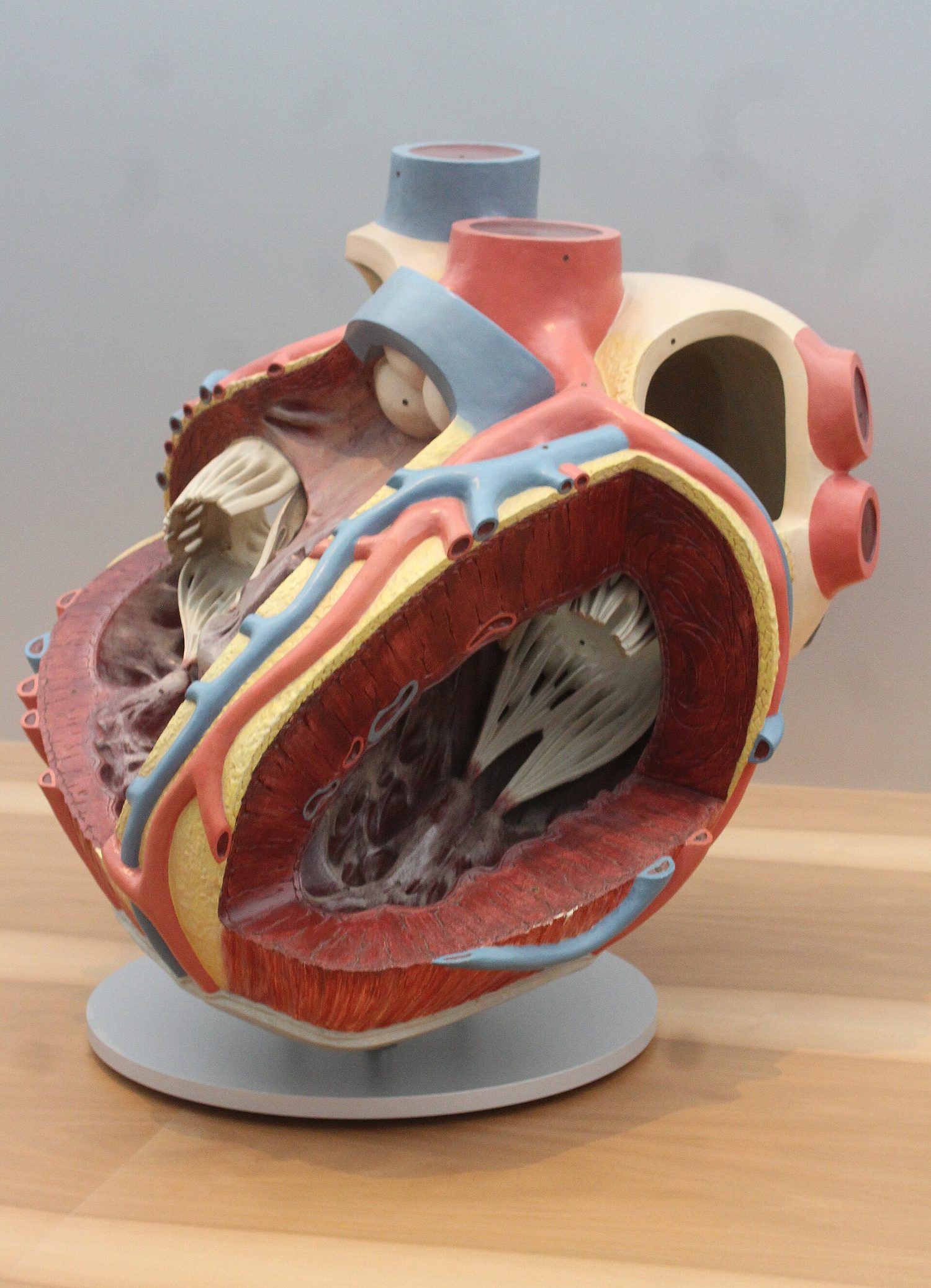 *Jantung yang sama seperti model museum: empat ruang, dan dinding ventrikel kiri yang terlihat lebih tebal
Cara jantung berdetak (Suplemen)
- Atrium berkontraksi dan mendorong darah turun ke ventrikel.
- Ventrikel berkontraksi dan memaksa darah keluar ke arteri; katup menyepit sehingga darah tidak dapat mengalir balik.
- Otot relaksasi dan jantung terisi darah lagi.
Darah dipompa menjauhi jantung melalui arteri dan kembali ke jantung melalui vena.
Denyut jantung dan olahraga
Anda dapat memeriksa aktivitas jantung dengan ECG, meraba denyutan di arteri, atau mendengarkan penutupan katup. Saat berolahraga, denyut jantung meningkat, sehingga darah mencapai otot lebih cepat, membawa oksigen dan glukosa ekstra yang dibutuhkan.
 *Saat berolahraga, denyut jantung meningkat sehingga darah mencapai otot lebih cepat
Contoh pengerjaan. Seorang siswa menghitung 18 detak denyutan selama 15 detik saat istirahat, dan 33 detak selama 15 detik tepat setelah olahraga. Berikan kedua denyut jantung dalam detak per menit. Satu menit mengandung 60 ÷ 15 = 4 bagian dari 15 detik, jadi kalikan dengan 4. Saat istirahat: 18 × 4 = 72 detak per menit. Setelah olahraga: 33 × 4 = 132 detak per menit. Peningkatan ini mengirimkan lebih banyak oksigen dan glukosa ke otot. Menuliskan hitungan 15 detik langsung sebagai denyut jantung adalah kesalahan paling umum - selalu skalakan ke satu menit penuh.
Penyakit jantung koroner
Penyakit jantung koroner terjadi ketika arteri koroner menyempit atau tersumbat, sehingga otot jantung tidak mendapatkan cukup oksigen. Faktor risiko meliputi diet tinggi lemak, kurangnya olahraga, stres, merokok, riwayat keluarga (genetika), usia tua, dan jenis kelamin laki-laki. Diet sehat dan olahraga teratur menurunkan risiko.
 *Penyakit jantung koroner menyempitkan arteri; beberapa faktor risiko meningkatkannya dan gaya hidup sehat menurunkannya


