Skip to content · ⁨Lompat ke konten⁩

Torque and Rotational Dynamics · ⁨Torsi dan Dinamika Rotasi⁩

AP Physics C: Mechanics · ⁨AP Fisika C: Mekanika⁩ · Topic 5 · ⁨Topik 5⁩

Video lesson for this topic · ⁨Pelajaran video untuk topik ini⁩ Open the video page · ⁨Buka halaman video⁩
7:22

Torsi dan Dinamika Rotasi

Dorong pintu di gagangnya dan pintu terbuka dengan mudah. Sekarang dorong dengan kekuatan yang sama, tepat di samping engsel. Hampir tidak terjadi apa-apa. Gayanya sama kedua kalinya.…

English narration · English + 中文 subtitles burned in · ⁨Narasi bahasa Inggris · Subtitle bahasa Inggris + 中文 disematkan langsung⁩

5.1

Rotational Kinematics · ⁨Kinematika Rotasi⁩

Syllabus · ⁨Silabus⁩
English

Learning Objective 5.1.A: Describe the rotation of a system with respect to time using angular displacement, angular velocity, and angular acceleration.

  • 5.1.A.1 Angular displacement is the measurement of the angle, in radians, through which a point on a rigid system rotates about a specified axis.
    • Equation: $\Delta\theta = \theta - \theta_0$
    • 5.1.A.1.i A rigid system is one that holds its shape but in which different points on the system move in different directions during rotation. A rigid system cannot be modeled as an object.
    • 5.1.A.1.ii One direction of angular displacement about an axis of rotation—clockwise or counterclockwise—is typically indicated as mathematically positive, with the other direction becoming mathematically negative.
    • 5.1.A.1.iii If the rotation of a system about an axis may be well described using the motion of the system's center of mass, the system may be treated as a single object. For example, the rotation of Earth about its axis may be considered negligible when considering the revolution of Earth about the center of mass of the Earth–Sun system.
  • 5.1.A.2 Angular velocity is the rate at which angular position changes with respect to time.
    • Equation: $\omega = \dfrac{d\theta}{dt}$
  • 5.1.A.3 Angular acceleration is the rate at which angular velocity changes with respect to time.
    • Equation: $\alpha = \dfrac{d\omega}{dt}$
  • 5.1.A.4 Angular displacement, angular velocity, and angular acceleration around one axis are analogous to linear displacement, velocity, and acceleration in one dimension and demonstrate the same mathematical relationships.
    • 5.1.A.4.i For constant angular acceleration, the mathematical relationships between angular displacement, angular velocity, and angular acceleration can be described with the following equations:
      • $\omega = \omega_0 + \alpha t$
      • $\theta = \theta_0 + \omega_0 t + \dfrac{1}{2}\alpha t^2$
      • $\omega^2 = \omega_0^2 + 2\alpha(\theta - \theta_0)$
    • 5.1.A.4.ii Graphs of angular displacement, angular velocity, and angular acceleration as functions of time can be used to find the relationships between those quantities.

Boundary statement: AP Physics C: Mechanics expects students to be able to mathematically manipulate the magnitudes of angular displacement, angular velocity, and angular acceleration using vector conventions. However, the directions of said vectors will not be assessed on the exam.

Descriptions of the directions of rotational kinematics quantities for a point or rigid body are limited to clockwise and counterclockwise with respect to a given axis of rotation.

Bahasa Indonesia

Tujuan Pembelajaran 5.1.A: Deskripsikan rotasi suatu sistem terhadap waktu menggunakan simpangan sudut, kecepatan sudut, dan percepatan sudut.

  • 5.1.A.1 Simpangan sudut adalah pengukuran sudut, dalam radian, melalui mana sebuah titik pada sistem kaku berotasi sekitar sumbu yang ditentukan.
    • Persamaan: $\Delta\theta = \theta - \theta_0$
    • 5.1.A.1.i Sistem kaku adalah sistem yang mempertahankan bentuknya tetapi di mana titik-titik berbeda pada sistem bergerak ke arah yang berbeda selama rotasi. Sistem kaku tidak dapat dimodelkan sebagai satu objek.
    • 5.1.A.1.ii Salah satu arah simpangan sudut terhadap sumbu rotasi—searah jarum jam atau berlawanan arah jarum jam—biasanya ditunjukkan secara matematis sebagai positif, dengan arah lainnya menjadi negatif secara matematis.
    • 5.1.A.1.iii Jika rotasi sistem terhadap sumbu dapat dijelaskan dengan baik menggunakan gerakan pusat massa sistem, sistem tersebut dapat diperlakukan sebagai satu objek tunggal. Sebagai contoh, rotasi Bumi terhadap porosnya dapat dianggap dapat diabaikan ketika mempertimbangkan revolusi Bumi terhadap pusat massa sistem Bumi-Matahari.
  • 5.1.A.2 Kecepatan sudut adalah laju perubahan posisi sudut terhadap waktu.
    • Persamaan: $\omega = \dfrac{d\theta}{dt}$
  • 5.1.A.3 Percepatan sudut adalah laju perubahan kecepatan sudut terhadap waktu.
    • Persamaan: $\alpha = \dfrac{d\omega}{dt}$
  • 5.1.A.4 Simpangan sudut, kecepatan sudut, dan percepatan sudut di sekitar satu sumbu analog dengan perpindahan linear, kecepatan, dan percepatan dalam satu dimensi dan menunjukkan hubungan matematis yang sama.
    • 5.1.A.4.i Untuk percepatan sudut konstan, hubungan matematis antara simpangan sudut, kecepatan sudut, dan percepatan sudut dapat dijelaskan dengan persamaan berikut:
      • $\omega = \omega_0 + \alpha t$
      • $\theta = \theta_0 + \omega_0 t + \dfrac{1}{2}\alpha t^2$
      • $\omega^2 = \omega_0^2 + 2\alpha(\theta - \theta_0)$
    • 5.1.A.4.ii Grafik simpangan sudut, kecepatan sudut, dan percepatan sudut sebagai fungsi waktu dapat digunakan untuk menemukan hubungan antar besaran tersebut.

Pernyataan Batas: AP Physics C: Mekanika mengharapkan siswa mampu memanipulasi secara matematis besaran simpangan sudut, kecepatan sudut, dan percepatan sudut menggunakan konvensi vektor. Namun, arah vektor-vektor tersebut tidak akan diujikan dalam ujian.

Deskripsi arah kuantitas kinematika rotasi untuk sebuah titik atau benda kaku terbatas pada arah searah jarum jam dan berlawanan arah jarum jam relatif terhadap sumbu rotasi tertentu.
Source: College Board AP Course and Exam Description · ⁨Sumber: Deskripsi Kursus dan Ujian College Board AP⁩

English

Rotation mirrors linear motion with angular quantities, defined as derivatives:

$$\omega=\frac{d\theta}{dt},\qquad \alpha=\frac{d\omega}{dt}=\frac{d^2\theta}{dt^2}.$$

Here $\theta$ is angular displacement 角位移 in radians 弧度, $\omega$ the angular velocity 角速度, and $\alpha$ the angular acceleration 角加速度. (AP works with their magnitudes and signs; the 3D vector directions are not assessed.) For constant $\alpha$, the kinematic equations are the linear ones re-lettered:

$$\omega=\omega_0+\alpha t,\qquad \Delta\theta=\omega_0t+\tfrac12\alpha t^2,\qquad \omega^2=\omega_0^2+2\alpha\,\Delta\theta.$$

Worked example. A fan blade slows from $30\ \text{rad/s}$ to rest with $\alpha=-6.0\ \text{rad/s}^2$: it takes $t=5.0\ \text{s}$ and turns through $\Delta\theta=\dfrac{0-30^2}{2(-6.0)}=75\ \text{rad}$ – about $12$ revolutions.

Bahasa Indonesia

Rotasi memirrorikan gerak linear dengan besaran sudut, didefinisikan sebagai turunan:

$$\omega=\frac{d\theta}{dt},\qquad \alpha=\frac{d\omega}{dt}=\frac{d^2\theta}{dt^2}.$$

Di sini $\theta$ adalah pergeseran sudut dalam radian, $\omega$ adalah kecepatan sudut, dan $\alpha$ adalah percepatan sudut. (AP bekerja dengan nilai mutlak dan tanda mereka; arah vektor 3D tidak diujikan.) Untuk konstanta $\alpha$, persamaan kinematika adalah persamaan linear yang ditulis ulang:

$$\omega=\omega_0+\alpha t,\qquad \Delta\theta=\omega_0t+\tfrac12\alpha t^2,\qquad \omega^2=\omega_0^2+2\alpha\,\Delta\theta.$$
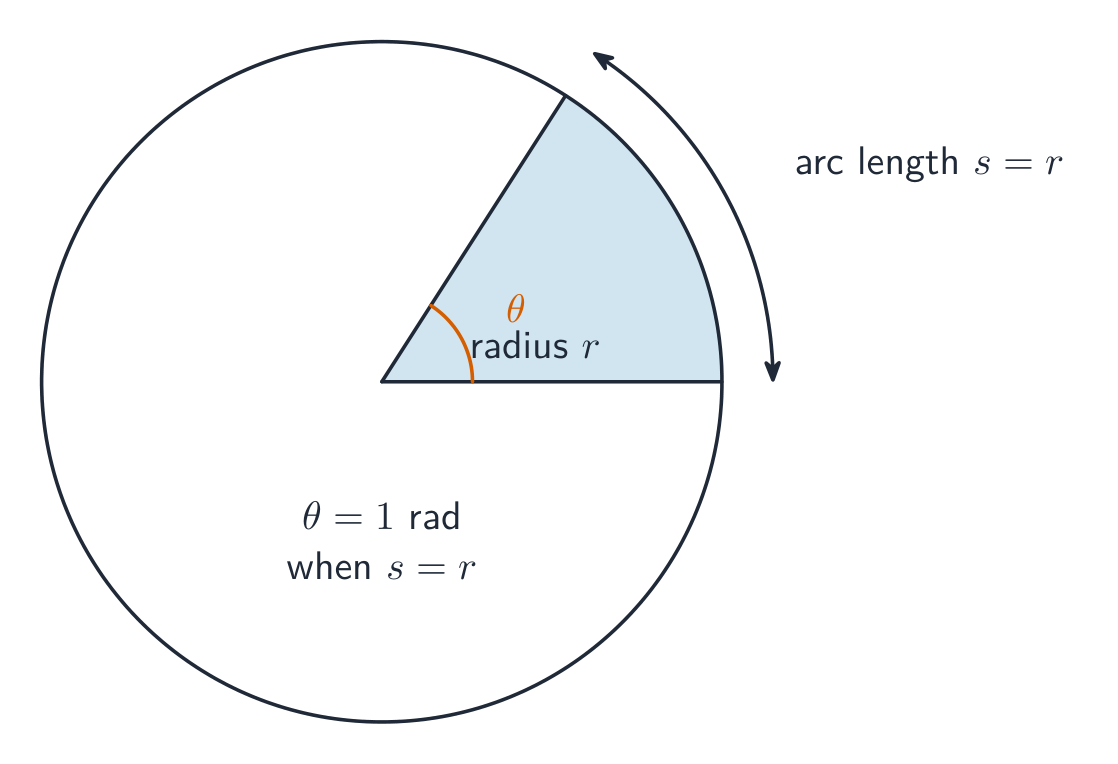
Satu radian adalah sudut yang panjang busurnya sama dengan jari-jari

Contoh terpecahkan. Baling-baling kipas melambat dari $30\ \text{rad/s}$ hingga berhenti dengan $\alpha=-6.0\ \text{rad/s}^2$: membutuhkan waktu $t=5.0\ \text{s}$ dan berputar sejauh $\Delta\theta=\dfrac{0-30^2}{2(-6.0)}=75\ \text{rad}$ – sekitar $12$ putaran.

5.2

Connecting Linear and Rotational Motion · ⁨Menghubungkan Gerak Linear dan Rotasi⁩

Syllabus · ⁨Silabus⁩
English

Learning Objective 5.2.A: Describe the linear motion of a point on a rotating rigid system that corresponds to the rotational motion of that point, and vice versa.

  • 5.2.A.1 For a point at a distance $r$ from a fixed axis of rotation, the linear distance $s$ traveled by the point as the system rotates through an angle $\Delta\theta$ is given by the equation $\Delta s = r\Delta\theta$.
  • 5.2.A.2 Derived relationships of linear velocity and of the tangential component of acceleration to their respective angular quantities are given by the following equations:
    • $s = r\theta$
    • $v = r\omega$
    • $a_T = r\alpha$
  • 5.2.A.3 For a rigid system, all points within that system have the same angular velocity and angular acceleration.

Boundary statement: AP Physics C: Mechanics expects students to be able to mathematically manipulate the magnitudes of angular displacement, angular velocity, and angular acceleration using vector conventions. However, the directions of the vectors will not be assessed on the exam.

Descriptions of the directions of rotational kinematics quantities for a point or rigid body are limited to clockwise and counterclockwise with respect to a given axis of rotation.

Bahasa Indonesia

Tujuan Pembelajaran 5.2.A: Deskripsikan gerakan linear sebuah titik pada sistem kaku berotasi yang sesuai dengan gerakan rotasi titik tersebut, dan sebaliknya.

  • 5.2.A.1 Untuk sebuah titik pada jarak $r$ dari sumbu rotasi tetap, jarak linear $s$ yang ditempuh oleh titik tersebut saat sistem berotasi sejauh sudut $\Delta\theta$ diberikan oleh persamaan $\Delta s = r\Delta\theta$.
  • 5.2.A.2 Hubungan turunan dari kecepatan linear dan komponen tangensial percepatan terhadap besaran sudut masing-masing diberikan oleh persamaan berikut:
    • $s = r\theta$
    • $v = r\omega$
    • $a_T = r\alpha$
  • 5.2.A.3 Untuk sistem kaku, semua titik di dalamnya memiliki kecepatan sudut dan percepatan sudut yang sama.

Pernyataan Batas: AP Physics C: Mekanika mengharapkan siswa mampu memanipulasi secara matematis besaran simpangan sudut, kecepatan sudut, dan percepatan sudut menggunakan konvensi vektor. Namun, arah vektor-vektor tersebut tidak akan diujikan dalam ujian.

Deskripsi arah kuantitas kinematika rotasi untuk sebuah titik atau benda kaku terbatas pada arah searah jarum jam dan berlawanan arah jarum jam relatif terhadap sumbu rotasi tertentu.
Source: College Board AP Course and Exam Description · ⁨Sumber: Deskripsi Kursus dan Ujian College Board AP⁩

English

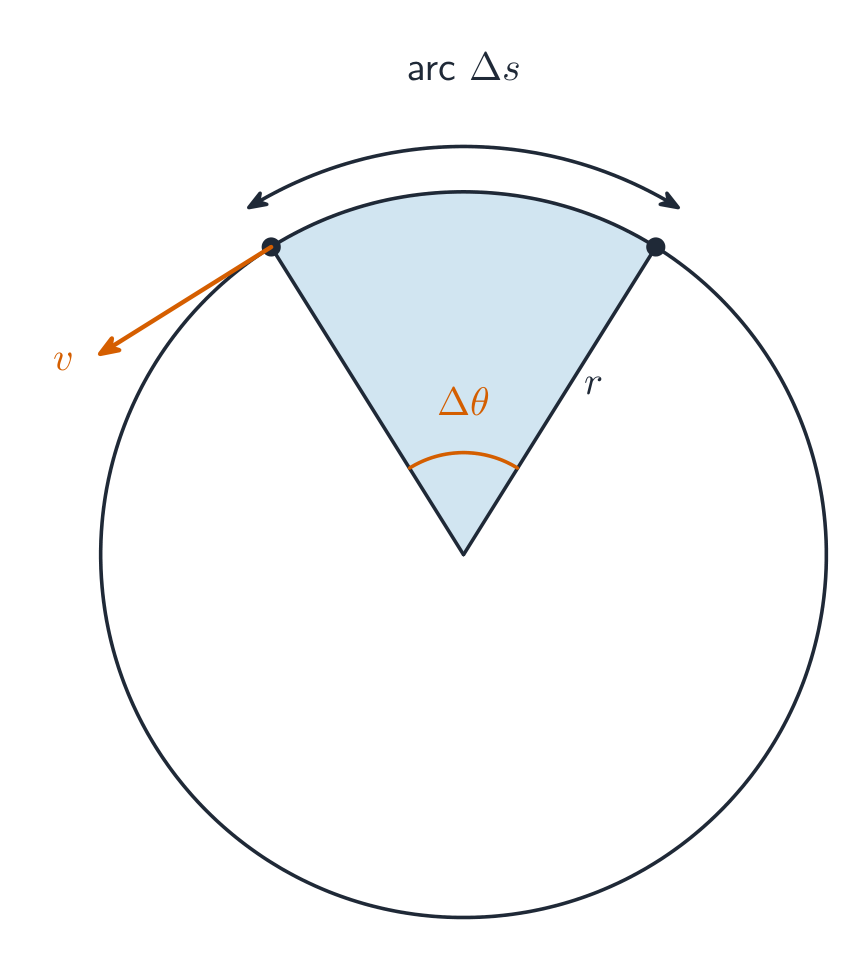
A point at radius $r$ from the axis moves along its arc with

$$s=r\theta,\qquad v=r\omega,\qquad a_t=r\alpha,$$

so points farther out move faster. A rotating point generally has two acceleration components at once: the tangential acceleration 切向加速度 $a_t=r\alpha$ (speeding up along the arc) and the centripetal acceleration 向心加速度 $a_c=\dfrac{v^2}{r}=r\omega^2$ (turning, towards the axis). They are perpendicular, so $a=\sqrt{a_t^2+a_c^2}$.

Bahasa Indonesia

Sebuah titik pada jari-jari $r$ dari sumbu bergerak sepanjang busurnya dengan

$$s=r\theta,\qquad v=r\omega,\qquad a_t=r\alpha,$$

sehingga titik yang lebih jauh bergerak lebih cepat. Sebuah titik yang berotasi umumnya memiliki dua komponen percepatan sekaligus: percepatan tangensial $a_t=r\alpha$ (menambah kecepatan sepanjang busur) dan percepatan sentripetal $a_c=\dfrac{v^2}{r}=r\omega^2$ (berbelok, menuju sumbu). Keduanya tegak lurus, sehingga $a=\sqrt{a_t^2+a_c^2}$.

As the radius turns through an angle, a point moves along an arc at speed v
5.3

Torque · ⁨Torsi⁩

Syllabus · ⁨Silabus⁩
Learning ObjectiveEssential Knowledge

5.3.A
Identify the torques exerted on a rigid system.

  • 5.3.A.1 Torque results only from the force component perpendicular to the position vector from the axis of rotation to the point of application of the force.
  • 5.3.A.2 The lever arm is the perpendicular distance from the axis of rotation to the line of action of the exerted force.

5.3.B
Describe the torques exerted on a rigid system.

  • 5.3.B.1 Torques can be described using force diagrams.
    • 5.3.B.1.i Force diagrams are similar to free-body diagrams and are used to analyze the torques exerted on a rigid system.
    • 5.3.B.1.ii Similar to free-body diagrams, force diagrams represent the relative magnitude and direction of the forces exerted on a rigid system. Force diagrams also depict the location at which those forces are exerted relative to the axis of rotation.
  • 5.3.B.2 The torque exerted on a rigid system about a chosen pivot point by a given force is described by $\vec{\tau} = \vec{r} \times \vec{F}$.
    • 5.3.B.2.i The cross-product between two vectors, $\vec{A}$ and $\vec{B}$, results in a vector quantity of magnitude $\vec{A} \times \vec{B} = AB\sin\theta$.
    • 5.3.B.2.ii The direction of the vector resulting from the cross-product of vectors $\vec{A}$ and $\vec{B}$ is perpendicular to both vectors $\vec{A}$ and $\vec{B}$ and therefore is normal to the plane defined by vectors $\vec{A}$ and $\vec{B}$.
    • 5.3.B.2.iii The direction of the vector resulting from the cross-product of vectors $\vec{A}$ and $\vec{B}$ can be qualitatively determined by applying the appropriate right-hand rule.

Source: College Board AP Course and Exam Description · ⁨Sumber: Deskripsi Kursus dan Ujian College Board AP⁩

English
The principle of moments (torque)

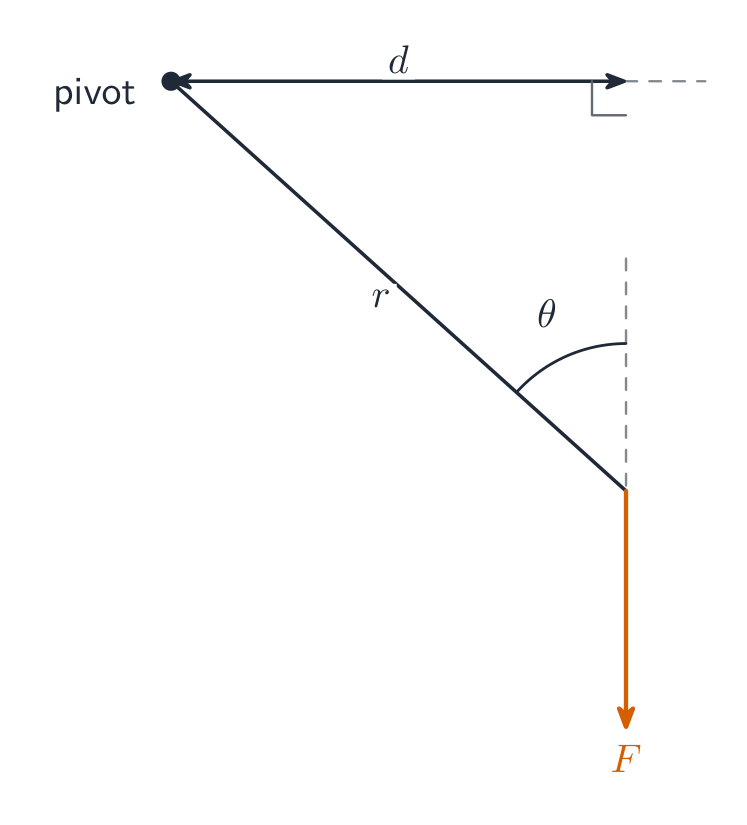
Torque 力矩 is the turning effect of a force – the rotational cause, as force is the translational cause. It is a vector product 矢量积:

$$\vec{\tau}=\vec{r}\times\vec{F},\qquad \tau=rF\sin\theta=F\,r_\perp,$$

where $r_\perp$, the moment arm 力臂, is the perpendicular distance from the axis to the force's line of action. More force, applied farther from the axis, more perpendicular: more torque. A force pointing straight at (or away from) the axis has zero torque. In a plane, give counterclockwise and clockwise torques opposite signs and add.

As a vector product, $\vec\tau=\vec r\times\vec F$ points perpendicular to the plane of $\vec r$ and $\vec F$, with its direction fixed by the right-hand rule 右手定则: curl your right fingers from $\vec r$ toward $\vec F$ and your thumb points along $\vec\tau$ – out of the page for a counterclockwise turn, into it for a clockwise one. The same rule gives the direction of angular momentum $\vec L=\vec r\times\vec p$.

Bahasa Indonesia
The principle of moments (torque)

Torsi adalah efek putaran dari sebuah gaya – penyebab rotasi, sebagaimana gaya adalah penyebab translasi. Ini adalah produk vektor:

$$\vec{\tau}=\vec{r}\times\vec{F},\qquad \tau=rF\sin\theta=F\,r_\perp,$$

di mana $r_\perp$, lengan momen, adalah jarak tegak lurus dari sumbu ke garis kerja gaya. Semakin besar gaya, diterapkan semakin jauh dari sumbu, semakin tegak lurus: semakin besar torsi. Gaya yang mengarah lurus ke (atau menjauhi) sumbu memiliki torsi nol. Dalam bidang, berikan tanda yang berlawanan untuk torsi berlawanan jarum jam dan searah jarum jam, lalu jumlahkan.

Sebagai produk vektor, $\vec\tau=\vec r\times\vec F$ menunjuk tegak lurus terhadap bidang dari $\vec r$ dan $\vec F$, dengan arahnya ditentukan oleh aturan tangan kanan: tekuk jari kanan Anda dari $\vec r$ menuju $\vec F$ dan ibu jari Anda menunjuk sepanjang $\vec\tau$ – keluar dari halaman untuk putaran berlawanan jarum jam, masuk ke dalamnya untuk putaran searah jarum jam. Aturan yang sama memberikan arah momentum sudut $\vec L=\vec r\times\vec p$.

Torsi dari suatu gaya bergantung pada jarak tegak lurus dari sumbu
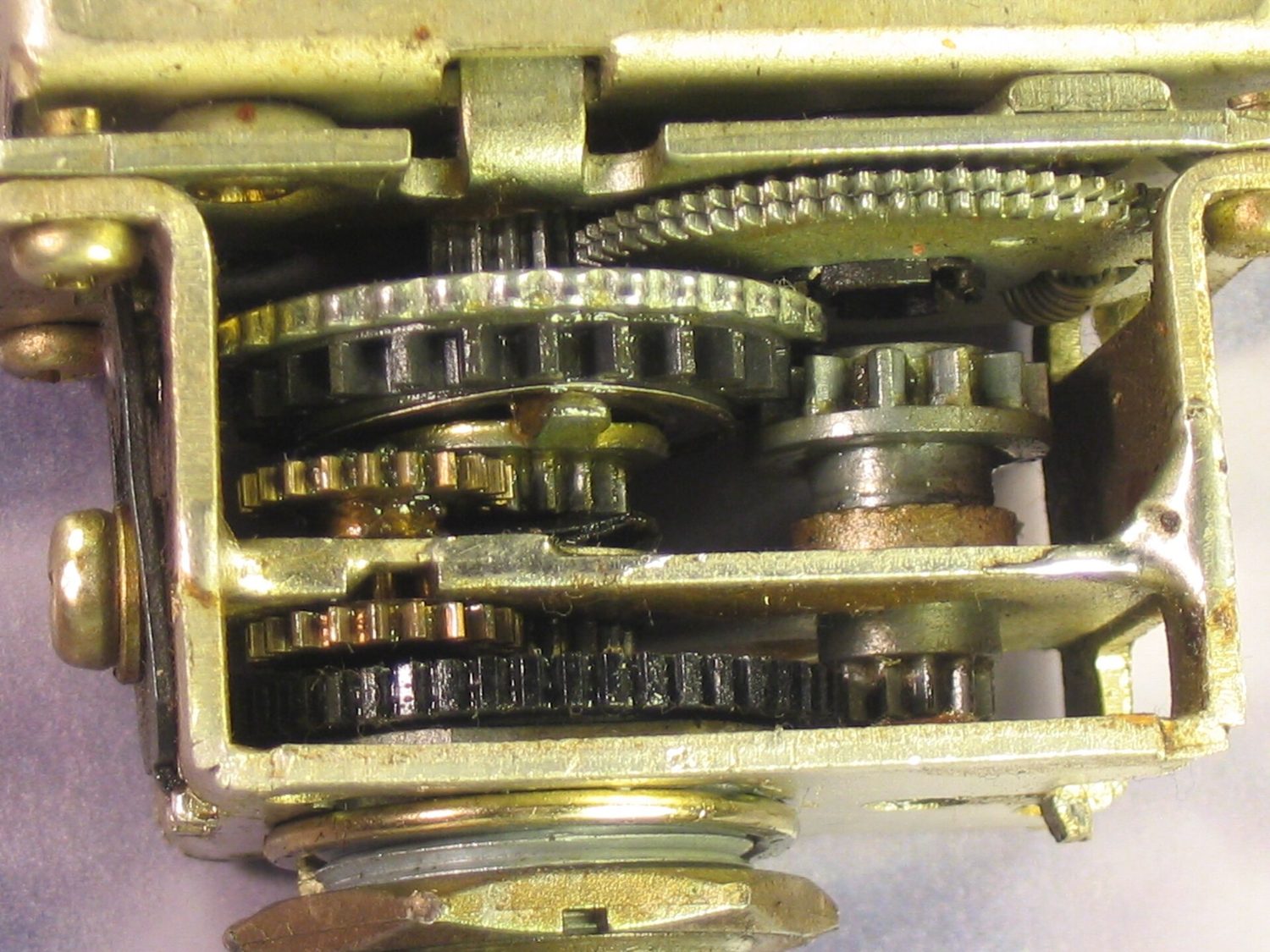
Rangkaian gigi: torsi dan inersia rotasi terhubung melalui rasio gigi
Explore · ⁨Jelajahi⁩

Balance torques on a beam · ⁨Seimbangkan torsi pada balok⁩

Torque is force times perpendicular distance, $\tau=Fd$. The beam is in rotational equilibrium when the torques on each side are equal. · ⁨Torsi adalah gaya dikali jarak tegak lurus, $\tau=Fd$. Balok berada dalam keseimbangan rotasi ketika torsi di kedua sisi sama.⁩

Vocabulary · ⁨Kosa kata⁩ Train · ⁨Latih⁩
English Bahasa Indonesia
angular displacement/ˈæŋɡjʊlə dɪˈspleɪsmənt/ pencucupan sudut
radians/ˈreɪdɪənz/ radian
angular velocity/ˈæŋɡjʊlə vəˈlɒsɪti/ halaju sudut
angular acceleration/ˈæŋɡjʊlə əkˌseləˈreɪʃn/ pecutan sudut
tangential acceleration/tænˈdʒenʃl əkˌseləˈreɪʃn/ pecutan tangensial
centripetal acceleration/senˈtrɪpɪtl əkˌseləˈreɪʃn/ percepatan sentripetal
Torque/tɔːk/ Torsi
vector product/ˈvektə ˈprɒdʌkt/ perkalian vektor
moment arm/ˈməʊmənt ɑːm/ Lengan momen
right-hand rule/raɪt hænd ruːl/ aturan tangan kanan
Rotational inertia/rəʊˈteɪʃənl ɪˈnɜːʃə/ Inersia rotasi
linear density/ˈlɪnɪə ˈdensɪti/ Kepadatan linear
parallel-axis theorem/ˈpærəlel ˈæksɪs ˈθɪərəm/ teorem sumbu sejajar
rotational equilibrium/rəʊˈteɪʃənl ˌiːkwɪˈlɪbrɪəm/ keseimbangan rotasi
static equilibrium/ˈstætɪk ˌiːkwɪˈlɪbrɪəm/ kesetimbangan statis
Watch lesson · ⁨Tonton pelajaran⁩
5.4

Rotational Inertia · ⁨Inersia Rotasi⁩

Syllabus · ⁨Silabus⁩
English

Learning Objective 5.4.A: Describe the rotational inertia of a rigid system relative to a given axis of rotation.

  • 5.4.A.1 Rotational inertia measures a rigid system's resistance to changes in rotation and is related to the mass of the system and the distribution of that mass relative to the axis of rotation.
  • 5.4.A.2 The rotational inertia of an object rotating a perpendicular distance $r$ from an axis is described by the equation $I = mr^2$.
  • 5.4.A.3 The total rotational inertia of a collection of objects about an axis is the sum of the rotational inertias of each object about that axis.
    • Equation: $I_{\text{tot}} = \sum I_i = \sum m_i r_i^2$
  • 5.4.A.4 For a solid that can be considered as a collection of differential masses, $dm$, the solid's rotational inertia can be calculated using the equation $I = \int r^2\, dm$, where $r$ is the perpendicular distance from $dm$ to the axis of rotation.

Learning Objective 5.4.B: Describe the rotational inertia of a rigid system rotating about an axis that does not pass through the system's center of mass.

  • 5.4.B.1 A rigid system's rotational inertia in a given plane is at a minimum when the rotational axis passes through the system's center of mass.
  • 5.4.B.2 The parallel axis theorem uses the following equation to relate the rotational inertia of a rigid system about any axis that is parallel to an axis through its center of mass:
    • Equation: $I' = I_{\text{cm}} + Md^2$

Boundary statement: AP Physics C: Mechanics only expects students to use calculus in the derivations of the rotational inertia of thin rods of uniform or nonuniform density about an arbitrary axis perpendicular to the rod, as well as derivations of the rotational inertia of a thin cylindrical shell, disk, or rigid bodies that can be considered to be made up of coaxial rings or shells about an axis that passes through their centers (e.g., annular rings).

Students should have a qualitative understanding of the factors that affect rotational inertia; for example, how rotational inertia is greater when mass is farther from the axis of rotation, which is why a hoop has more rotational inertia than a solid puck of the same mass and radius.

Bahasa Indonesia

Tujuan Pembelajaran 5.4.A: Jelaskan inersia rotasi sistem kaku relatif terhadap sumbu rotasi tertentu.
  • 5.4.A.1 Inersia rotasi mengukur resistensi sistem kaku terhadap perubahan rotasi dan berkaitan dengan massa sistem serta distribusi massa tersebut relatif terhadap sumbu rotasi.
  • 5.4.A.2 Inersia rotasi sebuah objek yang berputar pada jarak tegak lurus $r$ dari sebuah sumbu dijelaskan oleh persamaan $I = mr^2$.
  • 5.4.A.3 Total inersia rotasi dari sekumpulan objek tentang sebuah sumbu adalah jumlah dari inersia rotasi setiap objek tentang sumbu tersebut.
    • Persamaan: $I_{\text{tot}} = \sum I_i = \sum m_i r_i^2$
  • 5.4.A.4 Untuk padatan yang dapat dianggap sebagai kumpulan diferensial massa, $dm$, inersia rotasi padatan tersebut dapat dihitung menggunakan persamaan $I = \int r^2\, dm$, di mana $r$ adalah jarak tegak lurus dari $dm$ ke sumbu rotasi.

Tujuan Pembelajaran 5.4.B: Jelaskan inersia rotasi sistem kaku yang berotasi tentang sumbu yang tidak melewati pusat massa sistem.

  • 5.4.B.1 Inersia rotasi sistem kaku dalam bidang tertentu mencapai nilai minimum ketika sumbu rotasi melewati pusat massa sistem.
  • 5.4.B.2 Teorem sumbu sejajar menggunakan persamaan berikut untuk menghubungkan inersia rotasi sistem kaku tentang sembarang sumbu yang sejajar dengan sumbu yang melalui pusat massanya:
    • Persamaan: $I' = I_{\text{cm}} + Md^2$

Pernyataan Batas: AP Physics C: Mekanika hanya mengharapkan siswa menggunakan kalkulus dalam penurunan rumus inersia rotasi batang tipis dengan densitas seragam atau tidak seragam tentang sembarang sumbu tegak lurus batang, serta penurunan rumus inersia rotasi kulit silinder tipis, cakram, atau benda kaku yang dapat dianggap terdiri dari cincin atau cangkang koaksial tentang sumbu yang melalui pusat mereka (misalnya, cincin annular).

Siswa harus memiliki pemahaman kualitatif mengenai faktor-faktor yang memengaruhi inersia rotasi; misalnya, bagaimana inersia rotasi lebih besar ketika massa berada lebih jauh dari sumbu rotasi, yang menjelaskan mengapa sebuah lingkaran memiliki inersia rotasi lebih besar daripada cakram pekat dengan massa dan jari-jari yang sama.

Source: College Board AP Course and Exam Description · ⁨Sumber: Deskripsi Kursus dan Ujian College Board AP⁩

English

Rotational inertia 转动惯量 $I$ measures resistance to angular acceleration – the rotational analog of mass, but it depends on where the mass sits. For point masses, $I=\sum m_ir_i^2$; for a continuous body,

$$I=\int r^2\,dm.$$

Mass far from the axis dominates, because of the $r^2$.

Worked example (rod). A uniform rod (mass $M$, length $L$) about its centre: with linear density 线密度 $\lambda=M/L$, $dm=\lambda\,dx$, so $I=\displaystyle\int_{-L/2}^{L/2}x^2\,\frac{M}{L}\,dx=\frac{1}{12}ML^2$. AP also expects nonuniform rods: if $\lambda(x)=cx$ on $[0,L]$, first find $M=\int_0^L cx\,dx=\tfrac12cL^2$, then $I=\int_0^L x^2(cx)\,dx=\tfrac14cL^4=\tfrac12ML^2$ about the light end.

Worked example (disk from rings). A solid disk is a nest of rings: a ring at radius $r$ of width $dr$ has $dm=\dfrac{M}{\pi R^2}\,2\pi r\,dr$, so

$$I=\int_0^R r^2\,dm=\frac{2M}{R^2}\int_0^R r^3\,dr=\tfrac12MR^2.$$

The same coaxial-shell method handles cylindrical shells and annular rings.

The parallel-axis theorem 平行轴定理 shifts any known $I$ to a parallel axis a distance $d$ away:

$$I'=I_{\text{cm}}+Md^2.$$

For the rod about one end: $I=\tfrac1{12}ML^2+M\big(\tfrac{L}{2}\big)^2=\tfrac13ML^2$.

Bahasa Indonesia

Inersia rotasi $I$ mengukur resistansi terhadap percepatan sudut – analog rotasi dari massa, tetapi tergantung pada dimana massa berada. Untuk massa titik, $I=\sum m_ir_i^2$; untuk tubuh kontinu,

$$I=\int r^2\,dm.$$

Massa jauh dari sumbu mendominasi, karena $r^2$.

Contoh terpecahkan (batang). Batang seragam (massa $M$, panjang $L$) tentang pusatnya: dengan kerapatan linear $\lambda=M/L$, $dm=\lambda\,dx$, sehingga $I=\displaystyle\int_{-L/2}^{L/2}x^2\,\frac{M}{L}\,dx=\frac{1}{12}ML^2$. AP juga mengharapkan batang tidak seragam: jika $\lambda(x)=cx$ pada $[0,L]$, pertama-tama cari $M=\int_0^L cx\,dx=\tfrac12cL^2$, lalu $I=\int_0^L x^2(cx)\,dx=\tfrac14cL^4=\tfrac12ML^2$ tentang ujung ringan.

Contoh terpecahkan (cakram dari cincin). Cakram padat adalah sarang cincin: sebuah cincin pada jari-jari $r$ dengan lebar $dr$ memiliki $dm=\dfrac{M}{\pi R^2}\,2\pi r\,dr$, sehingga

$$I=\int_0^R r^2\,dm=\frac{2M}{R^2}\int_0^R r^3\,dr=\tfrac12MR^2.$$

Metode cangkang koaksial yang sama menangani cangkang silinder dan cincin annular.

Teorema sumbu sejajar menggeser setiap $I$ yang diketahui ke sumbu sejajar yang berjarak $d$:

$$I'=I_{\text{cm}}+Md^2.$$

Untuk batang tentang salah satu ujung: $I=\tfrac1{12}ML^2+M\big(\tfrac{L}{2}\big)^2=\tfrac13ML^2$.

5.5

Rotational Equilibrium · ⁨Kesetimbangan Rotasi⁩

Syllabus · ⁨Silabus⁩
English

Learning Objective 5.5.A: Describe the conditions under which a system's angular velocity remains constant.

  • 5.5.A.1 A system may exhibit rotational equilibrium (constant angular velocity) without being in translational equilibrium, and vice versa.
    • 5.5.A.1.i Free-body and force diagrams describe the nature of the forces and torques exerted on an object or rigid system.
    • 5.5.A.1.ii Rotational equilibrium is a configuration of torques such that the net torque exerted on the system is zero.
      • Equation: $\sum \tau_i = 0$
    • 5.5.A.1.iii The rotational analog of Newton's first law is that a system will have a constant angular velocity only if the net torque exerted on the system is zero.
  • 5.5.A.2 A rotational corollary to Newton's second law states that if the torques exerted on a rigid system are not balanced, the system's angular velocity must be changing.

Boundary statement: AP Physics C: Mechanics does not expect students to simultaneously analyze rotation in multiple planes.

Bahasa Indonesia

Tujuan Pembelajaran 5.5.A: Jelaskan kondisi di mana kecepatan sudut sistem tetap konstan.

  • 5.5.A.1 Suatu sistem dapat menunjukkan kesetimbangan rotasi (kecepatan sudut konstan) tanpa berada dalam kesetimbangan translasi, dan sebaliknya.
    • 5.5.A.1.i Diagram benda bebas dan diagram gaya mendeskripsikan sifat gaya-gaya dan torsi-torsi yang diberikan pada suatu objek atau sistem kaku.
    • 5.5.A.1.ii Kesetimbangan rotasi adalah konfigurasi torsi sedemikian rupa sehingga resultan torsi yang diberikan pada sistem adalah nol.
      • Persamaan: $\sum \tau_i = 0$
    • 5.5.A.1.iii Analog rotasi dari hukum pertama Newton menyatakan bahwa sistem akan memiliki kecepatan sudut konstan hanya jika resultan torsi yang diberikan pada sistem adalah nol.
  • 5.5.A.2 Koreolarium rotasi dari hukum kedua Newton menyatakan bahwa jika torsi-torsi yang diberikan pada sistem kaku tidak seimbang, maka kecepatan sudut sistem harus berubah.

Pernyataan Batas: AP Physics C: Mekanika tidak mengharapkan siswa untuk secara bersamaan menganalisis rotasi dalam beberapa bidang.

Source: College Board AP Course and Exam Description · ⁨Sumber: Deskripsi Kursus dan Ujian College Board AP⁩

English

Newton's first law has a rotational form: with zero net torque, angular velocity is constant – an object in rotational equilibrium 转动平衡 either does not rotate or rotates steadily. Full static equilibrium 静平衡 needs both $\sum F=0$ and $\sum\tau=0$ (about any axis). The standard move for beams and ladders: put the axis at the point where an unknown force acts, so that force drops out of the torque equation.

Worked example. A uniform $20\ \text{kg}$ beam, $4.0\ \text{m}$ long, is pivoted at its left end and held horizontal by a vertical rope at its right end. A $40\ \text{kg}$ child sits $1.0\ \text{m}$ from the pivot. Torques about the pivot: $T(4.0)=20g(2.0)+40g(1.0)$, so $T=\dfrac{392+392}{4.0}=196\ \text{N}$. Then vertical force balance gives the pivot's upward push: $F_p=(60)(9.8)-196=392\ \text{N}$. Choosing the pivot as the axis removed $F_p$ from the torque equation entirely.

Bahasa Indonesia

Hukum pertama Newton memiliki bentuk rotasi: dengan torsi neto nol, kecepatan sudut adalah konstan – sebuah objek dalam keseimbangan rotasi tidak berputar atau berputar stabil. Keseimbangan statis penuh membutuhkan kedua $\sum F=0$ dan $\sum\tau=0$ (tentang sumbu apa pun). Langkah standar untuk balok dan tangga: letakkan sumbu di titik di mana gaya tak dikenal bekerja, sehingga gaya itu hilang dari persamaan torsi.

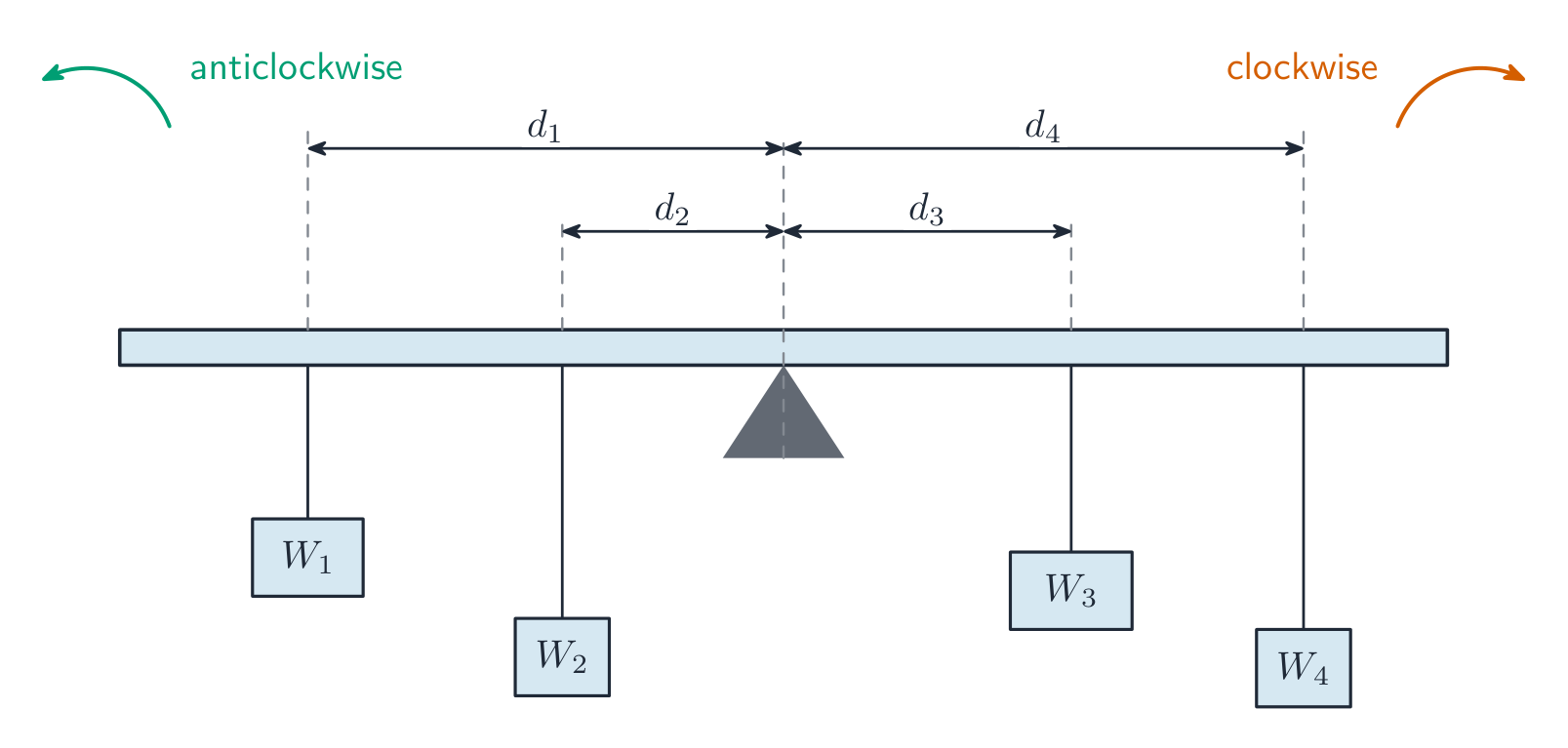
Pada kesetimbangan, torsi searah jarum jam dan berlawanan arah jarum jam terhadap sumbu adalah sama
Pada keseimbangan torsi searah jarum jam dan berlawanan jarum jam tentang sumbu adalah sama

Contoh terpecahkan. Sebuah balok $20\ \text{kg}$ seragam, panjangnya $4.0\ \text{m}$, ditumpukan di ujung kirinya dan dijaga tetap horizontal oleh tali vertikal di ujung kanannya. Seorang anak $40\ \text{kg}$ duduk $1.0\ \text{m}$ dari titik tumpu. Torsi terhadap titik tumpu: $T(4.0)=20g(2.0)+40g(1.0)$, sehingga $T=\dfrac{392+392}{4.0}=196\ \text{N}$. Kemudian keseimbangan gaya vertikal memberikan dorongan ke atas dari titik tumpu: $F_p=(60)(9.8)-196=392\ \text{N}$. Memilih titik tumpu sebagai sumbu sepenuhnya menghilangkan $F_p$ dari persamaan torsi.

Neraca balok: kesetimbangan rotasi ketika torsi searah dan berlawanan arah jarum jam setara
Pembalance balok: keseimbangan rotasi ketika torsi searah dan berlawanan jarum jam cocok
Explore · ⁨Jelajahi⁩

Find the balance point · ⁨Temukan titik keseimbangan⁩

For rotational equilibrium the total clockwise torque equals the total anticlockwise torque. Move the forces and distances until the beam balances. · ⁨Untuk keseimbangan rotasi, total torsi searah jarum jam sama dengan total torsi berlawanan arah jarum jam. Gerakkan gaya dan jarak hingga balok seimbang.⁩

Watch lesson · ⁨Tonton pelajaran⁩
5.6

Newton's Second Law in Rotational Form · ⁨Hukum Kedua Newton dalam Bentuk Rotasi⁩

Syllabus · ⁨Silabus⁩
English

Learning Objective 5.6.A: Describe the conditions under which a system's angular velocity changes.

  • 5.6.A.1 Angular velocity changes when the net torque exerted on the object or system is not equal to zero.
  • 5.6.A.2 The rate at which the angular velocity of a rigid system changes is directly proportional to the net torque exerted on the rigid system and is in the same direction. The angular acceleration of the rigid system is inversely proportional to the rotational inertia of the rigid system.
    • Equation: $\alpha_{\text{sys}} = \dfrac{\Sigma\tau}{I_{\text{sys}}} = \dfrac{\tau_{\text{net}}}{I_{\text{sys}}}$
  • 5.6.A.3 To fully describe a rotating rigid system, linear and rotational analyses may need to be performed independently.
Bahasa Indonesia

Tujuan Pembelajaran 5.6.A: Jelaskan kondisi di mana kecepatan sudut sistem berubah.

  • 5.6.A.1 Kecepatan sudut berubah ketika resultan torsi yang diberikan pada objek atau sistem tidak sama dengan nol.
  • 5.6.A.2 Laju perubahan kecepatan sudut sistem kaku berbanding lurus dengan resultan torsi yang diberikan pada sistem kaku dan berarah sama. Percepatan sudut sistem kaku berbanding terbalik dengan inersia rotasi sistem kaku.
    • Persamaan: $\alpha_{\text{sys}} = \dfrac{\Sigma\tau}{I_{\text{sys}}} = \dfrac{\tau_{\text{net}}}{I_{\text{sys}}}$
  • 5.6.A.3 Untuk mendeskripsikan sepenuhnya sistem kaku yang berotasi, analisis linear dan rotasi mungkin perlu dilakukan secara independen.

Source: College Board AP Course and Exam Description · ⁨Sumber: Deskripsi Kursus dan Ujian College Board AP⁩

English

A net torque produces angular acceleration in proportion to the rotational inertia:

$$\alpha=\frac{\sum\tau}{I}\qquad\Big(\text{more generally }\sum\vec{\tau}=\frac{d\vec{L}}{dt}\Big).$$

Solve rotational dynamics exactly like translational dynamics, with $\tau\leftrightarrow F$, $I\leftrightarrow m$, $\alpha\leftrightarrow a$ – free-body diagram, equations, solve.

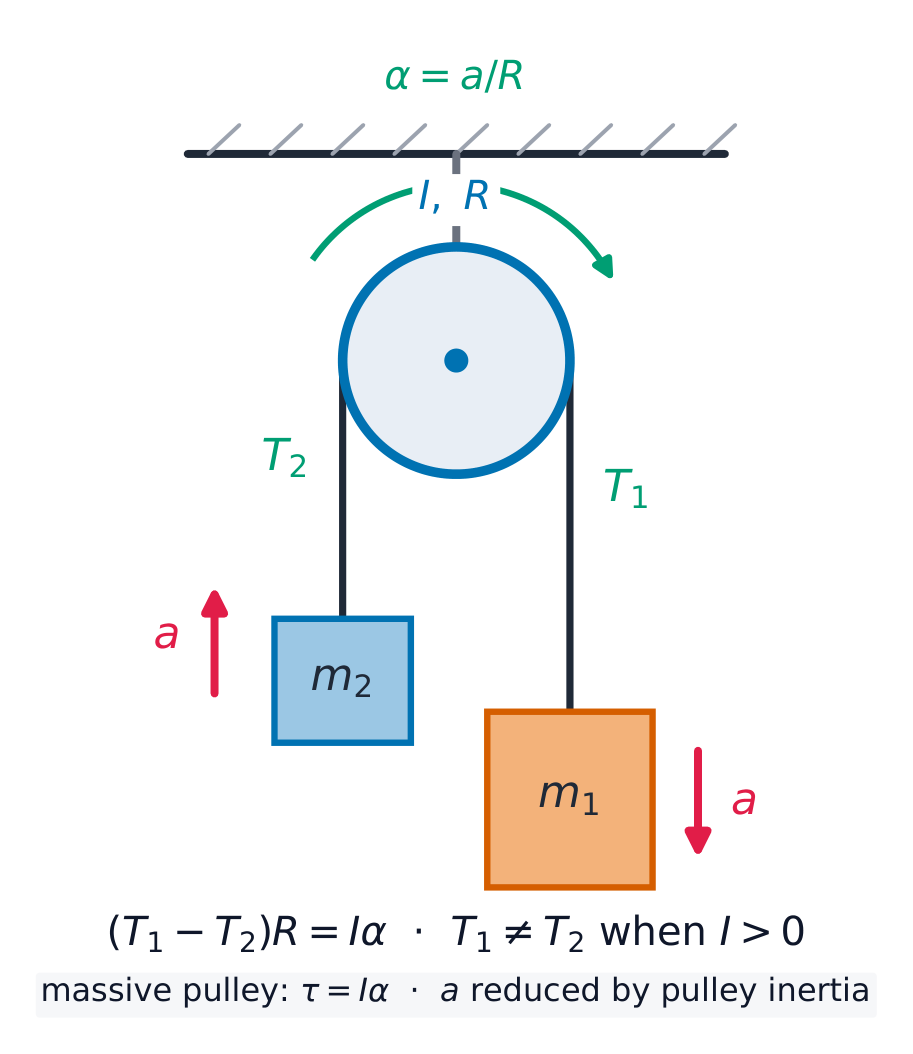
Worked example (massive pulley). Masses $m_1=4.0\ \text{kg}$ and $m_2=2.0\ \text{kg}$ hang from a rope over a pulley 滑轮 of rotational inertia $I=0.50\ \text{kg}\cdot\text{m}^2$ and radius $R=0.20\ \text{m}$. Three Newton's-law equations, one per body:

$$m_1g-T_1=m_1a,\qquad T_2-m_2g=m_2a,\qquad (T_1-T_2)R=I\alpha=\frac{Ia}{R}.$$

Adding them (with $I/R^2=12.5\ \text{kg}$): $a=\dfrac{(m_1-m_2)g}{m_1+m_2+I/R^2}=\dfrac{19.6}{18.5}=1.1\ \text{m/s}^2$. Then $T_1=m_1(g-a)=35\ \text{N}$ and $T_2=m_2(g+a)=22\ \text{N}$. The tensions must differ – otherwise nothing would spin the pulley. (If a problem says the pulley is light, then $I\approx0$ and the tensions become equal again.)

Exam skill. Rotational FRQs score the setup: separate free-body diagrams for each mass and the pulley, the string constraint $a=R\alpha$ stated, and the sign convention consistent. The single most common error is assuming one tension throughout a rope that passes over a massive pulley.

Bahasa Indonesia

Torsi neto menghasilkan percepatan sudut sebanding dengan inersia rotasi:

$$\alpha=\frac{\sum\tau}{I}\qquad\Big(\text{more generally }\sum\vec{\tau}=\frac{d\vec{L}}{dt}\Big).$$

Selesaikan dinamika rotasi persis seperti dinamika translasi, dengan $\tau\leftrightarrow F$, $I\leftrightarrow m$, $\alpha\leftrightarrow a$ – diagram benda bebas, persamaan, selesaikan.

Katrol bermassa: dua tegangan berbeda karena katrol memerlukan torsi bersih
Katrol bermassa: dua tegangan berbeda karena katrol memerlukan torsi neto

Contoh terpecahkan (katrol bermassa). Massa $m_1=4.0\ \text{kg}$ dan $m_2=2.0\ \text{kg}$ digantungkan pada tali yang dilintaskan katrol dengan inersia rotasi $I=0.50\ \text{kg}\cdot\text{m}^2$ dan jari-jari $R=0.20\ \text{m}$. Tiga persamaan hukum Newton, satu untuk setiap benda:

$$m_1g-T_1=m_1a,\qquad T_2-m_2g=m_2a,\qquad (T_1-T_2)R=I\alpha=\frac{Ia}{R}.$$

Menambahkan keduanya (dengan $I/R^2=12.5\ \text{kg}$): $a=\dfrac{(m_1-m_2)g}{m_1+m_2+I/R^2}=\dfrac{19.6}{18.5}=1.1\ \text{m/s}^2$. Kemudian $T_1=m_1(g-a)=35\ \text{N}$ dan $T_2=m_2(g+a)=22\ \text{N}$. Tegangan harus berbeda – jika tidak, tidak akan ada yang memutar katrol. (Jika soal menyatakan katrolnya ringan, maka $I\approx0$ dan tegangan menjadi sama lagi.)

Keterampilan ujian. FRQ rotasi menilai penyusunan: diagram benda bebas terpisah untuk setiap massa dan katrol, batasan tali $a=R\alpha$ dinyatakan, serta konvensi tanda konsisten. Kesalahan paling umum adalah mengasumsikan satu tegangan sepanjang tali yang melewati katrol berrate.

Vocabulary · ⁨Kosa kata⁩ Train · ⁨Latih⁩
English Bahasa Indonesia
pulley/ˈpʊli/ katrol
5.6

Exam tips · ⁨Tips ujian⁩

English
  • Use the rotational analogues: $\theta,\omega=\tfrac{d\theta}{dt},\alpha=\tfrac{d\omega}{dt}$, with the constant-$\alpha$ equations mirroring linear kinematics.
  • Convert between linear and angular with $v=r\omega$ and $a_t=r\alpha$ (plus centripetal $a_c=\tfrac{v^2}{r}=\omega^2 r$).
  • Keep radians throughout and fix a positive sense of rotation.
  • Relate torque to angular acceleration through $\tau=I\alpha$.
  • Draw the rotation axis — the moment arm is the perpendicular distance to it.
Bahasa Indonesia
  • Gunakan analogi rotasi: $\theta,\omega=\tfrac{d\theta}{dt},\alpha=\tfrac{d\omega}{dt}$, dengan persamaan konstan-$\alpha$ yang meniru kinematika linear.
  • Konversi antara linear dan sudut dengan $v=r\omega$ dan $a_t=r\alpha$ (ditambah sentripetal $a_c=\tfrac{v^2}{r}=\omega^2 r$).
  • Pertahankan radian sepanjang proses dan tetapkan arah positif rotasi.
  • Hubungkan torsi dengan percepatan sudut melalui $\tau=I\alpha$.
  • Gambar sumbu rotasi – lengan momen adalah jarak tegak lurus ke sana.

Interactive lessons on this topic · ⁨Pelajaran interaktif untuk topik ini⁩

Work through it step by step, with instant-check exercises. · ⁨Kerjakan langkah demi langkah, dengan latihan pengecekan instan.⁩

Past Papers · ⁨Soal-Soil Masa Lalu⁩

More topics in AP Physics C: Mechanics · ⁨AP Fisika C: Mekanika⁩ · ⁨Topik lain dalam AP Physics C: Mechanics · ⁨AP Fisika C: Mekanika⁩⁩

Log in or create account · ⁨Masuk atau buat akun⁩

IGCSE, A-Level & AP