Skip to content · ⁨Lompat ke konten⁩

Work, Energy, and Power · ⁨Usaha, Energi, dan Daya⁩

AP Physics C: Mechanics · ⁨AP Fisika C: Mekanika⁩ · Topic 3 · ⁨Topik 3⁩

Video lesson for this topic · ⁨Pelajaran video untuk topik ini⁩ Open the video page · ⁨Buka halaman video⁩
7:46

Usaha, Energi, dan Daya

Blok meluncur ke pegas dan memampatkannya hingga berhenti. Berapa jauh pegas terkompresi? Cobalah itu dengan persamaan kinematika. Anda tidak dapat — gayanya bertambah…

English narration · English + 中文 subtitles burned in · ⁨Narasi bahasa Inggris · Subtitle bahasa Inggris + 中文 disematkan langsung⁩

3.1

Translational Kinetic Energy · ⁨Energi Kinetik Translasi⁩

Syllabus · ⁨Silabus⁩
English

Learning Objective 3.1.A: Describe the translational kinetic energy of an object in terms of the object's mass and velocity.

  • 3.1.A.1 An object's translational kinetic energy is given by the equation
    • Equation: $K = \dfrac{1}{2}mv^2$
  • 3.1.A.2 Translational kinetic energy is a scalar quantity.
  • 3.1.A.3 Different observers may measure different values of the translational kinetic energy of an object, depending on the observer's frame of reference.
Bahasa Indonesia

Tujuan Pembelajaran 3.1.A: Jelaskan energi kinetik translasi suatu benda dalam hubungannya dengan massa dan kecepatan benda tersebut.

  • 3.1.A.1 Energi kinetik translasi suatu benda diberikan oleh persamaan
    • Persamaan: $K = \dfrac{1}{2}mv^2$
  • 3.1.A.2 Energi kinetik translasi adalah besaran skalar.
  • 3.1.A.3 Pengamat yang berbeda mungkin mengukur nilai energi kinetik translasi yang berbeda, tergantung pada kerangka acuan pengamat tersebut.
Source: College Board AP Course and Exam Description · ⁨Sumber: Deskripsi Kursus dan Ujian College Board AP⁩

English

Kinetic energy 动能 is the energy of motion, a scalar 标量 measured in joules 焦耳 (J):

$$K=\tfrac{1}{2}mv^2.$$

It grows with the square of speed – doubling the speed quadruples $K$. One subtlety worth knowing: kinetic energy depends on the observer's reference frame 参考系. A passenger walking down a train has a small $K$ measured inside the train and a huge one measured from the ground – both observers are right, each in their own frame.

Bahasa Indonesia

Energi kinetik adalah energi gerak, besaran skalar yang diukur dalam joule (J):

$$K=\tfrac{1}{2}mv^2.$$

Gaya hambat tumbuh dengan kuadrat kecepatan – menggandakan kecepatan membuat kuadruplikasi $K$. Satu nuansa penting untuk diketahui: energi kinetik bergantung pada kerangka acuan pengamat. Seorang penumpang berjalan di dalam kereta memiliki $K$ kecil yang terukur di dalam kereta dan sangat besar jika diukur dari tanah – kedua pengamat benar, masing-masing dalam kerangka acuannya sendiri.

3.2

Work · ⁨Usaha⁩

Syllabus · ⁨Silabus⁩
English

Learning Objective 3.2.A: Describe the work done on an object or system by a given force or collection of forces.

  • 3.2.A.1 Work is the amount of energy transferred into or out of a system by a force exerted on that system over a distance.
    • 3.2.A.1.i The work done by a conservative force exerted on a system is path-independent and only depends on the initial and final configurations of that system.
    • 3.2.A.1.ii The work done by a conservative force on a system—or the change in the potential energy of the system—will be zero if the system returns to its initial configuration.
    • 3.2.A.1.iii Potential energies are associated only with conservative forces.
    • 3.2.A.1.iv The work done by a nonconservative force is path-dependent.
    • 3.2.A.1.v The most common nonconservative forces are friction and air resistance.
  • 3.2.A.2 Work is a scalar quantity that may be positive, negative, or zero.
  • 3.2.A.3 The work done on an object by a variable force is calculated using
    • Equation: $W = \displaystyle\int_a^b \vec{F}(r) \cdot d\vec{r}$, where the integral is taken over the path from point $a$ to point $b$.
    • 3.2.A.3.i The dot product between two vectors, $\vec{A}$ and $\vec{B}$, results in a scalar quantity of magnitude $\vec{A} \cdot \vec{B} = AB\cos\theta$.
    • 3.2.A.3.ii Only the component of the force exerted on a system that is parallel to the displacement of the point of application of the force will change the system's total energy.
    • 3.2.A.3.iii If the component of the force exerted on a system that is parallel to the displacement is constant, the work done on the system by the force is given by the derived equation $W = F_{\parallel}d = Fd\cos\theta$.
    • 3.2.A.3.iv The component of the force exerted on a system perpendicular to the direction of the displacement of the system's center of mass can change the direction of the system's motion without changing the system's kinetic energy.
  • 3.2.A.4 The work–energy theorem states that the change in an object's kinetic energy is equal to the sum of the work (net work) being done by all forces exerted on the object.
    • Equation: $\Delta K = \displaystyle\sum W_i = \sum F_{\parallel,i}\, d_i$
    • 3.2.A.4.i An external force may change the configuration of a system. The component of the external force parallel to the displacement times the displacement of the point of application of the force gives the change in kinetic energy of the system.
    • 3.2.A.4.ii If the system's center of mass and the point of application of the force move the same distance when a force is exerted on a system, then the system may be modeled as an object, and only the system's kinetic energy can change.
    • 3.2.A.4.iii The energy dissipated by friction is typically equated to the force of friction times the length of the path over which the force is exerted.
      • Equation: $\Delta E_{\text{mech}} = F_f d\cos\theta$
    • 3.2.A.5 Work is equal to the area under the curve of a graph of $F_{\parallel}$ as a function of displacement.

Boundary statement: AP Physics C: Mechanics only expects students to analyze the transfer of mechanical energy, although students should be aware that mechanical energy may be dissipated in the form of thermal energy or sound.

Bahasa Indonesia

Tujuan Pembelajaran 3.2.A: Jelaskan usaha yang dilakukan pada suatu benda atau sistem oleh gaya tertentu atau kumpulan gaya.

  • 3.2.A.1 Usaha adalah jumlah energi yang ditransfer masuk atau keluar dari sebuah sistem melalui gaya yang bekerja pada sistem tersebut sepanjang jarak tempuh.
    • 3.2.A.1.i Usaha yang dilakukan oleh gaya konservatif pada suatu sistem bersifat independen terhadap lintasan dan hanya bergantung pada konfigurasi awal dan akhir sistem tersebut.
    • 3.2.A.1.ii Usaha yang dilakukan oleh gaya konservatif pada suatu sistem—atau perubahan energi potensial sistem—akan bernilai nol jika sistem kembali ke konfigurasi awalnya.
    • 3.2.A.1.iii Energi potensial hanya terkait dengan gaya-gaya konservatif.
    • 3.2.A.1.iv Usaha yang dilakukan oleh gaya nonkonservatif bergantung pada lintasan.
    • 3.2.A.1.v Gaya nonkonservatif yang paling umum adalah gesekan dan hambatan udara.
  • 3.2.A.2 Usaha adalah besaran skalar yang dapat bernilai positif, negatif, atau nol.
  • 3.2.A.3 Usaha yang dilakukan pada objek oleh gaya berubah dihitung menggunakan
    • Persamaan: $W = \displaystyle\int_a^b \vec{F}(r) \cdot d\vec{r}$, di mana integral diambil sepanjang lintasan dari titik $a$ ke titik $b$.
    • 3.2.A.3.i Hasil kali titik antara dua vektor, $\vec{A}$ dan $\vec{B}$, menghasilkan besaran skalar dengan magnitudo $\vec{A} \cdot \vec{B} = AB\cos\theta$.
    • 3.2.A.3.ii Hanya komponen gaya yang bekerja pada sistem yang sejajar dengan perpindahan titik aplikasi gaya yang akan mengubah energi total sistem.
    • 3.2.A.3.iii Jika komponen gaya yang bekerja pada sistem yang sejajar dengan perpindahan adalah konstan, usaha yang dilakukan pada sistem oleh gaya tersebut diberikan oleh persamaan turunan $W = F_{\parallel}d = Fd\cos\theta$.
    • 3.2.A.3.iv Komponen gaya yang bekerja pada sistem tegak lurus terhadap arah perpindahan pusat massa sistem dapat mengubah arah gerak sistem tanpa mengubah energi kinetik sistem.
  • 3.2.A.4 Teorema usaha-energi menyatakan bahwa perubahan energi kinetik objek sama dengan jumlah usaha (usaha bersih) yang dilakukan oleh semua gaya yang bekerja pada objek.
    • Persamaan: $\Delta K = \displaystyle\sum W_i = \sum F_{\parallel,i}\, d_i$
    • 3.2.A.4.i Gaya eksternal dapat mengubah konfigurasi suatu sistem. Komponen gaya eksternal yang sejajar dengan perpindahan dikali perpindahan titik aplikasi gaya memberikan perubahan energi kinetik sistem.
    • 3.2.A.4.ii Jika pusat massa sistem dan titik aplikasi gaya bergerak sejauh yang sama ketika gaya bekerja pada sistem, maka sistem dapat dimodelkan sebagai benda tunggal, dan hanya energi kinetik sistem yang dapat berubah.
    • 3.2.A.4.iii Energi yang terdisipasi oleh gesekan biasanya disamakan dengan gaya gesek dikalikan dengan panjang lintasan tempat gaya tersebut bekerja.
      • Persamaan: $\Delta E_{\text{mech}} = F_f d\cos\theta$
    • 3.2.A.5 Usaha sama dengan luas di bawah kurva grafik $F_{\parallel}$ sebagai fungsi perpindahan.

Pernyataan Batas: AP Physics C: Mekanika hanya mengharapkan siswa menganalisis transfer energi mekanik, meskipun siswa harus menyadari bahwa energi mekanik dapat terdisipasi dalam bentuk energi termal atau bunyi.

Source: College Board AP Course and Exam Description · ⁨Sumber: Deskripsi Kursus dan Ujian College Board AP⁩

English

Work 功 is energy transferred into or out of a system by a force acting over a distance. For a variable force it is an integral 积分 along the path:

$$W=\int_a^b \vec{F}\cdot d\vec{r}=\int F\cos\theta\,dr.$$

For a constant force this reduces to $W=Fd\cos\theta$; on a force–position graph, work is the area under the curve. Work is a scalar with a sign, and the sign is physics, not bookkeeping:

  • Positive – force has a component along the motion (it speeds the object up).
  • Negative – force opposes the motion (friction 摩擦力 and air drag do negative work).
  • Zero – force perpendicular to the motion (the normal force 法向力 on a sliding block, gravity on a horizontal move, tension in a circular swing).

The work–energy theorem 动能定理 collects every force's contribution: the net work equals the change in kinetic energy,

$$W_{\text{net}}=\sum W_i=\Delta K.$$

Worked example. A variable force $F(x)=3x^2\ \text{N}$ (along the motion) acts from $x=0$ to $x=2\ \text{m}$: $W=\displaystyle\int_0^2 3x^2\,dx=\big[x^3\big]_0^2=8\ \text{J}$. Acting alone on a body starting from rest, it would raise the kinetic energy to exactly $8\ \text{J}$.

Bahasa Indonesia

Usaha adalah energi yang ditransfer masuk atau keluar dari sistem oleh gaya yang bekerja sepanjang jarak. Untuk gaya variabel, usaha merupakan integral sepanjang lintasan:

$$W=\int_a^b \vec{F}\cdot d\vec{r}=\int F\cos\theta\,dr.$$

Untuk gaya konstan, ini menyederhanakan menjadi $W=Fd\cos\theta$; pada grafik gaya–posisi, usaha adalah luas di bawah kurva. Usaha adalah skalar dengan tanda, dan tanda tersebut bermakna fisika, bukan sekadar pencatatan:

  • Positif – gaya memiliki komponen sejajar dengan gerak (mempercepat benda).
  • Negatif – gaya berlawanan arah dengan gerak (gesekan dan hambat udara melakukan usaha negatif).
  • Nol – gaya tegak lurus terhadap gerak (gaya normal pada balok meluncur, gravitasi pada gerak horizontal, tegangan pada ayunan melingkar).
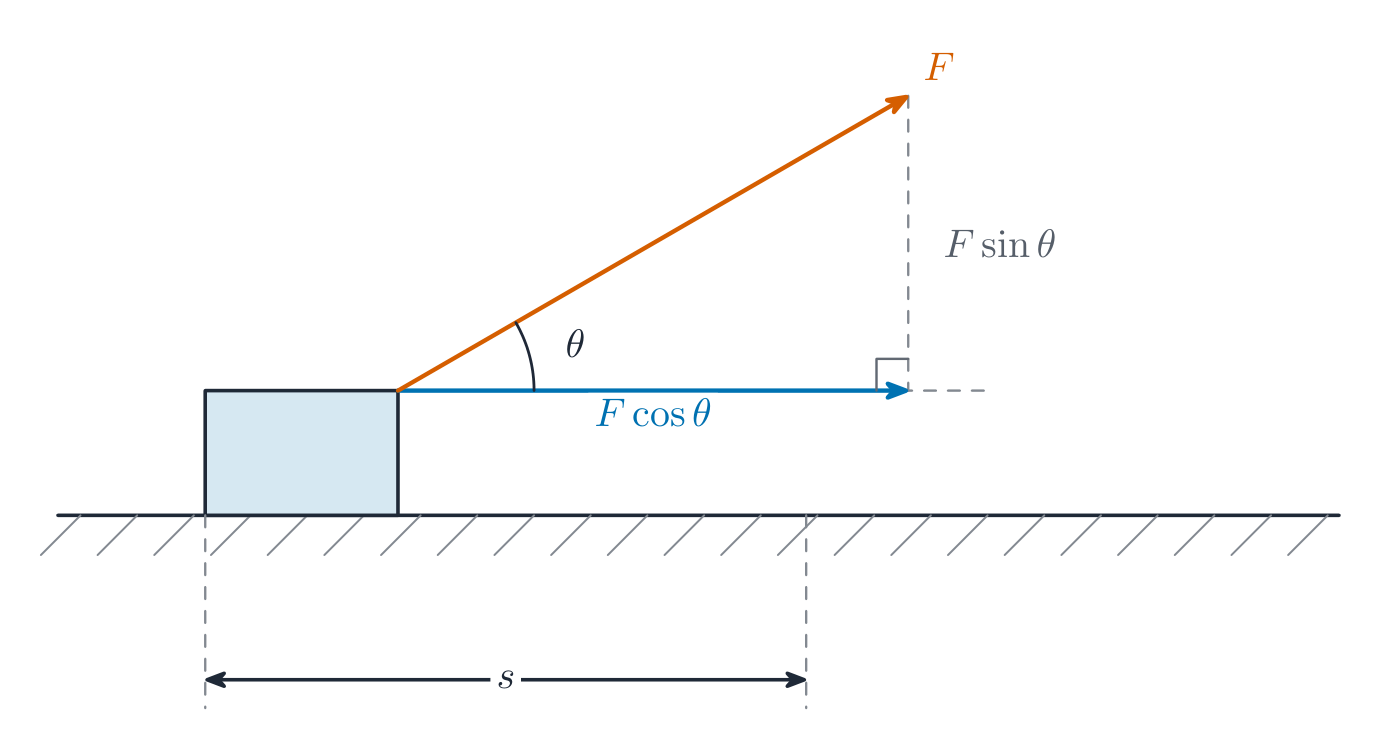
Hanya komponen gaya sepanjang perpindahan yang melakukan usaha

Teorema usaha-energi menjumlahkan kontribusi setiap gaya: usaha neto sama dengan perubahan energi kinetik,

$$W_{\text{net}}=\sum W_i=\Delta K.$$

Contoh terpecahkan. Gaya variabel $F(x)=3x^2\ \text{N}$ (sejajar dengan gerak) bekerja dari $x=0$ hingga $x=2\ \text{m}$: $W=\displaystyle\int_0^2 3x^2\,dx=\big[x^3\big]_0^2=8\ \text{J}$. Bekerja sendirian pada benda yang mulai dari keadaan diam, gaya ini akan menaikkan energi kinetik tepat sebesar $8\ \text{J}$.

Vocabulary · ⁨Kosa kata⁩ Train · ⁨Latih⁩
English Bahasa Indonesia
Kinetic energy/kɪˈnetɪk ˈenədʒi/ Energi kinetik
scalar/ˈskeɪlə/ skalar
joules/dʒuːlz/ joule
reference frame/ˈrefrəns freɪm/ kerangka acuan
Work/wɜːk/ Usaha
integral/ˈɪntɪɡrəl/ integral
friction/ˈfrɪkʃn/ gesekan
normal force/ˈnɔːml fɔːs/ gaya normal
work–energy theorem/wɜːk ˈenədʒi ˈθɪərəm/ Teorema usaha-energi
3.3

Potential Energy · ⁨Energi Potensial⁩

Syllabus · ⁨Silabus⁩
English

Learning Objective 3.3.A: Describe the potential energy of a system.

  • 3.3.A.1 A system composed of two or more objects has potential energy if the objects within that system only interact with each other through conservative forces.
  • 3.3.A.2 Potential energy is a scalar quantity associated with the position of objects within a system.
  • 3.3.A.3 The definition of zero potential energy for a given system is a decision made by the observer considering the situation to simplify or otherwise assist in analysis.
  • 3.3.A.4 The relationship between conservative forces exerted on a system and the system's potential energy is
    • Equation: $\Delta U = -\displaystyle\int_a^b \vec{F}_{cf}(r) \cdot d\vec{r}$
  • 3.3.A.5 The conservative forces exerted on a system in a single dimension can be determined using the slope of the system's potential energy with respect to position in that dimension; these forces point in the direction of decreasing potential energy.
    • Equation: $F_x = -\dfrac{dU(x)}{dx}$
  • 3.3.A.6 Graphs of a system's potential energy as a function of its position can be useful in determining physical properties of that system.
    • 3.3.A.6.i Stable equilibrium is a location at which a small displacement in an object's position results in a force exerted on the object opposite to the direction of the small displacement, accelerating the object back toward the equilibrium position.
    • 3.3.A.6.ii Unstable equilibrium is a location at which a small displacement in an object's position results in a force exerted on the object in the same direction as the small displacement, accelerating the object away from the equilibrium position.
    • 3.3.A.6.iii In a given dimension, stable equilibrium positions exist at locations where the potential energy as a function of position in that dimension has a local minimum.
    • 3.3.A.6.iv In a given dimension, unstable equilibrium positions occur at locations where the potential energy as a function of position in that dimension has a local maximum.
  • 3.3.A.7 The potential energy of common physical systems can be described using the physical properties of that system.
    • 3.3.A.7.i The elastic potential energy of an ideal spring is given by the following equation, where $\Delta x$ is the distance the spring has been stretched or compressed from its equilibrium length.
      • Equation: $U_s = \dfrac{1}{2}k(\Delta x)^2$
    • 3.3.A.7.ii The general form for the gravitational potential energy of a system consisting of two approximately spherical distributions of mass (e.g., moons, planets, or stars) is given by the equation
      • Equation: $U_g = -G\dfrac{m_1 m_2}{r}$
    • 3.3.A.7.iii Because the gravitational field near the surface of a planet is nearly constant, the change in gravitational potential energy in a system consisting of an object with mass $m$ and a planet with gravitational field of magnitude $g$ when the object is near the surface of the planet may be approximated by the equation
      • Equation: $\Delta U_g = mg\Delta y$
  • 3.3.A.8 The total potential energy of a system containing more than two objects is the sum of the potential energy of each pair of objects within the system.
Bahasa Indonesia

Tujuan Pembelajaran 3.3.A: Jelaskan energi potensial suatu sistem.

  • 3.3.A.1 Sistem yang terdiri dari dua atau lebih benda memiliki energi potensial jika benda-benda di dalamnya hanya berinteraksi satu sama lain melalui gaya-gaya konservatif.
  • 3.3.A.2 Energi potensial adalah besaran skalar yang terkait dengan posisi benda-benda di dalam suatu sistem.
  • 3.3.A.3 Definisi nol energi potensial untuk suatu sistem tertentu merupakan keputusan yang diambil oleh pengamat berdasarkan situasi untuk menyederhanakan atau membantu analisis.
  • 3.3.A.4 Hubungan antara gaya konservatif yang bekerja pada sistem dan energi potensial sistem adalah
    • Persamaan: $\Delta U = -\displaystyle\int_a^b \vec{F}_{cf}(r) \cdot d\vec{r}$
  • 3.3.A.5 Gaya konservatif yang bekerja pada sistem dalam satu dimensi dapat ditentukan menggunakan kemiringan energi potensial sistem terhadap posisi dalam dimensi tersebut; gaya-gaya ini mengarah pada penurunan energi potensial.
    • Persamaan: $F_x = -\dfrac{dU(x)}{dx}$
  • 3.3.A.6 Grafik energi potensial sistem sebagai fungsi posisinya dapat berguna dalam menentukan sifat fisik dari sistem tersebut.
    • 3.3.A.6.i Kesetimbangan stabil adalah lokasi di mana pergeseran kecil pada posisi objek menghasilkan gaya yang bekerja pada objek berlawanan arah dengan pergeseran kecil tersebut, mempercepat objek kembali menuju posisi kesetimbangan.
    • 3.3.A.6.ii Kesetimbangan tidak stabil adalah lokasi di mana pergeseran kecil pada posisi objek menghasilkan gaya yang bekerja pada objek searah dengan pergeseran kecil tersebut, mempercepat objek menjauhi posisi kesetimbangan.
    • 3.3.A.6.iii Dalam suatu dimensi tertentu, posisi kesetimbangan stabil terdapat di lokasi di mana energi potensial sebagai fungsi posisi dalam dimensi tersebut memiliki nilai minimum lokal.
    • 3.3.A.6.iv Dalam suatu dimensi tertentu, posisi kesetimbangan tidak stabil terjadi di lokasi di mana energi potensial sebagai fungsi posisi dalam dimensi tersebut memiliki nilai maksimum lokal.
  • 3.3.A.7 Energi potensial dari sistem fisika umum dapat dijelaskan menggunakan sifat fisik dari sistem tersebut.
    • 3.3.A.7.i Energi potensial elastis pegas ideal diberikan oleh persamaan berikut, di mana $\Delta x$ adalah jarak pegas telah diregangkan atau ditekan dari panjang kesetimbangannya.
      • Persamaan: $U_s = \dfrac{1}{2}k(\Delta x)^2$
    • 3.3.A.7.ii Bentuk umum untuk energi potensial gravitasi sistem yang terdiri dari distribusi massa yang kira-kira berbentuk bola (misalnya, bulan, planet, atau bintang) diberikan oleh persamaan
      • Persamaan: $U_g = -G\dfrac{m_1 m_2}{r}$
    • 3.3.A.7.iii Karena medan gravitasi di dekat permukaan planet hampir konstan, perubahan energi potensial gravitasi dalam sistem yang terdiri dari objek bermassa $m$ dan planet dengan besar medan gravitasi $g$ ketika objek berada di dekat permukaan planet dapat didekati oleh persamaan
      • Persamaan: $\Delta U_g = mg\Delta y$
  • 3.3.A.8 Total energi potensial sistem yang mengandung lebih dari dua objek adalah jumlah energi potensial dari setiap pasangan objek di dalam sistem.

Source: College Board AP Course and Exam Description · ⁨Sumber: Deskripsi Kursus dan Ujian College Board AP⁩

English

Potential energy 势能 is energy a system stores by the positions of its parts – it exists only for conservative forces 保守力, whose work is path independent. It is defined through work:

$$\Delta U=-\int_a^b\vec{F}\cdot d\vec{r},$$

and you are free to choose where $U=0$ – only changes in $U$ matter, so pick the zero that makes the problem simplest. The standard results:

  • Gravity near a surface: $\Delta U_g=mg\,\Delta y$.
  • Gravity in general: $U_g=-\dfrac{Gm_1m_2}{r}$ (zero at infinite separation).
  • Spring: $U_s=\tfrac12k(\Delta x)^2$, with $\Delta x$ measured from natural length.

For systems of several objects, add the potential energy of each pair. Turning the definition around, a conservative force is minus the derivative 导数 of its potential energy:

$$F_x=-\frac{dU}{dx}.$$

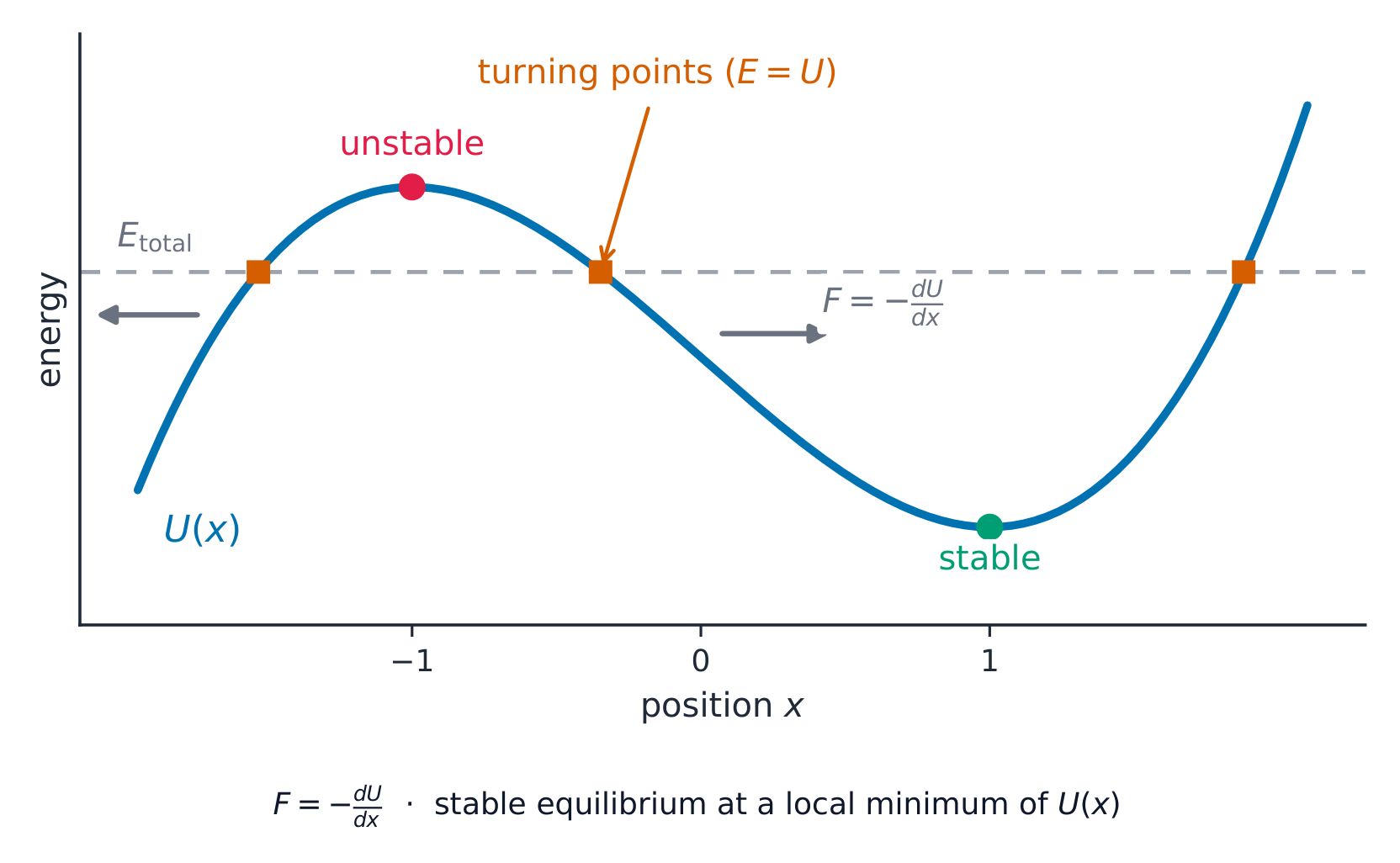
The force points "downhill" on the $U(x)$ curve. Equilibrium sits where the slope is zero: a minimum is a stable equilibrium 稳定平衡 (displaced, the force pushes back), a maximum is an unstable equilibrium 不稳定平衡 (displaced, the force pushes away).

Worked example. Given $U(x)=2x^3-6x$ (joules), the force is $F=-\dfrac{dU}{dx}=6-6x^2$. Equilibria sit at $F=0$: $x=\pm1$. Since $\dfrac{d^2U}{dx^2}=12x$ is positive at $x=+1$ (a minimum – stable) and negative at $x=-1$ (a maximum – unstable), the two points behave oppositely.

Bahasa Indonesia

Energi potensial adalah energi yang disimpan oleh sistem akibat posisi bagian-bagiannya – hanya ada untuk gaya konservatif, yang usahanya tidak bergantung lintasan. Energi ini didefinisikan melalui usaha:

$$\Delta U=-\int_a^b\vec{F}\cdot d\vec{r},$$

dan Anda bebas untuk memilih di mana $U=0$ – hanya perubahan $U$ yang penting, jadi pilih nol yang membuat soal paling sederhana. Hasil standar:

  • Gravitasi dekat permukaan: $\Delta U_g=mg\,\Delta y$.
  • Gravitasi umum: $U_g=-\dfrac{Gm_1m_2}{r}$ (nol pada pemisahan tak terhingga).
  • Pegas: $U_s=\tfrac12k(\Delta x)^2$, dengan $\Delta x$ diukur dari panjang alami.

Untuk sistem beberapa benda, jumlahkan energi potensial dari setiap pasangan. Membalik definisi, gaya konservatif adalah minus turunan dari energi potensinya:

$$F_x=-\frac{dU}{dx}.$$

Gaya menunjuk "turun" pada kurva $U(x)$. Keseimbangan berada di tempat kemiringan nol: minimum adalah keseimbangan stabil (digeser, gaya mendorong kembali), maksimum adalah keseimbangan tidak stabil (digeser, gaya mendorong menjauh).

Pada kurva energi potensial, gaya mengarah ke bawah dan E = U menandai titik balik
Pada kurva energi potensial gaya menunjuk turun dan E = U menandai titik balik

Contoh terpecahkan. Diketahui $U(x)=2x^3-6x$ (joule), gayanya adalah $F=-\dfrac{dU}{dx}=6-6x^2$. Keseimbangan berada di $F=0$: $x=\pm1$. Karena $\dfrac{d^2U}{dx^2}=12x$ bernilai positif di $x=+1$ (minimum – stabil) dan negatif di $x=-1$ (maksimum – tidak stabil), kedua titik tersebut berperilaku berlawanan.

Explore · ⁨Jelajahi⁩

Store elastic potential energy in a spring · ⁨Simpan energi potensial elastis dalam pegas⁩

Stretching a spring stores elastic potential energy $\tfrac12 kx^2$ — the area under the force-extension line. Release it and that energy becomes kinetic. · ⁨Meregangkan pegas menyimpan energi potensial elastis $\tfrac12 kx^2$ — yaitu area di bawah garis gaya-perpanjangan. Lepaskan dan energi tersebut berubah menjadi energi kinetik.⁩

Vocabulary · ⁨Kosa kata⁩ Train · ⁨Latih⁩
English Bahasa Indonesia
Potential energy/pəˈtenʃl ˈenədʒi/ Energi potensial
conservative forces/kənˈsɜːvətɪv ˈfɔːsɪz/ Gaya konservatif
derivative/dɪˈrɪvətɪv/ turunan
stable equilibrium/ˈsteɪbl ˌiːkwɪˈlɪbrɪəm/ keseimbangan stabil
unstable equilibrium/ʌnˈsteɪbl ˌiːkwɪˈlɪbrɪəm/ keseimbangan tidak stabil
Mechanical energy/mɪˈkænɪkl ˈenədʒi/ Energi mekanik
nonconservative forces/ˌnɒŋkənˈsɜːvətɪv ˈfɔːsɪz/ gaya nonkonservatif
thermal energy/ˈθɜːml ˈenədʒi/ energi termal
turning points/ˈtɜːnɪŋ pɔɪnts/ titik balik
3.4

Conservation of Energy · ⁨Kekekalan Energi⁩

Syllabus · ⁨Silabus⁩
English

Learning Objective 3.4.A: Describe the energies present in a system.

  • 3.4.A.1 A system composed of only a single object can only have kinetic energy.
  • 3.4.A.2 A system that contains objects that interact via conservative forces or that can change its shape reversibly may have both kinetic and potential energies.

Learning Objective 3.4.B: Describe the behavior of a system using conservation of mechanical energy principles.

  • 3.4.B.1 Mechanical energy is the sum of a system's kinetic and potential energies.
  • 3.4.B.2 Any change to a type of energy within a system must be balanced by an equivalent change of other types of energies within the system or by a transfer of energy between the system and its surroundings.
  • 3.4.B.3 A system may be selected so that the total energy of that system is constant.
  • 3.4.B.4 If the total energy of a system changes, that change will be equivalent to the energy transferred into or out of the system.

Learning Objective 3.4.C: Describe how the selection of a system determines whether the energy of that system changes.

  • 3.4.C.1 Energy is conserved in all interactions.
  • 3.4.C.2 If the work done on a selected system is zero and there are no nonconservative interactions within the system, the total mechanical energy of the system is constant.
  • 3.4.C.3 If the work done on a selected system is nonzero, energy is transferred between the system and the environment.

Boundary statement: AP Physics C: Mechanics expects students to know that mechanical energy can be dissipated as thermal energy or sound by nonconservative forces.

Bahasa Indonesia

Tujuan Pembelajaran 3.4.A: Jelaskan energi-energi yang ada dalam suatu sistem.

  • 3.4.A.1 Sistem yang terdiri hanya dari satu benda hanya dapat memiliki energi kinetik.
  • 3.4.A.2 Sistem yang berisi benda-benda yang berinteraksi melalui gaya konservatif atau yang dapat mengubah bentuknya secara reversibel dapat memiliki energi kinetik maupun potensial.

Tujuan Pembelajaran 3.4.B: Jelaskan perilaku sistem menggunakan prinsip-prinsip kekekalan energi mekanik.

  • 3.4.B.1 Energi mekanik adalah jumlah energi kinetik dan potensial suatu sistem.
  • 3.4.B.2 Perubahan apa pun pada jenis energi dalam suatu sistem harus seimbang dengan perubahan ekuivalen dari jenis energi lainnya dalam sistem atau melalui perpindahan energi antara sistem dan lingkungannya.
  • 3.4.B.3 Suatu sistem dapat dipilih sedemikian rupa sehingga total energi sistem tersebut konstan.
  • 3.4.B.4 Jika total energi sistem berubah, perubahan tersebut akan setara dengan energi yang ditransfer masuk atau keluar dari sistem.

Tujuan Pembelajaran 3.4.C: Jelaskan bagaimana pemilihan sistem menentukan apakah energi sistem tersebut berubah.

  • 3.4.C.1 Energi kekal dalam semua interaksi.
  • 3.4.C.2 Jika usaha yang dilakukan pada sistem yang dipilih adalah nol dan tidak ada interaksi nonkonservatif di dalam sistem, maka total energi mekanik sistem adalah konstan.
  • 3.4.C.3 Jika usaha yang dilakukan pada sistem yang dipilih tidak nol, energi ditransfer antara sistem dan lingkungan.

Pernyataan Batas: AP Physics C: Mekanika mengharapkan siswa mengetahui bahwa energi mekanik dapat terdisipasi menjadi energi termal atau bunyi oleh gaya nonkonservatif.

Source: College Board AP Course and Exam Description · ⁨Sumber: Deskripsi Kursus dan Ujian College Board AP⁩

English
Energy conservation: KE ⇄ PE

Energy is conserved in all interactions – the question is only where it goes. Mechanical energy 机械能 is the sum $E=K+U$. If the external work on a system is zero and nothing inside it acts through nonconservative forces 非保守力, then

$$K_1+U_1=K_2+U_2.$$

When friction or drag act, they convert mechanical energy into thermal energy 热能 ($\Delta E_{\text{mech}}=-F_fd$), and the balance must include that term. If external work is done, the system's total energy changes by exactly the energy transferred: $W_{\text{ext}}=\Delta E_{\text{sys}}$. Choosing the system is choosing the bookkeeping – a single object can only have kinetic energy; include the Earth or the spring and the system can store potential energy too.

A potential-energy graph is a complete motion map: the horizontal line at height $E$ is the total energy, the gap $E-U(x)$ is the kinetic energy at each $x$, and the crossings $E=U$ are the turning points 转折点 where the object momentarily stops and reverses.

Worked example. A $2.0\ \text{kg}$ block slides down a ramp from rest at height $1.5\ \text{m}$, arriving at the bottom at $4.0\ \text{m/s}$. Energy accounting: $mgh=29.4\ \text{J}$ available; $\tfrac12mv^2=16\ \text{J}$ arrives as kinetic energy; so friction converted $29.4-16=13\ \text{J}$ into thermal energy along the way.

Bahasa Indonesia
Kekekalan energi: KE ⇄ PE

Energi kekal dalam semua interaksi – pertanyaannya hanyalah ke mana energi itu pergi. Energi mekanik adalah jumlah $E=K+U$. Jika usaha eksternal pada sistem adalah nol dan tidak ada yang di dalamnya bekerja melalui gaya nonkonservatif, maka

$$K_1+U_1=K_2+U_2.$$

Ketika gesekan atau hambat bekerja, mereka mengonversi energi mekanik menjadi energi termal ($\Delta E_{\text{mech}}=-F_fd$), dan neraca harus memasukkan suku tersebut. Jika usaha eksternal dibuat, total energi sistem berubah persis sebesar energi yang ditransfer: $W_{\text{ext}}=\Delta E_{\text{sys}}$. Memilih sistem adalah memilih cara pencatatan – satu benda tunggal hanya dapat memiliki energi kinetik; sertakan Bumi atau pegas agar sistem juga dapat menyimpan energi potensial.

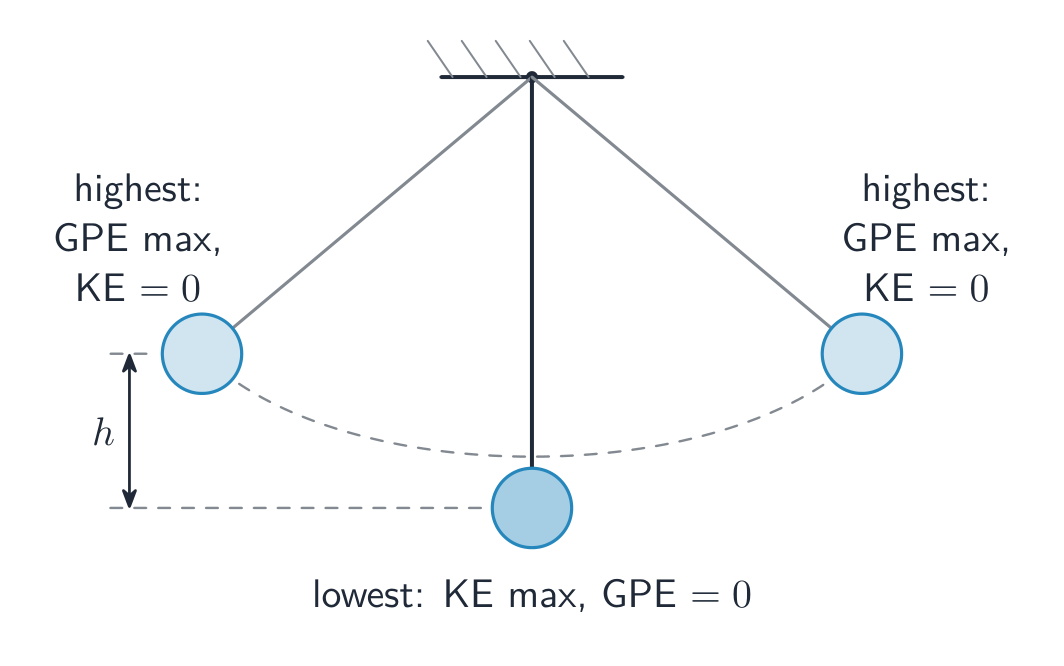
Ayunan menukar energi potensial gravitasi menjadi energi kinetik dan sebaliknya
Ayon menukar energi potensial gravitasi menjadi energi kinetik dan sebaliknya

Grafik energi potensial adalah peta gerak lengkap: garis horizontal pada ketinggian $E$ adalah energi total, celah $E-U(x)$ adalah energi kinetik pada setiap $x$, dan perpotongan $E=U$ adalah titik balik di mana benda berhenti sejenak dan berbalik arah.

Contoh terpecahkan. Sebuah balok $2.0\ \text{kg}$ meluncur menuruni landai dari keadaan diam pada ketinggian $1.5\ \text{m}$, tiba di bagian bawah dengan kecepatan $4.0\ \text{m/s}$. Akuntansi energi: $mgh=29.4\ \text{J}$ tersedia; $\tfrac12mv^2=16\ \text{J}$ tiba sebagai energi kinetik; sehingga gesekan telah mengonversi $29.4-16=13\ \text{J}$ menjadi energi termal sepanjang perjalanan.

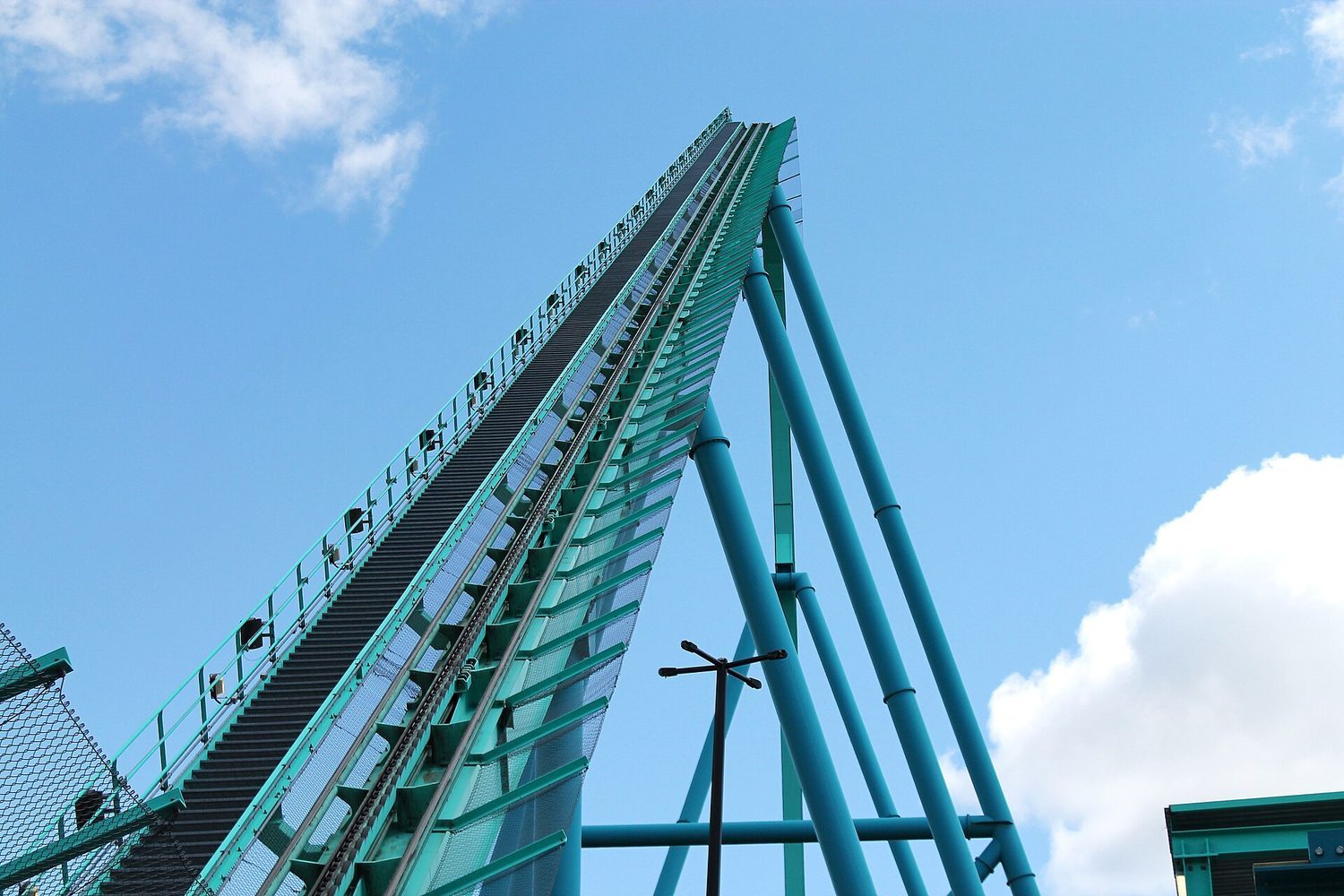
A roller coaster trades energy back and forth: highest (most PE) at the top, fastest (most KE) at the bottom
Explore · ⁨Jelajahi⁩

Watch energy convert as an object falls · ⁨Amati konversi energi saat benda jatuh⁩

With no friction, mechanical energy is conserved: as an object falls, gravitational potential energy turns into kinetic energy while the total stays fixed. · ⁨Tanpa gesekan, energi mekanik kekal: saat benda jatuh, energi potensial gravitasi berubah menjadi energi kinetik sementara totalnya tetap.⁩

Watch lesson · ⁨Tonton pelajaran⁩
3.5

Power · ⁨Daya⁩

Syllabus · ⁨Silabus⁩
English

Learning Objective 3.5.A: Describe the transfer of energy into, out of, or within a system in terms of power.

  • 3.5.A.1 Power is the rate at which energy changes with respect to time, either by transfer into or out of a system or by conversion from one type to another within a system.
  • 3.5.A.2 Average power is the amount of energy being transferred or converted, divided by the time it took for that transfer or conversion to occur.
    • Equation: $P_{\text{avg}} = \dfrac{\Delta E}{\Delta t}$
  • 3.5.A.3 Because work is the change in energy of an object or system due to a force, average power is the total work done, divided by the time during which that work was done.
    • Equation: $P_{\text{avg}} = \dfrac{W}{\Delta t}$
  • 3.5.A.4 The instantaneous power delivered to an object by a force is given by the equation
    • Equation: $P_{\text{inst}} = \dfrac{dW}{dt}$
  • 3.5.A.5 The instantaneous power delivered to an object by the component of a constant force parallel to the object's velocity can be described with the derived equation
    • Equation: $P_{\text{inst}} = F_{\parallel}v = Fv\cos\theta$
Bahasa Indonesia

Tujuan Pembelajaran 3.5.A: Jelaskan perpindahan energi masuk, keluar, atau di dalam suatu sistem dalam istilah daya.

  • 3.5.A.1 Daya adalah laju perubahan energi terhadap waktu, baik melalui transfer masuk atau keluar dari sistem maupun melalui konversi dari satu jenis ke jenis lain di dalam sistem.
  • 3.5.A.2 Daya rata-rata adalah jumlah energi yang ditransfer atau dikonversi, dibagi dengan waktu yang dibutuhkan untuk transfer atau konversi tersebut terjadi.
    • Persamaan: $P_{\text{avg}} = \dfrac{\Delta E}{\Delta t}$
  • 3.5.A.3 Karena usaha adalah perubahan energi suatu objek atau sistem akibat gaya, daya rata-rata adalah total usaha yang dilakukan, dibagi dengan waktu selama usaha itu dilakukan.
    • Persamaan: $P_{\text{avg}} = \dfrac{W}{\Delta t}$
  • 3.5.A.4 Daya sesaat yang disalurkan kepada objek oleh gaya diberikan oleh persamaan
    • Persamaan: $P_{\text{inst}} = \dfrac{dW}{dt}$
  • 3.5.A.5 Daya sesaat yang disalurkan kepada objek oleh komponen gaya konstan yang sejajar dengan kecepatan objek dapat digambarkan dengan persamaan turunan
    • Persamaan: $P_{\text{inst}} = F_{\parallel}v = Fv\cos\theta$

Source: College Board AP Course and Exam Description · ⁨Sumber: Deskripsi Kursus dan Ujian College Board AP⁩

English

Power 功率 is the rate of energy transfer, in watts 瓦特 (W):

$$P_{\text{avg}}=\frac{\Delta E}{\Delta t}=\frac{W}{\Delta t},\qquad P_{\text{inst}}=\frac{dW}{dt}=\vec{F}\cdot\vec{v}.$$

It measures how fast work is done, not how much. The dot product matters: only the force component along the velocity delivers power.

Worked example. A block released from rest at the top of a frictionless $3.0\ \text{m}$-high ramp reaches the bottom at $v=\sqrt{2gh}=7.7\ \text{m/s}$ (from $mgh=\tfrac12mv^2$). A motor that then drives it at a steady $7.7\ \text{m/s}$ against a $20\ \text{N}$ resistance delivers $P=Fv=20(7.7)\approx150\ \text{W}$.

Worked example. A $1200\ \text{kg}$ car climbs a hill that rises $1.0\ \text{m}$ for every $20\ \text{m}$ of road, at a steady $15\ \text{m/s}$. The engine must supply gravity's power drain: $P=mg\,v\sin\theta=1200(9.8)(15)\big(\tfrac{1}{20}\big)\approx8.8\ \text{kW}$ – before adding air resistance.

Exam skill. Energy FRQs reward the accounting sentence: name your system, state which forces do work on it, and write the balance ($W_{\text{ext}}=\Delta K+\Delta U+\Delta E_{\text{thermal}}$) before plugging in numbers. "Friction is present, so mechanical energy is not conserved" is a scored statement.

Bahasa Indonesia

Daya adalah laju perpindahan energi, dalam satuan watt (W):

$$P_{\text{avg}}=\frac{\Delta E}{\Delta t}=\frac{W}{\Delta t},\qquad P_{\text{inst}}=\frac{dW}{dt}=\vec{F}\cdot\vec{v}.$$

Ini mengukur seberapa cepat usaha dilakukan, bukan berapa banyak. Hasil kali titik penting: hanya komponen gaya sepanjang kecepatan yang memberikan daya.

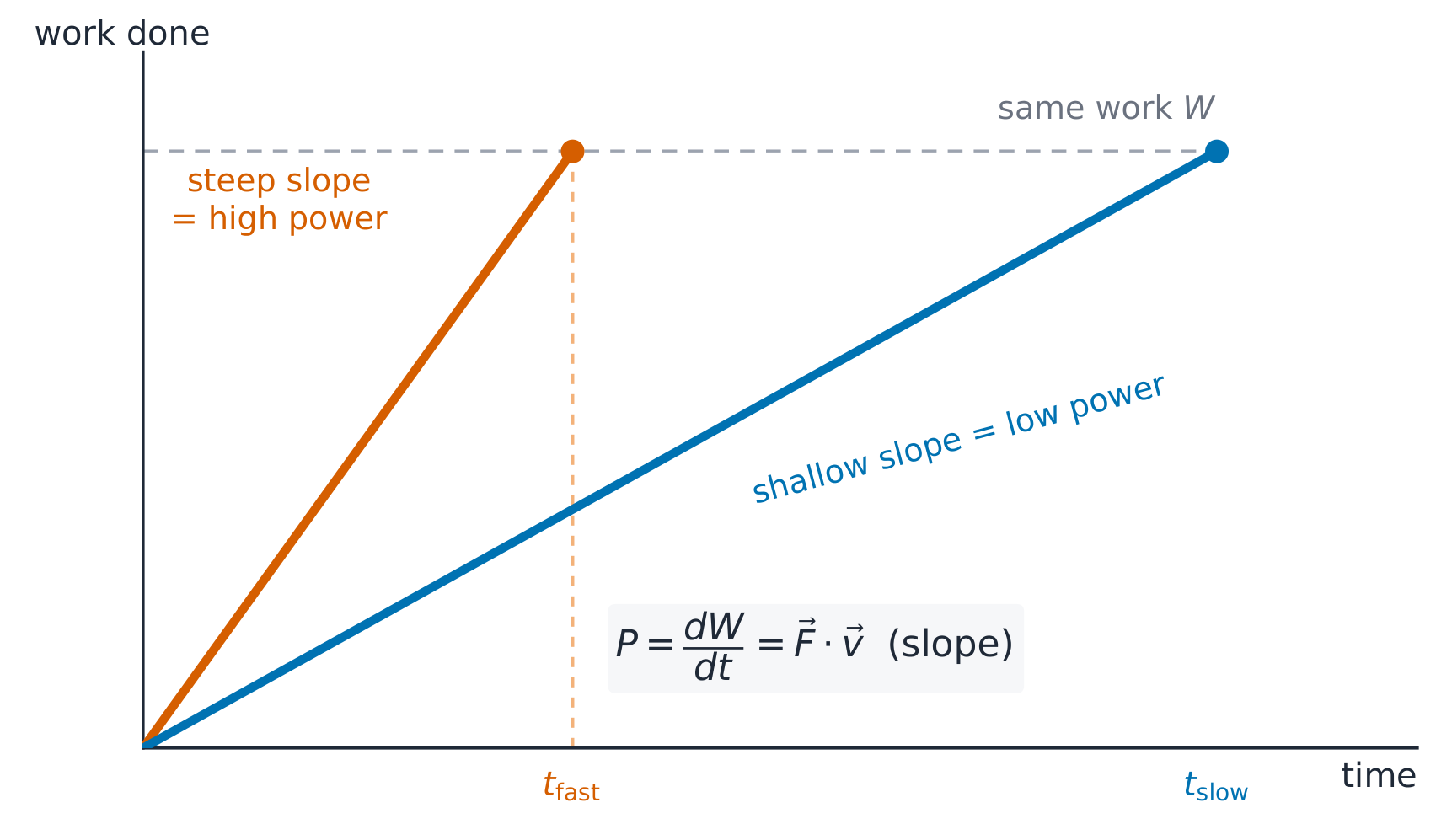
Daya adalah kemiringan grafik usaha-waktu: usaha yang sama dalam waktu lebih sedikit berarti daya lebih besar

Contoh terpecahkan. Sebuah balok dilepaskan dari keadaan diam di puncak landai licin setinggi $3.0\ \text{m}$ mencapai bagian bawah dengan kecepatan $v=\sqrt{2gh}=7.7\ \text{m/s}$ (dari $mgh=\tfrac12mv^2$). Motor yang kemudian menggerakkannya pada kecepatan tetap $7.7\ \text{m/s}$ melawan hambatan $20\ \text{N}$ menghasilkan daya $P=Fv=20(7.7)\approx150\ \text{W}$.

Contoh terpecahkan. Sebuah mobil $1200\ \text{kg}$ menaiki bukit yang meninggi $1.0\ \text{m}$ untuk setiap $20\ \text{m}$ jalan, dengan kecepatan tetap $15\ \text{m/s}$. Mesin harus menyediakan daya yang dikurangi gravitasi: $P=mg\,v\sin\theta=1200(9.8)(15)\big(\tfrac{1}{20}\big)\approx8.8\ \text{kW}$ – sebelum menambahkan hambatan udara.

Keterampilan ujian. Soal FRQ energi menghargai kalimat akuntansi: sebutkan sistem Anda, nyatakan gaya mana yang melakukan usaha padanya, dan tulis neranganya ($W_{\text{ext}}=\Delta K+\Delta U+\Delta E_{\text{thermal}}$) sebelum memasukkan angka. "Gesekan ada, sehingga energi mekanik tidak kekal" adalah pernyataan yang bernilai poin.

Vocabulary · ⁨Kosa kata⁩ Train · ⁨Latih⁩
English Bahasa Indonesia
Power/ˈpaʊə/ Daya
watts/wɒts/ watt
3.5

Exam tips · ⁨Tips ujian⁩

English
  • Use the work–energy theorem $W_{net}=\Delta KE$ and compute work as $W=\int \vec F\cdot d\vec r$ for a variable force.
  • Read work off a force–position graph as the area under the curve.
  • Power is $P=\tfrac{dW}{dt}=\vec F\cdot\vec v$; watch instantaneous vs average.
  • Split forces into conservative (define a potential energy) and non-conservative (dissipate energy).
  • Choose energy methods over kinematics when the force varies or the path is complex.
Bahasa Indonesia
  • Gunakan teorema usaha-energi $W_{net}=\Delta KE$ dan hitung usaha sebagai $W=\int \vec F\cdot d\vec r$ untuk gaya variabel.
  • Baca usaha dari grafik gaya-posisi sebagai luas di bawah kurva.
  • Daya adalah $P=\tfrac{dW}{dt}=\vec F\cdot\vec v$; perhatikan antara daya sesaat vs rata-rata.
  • Pisahkan gaya menjadi konservatif (definisikan energi potensial) dan non-konservatif (menghabiskan energi).
  • Pilih metode energi daripada kinematika ketika gayanya berubah atau jalurnya kompleks.

Interactive lessons on this topic · ⁨Pelajaran interaktif untuk topik ini⁩

Work through it step by step, with instant-check exercises. · ⁨Kerjakan langkah demi langkah, dengan latihan pengecekan instan.⁩

Past Papers · ⁨Soal-Soil Masa Lalu⁩

More topics in AP Physics C: Mechanics · ⁨AP Fisika C: Mekanika⁩ · ⁨Topik lain dalam AP Physics C: Mechanics · ⁨AP Fisika C: Mekanika⁩⁩

Log in or create account · ⁨Masuk atau buat akun⁩

IGCSE, A-Level & AP