7.1.A.1 Simple harmonic motion is a special case of periodic motion.
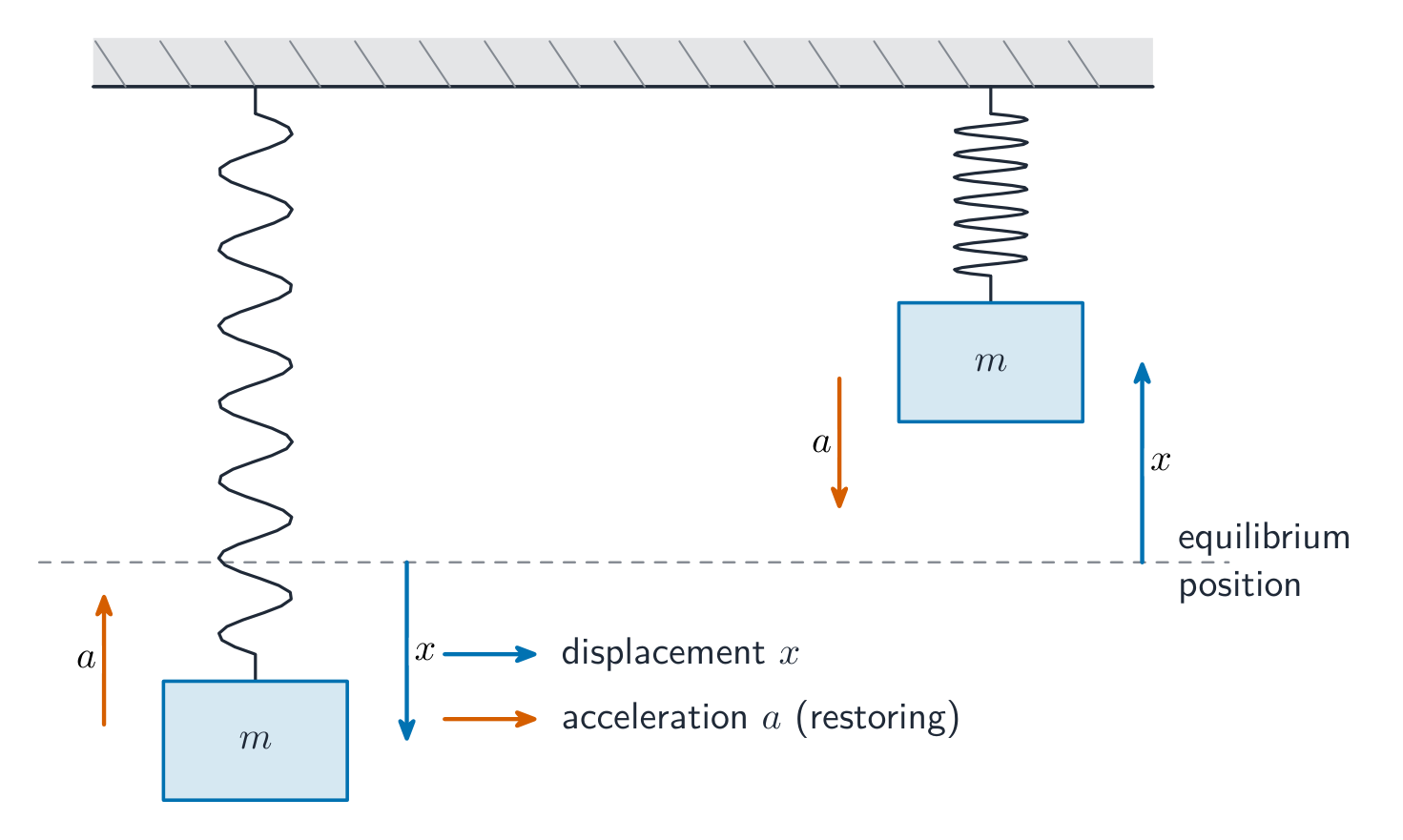
7.1.A.2 SHM results when the magnitude of the restoring force exerted on an object is proportional to that object's displacement from its equilibrium position.
Derived equation:$ma_x = -k\Delta x$
7.1.A.2.i A restoring force is a force that is exerted in a direction opposite to the object's displacement from an equilibrium position.
7.1.A.2.ii An equilibrium position is a location at which the net force exerted on an object or system is zero.
עברית
מטרת למידה 7.1.A: לתאר תנועה הרמונית פשוטה.
7.1.A.1 תנועה הרמונית פשוטה היא מקרה מיוחד של תנועה מחזורית.
7.1.A.2 SHM נוצר כאשר גודל כוח ההשבה הפועל על גוף הוא פרופורציונלי להזזה של אותו גוף ממיקום האיזון שלו.
משוואה גזורה:$ma_x = -k\Delta x$
7.1.A.2.i כוח השבה הוא כוח הפועל בכיוון הנגדי להזזה של הגוף ממיקום איזון.
7.1.A.2.ii מיקום איזון הוא מיקום שבו הכוח הכולל הפועל על גוף או מערכת הוא אפס.
Source: College Board AP Course and Exam Description · מקור: תיאור הקורס והמבחן של College Board AP
English
Simple harmonic motion
Simple harmonic motion 简谐运动 (SHM) is a special case of periodic motion 周期运动. It appears whenever two things are true: there is an equilibrium 平衡位置 position where the net force is zero, and displacing the object produces a restoring force 回复力 – a force pointing back toward equilibrium – whose magnitude is proportional to the displacement:
$$F=-k\,\Delta x.$$
Newton's second law then gives the defining differential equation 微分方程:
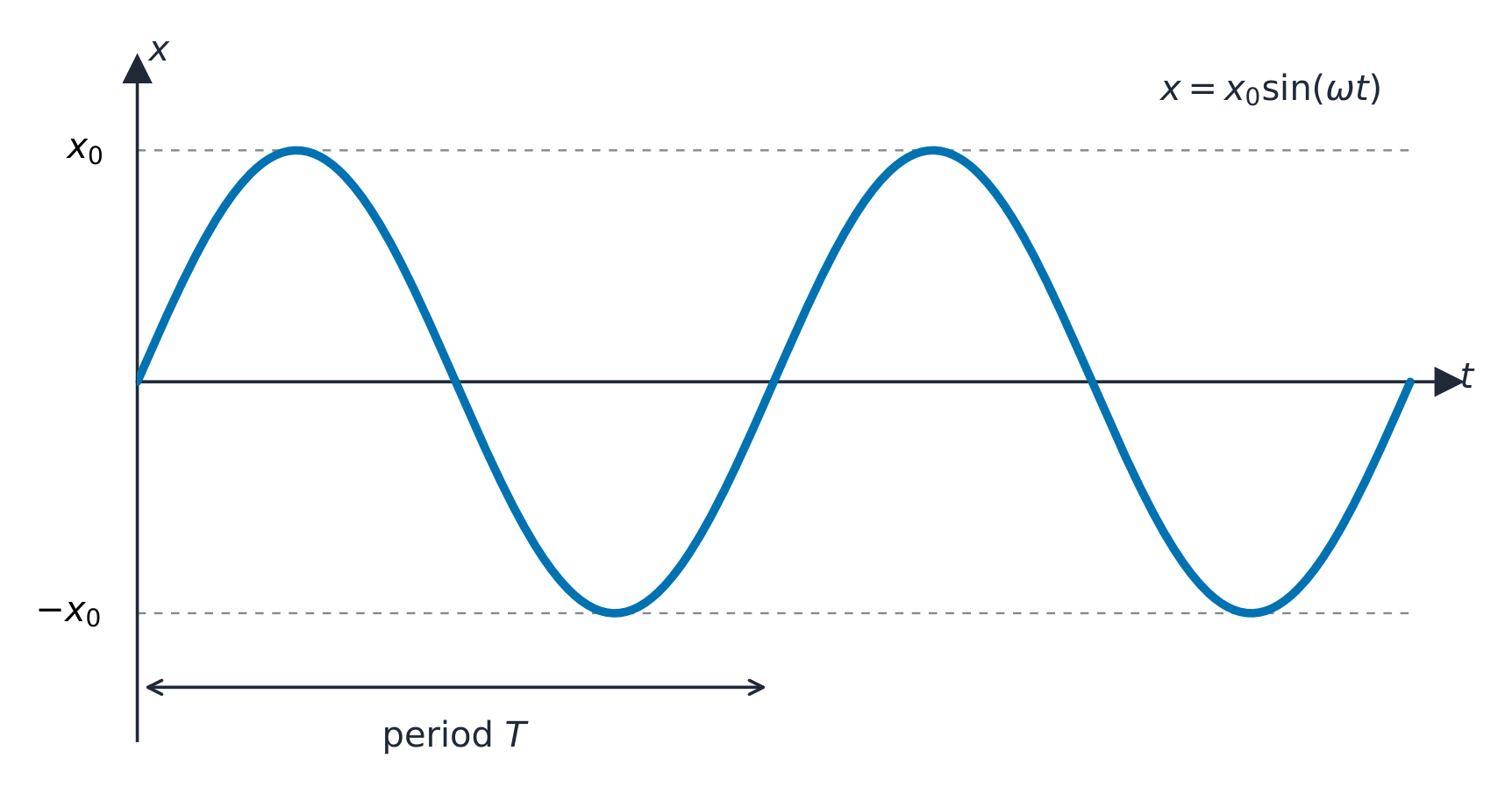
Its solution is sinusoidal, $x(t)=A\cos(\omega t+\phi)$. You do not need to prove this solution – you need to recognise the equation: any system whose motion obeys "$\ddot{x}=-\omega^2x$" is a simple harmonic oscillator, whatever it is made of. (A mass hanging on a vertical spring works the same way: gravity only shifts the equilibrium point; the oscillation about it is unchanged.)
עברית
תנועה הרמונית פשוטה
תנועה הרמונית פשוטה (SHM) היא מקרה פרטי של תנועה מחזורית. היא מופיעה כאשר שני דברים מתקיימים בו-זמנית: קיים נקודת איזון בה הכוח הכולל הוא אפס, והזזה של הגוף מייצרת כוח מחזיר – כוח המצביע חזרה לכיוון נקודת האיזון – שגודלו פרופורציונלי להזזה:
$$F=-k\,\Delta x.$$
חוק השני של ניוטון נותן אז את משוואת הפרדינגנל המגדירה:
הפתרון שלו הוא סינוסואידלי, $x(t)=A\cos(\omega t+\phi)$. אין צורך להוכיח פתרון זה – עליכם ל-זהות את המשוואה: כל מערכת שבה התנועה עומדת ב-"$\ddot{x}=-\omega^2x$" היא מתנד הרמוני פשוט, ללא קשר לחומר ממנו היא עשויה. (מסה תלויה על קפיץ אנכי עובדת באותו אופן: הכבידה רק מזיזה את נקודת האיזון; התנודה סביבה נשארת ללא שינוי.)
בתנועה הרמונית פשוטה האוצר תמיד מצביע חזרה לאיזון, הפוך להזזה
7.2
Frequency and Period of SHM · תדירות ותקופה של תנודות הרמוניות פשוטות
Syllabus · סיילבוס
English
Learning Objective 7.2.A: Describe the frequency and period of an object exhibiting SHM.
7.2.A.1 The period of SHM is related to the angular frequency, $\omega$, of the object's motion by the following equation:
Two classic conceptual traps: the period of SHM never depends on the amplitude 振幅, and each system ignores one obvious variable – the pendulum's period does not involve its mass, and the spring's period does not involve $g$ (a spring–block oscillator keeps perfect time in orbit; a pendulum clock does not).
שני כלי מלכודת קונספטואליים קלאסיים: התקופה של תנודות הרמוניות פשוטות (SHM) לעולם אינה תלויה במשרעת, וכל מערכת מתעלמת משתנה ברור אחד – תקופת המנדול אינה כוללת את מסתו, ותקופת הקפיץ אינה כוללת $g$ (מתנד קפיץ-גוף שומר על זמן מדויק באורביט; שעון מנדול לא עושה זאת).
Explore · חקור
Time a pendulum's swing · מדוד זמן תנודת מתלה
A pendulum's period depends on its length and gravity, not its mass or (small) amplitude: $T=2\pi\sqrt{L/g}$. Lengthen it and each swing takes longer. · התקופה של מתלה תלויה באורכו ובכובד, ולא במסתו או במשרעתו (הקטנה): $T=2\pi\sqrt{L/g}$. אם מאריכים אותו, כל תנודה לוקחת יותר זמן.
7.3
Representing and Analyzing SHM · ייצוג וניתוח של תנודות הרמוניות פשוטות
Syllabus · סיילבוס
English
Learning Objective 7.3.A: Describe the displacement, velocity, and acceleration of an object exhibiting SHM.
7.3.A.1 For an object exhibiting SHM, the displacement of that object measured from its equilibrium position can be represented by the equations $x = A\cos(2\pi ft)$ or $x = A\sin(2\pi ft)$.
7.3.A.1.i Minima, maxima, and zeros of displacement, velocity, and acceleration are features of harmonic motion.
7.3.A.1.ii Recognizing the positions or times at which the displacement, velocity, and acceleration for SHM have extrema or zeros can help in qualitatively describing the behavior of the motion.
7.3.A.2 The position as a function of time for an object exhibiting SHM is a solution of the second-order differential equation derived from the application of Newton's second law.
7.3.A.3 Characteristics of SHM, such as velocity and acceleration, can be determined by or derived from the equation $x = A\cos(\omega t + \phi).$
7.3.A.3.i The acceleration of an object exhibiting SHM is related to the object's angular frequency and position.
Derived equation:$a = -\omega^2 x$
7.3.A.3.ii It can be shown that the maximum velocity and acceleration of an object exhibiting SHM are related to the angular frequency of the object's motion.
Derived equations:$v_{\max} = A\omega$
$a_{\max} = A\omega^2$
7.3.A.4 In the presence of a sinusoidal external force, a system may exhibit resonance.
7.3.A.4.i Resonance occurs when an external force is exerted at the natural frequency of an oscillating system.
7.3.A.4.ii Resonance increases the amplitude of oscillating motion.
7.3.A.4.iii The natural frequency of a system is the frequency at which the system will oscillate when it is displaced from its equilibrium position.
7.3.A.5 Changing the amplitude of a system exhibiting SHM will not change its period.
7.3.A.6 Properties of SHM can be determined and analyzed using graphical representations.
Boundary statement: AP Physics C: Mechanics only expects students to know the solution to the second-order differential equation that describes SHM, as well as be able to identify SHM. AP Physics C: Mechanics does not expect students to mathematically prove that the solution is correct.
עברית
מטרת למידה 7.3.A: לתאר את ההזזה, המהירות והתאוצה של גוף המציג SHM.
7.3.A.1 עבור גוף המציג SHM, ההזזה של אותו גוף הנמדדת ממיקום האיזון שלו יכולה להיות מיוצגת על ידי המשוואות $x = A\cos(2\pi ft)$ או $x = A\sin(2\pi ft)$.
7.3.A.1.i מינימום, מקסימום ואפסים של הזזה, מהירות ותאוצה הם מאפיינים של תנועה הרמונית.
7.3.A.1.ii זיהוי המיקומים או הזמנים שבהם ההזזה, המהירות והתאוצה ל-SHM מגיעים לקיצונים או לאפסים יכול לעזור בתיאור איכותני של התנהגות התנועה.
7.3.A.2 המיקום כתלות בזמן עבור אובייקט המציג תנודות הרמוניות הוא פתרון למשוואה דיפרנציאלית מסדר שני הנגזרת מהיישום של החוק השני של ניוטון.
משוואה גזורה:$\dfrac{d^2 x}{dt^2} = -\omega^2 x$
7.3.A.3 מאפיינים של תנודות הרמוניות, כגון מהירות ותאוצה, יכולים להיות נקבעים או מופקים מהמשוואה $x = A\cos(\omega t + \phi).$
7.3.A.3.i התאוצה של אובייקט המציג תנודות הרמוניות קשורה לתדר הזוויתי ולמיקום של האובייקט.
משוואה נגזרת:$a = -\omega^2 x$
7.3.A.3.ii ניתן להראות שהמהירות והתאוצה המרביות של אובייקט המציג תנודות הרמוניות קשורות לתדר הזוויתי של תנועת האובייקט.
משוואות מופקות:$v_{\max} = A\omega$
$a_{\max} = A\omega^2$
7.3.A.4 בנוכחות כוח חיצוני סינוסואידי, מערכת עשויה להציג תהודה (Resonance).
7.3.A.4.i תהודה מתרחשת כאשר כוח חיצוני מופעל בתדר הטבעי של מערכת רונדלרית.
7.3.A.4.ii תהודה מגבירה את המשרעת של תנועת הרונדלציה.
7.3.A.4.iii התדר הטבעי של מערכת הוא התדר בו תרונדלר המערכת כאשר היא מוסחת ממיקום האיזון שלה.
7.3.A.5 שינוי במשרעת של מערכת המציגה תנודות הרמוניות לא ישנה את התקופה שלה.
7.3.A.6 מאפיינים של תנודות הרמוניות יכולים לקבוע ולנתח באמצעות נציגות גרפית.
הצהרת גבול: AP Physics C: המכניקה מצפה רק שהתלמידים ידעו את הפתרון למשוואה הדיפרנציאלית מסדר שני המתארת תנודה הרמונית פשוטה (SHM), כמו גם להיות מסוגלים לזהות SHM. AP Physics C: המכניקה אינה מצפה מהתלמידים להוכיח מתמטית שהפתרון נכון.
Source: College Board AP Course and Exam Description · מקור: תיאור הקורס והמבחן של College Board AP
So at the ends of the swing ($x=\pm A$) the speed is zero and the acceleration is largest; passing through equilibrium ($x=0$) the acceleration is zero and the speed is largest, $v_{\max}=A\omega$. The amplitude $A$ and the phase constant 相位常数$\phi$ come from the initial conditions: where the object starts and how fast it is moving. Eliminating $t$ (or using energy, below) gives speed as a function of position:
$$v=\pm\,\omega\sqrt{A^2-x^2}.$$
Worked example. A $0.50\ \text{kg}$ mass on a $k=200\ \text{N/m}$ spring: $\omega=\sqrt{k/m}=20\ \text{rad/s}$, $T=2\pi/\omega=0.31\ \text{s}$. With $A=0.10\ \text{m}$: $v_{\max}=A\omega=2.0\ \text{m/s}$ at equilibrium, and at $x=0.050\ \text{m}$ the speed is $v=\omega\sqrt{A^2-x^2}=20\sqrt{0.10^2-0.050^2}=1.7\ \text{m/s}$.
לכן בקצוות הנדודה ($x=\pm A$) המהירות היא אפס והאוצר הגדול ביותר; במעבר דרך נקודת האיזון ($x=0$) האוצר הוא אפס והמהירות הגדולה ביותר, $v_{\max}=A\omega$. המשרעת $A$ והקבוע הפאזה$\phi$ נובעים מתנאים ההתחלה: היכן שהגוף מתחיל וכמה מהיר הוא נע. הסרת $t$ (או שימוש באנרגיה, למטה) נותנת את המהירות כתלות במיקום:
$$v=\pm\,\omega\sqrt{A^2-x^2}.$$
המיקום משתנה סינוסואידלית עם הזמן בתנועה פשוטה הרמונית
דוגמה מופרדת. מסה $0.50\ \text{kg}$ על קפיץ $k=200\ \text{N/m}$: $\omega=\sqrt{k/m}=20\ \text{rad/s}$, $T=2\pi/\omega=0.31\ \text{s}$. עם $A=0.10\ \text{m}$: $v_{\max}=A\omega=2.0\ \text{m/s}$ באיזון, ובמיקום $x=0.050\ \text{m}$ המהירות היא $v=\omega\sqrt{A^2-x^2}=20\sqrt{0.10^2-0.050^2}=1.7\ \text{m/s}$.
7.4
Energy of Simple Harmonic Oscillators · אנרגיה של מתנדדים הרמוניים פשוטים
Syllabus · סיילבוס
Learning Objective
Essential Knowledge
7.4.A
Describe the mechanical energy of a system exhibiting SHM.
7.4.A.1 The total energy of a system exhibiting SHM is the sum of the system's kinetic and potential energies.
Relevant equation:$E_{\text{total}} = U + K$
7.4.A.2 Conservation of energy indicates that the total energy of a system exhibiting SHM is constant.
7.4.A.3 The kinetic energy of a system exhibiting SHM is at a maximum when the system's potential energy is at a minimum.
7.4.A.4 The potential energy of a system exhibiting SHM is at a maximum when the system's kinetic energy is at a minimum.
7.4.A.4.i The minimum kinetic energy of a system exhibiting SHM is zero.
7.4.A.4.ii Changing the amplitude of a system exhibiting SHM will change the maximum potential energy of the system and, therefore, the total energy of the system.
Relevant equation for a spring–object system:$E_{\text{total}} = \dfrac{1}{2}kA^2$
Source: College Board AP Course and Exam Description · מקור: תיאור הקורס והמבחן של College Board AP
English
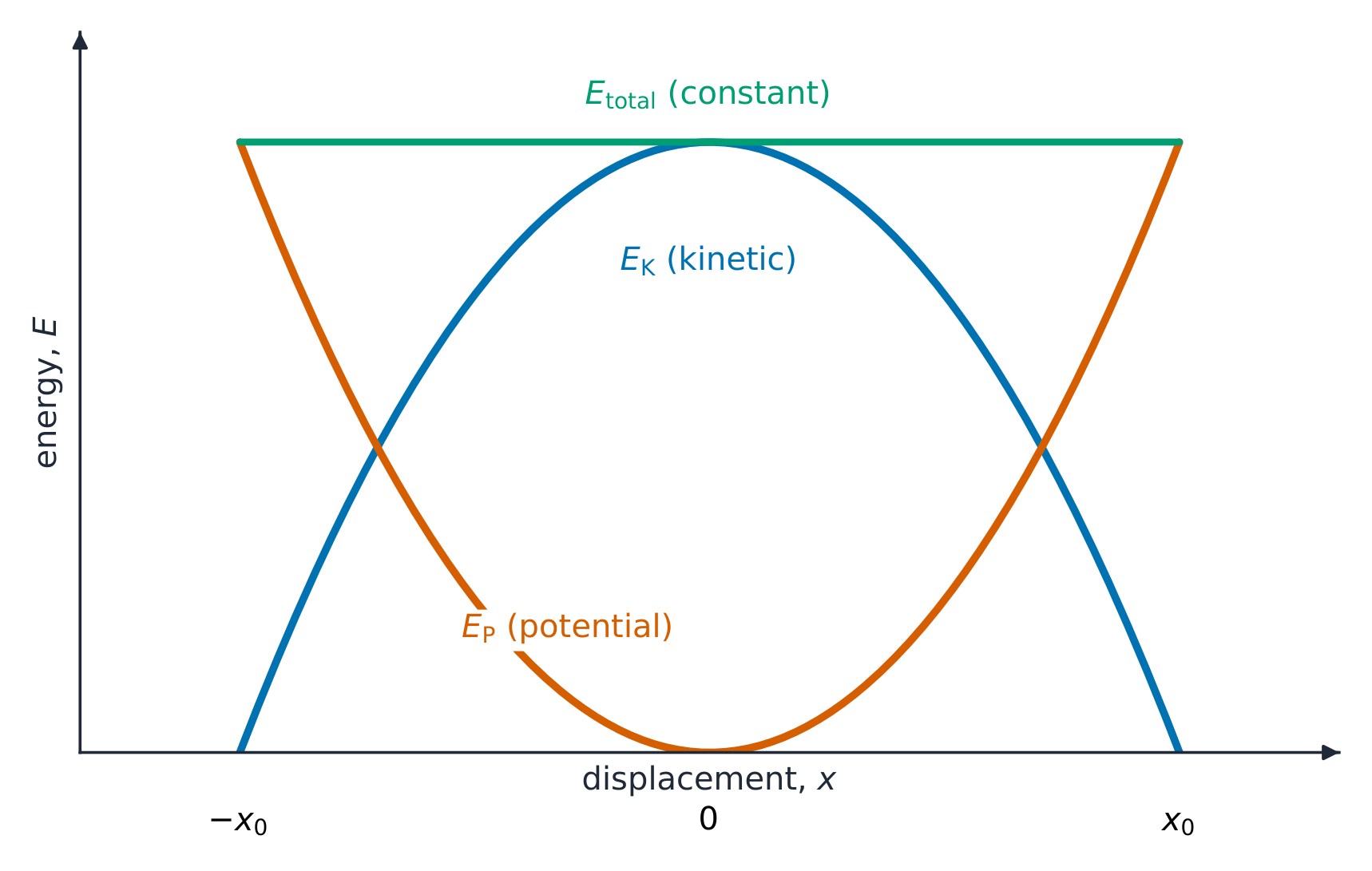
The total energy of the oscillator is the sum $E=U+K$, and with no friction it is constant – energy just trades back and forth between the spring's potential energy and the mass's kinetic energy:
$$E=\tfrac12kA^2=\tfrac12kx^2+\tfrac12mv^2.$$
All potential at the ends (where $K=0$), all kinetic at equilibrium (where $U$ is minimum). Because $E\propto A^2$, doubling the amplitude quadruples the energy.
Worked example. Where is the energy split evenly? Set $\tfrac12kx^2=\tfrac12E=\tfrac14kA^2$, so $x=A/\sqrt2\approx0.71A$ – much closer to the end than to the middle. For the system above ($A=0.10\ \text{m}$): $x=0.071\ \text{m}$.
Left alone, a system oscillates at its own natural frequency 固有频率 (set by $k$ and $m$: $f_0=\frac{1}{2\pi}\sqrt{k/m}$). Drive it with a periodic force at that same frequency and the amplitude grows dramatically – resonance 共振. Each well-timed push adds energy faster than damping removes it, so the driven amplitude peaks sharply when the driving frequency matches $f_0$ (a swing pumped in time, a bridge shaken by wind).
עברית
האנרגיה הכוללת של המתנד היא הסכום $E=U+K$, וללא חיכוך היא קבועה – האנרגיה פשוט משתנה חלופית בין האנרגיה הפוטנציאלית של הקפיץ לאנרגיה הקינטית של המסה:
$$E=\tfrac12kA^2=\tfrac12kx^2+\tfrac12mv^2.$$
כל האנרגיה פוטנציאלית בקצוות (כאן $K=0$), כל האנרגיה קינטית באיזון (כאן $U$ מינימלי). מכיוון ש$E\propto A^2$, הכפלת המשרעת מארבעה את האנרגיה.
אנרגיה קינטית ופוטנציאלית מתחלפות במהלך מחזור בעוד שהאנרגיה הכוללת נשארת קבועה
דוגמה מופרדת. היכן האנרגיה מחולקת באופן שווה? נציב $\tfrac12kx^2=\tfrac12E=\tfrac14kA^2$, ולכן $x=A/\sqrt2\approx0.71A$ – הרבה יותר קרוב לקצה מאשר למרכז. עבור המערכת הנ"ל ($A=0.10\ \text{m}$): $x=0.071\ \text{m}$.
כאשר מושארים לבדם, מערכת מתנדדת בתדר טבעי שלה (נקבע על ידי $k$ ו$m$: $f_0=\frac{1}{2\pi}\sqrt{k/m}$). אם גורמים לה בכוח מחזורי באותו תדר, המשרעת גדלה באופן דרמטי – תהודה. כל דחיפה בזמן הנכון מוסיפה אנרגיה מהר יותר מהשחיקה שהיא מסירה, כך שמשרעת הדרייב מקבלת שיא חד כאשר תדר ההנעה מתאים ל$f_0$ (מתנד שמתנדנד בזמן, גשר שנערעע על ידי רוח).
Explore · חקור
Trade kinetic and potential energy in SHM · חילוף אנרגיה קינטית ופוטנציאלית בתנועה הרמונית פשוטה
In simple harmonic motion, energy sloshes between kinetic (fastest at the centre) and potential (greatest at the extremes) while the total stays constant. · בתנועה רמונית פשוטה, האנרגיה מתחלפת בין קינטית (מהירה ביותר במרכז) לפוטנציאלית (גבוהה ביותר בקצוות), בעוד שהסך הכל נשאר קבוע.
7.5
Simple and Physical Pendulums · מטוטלות פשוטות ומטוטלות פיזיקליות
Syllabus · סיילבוס
Learning Objective
Essential Knowledge
7.5.A
Describe the properties of a physical pendulum.
7.5.A.1 A physical pendulum is a rigid body that undergoes oscillation about a fixed axis.
7.5.A.2 For small amplitudes of motion, the period of a physical pendulum is derived from the application of Newton's second law in rotational form.
7.5.A.3 A simple pendulum is a special case of physical pendulums in which the hanging object can be modeled as a point mass at a distance, $l$, from the pivot point.
7.5.A.4 A torsion pendulum is a case of SHM where the restoring torque is proportional to the angular displacement of a rotating system. For example, a horizontal disk that is suspended from a wire attached to its center of mass may undergo rotational oscillations about the wire in the horizontal plane.
Derived equation:$I\alpha = -k\Delta\theta$
Source: College Board AP Course and Exam Description · מקור: תיאור הקורס והמבחן של College Board AP
English
Energy conservation: KE ⇄ PE
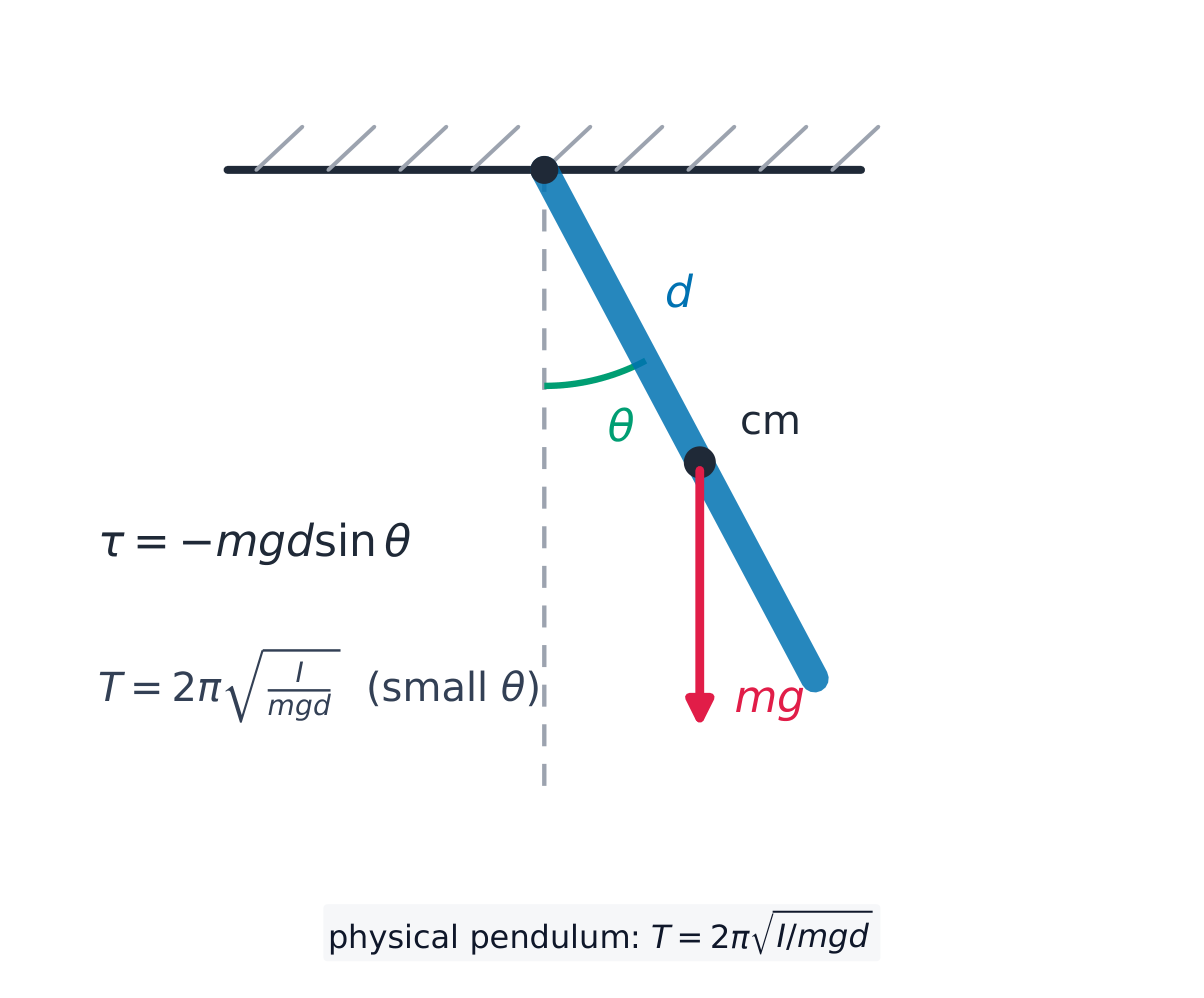
A physical pendulum 物理摆 is any rigid body swinging about a fixed pivot. Displace it by an angle $\theta$ and gravity, acting at the center of mass a distance $d$ from the pivot, supplies a restoring torque
$$\tau=-mgd\sin\theta.$$
For small angles, apply the small-angle approximation 小角度近似$\sin\theta\approx\theta$ and Newton's second law in rotational form ($\tau=I\alpha$):
This is the same "$\ddot\theta=-\omega^2\theta$" pattern as before – recognising it is the derivation. A simple pendulum 单摆 is the special case of a point mass on a light string: $I=m\ell^2$ and $d=\ell$ give $T=2\pi\sqrt{\ell/g}$.
Worked example. A uniform rod (mass $M$, length $L$) swings from one end: $I=\tfrac13ML^2$, $d=\tfrac{L}{2}$, so
– shorter than a simple pendulum of length $L$, because the rod's mass sits nearer the pivot.
A torsion pendulum 扭摆 – a disk hanging from a wire that twists – is SHM one more time: the wire's restoring torque is proportional to the twist angle, $I\alpha=-\kappa\,\Delta\theta$, giving $T=2\pi\sqrt{I/\kappa}$.
Exam skill. Every pendulum FRQ wants the same three steps: write the restoring torque about the pivot, apply the small-angle approximation, and match the result to $\ddot\theta=-\omega^2\theta$ to read off $\omega$. State the small-angle step explicitly – it is a scored point, and it is why large-amplitude swings are not simple harmonic.
עברית
שימור אנרגיה: KE ⇄ PE
מטוטלה פיזיקלית היא כל גוף קשיח המתנדנד סביב ציר סיבוב קבוע. אם מסטים אותה בזווית $\theta$ והכובד, הפועל במרכז המסה במרחק $d$ מציר הסיבוב, מספק מומנט מחזיר
$$\tau=-mgd\sin\theta.$$
עבור זוויות קטנות, נפעיל את הקרבת הזוויות הקטנות$\sin\theta\approx\theta$ ואת חוק牛顿 השני בצורה הסיבובית ($\tau=I\alpha$):
זו אותה דוגמה "$\ddot\theta=-\omega^2\theta$" כמו קודם – זיהוי שהוא המסלול של ההוכחה. מטוטלה פשוטה היא המקרה המיוחד של מסה נקודתית על חוט קל: $I=m\ell^2$ ו$d=\ell$ נותנים $T=2\pi\sqrt{\ell/g}$.
כוח הכובד הפועל במרכז המסה מספק את המומנט המחזיר של מטוטלה פיזיקלית
דוגמה מופרדת. מוט אחיד (מסה $M$, אורך $L$) מתנדנד מקצה אחד: $I=\tfrac13ML^2$, $d=\tfrac{L}{2}$, ולכן
– קצר יותר ממטוטלה פשוטה באורך $L$, מכיוון שמסת המוט נמצאת קרובה יותר לציר הסיבוב.
מטוטלת טורסיה – דיסק התלויה בחוט המסתובב – היא SHM עוד פעם: המומנט המחזיר של החוט פרופורציונלי לזווית הסיבוב, $I\alpha=-\kappa\,\Delta\theta$, ונותן $T=2\pi\sqrt{I/\kappa}$.
מיומנות מבחן. כל שאלת FRQ לגבי מטוטלה דורשת את אותו שלושה צעדים: לכתוב את המומנט המחזיר ביחס לציר הסיבוב, להפעיל את הקרבת הזוויות הקטנות, ולהתאים את התוצאה ל$\ddot\theta=-\omega^2\theta$ כדי לקרוא את $\omega$. יש לציין במפורש את שלב הקרבת הזוויות הקטנות – זה נקודת ציון, וזה הסיבה לכך ששאיפות בעלות משרעת גדולה אינן תנודה הרמונית פשוטה.
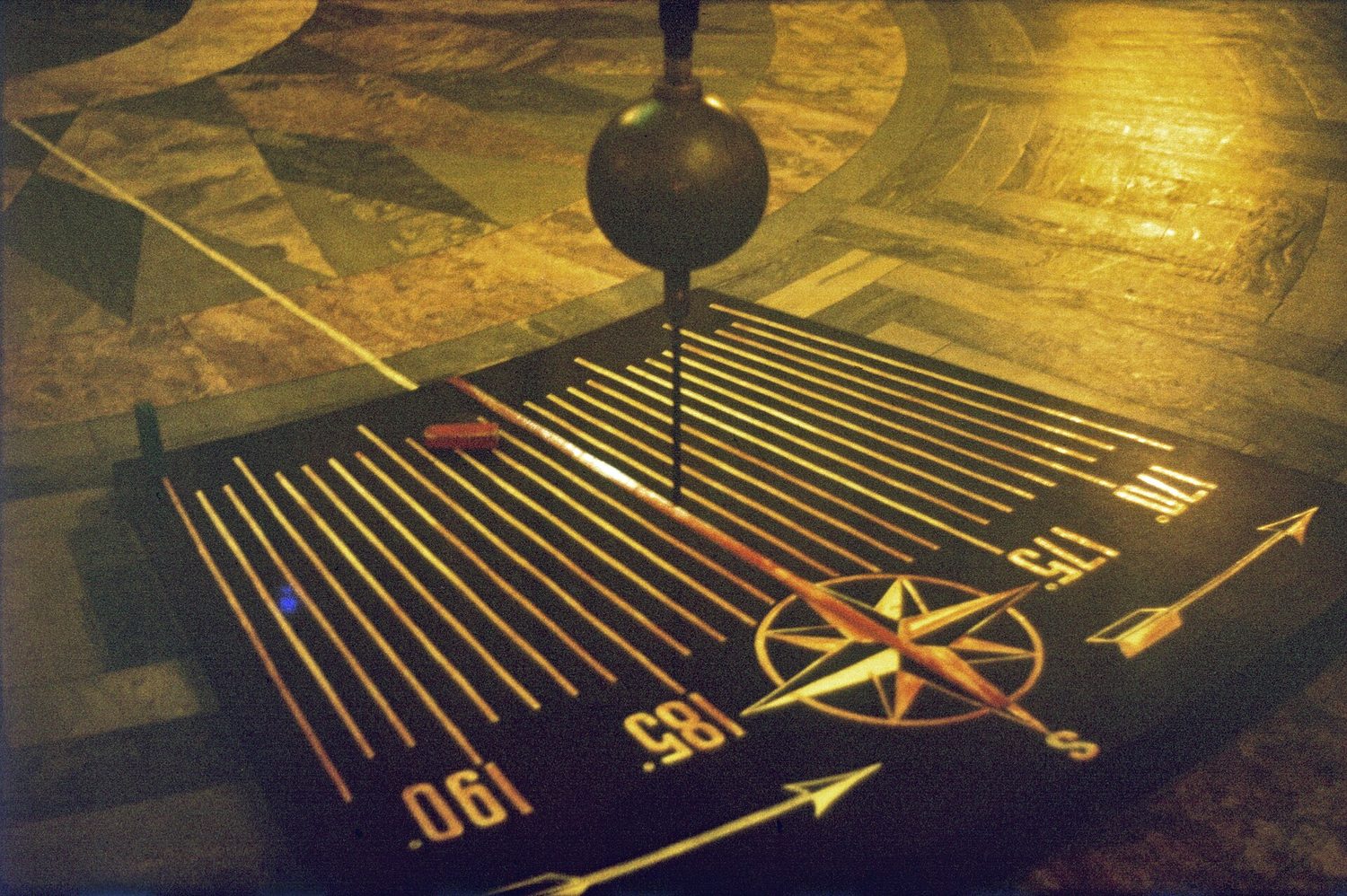
מטוטלת פואקו: מטוטלה ארוכה וכבדה שאיטיות התנדדותה חושפת את סיבוב כדור הארץ מתחתיה
Pick one and the site follows you — notes, papers, videos and practice all open on it. · בחרו נושא אחד והאתר יעקוב אחריו — הערות, מסמכים, וידאו ותרגולים פתוחים בו.
Type to search notes, lessons, code, vocabulary and past-paper questions across every subject. · הקלד כדי לחפש הערות, שיעורים, קוד, אוצר מילים ושאלות מבחנים בכל הנושאים.