רכב עצור בתאונה. עם כרית אוויר, הנהג יוצא בשלום. ללאה, הוא אינו. בשני המקרים השינוי בתנע זהה בדיוק — ממומל…
English narration · English + 中文 subtitles burned in · קריאת קול באנגלית · תרגום אנגלי + סינית שרוף בתוך הסרטון
4.1
Linear Momentum · תנע ליני
Syllabus · סיילבוס
English
Learning Objective 4.1.A: Describe the linear momentum of an object or system.
4.1.A.1 Linear momentum is defined by the equation $\vec{p} = m\vec{v}$.
4.1.A.2 Momentum is a vector quantity and has the same direction as the velocity.
4.1.A.3 Momentum can be used to analyze collisions and explosions.
4.1.A.3.i A collision is a model for an interaction where the forces exerted between the involved objects in the system are much larger than the net external force exerted on those objects during the interaction.
4.1.A.3.ii As only the initial and final states of a collision are analyzed, the object model may be used to analyze collisions.
4.1.A.3.iii An explosion is a model for an interaction in which forces internal to the system move objects within that system apart.
עברית
מטרות למידה 4.1.A: תיאור התנע הליניארי של גוף או מערכת.
4.1.A.1 התנע הליניארי מוגדר על ידי המשוואה $\vec{p} = m\vec{v}$.
4.1.A.2 התנע הוא גודל וקטורי ולו אותה כיוון כמו המהירות.
4.1.A.3 ניתן להשתמש בתנע כדי לנתח התנגשויות והתפוצצויות.
4.1.A.3.i התנגשות היא דגם לאינטראקציה שבה הכוחות המופעלים בין הגופים המעורבים במערכת הם גדולים משמעותית מהכוח החיצוני הכולל הפועל עליהם במהלך האינטראקציה.
4.1.A.3.ii מכיוון שננתחים רק המצבים ההתחלתי והסופי של התנגשות, ניתן להשתמש בדגם הגוף כדי לנתח התנגשויות.
4.1.A.3.iii התפוצצות היא דגם לאינטראקציה שבה כוחות פנימיים למערכת מזיזים גופים בתוך המערכת זה הרחק מזה.
Source: College Board AP Course and Exam Description · מקור: תיאור הקורס והמבחן של College Board AP
English
Linear momentum 动量 is mass times velocity:
$$\vec{p}=m\vec{v}.$$
It is a vector 矢量 pointing along the velocity, and it is the quantity for analysing collisions 碰撞 and explosions 爆炸. A collection of objects can be treated as one system moving with the velocity of its center of mass 质心:
4.2.A.3 Impulse is a vector quantity and has the same direction as the net force exerted on the system.
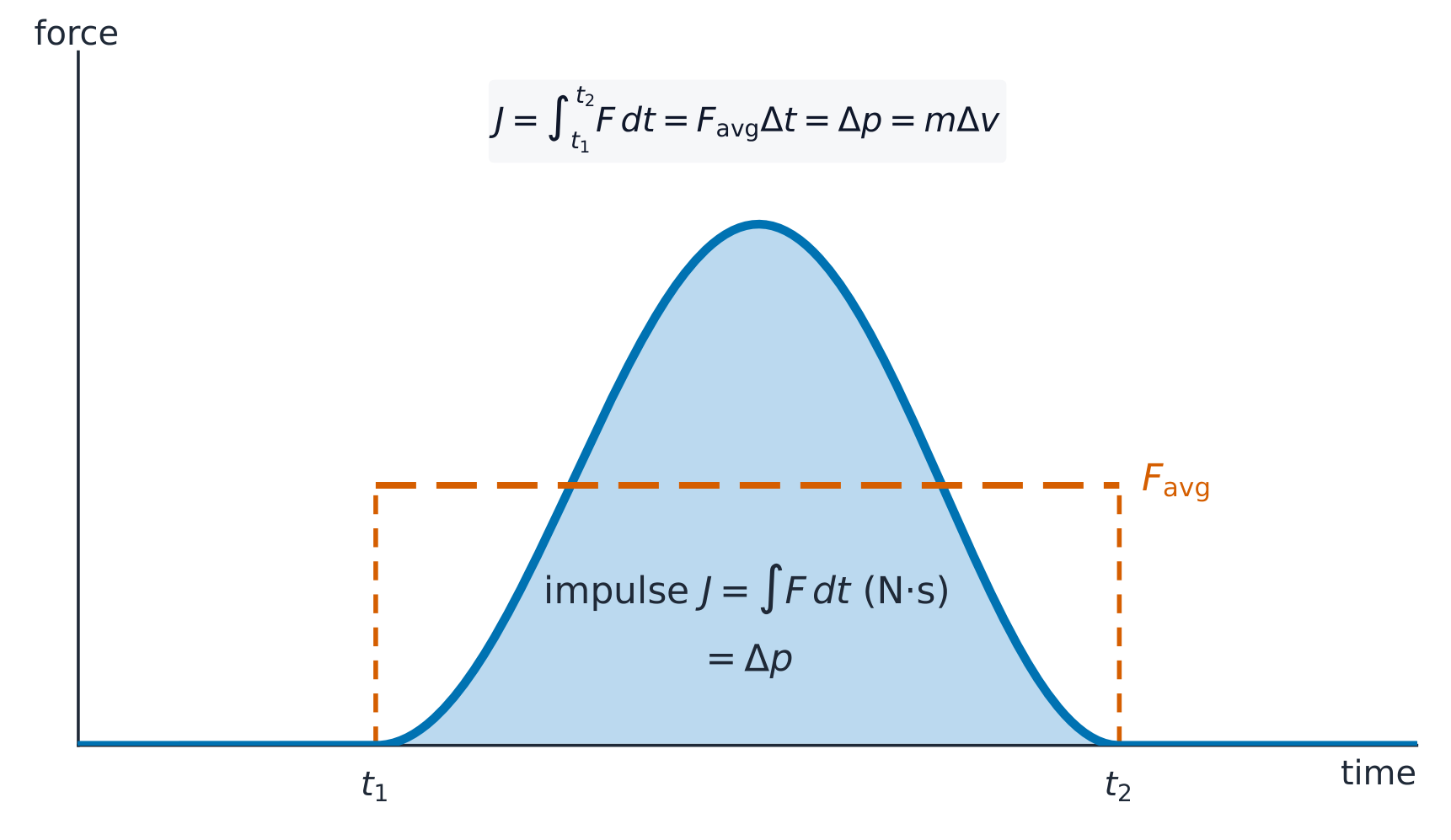
4.2.A.4 The impulse delivered to a system by a net external force is equal to the area under the curve of a graph of the net external force exerted on the system as a function of time.
4.2.A.5 The net external force exerted on a system is equal to the slope of a graph of the momentum of the system as a function of time.
Learning Objective 4.2.B: Describe the relationship between the impulse exerted on an object or system and the change in momentum of the object or system.
4.2.B.1 Change in momentum is the difference between a system's final momentum and its initial momentum.
Equation:$\Delta\vec{p} = \vec{p} - \vec{p}_0$
4.2.B.2 The impulse–momentum theorem relates the impulse delivered to an object and the object's change in momentum.
4.2.B.2.i The impulse exerted on an object is equal to the object's change in momentum.
4.2.B.2.iii The impulse–momentum theorem also describes the behavior of a system in which the velocity is constant but the mass changes with respect to time.
Source: College Board AP Course and Exam Description · מקור: תיאור הקורס והמבחן של College Board AP
English
Newton's second law is really a statement about momentum:
$$\vec{F}_{\text{net}}=\frac{d\vec{p}}{dt},$$
which reduces to $m\vec{a}$ when the mass is constant – and handles a changing mass when it is not (the special case $\vec{F}=\dfrac{dm}{dt}\vec{v}$ holds only when the velocity is constant, e.g. a chain piling onto a scale or sand landing on a belt moving at fixed speed; a rocket does not fit, since it accelerates). The impulse 冲量 delivered by a force is its time integral, and the impulse–momentum theorem 冲量-动量定理 says it equals the change in momentum:
Impulse is a vector along the net force. Read it off graphs both ways:
On a force–time graph, impulse is the area under the curve.
On a momentum–time graph, the net force is the slope 斜率 at each instant.
Spreading the same $\Delta p$ over a longer time lowers the force – that is why airbags, crumple zones, and soft landings work, and why you bend your knees when you land.
Worked example. A time-varying force $F(t)=10t\ \text{N}$ acts on a $2.0\ \text{kg}$ object for $2.0\ \text{s}$. The impulse is $J=\displaystyle\int_0^2 10t\,dt=\big[5t^2\big]_0^2=20\ \text{N}\cdot\text{s}$, so the speed changes by $\Delta v=J/m=10\ \text{m/s}$.
עברית
חוק השני של ניוטון הוא למעשה הצהרה על תנע:
$$\vec{F}_{\text{net}}=\frac{d\vec{p}}{dt},$$
שהוא מצטמצם ל$m\vec{a}$ כאשר המסה קבועה – ומטפל במסה מתغيرة כאשר זו אינה כזו (המקרה המיוחד $\vec{F}=\dfrac{dm}{dt}\vec{v}$ תקף רק כאשר המהירות קבועה, למשל שרשרת מצטברת על משקל או חול נופל על חגורה הנעה במהירות קבועה; רקטור לא מתאים, שכן הוא מאיץ). התנעה המסופקת על ידי כוח היא האיגרל של הזמן שלו, ומשפט התנעה-תנע- אומר שהוא שווה לשינוי בתנע:
התנעה היא וקטור לאורך הכוח הכולל. קראו אותה בגרפים בשתי דרכים:
בגרף כוח-זמן, התנעה היא שטח מתחת לעקומה.
בגרף התנע–זמן, הכוח הכולל הוא השיפוע בכל רגע נתון.
העתק הוא השטח מתחת לעקומת הכוח-זמן, שווה לכוח הממוצע כפול זמן המגע
פיזור אותו $\Delta p$ על פני זמן ארוך יותר מפחית את הכוח – ולכן בוליות אוויר, אזורי התכווצות ונחיתה רכה עובדים, וכך גם כיפוף הברכיים בזמן הנחיתה.
דוגמה מפורטת. כוח תלוי-זמן $F(t)=10t\ \text{N}$ פועל על גוף בעל מסת $2.0\ \text{kg}$ למשך $2.0\ \text{s}$. האימפולס הוא $J=\displaystyle\int_0^2 10t\,dt=\big[5t^2\big]_0^2=20\ \text{N}\cdot\text{s}$, ולכן המהירות משתנה ב-$\Delta v=J/m=10\ \text{m/s}$.
4.3.A.1.ii The velocity of a system's center of mass is constant in the absence of a net external force.
4.3.A.2 The total momentum of a system is the sum of the momenta of the system's constituent parts.
4.3.A.3 In the absence of net external forces, any change to the momentum of an object within a system must be balanced by an equivalent and opposite change of momentum elsewhere within the system. Any change to the momentum of a system is due to a transfer of momentum between the system and its surroundings.
4.3.A.3.i The impulse exerted by one object on a second object is equal and opposite to the impulse exerted by the second object on the first. This is a direct result of Newton's third law.
4.3.A.3.ii A system may be selected so that the total momentum of that system is constant.
4.3.A.3.iii If the total momentum of a system changes, that change will be equivalent to the impulse exerted on the system.
Equation:$\vec{J} = \Delta\vec{p}$
4.3.A.4 Correct application of conservation of momentum can be used to determine the velocity of a system immediately before and immediately after collisions or explosions.
Boundary statement: AP Physics C: Mechanics only expects students to quantitatively analyze collisions and interactions in one or two dimensions. Three-dimensional collisions may be analyzed qualitatively.
Learning Objective 4.3.B: Describe how the selection of a system determines whether the momentum of that system changes.
4.3.B.1 Momentum is conserved in all interactions.
4.3.B.2 If the net external force on the selected system is zero, the total momentum of the system is constant.
4.3.B.3 If the net external force on the selected system is nonzero, momentum is transferred between the system and the environment.
עברית
מטרות למידה 4.3.A: לתאר את התנהגות המערכת באמצעות שימור תנע ליני.
4.3.A.1 אוסף של עצמים עם תנעים פרטיים ניתן לתיאור כמערכת אחת עם מהירות מרכז המסה אחת.
4.3.A.1.i עבור קבוצת גופים, מהירות מרכז המסה של מערכת ניתנת לחישוב באמצעות המשוואה
4.3.A.1.ii מהירות מרכז המסה של המערכת היא קבועה בהיעדר כוח חיצוני נטו.
4.3.A.2 התנע הכולל של מערכת הוא סכום התנעים של החלקים המרכיבים אותה.
4.3.A.3 בהיעדר כוחות חיצוניים נטו, כל שינוי בתנע של גוף כלשהו בתוך המערכת חייב להיות מאוזן על ידי שינוי תנע שווה בגודלו אך מנוגד בכיוונו במקום אחר בתוך המערכת. כל שינוי בתנע המערכת נובע מהעברת תנע בין המערכת לסביבתה.
4.3.A.3.i הדחיפה שמפעיל גוף אחד על גוף שני שווה בגודלה ומנוגדת בכיוונה לדחיפה שמפעיל הגוף השני על הראשון. זהו תוצאה ישירה של חוק השלישי של ניוטון.
4.3.A.3.ii ניתן לבחור מערכת כך שתנעה הכולל שלה יהיה קבוע.
4.3.A.3.iii אם התנע הכולל של המערכת משתנה, השינוי הזה יהיה שקול לדחיפה שהופעלה על המערכת.
משוואה:$\vec{J} = \Delta\vec{p}$
4.3.A.4 יישום נכון של שימור התנע יכול לשמש לקביעת מהירות המערכת מיד לפני ומיד לאחר התנגשות או פיצוץ.
הצהרת גבול: AP Physics C: Mechanics מצפה מתלמידים לניתוח כמותי של התנגשויות ופעולות ממדים אחד או שניים בלבד. התנגשויות תלת-ממדיות ניתנות לניתוח איכותי בלבד.
מטרות למידה 4.3.B: לתאר כיצד בחירת המערכת קובעת האם תנעה שלה משתנה.
4.3.B.1 תנע נשמר בכל האינטראקציות.
4.3.B.2 אם הכוח החיצוני הנטו על המערכת הנבחרת הוא אפס, התנע הכולל של המערכת הוא קבוע.
4.3.B.3 אם הכוח החיצוני הנטו על המערכת הנבחרת אינו אפס, מתבצע העברת תנע בין המערכת לסביבה.
Source: College Board AP Course and Exam Description · מקור: תיאור הקורס והמבחן של College Board AP
English
Internal forces come in Newton's-third-law pairs, so they cancel inside any system: they can shuffle momentum between parts but never change the total. Momentum only enters or leaves a system through a net external force ($\vec{J}=\Delta\vec{p}$). So, with zero net external force, total momentum is conserved 守恒:
Momentum is conserved in every collision, however violent – choose the system large enough that the collision forces are internal. Apply conservation separately along each axis; AP asks for quantitative work in one or two dimensions.
Worked example (explosion). A $6.0\ \text{kg}$ shell at rest splits into a $2.0\ \text{kg}$ piece moving at $9.0\ \text{m/s}$ east and a $4.0\ \text{kg}$ piece. Total momentum stays zero, so the heavy piece moves west at $v=\dfrac{2.0(9.0)}{4.0}=4.5\ \text{m/s}$. The kinetic energy came from stored (chemical or spring) energy – momentum conservation does not require kinetic-energy conservation.
עברית
כוחות פנימיים מגיעים בזוגות החוק השלישי של ניוטון, ולכן הם מתאפסים בתוך כל מערכת: הם יכולים להעביר תנע בין חלקי המערכת אך לעולם לא לשנות את הסך הכל. תנע נכנס או יוצא ממערכת רק דרך כוח חיצוני נטו ($\vec{J}=\Delta\vec{p}$). לכן, עם כוח חיצוני נטו אפס, התנע הכולל נשמר:
תנע נשמר בכל התנגשות, ללא קשר לווריאנטיות – יש לבחור במערכת גדולה מספיק כך שכוחות ההתנגשות יהיו פנימיים. יש לחייב שמירה בנפרד לאורך כל ציר; AP דורשת עבודה כמותית בממד אחד או שניים.
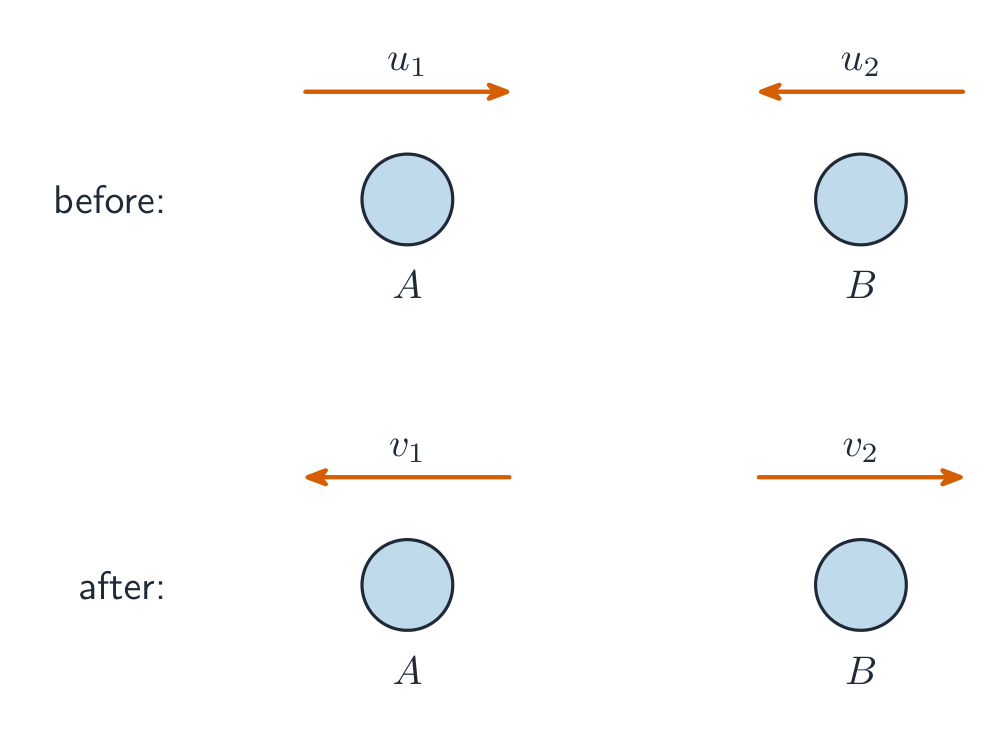
התנגשות ראש-בראש: התנע הכולל לפני שווה להתנע הכולל אחרי
דוגמה פתורה (פיצוץ). קליע בעל מסה $6.0\ \text{kg}$ בשקט מתפצל לחתיכה בעלת מסה $2.0\ \text{kg}$ הנעה במהירות $9.0\ \text{m/s}$ מזרח וחתיכה בעלת מסה $4.0\ \text{kg}$. התנע הכולל נשאר אפס, ולכן החתיכה הכבדה נעה מערב במהירות $v=\dfrac{2.0(9.0)}{4.0}=4.5\ \text{m/s}$. האנרגיה הקינטית הגיעה מאנרגיה מאוגרת (כימית או קפיצית) – שמירת תנע אינה דורשת שמירת אנרגיה קינטית.
Explore · חקור
Collide two carts and conserve momentum · התנגשות בין שני עגלות ושימור תנע
In any collision the total momentum$\sum mv$ before equals the total after. Set the masses and speeds and check the momentum bookkeeping. · בהתנגשות כלשהי ה-תנע הכולל$\sum mv$ לפני שווה לזה לאחר. הגדר את המסות והמהירויות ובדוק את חשבונות התנע.
4.4
Elastic and Inelastic Collisions · התנגשויות אלסטיות ולא-אלסטיות
Syllabus · סיילבוס
English
Learning Objective 4.4.A: Describe whether an interaction between objects is elastic or inelastic.
4.4.A.1 An elastic collision between objects is one in which the initial kinetic energy of the system is equal to the final kinetic energy of the system.
4.4.A.2 In an elastic collision, the final kinetic energies of each of the objects within the system may be different from their initial kinetic energies.
4.4.A.3 An inelastic collision between objects is one in which the total kinetic energy of the system decreases.
4.4.A.4 In an inelastic collision, some of the initial kinetic energy is not restored to kinetic energy but is transformed by nonconservative forces into other forms of energy.
4.4.A.5 In a perfectly inelastic collision, the objects stick together and move with the same velocity after the collision.
עברית
מטרת למידה 4.4.A: תאר האם האינטראקציה בין גופים היא אלסטית או לא-אלסטית.
4.4.A.1 התנגשות אלסטית בין גופים היא זו שבה אנרגיית הקינטיקה ההתחלתית של המערכת שווה לאנרגיית הקינטיקה הסופית של המערכת.
4.4.A.2 בהתנגשות אלסטית, אנרגיות הקינטיקה הסופיות של כל אחד מהגופים בתוך המערכת עשויות להיות שונות מאנרגיות הקינטיקה ההתחלתיות שלהם.
4.4.A.3 התנגשות לא-אלסטית בין גופים היא זו שבה סך אנרגיית הקינטיקה של המערכת יורדת.
4.4.A.4 בהתנגשות לא-אלסטית, חלק מאנרגיית הקינטיקה ההתחלתית אינו מוחזר כאנרגיית קינטיקה אלא הופץ על ידי כוחות לא-שמרניים לצורות אנרגיה אחרות.
4.4.A.5 בהתנגשות לא-אלסטית מושלמת, הגופים נדבקים זה לזה ונעים במהירות זהה לאחר ההתנגשות.
Source: College Board AP Course and Exam Description · מקור: תיאור הקורס והמבחן של College Board AP
English
Conservation of momentum in a collision
All collisions conserve momentum; they differ in what happens to the kinetic energy 动能:
type
momentum
kinetic energy
elastic collision 弹性碰撞
conserved
total conserved (individual shares may change)
inelastic collision 非弹性碰撞
conserved
decreases – some becomes heat, sound, deformation 形变
perfectly inelastic collision 完全非弹性碰撞
conserved
largest possible loss – the objects stick and share one velocity
Strategy: always write momentum conservation first; add the kinetic-energy equation only when the problem says "elastic". Two useful elastic facts: equal masses in a 1D elastic collision simply exchange velocities, and in the center-of-mass frame each object just reverses its velocity.
Worked example. A $1000\ \text{kg}$ car at $20\ \text{m/s}$ strikes a stationary $1500\ \text{kg}$ car and they lock together – perfectly inelastic. Momentum: $v=\dfrac{1000(20)}{2500}=8.0\ \text{m/s}$. Kinetic energy falls from $2.0\times10^5\ \text{J}$ to $\tfrac12(2500)(8.0)^2=8.0\times10^4\ \text{J}$: about $60\%$ is lost, even though momentum is exactly conserved.
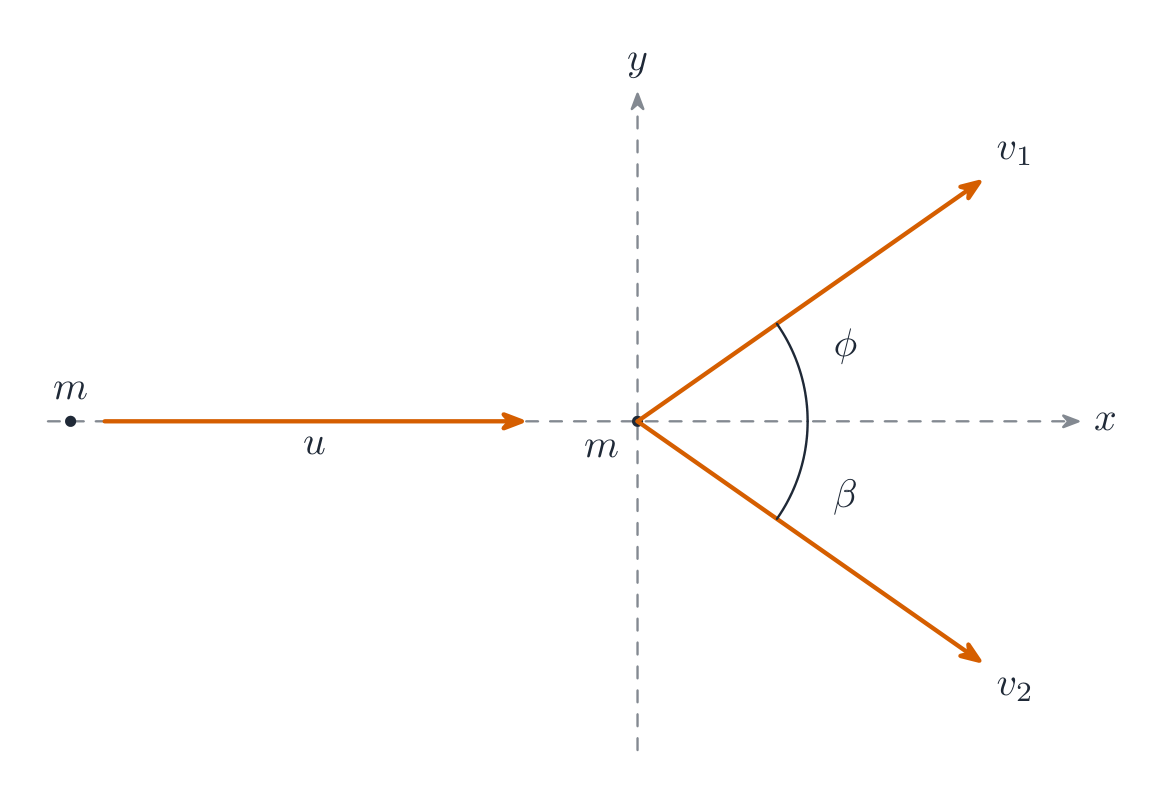
Worked example (2D). A puck moving east at $4.0\ \text{m/s}$ strikes an identical puck at rest; after the glancing hit, one moves at $2.0\ \text{m/s}$ at $60^\circ$ north of east. Conserve each axis: east–west, $m(4.0)=m(2.0)\cos60^\circ+mv_x$, so $v_x=3.0\ \text{m/s}$; north–south, $0=m(2.0)\sin60^\circ-mv_y$, so $v_y=1.7\ \text{m/s}$. The second puck moves at $\sqrt{3.0^2+1.7^2}=3.5\ \text{m/s}$, about $30^\circ$ south of east.
Exam skill. On FRQs, justify with the condition, not the slogan: "the net external force on the two-puck system is zero during the collision, so its total momentum is constant." If asked whether the collision is elastic, compute the kinetic energy before and after and compare – never assume.
עברית
שימור תנע בהתנגשות
כל ההתנגשותות שומרות על תנע; הן נבדלות זה מזה במה שקורה לאנרגיה הקינטית:
סוג
תנע
אנרגיה קינטית
התנגשות אלסטית
נשמר
סך הכל נשמר (חלקים פרטיים עשויים להשתנות)
התנגשות לא-אלסטית
נשמר
יורדת – חלק מהם הופך לחום, קול או עיוות
התנגשות לא-אלסטית מושלמת
נשמר
איבוד האנרגיה הגדול ביותר – האובייקטים נדבקים ומשתפים מהירות אחת
אסטרטגיה: תמיד כתבו שימור תנע קודם כל; הוסיפו את משוואת האנרגיה הקינטית רק כאשר השאלה אומרת "אלסטית". שתי עובדות שימושיות לגבי התנגשויות אלסטיות: מסות שוות בהתנגשות אלסטית ב1D פשוט מחליפות מהירויות, ובמסגרת הייחוס של מרכז המסה כל גוף פשוט מקבל את כיוון המהירות הפוך.
דוגמה מפורטת. רכב בעל מסת $1000\ \text{kg}$ המנוע במהירות $20\ \text{m/s}$ פוגע ברכב נח不动 בעל מסת $1500\ \text{kg}$ והם ננעלים יחד – התנגשות לא-אלסטית מושלמת. תנע: $v=\dfrac{1000(20)}{2500}=8.0\ \text{m/s}$. אנרגיה קינטית יורדת מ-$2.0\times10^5\ \text{J}$ ל-$\tfrac12(2500)(8.0)^2=8.0\times10^4\ \text{J}$: כ-$60\%$ אובדו, אף על פי שהתנע שמור בדיוק.
דוגמה פתורה (2D). פאנק נעים מזרח במהירות $4.0\ \text{m/s}$ פוגע בפאנק זהה בשקט; לאחר הפגיעה הרחבה, אחד נע במהירות $2.0\ \text{m/s}$ בזווית $60^\circ$ צפון-מזרח. שמור על כל ציר: מזרח-מערב, $m(4.0)=m(2.0)\cos60^\circ+mv_x$, ולכן $v_x=3.0\ \text{m/s}$; צפון-דרום, $0=m(2.0)\sin60^\circ-mv_y$, ולכן $v_y=1.7\ \text{m/s}$. הפאנק השני נע במהירות $\sqrt{3.0^2+1.7^2}=3.5\ \text{m/s}$, כ-$30^\circ$ דרום-מזרח.
התנגשות צדדית, פרוקה לאורך שני צירים מאונכים
מיומנות מבחן. בקטעי FRQ, נמקו לפי התנאי, לא לפי הלחש: "הכוח החיצוני הנטו על מערכת שני הפאנקים הוא אפס במהלך ההתנגשות, ולכן התנע הכולל שלה קבוע". אם נשאל האם ההתנגשות היא אלסטית, חשב את האנרגיה הקינטית לפני ואחרי והשווה – לעולם אל תניח.
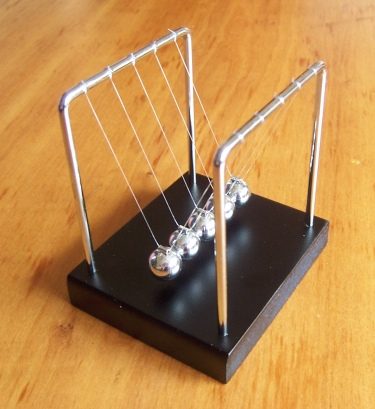
כדור ניוטון מדגים העברת תנע ואנרגיה קינטית דרך התנגשות כמעט אלסטית
Explore · חקור
Compare elastic and inelastic collisions · השוואת התנגשות אלסטית ולא-אלסטית
Momentum is always conserved, but kinetic energy is only conserved in an elastic collision. In an inelastic one the carts stick and some energy becomes heat. · תנע תמיד נשמר, אך אנרגיה קינטית נשמרת רק בהתנגשות אלסטית. בהתנגשות לא-אלסטית העגלות נדבקות וחלק מהאנרגיה הופך לחום.
4.4
Exam tips · טיפים לבחינות
English
Impulse equals the momentum change: $\vec J=\int \vec F\,dt=\Delta\vec p$, and it is the area under a force–time graph.
Momentum is conserved whenever the net external force is zero — always the go-to for collisions.
Distinguish elastic (kinetic energy conserved) from inelastic (kinetic energy decreases) collisions; in a perfectly inelastic collision the objects stick and move with one velocity.
Apply conservation to each component (x and y) separately in 2-D.
Connect to center of mass: total momentum $=M\vec v_{cm}$.
עברית
האימפולס שווה לשינוי התנע: $\vec J=\int \vec F\,dt=\Delta\vec p$, והוא השטח מתחת לגרף כוח-זמן.
תנע נשמר בכל פעם שהכוח החיצוני הנטו הוא אפס – תמיד הכלי היעיל ביותר להתנגשותות.
הבדל בין התנגשות אלסטית (אנרגיה קינטית נשמרת) להתנגשות לא-אלסטית (אנרגיה קינטית יורדת); בהתנגשות לא-אלסטית מושלמת האובייקטים נדבקים ונעים במהירות אחת.
חייב שמירה על כל רכיב (x ו-y) בנפרד ב-2-D.
קשר למרכז המסה: התנע הכולל $=M\vec v_{cm}$.
Interactive lessons on this topic · שיעורים אינטראקטיביים בנושא זה
Work through it step by step, with instant-check exercises. · לעבור על הדברים צעד אחר צעד, עם תרגילים לבדיקה מיידית.
Pick one and the site follows you — notes, papers, videos and practice all open on it. · בחרו נושא אחד והאתר יעקוב אחריו — הערות, מסמכים, וידאו ותרגולים פתוחים בו.
Type to search notes, lessons, code, vocabulary and past-paper questions across every subject. · הקלד כדי לחפש הערות, שיעורים, קוד, אוצר מילים ושאלות מבחנים בכל הנושאים.