בלוק מחליק לתוך קפיץ ומצמיד אותו עד עצירה. כמה הקפיץ מתכווץ? נסה לעשות זאת עם משוואה קינמטית. אי אפשר – הכוח גדל…
קריאת קול באנגלית · תרגום אנגלי + סינית שרוף בתוך הסרטון
3.1
אנרגיה קינטית תרגולית
סיילבוס
מטרות למידה 3.1.A: לתאר את האנרגיה הקינטית התרגולית של גוף בהתאם למסתו ולמהירותו.
3.1.A.1 האנרגיה הקינטית התרגולית של גוף נתונה על ידי המשוואה
משוואה:$K = \dfrac{1}{2}mv^2$
3.1.A.2 אנרגיה קינטית תרגולית היא גודל סקלרי.
3.1.A.3 צופים שונים עשויים למדוד ערכים שונים של האנרגיה הקינטית התרגולית של גוף, בהתאם למערכת הייחוס שלהם.
מקור: תיאור הקורס והמבחן של College Board AP
אנרגיה קינטית היא אנרגיית התנועה, סקלר שנמדד בג'אולים (J):
$$K=\tfrac{1}{2}mv^2.$$
היא עולה עם הריבוע של המהירות – הכפלת המהירות ארבע-עלה את $K$. נקודה מעניינת שחשוב לדעת: אנרגיה קינטית תלויה במערכת הייחוס של הצופה. נוסע הולך במסילה בתוך רכבת בעל $K$ קטנה שנמדדת בתוך הרכבת, ועצום שנמדד מהקרקע – שני הצופים צודקים, כל אחד לפי מערכת הייחוס שלו.
3.2
עבודה
סיילבוס
Learning Objective
Essential Knowledge
3.2.A
Describe the work done on an object or system by a given force or collection of forces.
3.2.A.1 Work is the amount of energy transferred into or out of a system by a force exerted on that system over a distance.
3.2.A.1.i The work done by a conservative force exerted on a system is path-independent and only depends on the initial and final configurations of that system.
3.2.A.1.ii The work done by a conservative force on a system—or the change in the potential energy of the system—will be zero if the system returns to its initial configuration.
3.2.A.1.iii Potential energies are associated only with conservative forces.
3.2.A.1.iv The work done by a nonconservative force is path-dependent.
3.2.A.1.v The most common nonconservative forces are friction and air resistance.
3.2.A.2 Work is a scalar quantity that may be positive, negative, or zero.
3.2.A.3 The work done on an object by a variable force is calculated using
Equation:$W = \displaystyle\int_a^b \vec{F}(r) \cdot d\vec{r}$, where the integral is taken over the path from point $a$ to point $b$.
3.2.A.3.i The dot product between two vectors, $\vec{A}$ and $\vec{B}$, results in a scalar quantity of magnitude $\vec{A} \cdot \vec{B} = AB\cos\theta$.
3.2.A.3.ii Only the component of the force exerted on a system that is parallel to the displacement of the point of application of the force will change the system's total energy.
3.2.A.3.iii If the component of the force exerted on a system that is parallel to the displacement is constant, the work done on the system by the force is given by the derived equation $W = F_{\parallel}d = Fd\cos\theta$.
3.2.A.3.iv The component of the force exerted on a system perpendicular to the direction of the displacement of the system's center of mass can change the direction of the system's motion without changing the system's kinetic energy.
3.2.A.4 The work–energy theorem states that the change in an object's kinetic energy is equal to the sum of the work (net work) being done by all forces exerted on the object.
Equation:$\Delta K = \displaystyle\sum W_i = \sum F_{\parallel,i}\, d_i$
3.2.A.4.i An external force may change the configuration of a system. The component of the external force parallel to the displacement times the displacement of the point of application of the force gives the change in kinetic energy of the system.
3.2.A.4.ii If the system's center of mass and the point of application of the force move the same distance when a force is exerted on a system, then the system may be modeled as an object, and only the system's kinetic energy can change.
3.2.A.4.iii The energy dissipated by friction is typically equated to the force of friction times the length of the path over which the force is exerted.
3.2.A.5 Work is equal to the area under the curve of a graph of $F_{\parallel}$ as a function of displacement.
Boundary statement: AP Physics C: Mechanics only expects students to analyze the transfer of mechanical energy, although students should be aware that mechanical energy may be dissipated in the form of thermal energy or sound.
מקור: תיאור הקורס והמבחן של College Board AP
עבודה היא אנרגיה המועברת לתוך או מחוץ למערכת על ידי כוח הפועל על מרחק. עבור כוח משתנה, זוהי אינטגרל לאורך המסלול:
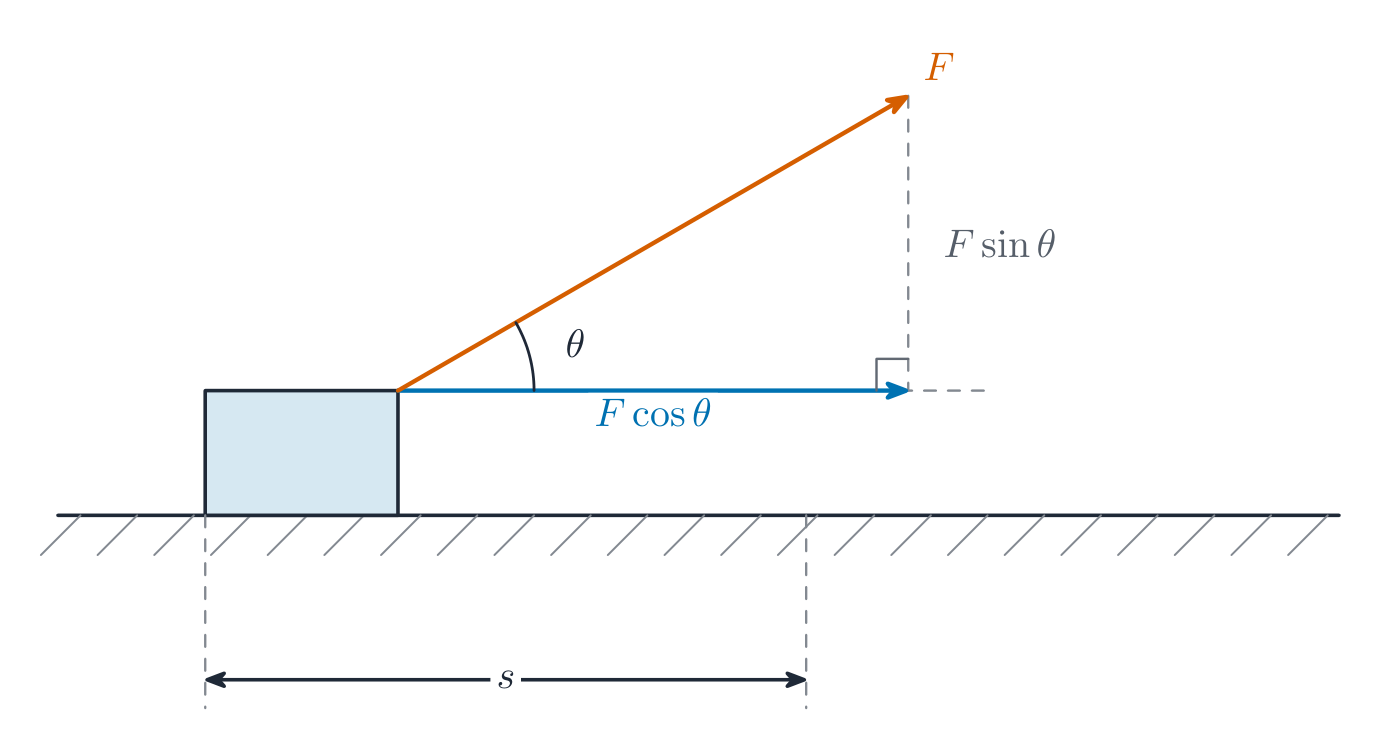
עבור כוח קבוע, הביטוי מצטמצם ל$W=Fd\cos\theta$; בגרף כוח–מיקום, העבודה היא השטח מתחת לעקומה. עבודה היא סקלר עם סימן, והסימן הוא פיזיקה ולא ספרנות:
חיובי – הכוח מכיל רכיב לאורך התנועה (הוא מאיץ את הגוף).
שלילי – הכוח נגד התנועה (חיכוך ודינמיקת אוויר מבצעים עבודה שלילית).
אפס – כוח מאונך לתנועה (הכוח הנורמלי על בלוק מחליק, כוח הכבידה בתנועה אופקית, מתח במעגל תנודתי).
רק רכיב הכוח לאורך התזוזה מבצע עבודה
משפט העבודה-אנרגיה מקבל בחשבון את התרומה של כל כוח: העבודה הכללית שווה לשינוי באנרגיה הקינטית,
$$W_{\text{net}}=\sum W_i=\Delta K.$$
דוגמה מוצגת. כוח משתנה $F(x)=3x^2\ \text{N}$ (בכיוון התנועה) פועל מ$x=0$ עד $x=2\ \text{m}$: $W=\displaystyle\int_0^2 3x^2\,dx=\big[x^3\big]_0^2=8\ \text{J}$. פעולה לבדו על גוף המתחיל ממצב רגיעה, היא תעלה את האנרגיה הקינטית בדיוק ל$8\ \text{J}$.
3.3.A.1 A system composed of two or more objects has potential energy if the objects within that system only interact with each other through conservative forces.
3.3.A.2 Potential energy is a scalar quantity associated with the position of objects within a system.
3.3.A.3 The definition of zero potential energy for a given system is a decision made by the observer considering the situation to simplify or otherwise assist in analysis.
3.3.A.4 The relationship between conservative forces exerted on a system and the system's potential energy is
Equation:$\Delta U = -\displaystyle\int_a^b \vec{F}_{cf}(r) \cdot d\vec{r}$
3.3.A.5 The conservative forces exerted on a system in a single dimension can be determined using the slope of the system's potential energy with respect to position in that dimension; these forces point in the direction of decreasing potential energy.
Equation:$F_x = -\dfrac{dU(x)}{dx}$
3.3.A.6 Graphs of a system's potential energy as a function of its position can be useful in determining physical properties of that system.
3.3.A.6.i Stable equilibrium is a location at which a small displacement in an object's position results in a force exerted on the object opposite to the direction of the small displacement, accelerating the object back toward the equilibrium position.
3.3.A.6.ii Unstable equilibrium is a location at which a small displacement in an object's position results in a force exerted on the object in the same direction as the small displacement, accelerating the object away from the equilibrium position.
3.3.A.6.iii In a given dimension, stable equilibrium positions exist at locations where the potential energy as a function of position in that dimension has a local minimum.
3.3.A.6.iv In a given dimension, unstable equilibrium positions occur at locations where the potential energy as a function of position in that dimension has a local maximum.
3.3.A.7 The potential energy of common physical systems can be described using the physical properties of that system.
3.3.A.7.i The elastic potential energy of an ideal spring is given by the following equation, where $\Delta x$ is the distance the spring has been stretched or compressed from its equilibrium length.
Equation:$U_s = \dfrac{1}{2}k(\Delta x)^2$
3.3.A.7.ii The general form for the gravitational potential energy of a system consisting of two approximately spherical distributions of mass (e.g., moons, planets, or stars) is given by the equation
Equation:$U_g = -G\dfrac{m_1 m_2}{r}$
3.3.A.7.iii Because the gravitational field near the surface of a planet is nearly constant, the change in gravitational potential energy in a system consisting of an object with mass $m$ and a planet with gravitational field of magnitude $g$ when the object is near the surface of the planet may be approximated by the equation
Equation:$\Delta U_g = mg\Delta y$
3.3.A.8 The total potential energy of a system containing more than two objects is the sum of the potential energy of each pair of objects within the system.
מקור: תיאור הקורס והמבחן של College Board AP
אנרגיה פוטנציאלית היא אנרגיה שמערכת מאחסנת בשל מיקום חלקיה – היא קיימת רק עבור כוחות שמרניים, שעבודתם אינה תלויה במסלול. היא מוגדרת דרך עבודה:
$$\Delta U=-\int_a^b\vec{F}\cdot d\vec{r},$$
וכל המצבים חופשיים לבחור איפה $U=0$ – רק שינויים ב$U$ הם בעלי משמעות, ולכן בחר את נקודת האפס שהופכת את הבעיה לפשוטה ביותר. התוצאות הסטנדרטיות:
קפיץ: $U_s=\tfrac12k(\Delta x)^2$, כאשר $\Delta x$ נמדד מאורך הטבעי.
למערכות של מספר גופים, יש להוסיף את האנרגיה הפוטנציאלית של כל זוג. בהיפוך ההגדרה, כוח שמרני הוא מינוס ה-נגזרת של האנרגיה הפוטנציאלית שלו:
$$F_x=-\frac{dU}{dx}.$$
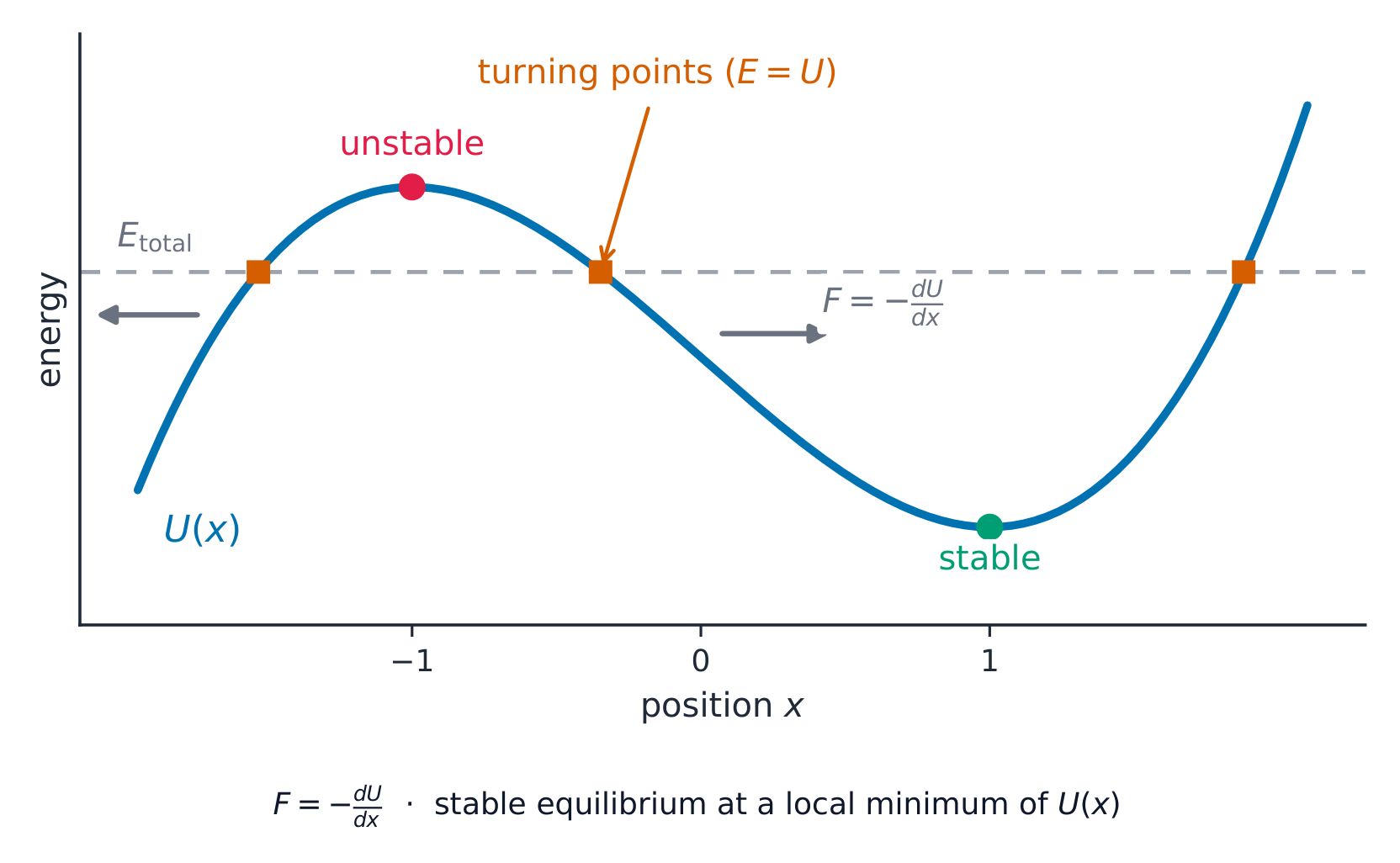
הכוח מכוון "למטה" לאורך עקומת ה$U(x)$. איזון ממוקם שם שבו השיפוע הוא אפס: מינימום הוא איזון יציב (בהזזה, הכוח דוחף חזרה), מקסימום הוא איזון לא יציב (בהזזה, הכוח דוחף הרחק).
בעקומת אנרגיה פוטנציאלית הכוח מכוון למטה ו-E = U מסמן את נקודות ההפיכה
דוגמה מוצגת. נתון $U(x)=2x^3-6x$ (ג'ול), הכוח הוא $F=-\dfrac{dU}{dx}=6-6x^2$. נקודות האיזון נמצאות ב$F=0$: $x=\pm1$. מכיוון ש$\dfrac{d^2U}{dx^2}=12x$ חיובי ב$x=+1$ (מינימום – יציב) ושלילי ב$x=-1$ (מקסימום – לא יציב), שתי הנקודות מתנהגות בצורה הפוכה.
חקור
אחסון אנרגיה פוטנציאלית אלסטית בקפיץ
מתיחת קפיץ אוכפת אנרגיה פוטנציאלית אלסטית $\tfrac12 kx^2$ — השטח מתחת לקו הכוח-המתיחה. שחרר אותו ואותה אנרגיה הופכת לקינטית.
מטרות למידה 3.4.A: לתאר את האנרגיות הקיימות במערכת.
3.4.A.1 מערכת המורכבת מאובייקט יחיד יכולה להיות לה רק אנרגיה קינטית.
3.4.A.2 מערכת המכילה אובייקטים המגיבים זה לזה באמצעות כוחות שימוריים או שמסוגלים לשנות את צורתם באופן הפיכי יכולה להיות לה גם אנרגיה קינטית וגם אנרגיה פוטנציאלית.
מטרות למידה 3.4.B: לתאר את התנהגות מערכת באמצעות עקרונות שימור אנרגיה מכנית.
3.4.B.1 האנרגיה המכנית היא סכום האנרגיה הקינטית והפוטנציאלית של מערכת.
3.4.B.2 כל שינוי בסוג אנרגיה בתוך מערכת חייב להיות מאוזן על ידי שינוי שווה בסוגי אנרגיה אחרים בתוך המערכת או על ידי העברת אנרגיה בין המערכת לסביבתה.
3.4.B.3 ניתן לבחור מערכת כך שהאנרגיה הכוללת שלה תהיה קבועה.
3.4.B.4 אם האנרגיה הכוללת של מערכת משתנה, השינוי יהיה שווה לאנרגיה שהועברה לתוך המערכת או מחוץ לה.
מטרת למידה 3.4.C: תאר כיצד בחירת המערכת קובעת האם האנרגיה שלה משתנה.
3.4.C.1 האנרגיה נשמרת בכל האינטראקציות.
3.4.C.2 אם העבודה שנעשתה על מערכת הנבחרת היא אפס ואין אינטראקציות לא-שימוריות בתוך המערכת, האנרגיה המכנית הכוללת שלה תהיה קבועה.
3.4.C.3 אם העבודה שנעשתה על מערכת הנבחרת אינה אפס, אנרגיה מועברת בין המערכת לסביבה.
הצהרת גבול: AP Physics C: Mechanics מצפה מתלמידים שיודעים שאנרגיה מכנית עשויה להתפזר כאנרגיה תרמית או כקול על ידי כוחות לא-שימוריים.
מקור: תיאור הקורס והמבחן של College Board AP
שימור אנרגיה: KE ⇄ PE
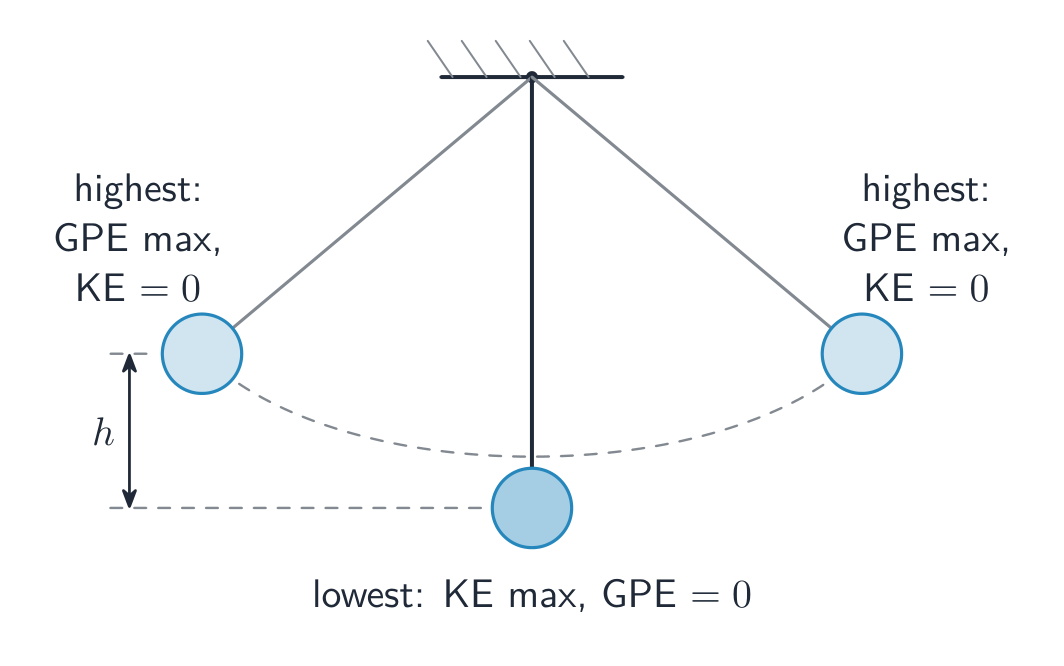
אנרגיה נשמרת בכל האינטראקציות – השאלה היחידה היא לאן היא הולכת. אנרגיה מכנית היא הסכום $E=K+U$. אם העבודה החיצונית על מערכת היא אפס ואין בתוכה פעולה של כוחות לא שמרניים, אז
$$K_1+U_1=K_2+U_2.$$
כאשר פעולות חיכוך או התנגדות מתרחשות, הן ממירות אנרגיה מכנית לאנרגיה תרמית ($\Delta E_{\text{mech}}=-F_fd$), והאיזון חייב לכלול את האיבר הזה. אם עבודה חיצונית מתבצעת, האנרגיה הכוללת של המערכת משתנה בדיוק בכמות האנרגיה שהועברה: $W_{\text{ext}}=\Delta E_{\text{sys}}$. בחירת המערכת היא בחירת שיטת会计 – גוף בודד יכול רק ל拥有一个 אנרגיה קינטית; לשלב את כדור הארץ או הקפיץ לתוך המערכת וזה יכול גם לאחסן אנרגיה פוטנציאלית.
מנדוליום מחליף אנרגיה פוטנציאלית כבידה לאנרגיה קינטית ולהפך
גרף אנרגיה פוטנציאלית הוא מפת תנועה מלאה: הקו האופקי בגובה $E$ הוא האנרגיה הכוללת, הפער $E-U(x)$ הוא האנרגיה הקינטית בכל $x$, וחיתוך ה-Stable $E=U$ הן נקודות ההפיכה שבהן הגוף עצור לרגע ומתהפך.
דוגמה מוצגת. בלוק של $2.0\ \text{kg}$ מחליק לאורך מגל מהמצב הרגיע בגובה $1.5\ \text{m}$, ומגיע לתחתית במהירות $4.0\ \text{m/s}$. חשבון אנרגיה: $mgh=29.4\ \text{J}$ זמין; $\tfrac12mv^2=16\ \text{J}$ מגיע כאנרגיה קינטית; לכן החיכוך ממיר $29.4-16=13\ \text{J}$ לאנרגיה תרמית לאורך הדרך.
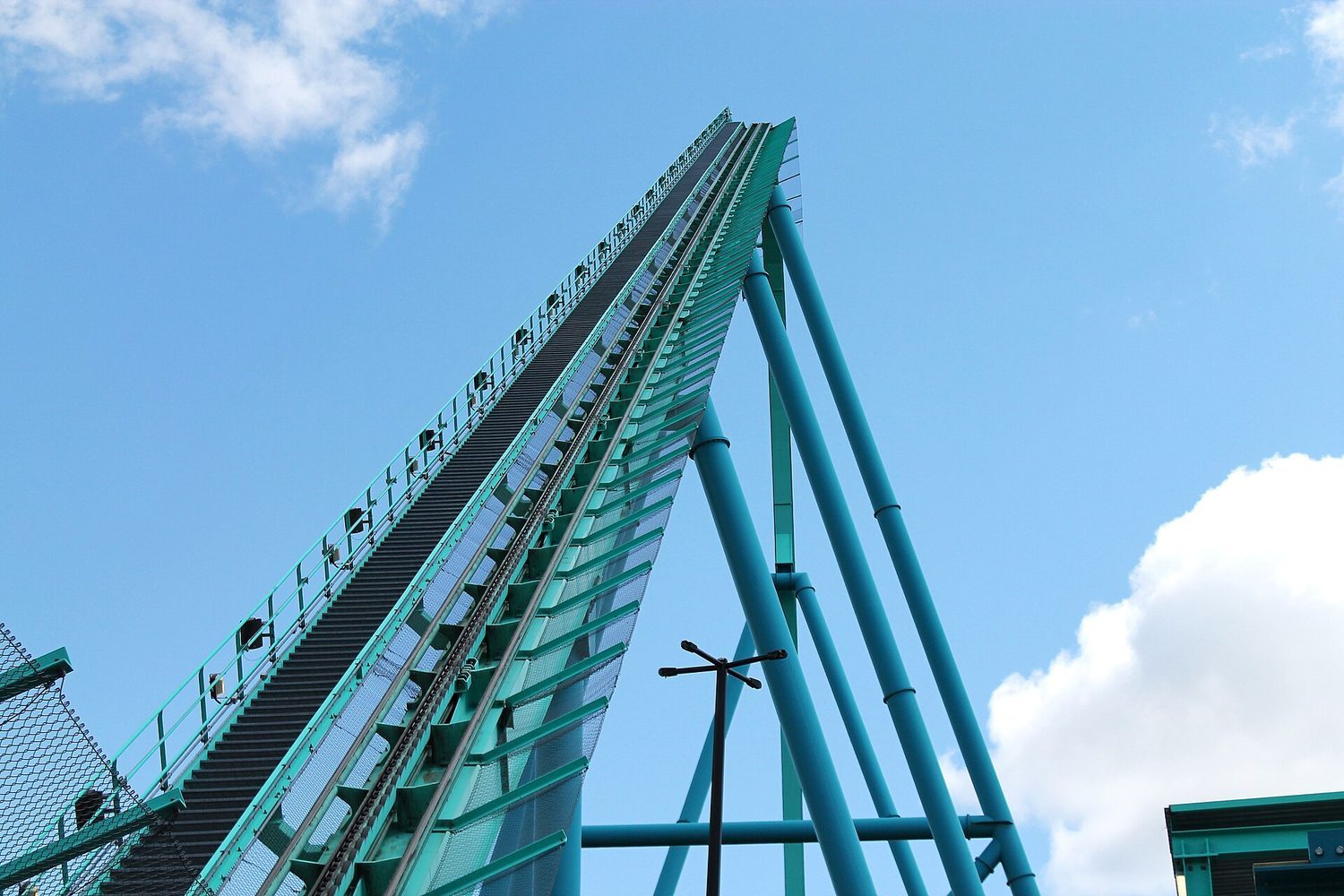
מרכבת הרים מאבדת ואוספת אנרגיה: מקסימלית (הכי הרבה PE) בשיא, ומהירה ביותר (הכי הרבה KE) בתחתית
חקור
צפה בהמרת אנרגיה כאשר גוף צולל
ללא חיכוך, אנרגיה מכנית נשמרת: כאשר גוף צולל, אנרגיה פוטנציאלית כבידתית הופכת לאנרגיה קינטית בעוד שהסך הכל נשאר קבוע.
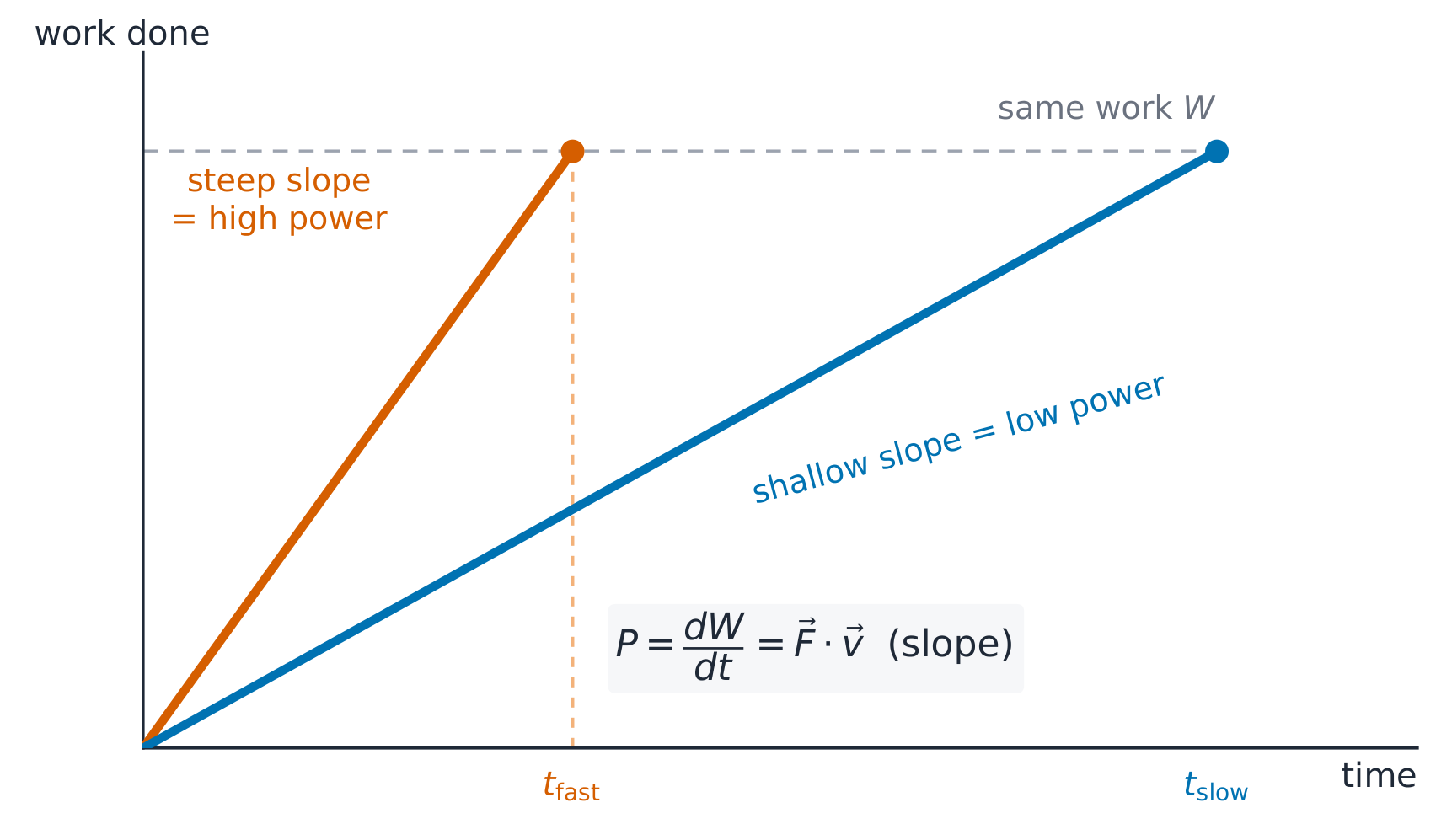
הוא מודד עד מהר עבודה נעשית, ולא כמה. המכפלה הנקודתית היא קריטית: רק רכיב הכוח לאורך מהירות מספק הספק.
הספק הוא השיפוע בגרף עבודה-זמן: אותה עבודה בזמן פחות משמעו הספק גבוה יותר
דוגמה פותרת. חסימת שחררה ממנוחה בראם של מכון ללא חיכוך $3.0\ \text{m}$ גבוה מגיעה לתחתית ב-$v=\sqrt{2gh}=7.7\ \text{m/s}$ (מ-$mgh=\tfrac12mv^2$). מנוע שמניע אותה בקצב יציב $7.7\ \text{m/s}$ כנגד התנגדות $20\ \text{N}$ מספק $P=Fv=20(7.7)\approx150\ \text{W}$.
דוגמה פותרת. מכונית בעלת מסה $1200\ \text{kg}$ מטפסת בגבעה שעולה $1.0\ \text{m}$ לכל $20\ \text{m}$ של כביש, במהירות יציבה $15\ \text{m/s}$. המנוע צריך לספק את הספק המשיכה: $P=mg\,v\sin\theta=1200(9.8)(15)\big(\tfrac{1}{20}\big)\approx8.8\ \text{kW}$ – לפני הוספת התנגדות אוויר.
מיומנות למבחן. שאלות FRQ באנרגיה מעריכות את משפט החישוב: ציין את המערכת שלך, ציין אילו כוחות עושים עליה עבודה, וכתוב את איזון האנרגיה ($W_{\text{ext}}=\Delta K+\Delta U+\Delta E_{\text{thermal}}$) לפני הצבת המספרים. "יש חיכוך, ולכן אנרגיה מכנית אינה שימורה" הוא משפט שקול.