Skip to content · ⁨דלג לתוכן⁩

Further Pure Mathematics 1 · ⁨מתמטיקה נקודתית מתקדמת 1⁩

A-Level Further Mathematics · ⁨מתמטיקה מתקדמת A-Level⁩ · Topic 1 · ⁨נושא 1⁩

Video lesson for this topic · ⁨שיעור וידאו לנושא זה⁩ Open the video page · ⁨פתח את עמוד הוידאו⁩
14:28

מתמטיקה נקודתית מתקדמת 1

הנה משוואה קובית החותכת את ציר ה-x בשלושה שורשים. מציאת השורשים האלה במדויק עשויה להיות קשה — או אף בלתי אפשרית ביד. אבל הנה דבר יפה…

English narration · English + 中文 subtitles burned in · ⁨קריאת קול באנגלית · תרגום אנגלי + סינית שרוף בתוך הסרטון⁩

English

This handout covers Topic 1: Further Pure Mathematics 进阶纯数学 1. It adds new algebra, matrices, polar coordinates, more vectors, and proof by induction.

עברית

דף זה מכסה נושא 1: מתמטיקה נקייה נוספת 1. הוא מוסיף אלגברה חדשה, מטריצות, קואורדינטות קוטביות, וקטורים נוספים, והוכחה באינדוקציה.
1.1

Roots of polynomial equations · ⁨שורשים של משוואות פולינומיות⁩

Syllabus · ⁨סיילבוס⁩
English
Candidates should be able to: Notes and examples
• recall and use the relations between the roots and coefficients of polynomial equations e.g. to evaluate symmetric functions of the roots or to solve problems involving unknown coefficients in equations; restricted to equations of degree 2, 3 or 4 only.
• use a substitution to obtain an equation whose roots are related in a simple way to those of the original equation Substitutions will not be given for the easiest cases, e.g. where the new roots are reciprocals or squares or a simple linear function of the old roots.
עברית
המועמדים אמורים להיות מסוגלים: הערות לדוגמאות
• להיזכר ולהשתמש בקשרים בין שורשים למקדמים של משוואות פולינומיות לדוגמה, כדי לחשב פונקציות סימטריות של השורשים או לפתור בעיות המעורבות במקדמים לא ידועים במשוואות; מוגבל למשוואות ממעלה 2, 3 או 4 בלבד.
• להשתמש בהצבה לקבלת משוואה ששורשיה קשורים באופן פשוט לשורשים של המשוואה המקורית ההצבות לא תינתנה עבור המקרים הקלים ביותר, לדוגמה כאשר השורשים החדשים הם הפוכים, ריבועים או פונקציה ליניארית פשוטה של השורשים הישנים.

Source: Cambridge International syllabus · ⁨מקור: הסיילבוס הבינלאומי של קמבריד'ג'⁩

English

For a polynomial equation, the roots 根 are linked to the coefficients 系数. For $ax^2 + bx + c = 0$ with roots $\alpha, \beta$:

$$\alpha + \beta = -\frac{b}{a}, \qquad \alpha\beta = \frac{c}{a}.$$
For a cubic $ax^3 + bx^2 + cx + d = 0$ with roots $\alpha, \beta, \gamma$:
$$\sum\alpha = -\frac{b}{a}, \qquad \sum\alpha\beta = \frac{c}{a}, \qquad \alpha\beta\gamma = -\frac{d}{a}.$$
Sums like $\sum\alpha$ and $\sum\alpha\beta$ are symmetric functions 对称函数 of the roots (unchanged if the roots are swapped). To find an equation whose roots are changed in a simple way, use a substitution 代换 (for example, put $w = \alpha + 1$).

Worked example. The equation $x^2 - 5x + 6 = 0$ has roots $\alpha, \beta$. Find the equation with roots $\alpha + 1, \beta + 1$.

Here $\alpha + \beta = 5$ and $\alpha\beta = 6$. The new sum is $(\alpha + 1) + (\beta + 1) = 7$, and the new product is $(\alpha + 1)(\beta + 1) = \alpha\beta + \alpha + \beta + 1 = 6 + 5 + 1 = 12$. So the new equation is

$$x^2 - 7x + 12 = 0.$$

עברית

למשוואה פולינומית, ה-שורשים קשורים ל-מקדמים. עבור $ax^2 + bx + c = 0$ עם שורשים $\alpha, \beta$:

$$\alpha + \beta = -\frac{b}{a}, \qquad \alpha\beta = \frac{c}{a}.$$
למשוואה מערכית (קובית) $ax^3 + bx^2 + cx + d = 0$ עם שורשים $\alpha, \beta, \gamma$:
$$\sum\alpha = -\frac{b}{a}, \qquad \sum\alpha\beta = \frac{c}{a}, \qquad \alpha\beta\gamma = -\frac{d}{a}.$$
סכומים כמו $\sum\alpha$ ו$\sum\alpha\beta$ הם פונקציות סימטריות של השורשים (לא משתנות אם השורשים מוחלפים). כדי למצוא משוואה whose roots are changed in a simple way, use a substitution (for example, put $w = \alpha + 1$).

דוגמה מפורשת. המשוואה $x^2 - 5x + 6 = 0$ יש שורשים $\alpha, \beta$. מצאו את המשוואה עם שורשים $\alpha + 1, \beta + 1$.

הנה $\alpha + \beta = 5$ ו-$\alpha\beta = 6$. הסכום החדש הוא $(\alpha + 1) + (\beta + 1) = 7$, והמכפלה החדשה היא $(\alpha + 1)(\beta + 1) = \alpha\beta + \alpha + \beta + 1 = 6 + 5 + 1 = 12$. לכן המשוואה החדשה היא

$$x^2 - 7x + 12 = 0.$$

Explore · ⁨חקור⁩

Roots of a polynomial · ⁨שורשים של פולינום⁩

y = ax³ + bx² + cx + d

The roots are where the curve meets the x-axis — their sum and product link to the coefficients. · ⁨השורשים הם הנקודות שבהן העקומה חוצה את ציר ה-x — הסכום והמכפלה שלהם קשורים למקדמים.⁩

Vocabulary · ⁨מילון מונחים⁩ Train · ⁨אימון⁩
English עברית
Further Pure Mathematics/ˈfɜːðə pjʊə ˌmæθɪˈmætɪks/ מתמטיקה נטו נוספת
roots/ruːts/ שורשים
coefficients/ˌkəʊɪˈfɪʃənts/ מקדמים
substitution/ˌsʌbstɪˈtjuːʃn/ החלפה
rational function/ˈræʃənl ˈfʌŋkʃn/ פונקציה רציונלית
1.2

Rational functions and graphs · ⁨פונקציות רציונליות וגרפים⁩

Syllabus · ⁨סיילבוס⁩
English
Candidates should be able to: Notes and examples
• sketch graphs of simple rational functions, including the determination of oblique asymptotes, in cases where the degree of the numerator and the denominator are at most 2 Including determination of the set of values taken by the function, e.g. by the use of a discriminant. Detailed plotting of curves will not be required, but sketches will generally be expected to show significant features, such as turning points, asymptotes and intersections with the axes.
• understand and use relationships between the graphs of $y = f(x)$, $y^2 = f(x)$, $y = \frac{1}{f(x)}$, $y = |f(x)|$ and $y = f(|x|)$ Including use of such sketch graphs in the course of solving equations or inequalities.
עברית
המועמדים אמורים להיות מסוגלים: הערות לדוגמאות
• לערוך גרפים של פונקציות רציונליות פשוטות, כולל קביעת אסימפטוטות אלכסוניות, במקרים שבהם מעלת המונה והמכנה אינם עולים על 2 כולל קביעת קבוצת הערכים הנלקחת על ידי הפונקציה, לדוגמה באמצעות דיסקרימיננטה. ציור מדויק של curves לא יהיה נדרש, אך גרפים טריים יצופו בדרך כלל להציג מאפיינים משמעותיים, כמו נקודות שינוי, אסימפטוטות וחיתוך עם הצירים.
• להבין ולהשתמש בקשרים בין הגרפים של $y = f(x)$, $y^2 = f(x)$, $y = \frac{1}{f(x)}$, $y = |f(x)|$ ו$y = f(|x|)$ כולל השימוש בגרפים טריים אלו בתהליך פתרון משוואות או אי-שוויונות.

Source: Cambridge International syllabus · ⁨מקור: הסיילבוס הבינלאומי של קמבריד'ג'⁩

English

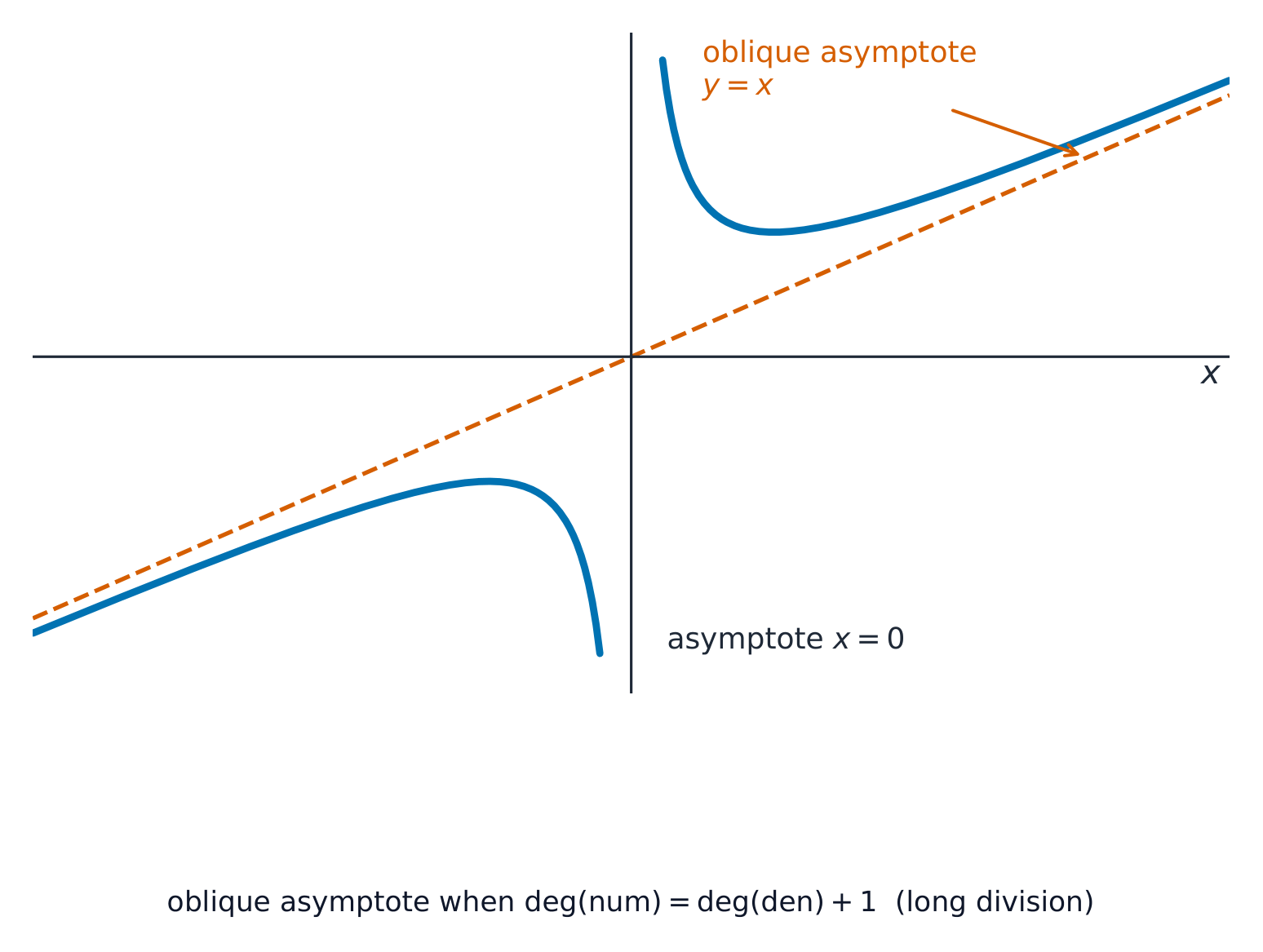
A rational function 有理函数 is a fraction of two polynomials. When the top has degree exactly one higher than the bottom, the graph has an oblique asymptote 斜渐近线 (a slanted line the curve approaches); find it by dividing out. You should also be able to relate the graph of $y = f(x)$ to those of $y^2 = f(x)$, $y = \dfrac{1}{f(x)}$, $y = |f(x)|$ and $y = f(|x|)$. Find the set of values the function can take using the discriminant 判别式, and locate its turning points 驻点.

Worked example. Find the oblique asymptote of $y = \dfrac{x^2 + x + 1}{x + 1}$.

Divide out the fraction: $\dfrac{x^2 + x + 1}{x + 1} = x + \dfrac{1}{x + 1}$. As $x \to \pm\infty$ the remainder $\dfrac{1}{x+1} \to 0$, so the curve approaches the line $y = x$ — the oblique asymptote.

עברית

פונקציה רציונלית היא שבר של שני פולינומים. כאשר דרגת המונה גבוהה ב-1 בדיוק מדרגת המכנה, לגרף יש אסימפטוטה אלכסונית (קו אלכסוני שהעקומה מתקרבת אליו); ניתן למצוא אותה על ידי ביצוע חלוקה. עליך גם להיות מסוגל לקשר את הגרף של $y = f(x)$ לגרפים של $y^2 = f(x)$, $y = \dfrac{1}{f(x)}$, $y = |f(x)|$ ו-$y = f(|x|)$. מצא את קבוצת הערכים שתוכל לקבל מהפונקציה באמצעות הדיסקרימיננטה, ומיקום הנקודות המינוף שלה.

עקומה רציונלית בשני ענפים הרצים במקביל לקו מקווקם אלכסוני
רחוק מהראשית העקומה נדבקת לקו האלכסוני $y=x$; בקרבת $x=0$ היא יורדת לאורך האסימפטוטה האנכית.

דוגמה מפורטת. מצא את האסימפטוטה האלכסונית של $y = \dfrac{x^2 + x + 1}{x + 1}$.

בצע חלוקה לשבר: $\dfrac{x^2 + x + 1}{x + 1} = x + \dfrac{1}{x + 1}$. מכיוון ש-$x \to \pm\infty$ שארית ה$\dfrac{1}{x+1} \to 0$, העקומה מתקרבת לקו $y = x$ — האסימפטוטה האלכסונית.

Explore · ⁨חקור⁩

Rational functions · ⁨פונקציות רציונליות⁩

y = a/(x − b) + c

A rational function has asymptotes the curve approaches but never touches. · ⁨לפונקציה רציונלית יש אסימפטוטות שהעקומה שואפת אליהן אך לעולם אינה נוגעת בהן.⁩

Vocabulary · ⁨מילון מונחים⁩ Train · ⁨אימון⁩
English עברית
oblique asymptote/əˈbliːk ˈæsɪmptəʊt/ אסימפטוטה אלכסונית
method of differences/ˈmeθəd ɒv ˈdɪfrənsɪz/ שיטת ההפרשים
convergent/kənˈvɜːdʒənt/ סופרנאגטיבי
sum to infinity/sʌm tʊ ɪnˈfɪnɪti/ סכום אינסופי
1.3

Summation of series · ⁨סכום סדרות⁩

Syllabus · ⁨סיילבוס⁩
English
Candidates should be able to: Notes and examples
• use the standard results for $\sum r$, $\sum r^2$, $\sum r^3$ to find related sums
• use the method of differences to obtain the sum of a finite series Use of partial fractions to express a general term in a suitable form may be required.
• recognise, by direct consideration of a sum to $n$ terms, when a series is convergent, and find the sum to infinity in such cases
עברית
המועמדים אמורים להיות מסוגלים: הערות לדוגמאות
• להשתמש בתוצאות הסטנדרטיות עבור $\sum r$, $\sum r^2$, $\sum r^3$ כדי למצוא סכומים קשורים
• להשתמש בשיטת הפרשים כדי לקבל את סכום סדרה סופית עשוי להיות נדרש שימוש בשברים חלקיים כדי לבטא איבר כללי בצורה מתאימה.
• לזהות, בהתייחס ישיר לסכום עד $n$ איברים, מתי סדרה היא מתכנסת, ולמצוא את הסכום האינסוי במקרים כאלה

Source: Cambridge International syllabus · ⁨מקור: הסיילבוס הבינלאומי של קמבריד'ג'⁩

English

Learn the standard results:

$$\sum_{r=1}^{n} r = \tfrac12 n(n+1), \qquad \sum_{r=1}^{n} r^2 = \tfrac16 n(n+1)(2n+1), \qquad \sum_{r=1}^{n} r^3 = \tfrac14 n^2(n+1)^2.$$
The method of differences 差分法 sums a series by cancelling middle terms: if partial fractions 部分分式 write each term as $f(r) - f(r+1)$, almost everything cancels. From the sum to $n$ terms you can see whether a series is convergent 收敛 and, if so, find its sum to infinity 无穷和.

Worked example. Find $\displaystyle\sum_{r=1}^{n} (2r + 1)$.

$$\sum_{r=1}^{n}(2r + 1) = 2\sum_{r=1}^{n} r + \sum_{r=1}^{n} 1 = 2\cdot\tfrac12 n(n+1) + n = n(n+1) + n = n(n+2).$$

עברית

למד תוצאות סטנדרטיות:

$$\sum_{r=1}^{n} r = \tfrac12 n(n+1), \qquad \sum_{r=1}^{n} r^2 = \tfrac16 n(n+1)(2n+1), \qquad \sum_{r=1}^{n} r^3 = \tfrac14 n^2(n+1)^2.$$
שיטת ההפרשים מחשבת סכום סדרה על ידי ביטול איברים אמצעיים: אם שברים חלקיים כותבים כל איבר כ$f(r) - f(r+1)$, כמעט הכל מתבטל. ממציאת הסכום עד $n$ איברים ניתן לראות האם סדרה מתכנסת, ואם כן, למצוא את סכומה האינסופי.

דוגמה מפורטת. מצא $\displaystyle\sum_{r=1}^{n} (2r + 1)$.

$$\sum_{r=1}^{n}(2r + 1) = 2\sum_{r=1}^{n} r + \sum_{r=1}^{n} 1 = 2\cdot\tfrac12 n(n+1) + n = n(n+1) + n = n(n+2).$$

Explore · ⁨חקור⁩

Sequences and their sums · ⁨סדרות וסכומיהן⁩

Step through the terms and the running total — the idea behind a series and its sum to n terms. · ⁨תנוע לאורך האיברים והסכום הצובר — הרעיון מאחורי סדרה וסכומה ל-n איברים.⁩

1.4

Matrices · ⁨מטריצות⁩

Syllabus · ⁨סיילבוס⁩
English
Candidates should be able to: Notes and examples
carry out operations of matrix addition, subtraction and multiplication, and recognise the terms zero matrix and identity (or unit) matrix Including non-square matrices. Matrices will have at most 3 rows and columns.
recall the meaning of the terms singular and non-singular as applied to square matrices and, for $2 \times 2$ and $3 \times 3$ matrices, evaluate determinants and find inverses of non-singular matrices The notations $\det \mathbf{M}$ for the determinant of a matrix $\mathbf{M}$, and $\mathbf{I}$ for the identity matrix, will be used.
understand and use the result, for non-singular matrices, $(\mathbf{AB})^{-1} = \mathbf{B}^{-1}\mathbf{A}^{-1}$ Extension to the product of more than two matrices may be required.
understand the use of $2 \times 2$ matrices to represent certain geometric transformations in the $x$-$y$ plane, in particular: – understand the relationship between the transformations represented by $\mathbf{A}$ and $\mathbf{A}^{-1}$ – recognise that the matrix product $\mathbf{AB}$ represents the transformation that results from the transformation represented by $\mathbf{B}$ followed by the transformation represented by $\mathbf{A}$ – recall how the area scale factor of a transformation is related to the determinant of the corresponding matrix – find the matrix that represents a given transformation or sequence of transformations Understanding of the terms rotation, reflection, enlargement, stretch and shear for 2D transformations will be required. Other 2D transformations may be included, but no particular knowledge of them is expected.
understand the meaning of invariant as applied to points and lines in the context of transformations represented by matrices, and solve simple problems involving invariant points and invariant lines. e.g. to locate the invariant points of the transformation represented by $\begin{pmatrix} 6 & 5 \\ 2 & 3 \end{pmatrix}$, or to find the invariant lines through the origin for $\begin{pmatrix} 4 & -1 \\ 2 & 1 \end{pmatrix}$, or to show that any line with gradient 1 is invariant for $\begin{pmatrix} 2 & 0 \\ 1 & 1 \end{pmatrix}$.
עברית
המועמדים אמורים להיות מסוגלים: הערות לדוגמאות
לבצע פעולות של חיבור, חיסור וכפל מטריצות, ולהכיר את המונחים מטריצת אפס ומטריצת זהות (או יחידה) כולל מטריצות שאינן רבועיות. המטריצות יהיו בעלות עד 3 שורות ועמודות.
להיזכר במשמעות המונחים סינגולרי ולא-סינגולרי כפי שהם חלים על מטריצות רבועיות, ולעבור על מטריצות $2 \times 2$ ו$3 \times 3$, לחשב קובעים ולמצוא הפוכים של מטריצות לא-סינגולריות הסימונים $\det \mathbf{M}$ לקובע של מטריצה $\mathbf{M}$, ו$\mathbf{I}$ למטריצת זהות, יישמשו.
להבין ולהשתמש בתוצאה, עבור מטריצות לא-סינגולריות, $(\mathbf{AB})^{-1} = \mathbf{B}^{-1}\mathbf{A}^{-1}$ הרחבה ל מכפלה של יותר משתי מטריצות עשויה להיות נדרשת.
הבנת השימוש במטריצות $2 \times 2$ כדי לייצג מספר טרנספורמציות גיאומטריות במישור $x$-$y$, ובפרט: – הבנת הקשר בין הטרנספורמציות המיוצגות על ידי $\mathbf{A}$ ו-$\mathbf{A}^{-1}$ – זיהוי כי מכפלת המטריצות $\mathbf{AB}$ מייצגת את הטרנספורמציה הנובעת מהטרנספורמציה המיוצגת על ידי $\mathbf{B}$ שלאחריה נעשית הטרנספורמציה המיוצגת על ידי $\mathbf{A}$ – הזכרת הקשר בין גורם קנה מידה לשטח של טרנספורמציה לבין הדטרמיננטה של המטריצה המתאימה – מציאת המטריצה המייצגת טרנספורמציה נתונה או סדרת טרנספורמציות דרישה להבנת המונחים סיבוב, השתקפות, הגדלה, מתיחה וזחילה עבור טרנספורמציות 2D. ייתכן שיוכללו טרנספורמציות 2D נוספות, אך אין צורך בידע ספציפי לגביהן.
להבין את המשמעות של בלתי משתנה כפי שהיא חלה על נקודות וקווים בהקשר של המרות המיוצגות על ידי מטריצות, ולפתור בעיות פשוטות המעורבות בנקודות בלתי משתנות וקווים בלתי משתנים. לדוגמה, למצוא את נקודות השינוי של ההמרה המיוצגת על ידי $\begin{pmatrix} 6 & 5 \\ 2 & 3 \end{pmatrix}$, או למצוא את הקווים הבלתי משתנים העוברים דרך הראשית עבור $\begin{pmatrix} 4 & -1 \\ 2 & 1 \end{pmatrix}$, או להראות כי כל קו עם שיפוע 1 הוא בלתי משתנה עבור $\begin{pmatrix} 2 & 0 \\ 1 & 1 \end{pmatrix}$.

Source: Cambridge International syllabus · ⁨מקור: הסיילבוס הבינלאומי של קמבריד'ג'⁩

English
A matrix moves the plane

A matrix 矩阵 is a rectangular block of numbers. Matrix addition adds entries in matching positions; you can also subtract and multiply matrices (multiplication is row $\times$ column). The zero matrix 零矩阵 has every entry $0$, and the identity matrix 单位矩阵 (or unit matrix) $I$ leaves any matrix unchanged under multiplication.

For a $2\times 2$ matrix $A = \begin{pmatrix} a & b \\ c & d \end{pmatrix}$, the determinant 行列式 is $\det A = ad - bc$. If $\det A \neq 0$ the matrix is non-singular (otherwise it is a singular matrix 奇异矩阵), and the inverse matrix 逆矩阵 is

$$A^{-1} = \frac{1}{ad - bc}\begin{pmatrix} d & -b \\ -c & a \end{pmatrix}.$$
For a product, $(AB)^{-1} = B^{-1}A^{-1}$. A $2\times 2$ matrix can represent a geometric transformation 几何变换 of the plane — a rotation 旋转, reflection 反射, enlargement 放大, stretch 拉伸 or shear 切变: the determinant gives the area scale factor, and a product $AB$ means "do $B$, then $A$". Points or lines that do not move are called invariant points 不变点 and invariant lines 不变直线.

Worked example. Find the inverse of $A = \begin{pmatrix} 3 & 1 \\ 2 & 4 \end{pmatrix}$.

$\det A = 3\times 4 - 1\times 2 = 10$, so

$$A^{-1} = \frac{1}{10}\begin{pmatrix} 4 & -1 \\ -2 & 3 \end{pmatrix}.$$

עברית
מטריצה מזיזה את המישור

מטריצה היא בלוק מלבני של מספרים. חיבור מטריצות מוסיף איברים במיקומים תואמים; ניתן גם לחסר ולכפול מטריצות (כפל הוא שורה $\times$ עמודה). המטריצה הרווחית היא בעלת כל איבר $0$, וה-מטריצה היחידית (או מטריצת היחיד) $I$ משאירה כל מטריצה ללא שינוי תחת כפל.

עבור מטריצה $2\times 2$ $A = \begin{pmatrix} a & b \\ c & d \end{pmatrix}$, ה-דטרמיננטה היא $\det A = ad - bc$. אם $\det A \neq 0$ המטריצה היא אי-סינגולרית (אחרת היא מטריצה סינגולרית), וה-מטריצה ההפוכה היא

$$A^{-1} = \frac{1}{ad - bc}\begin{pmatrix} d & -b \\ -c & a \end{pmatrix}.$$
עבור מכפלה, $(AB)^{-1} = B^{-1}A^{-1}$. מטריצה $2\times 2$ יכולה לייצג המרה גיאומטרית של המישור — סיבוב, השתקפות, הגדלה, מתיחה או זחילה: הדטרמיננטה נותנת את גורם הקנה מידה לשטח, ומכפלה $AB$ משמעותה "עשה $B$, אחר כך $A$". נקודות או קווים שלא זזים נקראים נקודות אינבריאנטיות ו-קווים אינבריאנטיים.

מربع יחיד והפרללוגרם הגדול יותר שהוא הופך אליו תחת מטריצה
המטריצה שולחת את מربع היחיד לפרללוגרם whose שטח הוא הקובעת.

דוגמה מפורטת. מצא את ההפוך של $A = \begin{pmatrix} 3 & 1 \\ 2 & 4 \end{pmatrix}$.

$\det A = 3\times 4 - 1\times 2 = 10$, לכן

$$A^{-1} = \frac{1}{10}\begin{pmatrix} 4 & -1 \\ -2 & 3 \end{pmatrix}.$$

Explore · ⁨חקור⁩

Matrices as transformations · ⁨מטריצות כהפיכות⁩

Change the four entries and watch the unit square map to a new shape. The determinant is the area scale factor. · ⁨שנה את ארבעת האלמנטים והצפה איך הריבוע היחידה מתמפה לצורה חדשה. הדיטרמיננטה היא גורם הקנה מידה של השטח.⁩

Vocabulary · ⁨מילון מונחים⁩ Train · ⁨אימון⁩
English עברית
matrix/ˈmeɪtrɪks/ מטריצה
zero matrix/ˈzɪərəʊ ˈmeɪtrɪks/ מטריצת אפס
identity matrix/aɪˈdentɪti ˈmeɪtrɪks/ מטריצת זהות
determinant/dɪˈtɜːmɪnənt/ קובעת
singular matrix/ˈsɪŋɡjʊlə ˈmeɪtrɪks/ מטריצה סינגולרית
inverse matrix/ɪnˈvɜːs ˈmeɪtrɪks/ מטריצה הפוכה
geometric transformation/ˌdʒiːəʊˈmetrɪk trænsfɔːˈmeɪʃn/ טרנספורמציה גיאומטרית
invariant points/ɪnˈveərɪənt pɔɪnts/ נקודות אינבריינטיות
invariant lines/ɪnˈveərɪənt laɪnz/ קווים אינבריינטיים
polar coordinates/ˈpəʊlə kəʊˈɔːdɪnəts/ קואורדינטות קוטביות
Cartesian coordinates/kɑːˈtiːzɪən kəʊˈɔːdɪnəts/ קואורדינטות קרטזיות
polar curves/ˈpəʊlə kɜːvz/ עקומות קוטביות
plane/pleɪn/ מישור
Watch lesson · ⁨צפה בשיעור⁩
1.5

Polar coordinates · ⁨קואורדינטות קוטביות⁩

Syllabus · ⁨סיילבוס⁩
English
Candidates should be able to: Notes and examples
understand the relations between Cartesian and polar coordinates, and convert equations of curves from Cartesian to polar form and vice versa The convention $r \geqslant 0$ will be used.
sketch simple polar curves, for $0 \leqslant \theta < 2\pi$ or $-\pi < \theta \leqslant \pi$ or a subset of either of these intervals Detailed plotting of curves will not be required, but sketches will generally be expected to show significant features, such as symmetry, coordinates of intersections with the initial line, the form of the curve at the pole and least/greatest values of $r$.
recall the formula $\frac{1}{2} \int r^2 \mathrm{d}\theta$ for the area of a sector, and use this formula in simple cases.
עברית
המועמדים אמורים להיות מסוגלים: הערות לדוגמאות
להבין את הקשרים בין קואורדינטות קרטזיות לקואורדינטות קוטביות, ולהמיר משוואות של curves מפורמ קרטזי לקוטבי ולהפוך הקונבנציה $r \geqslant 0$ תיستخدم.
שרטט עקומות קוטביות פשוטות, עבור $0 \leqslant \theta < 2\pi$ או $-\pi < \theta \leqslant \pi$ או תת-קבוצה מכל אחד מהמרווחים הללו אינו נדרש ביצוע גרף מדויק של העקומות, אך יצופה שהשרטוט יציג מאפיינים משמעותיים, כגון סימטריה, קואורדינטות החיתוך עם הקו ההתחלתי, צורת העקומה בקוטב וערכים מינימליים/מקסימליים של $r$.
תזכור את הנוסחה $\frac{1}{2} \int r^2 \mathrm{d}\theta$ לשטח של עיגולית, והשתמש בנוסחה זו במקרים פשוטים.

Source: Cambridge International syllabus · ⁨מקור: הסיילבוס הבינלאומי של קמבריד'ג'⁩

English
Tracing a polar curve: the cardioid

Polar coordinates 极坐标 give a point by its distance $r$ from the origin and its angle $\theta$. They link to Cartesian coordinates 直角坐标 by

$$x = r\cos\theta, \qquad y = r\sin\theta, \qquad r^2 = x^2 + y^2.$$

You should sketch simple polar curves 极坐标曲线, and find the area of a sector with

$$\text{area} = \tfrac12\int r^2\,d\theta.$$

Worked example. Convert the polar equation $r = 4\cos\theta$ to Cartesian form.

Multiply both sides by $r$: $r^2 = 4r\cos\theta$, so $x^2 + y^2 = 4x$. Completing the square gives $(x - 2)^2 + y^2 = 4$, a circle of radius $2$ centred at $(2, 0)$.

עברית
שרטוט עקומה קוטבית: הקרדיויד
מבט מלמעלה על מדרגות ספירליות רחבות
מדרגות ספירליות: ספיירות מתוארות באופן טבעי באמצעות קואורדינטות קוטביות.

קואורדינטות קוטביות נותנות נקודה לפי המרחק $r$ מהראשית והזווית $\theta$. הן מקושרות לקואורדינטות קרטזיות על ידי

$$x = r\cos\theta, \qquad y = r\sin\theta, \qquad r^2 = x^2 + y^2.$$

נקודה שהושגה במרחק r בזווית תטא, עם רכיבי ה-x וה-y שלה
קואורדינטות קוטביות $(r,\theta)$ מונחות לקרטזיות על ידי $x=r\cos\theta$ ו-$y=r\sin\theta$.

עליך לשרטט עקומות קוטביות פשוטות, ולמצוא את שטח העיגולון עם

$$\text{area} = \tfrac12\int r^2\,d\theta.$$

קרדיויד בצורת לב מצויר על גריד קוטבי
הקרדיויד $r=1+\cos\theta$, מצויר ישירות מתוך $r$ כפונקציה של $\theta$.

דוגמה מוצגת. המרה למשוואה קוטבית $r = 4\cos\theta$ לצורה קרטזית.

כפול את שני האגפים ב-$r$: $r^2 = 4r\cos\theta$, ולכן $x^2 + y^2 = 4x$. השלמת מربع נותנת $(x - 2)^2 + y^2 = 4$, מעגל בעל רדיוס $2$ שמרכזו ב-$(2, 0)$.

Explore · ⁨חקור⁩

Polar curves · ⁨עקומות קוטביות⁩

Pick a curve and change a. In polar form a point is set by its distance r and angle θ — that draws roses, cardioids and spirals. · ⁨בחר עקומה ושנה את a. בצורת הקוטב נקודה מוגדרת לפי המרחק r והזווית θ — הדבר יוצר ורדים, קרדיוئידים וספירלות.⁩

Watch lesson · ⁨צפה בשיעור⁩
1.6

Vectors · ⁨וקטורים⁩

Syllabus · ⁨סיילבוס⁩
English
Candidates should be able to: Notes and examples
use the equation of a plane in any of the forms $ax + by + cz = d$ or $\mathbf{r.n} = p$ or $\mathbf{r} = \mathbf{a} + \lambda\mathbf{b} + \mu\mathbf{c}$ and convert equations of planes from one form to another as necessary in solving problems
recall that the vector product $\mathbf{a} \times \mathbf{b}$ of two vectors can be expressed either as $|\mathbf{a}||\mathbf{b}|\sin\theta\hat{\mathbf{n}}$, where $\hat{\mathbf{n}}$ is a unit vector, or in component form as $(a_2b_3 - a_3b_2)\mathbf{i} + (a_3b_1 - a_1b_3)\mathbf{j} + (a_1b_2 - a_2b_1)\mathbf{k}$
use equations of lines and planes, together with scalar and vector products where appropriate, to solve problems concerning distances, angles and intersections, including: – determining whether a line lies in a plane, is parallel to a plane or intersects a plane, and finding the point of intersection of a line and a plane when it exists – finding the foot of the perpendicular from a point to a plane – finding the angle between a line and a plane, and the angle between two planes – finding an equation for the line of intersection of two planes – calculating the shortest distance between two skew lines – finding an equation for the common perpendicular to two skew lines.
עברית
המועמדים אמורים להיות מסוגלים: הערות לדוגמאות
השתמש במשוואת מישור בכל אחת מהצורות $ax + by + cz = d$ או $\mathbf{r.n} = p$ או $\mathbf{r} = \mathbf{a} + \lambda\mathbf{b} + \mu\mathbf{c}$ והמיר משוואות מישור מצורה לצורה אחרת בהתאם הנדרש לפתרון בעיות
תזכור כי מכפלת וקטורית $\mathbf{a} \times \mathbf{b}$ של שני וקטורים ניתן לביטוי גם בצורה $|\mathbf{a}||\mathbf{b}|\sin\theta\hat{\mathbf{n}}$, כאשר $\hat{\mathbf{n}}$ הוא וקטור יחיד, או בצורה רכיבים כ$(a_2b_3 - a_3b_2)\mathbf{i} + (a_3b_1 - a_1b_3)\mathbf{j} + (a_1b_2 - a_2b_1)\mathbf{k}$
השתמש במשוואות של קווים ומישורים, יחד עם מכפלות סקאלריות ווקטוריות כפי שמתאים, לפתרון בעיות הקשורות למרחקים, זוויות וחיתוכים, כולל: – קביעת האם קו נמצא במישור, מקביל למישור או חותך מישור, ומציאת נקודת החיתוך בין קו למישור כאשר היא קיימת – מציאת רגל המטרה מנקודה למישור – מציאת הזווית בין קו למישור, ובין שני מישורים – מציאת משוואה לקו החיתוך של שני מישורים – חישוב המרחק הקצר ביותר בין שני קווים אלכסוניים (שלא נחתכים ולא מקבילים) – מציאת משוואה למטרה המשותפת לשני קווים אלכסוניים.

Source: Cambridge International syllabus · ⁨מקור: הסיילבוס הבינלאומי של קמבריד'ג'⁩

English

In three dimensions a plane 平面 can be written as $ax + by + cz = d$, or $\mathbf{r}\cdot\mathbf{n} = p$, or $\mathbf{r} = \mathbf{a} + \lambda\mathbf{b} + \mu\mathbf{c}$. Besides the scalar product, there is the vector product 向量积 of two vectors 向量:

$$\mathbf{a}\times\mathbf{b} = |\mathbf{a}|\,|\mathbf{b}|\sin\theta\;\hat{\mathbf{n}},$$
which gives a vector at right angles to both. With scalar and vector products you can find distances, angles, and where lines and planes meet — including the shortest distance between skew lines 异面直线.

Worked example. Find $\mathbf{a}\times\mathbf{b}$ for $\mathbf{a} = \mathbf{i} + \mathbf{j}$ and $\mathbf{b} = \mathbf{j} + \mathbf{k}$.

$$\mathbf{a}\times\mathbf{b} = \begin{vmatrix} \mathbf{i} & \mathbf{j} & \mathbf{k} \\ 1 & 1 & 0 \\ 0 & 1 & 1 \end{vmatrix} = \mathbf{i}(1) - \mathbf{j}(1) + \mathbf{k}(1) = \mathbf{i} - \mathbf{j} + \mathbf{k}.$$

עברית
סירת מפרשים עם מפרש ספינה מלא
כוחות כמו רוח ומים הם וקטורים — להם גם גודל וגם כיוון.

בשלושה ממדים מישור ניתן לכתוב כ-$ax + by + cz = d$, או כ-$\mathbf{r}\cdot\mathbf{n} = p$, או כ-$\mathbf{r} = \mathbf{a} + \lambda\mathbf{b} + \mu\mathbf{c}$. בנוסף ל מכפלה סקלרית, קיימת גם מכפלה וקטורית של שני וקטורים:

$$\mathbf{a}\times\mathbf{b} = |\mathbf{a}|\,|\mathbf{b}|\sin\theta\;\hat{\mathbf{n}},$$
שמניבה וקטור מאונך לשניהם. עם מכפלות סקלריות ווקטוריות ניתן למצוא מרחקים, זוויות, ואת נקודות החיתוך של ישרים ומישורים — כולל המרחק הקצר ביותר בין ישרים סקסיים (שלוויים).

שני וקטורים המשקיפים מקבילית עם המכפלה הוקטורית שלהם עומדת לאנך כלפי מעלה
$\mathbf{a}\times\mathbf{b}$ מאונך לשני הוקטורים; אורכו שווה לשטח המקבילית שהם משקיפים.

דוגמה מוצגת. מצאו $\mathbf{a}\times\mathbf{b}$ עבור $\mathbf{a} = \mathbf{i} + \mathbf{j}$ ו$\mathbf{b} = \mathbf{j} + \mathbf{k}$.

$$\mathbf{a}\times\mathbf{b} = \begin{vmatrix} \mathbf{i} & \mathbf{j} & \mathbf{k} \\ 1 & 1 & 0 \\ 0 & 1 & 1 \end{vmatrix} = \mathbf{i}(1) - \mathbf{j}(1) + \mathbf{k}(1) = \mathbf{i} - \mathbf{j} + \mathbf{k}.$$

Explore · ⁨חקור⁩

Vectors · ⁨ווקטורים⁩

a · b = |a||b|cos θ

The dot product is zero exactly when two vectors are perpendicular. · ⁨הכפלה נקודתית היא אפס בדיוק כאשר שני וקטורים אנכיים.⁩

Vocabulary · ⁨מילון מונחים⁩ Train · ⁨אימון⁩
English עברית
vector product/ˈvektə ˈprɒdʌkt/ מכפלה וקטורית
vectors/ˈvektəz/ משרשים
skew lines/skjuː laɪnz/ קווים אל-שטוחיים
mathematical induction/ˌmæθɪˈmætɪkl ɪnˈdʌkʃn/ אינדוקציה מתמטית
conjecture/kənˈdʒektʃə/ ניחוש
inductive proof/ɪnˈdʌktɪv pruːf/ הוכחה באינדוקציה
symmetric functions/sɪˈmetrɪk ˈfʌŋkʃnz/ פונקציות סימטריות
discriminant/dɪˈskrɪmɪnənt/ דיסקרימיננטה
turning points/ˈtɜːnɪŋ pɔɪnts/ נקודות קיצון
partial fractions/ˈpɑːʃl ˈfrækʃnz/ שברים חלקיים
rotation/rəʊˈteɪʃn/ סיבוב
reflection/rɪˈflekʃn/ השתקפות
enlargement/enˈlɑːdʒmənt/ הרחבת תפקידים
stretch/stretʃ/ מתיחה
shear/ʃɪə/ מאמץ
Watch lesson · ⁨צפה בשיעור⁩
1.7

Proof by induction · ⁨הוכחה על ידי אינדוקציה⁩

Syllabus · ⁨סיילבוס⁩
English
Candidates should be able to: Notes and examples
use the method of mathematical induction to establish a given result e.g. $\sum_{r=1}^{n} r^4 = \frac{1}{4}n^2(n+1)^2$, $u_n = \frac{1}{2}(1 + 3^{n-1})$ for the sequence given by $u_{n+1} = 3u_n - 1$ and $u_1 = 1$, $\begin{pmatrix} 4 & -1 \\ 6 & -1 \end{pmatrix}^n = \begin{pmatrix} 3 \times 2^n - 2 & 1 - 2^n \\ 3 \times 2^{n+1} - 6 & 3 - 2^{n+1} \end{pmatrix}$, $3^{2n} + 2 \times 5^n - 3$ is divisible by 8.
recognise situations where conjecture based on a limited trial followed by inductive proof is a useful strategy, and carry this out in simple cases. e.g. find the $n$th derivative of $x e^x$, find $\sum_{r=1}^{n} r \times r!$.
עברית
המועמדים אמורים להיות מסוגלים: הערות לדוגמאות
השתמש בשיטת אינדוקציה מתמטית כדי להוכיח תוצאה נתונה לדוגמה: $\sum_{r=1}^{n} r^4 = \frac{1}{4}n^2(n+1)^2$, $u_n = \frac{1}{2}(1 + 3^{n-1})$ לסדרה הנתונה על ידי $u_{n+1} = 3u_n - 1$ ו$u_1 = 1$, $\begin{pmatrix} 4 & -1 \\ 6 & -1 \end{pmatrix}^n = \begin{pmatrix} 3 \times 2^n - 2 & 1 - 2^n \\ 3 \times 2^{n+1} - 6 & 3 - 2^{n+1} \end{pmatrix}$, $3^{2n} + 2 \times 5^n - 3$ מתחלק ב-8.
זיהוי מצבים שבהם ניחוש המבוסס על ניסיון מוגבל שאחריו הוכחה אינדוקטיבית היא אסטרטגיה שימושית, וביצוע זאת במקרים פשוטים. לדוגמה: מציאת ה$n$-הנגזרת של $x e^x$, מציאת $\sum_{r=1}^{n} r \times r!$.

Source: Cambridge International syllabus · ⁨מקור: הסיילבוס הבינלאומי של קמבריד'ג'⁩

English
Induction: the domino proof

Mathematical induction 数学归纳法 proves a result for every positive integer $n$ in two steps:

  1. Base case: show the result is true for $n = 1$.
  2. Inductive step: assume it is true for $n = k$, then prove it for $n = k + 1$.

If both steps work, the result is true for all $n$. Often you first make a conjecture 猜想 (a sensible guess) from a few cases, then confirm it by inductive proof 归纳证明.

Worked example. Prove that $\displaystyle\sum_{r=1}^{n} r = \tfrac12 n(n+1)$.

Base case $n = 1$: the left side is $1$ and the right side is $\tfrac12(1)(2) = 1$. True. Inductive step: assume $\displaystyle\sum_{r=1}^{k} r = \tfrac12 k(k+1)$. Then

$$\sum_{r=1}^{k+1} r = \tfrac12 k(k+1) + (k+1) = (k+1)\left(\tfrac{k}{2} + 1\right) = \tfrac12 (k+1)(k+2).$$
This is the formula with $n = k + 1$, so by induction it holds for all $n$.

עברית
אינדוקציה: ההוכחה באמצעות קוביות דומינו

אינדוקציה מתמטית מוכיחה תוצאה לכל מספר טבעי חיובי $n$ בשני שלבים:

  1. מקרה בסיס: להראות שהתוצאה נכונה עבור $n = 1$.
  2. שלב אינדוקטיבי: להניח שהיא נכונה עבור $n = k$, ולאחר מכן להוכיחה עבור $n = k + 1$.

אם שני השלבים עובדים, התוצאה נכונה לכל $n$. לעיתים קרובות תחילה מעשים ניחוש (הנחיה הגיונית) מכמה מקרים, ואז מאשרים אותו באמצעות הוכחת אינדוקציה.

שורה של קוביות דומינו: הקוביה הראשונה נוטה (מקרה הבסיס), וחצים מראים כל אחת גוררת את הבאה (השלב האינדוקטיבי), כך כולן נוטות
האינדוקציה דומה לקוביות דומינו: מקרה הבסיס הופך את הראשונה, והשלב האינדוקטיבי גורם לכל אחת לגרוף את הבאה — כך התוצאה תקפה לכל n

דוגמה מוצגת. הוכיחו כי $\displaystyle\sum_{r=1}^{n} r = \tfrac12 n(n+1)$.

מקרה בסיס $n = 1$: האגף שמאל הוא $1$ והאגף ימין הוא $\tfrac12(1)(2) = 1$. נכון. שלב אינדוקטיבי: הנחתי $\displaystyle\sum_{r=1}^{k} r = \tfrac12 k(k+1)$. אז

$$\sum_{r=1}^{k+1} r = \tfrac12 k(k+1) + (k+1) = (k+1)\left(\tfrac{k}{2} + 1\right) = \tfrac12 (k+1)(k+2).$$
זוהי הנוסחה עם $n = k + 1$, ולכן לפי עקרון האינדוקציה היא מתקיימת לכל $n$.

Explore · ⁨חקור⁩

Proof by induction route · ⁨מסלול ההוכחה באמצעות אינדוקציה⁩

See induction as a first domino plus a rule that pushes every next case. · ⁨תחשבו על אינדוקציה כעל המדומה הראשונה בתור, שאליו מצטרפת כלל הדוחף את כל המקרה הבא.⁩

Watch lesson · ⁨צפה בשיעור⁩
1.7

Exam tips · ⁨טיפים לבחינות⁩

English
  • Use the relationships between roots and coefficients (sum, sum of pairs, product) instead of solving the polynomial.
  • For proof by induction, set out the base case, assume the result for $n = k$, prove it for $n = k+1$, and write a clear closing statement.
  • Sketch rational-function graphs with their asymptotes and turning points; use the method of differences for a summation.
  • For matrices, know the determinant, inverse and invariant lines, and interpret each transformation geometrically.
עברית
  • השתמשו ב-יחסים בין שורשים למקדמים (סכום, סכום זוגות, מכפלה) במקום לפתור את הפולינום.
  • עבור הוכחה על ידי אינדוקציה, סדרו את מקרה הבסיס, הנחתי את התוצאה עבור $n = k$, הוכיחו אותה עבור $n = k+1$, ותנו סיום ברור.
  • ציירו גרפים של פונקציות רציונליות עם האסימפטורות והנקודות הקיצוני שלהן; השתמשו ב-שיטת ההפרשים לסכום.
  • עבור מטריצות, הכירו את הדטרמיננטה, ההופכות והישרים האינווריאנטיים, ופרשו כל שינוי גיאומטרית.

Interactive lessons on this topic · ⁨שיעורים אינטראקטיביים בנושא זה⁩

Work through it step by step, with instant-check exercises. · ⁨לעבור על הדברים צעד אחר צעד, עם תרגילים לבדיקה מיידית.⁩

Past Papers · ⁨מבחני עבר⁩

More topics in A-Level Further Mathematics · ⁨מתמטיקה מתקדמת A-Level⁩ · ⁨נושאים נוספים בA-Level Further Mathematics · ⁨מתמטיקה מתקדמת A-Level⁩⁩

Log in or create account · ⁨היכנס או צור חשבון⁩

IGCSE, A-Level & AP