Rational functions and graphs
Introduced| English | Meaning |
|---|---|
| polynomial/ˌpɒlɪˈnəʊmɪəl/ | An expression formed by adding terms with non-negative integer powers of its variables. |
| vertical asymptote/ˈvɜːtɪkl ˈæsɪmptəʊt/ | A vertical line that a graph approaches as its function values grow without bound near a particular input. |
| oblique asymptote/əˈbliːk ˈæsɪmptəʊt/ | A non-horizontal straight line that a graph approaches, with its vertical difference from the line tending to zero as x tends to an appropriate infinity. |
| denominator/dɪˈnɒmɪneɪtə/ | The lower part of a fraction, indicating the divisor or the number of equal parts in a whole. |
| rational function/ˈræʃənl ˈfʌŋkʃn/ | A function expressible as a ratio of two polynomials, with a non-zero denominator. |
| remainder/rɪˈmeɪndə/ | The amount left after division into equal whole groups, or the residual expression after algebraic division. |
| quotient/ˈkwəʊʃənt/ | The result of dividing one quantity or expression by another. |
Check a fitted curve before trusting it
- A program may fit a ratio of two polynomials 多项式 to data. Its graph can look smooth on a screen while hiding an excluded input or a separate branch.
- For a rational function 有理函数 $f(x)=P(x)/Q(x)$, begin with the original denominator 分母: require $Q(x)\ne0$. Then find the features that a sketch must show.
An excluded input can be a hole
- A denominator zero gives a vertical asymptote 垂直渐近线 only when the remaining expression becomes unbounded there. Factor first; cancellation may instead leave a missing point.
- For $f(x)=(x^2-1)/(x-1)=x+1$, the original restriction $x\ne1$ remains. Draw the line with an open point at $(1,2)$, not a vertical asymptote. A zero of the numerator is an intercept only if the original denominator is non-zero there.
Rational functions
y = a/(x − b) + c
A rational function has asymptotes the curve approaches but never touches.
A rational function is a fraction of two polynomials.
Difficulty 1/5 · 100 coins + a small bonus on first completion today
That is the definition — one polynomial over another.
Asymptotes from degree and division
- After cancellation, compare degrees: a lower-degree numerator gives horizontal limit 0; equal degrees give the ratio of leading coefficients. An oblique asymptote 斜渐近线 is a sloping line, so the numerator degree must be exactly one higher.
- Divide to obtain the quotient 商 plus the remainder 余数 over the denominator. For $(x^2-1)/(x-2)$, this is $x+2+3/(x-2)$. Thus $y=x+2$ is the slant limit as $x\to\pm\infty$; $x=2$ is vertical.
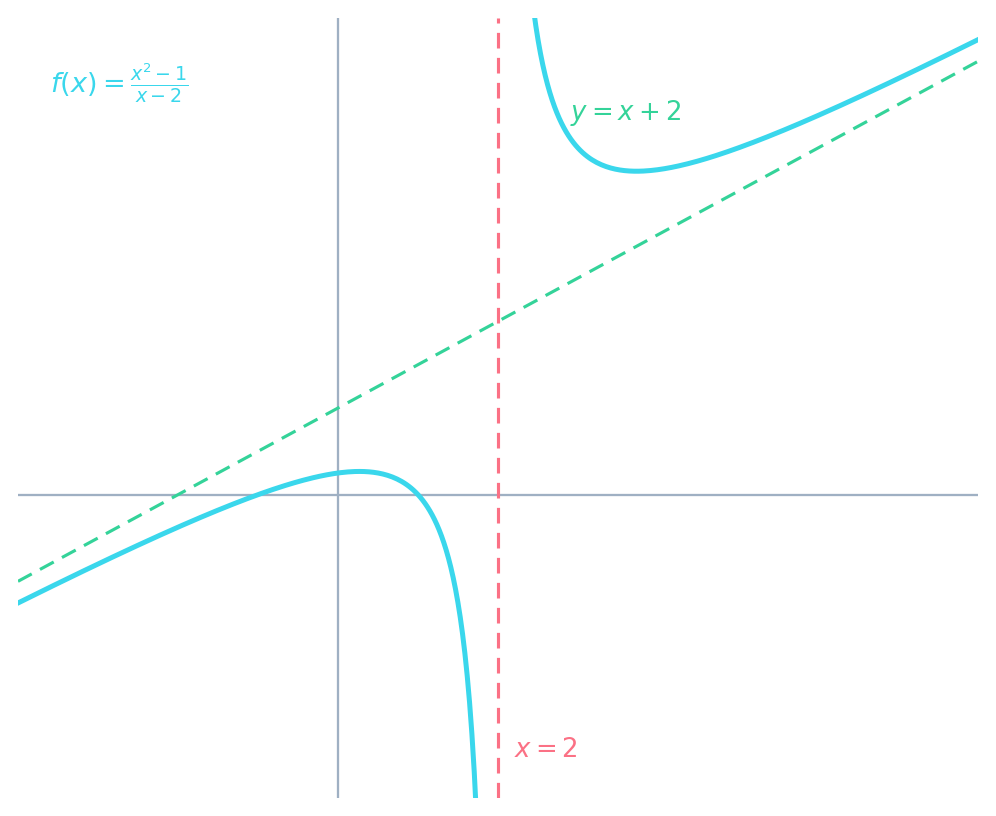
A horizontal or slant asymptote describes distant behaviour; it may be crossed at a finite input. For $f(x)=(x^2+x)/(x^2+1)$, the horizontal asymptote is $y=1$, and $f(1)=1$.
A rational function has an oblique (slant) asymptote when the degree of the top is:
Difficulty 1/5 · 100 coins + a small bonus on first completion today
When the numerator's degree exceeds the denominator's, dividing out leaves a slant line the curve approaches.
You find an oblique asymptote by:
Difficulty 1/5 · 100 coins + a small bonus on first completion today
Polynomial division gives the straight-line part the curve approaches far from the origin.
For f(x) = (x²−1)/(x−2), divide to get f(x) = x + 2 + 3/(x−2). The oblique asymptote is y = x + ?
Difficulty 2/5 · 140 coins + a small bonus on first completion today
The quotient is x + 2, so the oblique asymptote is y = x + 2.
Turning points 驻点 and a complete sketch
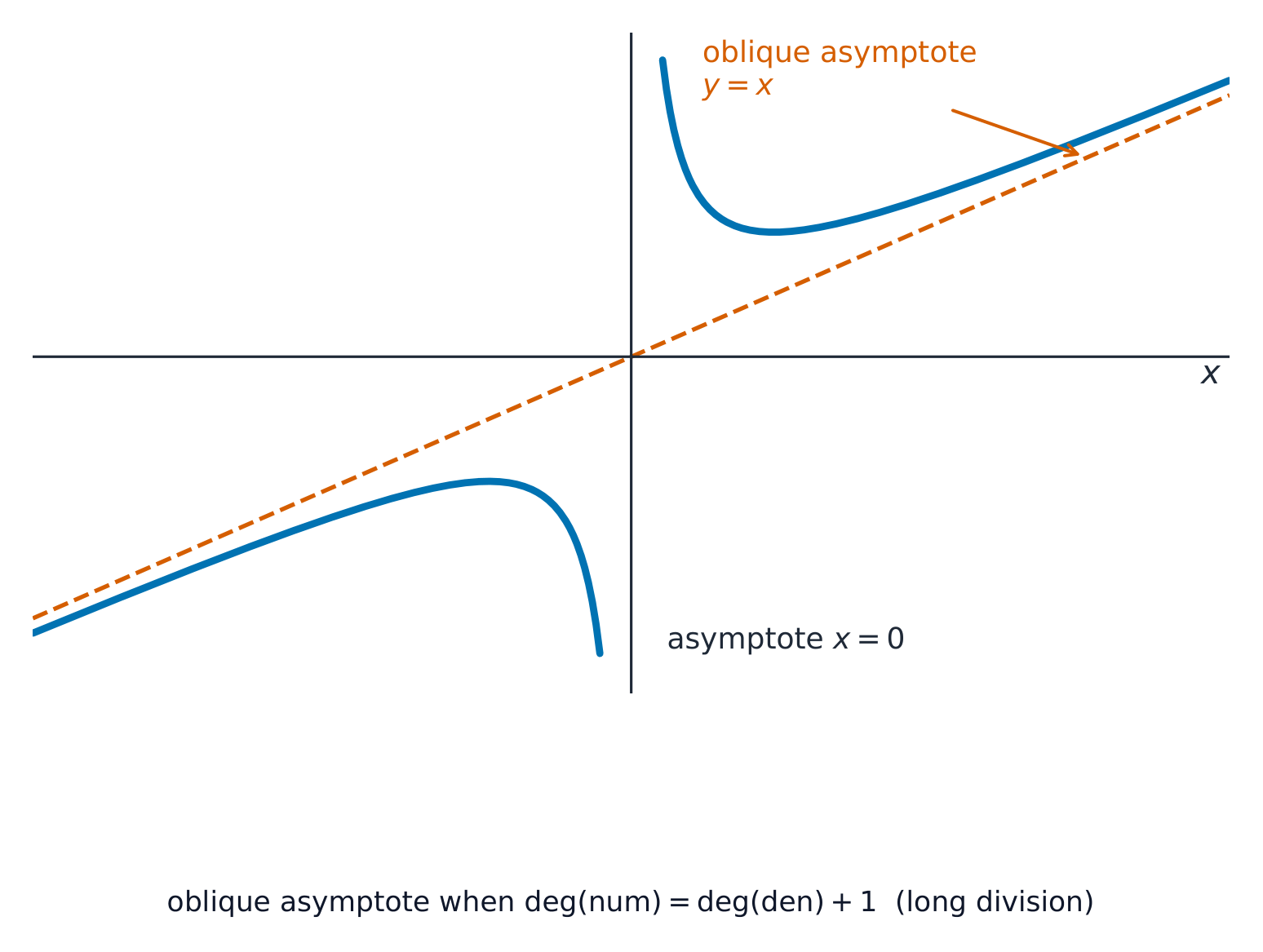
- For $f(x)=x+1/x$, $x\ne0$, $f'(x)=1-1/x^2$. The turning points are $(-1,-2)$, a local maximum, and $(1,2)$, a local minimum, as the derivative changes sign.
- There are no axis intersections. Draw both branches with vertical asymptote $x=0$ and slant asymptote $y=x$. The left branch lies below the slant line and the right above it. Near zero, the left branch falls to $-\infty$ and the right rises to $+\infty$.
For y = 1/f(x), the zeros of f(x) become the zeros of y.
Difficulty 1/5 · 100 coins + a small bonus on first completion today
False. Where f(x) = 0, 1/f(x) is undefined, so the zeros of f become vertical asymptotes of y = 1/f(x). 1/f(x) is never zero.
The graph of y = |f(x)| is obtained from y = f(x) by:
Difficulty 1/5 · 100 coins + a small bonus on first completion today
The modulus reflects any part of the graph below the x-axis to above it.
Prove the range with a discriminant 判别式
- Rearrange $y=x+1/x$ as $x^2-yx+1=0$. A real input exists exactly when its discriminant satisfies $y^2-4\ge0$. The range is $y\le-2$ or $y\ge2$, including both turning values.
- Check exclusions and any case where the equation stops being quadratic. For $y=x/(x^2+1)$, rearrangement gives $yx^2-x+y=0$. At $y=0$ this is the valid linear equation $x=0$; do not discard that range value.
For the second function, $1-4y^2\ge0$ gives $-1/2\le y\le1/2$. Its denominator is never zero for real $x$, so all these values occur, including $0$ and the two endpoints.
Change the output: modulus and reciprocal
- Take $f(x)=(x-1)/(x+1)$. For $y=|f(x)|$, keep nonnegative pieces and reflect negative pieces above the $x$-axis. The exclusion $x=-1$ remains. Its only zero is $x=1$.
- For $y=1/f(x)=(x+1)/(x-1)$, exclude both $x=-1$ and $x=1$: the first was never in the original domain and the second makes the reciprocal undefined. There is a hole at $(-1,0)$ and a vertical asymptote at $x=1$; the hole is not a zero.
For (x squared plus 1) divided by (x minus 1), what is the oblique asymptote, and why is the remainder not that line?
Polynomial division writes the function as quotient plus remainder over divisor. Only the quotient survives as the oblique asymptote.
What is the constant added to x in the oblique asymptote?
Difficulty 1/5 · 100 coins + a small bonus on first completion today
The quotient is x plus 1, so the constant is 1. The remainder is 2.
Change the input, or square the output
- For $f(|x|)$, keep the original right half and reflect it across the $y$-axis. Here the denominator $|x|+1$ never vanishes; the range is $[-1,1)$, with zeros at $x=\pm1$ and a corner at $(0,-1)$. Such a corner is not automatic: if the original right-hand slope at zero is zero, the join can be smooth.
- For $y^2=f(x)$, keep only original inputs where $f(x)\ge0$, then draw both $y=\sqrt{f(x)}$ and $y=-\sqrt{f(x)}$. Here $x<-1$ or $x\ge1$; the two branches meet at $(1,0)$, and no graph exists for $-1<x<1$.

Solve inequalities from boundaries and branches
- To solve $|(x-1)/(x+1)|<2$, find where $f=2$ and $f=-2$: the boundary inputs are $-3$ and $-1/3$. Include the pole $-1$ in the sign or branch diagram.
- Test the intervals separated by these values. The answer is $x<-3$ or $x>-1/3$, with strict endpoints excluded. Do not multiply an inequality by $x+1$ without first deciding its sign; multiplying by $(x+1)^2$ is safe only after excluding $x=-1$.
Use symmetry to solve an input-modulus inequality
- For $f(|x|)<1/2$, put $t=|x|\ge0$. Then $(t-1)/(t+1)<1/2$ has a positive denominator and gives $t<3$.
- Translate back to $-3<x<3$. The value zero is included. If a quadratic calculation produces a negative boundary for $t$, it cannot be a value of $|x|$; inspect the allowed half-line before reflecting the result.
Build the sketch from evidence
- Record the domain, intercepts, asymptotes, stationary coordinates and one-sided behaviour. Use a range calculation to confirm which vertical gaps are real; a horizontal asymptote need not be an excluded output value.
- For a related graph, state the new domain before drawing. For an inequality, mark all boundaries and poles, test branches, and preserve strict or inclusive endpoints.