אף אחד לעולם לא כתב את החוקים להבחנה בין חתול לכלב. אף מתכנת לא ישב והקליד "אם יש לו אוזניים מחודדות וזקניים". עם זאת, הטלפון שלך עושה זאת…
English narration · English + 中文 subtitles burned in · קריאת קול באנגלית · תרגום אנגלי + סינית שרוף בתוך הסרטון
18.1
What AI is · מהי בינה מלאכותית
Syllabus · סיילבוס
English
Candidates should be able to:
Notes and guidance
Show understanding of how graphs can be used to aid Artificial Intelligence (AI)
Purpose and structure of a graph Use A algorithm* and Dijkstra’s algorithm to perform searches on a graph Candidates will not be required to write algorithms to set up, access, or perform searches on graphs
Show understanding of how artificial neural networks have helped with machine learning
Show understanding of Deep Learning, Machine Learning and Reinforcement Learning and the reasons for using these methods.
Understand machine learning categories, including supervised learning, unsupervised learning
Show understanding of back propagation of errors and regression methods in machine learning
עברית
המועמדים צריכים להיות מסוגלים:
הערות והנחיות
להראות הבנה כיצד גרפים יכולים לשמש לסייע ב-בינה מלאכותית (AI)
מטרה ומבנה של גרף. שימוש ב-A algorithm* וב-Dijkstra’s algorithm לבצע חיפושים בגרף. תלמידים לא ידרשו לכתוב אלגוריתמים להגדרה, גישה או ביצוע חיפושים בגרפים
להראות הבנה כיצד רשתות עצביות מלאכותיות תרמו ל-למידת מכונה
להראות הבנה של Deep Learning, Machine Learning ו-Reinforcement Learning והסיבות לשימוש בשיטות אלו.
הבנת קטגוריות של למידת מכונה, כולל supervised learning, unsupervised learning
להראות הבנה של back propagation of errors ו-regression methods בלמידת מכונה
Source: Cambridge International syllabus · מקור: הסיילבוס הבינלאומי של קמבריד'ג'
English
Artificial intelligence 人工智能 (AI) builds systems that do tasks normally needing human intelligence — recognising speech and images, translating, playing games, driving, generating text. Most modern AI uses machine learning 机器学习 — algorithms that learn patterns from data instead of being programmed step by step. Within it, deep learning 深度学习, using neural networks 神经网络 with many layers, has been dominant since the 2010s.
A humanoid robot 人形机器人 puts many of these abilities into one body: it uses AI to see faces, understand speech and move its face and arms in a lifelike way.
עברית
בינה מלאכותית (AI) בונה מערכות שמבצעות משימות שדורשות לרוב חכמה אנושית — זיהוי דיבור ותמונות, תרגום, משחקים, נהיגה, יצירת טקסט. רוב הבינה המלאכותית המודרנית משתמשת בלמידת מכונה — אלגוריתמים שלומדים דפוסים מהנתונים במקום להיות מוגדרים צעד אחר צעד. בתוכו, למידה עמוקה, המשמשת רשתות עצב עם הרבה שכבות, הייתה דומיננטית מאז שנות ה-2010.
רובוט אנושי-צורה מכיל מספר רב של יכולות אלו בגוף אחד: הוא משתמש ב-AI כדי לראות פנים, להבין דיבור ולזז את הפנים והזרועות בצורה מציאותית.
רובוט אנושי-צורה משתמש ב-AI כדי לראות, לשמוע ולהגיב כמו אדםלימוד עמוק הוא חלק ממלמידת מכונה, שהיא חלק מ-AI
Explore · חקור
AI learning type lab · מעבדה לסוגי למידת בינה מלאכותית
Classify AI examples by the type of learning or concern involved. · סווג דוגמאות בינה מלאכותית לפי סוג הלמידה או הדאגה הקיימת בהן.
Many AI problems sit on a graph 图 — nodes 节点 (states, places) joined by edges 边 (moves, relationships).
pathfinding: roads form a graph; the shortest route is a graph search (Dijkstra's algorithm, the A* algorithm).
game playing: each board position is a node, each move an edge; minimax 极小化极大 with alpha-beta pruning searches the game tree.
state-space search: a planning problem is moving between states by applying operators to reach a goal.
knowledge representation: a semantic network 语义网络 has concepts as nodes and relationships as edges ("dog IS-A animal"); a knowledge graph 知识图谱 stores facts about the world for search engines and assistants.
Standard tools for navigating graphs include breadth-first search 广度优先搜索 and depth-first search 深度优先搜索.
"Describe the purpose and structure of a graph in an AI system."Purpose: to represent a problem as a set of states (or places) and the possible moves between them, so that an algorithm can search it for a solution, such as the shortest or cheapest route, or the best next move. Structure: a set of nodes (vertices), each representing a state, location or item, joined by edges representing the connections between them; each edge may carry a weight (a cost, distance or time), and edges may be directed (one-way) or undirected. "Explain the use of graphs to aid AI": the graph is the model on which the AI's search algorithms run: A* and Dijkstra's algorithm find optimal paths through it (navigation, routing), game positions form a tree searched for the best move, and knowledge stored as a graph lets a system reason about how facts are related.
The graph used below: the edge numbers are real distances; the red numbers are each node's heuristic 启发式 estimate of how far the goal still is, which only A uses*
Dijkstra's algorithm. It finds the shortest distance from the start to every node. Keep a table of the best distance found so far to each node (start 0, all others infinity). Repeatedly take the unvisited node with the smallest distance, mark it visited, and for each neighbour check whether going through this node gives a shorter distance; if so, update it and record where it came from. Stop when every node is visited (or the target is).
Worked example. Find the shortest distances from H to every other node in the graph above.
step
visit
H
A
B
C
D
G
start
0
∞
∞
∞
∞
∞
1
H (0)
0
4 (H)
3 (H)
∞
∞
∞
2
B (3)
0
4 (H)
3
∞
9 (B)
∞
3
A (4)
0
4
3
9 (A)
8 (A)
∞
4
D (8)
0
4
3
9 (A)
8
10 (D)
5
C (9)
0
4
3
9
8
10 (D)
6
G (10)
Shortest distances: A 4, B 3, D 8, C 9, G 10, and the path to G is H–A–D–G (read the "came from" labels backwards). At step 3, A offers D a distance of $4 + 4 = 8$, better than the 9 found through B, so D is updated; at step 5, C could reach G at $9 + 3 = 12$, worse than 10, so nothing changes. Showing these comparisons is the "working" the question asks for.
The A* algorithm. Dijkstra explores in every direction. A* adds a heuristic$h$, an estimate of the distance still to go, and always expands the node with the smallest $f = g + h$, where $g$ is the distance travelled so far. With a sensible heuristic (never over-estimating), it finds the same shortest path while looking at far fewer nodes, which is why satnavs and games use it. The exam gives $h$ for each node and a table to fill in.
Worked example. Find a path from H to G with A*, showing the working.
node expanded
$g$ so far
$h$
$f = g + h$
neighbours added (node: $g$, $h$, $f$)
H
0
7
7
A: 4, 5, 9; B: 3, 6, 9
B (tie with A; either)
3
6
9
D via B: 9, 2, 11
A
4
5
9
C: 9, 3, 12; D via A: 8, 2, 10 (better than 11, keep)
D
8
2
10
G: 10, 0, 10; C via D: 9 (no better)
G
10
0
10
goal reached
Path H–A–D–G, length 10, the same as Dijkstra's, but C was never expanded. Each time a node is reached by a second route, keep the smaller $g$; the search ends when the goal is the node with the smallest $f$. State the $g$, $h$ and $f$ values in every row: those are the marks.
עברית
בעיות רבות של AI ממוקמות על גרף — צמתים (מצבים, מקומות) המחוברים על ידי קשרים (פעולות, יחסים).
חיפוש נתיב: כבישים יוצרים גרף; הנתיק הקצר ביותר הוא חיפוש בגרף (אלגוריתם דייקסטרה, אלגוריתם A*).
משחקים: כל מצב במשחק הוא צומת, כל פעולה היא קשר; מינימקס עם גיזום אלפא-בטה מחפש את עץ המשחק.
חיפוש במרחב מצבים: בעיית תכנון היא מעבר בין מצבים על ידי יישום אופרטורים כדי להגיע למטרה.
ייצוג ידע: רשת סמנטית יש לה קונספטים כצמתים ויחסים כקשרים ("כלב IS-A חיית מחמד"); גרף ידע מאחסן עובדות על העולם למנועי חיפוש ולעוזרים.
בעיות AI לעיתים קרובות ממוקמות על גרף; כאן הנתיק הקצר ביותר מודגש
כלי סטנדרטיים לנווט בגרפים כוללים חיפוש ברוחב וחיפוע בעומק.
"תאר את המטרות והמבנה של גרף במערכת AI." מטרה: לייצג בעיה כסדרה של מצבים (או מקומות) והפעולות האפשריות ביניהם, כך שאלגוריתם יוכל לחפש אותו לפתרון, כמו הנתיק הקצר או הזול ביותר, או התנועה הטובה הבאה. מבנה: סדרה של צמתים (קודקודים), כל אחד מייצג מצב, מיקום או פריט, המחוברים על ידי קשרים המייצגים את החיבורים ביניהם; לכל קשר עשוי להיות משקל (עלות, מרחק או זמן), וקשרים עשויים להיות מוכונים (חד-כיווניים) או לא מוכנים. "הסבר את השימוש בגרפים כדי לסייע ל-AI": הגרף הוא הדגם שעליו פועלים אלגוריתמי החיפוש של ה-AI: A* ואלגוריתם דייקסטרה מוצאים נתיקים מיטביים דרכו (ניווט, נתובות), מצבי משחק יוצרים עץ שנחפש עבור התנועה הטובה ביותר, וידע המאוחסן כגרף מאפשר למערכת להסיק לגבי איך עובדות קשורות זו לזו.
הגרף המשמש להלן: המספרים בקצוות הם מרחקים אמיתיים; המספרים האדומים הם הערכות אסתמטיות של כל צמת לכמה עוד יש למטרה, שהן משמשות רק את A
אלגוריתם דייקסטר. הוא מוצא את המרחק הקצר ביותר מהתחלה לכל צמת. שמור טבלה של המרחק הטוב שנמצא עד כה לכל צמת (התחלה 0, כולם אינסוף). קח חוזר ושוב את הצמת שלא נבחר עם המרחק הקטן ביותר, סמן אותו כנבחר, ובכל שכנו בודק האם מעבר דרך צמת זה נותן מרחק קצר יותר; אם כן, עדכן אותו ורשום מאיפה הוא הגיע. עצור כשכל הצמתים נבחרו (או המטרה הושגה).
דוגמא פתורה. מצא את המרחקים הקצרים ביותר מ-H לכל צמת אחר בגרף למעלה.
שלב
ביקור
H
A
B
C
D
G
התחלה
0
∞
∞
∞
∞
∞
1
H (0)
0
4 (H)
3 (H)
∞
∞
∞
2
B (3)
0
4 (H)
3
∞
9 (B)
∞
3
A (4)
0
4
3
9 (A)
8 (A)
∞
4
D (8)
0
4
3
9 (A)
8
10 (D)
5
C (9)
0
4
3
9
8
10 (D)
6
G (10)
מרחקים קצרים: A 4, B 3, D 8, C 9, G 10, והדרך ל-G היא H–A–D–G (קרא את תוויות "הגיע מ" הפוך). בשלב 3, A מציע ל-D מרחק של $4 + 4 = 8$, טוב יותר מה-9 שנמצא דרך B, אז D מעודכן; בשלב 5, C יכול להגיע ל-G ב-$9 + 3 = 12$, גרוע יותר מ-10, אז אין שינוי. הצגת השוואות אלו היא ה"עבודה" שהשאלה מבקשת.
אלגוריתם A*. דייקסטר חוקר בכל כיוון. A* מוסיף אסתמטיקה$h$, הערכת המרחק שנותר, ותמיד מרחיב את הצמת עם ה-$f = g + h$ הקטן ביותר, כאשר $g$ הוא המרחק שעבר עד כה. עם אסתמטיקה סבירה (ללא הערכת יתר), הוא מוצא את אותו מסלול הקצר בעוד שהוא בודק הרבה פחות צמתים, ולכן נעשה בו שימוש במחלקות ניווט ובמשחקים. לשאלת הבחין מוענקת ⟨$h$⟩ עבור כל צמת וטבלה למילוי.
דוגמא פתורה. מצא מסלול מ-H ל-G בשימוש A*, תוך הצגת העבודה.
צמת מורחב
$g$ עד כה
$h$
$f = g + h$
שכנים נוספו (צמת: $g$, $h$, $f$)
H
0
7
7
A: 4, 5, 9; B: 3, 6, 9
B (שווה ל-A; כל אחד מהם)
3
6
9
D דרך B: 9, 2, 11
A
4
5
9
C: 9, 3, 12; D דרך A: 8, 2, 10 (טוב יותר מ-11, נשמור)
D
8
2
10
G: 10, 0, 10; C דרך D: 9 (לא טוב יותר)
G
10
0
10
ייעוד הושג
מסלול H–A–D–G, אורך 10, זהה לזה של דייקסטרה, אך C מעולם לא הורחב. בכל פעם שצומת מושג בדרכים שניות, שמור את ה-$g$ הקטן ביותר; החיפוש מסתיים כאשר היעד הוא הצומת עם ה-$f$ הקטן ביותר. ציין את ערכי ה-$g$, $h$ ו-$f$ בשורה כלשהי: אלו הם הנקודות.
An ANN is inspired by the brain's neurons. An artificial neuron 人工神经元:
takes several input values, multiplies each by a weight 权重, and adds them up with a bias term 偏置项.
applies an activation function 激活函数 (a non-linear function such as ReLU) to the sum.
outputs the result, which feeds neurons further on.
Neurons sit in layers: an input layer, one or more hidden layers 隐藏层 (where useful internal patterns are learned), and an output layer. With many hidden layers it is a deep neural network 深度神经网络, and training it is deep learning.
ANNs let models learn complex patterns straight from raw data (pixels, audio, text) without hand-designed features — driving breakthroughs in image recognition 图像识别, speech recognition 语音识别, machine translation 机器翻译, and game playing. They do well with large amounts of data, noisy or very complex input, and patterns too hard to capture with explicit rules.
"Explain what is meant by an artificial neural network."A model of the brain's network of neurons, made of layers of connected nodes: an input layer, one or more hidden layers and an output layer. Each connection has a weight; each node sums its weighted inputs and passes the result through an activation function to the next layer. "Explain how ANNs enable machine learning" (three marks): the network is trained on many examples; for each example the output is compared with the expected result and the error is used to adjust the weights (back propagation) so that the error falls; after enough examples the weights encode the patterns in the data, and the network can then classify or predict for new data it has never seen. "State the reason for multiple hidden layers": each additional layer combines the features found by the layer before it into more complex, more abstract features, so the network can learn more complex relationships (edges, then shapes, then objects); that is what makes a network deep.
עברית
רשת עצבית מואצת מעצבי המוח. עצב מלאכותי:
מקבל מספר ערכי כניסה, כופל כל אחד ב-משקל, ומסכם אותם עם איבר סטייה.
מחיל פונקציית הפעלה (פונקציה לא-ליניארית כמו ReLU) על הסכום.
מוציא תוצאה, המזינה עצבים מאוחר יותר.
ניירון יחיד: כל קלט כפול במשקלו, סכום עם טווח, ולאחר מכן פונקציית פעולה
הניירונים מסודרים בשכבות: שכבת קלט, שכבה אחת או יותר של נירונים נסתרים (בהן נלמדים דפוסים פנימיים שימושיים), ושכבת תוצאה. כאשר ישנן הרבה שכבות נסתרות, מדובר ברשת ניירונים עמוקה, והאימון שלה נקרא למידת עומק.
רשת ניירונים עם שכבת קלט, שתי שכבות נסתרות ושכבת תוצאה
רשתות ANN מאפשרות למודלים ללמוד דפוסים מורכבים ישירות ממאגר נתונים גס (פיקסלים, שמע, טקסט) ללא תכנון ידני של מאפיין — מה שהוביל לפריצות דרך בזיהוי תמונות, זיהוי דיבור, תרגום מכונה ומשחקי מחשב. הן מצליחות היטב עם כמויות גדולות של נתונים, קלט רועש או מורכב מאוד, ודפוסים שקשה לצאת אותם על ידי כללים מפורשים.
"הסבר מה מתכוונים ברשת ניירונים מלאכותית."מודל של רשת הניירונים במוח, המורכב משכבות של צמתים מחוברים: שכבת קלט, שכבה אחת או יותר של נירונים נסתרים ושכבת תוצאה. לכל חיבור יש משקל; כל צומת סוכם את הקלטות המשוקלות שלו ועובר את התוצאה דרך פונקציית פעולה לשכבה הבאה. "הסבר כיצד ANNs מאפשרות למכונת ללמוד" (שלוש נקודות): הרשת מומנת על מגוון דוגמאות; עבור כל דוגמה, התוצאה מושווה לתוצאה המצופה וה-שגיאה משמשת לכוון את המשקלים (הפרופגציה הפנימה) כך שהשגיאה תרד; לאחר כמות מספקת של דוגמאות, המשקלים מקודדים את ה-דפוסים בנתונים, והרשת יכולה אז לסווג או לחזות עבור נתונים חדשים שלא ראתה מעולם. "ציינו את הסיבה לקיום של שכבות נסתרות מרובות": כל שכבה נוספת משלבת את המאפיינים שנמצאו על ידי השכבה שקדמה לה למאפיינים מורכבים יותר, מופשטים יותר, כך שהרשת יכולה ללמוד קשרים מורכבים יותר (קצוות, אחר כך צורות, אחר כך אובייקטים); זוהי בדיוק הסיבה לכך שהרשת נחשבת "עמוקה".
Explore · חקור
Tap the parts of a neural network · גשו על חלקי רשת נוירונים
Explore the layers. Data flows left to right: the input layer takes the features, the hidden layers learn patterns, and the output layer gives the answer — with every connection carrying a weight that training adjusts. · חקרו את השכבות. הנת זורמים משמאל לימין: שכבת הקלט לוקחת את המאפיינים, השכבות הנסתרות לומדות דפוסים, ושכבת הפלט נותנת את התשובה — כאשר כל חיבור נושא משקל שהאימון מתכוונן.
The umbrella term — any algorithm that learns from data. Three paradigms:
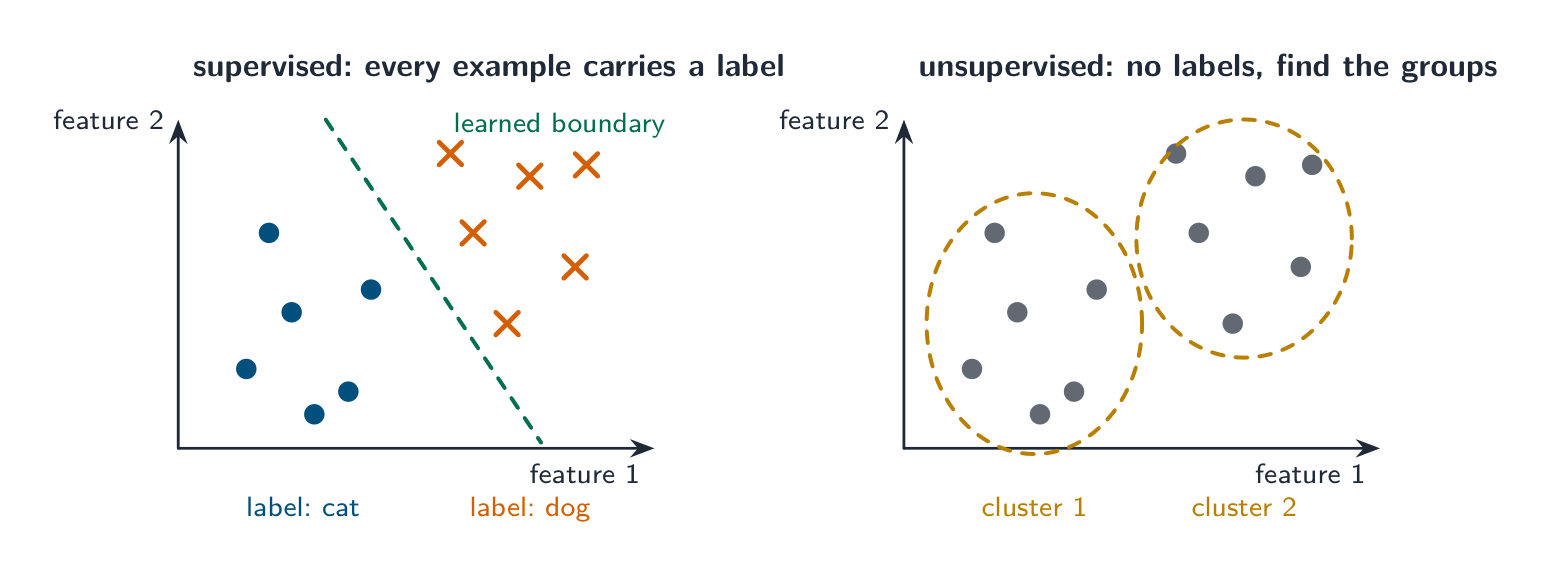
supervised learning 监督学习 — the data has labels 标签 (images tagged "cat"/"dog"); the algorithm learns input → label. Used for classification 分类 (a category) and regression.
unsupervised learning 无监督学习 — no labels; the algorithm finds structure, e.g. a cluster 聚类 of similar customers.
reinforcement learning (below).
Use ML when explicit rules would be impractical (spam filters, recommendations, fraud detection).
"Describe supervised learning and unsupervised learning" (the marked wordings).Supervised learning: the algorithm is trained on labelledtraining data 训练数据, each example paired with the correct output (the target); it learns the relationship between inputs and outputs and uses it to classify or predict for new inputs; the answers are known while training, so the error can be measured. Unsupervised learning: the data is unlabelled, with no correct answers given; the algorithm looks for patterns, structure or groupings in the data by itself (clustering similar items, finding associations); the output is a set of categories or relationships that were not defined in advance. How they differ: labelled against unlabelled data; known outputs against discovered structure; supervised is used to predict (classification, regression), unsupervised to explore (clustering, anomaly detection). Both are categories of machine learning; the third is reinforcement learning.
Deep learning
A subset of ML using deep neural networks. Lower layers learn simple patterns (edges, phonemes), higher layers combine them into abstract concepts. It needs lots of data and lots of compute (GPUs); for small datasets, simpler ML methods often do better.
"Explain what is meant by deep learning" (three marks).Machine learning that uses artificial neural networks with many hidden layers (deep networks); the network is trained on very large amounts of data, and each layer extracts features from the output of the layer below, so that the network learns the features it needs by itself rather than having them specified by the programmer.Reasons for using it: it can solve problems too complex for hand-written rules or shallow models (recognising faces, understanding speech, translating text); it improves as more data becomes available; it removes the need for human feature engineering; and it can handle unstructured data such as images, sound and text. How it is made more effective: more (and better-labelled) training data; more layers or nodes, within the limits of overfitting; more processing power (GPUs) and training time; tuning the learning rate and other parameters. Examples: speech recognition in voice assistants, image recognition in medical scans and self-driving cars, machine translation, recommendation systems.
Reinforcement learning
In reinforcement learning 强化学习, an agent 智能体 acts in an environment; each action changes the state and returns a reward 奖励. The agent learns a policy 策略 (a strategy) that maximises the total reward over time, by trial and error with no labels up front. Used for sequential-decision problems — games, robot control, autonomous driving.
"Explain what is meant by reinforcement learning" (three marks).An agent learns by interacting with its environment: it takes an action, the environment moves to a new state and returns a reward (or penalty), and the agent adjusts its behaviour so as to maximise the total reward over time. There is no labelled data: the agent learns by trial and error, discovering which actions are good from the rewards it collects, and gradually forms a policy that says what to do in each state. Used where the right answer is not known in advance but the result of an action can be scored: game playing (chess, Go), robot control, traffic-light timing, resource allocation. A computer playing a board game against a user learns in this way, or searches the game tree with minimax to choose the move whose worst outcome is best.
A self-driving car 自动驾驶汽车 is a real example. Lidar 激光雷达 and camera sensors (the spinning unit on the roof) build a live picture of the road, and a learned policy decides how to steer, speed up and brake safely.
עברית
למידת מכונה
המונח הכללי — כל אלגוריתם הלומד ממאגר נתונים. שלושה פרדיגמות:
למידה מופקחת — לנתונים ישנם תוויות (תמונות שתויגו "חתול"/"כלב"); האלגוריתם לומד קלט → תווית. משמש לסיווג (קטגוריה) ולריגרסיה.
למידה לא מופקחת — אין תוויות; האלגוריתם מוצא מבנה, לדוגמה אשכול של לקוחות דומים.
למידת חיזוק (להלן).
השתמש ב-ML כאשר כללים מפורשים יהיו בלתי פרקטיים (מסנני ספאם, המלצות, זיהוי הונאה).
אותם הנתונים רואים בשתי דרכים: עם תוויות, המשימה היא ללמוד מה מפריד בין הקטגוריות; ללא תוויות, המשימה היא לגלות שישנם קבוצות בכלל
"תיארו למידה מופקחת ולמידה לא מופקחת" (הניסוחים המסומנים).למידה מופקחת: האלגוריתם מומן על נתוני אימון מסומנים, כל דוגמה זוגית עם התוצאה הנכונה (המטרה); הוא לומד את היחס בין קלטות לתוצאות ומשתמש בו לסווג או לחזות עבור קלטות חדשות; התשובות ידועות בזמן האימון, כך שהשגיאה ניתנת למדידה. למידה לא מופקחת: הנתונים ללא תוויות, ללא תשובות נכונות הנתונות; האלגוריתם מחפש דפוסים, מבנה או קבוצות בנתונים לבדו (אשכול של פריטים דומים, מציאת קשרים); התוצאה היא סט של קטגוריות או קשרים שלא הוגדרו מראש. כיצד הם שונים: נתונים מסומנים מול נתונים ללא תוויות; תוצאות ידועות מול מבנה נתגלה; למידה מופקחת משמשת לחזות (סיווג, רגרסיה), למידה לא מופקחת לחקור (אשכול, זיהוי חריגות). שניהן הן קטגוריות של למידת מכונה; השלישית היא למידת חיזוק.
למידה מופקחת: מודל מומן על נתונים מסומנים, ואחרי מכן מזהה נתונים חדשים
למידת עומק
תת-קבוצה של למידת מכונה המשתמשת ברשתות נוירונים עמוקות. שכבות תחתונות לומדות דפוסים פשוטים (קצוות, פונימות), ושכבות עליונות משלבות אותם לקונספטיות מופשטות. הדבר דורש נתונים רבים מאוד ועוצמת חישוב רבה (GPUs); עבור סט נתונים קטן, שיטות ML פשוטות לעיתים קרובות נותנות תוצאות טובות יותר.
"הסבר מהו הכוונה בלמידה עמוקה" (שלושה נקודות).למידת מכונה המשתמשת ברשתות נוירונים מלאכותיות עם שכבות נסתרות רבות (רשתות עמוקות); הרשת מאומנת על כמויות גדולות מאוד של נתונים, וכל שכבה חושפת מאפיין מתוצאת השכבה התחתונה, כך שהרשת לומדת את המאפיינים הנדרשים לה בעצמה ולא באמצעות הוגדרתם על ידי המתכנן.סיבות לשימוש בה: היא יכולה לפתור בעיות过于מורכבות מדי לכללי כתיבה ידנית או לדגמים רדודים (זיהוי פנים, הבנת דיבור, תרגום טקסט); היא משתפרת ככל שיש יותר נתונים; היא מסירה את הצורך בהנדסת מאפיינים אנושית; והיא יכולה להתמודד עם נתונים לא מבניים כמו תמונות, קול וטקסט. איך היא הופכת ליעילה יותר: יותר (ומסומן טוב יותר) נתוני אימון; יותר שכבות או צמתים, בתוך הגבולות של התאמה יתר; עוצמת עיבוד מוגברת (GPUs) וזמן אימון; כוונון קצב הלמידה ופרמטרים אחרים. דוגמאות: זיהוי דיבור במסייעים קוליים, זיהוי תמונות בסריקות רפואיות וברכבים אוטונומיים, תרגום מכונה, מערכות המלצה.
למידת חיזוק
בלמידת חיזוק, סוכן פועל בסביבה; כל פעולה משנה את המצב ומחזירה פרס. הסוכן לומד מדיניות (אסטרטגיה) שמקסימה את הפרס הכולל לאורך הזמן, באמצעות ניסוי וטעות ללא תוויות מראש. משמש לבעיות החלטות רציפות — משחקים, בקרת רובוטים, נהיגה אוטונומית.
"הסבר מהו הכוונה בלמידת חיזוק" (שלושה נקודות). * סוכן לומד באמצעות אינטראקציה עם הסביבה שלו: הוא מבצע פעולה, הסביבה עוברת למצב חדש ומחזירה פרס (או עונש), והסוכן מתכוונן את התנהגותו כדי להמקסימו את הפרס הכולל לאורך הזמן.* אין נתונים מסומנים: הסוכן לומד באמצעות ניסוי וטעות, מגלה אילו פעולות הן טובות מהפרסים שהוא אוסף, ויוצר בהדרגה מדיניות הקובעת מה לעשות בכל מצב. משמש כאשר התשובה הנכונה אינה ידועה מראש אך ניתן לצפות תוצאה של פעולה: משחקי מחשב (שחמט, גו), בקרת רובוטים, תזמון רמזורים, הקצאת משאבים. מחשב המשחק משחק לוח נגד משתמש לומד בדרך זו, או מחפש בעץ המשחק עם מינימקס כדי לבחור את ההלכה שהתוצאה הגרועה ביותר שלה היא הטובה ביותר.
למידת חיזוק: הסוכן פועל, הסביבה מחזירה מצב חדש ופרס, והסוכן לומד מכך
רכב אוטונומי הוא דוגמה אמיתית. לייזר (Lidar) ומצלמות (היחידה המסתובבת בגג) בונים תמונה חיה של הכביש, ומדיניות שנלמדה מחליטה כיצד לנהוג, להאיץ ולבלום בבטיחות.
רכב אוטונומי משתמש במצלמות ובחיישני לייזר כדי לראות את הכביש סביבוזרועות רובוט תעשייתיות בקו ייצור: למידת חיזוק יכולה ללמד רובוט לשלוט בתנועותיו
Training an ANN: backpropagation · אימון ANN: הפצה אחורית
English
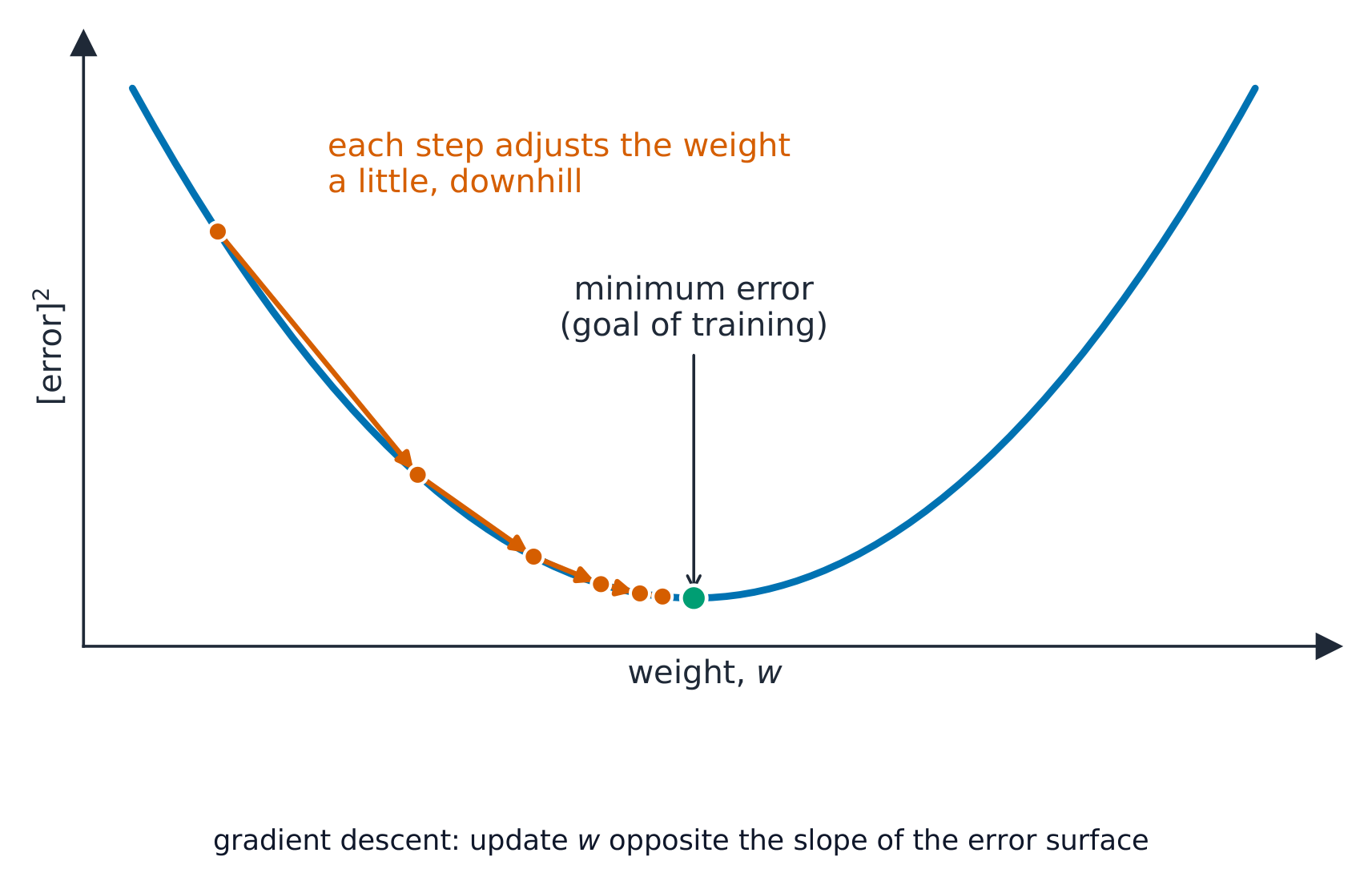
Training adjusts the weights so outputs match the targets. The standard method is backpropagation 反向传播 (back propagation of errors) with gradient descent 梯度下降. For each training example:
forward pass — feed the input through to the output.
compute the error with a loss function 损失函数 (a single number for how wrong the output is).
backward pass — propagate the error backwards, finding each weight's gradient (how much it contributed to the error) using the chain rule.
update the weights by a small step (set by the learning rate 学习率) that reduces the error.
Repeat over many examples and many passes (epochs 训练轮次) until the error stops shrinking. The name "back" comes from step 3: the error flows from the output back towards the input, so every weight's gradient is found in one sweep. After training, a new input needs only one forward pass to get a prediction.
"Describe the back propagation of errors method" (four marks). (1) An input is fed forward through the network and its output is compared with the expected (target) output; (2) the difference is the error; (3) the error is passed backwards through the network, layer by layer from the output to the input, and each weight's share of the error is calculated; (4) the weights are adjusted in proportion to their contribution, in the direction that reduces the error; (5) the process is repeated with many examples until the error is as small as required. The point of the method is that a network with hidden layers has no direct way of knowing which internal weight caused an output error; back propagation apportions the blame.
עברית
האימון מתכוונן את משקלים כך שהתוצאות תתאים למטרות. השיטה הסטנדרטית היא הפצה אחורית (backpropagation) עם ירידת מדרון. עבור כל דוגמת אימון:
מעבר קדמי — העברת הקלט דרך הרשת לתוצאה.
חישוב השגיאה באמצעות פונקציית אובדן (מספר יחיד המייצג כמה התוצאה שגויה).
מעבר אחורי — הפצת השגיאה אחורה, מציאת גרדיאנט של כל משקל (כמה הוא תרם לשגיאה) באמצעות כלל השרשרת.
עדכון המשקלים בצעד קטן (הנקבע על ידי קצב הלמידה) שמקטין את השגיאה.
המשך על פי רוב הדוגמאות והמעברים הרבים (אפוקות) עד שהשגיאה מפסיקה להתקטן. השם "אחורי" נובע משלב 3: השגיאה זורמת מהתוצאה אחורה לכיוון הקלט, כך שגרדיאנט של כל משקל נמצא במעבר אחד. לאחר האימון, קלט חדש דורש רק מעבר קדמי אחד לקבלת תחזית.
"תיאר את שיטת הפצת השגיאה האחורית" (ארבע נקודות). (1) קלט מועבר קדימה דרך הרשת ותוצאתו מושווה לתוצאה המצופה (מטרה); (2) ההפרש הוא השגיאה; (3) השגיאה עוברת אחורה דרך הרשת, שכבה אחר שכבה מהתוצאה לקלט, וחלק השגיאה של כל משקל מחושב; (4) המשקלים מתכווננים ביחס לתרומתם, בכיוון שמקטין את השגיאה; (5) התהליך חוזר על פי רוב הדוגמאות עד שהשגיאה קטנה כפי שדרוש. עיקרון השיטה הוא שרשת עם שכבות נסתרות אין לה דרך ישירה לדעת איזה משקל פנימי גרם לשגיאת תוצאה; הפצה אחורית מחלקת את האשמה.
האימון מתכוונן את המשקלים כדי להגיע לשגיאה מינימלית
Choose the coefficients to minimise the sum of squared errors against the training data. Use it when the relationship looks roughly linear and you want an interpretable model. For curved data, use polynomial, decision-tree, or neural-network regression methods — same idea: define a model, define a loss, and adjust the parameters to minimise it. Regression and classification are both supervised; the choice depends on whether the answer is a number or a category.
"Describe regression methods in machine learning" (two marks).Statistical methods that find the relationship between input variables and a continuous output, by fitting a function (a line or curve) to the training data with the smallest total error; the fitted function is then used to predict the output for new inputs. Linear regression fits a straight line; other methods fit curves. Regression predicts a value (a price, a temperature, a time); classification predicts a category, which is the distinction the exam asks for.
עברית
חלק ממשימות אלו חוזה מספר (מחיר דירה, טמפרטורה למחר) — רגרסיה, בניגוד לסיווג (קטגוריה).
בחרו את המקדמים כדי למזער את סכום השגיאות הרבועות ביחס לנתוני האימון. השתמשו בזה כאשר הקשר נראה בקירוב ליניארי ואתם רוצים מודל ניתן לפרשנות. עבור נתונים מעוקלים, השתמשו בשיטות רגרסיה פולינומיות, עצי החלטה או רשתות עצביים — אותה רעיון: הגדירו מודל, הגדירו פונקציית אובדן, והתאימו את הפרמטרים כדי למזער אותו. רגרסיה וסיווג הם שניהם למידה מופקחת; הבחירה תלויה בשאלה האם התשובה היא מספר או קטגוריה.
"תיארו שיטות רגרסיה במלמידת מכונה (שתי נקודות).** שיטות סטטיסטיות המצאות את הקשר בין משתנים לקלט לתוצאה רציפה, על ידי התאמת פונקציה (קו או עקומה) לנתוני האימון עם סך שגיאה מינימלי; הפונקציה המותאמת משמשת לאחר מכן לחזות תוצאה לקלטות חדשים. רגרסיה ליניארית מותאמת קו ישר; שיטות אחרות מותאמות עקומות. רגרסיה חוזה ערך (מחיר, טמפרטורה, זמן); סיווג חוזה קטגוריה, והזו ההבחנה שהמבחן מבקש.
רגרסיה ליניארית מותאמת את הקו שמזער את סך השגיאות הרבועות (הרווחים המקוטעים)
Explore · חקור
Fitting a regression line · התאמת קו רגרסיה
Drag the controls. Linear regression draws the straight line that makes the squared distances to the data points as small as possible — then it predicts a number for any new input. · גרור את הבקרים. רגרסיה ליניארית מציירת את הקו הישר שגורם למרחקים הריבועיים לנקודות הנתונים להיות מינימליים — ולאחר מכן היא חוזה מספר לכל כניסה חדשה.
optical character recognition/ˈɒptɪkl ˈkærɪktə ˌrekəɡˈnɪʃn/
זיהוי דפוס אופטי
text-to-speech/tekst tə spiːtʃ/
המרת טקסט לדיבור
18.1
How AI is used in a real scenario · איך AI משמש בתרחיש אמיתי
English
Many exam scenarios use the same pattern — a deep-learning model trained on labelled data, often several combined into a pipeline:
customer identification at an automated shop: the system is trained on labelled face images; a camera captures a face; image recognition extracts a representation; it is matched against registered customers; the closest match identifies the person.
reading text from images: image recognition finds text regions; optical character recognition 光学字符识别 extracts the characters; machine translation converts them; text-to-speech 文本转语音 reads them aloud.
checkout item-detection: object-detection AI, trained on labelled product images, sees which items go into a basket and charges the account.
By the time a user interacts with the system, the model is fast — it only does forward-pass inference; the intelligence is in the patterns learned during training.
Model answers for the scenario questions.A car-park camera reads registration numbers: the camera captures an image; an AI trained on many labelled images of number plates locates the plate in the image; character recognition (a deep-learning classifier, again trained on labelled characters) converts the plate into text; the text is stored with the time and matched when the car leaves. A CCTV system detects and tracks a person: image-recognition software trained on labelled images of people identifies a person in each frame; the system compares successive frames to follow their movement; unusual movement can trigger an alert. Speech turned into commands: speech recognition trained on many recorded voices converts the sound into text; the system matches the text to a set of known commands; it improves as it is corrected. A camera that focuses on faces: a face-detection model trained on labelled faces finds the face region, and the lens is adjusted to bring that region into focus. A bank's face-recognition login: the app captures the face, a deep network extracts its features, and they are compared with the stored features for that customer. In every case the pattern is: trained on labelled examples, extracts features, matches or classifies new input.
Worked example. For each task, say whether it needs regression or classification, and what the output layer of an ANN would look like: (a) predict tomorrow's temperature; (b) decide whether an email is spam. Ask what kind of thing is being predicted. (a) A temperature is a number on a continuous scale, so this is regression, and the output layer is a single neuron holding that value. (b) Spam or not-spam is a category, so this is classification, and the output gives a probability per class. Both are supervised learning: each needs labelled examples to train on, and training adjusts the weights by backpropagation to reduce the error. The deciding question is simply number-or-category - not how difficult the task feels.
עברית
תרחישי מבחן רבים משתמשים באותו דגם — מודל למידת עמוק מאומן על נתונים מסומנים, לעיתים קרובות כמה מהם משולבים בפייפליין:
זיהוי לקוח בחנות אוטומטית: המערכת מאומנת על תמונות פנים מסומנות; מצלמה תופסת פנים; זיהוי תמונות מבודד נציגות; היא מותאמת מול לקוחות רשומים; ההתאמה הקרובה ביותר מזדהה את האדם.
קריאת טקסט מתמונות: זיהוי תמונות מזהה אזורים בטקסט; זיהוי דמויות אופטי (OCR) מבודד את הדמויות; תרגום מכונתי ממיר אותן; טקסט-לתוך-דיבור קורא אותן בקול.**
זיהוי פריטים בסל קניות: בינה מלאכותית לזיהוי אובייקטים, מאומנת על תמונות מוצרים מסומנות, רואה אילו פריטים נכנסים לסל וגובת את החשבון.
עד שמשתמש מגיב למערכת, המודל מהיר — הוא מבצע רק חישוב קדימי; הבינה טמונה בדפוסים שנלמדו במהלך האימון.
תשובות דגם לשאלות התרחיש.מצלמת חניה קוראת מספרי רכב: המצלמה תופסת תמונה; בינה מלאכותית מאומנת על הרבה תמונות מסומנות של לוחיות מזהה את הלוחית בתמונה; זיהוי דמויות (מסנן למידת עמוק, שוב מאומן על דמויות מסומנות) ממיר את הלוחית לטקסט; הטקסט מאוחסן עם השעה ומותאם כשהרכב יוצא. מערכת CCTV מזהה ועוקבת אחר אדם: תוכנת זיהוי תמונות מאומנת על תמונות מסומנות של אנשים מזהה אדם בכל פריים; המערכת مقارנת פריימים ברצף כדי לעקוב אחר תנועתו; תנועה חריגה יכולה לגרום לאיתור. דיבור שהופך לפקודות: זיהוי דיבור מאומן על הרבה קליטי קול מומרים את הצליל לטקסט; המערכת מותאמת את הטקסט לסט של פקודות ידועות; היא משתפרת כשהיא מתוקנת. מצלמה המתמקדת בפנים: מודל זיהוי פנים מאומן על פנים מסומנות מזהה את אזור הפנים, והעדשה מותאמת כדי להביא את האזור למיקוד. כניסה בזיהוי פנים בבנק: האפליקציה תופסת פנים, רשת עמוקה מבודדת את המאפיינים שלהם, והם מותאמים למאפיינים המאוחסנים עבור לקוח זה. בכל מקרה הדגם הוא: מאומן לדוגמאות מסומנות, מבודד מאפיינים, מותאם או מסווג קלט חדש.
דוגמה מפורטת. לכל משימה, אמרו אם היא זקוקה לרגרסיה או לסיווג, ומה ייראה שכבת הפלט של ANN: (א) לחזות את הטמפרטורה למחר; (ב) להחליט אם מייל הוא ספאם. שאלו איזה סוג דבר נחזה. (א) טמפרטורה היא מספר בסולם רציף, לכן זו רגרסיה, וכפתרת הפלט היא נורונה אחת המחזיקה את הערך. (ב) ספאם או לא-ספאם היא קטגוריה, לכן זו סיווג, והפלט נותן הסתברות לכל מחלקה. שניהם הם למידה מופקפת: כל אחד זקוק לדוגמאות מסומנות לאימון, והאימון מתכוונן את המשקלים באמצעות backpropagation כדי להקטין את השגיאה. השאלה המכריעה היא פשוט מספר-מול-קטגוריה - לא כמה המשימה מרגישה קשה.
18.1
Definitions the examiner accepts · הגדרות מקובלות בקורס
English
A definition question is marked against fixed wording. Learn these exactly, and give one answer only.
Term
Definition
graph (in AI)
a set of nodes representing states or places, joined by edges representing connections, often weighted, that a search algorithm can explore
Dijkstra's algorithm
finds the shortest distance from a start node to every other node by always visiting the unvisited node with the smallest distance so far
A* algorithm
a shortest-path search that expands the node with the smallest total of distance so far plus a heuristic estimate of the distance to the goal
artificial neural network
a model of the brain's neurons: layers of nodes joined by weighted connections, trained by adjusting the weights
machine learning
algorithms that learn from data and improve with experience rather than following fixed rules
supervised learning
learning from labelled training data in which the correct output for each input is known
unsupervised learning
learning from unlabelled data by finding patterns, groupings or structure in it
reinforcement learning
an agent learns by trial and error, choosing actions in an environment to maximise the rewards it receives
deep learning
machine learning using neural networks with many hidden layers, trained on large amounts of data, each layer extracting features from the one below
back propagation of errors
comparing the network's output with the target, passing the error back through the layers and adjusting each weight to reduce it
regression
fitting a function to training data in order to predict a continuous output value from inputs
עברית
שאלת הגדרה מוקדמת לפי טקסט קבוע. לימודן במדויק, ותן תשובה אחת בלבד.
מונח
הגדרה
גרף (ב-AI)
סט של נודות המייצגות מצבים או מקומות, מחוברות על ידי קשרים המייצגים חיבורים, לעיתים קרובות משוקללות, שאלגוריתם חיפוש יכול לחקור
אלגוריתם דייקסטרה
מוצא את המרחק הקצר ביותר מנודת התחלה לכל נודה אחרת על ידי ביקור תמיד בנודה שלא נבדקה בעלת המרחק הקטן עד כה
אלגוריתם A*
חיפוש מסלול קצר ביותר המרחיב את הצומת בעל הסכום הקטן ביותר של המרחק עד כה פלו הערכת היסטריון למרחק מהיעד
רשת עצבנית מלאכותית
דגם של נוירונים במוח: שכבות של צמתים המחוברים באמצעות קשרים משוקלים, המאומנות על ידי התאמת המשקלים
למידת מכונה
אלגוריתמים הלומדים מתוך נתונים ומשפרים עם ניסיון, במקום לנהוג לפי כללים קבועים
למידה מופעלת
למידה מתוך נתוני אימון מסומנים שבהם ידוע הפלט הנכון עבור כל קלט
למידה לא מופעלת
למידה מתוך נתונים לא מסומנים על ידי זיהוי דפוסים, קבוצות או מבנה בתוכם
למידת חיזוי (ריinforcement)
סוכן לומד על ידי נסיון וטעות, בוחר פעולות בסביבה כדי למקסם את השכר שהתקבל
למידה עמוקה
למידת מכונה המשתמשת ברשתות עצבניות עם הרבה שכבות נסתרות, מאומנת על כמות גדולה של נתונים, כאשר כל שכבה חוזה תכונות מהשכבה שמתחת לה
פרופגציה הפוכה של שגיאות
השוואת הפלט של הרשת ליעד, העברת השגיאה החוצה דרך השכבות והתאמת כל משקל כדי להקטין אותה
רגרסיה
התאמת פונקציה לנתוני האימון כדי לחזות ערך רציף מפלט על בסיס קלט
18.1
Exam tips · טיפים לבחינות
English
Graph answers name nodes, edges and weights, and what they represent; then the algorithm. Dijkstra: table of distances, visit the smallest, update neighbours. A*: $g$, $h$ and $f = g + h$ in every row, expand the smallest $f$.
ANN answers name the layers, the weighted connections and training; deep learning adds many hidden layers, large data and automatic feature extraction, with a reason and an example.
The three categories in one line each: labelled data and known outputs; unlabelled data and discovered structure; agent, environment, actions and rewards.
Back propagation: compare with the target, error backwards through the layers, adjust weights to reduce it, repeat. Regression predicts a value; classification predicts a category.
Scenario questions want the pipeline: trained on labelled examples, extracts features, recognises or classifies new input; name the type of AI (image recognition, speech recognition, deep learning).
Common mistakes
Describing a graph as "a chart"; in AI it is nodes and edges.
Running Dijkstra by picking the nearest neighbour of the current node rather than the smallest overall distance not yet visited; or forgetting to update a node when a shorter route appears.
Adding $h$ into $g$ for the next step in A*; $g$ is only the real distance, $h$ is recomputed from the table.
Saying deep learning is "learning a lot"; it is the many hidden layers.
Confusing unsupervised learning with reinforcement learning; the first finds structure in data, the second learns from rewards.
Describing back propagation without the comparison with the expected output or without saying the weights are adjusted.
Calling a prediction of a price "classification"; a continuous value is regression.
עברית
תשובות לגרף: קראו שם לצמתים, לקשרים ולמשקלים, ומה הם מייצגים; ולאחר מכן את האלגוריתם. דייקסטרה: טבלת מרחקים, בקרו את הקטן ביותר, עדכנו שכנים. A*: $g$, $h$ ו$f = g + h$ בכל שורה, הרחיבו את הקטן ביותר $f$.
תשובות ל-ANN: קראו את השכבות, הקשרים המשוקלים והאימון; למידה עמופה מוסיפה הרבה שכבות נסתרות, נתונים גדולים וחילוץ תכונות אוטומטי, עם סיבה לדוגמה.
שלושה מחלקות בשורה אחת לכל אחת: נתונים מסומנים ופלטות ידועות; נתונים לא מסומנים ומבנה שנמצא; סוכן, סביבה, פעולות ושכרים.
פרופגציה הפוכה: השוו ליעד, שגיאה החוצה דרך השכבות, התאמת משקלים להקטנתה, חזרה על כך. רגרסיה חוזת ערך; סיווג חוזת קטגוריה.
שאלות תרחיש דורשות את הזרם: מאומן על דוגמאות מסומנות, חוזה תכונות, מזדהה או מסווג קלט חדש; קראו את סוג הבינה המלאכותית (זיהוי תמונות, זיהוי דיבור, למידה עמוקה).
טעויות נפוצות
תיאור גרף כ"טבלה"; בבינה מלאכותית מדובר בצמתים וקשרים.
ריצת דייקסטרה בחירת שכן קרוב יותר של הצומת הנוכחי במקום המרחק הקטן ביותר הכולל שאינו נבקר עדיין; או שכח לעדכן צומת כשיפנה קצר יותר מופיע.
הוספת $h$ לתוך $g$ לשלב הבא ב-A*; $g$ הוא רק המרחק האמיתי, $h$ מוחזר מחדש מתוך הטבלה.
אמירה ש"למידה עמוקה" היא "למוד הרבה"; זו למעשה הרבה שכבות נסתרות.
בלבול בין למידה לא מופעלת לבין למידת חיזוי; הראשונה מזהה מבנה בנתונים, השנייה לומדת מתוך שכרים.
תיאור פרופגציה הפוכה ללא ההשוואה לפלט המצופה או ללא ציון שהמשקלים מותאמים.
הכינון של תחזית למחיר כ"סיווג"; ערך רציף הוא רגרסיה.
Interactive lessons on this topic · שיעורים אינטראקטיביים בנושא זה
Work through it step by step, with instant-check exercises. · לעבור על הדברים צעד אחר צעד, עם תרגילים לבדיקה מיידית.
Pick one and the site follows you — notes, papers, videos and practice all open on it. · בחרו נושא אחד והאתר יעקוב אחריו — הערות, מסמכים, וידאו ותרגולים פתוחים בו.
Type to search notes, lessons, code, vocabulary and past-paper questions across every subject. · הקלד כדי לחפש הערות, שיעורים, קוד, אוצר מילים ושאלות מבחנים בכל הנושאים.