Volume with Disc Method: Revolving Around Other Axes
IntroducidoSpinning around a shifted line
- What if you revolve a region not around an axis, but around a line like $y=-1$ or $x=3$?
- If each slice of the region reaches the rotation line, the disc method still works — measure the radius from the curve to that shifted axis.
- The formula $V=\pi\int R^2$ is unchanged; only $R$ needs adjusting.
- Getting the radius right is the whole game.
Radius = distance to the new axis
- Revolving about a horizontal line $y=k$: the radius is the vertical gap $R=|f(x)-k|$.
- Revolving about a vertical line $x=k$: the radius is the horizontal gap $R=|g(y)-k|$.
- Subtract the axis's value from the curve's value (in the right variable) to get the distance.
- Then square, multiply by $\pi$, and integrate as usual.
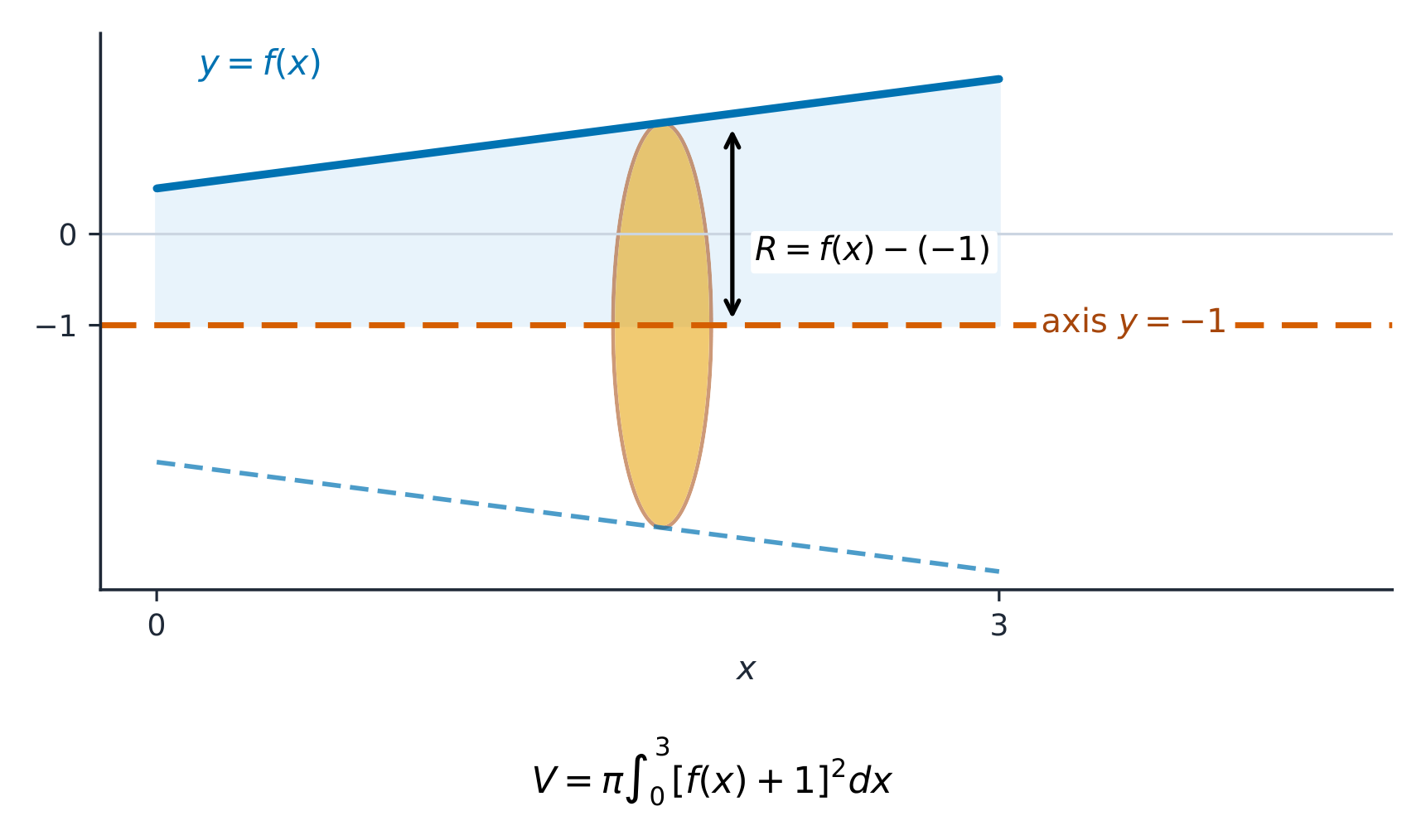
Rotating about y = −1: measure the radius from the axis, R = f(x) + 1
La curva sobre un eje desplazado
y = a·x (comparison profile)
This widget shows $y=x$. For the region between this line and $y=-1$ on $[0,2]$, discs about $y=-1$ have radius $x+1$. The worked example instead uses $y=\sqrt{x}$.
A favor $f(x)\ge-1$, revolve the region between $y=f(x)$ y $y=-1$ about $y=-1$. The disc radius is...
Dificultad 1/5 · 100 monedas + un pequeño bono en el primer intento de hoy
Distance from $f(x)$ down to $y=-1$ es $f(x)-(-1)=f(x)+1$.
Revolving about $y=k$ (below the region), the radius of a curve $f(x)$ is...
Dificultad 1/5 · 100 monedas + un pequeño bono en el primer intento de hoy
Curve value minus axis value: $f(x)-k$.
Revolving about a vertical line $x=k$, the radius is the ____ distance $|g(y)-k|$.
Dificultad 1/5 · 100 monedas + un pequeño bono en el primer intento de hoy
For a vertical axis, measure horizontally.
Axis below the region
- If the axis $y=k$ is below the region, the curve is above it, so $R=f(x)-k$ (a positive gap).
- Example: revolving about $y=-1$ a curve at height $f(x)$ gives radius $R=f(x)-(-1)=f(x)+1$.
- The "$+1$" is the extra distance down to the shifted axis.
- Always draw it: the radius reaches from the curve to the axis.
If the axis $y=3$ lies por encima de the region (curve $f(x)<3$), the radius is...
Dificultad 1/5 · 100 monedas + un pequeño bono en el primer intento de hoy
Distance is axis minus curve: $3-f(x)$ (a positive gap).
Don't reuse the plain-axis radius
- The most common error is forgetting to shift: using $R=f(x)$ when the axis is $y=-1$.
- That underestimates the radius by the shift amount, giving a wrong (too small) volume.
- Rewrite the radius as (curve value) $-$ (axis value) every time the axis isn't $y=0$ or $x=0$.
- Sketching the distance segment prevents this slip.
When revolving about $y=-1$, you can still use radius $R=f(x)$.
Dificultad 1/5 · 100 monedas + un pequeño bono en el primer intento de hoy
You must shift: $R=f(x)+1$.
Revolve the region between $y=\sqrt{x}$ y $y=-1$ on $[0,4]$ about $y=-1$. Its disc radius is $\sqrt{x}+1$. What is the volume?
Dificultad 1/5 · 100 monedas + un pequeño bono en el primer intento de hoy
$\pi\int_0^4(x+2\sqrt x+1)\,dx=\pi(8+\tfrac{32}{3}+4)=\tfrac{68\pi}{3}$.
For a shifted axis, the radius is the distance from the curve to that line, e.g. $R=f(x)-k$ for $y=k$ — not just $f(x)$. Revolving about $y=-1$ makes the radius larger (add $1$); about $y=3$ above the region makes it $3-f(x)$. Always measure to the correct axis before squaring.
Revolve the region between $y=\sqrt x$ and the line $y=-1$ on $[0,4]$ about $y=-1$. (The region reaches down to the axis, so each slice sweeps a solid disc — no hole.)
- Radius reaches from the curve down to $y=-1$: $R(x)=\sqrt x-(-1)=\sqrt x+1$.
- $V=\pi\displaystyle\int_0^4 (\sqrt x+1)^2\,dx=\pi\int_0^4 \big(x+2\sqrt x+1\big)\,dx$.
- $=\pi\Big[\tfrac{x^2}{2}+\tfrac{4}{3}x^{3/2}+x\Big]_0^4=\pi\big(8+\tfrac{32}{3}+4\big)=\tfrac{68\pi}{3}$.
When the region reaches the rotation axis, the disc method about a shifted axis keeps $V=\pi\int R^2$, but the radius is the distance from the curve to that line: $R=f(x)-k$ for $y=k$, or $g(y)-k$ for $x=k$. Adjust $R$ for the shift (an axis below the region adds to the radius); never reuse the plain-axis radius.
Write from a shifted radius
- A curve is y = x on [0, 2].
- The region between this curve and y = -1 is revolved about y = -1, so the slices have no hole.
What is the radius of a disc?
Distance to y = -1 is the function value plus 1.
Revolve the region between $y=x$ y $y=-1$ on $[0,2]$ about $y=-1$. What is the disc radius?
Dificultad 1/5 · 100 monedas + un pequeño bono en el primer intento de hoy
The axis is one unit below the origin line.