Skip to content

IGCSE Physics · November 2023 · Paper 31 · Difficulty 3 · Standard

Question 10

10

A nucleus of an isotope of actinium contains 89 protons and 136 neutrons. The chemical symbol for actinium is Ac.

(a)
(i)

Complete the nuclide notation for this isotope of actinium.

$$^{\text{.........}}_{\text{.........}}\text{Ac}$$

[1]

(ii)

State the number of electrons orbiting the nucleus of a neutral atom of this isotope.

number of electrons = [1]

(b)

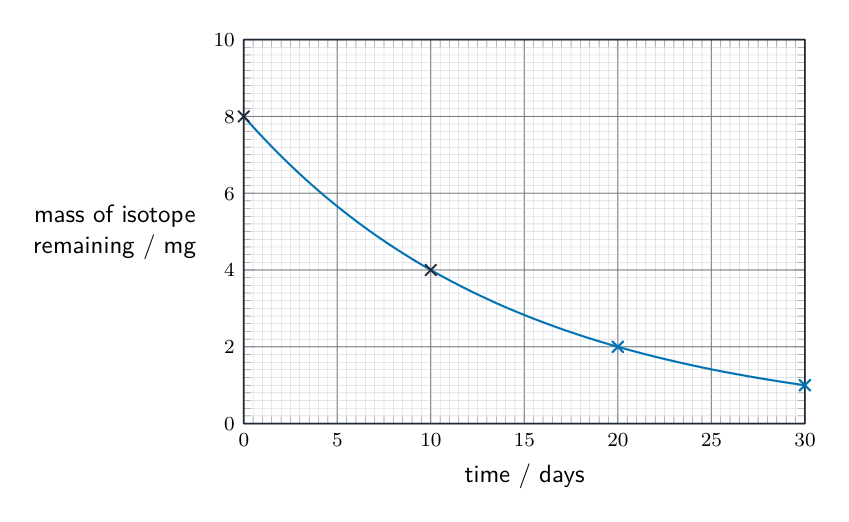
A sample contains $8.0\text{ mg}$ of this isotope of actinium.

The isotope of actinium has a half-life of 10.0 days.

The graph in Fig. 10.1 shows the original mass of the actinium in the sample and its mass after 10 days.

On Fig. 10.1, plot two more points for the mass remaining after 20 days and 30 days. Draw the decay curve for the sample over 30 days.

[3]

[Total: 5]
Show the mark scheme

These are the official mark-scheme rows. Each point that matches your answer earns a mark.

Tap the mark scheme to open it full size.

Show a worked answer

How to reach each mark, step by step. Try the question yourself first.

10(a)(i)

  • The nucleon number is $89+136=225$; the proton number is $89$.
  • The notation is ${}^{\mathbf{225}}_{\mathbf{89}}\mathrm{Ac}$.

10(a)(ii)

  • A neutral atom has as many electrons as protons, so it has $\mathbf{89}$ electrons.

10(b)

  • The mass halves every $10.0\,\mathrm{days}$, so plot $(20\,\mathrm{days}, 2.0\,\mathrm{mg})$ and $(30\,\mathrm{days}, 1.0\,\mathrm{mg})$.
  • Join the points with a smooth decay curve.
Worked answer drawing
Original question

Log in or create account

IGCSE, A-Level & AP