Skip to content

IGCSE Physics · November 2023 · Paper 31 · Difficulty 3 · Standard

Question 9

9

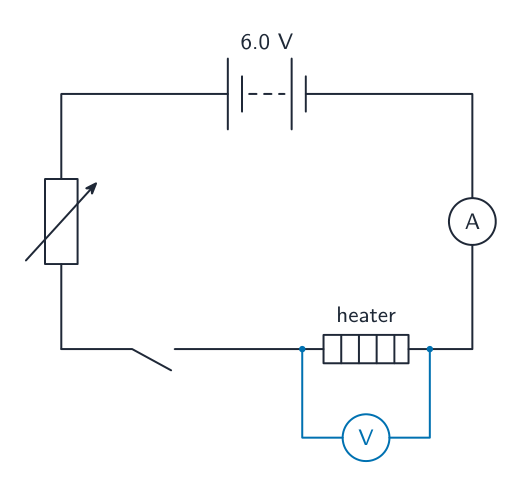
A student investigates an electric circuit. Fig. 9.1 shows the student’s circuit.

(a)
(i)

Describe the purpose of the variable resistor in Fig. 9.1.

[1]

(ii)

The student uses cells with an electromotive force (e.m.f.) of 1.5V.

Determine the number of cells needed for the 6.0V battery in Fig. 9.1.

number of cells needed = [1]

(iii)

The student connects another component to measure the potential difference (p.d.) across the heater.

On Fig. 9.1, draw the electrical symbol and connections for this component.[2]

(b)

The p.d. across the heater is 4.0V. The current in the heater is 1.6A.

Calculate the energy transferred electrically by the heater in 40s.

energy transferred = J[3]

[Total: 7]
Show the mark scheme

These are the official mark-scheme rows. Each point that matches your answer earns a mark.

Tap the mark scheme to open it full size.

Show a worked answer

How to reach each mark, step by step. Try the question yourself first.

9(a)(i)

  • The variable resistor is used to control the current in the heater.

9(a)(ii)

  • For cells in series, $n=V_{\mathrm{battery}}/V_{\mathrm{cell}}$.
  • $n=\frac{6.0\,\mathrm{V}}{1.5\,\mathrm{V}}=\mathbf{4}$ cells.

9(a)(iii)

  • Draw the voltmeter symbol, a circle containing V, connected in parallel across the heater.
Worked answer drawing

9(b)

  • Use $E = IVt$ for electrical energy transferred.
  • $E = (1.6\,\mathrm{A})(4.0\,\mathrm{V})(40\,\mathrm{s}) = 256\,\mathrm{J} = \mathbf{260}\,\mathrm{J}$.
Original question

Log in or create account

IGCSE, A-Level & AP