Skip to content

IGCSE Physics · November 2023 · Paper 31 · Difficulty 3 · Standard

Question 11

11

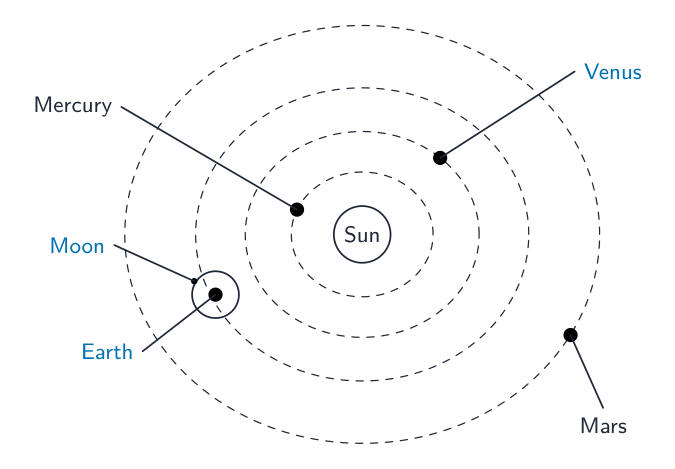
Fig. 11.1 represents the Sun and part of the Solar System.

(a)

Complete the labels on Fig. 11.1 by writing on the dotted lines.[3]

(b)

Complete the sentences about the Sun.

The Sun consists mostly of the elements and

Most of the Sun’s energy is radiated in the infrared,

and regions of the electromagnetic spectrum.[4]

(c)

Give an estimate for the diameter of the Milky Way galaxy.

diameter = light-years[1]
Show the mark scheme

These are the official mark-scheme rows. Each point that matches your answer earns a mark.

Tap the mark scheme to open it full size.

Show a worked answer

How to reach each mark, step by step. Try the question yourself first.

11(a)

  • Label the planet between Mercury and Earth Venus.
  • Label the planet next to Mars Earth, and its natural satellite the Moon.
Worked answer drawing

11(b)

  • The Sun consists mostly of hydrogen and helium.
  • It radiates most of its energy as infrared, visible light and ultraviolet.

11(c)

  • The Milky Way is about $\mathbf{100000}$ light-years across.
Original question

Log in or create account

IGCSE, A-Level & AP