In this experiment, you will investigate how the volume of water affects the rate at which hot water in a beaker cools.
Refer to Fig. 2.1.

Pour 200 cm$^{3}$ of hot water into the beaker. Use the graduations on the beaker as a guide. Place the thermometer in the water.
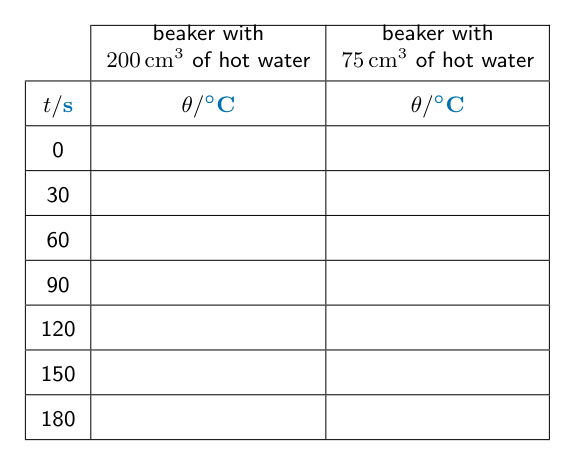
In the first row of Table 2.1, record the temperature $\theta$ of the water at time $t = 0$ and immediately start the stop-watch.
Record the temperature $\theta$ of the water at times $t = 30\text{s}$, $60\text{s}$, $90\text{s}$, $120\text{s}$, $150\text{s}$ and $180\text{s}$.
Remove the thermometer from the beaker and pour out the water.[1]
Repeat (a), using only 75 cm$^{3}$ of hot water.[2]
Add units to the column headings in Table 2.1.
| beaker with 200 cm$^{3}$ of hot water | beaker with 75 cm$^{3}$ of hot water | |
| $t$ / | $\theta$ / | $\theta$ / |
| 0 | ||
| 30 | ||
| 60 | ||
| 90 | ||
| 120 | ||
| 150 | ||
| 180 |
[1]
Write a conclusion stating how the volume of hot water affects the rate of cooling of the water. Justify your answer by reference to your results.[2]
Using your values for 75 cm$^{3}$ of water, calculate the average cooling rate $x_{1}$ for the first 90 s of the experiment. Use your readings from Table 2.1 and the equation $x_{1} = \frac{\theta_{0} - \theta_{90}}{T}$ where $T = 90\text{s}$ and $\theta_{0}$ and $\theta_{90}$ are the temperatures at $t = 0$ and $t = 90\text{s}$. Include the unit for the cooling rate.[2]
Using your values for 75 cm$^{3}$ of water, calculate the average cooling rate $x_{2}$ for the last 90 s of the experiment. Use your readings from Table 2.1 and the equation $x_{2} = \frac{\theta_{90} - \theta_{180}}{T}$ where $T = 90\text{s}$ and $\theta_{90}$ and $\theta_{180}$ are the temperatures at $t = 90\text{s}$ and $t = 180\text{s}$.[1]
A student states that it is important to start the two experiments in (a) and (b) with water at the same initial temperature. Explain whether your values for $x_{1}$ and $x_{2}$ support this statement.[1]
Another student repeats the experiment. State one variable, other than initial water temperature, that she should control to obtain readings that are as close as possible to those in Table 2.1.[1]