سيارة تتوقف في حادث. مع وسادة هوائية، يخرج السائق حياً. بدونها، لا يفعل ذلك. في الحالتين، التغير في كمية الحركة هو نفسه تماماً — من كامل…
English narration · English + 中文 subtitles burned in · سرد باللغة الإنجليزية · ترجمة مدمجة بالإنجليزية + الصينية
4.1
Linear Momentum · الزخم الخطي
Syllabus · المنهج
English
Learning Objective 4.1.A: Describe the linear momentum of an object or system.
4.1.A.1 Linear momentum is defined by the equation $\vec{p} = m\vec{v}$.
4.1.A.2 Momentum is a vector quantity and has the same direction as the velocity.
4.1.A.3 Momentum can be used to analyze collisions and explosions.
4.1.A.3.i A collision is a model for an interaction where the forces exerted between the involved objects in the system are much larger than the net external force exerted on those objects during the interaction.
4.1.A.3.ii As only the initial and final states of a collision are analyzed, the object model may be used to analyze collisions.
4.1.A.3.iii An explosion is a model for an interaction in which forces internal to the system move objects within that system apart.
4.1.A.3 يمكن استخدام الزخم لتحليل الاصطدامات والانفجارات.
4.1.A.3.i الاصطدام هو نموذج لتفاعل تكون فيه القوى المؤثرة بين الأجسام المشاركة في النظام أكبر بكثير من محصلة القوى الخارجية المؤثرة على تلك الأجسام أثناء التفاعل.
4.1.A.3.ii بما أنه يتم تحليل حالة البداية والنهاية فقط للاصطدام، يمكن استخدام نموذج الجسم النقطي لتحليل الاصطدامات.
4.1.A.3.iii الانفجار هو نموذج لتفاعل تتحرك فيه القوى الداخلية للنظام الأجسام الموجودة داخله مبتعدة عن بعضها البعض.
Source: College Board AP Course and Exam Description · المصدر: وصف دورة وامتحان College Board AP
English
Linear momentum 动量 is mass times velocity:
$$\vec{p}=m\vec{v}.$$
It is a vector 矢量 pointing along the velocity, and it is the quantity for analysing collisions 碰撞 and explosions 爆炸. A collection of objects can be treated as one system moving with the velocity of its center of mass 质心:
4.2.A.3 Impulse is a vector quantity and has the same direction as the net force exerted on the system.
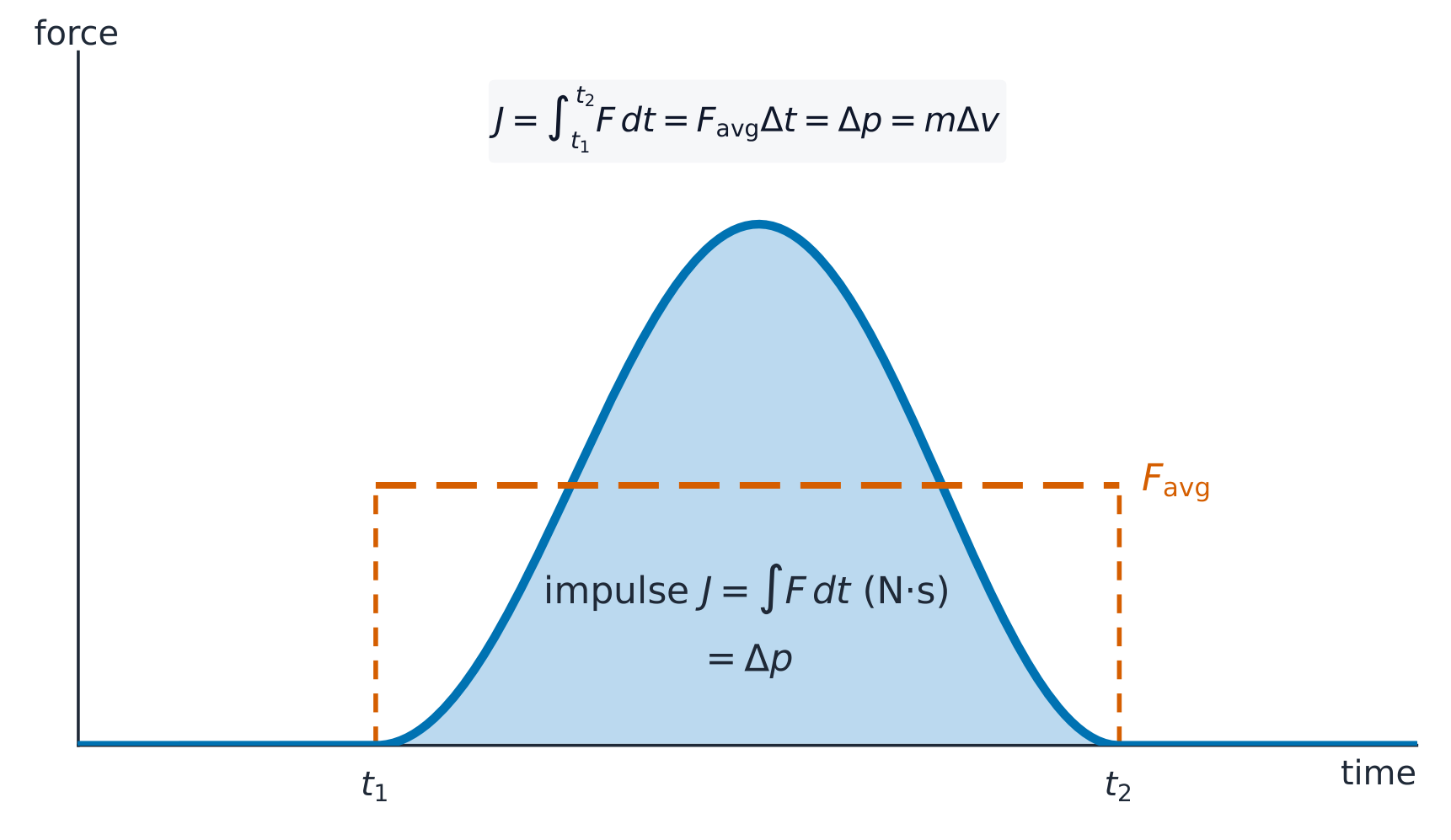
4.2.A.4 The impulse delivered to a system by a net external force is equal to the area under the curve of a graph of the net external force exerted on the system as a function of time.
4.2.A.5 The net external force exerted on a system is equal to the slope of a graph of the momentum of the system as a function of time.
Learning Objective 4.2.B: Describe the relationship between the impulse exerted on an object or system and the change in momentum of the object or system.
4.2.B.1 Change in momentum is the difference between a system's final momentum and its initial momentum.
Equation:$\Delta\vec{p} = \vec{p} - \vec{p}_0$
4.2.B.2 The impulse–momentum theorem relates the impulse delivered to an object and the object's change in momentum.
4.2.B.2.i The impulse exerted on an object is equal to the object's change in momentum.
4.2.B.2.iii The impulse–momentum theorem also describes the behavior of a system in which the velocity is constant but the mass changes with respect to time.
Source: College Board AP Course and Exam Description · المصدر: وصف دورة وامتحان College Board AP
English
Newton's second law is really a statement about momentum:
$$\vec{F}_{\text{net}}=\frac{d\vec{p}}{dt},$$
which reduces to $m\vec{a}$ when the mass is constant – and handles a changing mass when it is not (the special case $\vec{F}=\dfrac{dm}{dt}\vec{v}$ holds only when the velocity is constant, e.g. a chain piling onto a scale or sand landing on a belt moving at fixed speed; a rocket does not fit, since it accelerates). The impulse 冲量 delivered by a force is its time integral, and the impulse–momentum theorem 冲量-动量定理 says it equals the change in momentum:
Impulse is a vector along the net force. Read it off graphs both ways:
On a force–time graph, impulse is the area under the curve.
On a momentum–time graph, the net force is the slope 斜率 at each instant.
Spreading the same $\Delta p$ over a longer time lowers the force – that is why airbags, crumple zones, and soft landings work, and why you bend your knees when you land.
Worked example. A time-varying force $F(t)=10t\ \text{N}$ acts on a $2.0\ \text{kg}$ object for $2.0\ \text{s}$. The impulse is $J=\displaystyle\int_0^2 10t\,dt=\big[5t^2\big]_0^2=20\ \text{N}\cdot\text{s}$, so the speed changes by $\Delta v=J/m=10\ \text{m/s}$.
العربية
قانون نيوتن الثاني هو في الواقع بيان حول كمية التحرك:
$$\vec{F}_{\text{net}}=\frac{d\vec{p}}{dt},$$
والتي تختزل إلى $m\vec{a}$ عندما تكون الكتلة ثابتة – وتتعامل مع تغير الكتلة عندما لا تكون ثابتة (الحالة الخاصة $\vec{F}=\dfrac{dm}{dt}\vec{v}$ صحيحة فقط عندما تكون السرعة ثابتة، مثل سلسلة تتراكم على ميزان أو رمل يسقط على حزام يتحرك بسرعة ثابتة؛ الصاروخ لا ينطبق عليه هذا لأن تسارعه). الدفع الذي تقدمه قوة هو تكاملها الزمني، ومبرهنة الدفع-كمية التحرك تقول إنه يساوي التغير في كمية التحرك:
الدفع هو متجه في اتجاه محصلة القوى. اقرؤه من الرسوم البيانية بطريقتين:
على الرسم البياني للقوة-الزمن، الدفع هو المساحة تحت المنحنى.
على الرسم البياني لكمية التحرك-الزمن، القوة المحصلة هي الميل عند كل لحظة.
الدفع هو المساحة تحت منحنى القوة–الزمن، مساوية لمتوسط القوة مضروبًا في زمن التلامس
توزيع نفس $\Delta p$ على فترة زمنية أطول يقلل القوة – وهذا هو سبب عمل وسائد الهواء، ومناطق الاندماج، والهبوط الناعم، ولماذا نثني ركبينا عند الهبوط.
مثال محلول. قوة متغيرة مع الزمن $F(t)=10t\ \text{N}$ تؤثر على جسم كتلته $2.0\ \text{kg}$ لمدة $2.0\ \text{s}$. الدفع هو $J=\displaystyle\int_0^2 10t\,dt=\big[5t^2\big]_0^2=20\ \text{N}\cdot\text{s}$، لذا تتغير السرعة بمقدار $\Delta v=J/m=10\ \text{m/s}$.
4.3.A.1.ii The velocity of a system's center of mass is constant in the absence of a net external force.
4.3.A.2 The total momentum of a system is the sum of the momenta of the system's constituent parts.
4.3.A.3 In the absence of net external forces, any change to the momentum of an object within a system must be balanced by an equivalent and opposite change of momentum elsewhere within the system. Any change to the momentum of a system is due to a transfer of momentum between the system and its surroundings.
4.3.A.3.i The impulse exerted by one object on a second object is equal and opposite to the impulse exerted by the second object on the first. This is a direct result of Newton's third law.
4.3.A.3.ii A system may be selected so that the total momentum of that system is constant.
4.3.A.3.iii If the total momentum of a system changes, that change will be equivalent to the impulse exerted on the system.
Equation:$\vec{J} = \Delta\vec{p}$
4.3.A.4 Correct application of conservation of momentum can be used to determine the velocity of a system immediately before and immediately after collisions or explosions.
Boundary statement: AP Physics C: Mechanics only expects students to quantitatively analyze collisions and interactions in one or two dimensions. Three-dimensional collisions may be analyzed qualitatively.
4.3.B
Describe how the selection of a system determines whether the momentum of that system changes.
4.3.B.1 Momentum is conserved in all interactions.
4.3.B.2 If the net external force on the selected system is zero, the total momentum of the system is constant.
4.3.B.3 If the net external force on the selected system is nonzero, momentum is transferred between the system and the environment.
Source: College Board AP Course and Exam Description · المصدر: وصف دورة وامتحان College Board AP
English
Internal forces come in Newton's-third-law pairs, so they cancel inside any system: they can shuffle momentum between parts but never change the total. Momentum only enters or leaves a system through a net external force ($\vec{J}=\Delta\vec{p}$). So, with zero net external force, total momentum is conserved 守恒:
Momentum is conserved in every collision, however violent – choose the system large enough that the collision forces are internal. Apply conservation separately along each axis; AP asks for quantitative work in one or two dimensions.
Worked example (explosion). A $6.0\ \text{kg}$ shell at rest splits into a $2.0\ \text{kg}$ piece moving at $9.0\ \text{m/s}$ east and a $4.0\ \text{kg}$ piece. Total momentum stays zero, so the heavy piece moves west at $v=\dfrac{2.0(9.0)}{4.0}=4.5\ \text{m/s}$. The kinetic energy came from stored (chemical or spring) energy – momentum conservation does not require kinetic-energy conservation.
العربية
القوى الداخلية تأتي في أزواج قانون نيوتن الثالث، لذا تلغي بعضها داخل أي نظام: يمكنها تغيير كمية التحرك بين الأجزاء لكنها لا تغير الكمية الكلية. لا تدخل كمية التحرك النظام ولا تتركه إلا عبر قوة خارجية محصلة ($\vec{J}=\Delta\vec{p}$). لذا، مع عدم وجود قوة خارجية محصلة، تكون كمية التحرك الكلية محفوظة:
كمية التحرك محفوظة في كل تصادم، بغض عن عنفه – اختر نظامًا كبيرًا بما يكفي لتكون قوى التصادم داخلية. طبق الحفظ بشكل منفصل على كل محور؛ يطلب امتحان AP عملاً كمياً بعدد واحد أو اثنين من الأبعاد.
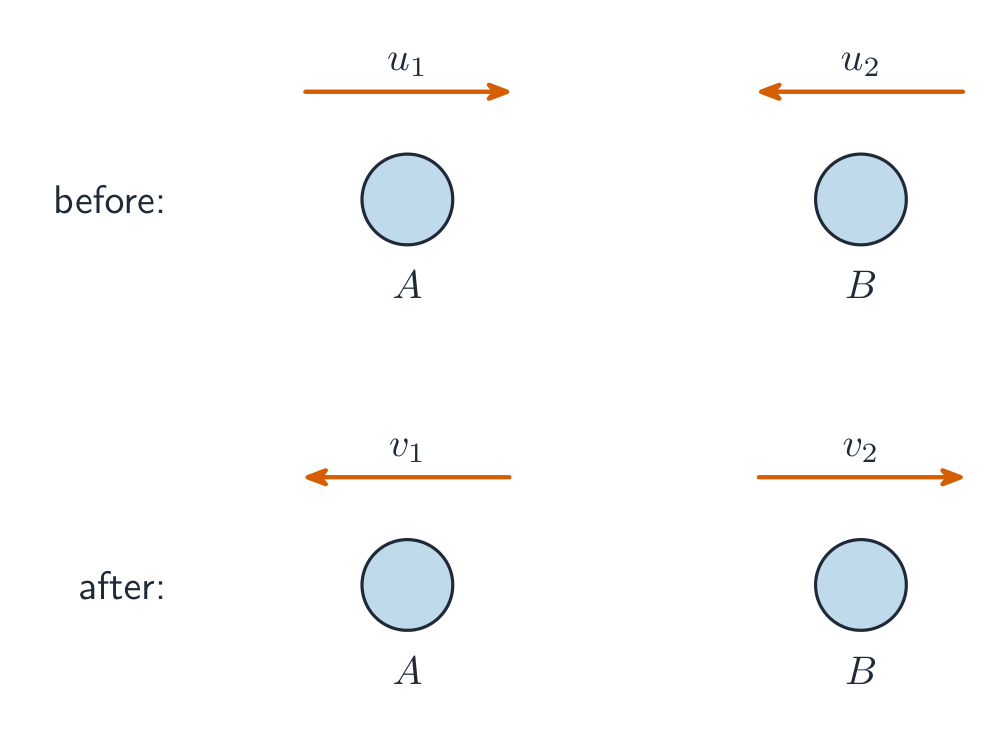
اصطدام أمامي: الزخم الكلي قبل الاصطدام يساوي الزخم الكلي بعده
مثال محلول (انفجار). قذيفة كتلتها $6.0\ \text{kg}$ كانت ساكنة تنقسم إلى قطعة كتلتها $2.0\ \text{kg}$ تتحرك بسرعة $9.0\ \text{m/s}$ نحو الشرق وقطعة كتلتها $4.0\ \text{kg}$. يبقى الزخم الكلي صفراً، لذا تتحرك القطعة الثقيلة غرباً بسرعة $v=\dfrac{2.0(9.0)}{4.0}=4.5\ \text{m/s}$. جاءت الطاقة الحركية من طاقة مخزنة (كيميائية أو زنبركية) – حفظ الزخم لا يتطلب حفظ الطاقة الحركية.
Explore · استكشف
Collide two carts and conserve momentum · اصطدم بعربة أخرى واحفظ الزخم
In any collision the total momentum$\sum mv$ before equals the total after. Set the masses and speeds and check the momentum bookkeeping. · في أي تصادم، يكون الزخم الكلي$\sum mv$ قبل التصادم مساويًا له بعد التصادم. حدد الكتل والسرعات وتحقق من حسابات الزخم.
4.4
Elastic and Inelastic Collisions · التصادمات المرنة وغير المرنة
Syllabus · المنهج
English
Learning Objective 4.4.A: Describe whether an interaction between objects is elastic or inelastic.
4.4.A.1 An elastic collision between objects is one in which the initial kinetic energy of the system is equal to the final kinetic energy of the system.
4.4.A.2 In an elastic collision, the final kinetic energies of each of the objects within the system may be different from their initial kinetic energies.
4.4.A.3 An inelastic collision between objects is one in which the total kinetic energy of the system decreases.
4.4.A.4 In an inelastic collision, some of the initial kinetic energy is not restored to kinetic energy but is transformed by nonconservative forces into other forms of energy.
4.4.A.5 In a perfectly inelastic collision, the objects stick together and move with the same velocity after the collision.
العربية
الهدف التعليمي 4.4.A: صف ما إذا كان التفاعل بين الأجسام مرناً أم غير مرن.
4.4.A.1 التصادم المرن بين الأجسام هو الذي تكون فيه الطاقة الحركية الأولية للنظام مساوية للطاقة الحركية النهائية للنظام.
4.4.A.2 في التصادم المرن، قد تختلف الطاقة الحركية النهائية لكل من الأجسام داخل النظام عن طاقتها الحركية الأولية.
4.4.A.3 التصادم غير المرن بين الأجسام هو الذي تنخفض فيه الطاقة الحركية الكلية للنظام.
4.4.A.4 في التصادم غير المرن، لا تُستعاد بعض الطاقة الحركية الأولية كطاقة حركية، بل تتحول بواسطة قوى غير محتفظة إلى أشكال أخرى من الطاقة.
4.4.A.5 في التصادم غير المرن تماماً، تتصل الأجسام ببعضها وتتحرك بنفس السرعة بعد التصادم.
Source: College Board AP Course and Exam Description · المصدر: وصف دورة وامتحان College Board AP
English
Conservation of momentum in a collision
All collisions conserve momentum; they differ in what happens to the kinetic energy 动能:
type
momentum
kinetic energy
elastic collision 弹性碰撞
conserved
total conserved (individual shares may change)
inelastic collision 非弹性碰撞
conserved
decreases – some becomes heat, sound, deformation 形变
perfectly inelastic collision 完全非弹性碰撞
conserved
largest possible loss – the objects stick and share one velocity
Strategy: always write momentum conservation first; add the kinetic-energy equation only when the problem says "elastic". Two useful elastic facts: equal masses in a 1D elastic collision simply exchange velocities, and in the center-of-mass frame each object just reverses its velocity.
Worked example. A $1000\ \text{kg}$ car at $20\ \text{m/s}$ strikes a stationary $1500\ \text{kg}$ car and they lock together – perfectly inelastic. Momentum: $v=\dfrac{1000(20)}{2500}=8.0\ \text{m/s}$. Kinetic energy falls from $2.0\times10^5\ \text{J}$ to $\tfrac12(2500)(8.0)^2=8.0\times10^4\ \text{J}$: about $60\%$ is lost, even though momentum is exactly conserved.
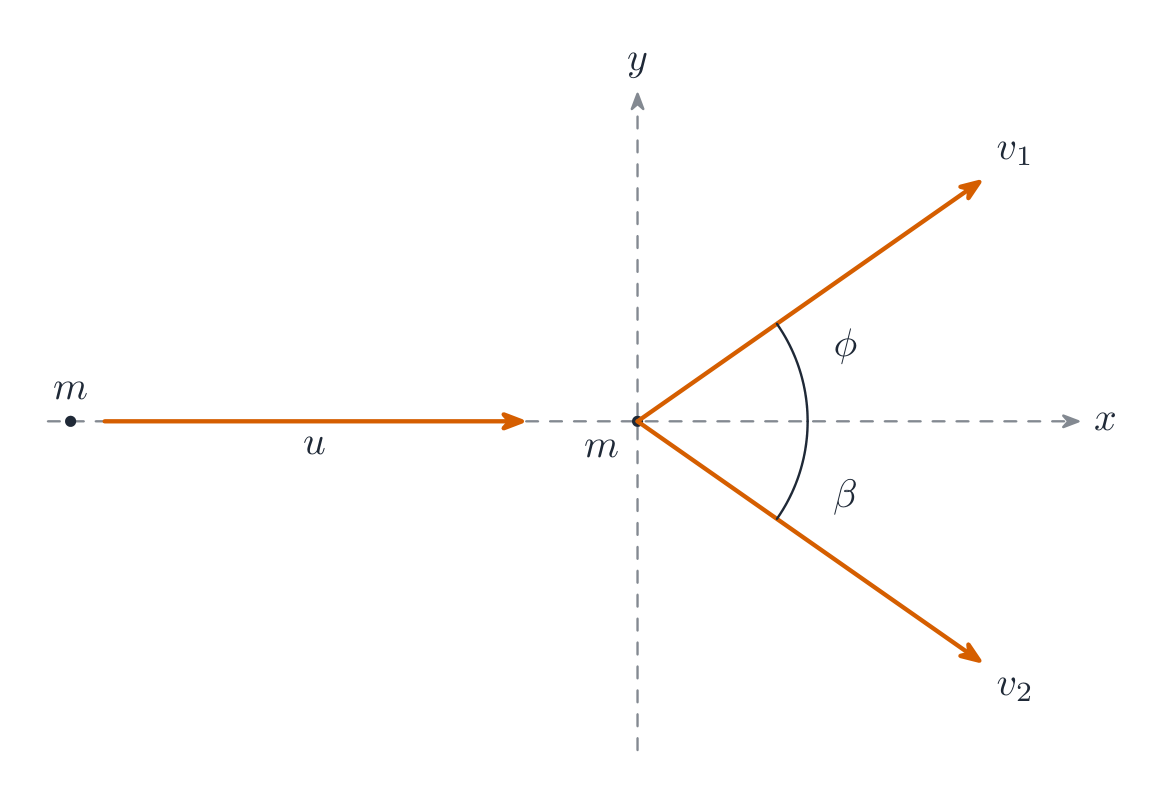
Worked example (2D). A puck moving east at $4.0\ \text{m/s}$ strikes an identical puck at rest; after the glancing hit, one moves at $2.0\ \text{m/s}$ at $60^\circ$ north of east. Conserve each axis: east–west, $m(4.0)=m(2.0)\cos60^\circ+mv_x$, so $v_x=3.0\ \text{m/s}$; north–south, $0=m(2.0)\sin60^\circ-mv_y$, so $v_y=1.7\ \text{m/s}$. The second puck moves at $\sqrt{3.0^2+1.7^2}=3.5\ \text{m/s}$, about $30^\circ$ south of east.
Exam skill. On FRQs, justify with the condition, not the slogan: "the net external force on the two-puck system is zero during the collision, so its total momentum is constant." If asked whether the collision is elastic, compute the kinetic energy before and after and compare – never assume.
العربية
حفظ الزخم في اصطدام
جميع التصادمات تحفظ كمية التحرك؛ تختلف فيما يحدث لـ الطاقة الحركية:
النوع
كمية التحرك
الطاقة الحركية
تصادم مرن
محفوظة
محفوظة كلياً (قد تتغير الحصص الفردية)
تصادم غير مرن
محفوظة
تنخفض – جزء منها يتحول إلى حرارة وصوت وتشوه
تصادم غير مرن تماماً
محفوظة
أكبر خسارة ممكنة – تتشبث الأجسام وتشترك في سرعة واحدة
استراتيجية: اكتب دائمًا معادلة حفظ العزم؛ أضف معادلة الطاقة الحركية فقط عندما تقول المسألة "مرن". حقيتان مفيدتان عن التصادمات المرنة: كتلتان متساويتان في تصادم مرن 1D تبدلان سرعاتهما ببساطة، وفي إطار مركز الكتلة كل جسم يعكس سرعته فقط.
مثال محلول. سيارة وزنها $1000\ \text{kg}$ تتحرك بسرعة $20\ \text{m/s}$ تصدم سيارة ساكنة وزنها $1500\ \text{kg}$ وتتشبكان – تصادم غير مرن تماماً. كمية التحرك: $v=\dfrac{1000(20)}{2500}=8.0\ \text{m/s}$. تنخفض الطاقة الحركية من $2.0\times10^5\ \text{J}$ إلى $\tfrac12(2500)(8.0)^2=8.0\times10^4\ \text{J}$: حوالي $60\%$ مفقودة، رغم أن كمية التحرك محفوظة بدقة.
مثال محلول (2D). قرص يتحرك نحو الشرق بسرعة $4.0\ \text{m/s}$ يصطدم بقرص مماثل في السكون؛ بعد الاصطدام المائل، يتحرك أحدهما بسرعة $2.0\ \text{m/s}$ بزاوية $60^\circ$ شمالًا من الشرق. نحفظ المحور لكل محور: شرق-غرب، $m(4.0)=m(2.0)\cos60^\circ+mv_x$، إذن $v_x=3.0\ \text{m/s}$؛ شمال-جنوب، $0=m(2.0)\sin60^\circ-mv_y$، إذن $v_y=1.7\ \text{m/s}$. يتحرك القرص الثاني بسرعة $\sqrt{3.0^2+1.7^2}=3.5\ \text{m/s}$، تقريبًا $30^\circ$ جنوبًا من الشرق.
تصادم جانبي، مُحلّل على طول محورين متعامدين
مهارة الامتحان. في الأسئلة المقالية (FRQs)، برر باستخدام الشرط، لا الشعار: "القوة الخارجية المحصلة على نظام القرصين تساوي صفرًا أثناء الاصطدام، لذا فإن زخمه الكلي ثابت." إذا سُئل عما إذا كان الاصطدام مرناً، احسب الطاقة الحركية قبل وبعد الاصطدام وقارن بينهما – ولا تفترض ذلك أبدًا.
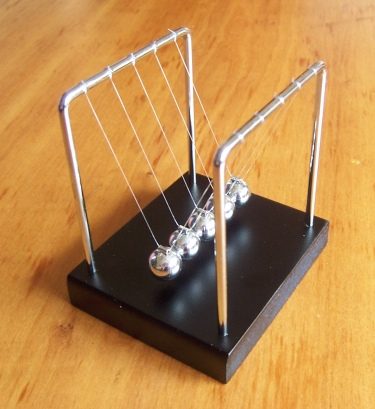
يعرض مجسم نيوتن مرور الزخم والطاقة الحركية خلال اصطدام شبه مرن
Explore · استكشف
Compare elastic and inelastic collisions · قارن بين التصادم المرن وغير المرن
Momentum is always conserved, but kinetic energy is only conserved in an elastic collision. In an inelastic one the carts stick and some energy becomes heat. · يُحفظ الزخم دائمًا، لكن الطاقة الحركية تُحفظ فقط في التصادم المرن. أما في التصادم غير المرن، فتلتصق العربات ببعضها وتتحول بعض الطاقة إلى حرارة.
4.4
Exam tips · نصائح للامتحان
English
Impulse equals the momentum change: $\vec J=\int \vec F\,dt=\Delta\vec p$, and it is the area under a force–time graph.
Momentum is conserved whenever the net external force is zero — always the go-to for collisions.
Distinguish elastic (kinetic energy conserved) from inelastic (kinetic energy decreases) collisions; in a perfectly inelastic collision the objects stick and move with one velocity.
Apply conservation to each component (x and y) separately in 2-D.
Connect to center of mass: total momentum $=M\vec v_{cm}$.
العربية
الاندفاع يساوي التغير في الزخم: $\vec J=\int \vec F\,dt=\Delta\vec p$، وهو المساحة تحت منحنى القوة–الزمن.
يُحفظ الزخم كلما كانت القوة الخارجية المحصلة تساوي صفراً – وهي دائماً الحل الأمثل للاصطدامات.
ميّز بين الاصطدامات المرونة (حيث تُحفظ الطاقة الحركية) والاصطدامات غير المرنة (حيث تنخفض الطاقة الحركية)؛ وفي الاصطدام غير المرن تماماً تلتصق الأجسام وتتحرك بسرعة واحدة.
طبق مبدأ الحفظ على كل مركبة (x و y) بشكل منفصل في 2-D.
ربط مركز الكتلة: الزخم الكلي $=M\vec v_{cm}$.
Interactive lessons on this topic · دروس تفاعلية حول هذا الموضوع
Work through it step by step, with instant-check exercises. · ا-working عليه خطوة بخطوة، مع تمارين تحقق فوري.
Pick one and the site follows you — notes, papers, videos and practice all open on it. · اختر واحدًا وسيتبعك الموقع — الملاحظات، الأوراق، الفيديوهات والتدريب جميعها تفتح عليه.
Type to search notes, lessons, code, vocabulary and past-paper questions across every subject. · اكتب للبحث عن ملاحظات، دروس، أكواد، مفردات وأسئلة امتحانات سابقة عبر جميع المواد.