كتلة تنزلق وتضغط ناباً حتى تتوقف. كم مسافة يضغط الناب؟ جرب ذلك بمعادلة كينماتيكية. لا يمكنك — لأن القوة تزداد…
English narration · English + 中文 subtitles burned in · سرد باللغة الإنجليزية · ترجمة مدمجة بالإنجليزية + الصينية
3.1
Translational Kinetic Energy · الطاقة الحركية الانتقالية
Syllabus · المنهج
English
Learning Objective 3.1.A: Describe the translational kinetic energy of an object in terms of the object's mass and velocity.
3.1.A.1 An object's translational kinetic energy is given by the equation
Equation:$K = \dfrac{1}{2}mv^2$
3.1.A.2 Translational kinetic energy is a scalar quantity.
3.1.A.3 Different observers may measure different values of the translational kinetic energy of an object, depending on the observer's frame of reference.
العربية
هدف التعلم 3.1.A: وصف الطاقة الحركية الانتقالية لجسم ما بدلالة كتلة الجسم وسرعته.
3.1.A.1 تُعطى الطاقة الحركية الانتقالية لجسم ما بالمعادلة
المعادلة:$K = \dfrac{1}{2}mv^2$
3.1.A.2 الطاقة الحركية الانتقالية هي كمية قياسية.
3.1.A.3 قد يقيس المراقبون المختلفون قيمًا مختلفة للطاقة الحركية الانتقالية لجسم ما، اعتمادًا على إطار مرجع المراقب.
Source: College Board AP Course and Exam Description · المصدر: وصف دورة وامتحان College Board AP
English
Kinetic energy 动能 is the energy of motion, a scalar 标量 measured in joules 焦耳 (J):
$$K=\tfrac{1}{2}mv^2.$$
It grows with the square of speed – doubling the speed quadruples $K$. One subtlety worth knowing: kinetic energy depends on the observer's reference frame 参考系. A passenger walking down a train has a small $K$ measured inside the train and a huge one measured from the ground – both observers are right, each in their own frame.
العربية
الطاقة الحركية هي طاقة الحركة، وهي كمية قياسية تقاس بـ الجول (J):
$$K=\tfrac{1}{2}mv^2.$$
إنها تزداد مع مربع السرعة – مضاعفة السرعة تضاعف $K$ أربع مرات. تفصيل دقيق يستحق المعرفة: الطاقة الحركية تعتمد على الإطار المرجعي للمراقب. راكب يمشي داخل قطار لديه طاقة حركية صغيرة $K$ مقاسة داخل القطار وطاقة هائلة مقاسة من الأرض – كلا المراقبين صحيحان، كل منهما في إطاره الخاص.
3.2
Work · العمل
Syllabus · المنهج
English
Learning Objective 3.2.A: Describe the work done on an object or system by a given force or collection of forces.
3.2.A.1 Work is the amount of energy transferred into or out of a system by a force exerted on that system over a distance.
3.2.A.1.i The work done by a conservative force exerted on a system is path-independent and only depends on the initial and final configurations of that system.
3.2.A.1.ii The work done by a conservative force on a system—or the change in the potential energy of the system—will be zero if the system returns to its initial configuration.
3.2.A.1.iii Potential energies are associated only with conservative forces.
3.2.A.1.iv The work done by a nonconservative force is path-dependent.
3.2.A.1.v The most common nonconservative forces are friction and air resistance.
3.2.A.2 Work is a scalar quantity that may be positive, negative, or zero.
3.2.A.3 The work done on an object by a variable force is calculated using
Equation:$W = \displaystyle\int_a^b \vec{F}(r) \cdot d\vec{r}$, where the integral is taken over the path from point $a$ to point $b$.
3.2.A.3.i The dot product between two vectors, $\vec{A}$ and $\vec{B}$, results in a scalar quantity of magnitude $\vec{A} \cdot \vec{B} = AB\cos\theta$.
3.2.A.3.ii Only the component of the force exerted on a system that is parallel to the displacement of the point of application of the force will change the system's total energy.
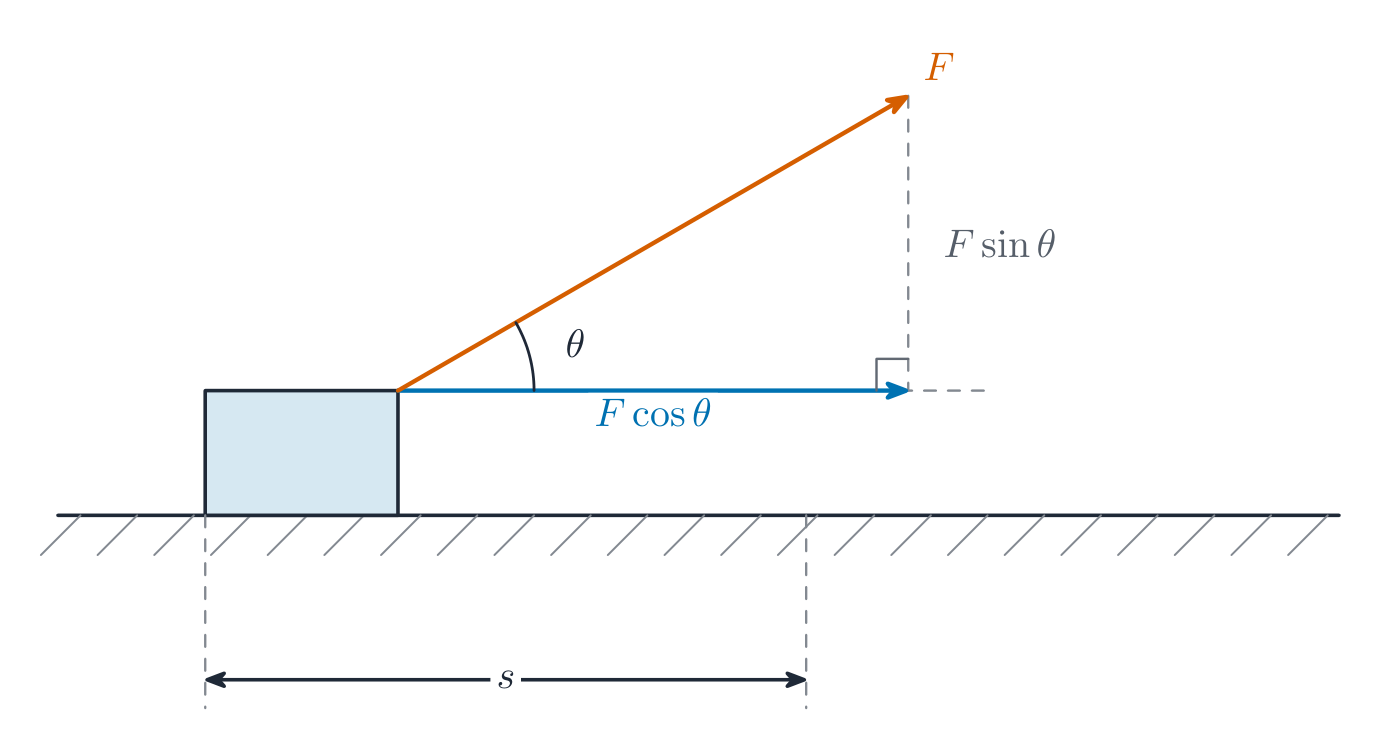
3.2.A.3.iii If the component of the force exerted on a system that is parallel to the displacement is constant, the work done on the system by the force is given by the derived equation $W = F_{\parallel}d = Fd\cos\theta$.
3.2.A.3.iv The component of the force exerted on a system perpendicular to the direction of the displacement of the system's center of mass can change the direction of the system's motion without changing the system's kinetic energy.
3.2.A.4 The work–energy theorem states that the change in an object's kinetic energy is equal to the sum of the work (net work) being done by all forces exerted on the object.
Equation:$\Delta K = \displaystyle\sum W_i = \sum F_{\parallel,i}\, d_i$
3.2.A.4.i An external force may change the configuration of a system. The component of the external force parallel to the displacement times the displacement of the point of application of the force gives the change in kinetic energy of the system.
3.2.A.4.ii If the system's center of mass and the point of application of the force move the same distance when a force is exerted on a system, then the system may be modeled as an object, and only the system's kinetic energy can change.
3.2.A.4.iii The energy dissipated by friction is typically equated to the force of friction times the length of the path over which the force is exerted.
3.2.A.5 Work is equal to the area under the curve of a graph of $F_{\parallel}$ as a function of displacement.
Boundary statement: AP Physics C: Mechanics only expects students to analyze the transfer of mechanical energy, although students should be aware that mechanical energy may be dissipated in the form of thermal energy or sound.
العربية
هدف التعلم 3.2.A: وصف الشغل المبذول على جسم أو نظام بواسطة قوة معينة أو مجموعة من القوى.
3.2.A.1 الشغل هو مقدار الطاقة المنقولة إلى داخل النظام أو خارجه بواسطة قوة تُمارَس على ذلك النظام عبر مسافة.
3.2.A.1.i الشغل المبذول بواسطة قوة محتفظة (conservative) مُمارَس على نظام يكون مستقلاً عن المسار ويعتمد فقط على التكوينات الأولية والنهائية لذلك النظام.
3.2.A.1.ii سيكون الشغل المبذول بواسطة قوة محتفظة على نظام—أو التغير في طاقة الوضع للنظام—صفرًا إذا عاد النظام إلى تكوينه الأولي.
3.2.A.1.iii ترتبط طاقات الوضع فقط بالقوى المحتفظة.
3.2.A.1.iv الشغل المبذول بواسطة قوة غير محتفظة يعتمد على المسار.
3.2.A.1.v أكثر القوى غير المحافظة شيوعاً هي الاحتكاك ومقاومة الهواء.
3.2.A.2 الشغل هو كمية قياسية قد تكون موجبة أو سالبة أو صفرية.
3.2.A.3 يُحسب الشغل المبذول على جسم بواسطة قوة متغيرة باستخدام
المعادلة:$W = \displaystyle\int_a^b \vec{F}(r) \cdot d\vec{r}$، حيث يتم إجراء التكامل على المسار من النقطة $a$ إلى النقطة $b$.
3.2.A.3.i ينتج الضرب القياسي بين متجهين، $\vec{A}$ و$\vec{B}$، كمية قياسية مقدارها $\vec{A} \cdot \vec{B} = AB\cos\theta$.
3.2.A.3.ii فقط مركبة القوة المؤثرة على نظام موازية لإزاحة نقطة تطبيق القوة هي التي تغير الطاقة الكلية للنظام.
3.2.A.3.iii إذا كانت مركبة القوة المؤثرة على نظام موازية للإزاحة ثابتة، فإن الشغل المبذول على النظام بواسطة القوة يُعطى بالمعادلة المستنتجة $W = F_{\parallel}d = Fd\cos\theta$.
3.2.A.3.iv يمكن لمركبة القوة المؤثرة على نظام عمودية على اتجاه إزاحة مركز كتلة النظام أن تغير اتجاه حركة النظام دون تغيير طاقته الحركية.
3.2.A.4 ينص مبدأ الشغل والطاقة على أن التغير في الطاقة الحركية لجسم يساوي مجموع الشغل (الشغل الصافي) الذي تبذله جميع القوى المؤثرة على الجسم.
المعادلة:$\Delta K = \displaystyle\sum W_i = \sum F_{\parallel,i}\, d_i$
3.2.A.4.i قد تغير قوة خارجية تكوين النظام. يعطي حاصل ضرب المكون من القوة الخارجية الموازي للإزاحة في إزاحة نقطة تطبيق القوة التغير في الطاقة الحركية للنظام.
3.2.A.4.ii إذا تحرك مركز كتلة النظام ونقطة تطبيق القوة نفس المسافة عند ممارسة قوة على نظام، فقد يتم نمذجة النظام كجسم واحد، ويمكن حينها أن يتغير فقط الطاقة الحركية للنظام.
3.2.A.4.iii عادةً ما يُساوى الطاقة المبددة بسبب الاحتكاك بقوة الاحتكاك مضروبة في طول المسار الذي تبذلت عليه القوة.
معادلة:$\Delta E_{\text{mech}} = F_f d\cos\theta$
3.2.A.5 الشغل يساوي المساحة تحت منحنى رسم بياني لـ $F_{\parallel}$ بدلالة الإزاحة.
بيان الحدود: يتوقع امتحان AP Physics C: Mechanics من الطلاب فقط تحليل انتقال الطاقة الميكانيكية، على الرغم من أنه يجب على الطلاب معرفة أن الطاقة الميكانيكية قد تُبدد على شكل طاقة حرارية أو صوت.
Source: College Board AP Course and Exam Description · المصدر: وصف دورة وامتحان College Board AP
English
Work 功 is energy transferred into or out of a system by a force acting over a distance. For a variable force it is an integral 积分 along the path:
For a constant force this reduces to $W=Fd\cos\theta$; on a force–position graph, work is the area under the curve. Work is a scalar with a sign, and the sign is physics, not bookkeeping:
Positive – force has a component along the motion (it speeds the object up).
Negative – force opposes the motion (friction 摩擦力 and air drag do negative work).
Zero – force perpendicular to the motion (the normal force 法向力 on a sliding block, gravity on a horizontal move, tension in a circular swing).
The work–energy theorem 动能定理 collects every force's contribution: the net work equals the change in kinetic energy,
$$W_{\text{net}}=\sum W_i=\Delta K.$$
Worked example. A variable force $F(x)=3x^2\ \text{N}$ (along the motion) acts from $x=0$ to $x=2\ \text{m}$: $W=\displaystyle\int_0^2 3x^2\,dx=\big[x^3\big]_0^2=8\ \text{J}$. Acting alone on a body starting from rest, it would raise the kinetic energy to exactly $8\ \text{J}$.
العربية
الشغل هو طاقة تنتقل إلى أو من نظام بواسطة قوة تؤثر عبر مسافة. بالنسبة لقوة متغيرة، يكون تكاملاً على طول المسار:
بالنسبة لقوة ثابتة، يتبسط هذا إلى $W=Fd\cos\theta$؛ على الرسم البياني للقوة-الموقع، الشغل هو المساحة تحت المنحنى. الشغل كمية قياسية ذات إشارة، والإشارة هنا فيزياء وليست محاسبة:
إيجابية – القوة لها مركبة على طول الحركة (تزيد سرعة الجسم).
سالبة – القوة تعاكس الحركة (الاحتكاك ومقاومة الهواء يقوم بشغل سلبي).
صفر – القوة عمودية على الحركة (قوة رد الفعل على كتلة تنزلق، الجاذبية على حركة أفقية، الشد في تأرجح دائري).
فقط مركبة القوة على طول الإزاحة تقوم بالعمل
ينص نظرية الشغل والطاقة على جمع مساهمات كل قوة: الشغل الصافي يساوي التغير في الطاقة الحركية،
$$W_{\text{net}}=\sum W_i=\Delta K.$$
مثال محلول. قوة متغيرة $F(x)=3x^2\ \text{N}$ (على طول الحركة) تعمل من $x=0$ إلى $x=2\ \text{m}$: $W=\displaystyle\int_0^2 3x^2\,dx=\big[x^3\big]_0^2=8\ \text{J}$. إذا عملت وحدها على جسم يبدأ من السكون، فسترفع طاقته الحركية إلى بالضبط $8\ \text{J}$.
Learning Objective 3.3.A: Describe the potential energy of a system.
3.3.A.1 A system composed of two or more objects has potential energy if the objects within that system only interact with each other through conservative forces.
3.3.A.2 Potential energy is a scalar quantity associated with the position of objects within a system.
3.3.A.3 The definition of zero potential energy for a given system is a decision made by the observer considering the situation to simplify or otherwise assist in analysis.
3.3.A.4 The relationship between conservative forces exerted on a system and the system's potential energy is
Equation:$\Delta U = -\displaystyle\int_a^b \vec{F}_{cf}(r) \cdot d\vec{r}$
3.3.A.5 The conservative forces exerted on a system in a single dimension can be determined using the slope of the system's potential energy with respect to position in that dimension; these forces point in the direction of decreasing potential energy.
Equation:$F_x = -\dfrac{dU(x)}{dx}$
3.3.A.6 Graphs of a system's potential energy as a function of its position can be useful in determining physical properties of that system.
3.3.A.6.i Stable equilibrium is a location at which a small displacement in an object's position results in a force exerted on the object opposite to the direction of the small displacement, accelerating the object back toward the equilibrium position.
3.3.A.6.ii Unstable equilibrium is a location at which a small displacement in an object's position results in a force exerted on the object in the same direction as the small displacement, accelerating the object away from the equilibrium position.
3.3.A.6.iii In a given dimension, stable equilibrium positions exist at locations where the potential energy as a function of position in that dimension has a local minimum.
3.3.A.6.iv In a given dimension, unstable equilibrium positions occur at locations where the potential energy as a function of position in that dimension has a local maximum.
3.3.A.7 The potential energy of common physical systems can be described using the physical properties of that system.
3.3.A.7.i The elastic potential energy of an ideal spring is given by the following equation, where $\Delta x$ is the distance the spring has been stretched or compressed from its equilibrium length.
Equation:$U_s = \dfrac{1}{2}k(\Delta x)^2$
3.3.A.7.ii The general form for the gravitational potential energy of a system consisting of two approximately spherical distributions of mass (e.g., moons, planets, or stars) is given by the equation
Equation:$U_g = -G\dfrac{m_1 m_2}{r}$
3.3.A.7.iii Because the gravitational field near the surface of a planet is nearly constant, the change in gravitational potential energy in a system consisting of an object with mass $m$ and a planet with gravitational field of magnitude $g$ when the object is near the surface of the planet may be approximated by the equation
Equation:$\Delta U_g = mg\Delta y$
3.3.A.8 The total potential energy of a system containing more than two objects is the sum of the potential energy of each pair of objects within the system.
العربية
هدف التعلم 3.3.A: وصف طاقة الوضع لنظام ما.
3.3.A.1 يمتلك نظام مكون من جسمين أو أكثر طاقة وضع إذا كانت الأجسام داخل ذلك النظام تتفاعل مع بعضها البعض فقط عبر قوى محتفظة.
3.3.A.2 طاقة الوضع هي كمية قياسية مرتبطة بموضع الأجسام داخل النظام.
3.3.A.3 تعريف صفر طاقة الوضع لنظام معين هو قرار يتخذه المراقب بناءً على الحالة لتبسيط التحليل أو لمساعدة أخرى في التحليل.
3.3.A.4 العلاقة بين القوى المحافظة المؤثرة على نظام وطاقة الوضع للنظام هي
المعادلة:$\Delta U = -\displaystyle\int_a^b \vec{F}_{cf}(r) \cdot d\vec{r}$
3.3.A.5 يمكن تحديد القوى المحافظة المؤثرة على نظام في بُعد واحد باستخدام ميل طاقة الوضع للنظام بالنسبة للموضع في ذلك البُعد؛ هذه القوى تشير في اتجاه تناقص طاقة الوضع.
المعادلة:$F_x = -\dfrac{dU(x)}{dx}$
3.3.A.6 يمكن أن تكون الرسوم البيانية لطاقة الوضع لنظام بدلالة موضعه مفيدة في تحديد الخصائص الفيزيائية لذلك النظام.
3.3.A.6.i التوازن المستقر هو موقع يؤدي فيه انحراف صغير في موضع الجسم إلى قوة مؤثرة على الجسم في عكس اتجاه الانحراف الصغير، مما يُسرع الجسم عائداً نحو موضع التوازن.
3.3.A.6.ii التوازن غير المستقر هو موقع يؤدي فيه انحراف صغير في موضع الجسم إلى قوة مؤثرة على الجسم في نفس اتجاه الانحراف الصغير، مما يُسرع الجسم مبتعداً عن موضع التوازن.
3.3.A.6.iii في بُعد معين، توجد مواقع التوازن المستقر عند المواقع التي يكون فيها طاقة الوضع كدالة للموضع في ذلك البُعد لها حد أدنى محلي.
3.3.A.6.iv في بُعد معين، تحدث مواقع التوازن غير المستقر عند المواقع التي يكون فيها طاقة الوضع كدالة للموضع في ذلك البُعد لها حد أعلى محلي.
3.3.A.7 يمكن وصف طاقة الوضع لأنظمة فيزيائية شائعة باستخدام الخصائص الفيزيائية لذلك النظام.
3.3.A.7.i تُعطى طاقة الوضع المرنة لنابض مثالي بالمعادلة التالية، حيث $\Delta x$ هي المسافة التي تم فيها مد النابض أو ضغطه من طوله المتزن.
معادلة:$U_s = \dfrac{1}{2}k(\Delta x)^2$
3.3.A.7.ii الصورة العامة لطاقة الوضع الجاذبية لنظام يتكون من توزيعين كتليين تقريباً كرويين (مثل الأقمار أو الكواكب أو النجوم) تُعطى بالمعادلة
معادلة:$U_g = -G\dfrac{m_1 m_2}{r}$
3.3.A.7.iii نظراً لحقل الجاذبية القريب من سطح الكوكب شبه ثابت، فإن التغير في طاقة الوضع الجاذبية في نظام يتكون من جسم كتلته $m$ وكوكب له حقل جاذبية مقداره $g$ عندما يكون الجسم قريباً من سطح الكوكب يمكن تقريبه بالمعادلة
معادلة:$\Delta U_g = mg\Delta y$
3.3.A.8 الطاقة势能 الكلية لنظام يحتوي على أكثر من جسمين هي مجموع طاقة الوضع لكل زوج من الأجسام داخل النظام.
Source: College Board AP Course and Exam Description · المصدر: وصف دورة وامتحان College Board AP
English
Potential energy 势能 is energy a system stores by the positions of its parts – it exists only for conservative forces 保守力, whose work is path independent. It is defined through work:
$$\Delta U=-\int_a^b\vec{F}\cdot d\vec{r},$$
and you are free to choose where $U=0$ – only changes in $U$ matter, so pick the zero that makes the problem simplest. The standard results:
Gravity near a surface: $\Delta U_g=mg\,\Delta y$.
Gravity in general: $U_g=-\dfrac{Gm_1m_2}{r}$ (zero at infinite separation).
Spring: $U_s=\tfrac12k(\Delta x)^2$, with $\Delta x$ measured from natural length.
For systems of several objects, add the potential energy of each pair. Turning the definition around, a conservative force is minus the derivative 导数 of its potential energy:
$$F_x=-\frac{dU}{dx}.$$
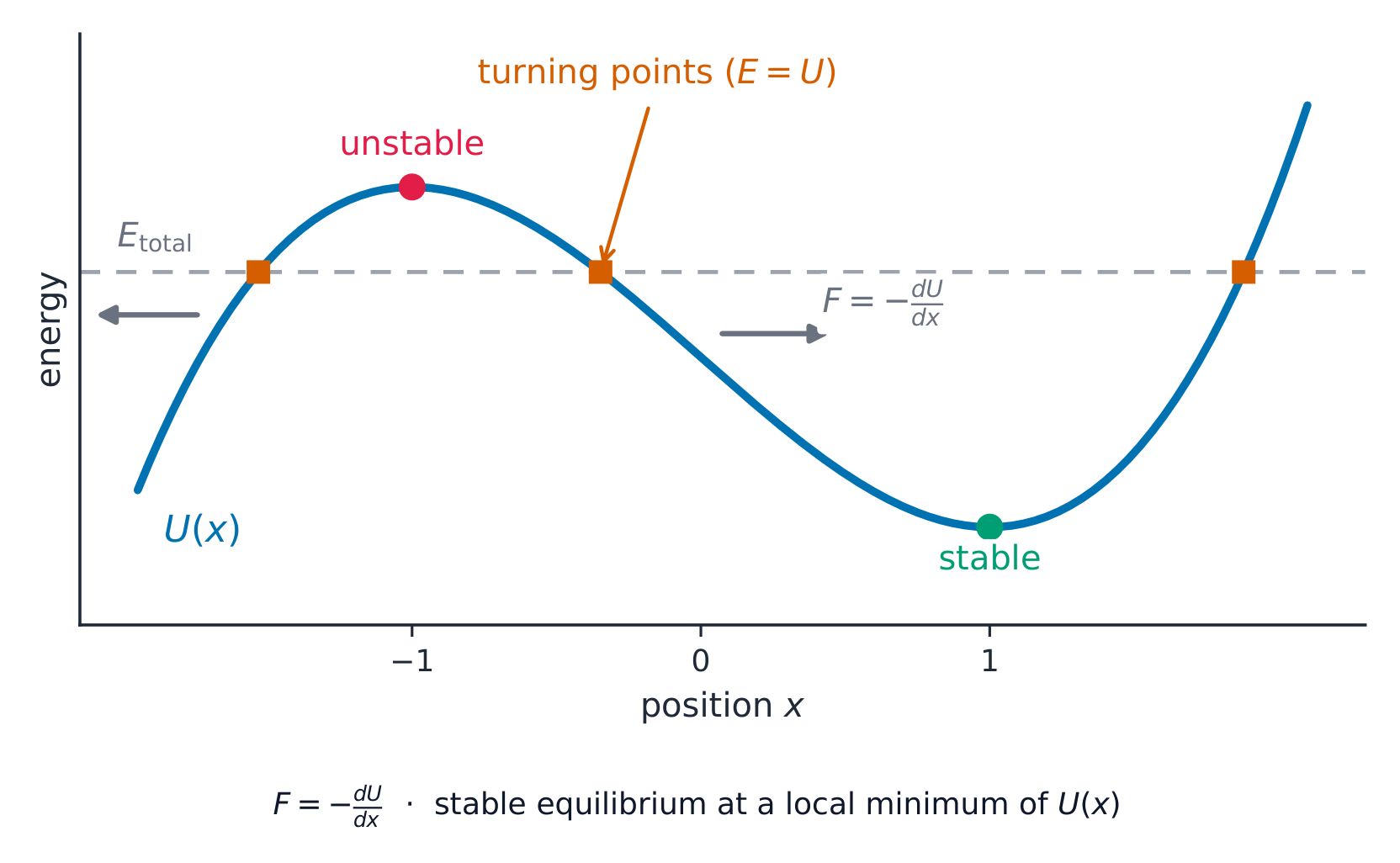
The force points "downhill" on the $U(x)$ curve. Equilibrium sits where the slope is zero: a minimum is a stable equilibrium 稳定平衡 (displaced, the force pushes back), a maximum is an unstable equilibrium 不稳定平衡 (displaced, the force pushes away).
Worked example. Given $U(x)=2x^3-6x$ (joules), the force is $F=-\dfrac{dU}{dx}=6-6x^2$. Equilibria sit at $F=0$: $x=\pm1$. Since $\dfrac{d^2U}{dx^2}=12x$ is positive at $x=+1$ (a minimum – stable) and negative at $x=-1$ (a maximum – unstable), the two points behave oppositely.
العربية
الطاقة الكامنة هي طاقة يخزنها نظام بسبب مواقع أجزائه – وجودها فقط للقوى المحفوظة، والتي يكون شغلها مستقلاً عن المسار. يتم تعريفها من خلال الشغل:
$$\Delta U=-\int_a^b\vec{F}\cdot d\vec{r},$$
وهنا لديك حرية اختيار مكان $U=0$ – فقط التغيرات في $U$ مهمة، لذا اختر الصفر الذي يجعل المسألة أبسط. النتائج القياسية:
الجاذبية بالقرب من سطح: $\Delta U_g=mg\,\Delta y$.
الجاذبية بشكل عام: $U_g=-\dfrac{Gm_1m_2}{r}$ (صفر عند الانفصال اللانهائي).
نابض: $U_s=\tfrac12k(\Delta x)^2$، مع $\Delta x$ مقاسة من الطول الطبيعي.
بالنسبة لأنظمة متعددة الأجسام، أضف الطاقة الكامنة لكل زوج. بعكس التعريف، القوة المحفوظة تساوي سالب المشتق لطاقتها الكامنة:
$$F_x=-\frac{dU}{dx}.$$
القوة تتجه "أسفل التلال" على منحنى $U(x)$. التوازن يقع حيث يكون الميل صفراً: الحد الأدنى هو توازن مستقر (عند إزاحته، تدفعه القوة للعودة)، والحد الأعلى هو توازن غير مستقر (عند إزاحته، تدفعه القوة للابتعاد).
على منحنى الطاقة الكامنة تتجه القوة لأسفل و E = U يحدد نقاط الانعطاف
مثال محلول. معطى $U(x)=2x^3-6x$ (جول)، القوة هي $F=-\dfrac{dU}{dx}=6-6x^2$. مواقع التوازن تقع عند $F=0$: $x=\pm1$. بما أن $\dfrac{d^2U}{dx^2}=12x$ موجبة عند $x=+1$ (حد أدنى – مستقر) وسالبة عند $x=-1$ (حد أعلى – غير مستقر)، فإن النقطتين تتصرفان بعكس بعضهما البعض.
Explore · استكشف
Store elastic potential energy in a spring · خزّن طاقة جهد مرنة في نابض
Stretching a spring stores elastic potential energy$\tfrac12 kx^2$ — the area under the force-extension line. Release it and that energy becomes kinetic. · تمديد نابض يخزن طاقة كامنة مرنة$\tfrac12 kx^2$ — وهي المساحة تحت منحنى القوة والامتداد. عند تحريره تتحول تلك الطاقة إلى طاقة حركية.
Learning Objective 3.4.A: Describe the energies present in a system.
3.4.A.1 A system composed of only a single object can only have kinetic energy.
3.4.A.2 A system that contains objects that interact via conservative forces or that can change its shape reversibly may have both kinetic and potential energies.
Learning Objective 3.4.B: Describe the behavior of a system using conservation of mechanical energy principles.
3.4.B.1 Mechanical energy is the sum of a system's kinetic and potential energies.
3.4.B.2 Any change to a type of energy within a system must be balanced by an equivalent change of other types of energies within the system or by a transfer of energy between the system and its surroundings.
3.4.B.3 A system may be selected so that the total energy of that system is constant.
3.4.B.4 If the total energy of a system changes, that change will be equivalent to the energy transferred into or out of the system.
Learning Objective 3.4.C: Describe how the selection of a system determines whether the energy of that system changes.
3.4.C.1 Energy is conserved in all interactions.
3.4.C.2 If the work done on a selected system is zero and there are no nonconservative interactions within the system, the total mechanical energy of the system is constant.
3.4.C.3 If the work done on a selected system is nonzero, energy is transferred between the system and the environment.
Boundary statement: AP Physics C: Mechanics expects students to know that mechanical energy can be dissipated as thermal energy or sound by nonconservative forces.
العربية
هدف التعلم 3.4.A: وصف الطاقات الموجودة في نظام ما.
3.4.A.1 النظام المكون من جسم واحد فقط يمكن أن يمتلك طاقة حركية فقط.
3.4.A.2 النظام الذي يحتوي على أجسام تتفاعل عبر قوى محتفظة أو يمكنه تغيير شكله بشكل عكسي قد يمتلك كلًا من الطاقة الحركية وطاقة الوضع.
هدف التعلم 3.4.B: وصف سلوك نظام باستخدام مبادئ حفظ الطاقة الميكانيكية.
3.4.B.1 الطاقة الميكانيكية هي مجموع طاقات الحركة والطاقة الكامنة للنظام.
3.4.B.2 أي تغيير في نوع من أنواع الطاقة داخل نظام ما يجب أن يكون مقابلاً لتغير مساوٍ في أنواع أخرى من الطاقة داخل النظام، أو بتحويل طاقة بين النظام ومحيطه.
3.4.B.3 يمكن اختيار نظام بحيث تكون الطاقة الكلية لذلك النظام ثابتة.
3.4.B.4 إذا تغيرت الطاقة الكلية لنظام ما، فإن هذا التغير سيكون مساوياً للطاقة المنقولة إلى النظام أو منه.
هدف التعلم 3.4.C: صف كيف يحدد اختيار النظام ما إذا كانت طاقة ذلك النظام تتغير.
3.4.C.1 تُحفظ الطاقة في جميع التفاعلات.
3.4.C.2 إذا كان الشغل المبذول على نظام مختار يساوي صفرًا ولم تكن هناك تفاعلات غير محافظية داخل النظام، فإن الطاقة الميكانيكية الكلية للنظام تكون ثابتة.
3.4.C.3 إذا كان الشغل المبذول على نظام مختار لا يساوي صفرًا، فإن الطاقة تنتقل بين النظام والبيئة المحيطة.
بيان الحدود: يتوقع امتحان AP Physics C: Mechanics من الطلاب معرفة أن الطاقة الميكانيكية يمكن تبديدها على شكل طاقة حرارية أو صوت بواسطة قوى غير محافظة.
Source: College Board AP Course and Exam Description · المصدر: وصف دورة وامتحان College Board AP
English
Energy conservation: KE ⇄ PE
Energy is conserved in all interactions – the question is only where it goes. Mechanical energy 机械能 is the sum $E=K+U$. If the external work on a system is zero and nothing inside it acts through nonconservative forces 非保守力, then
$$K_1+U_1=K_2+U_2.$$
When friction or drag act, they convert mechanical energy into thermal energy 热能 ($\Delta E_{\text{mech}}=-F_fd$), and the balance must include that term. If external work is done, the system's total energy changes by exactly the energy transferred: $W_{\text{ext}}=\Delta E_{\text{sys}}$. Choosing the system is choosing the bookkeeping – a single object can only have kinetic energy; include the Earth or the spring and the system can store potential energy too.
A potential-energy graph is a complete motion map: the horizontal line at height $E$ is the total energy, the gap $E-U(x)$ is the kinetic energy at each $x$, and the crossings $E=U$ are the turning points 转折点 where the object momentarily stops and reverses.
Worked example. A $2.0\ \text{kg}$ block slides down a ramp from rest at height $1.5\ \text{m}$, arriving at the bottom at $4.0\ \text{m/s}$. Energy accounting: $mgh=29.4\ \text{J}$ available; $\tfrac12mv^2=16\ \text{J}$ arrives as kinetic energy; so friction converted $29.4-16=13\ \text{J}$ into thermal energy along the way.
العربية
حفظ الطاقة: KE ⇄ PE
الطاقة محفوظة في جميع التفاعلات – السؤال هو فقط أين تذهب. الطاقة الميكانيكية هي المجموع $E=K+U$. إذا كان الشغل الخارجي على النظام صفراً ولا يوجد ما بداخله يعمل عبر قوى غير محفوظة، فإن
$$K_1+U_1=K_2+U_2.$$
عندما يعمل الاحتكاك أو المقاومة، يحول الطاقة الميكانيكية إلى طاقة حرارية ($\Delta E_{\text{mech}}=-F_fd$)، ويجب أن يتضمن الرصيد هذا الحد. إذا تم بذل شغل خارجي، يتغير الطاقة الكلية للنظام بدقة مقدار الطاقة المنقولة: $W_{\text{ext}}=\Delta E_{\text{sys}}$. اختيار النظام هو اختيار المحاسبة – جسم واحد يمكنه فقط امتلاك طاقة حركية؛ اشمل الأرض أو النابض ليتمكن النظام من تخزين الطاقة الكامنة أيضاً.
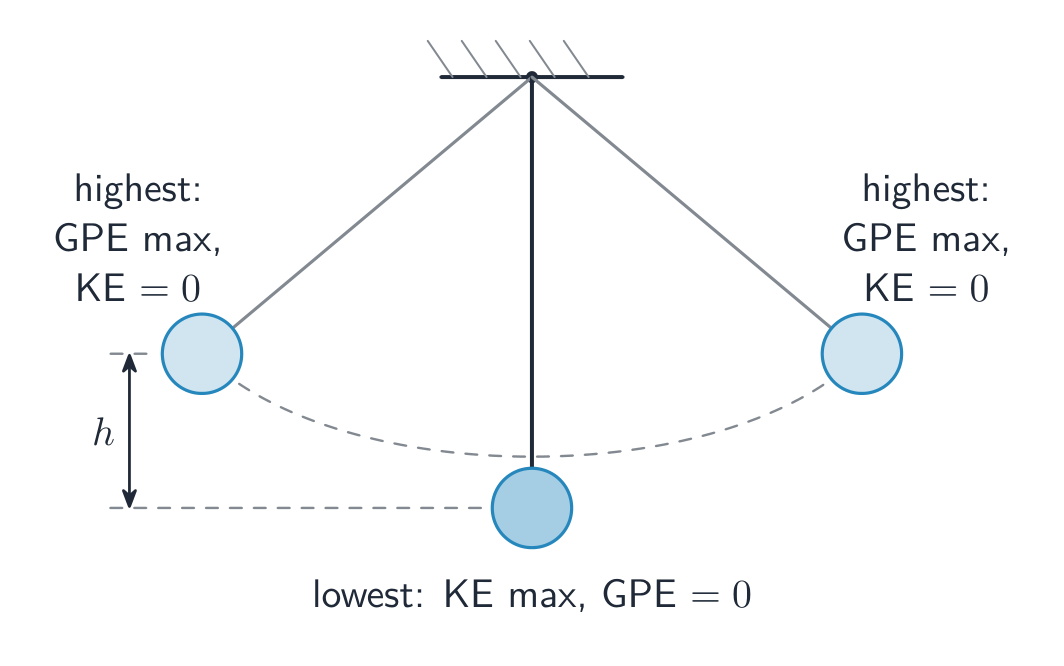
البندول يستبدل الطاقة الكامنة الجاذبية بالطاقة الحركية والعكس
رسم طاقة الوضع هو خريطة حركة كاملة: الخط الأفقي عند الارتفاع $E$ يمثل الطاقة الكلية، والفجوة $E-U(x)$ تمثل الطاقة الحركية في كل $x$، والنقاط التي تتقاطع فيها $E=U$ هي نقاط الانعطاف حيث يتوقف الجسم لحظيًا ثم يعكس اتجاهه.
مثال محلول. كتلة $2.0\ \text{kg}$ تنزلق على منحدر من السكون عند ارتفاع $1.5\ \text{m}$، وتصل إلى القاع بسرعة $4.0\ \text{m/s}$. حساب الطاقة: $mgh=29.4\ \text{J}$ متاحة؛ $\tfrac12mv^2=16\ \text{J}$ تصل كطاقة حركية؛ لذا حول الاحتكاك $29.4-16=13\ \text{J}$ إلى طاقة حرارية خلال الطريق.
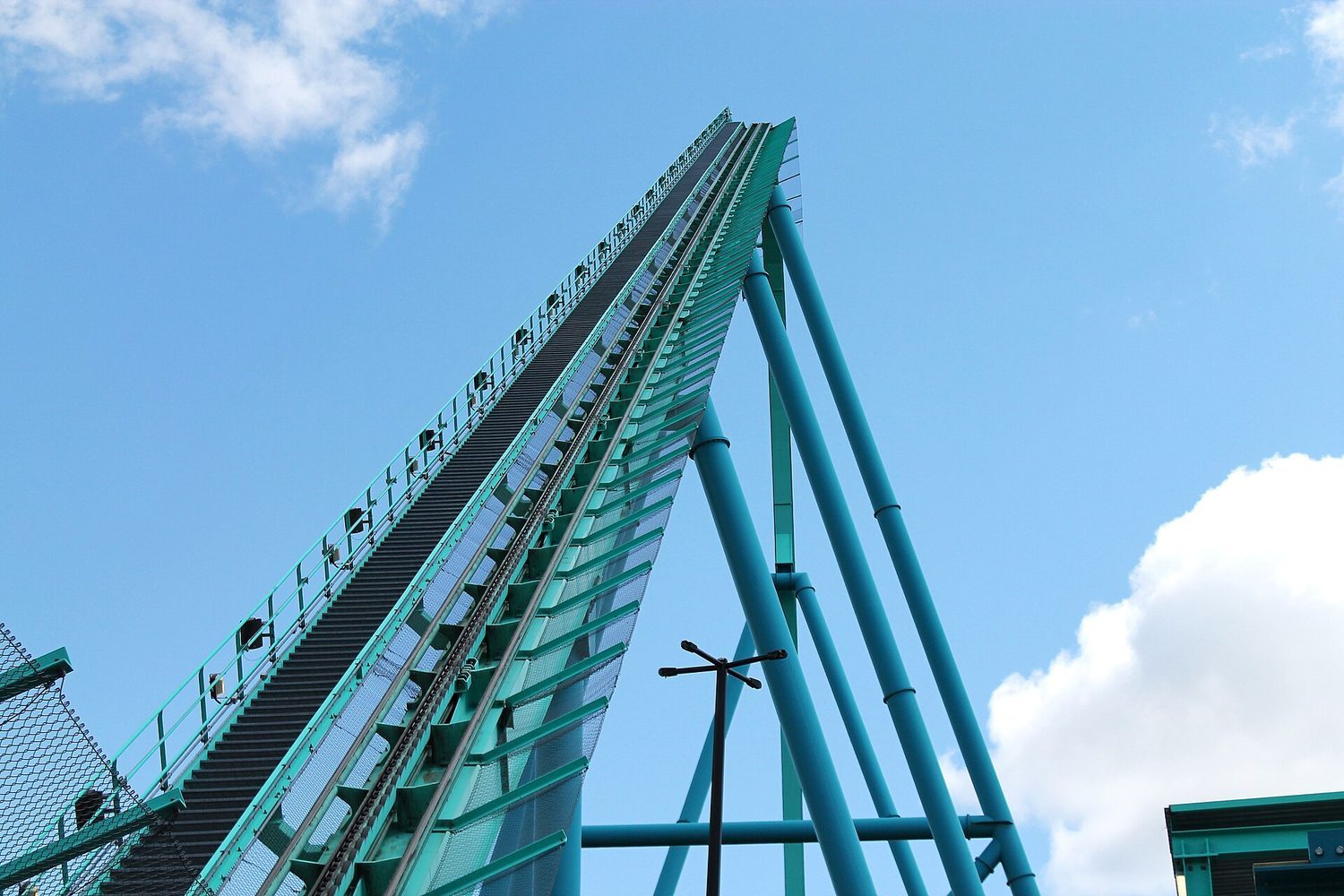
يعمل قطار التسلق على تبديل الطاقة ذهابًا وإيابًا: الأعلى (أكثر طاقة وضع) في القمة، الأسرع (أكثر طاقة حركية) في القاع
Explore · استكشف
Watch energy convert as an object falls · راقب تحول الطاقة أثناء سقوط جسم
With no friction, mechanical energy is conserved: as an object falls, gravitational potential energy turns into kinetic energy while the total stays fixed. · بدون احتكاك، تحفظ الطاقة الميكانيكية: أثناء سقوط الجسم، تتحول الطاقة الجهدية الجاذبية إلى طاقة حركية بينما تبقى المجموع ثابتاً.
Learning Objective 3.5.A: Describe the transfer of energy into, out of, or within a system in terms of power.
3.5.A.1 Power is the rate at which energy changes with respect to time, either by transfer into or out of a system or by conversion from one type to another within a system.
3.5.A.2 Average power is the amount of energy being transferred or converted, divided by the time it took for that transfer or conversion to occur.
3.5.A.3 Because work is the change in energy of an object or system due to a force, average power is the total work done, divided by the time during which that work was done.
Equation:$P_{\text{avg}} = \dfrac{W}{\Delta t}$
3.5.A.4 The instantaneous power delivered to an object by a force is given by the equation
Equation:$P_{\text{inst}} = \dfrac{dW}{dt}$
3.5.A.5 The instantaneous power delivered to an object by the component of a constant force parallel to the object's velocity can be described with the derived equation
3.5.A.3 نظرًا لأن الشغل هو تغير طاقة جسم أو نظام نتيجة لقوة، فإن القدرة المتوسطة تساوي إجمالي الشغل المبذول مقسومًا على الزمن الذي استغرقه تنفيذ ذلك الشغل.
المعادلة:$P_{\text{avg}} = \dfrac{W}{\Delta t}$
3.5.A.4 القدرة اللحظية الموصلة إلى جسم بواسطة قوة تُعطى بالمعادلة
المعادلة:$P_{\text{inst}} = \dfrac{dW}{dt}$
3.5.A.5 يمكن وصف القدرة اللحظية الموصلة إلى جسم بواسطة مركبة قوة ثابتة موازية لسرعة الجسم بالمعادلة المستنتجة
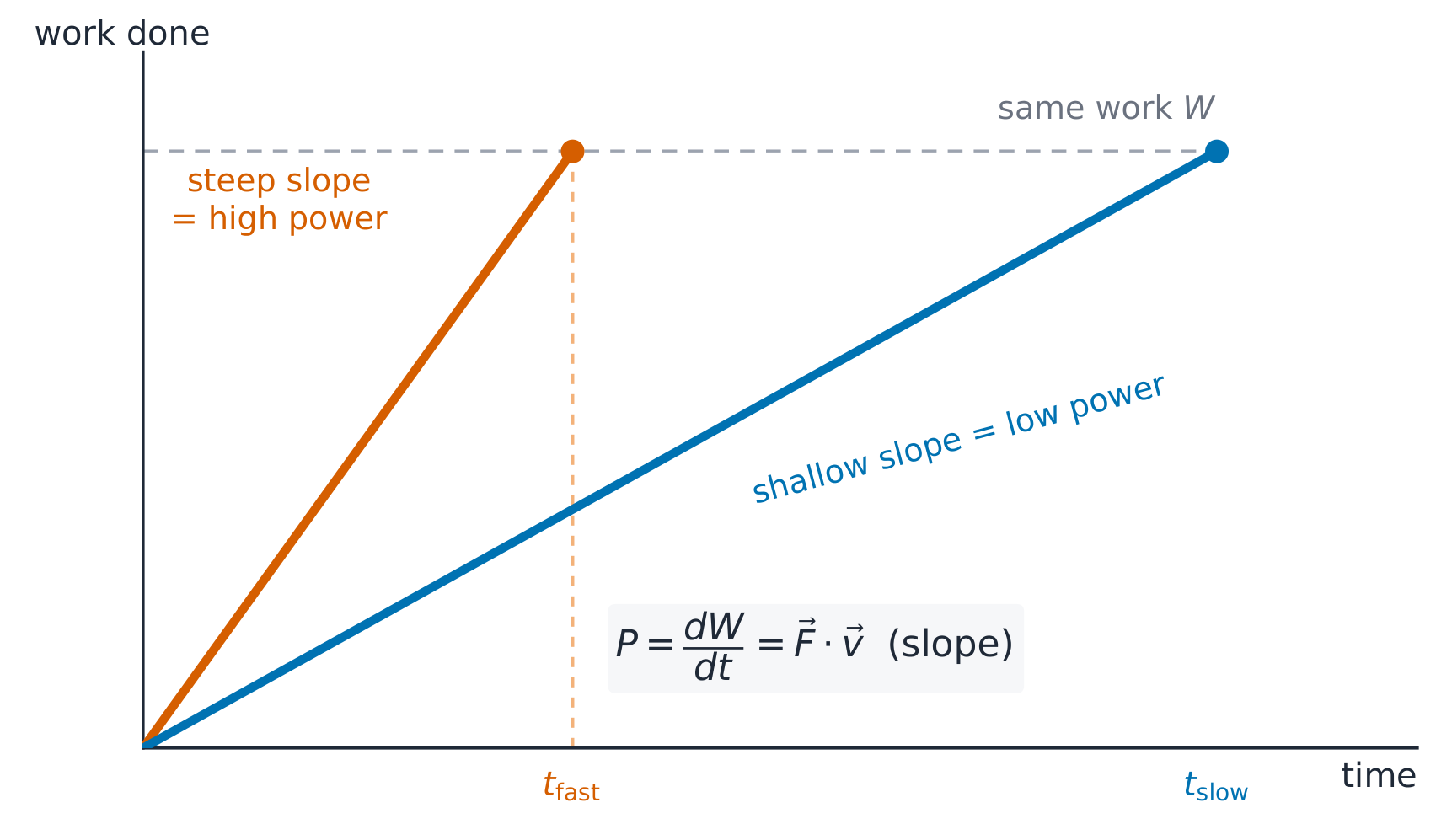
It measures how fast work is done, not how much. The dot product matters: only the force component along the velocity delivers power.
Worked example. A block released from rest at the top of a frictionless $3.0\ \text{m}$-high ramp reaches the bottom at $v=\sqrt{2gh}=7.7\ \text{m/s}$ (from $mgh=\tfrac12mv^2$). A motor that then drives it at a steady $7.7\ \text{m/s}$ against a $20\ \text{N}$ resistance delivers $P=Fv=20(7.7)\approx150\ \text{W}$.
Worked example. A $1200\ \text{kg}$ car climbs a hill that rises $1.0\ \text{m}$ for every $20\ \text{m}$ of road, at a steady $15\ \text{m/s}$. The engine must supply gravity's power drain: $P=mg\,v\sin\theta=1200(9.8)(15)\big(\tfrac{1}{20}\big)\approx8.8\ \text{kW}$ – before adding air resistance.
Exam skill. Energy FRQs reward the accounting sentence: name your system, state which forces do work on it, and write the balance ($W_{\text{ext}}=\Delta K+\Delta U+\Delta E_{\text{thermal}}$) before plugging in numbers. "Friction is present, so mechanical energy is not conserved" is a scored statement.
إنها تقيس مدى سرعة انجام الشغل، وليس كميته. الضرب النقطي مهم: فقط مركبة القوة الموازية للسرعة توفر القدرة.
القدرة هي ميل رسم بياني الشغل–الزمن: نفس العمل في وقت أقل يعني قدرة أكبر
مثال محلول. كتلة أُطلقت من السكون عند قمة منحدر أملس ارتفاعه $3.0\ \text{m}$، وصلت إلى القاع بسرعة $v=\sqrt{2gh}=7.7\ \text{m/s}$ (من $mgh=\tfrac12mv^2$). محرك يقودها بعد ذلك بسرعة ثابتة $7.7\ \text{m/s}$ ضد مقاومة مقدارها $20\ \text{N}$، ويوفر قدرة $P=Fv=20(7.7)\approx150\ \text{W}$.
مثال محلول. سيارة وزنها $1200\ \text{kg}$ تصعد تلة ترتفع $1.0\ \text{m}$ لكل $20\ \text{m}$ من الطريق، بسرعة ثابتة $15\ \text{m/s}$. يجب أن يزود المحرك القدرة المفقودة بسبب الجاذبية: $P=mg\,v\sin\theta=1200(9.8)(15)\big(\tfrac{1}{20}\big)\approx8.8\ \text{kW}$ – قبل إضافة مقاومة الهواء.
مهارة الامتحان. أسئلة FRQ الخاصة بالطاقة تكافئ جملة الحساب: حدد نظامك، واذكر القوى التي تقوم بشغل عليه، واكتب معادلة التوازن ($W_{\text{ext}}=\Delta K+\Delta U+\Delta E_{\text{thermal}}$) قبل التعويض بالأرقام. عبارة "وجود احتكاك يعني أن الطاقة الميكانيكية غير محفوظة" تُحسب كنقاط.
Pick one and the site follows you — notes, papers, videos and practice all open on it. · اختر واحدًا وسيتبعك الموقع — الملاحظات، الأوراق، الفيديوهات والتدريب جميعها تفتح عليه.
Type to search notes, lessons, code, vocabulary and past-paper questions across every subject. · اكتب للبحث عن ملاحظات، دروس، أكواد، مفردات وأسئلة امتحانات سابقة عبر جميع المواد.