| Learning Objective | Essential Knowledge |
|---|---|
1.1.A |
|
Kinematics · الحركية
AP Physics C: Mechanics · AP الفيزياء C: الميكانيكا · Topic 1 · الموضوع 1
 7:31
7:31
الحركية
صاروخ ينطلق. كل ثانية، يحرق محركه بقوة أكبر، لذا تستمر تسارته في النمو. الآن حاول إيجاد سرعته باستخدام المعادلات من أول…
English narration · English + 中文 subtitles burned in · سرد باللغة الإنجليزية · ترجمة مدمجة بالإنجليزية + الصينية
1.1
Scalars and Vectors · الكميات القياسية والمتجهات
Syllabus · المنهج
Source: College Board AP Course and Exam Description · المصدر: وصف دورة وامتحان College Board AP
English
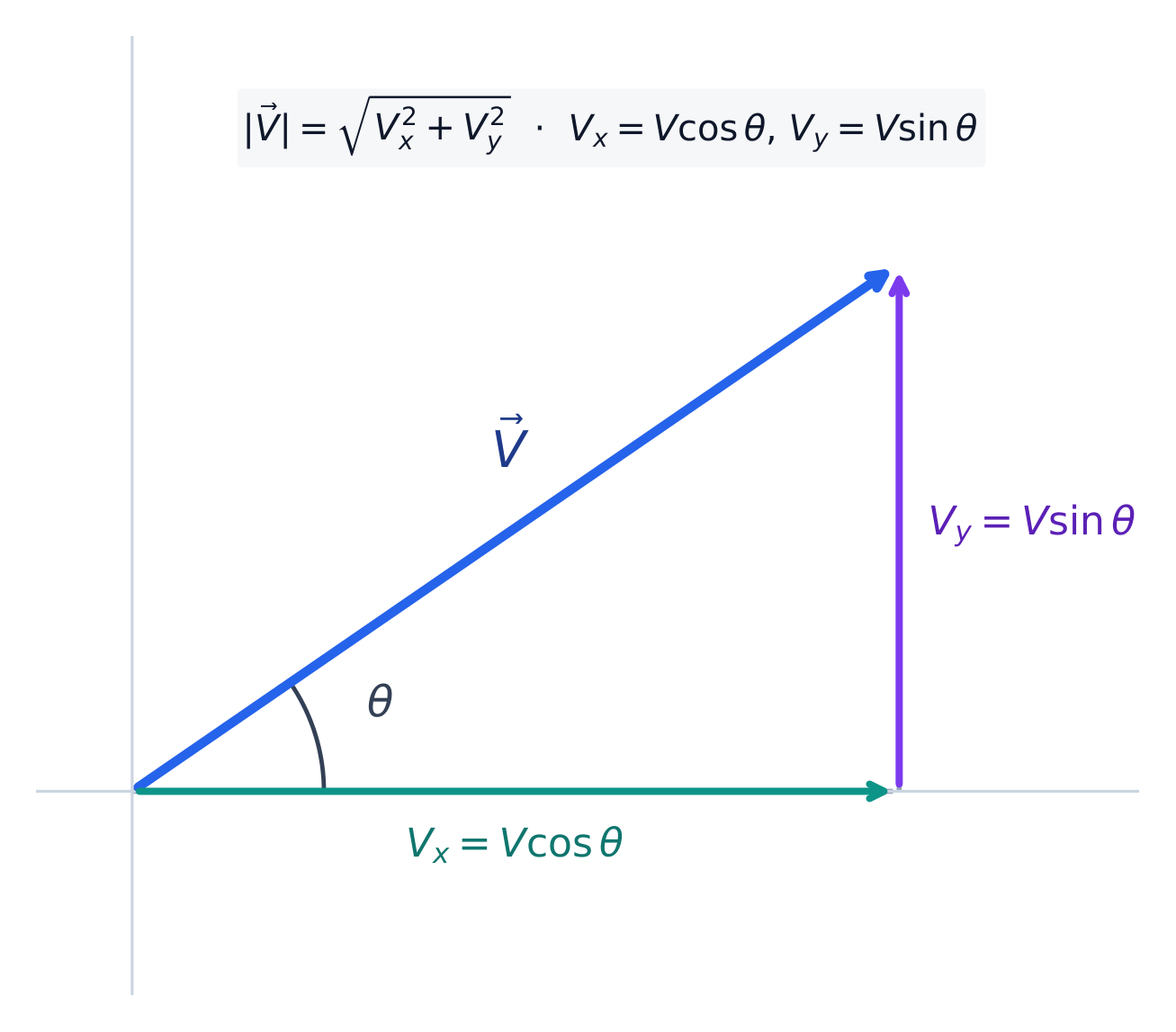
Kinematics 运动学 describes motion. Two kinds of quantity:
- A scalar 标量 has only size (magnitude 大小): distance, speed, mass, time.
- A vector 矢量 has magnitude and direction: displacement, velocity, acceleration, force.
In this calculus-based course you resolve vectors into components 分量 and add them component by component; a vector's magnitude is $\sqrt{v_x^2+v_y^2+\cdots}$. Physics C also writes vectors with unit vectors 单位矢量: $\vec{v}=v_x\hat{i}+v_y\hat{j}$, where $\hat{i}$ and $\hat{j}$ are directions of length one along $x$ and $y$ – handy because calculus can then act on each component separately.
العربية
الحركة تصف الحركة. نوعان من الكميات:
- الكمية القياسية لها حجم فقط (مقدار): المسافة، السرعة، الكتلة، الزمن.
- المتجه له مقدار و اتجاه: الإزاحة، السرعة المتجهة، التسارع، القوة.
في هذا المقرر القائم على التفاضل والتكامل تقوم بتفكيك المتجهات إلى مكونات وتجمعها مركبة بمركبة؛ مقدار المتجه هو $\sqrt{v_x^2+v_y^2+\cdots}$. كتب الفيزياء C أيضًا المتجهات باستخدام متجهات الوحدة: $\vec{v}=v_x\hat{i}+v_y\hat{j}$، حيث $\hat{i}$ و$\hat{j}$ هما اتجاهات وحدة الطول على طول $x$ و$y$ – مفيد لأن التفاضل والتكامل يمكن أن يؤثر على كل مركبة على حدة.
Explore · استكشف
Explore the dot product · استكشف الضرب القياسي
Drag the components of $\vec{A}$ and $\vec{B}$. The dot product $\vec{A}\cdot\vec{B}=A_xB_x+A_yB_y$ reaches zero exactly when the two vectors are perpendicular — the geometry behind $\cos\theta$. · اسحب مكونات $\vec{A}$ و$\vec{B}$. تصل الضرب القياسي $\vec{A}\cdot\vec{B}=A_xB_x+A_yB_y$ إلى الصفر بالضبط عندما يكون المتجهان متعامدين — وهذا هو الأساس الهندسي لـ $\cos\theta$.
Vocabulary · مفردات
Train · تدريب
| English | العربية |
|---|---|
| vector/ˈvektə/ | شعاعية |
| components/kəmˈpəʊnənts/ | مكونات |
| unit vectors/ˈjuːnɪt ˈvektəz/ | متجهات الوحدة |
| derivatives/dɪˈrɪvətɪvz/ | مشتقاتها |
| average velocity/ˈævrɪdʒ vəˈlɒsɪti/ | السرعة المتوسطة |
| instantaneous velocity/ˌɪnstənˈteɪnɪəs vəˈlɒsɪti/ | السرعة اللحظية |
| free fall/friː fɔːl/ | السقوط الحر |
| reference frame/ˈrefrəns freɪm/ | إطار مرجعي |
| relative motion/ˈrelətɪv ˈməʊʃn/ | الحركة النسبية |
| projectile motion/prəˈdʒektaɪl ˈməʊʃn/ | حركة المقذوفات |
1.2
Displacement, Velocity, and Acceleration · الإزاحة، والسرعة المتجهة، والتسارع
Syllabus · المنهج
English
Learning Objective 1.2.A: Describe a change in an object's position.
- 1.2.A.1 When using the object model, the size, shape, and internal configuration are ignored. The object may be treated as a single point with extensive properties such as mass and charge.
- 1.2.A.2 Displacement is the change in an object's position.
- Equation: $\Delta x = x - x_0$
Learning Objective 1.2.B: Describe the average velocity and acceleration of an object.
- 1.2.B.1 Averages of velocity and acceleration are calculated considering the initial and final states of an object over an interval of time.
- 1.2.B.2 Average velocity is the displacement of an object divided by the interval of time in which that displacement occurs.
- Equation: $\vec{v}_{\text{avg}} = \dfrac{\Delta \vec{x}}{\Delta t}$
- 1.2.B.3 Average acceleration is the change in velocity divided by the interval of time in which that change in velocity occurs.
- Equation: $\vec{a}_{\text{avg}} = \dfrac{\Delta \vec{v}}{\Delta t}$
- 1.2.B.4 An object is accelerating if either the magnitude and/or direction of the object's velocity are changing.
- 1.2.B.5 Calculating average velocity or average acceleration over a very small time interval yields a value that is very close to the instantaneous velocity or instantaneous acceleration.
Learning Objective 1.2.C: Describe the instantaneous position, velocity, and acceleration of an object as a function of time.
- 1.2.C.1 As the time interval used to calculate the average value of a quantity approaches zero, the average value of that quantity approaches the value of the quantity at that instant, called the instantaneous value.
- 1.2.C.1.i Instantaneous velocity is the rate of change of the object's position, which is equal to the derivative of position with respect to time.
- Equation: $\vec{v} = \dfrac{d\vec{r}}{dt}$
- Equation: $v_x = \dfrac{dx}{dt}$
- 1.2.C.1.ii Instantaneous acceleration is the rate of change of the object's velocity, which is equal to the derivative of velocity with respect to time.
- Equation: $\vec{a} = \dfrac{d\vec{v}}{dt}$
- Equation: $a_x = \dfrac{dv_x}{dt}$
- 1.2.C.1.i Instantaneous velocity is the rate of change of the object's position, which is equal to the derivative of position with respect to time.
- 1.2.C.2 Time-dependent functions and instantaneous values of position, velocity, and acceleration can be determined using differentiation and integration.
العربية
هدف التعلم 1.2.A: وصف تغير موقع جسم ما.
- 1.2.A.1 عند استخدام نموذج الجسم، يتم إهمال الحجم والشكل والتكوين الداخلي. يمكن التعامل مع الجسم كنقطة واحدة بخصائص واسعة مثل الكتلة والشحنة.
- 1.2.A.2 الإزاحة هي التغير في موقع جسم ما.
- المعادلة: $\Delta x = x - x_0$
هدف التعلم 1.2.B: وصف السرعة المتوسطة والتسارع المتوسط لجسم ما.
- 1.2.B.1 تُحسب متوسطات السرعة والتسارع مع مراعاة الحالات الأولية والنهائية للجسم خلال فترة زمنية.
- 1.2.B.2 السرعة المتوسطة هي إزاحة جسم مقسومة على الفترة الزمنية التي حدثت فيها تلك الإزاحة.
- المعادلة: $\vec{v}_{\text{avg}} = \dfrac{\Delta \vec{x}}{\Delta t}$
- 1.2.B.3 التسارع المتوسط هو التغير في السرعة مقسوماً على الفترة الزمنية الذي حدث فيها ذلك التغير في السرعة.
- المعادلة: $\vec{a}_{\text{avg}} = \dfrac{\Delta \vec{v}}{\Delta t}$
- 1.2.B.4 يكون الجسم متسارعًا إذا كان مقدار السرعة و/أو اتجاه سرعة الجسم يتغيران.
- 1.2.B.5 حساب السرعة المتوسطة أو التسارع المتوسط خلال فترة زمنية صغيرة جداً يعطي قيمة قريبة جداً من السرعة اللحظية أو التسارع اللحظي.
الهدف التعليمي 1.2.C: وصف الموضع اللحظي والسرعة والتسارع لجسم ما بدلالة الزمن.
- 1.2.C.1 مع اقتراب فترة الزمن المستخدمة لحساب القيمة المتوسطة لكمية ما من الصفر، تقترب القيمة المتوسطة لتلك الكمية من قيمتها عند تلك اللحظة، والتي تسمى القيمة اللحظية.
- 1.2.C.1.i السرعة اللحظية هي معدل تغير موضع الجسم، وهي تساوي المشتقة الزمنية للموضع.
- معادلة: $\vec{v} = \dfrac{d\vec{r}}{dt}$
- معادلة: $v_x = \dfrac{dx}{dt}$
- 1.2.C.1.ii التسارع اللحظي هو معدل تغير سرعة الجسم، وهو يساوي المشتقة الزمنية للسرعة.
- معادلة: $\vec{a} = \dfrac{d\vec{v}}{dt}$
- معادلة: $a_x = \dfrac{dv_x}{dt}$
- 1.2.C.1.i السرعة اللحظية هي معدل تغير موضع الجسم، وهي تساوي المشتقة الزمنية للموضع.
- 1.2.C.2 يمكن تحديد الدوال المعتمدة على الزمن والقيم اللحظية للموضع والسرعة والتسارع باستخدام التفاضل والتكامل.
Source: College Board AP Course and Exam Description · المصدر: وصف دورة وامتحان College Board AP
English
Because motion can change continuously, define the rates as derivatives 导数:
$$v=\frac{dx}{dt},\qquad a=\frac{dv}{dt}=\frac{d^2x}{dt^2}.$$
Reversing this, integrate to recover velocity and position:
$$v(t)=v_0+\int_0^t a\,dt,\qquad x(t)=x_0+\int_0^t v\,dt.$$
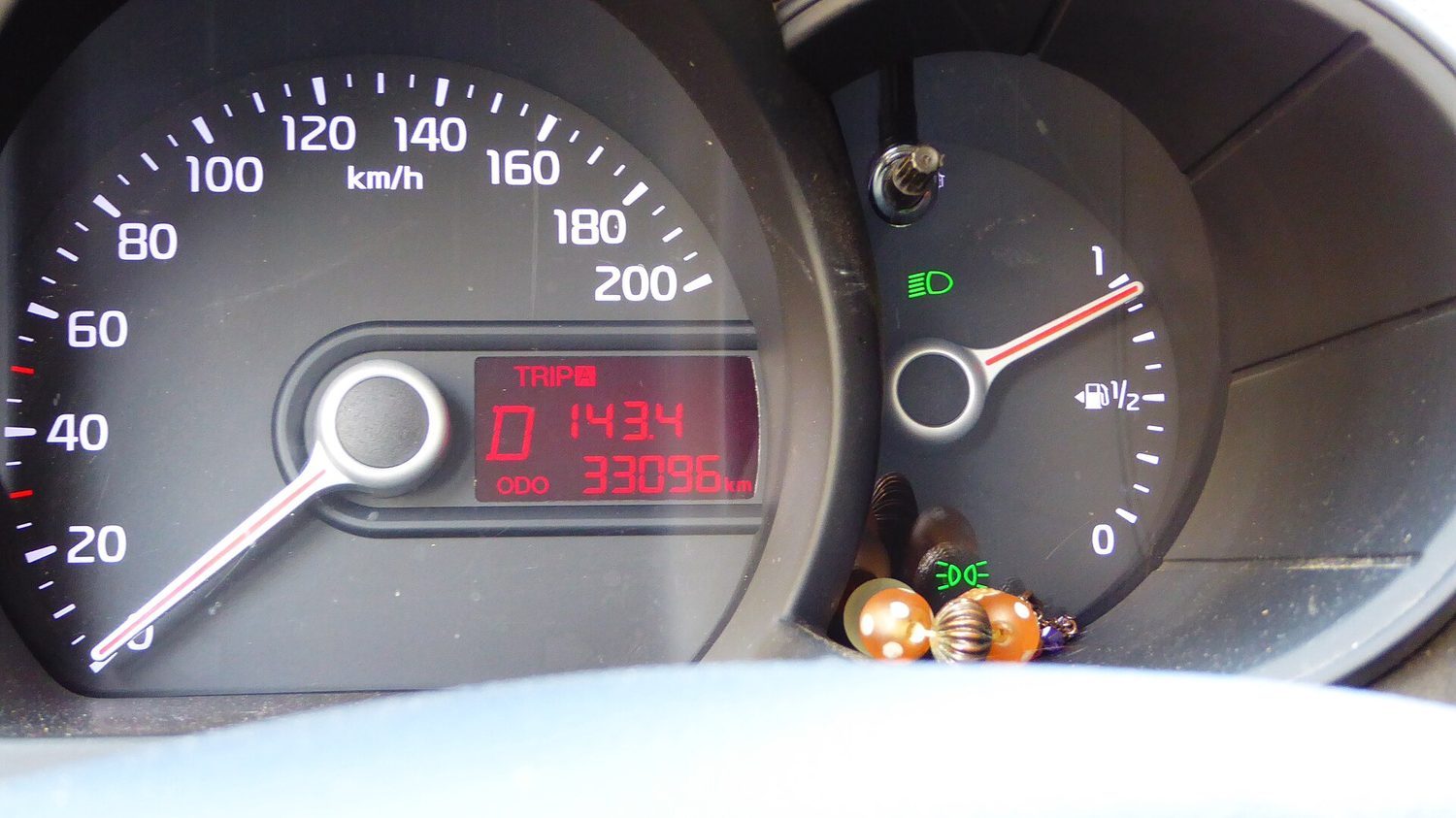
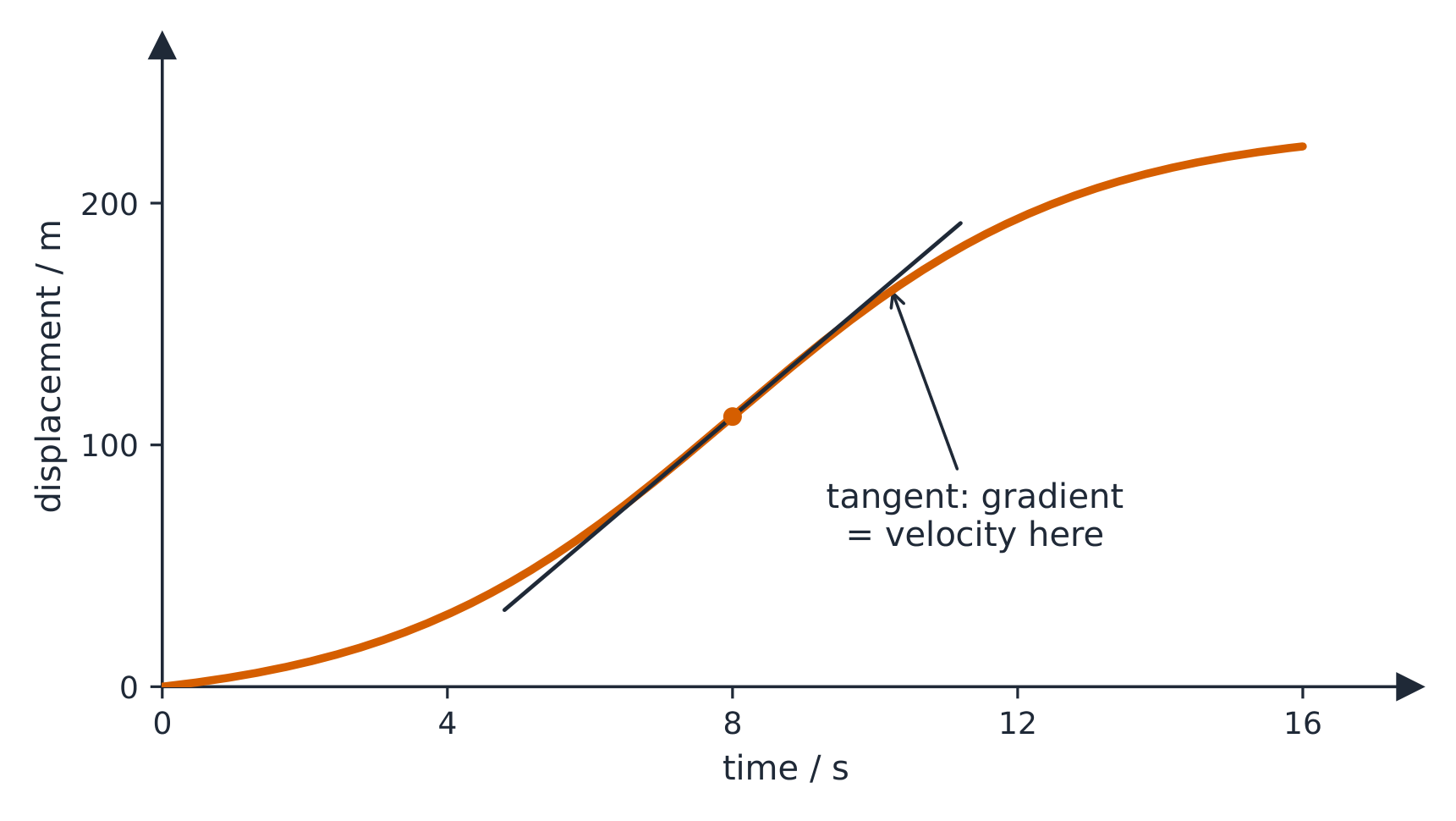
Distinguish the average from the instantaneous: average velocity 平均速度 is $\Delta x/\Delta t$ over an interval, while instantaneous velocity 瞬时速度 is the derivative at one moment – the slope of the tangent line, and what a speedometer shows.
For constant acceleration these give the familiar kinematic equations ($v=v_0+at$, $x=x_0+v_0t+\tfrac12at^2$, $v^2=v_0^2+2a\,\Delta x$). The most important constant-$a$ case is free fall 自由落体: near Earth's surface every object, heavy or light, accelerates downward at $g=9.8\ \text{m/s}^2$ once air resistance is negligible. When $a$ or $v$ varies with time, use the integrals directly.
Worked example. A particle moves with $x(t)=2t^3-3t^2$ (metres). Differentiate for velocity and acceleration:
$$v=\frac{dx}{dt}=6t^2-6t,\qquad a=\frac{dv}{dt}=12t-6.$$
At $t=2\ \text{s}$, $v=24-12=12\ \text{m/s}$ and $a=24-6=18\ \text{m/s}^2$. This calculus link – not just the constant-$a$ formulas – is what distinguishes Physics C.
Worked example. A particle starts from rest at the origin with $a(t)=6t$. Integrate: $v=\int 6t\,dt=3t^2$ and $x=\int 3t^2\,dt=t^3$. At $t=2\ \text{s}$, $v=12\ \text{m/s}$ and $x=8\ \text{m}$.
العربية
لأن الحركة يمكن أن تتغير باستمرار، عرّف المعدلات sebagai مشتقات:
$$v=\frac{dx}{dt},\qquad a=\frac{dv}{dt}=\frac{d^2x}{dt^2}.$$
عكس هذه العملية، قم بالتكامل لاستعادة السرعة والموقع:
$$v(t)=v_0+\int_0^t a\,dt,\qquad x(t)=x_0+\int_0^t v\,dt.$$
فرق بين المتوسط واللحظي: السرعة المتوسطة هي $\Delta x/\Delta t$ خلال فترة زمنية، بينما السرعة اللحظية هي المشتقة عند لحظة واحدة – ميل الخط المماس، وما يظهره عداد السرعة.
بالنسبة لتسارع ثابت، تعطي هذه المعادلات الحركية المألوفة ($v=v_0+at$، $x=x_0+v_0t+\tfrac12at^2$، $v^2=v_0^2+2a\,\Delta x$). الحالة الأهم لتسارع-$a$ ثابت هي السقوط الحر: بالقرب من سطح الأرض يتسارع كل جسم، ثقيلًا كان أو خفيفًا، لأسفل بمقدار $g=9.8\ \text{m/s}^2$ بمجرد إهمال مقاومة الهواء. عندما تتغير $a$ أو $v$ مع الزمن، استخدم التكاملات مباشرة.
مثال محلول. جسيم يتحرك بمقدار $x(t)=2t^3-3t^2$ (أمتار). اشتق للحصول على السرعة والتسارع:
$$v=\frac{dx}{dt}=6t^2-6t,\qquad a=\frac{dv}{dt}=12t-6.$$
عند $t=2\ \text{s}$، $v=24-12=12\ \text{m/s}$ و$a=24-6=18\ \text{m/s}^2$. هذا الرابط بالتفاضل والتكامل – ليس فقط معادلات تسارع-$a$ الثابت – هو ما يميز الفيزياء C.
مثال محلول. جسيم يبدأ من السكون عند نقطة الأصل بـ $a(t)=6t$. تكامل: $v=\int 6t\,dt=3t^2$ و$x=\int 3t^2\,dt=t^3$. عند $t=2\ \text{s}$، $v=12\ \text{m/s}$ و$x=8\ \text{m}$.
Vocabulary · مفردات
Train · تدريب
| English | العربية |
|---|---|
| Kinematics/ˌkɪnɪˈmætɪks/ | الحركية |
| scalar/ˈskeɪlə/ | كمية قياسية |
| magnitude/ˈmæɡnɪtjuːd/ | المقدار |
1.3
Representing Motion · تمثيل الحركة
Syllabus · المنهج
English
Learning Objective 1.3.A: Describe the position, velocity, and acceleration of an object using representations of that object's motion.
- 1.3.A.1 Motion can be represented by motion diagrams, figures, graphs, equations, and narrative descriptions.
- 1.3.A.2 For constant acceleration, three kinematic equations can be used to describe instantaneous linear motion in one dimension:
- Equation: $v_x = v_{x0} + a_x t$
- Equation: $x = x_0 + v_{x0} t + \dfrac{1}{2} a_x t^2$
- Equation: $v_x^2 = v_{x0}^2 + 2a_x \left( x - x_0 \right)$
- Note: The equations above are written to indicate motion in the $x$-direction, but these equations can be used in any single dimension as appropriate.
- 1.3.A.3 Near the surface of Earth, the vertical acceleration caused by the force of gravity is downward, constant, and has a measured value approximately equal to
- Equation: $a_g = g \approx 10 \ \text{m/s}^2$.
- 1.3.A.4 Graphs of position, velocity, and acceleration as functions of time can be used to find the relationships between those quantities.
- 1.3.A.4.i An object's instantaneous velocity is the rate of change of the object's position, which is equal to the slope of a line tangent to a point on a graph of the object's position as a function of time.
- Equation: $v_x = \dfrac{dx}{dt}$
- 1.3.A.4.ii An object's instantaneous acceleration is the rate of change of the object's velocity, which is equal to the slope of a line tangent to a point on a graph of the object's velocity as a function of time.
- Equation: $a_x = \dfrac{dv_x}{dt}$
- 1.3.A.4.iii The displacement of an object during a time interval is equal to the area under the curve of a graph of the object's velocity as a function of time (i.e., the area bounded by the function and the horizontal axis for the appropriate interval).
- Equation: $\Delta x = \displaystyle\int_{t_1}^{t_2} v_x(t) \ dt$
- 1.3.A.4.iv The change in velocity of an object during a time interval is equal to the area under the curve of a graph of the acceleration of the object as a function of time.
- Equation: $\Delta v_x = \displaystyle\int_{t_1}^{t_2} a_x(t) \ dt$
- 1.3.A.4.i An object's instantaneous velocity is the rate of change of the object's position, which is equal to the slope of a line tangent to a point on a graph of the object's position as a function of time.
Boundary statement: AP Physics C: Mechanics and AP Physics C: Electricity and Magnetism expects that for all situations in which a numerical quantity is required for g, the value $g \approx 10 \ \text{m/s}^2$ will be used. However, students will not be penalized for correctly using the more precise commonly accepted values of $g = 9.81 \ \text{m/s}^2$ or $g = 9.8 \ \text{m/s}^2$.
العربية
هدف التعلم 1.3.A: وصف موقع وسرعة وتسارع جسم ما باستخدام تمثيلات لحركته.
- 1.3.A.1 يمكن تمثيل الحركة بمخططات الحركة، الأشكال، الرسوم البيانية، المعادلات، والأوصاف السردية.
- 1.3.A.2 بالنسبة للتسارع الثابت، يمكن استخدام ثلاث معادلات حركية لوصف الحركة الخطية اللحظية في بُعد واحد:
- المعادلة: $v_x = v_{x0} + a_x t$
- المعادلة: $x = x_0 + v_{x0} t + \dfrac{1}{2} a_x t^2$
- المعادلة: $v_x^2 = v_{x0}^2 + 2a_x \left( x - x_0 \right)$
- ملاحظة: المعادلات أعلاه مكتوبة للإشارة إلى الحركة في اتجاه $x$، ولكن يمكن استخدام هذه المعادلات في أي بُعد واحد حسب الحاجة.
- 1.3.A.3 بالقرب من سطح الأرض، يكون التسارع الرأسي الناتج عن قوة الجاذبية نحو الأسفل، ثابتاً، وقيمته المقاسة تقارب
- المعادلة: $a_g = g \approx 10 \ \text{m/s}^2$.
- 1.3.A.4 يمكن استخدام رسوم بيانية للموقع والسرعة والتسارع كدوال للزمن لإيجاد العلاقات بين تلك الكميات.
- 1.3.A.4.i السرعة اللحظية لجسم ما هي معدل تغير موقعه، وتساوي ميل خط مماس لنقطة على رسم بياني لموقع الجسم كدالة للزمن.
- معادلة: $v_x = \dfrac{dx}{dt}$
- 1.3.A.4.ii التسارع اللحظي لجسم ما هو معدل تغير سرعته، ويساوي ميل خط مماس لنقطة على رسم بياني لسرعته كدالة للزمن.
- معادلة: $a_x = \dfrac{dv_x}{dt}$
- 1.3.A.4.iii إزاحة جسم ما خلال فترة زمنية تساوي المساحة تحت منحنى رسم بياني لسرعته كدالة للزمن (أي المساحة المحصورة بين الدالة والمحور الأفقي للفترة المناسبة).
- معادلة: $\Delta x = \displaystyle\int_{t_1}^{t_2} v_x(t) \ dt$
- 1.3.A.4.iv التغير في سرعة جسم ما خلال فترة زمنية يساوي المساحة تحت منحنى رسم بياني لتسارعه كدالة للزمن.
- معادلة: $\Delta v_x = \displaystyle\int_{t_1}^{t_2} a_x(t) \ dt$
- 1.3.A.4.i السرعة اللحظية لجسم ما هي معدل تغير موقعه، وتساوي ميل خط مماس لنقطة على رسم بياني لموقع الجسم كدالة للزمن.
عبارة حدودية: يتوقع امتحان AP Physics C: الميكانيكا وAP Physics C: الكهرباء والمغناطيس أن يُستخدم القيمة $g \approx 10 \ \text{m/s}^2$ لجميع الحالات التي يتطلب فيها حساب كمية عددية لـ g. ومع ذلك، لن يتم معاقبة الطلاب الذين يستخدمون بشكل صحيح القيم المقبولة عموماً والأكثر دقة لـ $g = 9.81 \ \text{m/s}^2$ أو $g = 9.8 \ \text{m/s}^2$.
Source: College Board AP Course and Exam Description · المصدر: وصف دورة وامتحان College Board AP
English
Move fluently between description, graph, table, and equation:
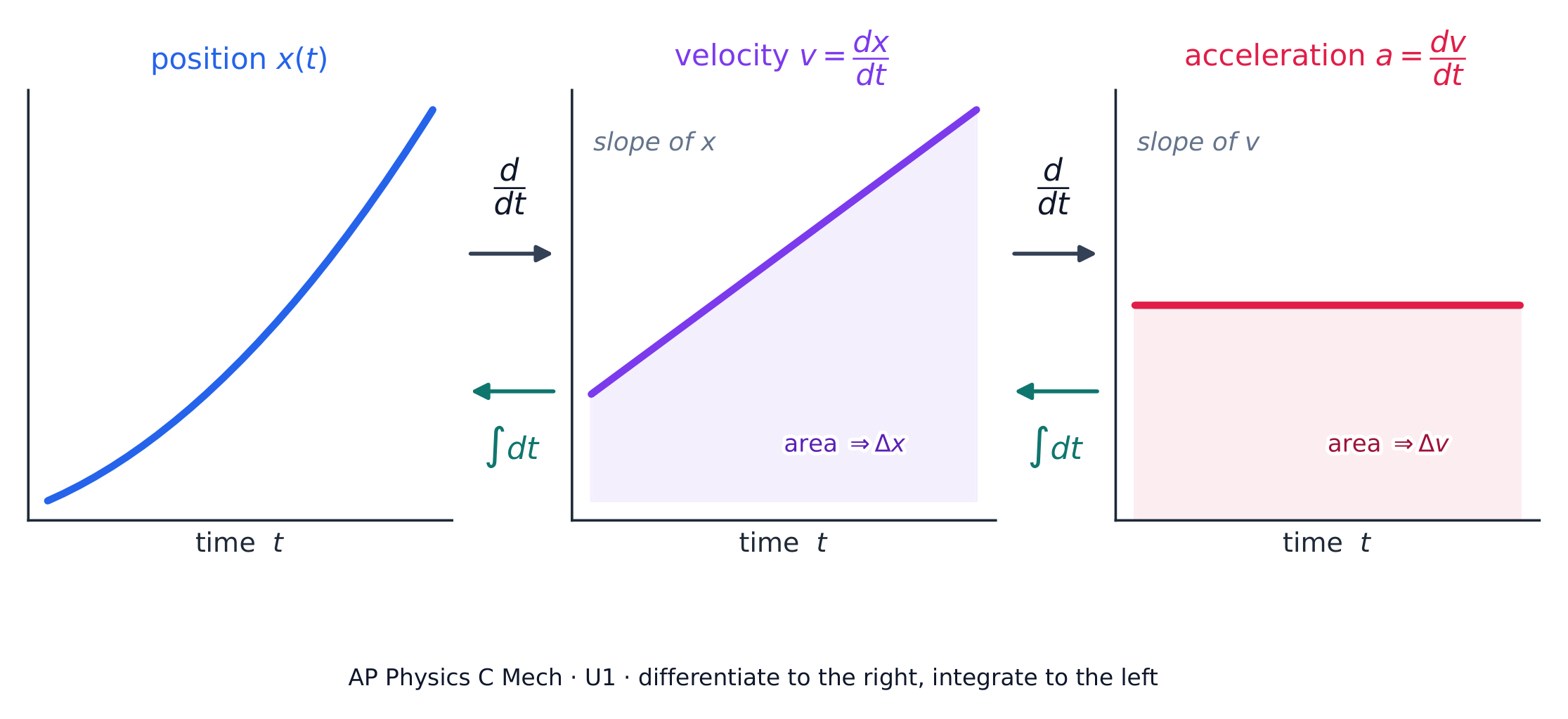
- On a position–time graph, the slope ($dx/dt$) is velocity.
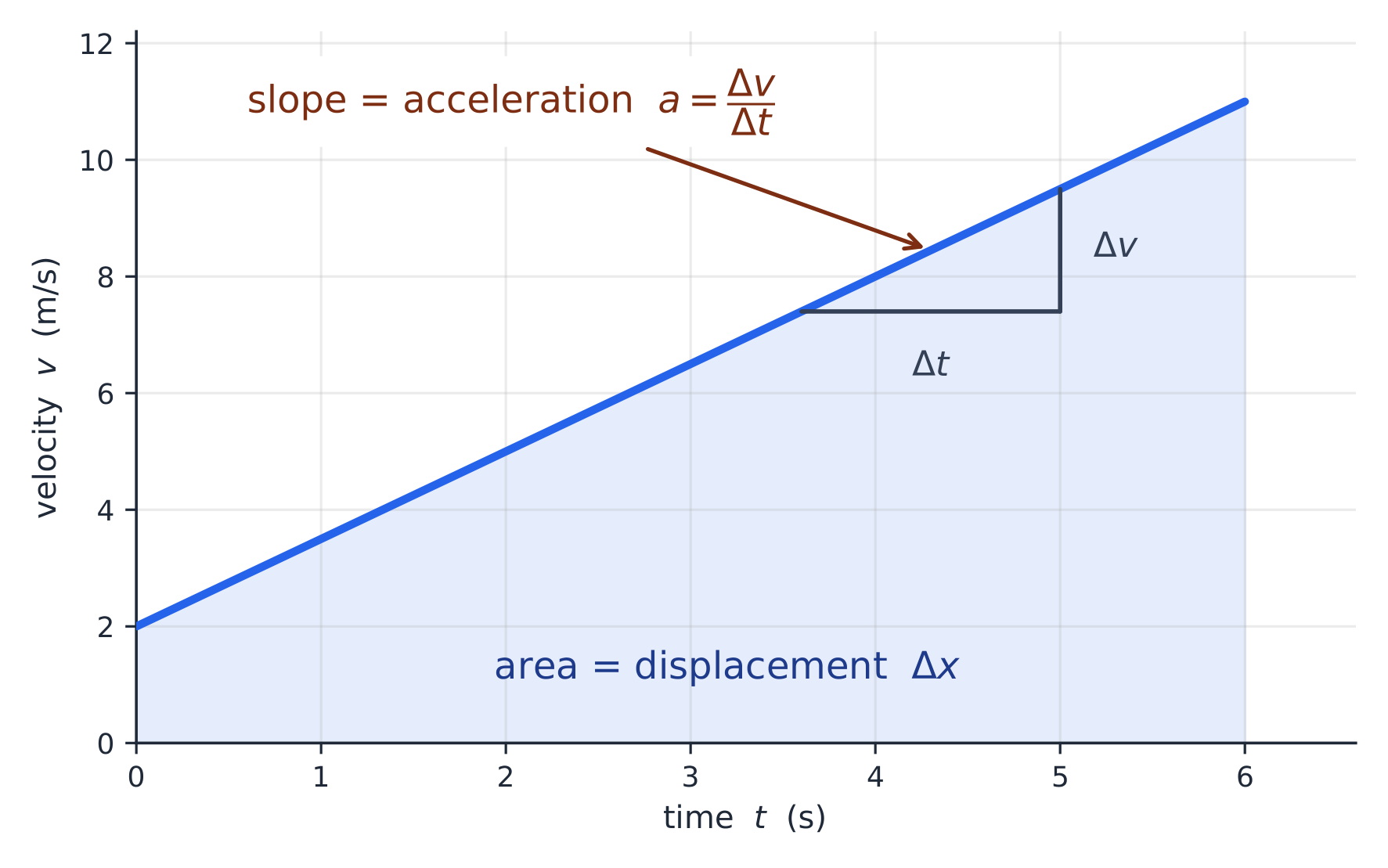
- On a velocity–time graph, the slope is acceleration and the area ($\int v\,dt$) is displacement.
- On an acceleration–time graph, the area ($\int a\,dt$) is the change in velocity.
Slopes are derivatives; areas are integrals – the two are inverse operations here.
العربية
انتقل بسلاسة بين الوصف، الرسم البياني، الجدول، والمعادلة:
- على رسم بياني الموقع–الزمن، الميل ($dx/dt$) هو السرعة.
- على رسم بياني السرعة–الزمن، الميل هو التسارع والمساحة ($\int v\,dt$) هي الإزاحة.
- على رسم بياني التسارع–الزمن، المساحة ($\int a\,dt$) هي التغير في السرعة.
الميل هو مشتق؛ المساحة هي تكامل – العمليتان هما معكوسان هنا.
Explore · استكشف
Explore the velocity–time graph · استكشف رسم السرعة-الزمن
Change the start velocity and acceleration. The slope of a $v$–$t$ line is the acceleration $a=\tfrac{dv}{dt}$, and the area underneath is the displacement $\Delta x=\int v\,dt$ — slope and area are the graphical faces of the derivative and the integral. · غيّر السرعة الابتدائية والتسارع. الميل لخط $v$–$t$ هو التسارع $a=\tfrac{dv}{dt}$، والمساحة تحته هي الإزاحة $\Delta x=\int v\,dt$ — فالميل والمساحة هما الوجه البياني للمشتقة والتكامل.
1.4
Reference Frames and Relative Motion · إطارات المرجع والحركة النسبية
Syllabus · المنهج
English
Learning Objective 1.4.A: Describe the reference frame of a given observer.
- 1.4.A.1 The choice of reference frame will determine the direction and magnitude of quantities measured by an observer in that reference frame.
Learning Objective 1.4.B: Describe the motion of objects as measured by observers in different inertial reference frames.
- 1.4.B.1 Measurements from a given reference frame may be converted to measurements from another reference frame.
- 1.4.B.2 The observed velocity of an object results from the combination of the object's velocity and the velocity of the observer's reference frame.
- 1.4.B.2.i Combining the motion of an object and the motion of an observer in a given reference frame involves the addition or subtraction of vectors.
- 1.4.B.2.ii The acceleration of any object is the same as measured from all inertial reference frames.
Boundary statement: Unless otherwise stated, the frame of reference of any problem may be assumed to be inertial.
العربية
هدف التعلم 1.4.A: وصف إطار المرجع لمراقب معين.
- 1.4.A.1 يحدد اختيار إطار مرجعي اتجاه وكميات الكمية المقاسة من قبل مراقب في ذلك الإطار المرجعي.
الهدف التعليمي 1.4.B: وصف حركة الأجسام كما تقيسها مراقب في إطارات مرجعية قصورية مختلفة.
- 1.4.B.1 يمكن تحويل القياسات من إطار مرجعي محدد إلى قياسات من إطار مرجعي آخر.
- 1.4.B.2 ناتج السرعة الظاهرية لجسم ما هو نتاج دمج سرعة الجسم مع سرعة الإطار المرجعي للمراقب.
- 1.4.B.2.i يتضمن دمج حركة جسم وحركة مراقب في إطار مرجعي معين عملية جمع أو طرح المتجهات.
- 1.4.B.2.ii تسارع أي جسم يكون نفسه عند قياسه من جميع الإطارات المرجعية القصورية.
عبارة الحدود: ما لم يُذكر خلاف ذلك، يمكن افتراض أن الإطار المرجعي لأي مسألة هو إطار قصوري.
Source: College Board AP Course and Exam Description · المصدر: وصف دورة وامتحان College Board AP
English
All motion is relative to a reference frame 参考系. Combine velocities by vector addition: $\vec{v}_{A/C}=\vec{v}_{A/B}+\vec{v}_{B/C}$. This handles boats crossing rivers and passengers on moving vehicles – relative motion 相对运动 problems. Read the subscripts as a chain: "A relative to B" plus "B relative to C" gives "A relative to C".
Worked example. A boat that moves at $4.0\ \text{m/s}$ in still water heads straight across a river flowing at $3.0\ \text{m/s}$. Relative to the ground the boat moves at $\sqrt{4.0^2+3.0^2}=5.0\ \text{m/s}$, angled downstream. If the river is $80\ \text{m}$ wide, the crossing still takes $t=\dfrac{80}{4.0}=20\ \text{s}$ – only the across-stream component crosses the river; the current just carries the boat $60\ \text{m}$ downstream.
العربية
جميع الحركات نسبية بالنسبة لإطار مرجعي مُعرّف. اجمع السرعات بجمع المتجهات: $\vec{v}_{A/C}=\vec{v}_{A/B}+\vec{v}_{B/C}$. هذا يُعالج عبور القوارب للأنهار والمسافرين في المركبات المتحركة – مسائل الحركة النسبية. اقرأ الفهارس كسلسلة: "A بالنسبة إلى B" زائد "B بالنسبة إلى C" يعطي "A بالنسبة إلى C".
مثال محلول. قارب يتحرك بسرعة $4.0\ \text{m/s}$ في ماء ساكن ويتجه مباشرة عبر نهر جريانه $3.0\ \text{m/s}$. بالنسبة للأرض، يتحرك القارب بسرعة $\sqrt{4.0^2+3.0^2}=5.0\ \text{m/s}$، مائلاً نحو مجرى النهر. إذا كان عرض النهر $80\ \text{m}$، فإن العبور يستغرق لا يزال $t=\dfrac{80}{4.0}=20\ \text{s}$ – فقط المكون المتقاطع مع تيار النهر يعبر النهر؛ بينما يجرّ التيار القارب مسافة $60\ \text{m}$ نحو الأسفل.
1.5
Motion in Two or Three Dimensions · الحركة في بعدين أو ثلاثة أبعاد
Syllabus · المنهج
English
Learning Objective 1.5.A: Describe the motion of an object moving in two or three dimensions.
- 1.5.A.1 Motion in two or three dimensions can be analyzed using one-dimensional kinematic relationships if the motion is separated into components.
- 1.5.A.2 Velocity and acceleration may be different in each dimension and may be nonuniform.
- 1.5.A.3 Motion in one dimension may be changed without causing a change in a perpendicular dimension.
- 1.5.A.4 Projectile motion is a special case of two-dimensional motion that has zero acceleration in one dimension and constant, nonzero acceleration in the second dimension.
Boundary statement: AP Physics C: Mechanics only expects students to quantitatively analyze the motion of an object in two dimensions. AP Physics C: Electricity and Magnetism expects students to also qualitatively describe the motion of a particle in three dimensions.
العربية
هدف التعلم 1.5.A: وصف حركة جسم يتحرك في بعدين أو ثلاثة أبعاد.
- 1.5.A.1 يمكن تحليل الحركة في بعدين أو ثلاثة أبعاد باستخدام العلاقات الحركية أحادية البعد إذا تم فصل الحركة إلى مركبات.
- 1.5.A.2 قد تختلف السرعة والتسارع في كل بُعد وقد تكون غير منتظمة.
- 1.5.A.3 يمكن تغيير الحركة في بُعد واحد دون إحداث تغيير في بُعد عمودي عليه.
- 1.5.A.4 حركة المقذوفات حالة خاصة من الحركة ثنائية الأبعاد تتميز بصفر تسارع في أحد البعدين وتسارع ثابت وغير صفري في البعد الثاني.
عبارة حدودية: يتوقع امتحان AP Physics C: الميكانيكا فقط من الطلاب التحليل الكمي لحركة جسم في بعدين. بينما يتوقع امتحان AP Physics C: الكهرباء والمغناطيس من الطلاب أيضاً الوصف النوعي لحركة جسيم في ثلاثة أبعاد.
Source: College Board AP Course and Exam Description · المصدر: وصف دورة وامتحان College Board AP
English
In two or three dimensions, position is a vector $\vec{r}(t)=\langle x(t),y(t),z(t)\rangle$, and velocity and acceleration are its successive derivatives – each component handled independently.
Worked example. $\vec{r}(t)=\big(2t^2\big)\hat{i}+\big(4t-t^3\big)\hat{j}$ (metres). Differentiating each component: $\vec{v}=4t\,\hat{i}+(4-3t^2)\,\hat{j}$ and $\vec{a}=4\,\hat{i}-6t\,\hat{j}$. At $t=1\ \text{s}$: $\vec{v}=4\hat{i}+1\hat{j}$, so the speed is $\sqrt{17}\approx4.1\ \text{m/s}$ – no new physics, just one derivative per component.
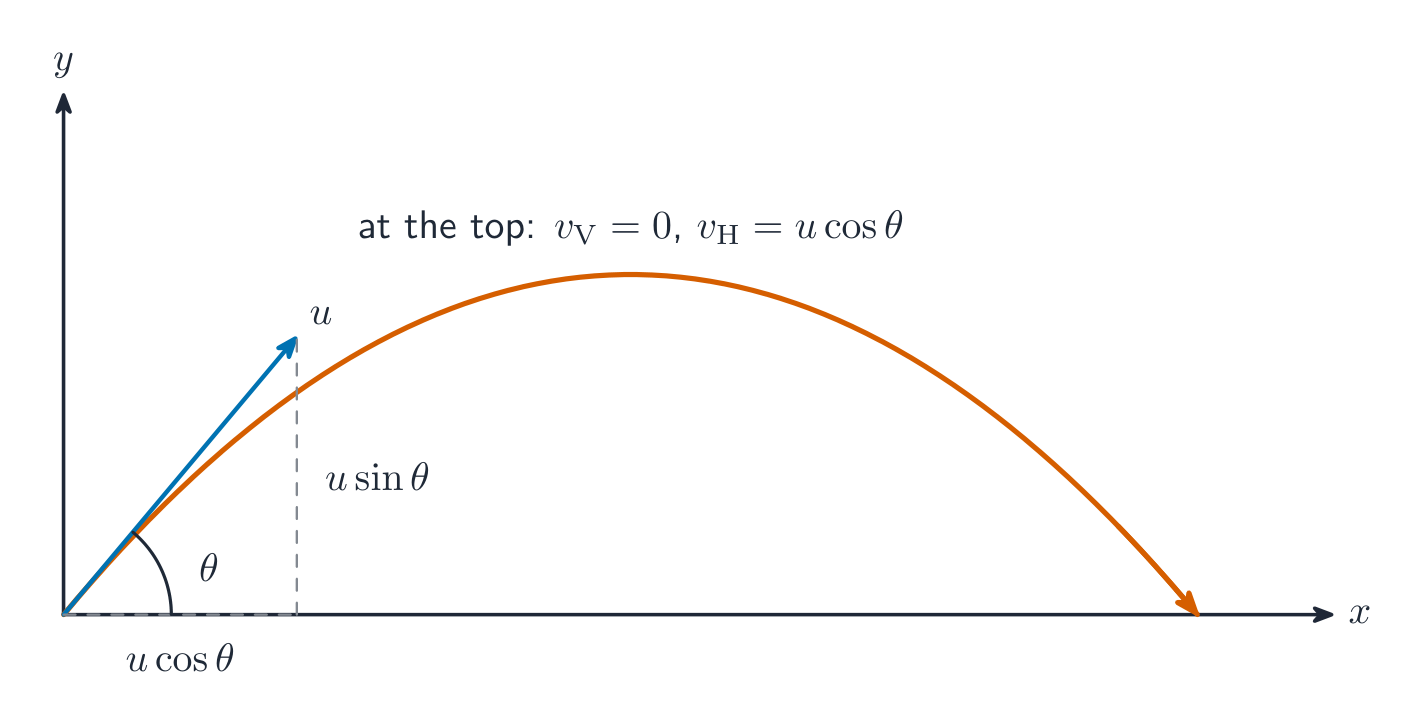
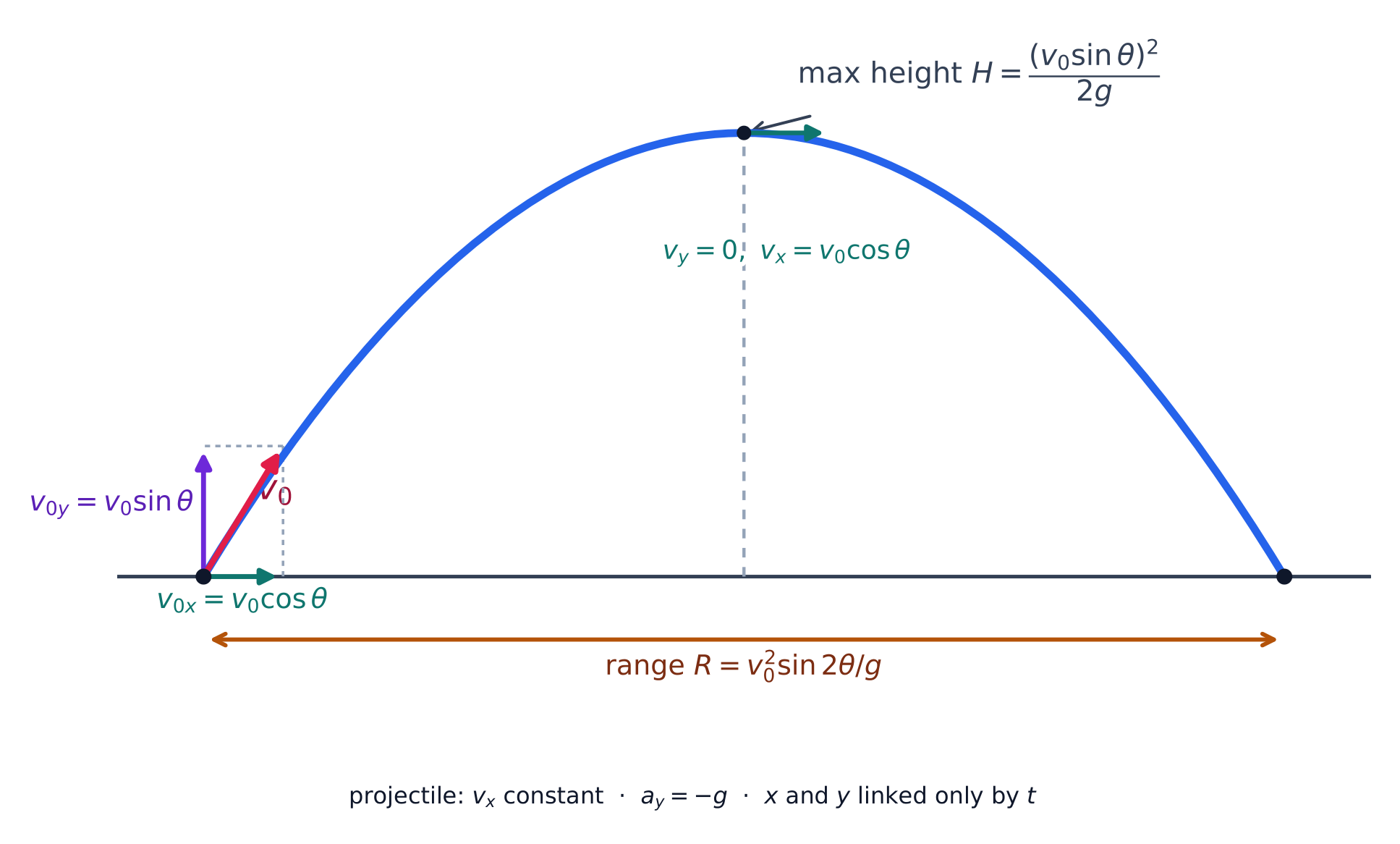
For projectile motion 抛体运动, horizontal and vertical motions are independent, linked only by time $t$: horizontally $a_x=0$ (constant velocity), vertically $a_y=-g$. The path is a parabola. This component method extends to any two-dimensional motion where the accelerations along each axis are known.
Worked example. A ball is launched at $20\ \text{m/s}$, $30^{\circ}$ above the horizontal ($g=9.8\ \text{m/s}^2$). The components are $v_{0x}=20\cos30^{\circ}=17.3\ \text{m/s}$ and $v_{0y}=20\sin30^{\circ}=10\ \text{m/s}$. The vertical motion sets the time: total flight $=\dfrac{2v_{0y}}{g}=\dfrac{20}{9.8}=2.0\ \text{s}$, maximum height $=\dfrac{v_{0y}^2}{2g}=5.1\ \text{m}$, and range $=v_{0x}\times2.0=35\ \text{m}$.
العربية
في بعدين أو ثلاثة أبعاد، الموضع هو متجه $\vec{r}(t)=\langle x(t),y(t),z(t)\rangle$، والسرعة والتسارع هما مشتقاته المتتالية – كل مكون يتم التعامل معه بشكل مستقل.
مثال محلول. $\vec{r}(t)=\big(2t^2\big)\hat{i}+\big(4t-t^3\big)\hat{j}$ (أمتار). باشتقاق كل مكون: $\vec{v}=4t\,\hat{i}+(4-3t^2)\,\hat{j}$ و $\vec{a}=4\,\hat{i}-6t\,\hat{j}$. عند $t=1\ \text{s}$: $\vec{v}=4\hat{i}+1\hat{j}$، لذا السرعة هي $\sqrt{17}\approx4.1\ \text{m/s}$ – لا فيزياء جديدة، مجرد مشتق واحد لكل مكون.
بالنسبة للحركة المقذوفة، الحركات الأفقية والرأسية مستقلة، ترتبطان فقط بالزمن $t$: أفقيًا $a_x=0$ (سرعة ثابتة)، رأسيًا $a_y=-g$. المسار هو قطع مكافئ. يمتد هذه الطريقة المكوّناتية إلى أي حركة ثنائية الأبعاد حيث تسارعات المحاور المعروفة.
مثال محلول. رمية تُطلق بسرعة $20\ \text{m/s}$، بزاوية $30^{\circ}$ فوق الأفقي ($g=9.8\ \text{m/s}^2$). المركبات هي $v_{0x}=20\cos30^{\circ}=17.3\ \text{m/s}$ و$v_{0y}=20\sin30^{\circ}=10\ \text{m/s}$. يحدد الحركة الرأسية الوقت: إجمالي زمن الطيران $=\dfrac{2v_{0y}}{g}=\dfrac{20}{9.8}=2.0\ \text{s}$، أقصى ارتفاع $=\dfrac{v_{0y}^2}{2g}=5.1\ \text{m}$، والمدى $=v_{0x}\times2.0=35\ \text{m}$.
Explore · استكشف
Explore projectile motion · استكشف حركة المقذوفات
Fire the projectile, then vary the angle and speed. The horizontal motion is steady while gravity acts only downward — together they trace a parabola. Find the angle that gives the greatest range (it peaks near $45^\circ$), and try the Moon. · أطلق المقذوف، ثم غيّر الزاوية والسرعة. الحركة الأفقية منتظمة بينما تعمل الجاذبية فقط لأسفل — معًا يرسمان قطعًا مكافئًا. جد الزاوية التي تعطي أقصى مدى (تصل للذروة بالقرب من $45^\circ$)، وحاول القمر الصناعي.
1.5
Exam tips · نصائح للامتحان
English
- Resolve every vector into components before adding — never add magnitudes at an angle directly.
- On Physics C you are expected to use calculus: velocity is $\vec v=\tfrac{d\vec r}{dt}$ and acceleration $\vec a=\tfrac{d\vec v}{dt}$; reverse with integration.
- Carry and check units and treat direction with signs (choose a positive axis and stick to it).
- Use the dot product for work-type quantities and the cross product for torque and angular momentum.
- Sketch the vectors — a diagram catches sign and direction errors the algebra hides.
العربية
- حلل كل متجه إلى مكونات قبل جمعه – لا تجمع المقدارات الزاوية مباشرة.
- في فيزياء C يُتوقع منك استخدام التفاضل والتكامل: السرعة هي $\vec v=\tfrac{d\vec r}{dt}$ والتسارع $\vec a=\tfrac{d\vec v}{dt}$؛ عوّض بالتكامل.
- احتفظ بـوحدات القياس وتحقق منها وعامِل الاتجاه بإشارات (اختر محورًا موجبًا التزم به).
- استخدم الضرب النقطي لكميات الشغل والضرب الاتجاهي للعزم وزخم الزاوية.
- ارسم المتجهات – الرسم البياني يكشف أخطاء الإشارات والاتجاه التي تخفيها الجبر.
Interactive lessons on this topic · دروس تفاعلية حول هذا الموضوع
Work through it step by step, with instant-check exercises. · ا-working عليه خطوة بخطوة، مع تمارين تحقق فوري.
Past Papers · أوراق الامتحانات السابقة