Skip to content · ⁨الانتقال إلى المحتوى⁩

Market Failure and the Role of Government · ⁨فشل السوق ودور الحكومة⁩

AP Microeconomics · ⁨الاقتصاد الجزئي (AP)⁩ · Topic 6 · ⁨الموضوع 6⁩

Video lesson for this topic · ⁨درس فيديو لهذا الموضوع⁩ Open the video page · ⁨افتح صفحة الفيديو⁩
8:21

فشل السوق ودور الحكومة

انظر إلى هذه المصنع. اشتَري شخص ما ما ينتجه، ودُفع لأخر لصنعه. كلا الجانبين سعيدان بالسعر. لكن الدخان ليس ضمن هذا السعر…

English narration · English + 中文 subtitles burned in · ⁨سرد باللغة الإنجليزية · ترجمة مدمجة بالإنجليزية + الصينية⁩

6.1

Socially Efficient and Inefficient Market Outcomes · ⁨النتائج الفعالة وغير الفعالة اجتماعيًا للسوق⁩

Syllabus · ⁨المنهج⁩
English

Enduring Understanding (POL-2): Perfectly competitive markets allocate resources efficiently, but imperfect competition often results in market inefficiencies.

Learning Objective POL-2.A: a. Define social efficiency. b. Explain (using graphs where appropriate) why resource allocation in perfectly competitive markets is socially efficient.

  • POL-2.A.1 The optimal quantity of a good occurs where the marginal benefit of consuming the last unit equals the marginal cost of producing that last unit, thus maximizing total economic surplus.
  • POL-2.A.2 The market equilibrium quantity is equal to the socially optimal quantity only when all social benefits and costs are internalized by individuals in the market. Total economic surplus is maximized at that quantity. [See also PRD-3 and POL-3.]

Learning Objective POL-2.B: Explain (using graphs where appropriate) how private incentives can lead to actions by rational agents that are socially undesirable (inefficient) market outcomes.

  • POL-2.B.1 Rational agents can pursue private actions to exploit or exercise market characteristics known as market power.
  • POL-2.B.2 Rational agents make optimal decisions by equating private marginal benefits and private marginal costs that can result in market inefficiencies.
  • POL-2.B.3 Policymakers use cost-benefit analysis to evaluate different actions to reduce or eliminate market inefficiencies.
  • POL-2.B.4 Market inefficiencies can be eliminated by designing policies that equate marginal social benefit with marginal social cost.

Learning Objective POL-2.C: a. Explain equilibrium allocations in imperfect markets relative to efficient allocations (using graphs where appropriate) and why these markets are inefficient. b. Calculate (using graphs where appropriate) the deadweight loss resulting from the production of a non-efficient quantity.

  • POL-2.C.1 Equilibrium allocations can deviate from efficient allocations due to situations such as monopoly; oligopoly; monopolistic competition; negative and positive externalities in production or consumption; asymmetric information; and insufficient production of public goods.
  • POL-2.C.2 Producing any non-efficient quantity results in deadweight loss.
العربية

الفهم الدائم (POL-2): تخصص الأسواق التنافسية تماماً الموارد بكفاءة، لكن المنافسة غير الكاملة غالباً ما تؤدي إلى عدم كفاءة في السوق.

هدف التعلم POL-2.A: أ.عرّف الكفاءة الاجتماعية. ب.اشرح (باستخدام الرسوم البيانية حيثما كان مناسباً) لماذا يكون تخصيص الموارد في الأسواق التنافسية تماماً فعالاً اجتماعياً.

  • POL-2.A.1 الكمية المثلى للسلع تحدث حيث يتساوى المنفعة الحدية لاستهلاك الوحدة الأخيرة مع التكلفة الحدية لإنتاج تلك الوحدة الأخيرة، مما يعظم فائض الاقتصاد الكلي.
  • POL-2.A.2 تتساوى كمية التوازن في السوق مع الكمية الأمثل اجتماعياً فقط عندما يتم دمج جميع المنافع والتكاليف الاجتماعية في الأفراد داخل السوق. يُعظم فائض الاقتصاد الكلي عند تلك الكمية. [انظر أيضاً PRD-3 و POL-3].

هدف التعلم POL-2.B: اشرح (باستخدام الرسوم البيانية حيثما كان مناسباً) كيف يمكن أن تؤدي الحوافز الخاصة إلى أفعال من قبل الواعين العقلانيين تنتج نتائج سوقية غير مرغوبة اجتماعياً (غير فعالة).

  • POL-2.B.1 يمكن للواعين العقلانيين اتخاذ إجراءات خاصة لاستغلال أو ممارسة خصائص السوق المعروفة باسم قوة السوق.
  • POL-2.B.2 الوكيلون العقلانيون يتخذون قرارات مثلى عن طريق مساواة المنافع الحدية الخاصة والتكاليف الحدية الخاصة، مما قد يؤدي إلى عدم كفاءة السوق.
  • POL-2.B.3 يستخدم صانعو السياسات التحليل التكلفة-الفائدة لتقييم الإجراءات المختلفة لتقليل أو القضاء على عدم كفاءة السوق.
  • POL-2.B.4 يمكن القضاء على عدم كفاءة السوق من خلال تصميم سياسات توازن المنفعة الحدية الاجتماعية مع التكلفة الحدية الاجتماعية.

هدف التعلم POL-2.C: أ. اشرح تخصيصات التوازن في الأسواق غير المثالية مقارنة بالتخصيصات الكفءة (باستخدام الرسوم البيانية عند الحاجة) ولماذا تكون هذه الأسواق غير كفؤة. ب. احسب (باستخدام الرسوم البيانية عند الحاجة) الخسارة العقيمة الناتجة عن إنتاج كمية غير كفؤة.

  • POL-2.C.1 يمكن أن تنحرف تخصيصات التوازن عن التخصيصات الكفئة بسبب حالات مثل الاحتكار؛ أوليغوبولي؛ المنافسة الاحتكارية؛ التأثيرات الخارجية السلبية والموجدة في الإنتاج أو الاستهلاك؛ المعلومات غير المتماثلة؛ والإنتاج غير الكافي للسلع العامة.
  • POL-2.C.2 يؤدي إنتاج أي كمية غير كفؤة إلى خسارة عقيمة.

Source: College Board AP Course and Exam Description · ⁨المصدر: وصف دورة وامتحان College Board AP⁩

English

A market outcome is socially efficient 社会有效率 when it maximizes total surplus – when the marginal social benefit equals the marginal social cost of the last unit. Perfect competition reaches this on its own. But sometimes markets fail to, producing too much or too little. This is market failure 市场失灵, and it is the main economic justification for government action.

العربية

تُعتبر نتيجة السوق فعالة اجتماعيًا عندما تعظم الفائض الكلي – أي عندما يتساوى الفائدة الاجتماعية الهامشة مع التكلفة الاجتماعية الهامشة للوحدة الأخيرة. تصل المنافسة المثلى إلى ذلك تلقائيًا. لكن أحيانًا تفشل الأسواق في تحقيق ذلك، مما ينتج عنه إنتاج زائد أو ناقص. هذا هو فشل السوق، وهو التبرير الاقتصادي الرئيسي للتدخل الحكومي.

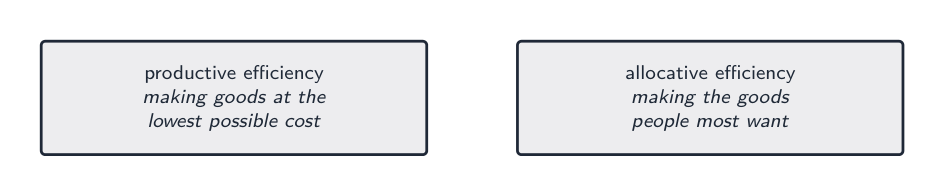
الكفاءة الإنتاجية هي أقل تكلفة؛ والكفاءة التخصيصية هي صنع ما يريده الناس
6.2

Externalities · ⁨الآثار الخارجية⁩

Syllabus · ⁨المنهج⁩
English

Enduring Understanding (POL-3): Private incentives can fail to account for all socially relevant considerations.

Learning Objective POL-3.A: a. Define externalities. b. Explain (using graphs where appropriate) how in the presence of externalities, private markets do not take into consideration social costs or social benefits.

  • POL-3.A.1 The socially optimal quantity of a good occurs where the marginal social benefit of consuming the last unit equals the marginal social cost of producing that last unit, thus maximizing total economic surplus.
  • POL-3.A.2 Externalities are either positive or negative and arise from lack of well-defined property rights and/or high transaction costs.
  • POL-3.A.3 In the presence of externalities, rational agents respond to private costs and benefits and not to external costs and benefits.
  • POL-3.A.4 Rational agents have the incentive to free ride when a good is non-excludable.

Learning Objective POL-3.B: Explain (using graphs where appropriate) how public policies address positive or negative externalities.

  • POL-3.B.1 Policies that address positive or negative externalities include taxes/subsidies, environmental regulation, public provision, the assignment of property rights, and the reassignment of property rights through private transactions.
العربية

فهم دائم (POL-3): الحوافز الخاصة قد تفشل في أخذ جميع الاعتبارات ذات الصلة اجتماعيًا بعين الاعتبار.

هدف التعلم POL-3.A: أ. عرّف التأثيرات الخارجية. ب. اشرح (باستخدام الرسوم البيانية عند الحاجة) كيف أن الأسواق الخاصة لا تأخذ في الاعتبار التكاليف أو المنافع الاجتماعية في ظل وجود تأثيرات خارجية.

  • POL-3.A.1 الكمية الاجتماعية المثلى للسلعة تحدث حيث تتساوى المنفعة الحدية الاجتماعية لاستهلاك الوحدة الأخيرة مع التكلفة الحدية الاجتماعية لإنتاج تلك الوحدة الأخيرة، مما يعظم فائض الاقتصاد الكلي.
  • POL-3.A.2 التأثيرات الخارجية إما موجدة أو سلبية وتنشأ عن عدم وضوح حقوق الملكية و/أو ارتفاع تكاليف المعاملة.
  • POL-3.A.3 في ظل وجود تأثيرات خارجية، يستجيب الوكيلون العقلانيون للتكاليف والمنافع الخاصة وليس للتكاليف والمنافع الخارجية.
  • POL-3.A.4 يمتلك الوكيلون العقلانيون حافزًا للاستفادة المجانية عندما تكون السلعة غير قابلة للاستبعاد.

هدف التعلم POL-3.B: اشرح (باستخدام الرسوم البيانية عند الحاجة) كيف تعالج السياسات العامة التأثيرات الخارجية الموجدة أو السلبية.

  • POL-3.B.1 تشمل السياسات التي تعالج التأثيرات الخارجية الموجدة أو السلبية الضرائب/الإعانات، والرقابة البيئية، والتوفير العام، وتعيين حقوق الملكية، وإعادة تعيين حقوق الملكية من خلال المعاملات الخاصة.

Source: College Board AP Course and Exam Description · ⁨المصدر: وصف دورة وامتحان College Board AP⁩

English
Negative externalities

An externality 外部性 is a cost or benefit that falls on a third party not involved in the transaction – so the private decision-makers ignore it.

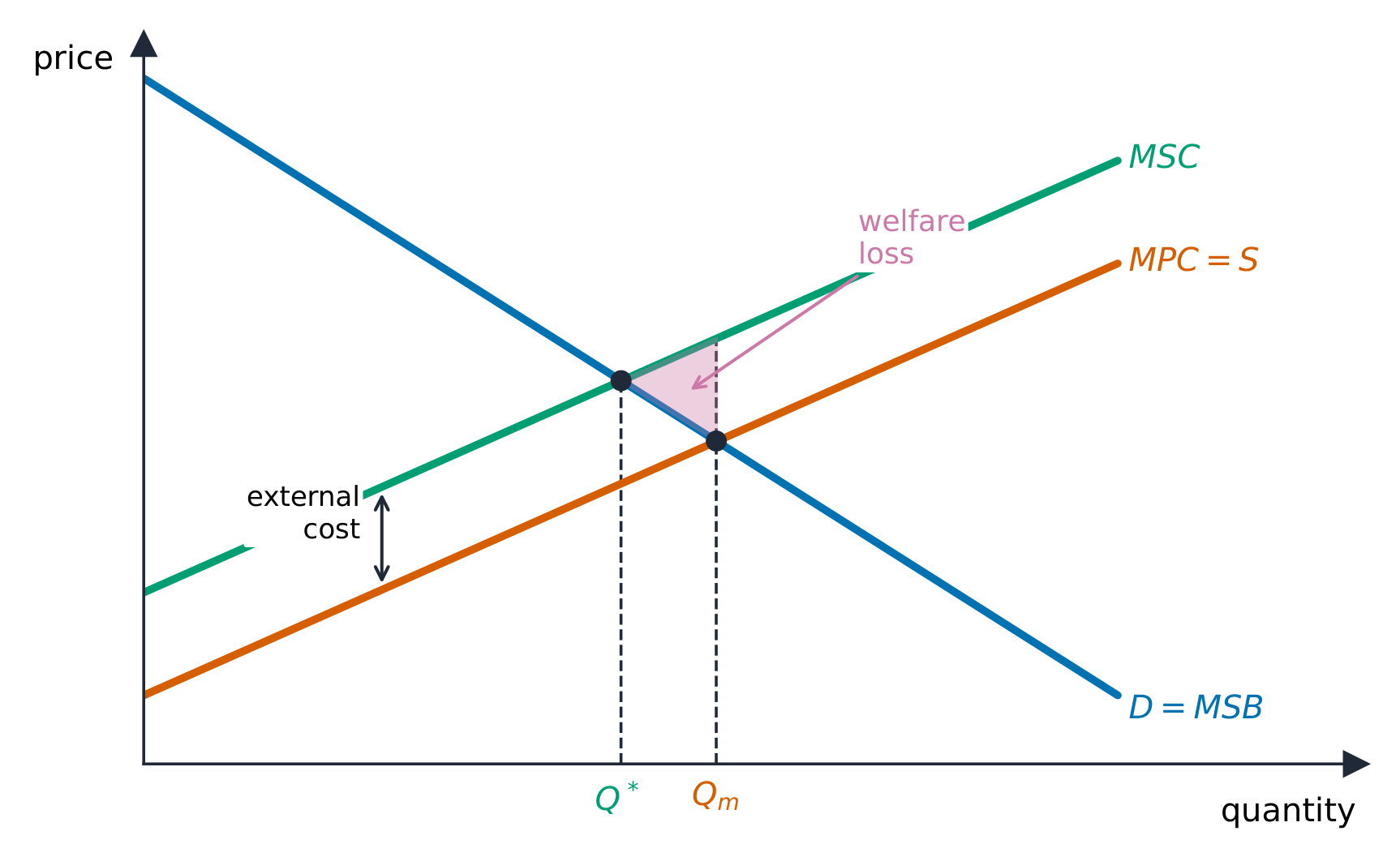
  • A negative externality 负外部性 (pollution) means marginal social cost > marginal private cost. The market over-produces; the deadweight loss is a triangle. Fixes: a Pigovian tax 庇古税 or regulation to make producers "internalize" the cost (shifting private cost up to social cost).
  • A positive externality 正外部性 (vaccination, education) means marginal social benefit > marginal private benefit. The market under-produces. Fixes: a subsidy to consumers or producers.
  • Coase theorem 科斯定理: if property rights are clear and bargaining is costless, private parties can solve an externality themselves – but that is rare with many people involved.

Worked example. A factory's private marginal cost of a chemical is $\$8$ per unit, but each unit also dumps $\$3$ of pollution on neighbors, so the marginal social cost is $\$11$. Ignoring the $\$3$, the market over-produces. A Pigovian tax of exactly $\$3$ per unit raises the firm's private cost to $\$11$ – now equal to the social cost – so the firm cuts output to the efficient quantity and the externality is "internalized."

Exam skill: identify whether an externality is positive or negative, show on a graph that private and social curves diverge, mark the deadweight loss, and name the correcting tax or subsidy.

العربية
السجائر: الآثار الخارجية تعني أن الأسواق الخاصة قد لا تصل إلى نتائج فعالة اجتماعيًا
الآثار الخارجية السلبية

الآثار الخارجية هي تكلفة أو منفعة تقع على طرف ثالث غير مشارك في الصفقة – بحيث يتجاهل صناع القرار الخاصونها.

أثر خارجي سلبي: السوق ينتج بشكل مفرط، مما يسبب خسارة رفاهية
  • الأثر الخارجي السلبي (التلوث) يعني أن التكلفة الاجتماعية الهامشة > التكلفة الخاصة الهامشة. يقوم السوق بـالإنتاج الزائد؛ وخسارة العجز هي مثلث. الحلول: ضريبة بيغو أو تنظيم لجعل المنتجين "يدخلوا" التكلفة (بتحويل التكلفة الخاصة للأعلى لتصل إلى التكلفة الاجتماعية).
  • الأثر الخارجي الإيجابي (التطعيم، التعليم) يعني أن الفائدة الاجتماعية الهامشة > الفائدة الخاصة الهامشة. يقوم السوق بـالإنتاج الناقص. الحلول: إعانة للمستهلكين أو المنتجين.
  • نظرية كوز: إذا كانت حقوق الملكية واضحة والمفاوضة بلا تكاليف، يمكن للأطراف الخاصة حل الأثر الخارجي بأنفسهم – لكن هذا نادر الحدوث عندما يكون هناك عدد كبير من الأشخاص المعنيين.
شارع مدينة مزدحم بالسيارات وجهًا لوجه في حالة توقف تام
الاكتظاظ هو أثر خارجي سلبي: كل سائق يفرض تكلفة على كل سائق آخر لا تحصيلها أي سعر

مثال محلول. التكلفة الخاصة الهامشة لمصنع ما لمادة كيميائية هي $\$8$ per unit, but each unit also dumps $\$3$ من التلوث على الجيران، لذا فإن التكلفة الاجتماعية الهامشة هي $\$11$. Ignoring the $\$3$، والسوق ينتج بشكل مفرط. ضريبة بيغو مقدارها بالضبط $\$3$ per unit raises the firm's private cost to $\$11$** – الآن مساوية للتكلفة الاجتماعية – sehingga تقلل الشركة الإنتاج إلى الكمية الفعالة ويتم "دخول" الأثر الخارجي.

مهارة الامتحان: حدد ما إذا كان الأثر الخارجي إيجابيًا أم سلبيًا، وأظهر على الرسم البياني أن المنحنيات الخاصة والاجتماعية تتباعد، وعلّم خسارة العجز، وسمّ الضريبة أو الإعانة المصححة.

تلوث صناعي: أثر خارجي سلبي تكون فيه التكلفة الاجتماعية أكبر من التكلفة الخاصة
Explore · ⁨استكشف⁩

A market with an externality · ⁨سوق به تأثير خارجي⁩

An externality makes private cost differ from social cost, so the free-market quantity is inefficient. See the deadweight loss and how a tax or subsidy corrects it. · ⁨التأثير الخارجي يجعل التكلفة الخاصة تختلف عن التكلفة الاجتماعية، لذا تكون الكمية في السوق الحر غير فعالة. رَأِ الخسارة الجماعية وكيف تصحح الضريبة أو الإعانة ذلك.⁩

Vocabulary · ⁨مفردات⁩ Train · ⁨تدريب⁩
English العربية
socially efficient/ˈsəʊʃəli ɪˈfɪʃənt/ فعالية اجتماعية
market failure/ˈmɑːkɪt ˈfeɪlɪə/ فشل السوق
externality/ekˈstɜːnælɪti/ التأثير الخارجي
negative externality/ˈneɡətɪv ekˈstɜːnælɪti/ الأثر الخارجي السلبي
Pigovian tax/pɪˈɡəʊvɪən tæks/ ضريبة بيغوفيان
positive externality/ˈpɒzɪtɪv ekˈstɜːnælɪti/ الأثر الخارجي الإيجابي
Coase theorem/kəʊs ˈθɪərəm/ نظرية كوز
rivalry/ˈraɪvəlri/ منافسة
excludability/eksˌkluːdəˈbɪlɪti/ الاستبعاد
private good/ˈpraɪvət ɡʊd/ سلعة خاصة
public good/ˈpʌblɪk ɡʊd/ سلعة عامة
free-ride/friː raɪd/ التسلق المجاني
Common resources/ˈkɒmən rɪˈzɔːsɪz/ الموارد المشتركة
tragedy of the commons/ˈtrædʒədi ɒvðə ˈkɒmənz/ مأساة-commons (المشتركات)
Antitrust laws/ˌæntɪˈtrʌst lɔːz/ قوانين مكافحة الاحتكار
per-unit tax/pɜː ˈjuːnɪt tæks/ ضريبة الوحدة الواحدة
lump-sum tax/lʌmp sʌm tæks/ ضريبة مقطوعة
lump-sum subsidy/lʌmp sʌm ˈsʌbsɪdi/ إعانة مقطوعة
income distribution/ˈɪŋkʌm ˌdɪstrɪˈbjuːʃn/ توزيع الدخل
6.3

Public and Private Goods · ⁨السلع العامة والخاصة⁩

Syllabus · ⁨المنهج⁩
English

Enduring Understanding (POL-3): Private incentives can fail to account for all socially relevant considerations.

Learning Objective POL-3.C: a. Define whether goods are rival and/or excludable. b. Explain how the nature of rival and/or excludable goods influences the behavior of individuals and groups.

  • POL-3.C.1 Private goods are rival and excludable, and public goods are non-rival and non-excludable.
  • POL-3.C.2 Due to the free rider problem, private individuals usually lack the incentive to produce public goods, leaving government as the only producer.
  • POL-3.C.3 Governments sometimes choose to produce private goods, such as educational services, and to allow free access to them.
  • POL-3.C.4 Some natural resources are, by their nature, non-excludable and rival and therefore open access. Private individuals inefficiently overconsume such resources.
العربية

فهم دائم (POL-3): الحوافز الخاصة قد تفشل في أخذ جميع الاعتبارات ذات الصلة اجتماعيًا بعين الاعتبار.

هدف التعلم POL-3.C: أ. عرّف ما إذا كانت السلع منافسة و/أو قابلة للاستبعاد. ب. اشرح كيف يؤثر طبيعة السلع المنافِسة و/أو القابلة للاستبعاد على سلوك الأفراد والمجموعات.

  • POL-3.C.1 السلع الخاصة هي سلعات منافسة وقابلة للاستبعاد، والسلع العامة هي سلعات غير منافسة وغير قابلة للاستبعاد.
  • POL-3.C.2 بسبب مشكلة الاستفادة المجانية، يفتقر الأفراد عادةً إلى الحافز لإنتاج السلع العامة، مما يجعل الحكومة المنتج الوحيد.
  • POL-3.C.3 تختار الحكومات أحيانًا إنتاج سلع خاصة، مثل الخدمات التعليمية، والسماح بالوصول المجاني إليها.
  • POL-3.C.4 بعض الموارد الطبيعية، بطبيعتها، غير قابلة للاستبعاد ومنافسة وبالتالي مفتوحة الوصول. يستهلك الأفراد مثل هذه الموارد بشكل مفرط وغير كفء.

Source: College Board AP Course and Exam Description · ⁨المصدر: وصف دورة وامتحان College Board AP⁩

English

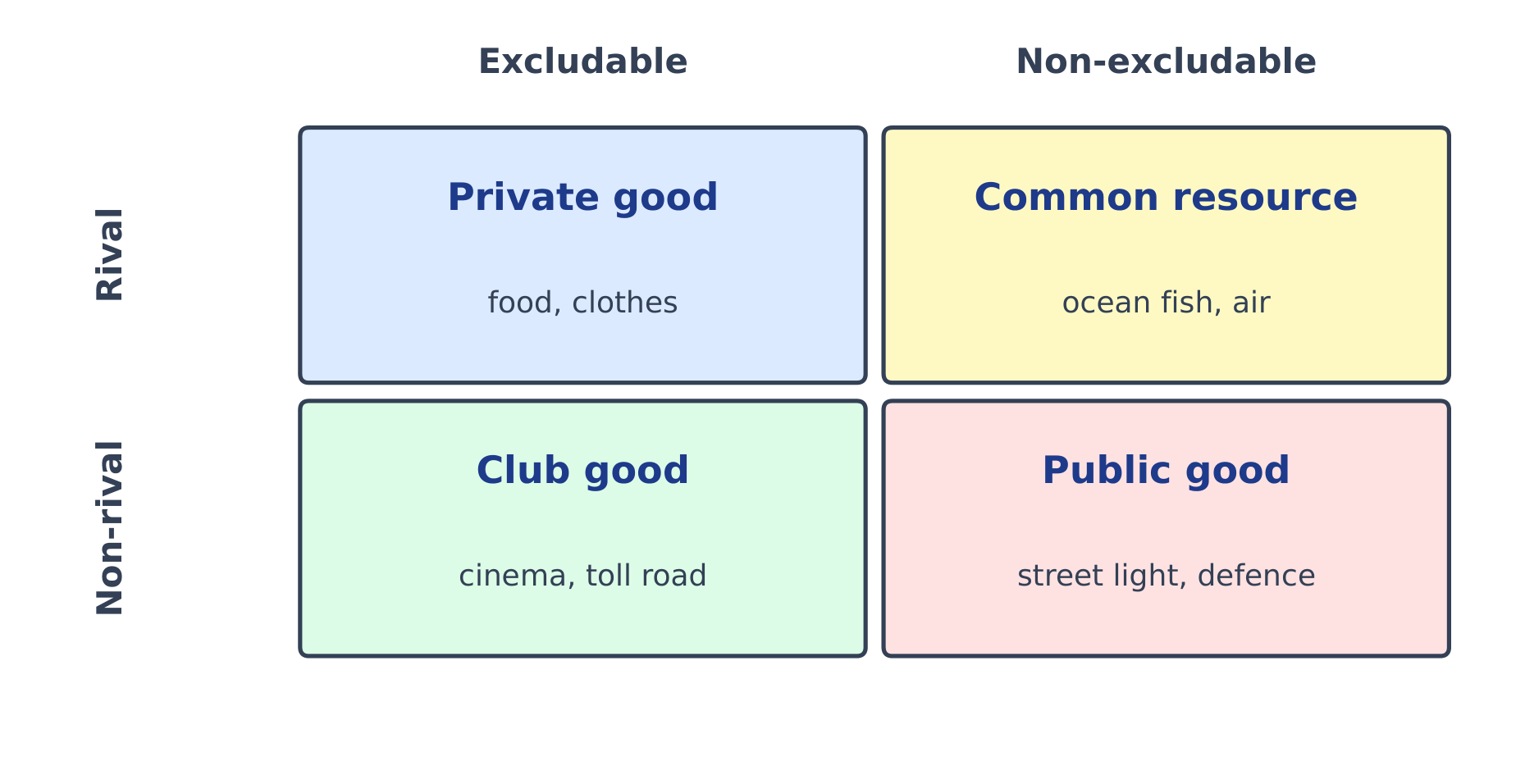
Goods differ along two traits: rivalry 竞争性 (does one person's use reduce another's?) and excludability 排他性 (can non-payers be kept out?).

  • A private good 私人物品 is rival and excludable (a sandwich) – markets handle these well.
  • A public good 公共物品 is non-rival and non-excludable (national defense, a lighthouse). Because non-payers cannot be excluded, people free-ride 搭便车 – enjoy it without paying – so markets under-provide it, and government usually supplies it.
  • Common resources 公共资源 are rival but non-excludable (ocean fish); over-use ruins them – the tragedy of the commons 公地悲剧.
العربية

تختلف السلع على أساس خاصيتين: المنافسة (هل يقلل استخدام شخص واحد من إمكانية استخدامه لشخص آخر؟) والاستبعاد (هل يمكن منع غير المدفوعين من الدخول؟).

تصنيف السلع بناءً على كونها منافسة ومستبعدة أم لا
  • السلعة الخاصة هي منافسة ومستبعدة (شطيرة) – تتعامل الأسواق مع هذه جيدًا.
  • السلعة العامة هي غير منافسة وغير مستبعدة (الدفاع الوطني، المنارة). نظرًا لأنه لا يمكن استبعاد غير المدفوعين، فإن الناس يتسربون – يستفيدون منها دون دفع ثمن – لذلك تقوم الأسواق بـتوفيرها بنقص، وعادةً ما تزودها الحكومة.
  • الموارد المشتركة هي منافسة لكنها غير مستبعدة (أسماك المحيط)؛ والاستخدام المفرط يدمرها – وهي مأساة الموارد المشتركة.
6.4

The Effects of Government Intervention in Different Market Structures · ⁨تأثيرات تدخل الحكومة في هياكل سوقية مختلفة⁩

Syllabus · ⁨المنهج⁩
English

Enduring Understanding (POL-4): In imperfect markets, well-designed government policy can reduce waste.

Learning Objective POL-4.A: a. Define government policy interventions in imperfect markets. b. Explain (using graphs where appropriate) how government policies can alter market outcomes in perfectly and imperfectly competitive markets. c. Calculate (using data from a graph or table as appropriate) changes in market outcomes resulting from government policies in perfectly competitive and imperfectly competitive markets.

  • POL-4.A.1 Per-unit taxes and subsidies affect the total price consumers pay, net price firms receive, equilibrium quantity, consumer and producer surpluses, deadweight loss, and government revenue or cost. The impact of change depends on the price elasticity of demand and supply.
  • POL-4.A.2 Lump-sum taxes and lump-sum subsidies do not change either marginal cost or marginal benefit; only fixed costs will be affected.
  • POL-4.A.3 Binding price ceilings and floors affect prices and quantities differently depending on the market structures (perfect competition, monopoly, monopolistic competition, and monopsony) and the price elasticities of supply and demand.
  • POL-4.A.4 Government intervention in imperfect markets can increase efficiency if the policy correctly addresses the incentives that led to the market failure.
  • POL-4.A.5 Government can use price regulation to address inefficiency due to monopoly.
  • POL-4.A.6 A natural monopoly will require a lump-sum subsidy to produce at the allocatively efficient quantity.
  • POL-4.A.7 Governments use antitrust policy in an attempt to make markets more competitive.
    • Exclusion statement: A graph of inefficiency and policy due to collusion is beyond the scope of the course and the AP Exam.
العربية

فهم دائم (POL-4): في الأسواق غير المثالية، يمكن للسياسة الحكومية الجيدة التصميم تقليل الهدر.

هدف التعلم POL-4.A: أ. عرّف تدخلات السياسة الحكومية في الأسواق غير المثالية. ب. اشرح (باستخدام الرسوم البيانية عند الحاجة) كيف يمكن للسياسات الحكومية تغيير نتائج السوق في الأسواق التنافسية تمامًا وغير التنافسية. ج. احسب (باستخدام بيانات من رسم بياني أو جدول عند الحاجة) التغيرات في نتائج السوق الناجمة عن السياسات الحكومية في الأسواق التنافسية تمامًا وغير التنافسية.

  • POL-4.A.1 تؤثر الضرائب والإعانات لكل وحدة على السعر الإجمالي الذي يدفعه المستهلكون، والسعر الصافي الذي تحصل عليه الشركات، والكمية المتوازنة، وفوائض المستهلكين والمنتجين، والخسارة العقيمة، وإيرادات الحكومة أو تكاليفها. يعتمد التأثير على مرونة الطلب والعرض.
  • POL-4.A.2 الضرائب والإعانات المباشرة لا تغير neither التكلفة الحدية nor المنفعة الحدية؛ بل تتأثر فقط التكاليف الثابتة.
  • POL-4.A.3影响 سقف وسقف الأسعار الملزمة الأسعار والكميات بشكل مختلف اعتمادًا على هياكل السوق (التنافس الكامل، الاحتكار، المنافسة الاحتكارية، وشراء واحد) ومرونة العرض والطلب.
  • POL-4.A.4 يمكن أن يزيد التدخل الحكومي في الأسواق غير المثالية الكفاءة إذا عالجت السياسة بشكل صحيح الحوافز التي أدت إلى فشل السوق.
  • POL-4.A.5 يمكن للحكومة استخدام تنظيم الأسعار لمعالجة عدم الكفاءة الناجم عن الاحتكار.
  • POL-4.A.6 سيحتاج الاحتكار الطبيعي إلى إعانة مباشرة لإنتاج الكمية الكفئة توزيعيًا.
  • POL-4.A.7 تستخدم الحكومات سياسة مكافحة الاحتكار لمحاولة جعل الأسواق أكثر تنافسية.
    • عبارة الاستبعاد: رسم بياني لعدم الكفاءة والسياسة الناتجة عن الاتفاق السري خارج نطاق المقرر وامتحان AP.

Source: College Board AP Course and Exam Description · ⁨المصدر: وصف دورة وامتحان College Board AP⁩

English

Government tools change outcomes differently by structure:

  • Regulating a monopoly's price toward $P=MC$ can increase efficiency (unlike a price control in a competitive market, which creates shortage/surplus).
  • Antitrust laws 反垄断法 break up or block anti-competitive mergers and collusion.
  • Taxes and subsidies shift output toward the socially efficient quantity when externalities are present.

The key insight: the same policy can help or hurt efficiency depending on whether the market was already efficient (competitive) or already failing (monopoly, externality).

Per-unit vs lump-sum. A per-unit tax 从量税 adds to marginal cost, so it shifts supply up, raises price, cuts quantity, and creates deadweight loss. A lump-sum tax 定额税 (a fixed charge like a licence fee) does not change marginal cost or marginal benefit, so in the short run the profit-maximising price and quantity are unchanged – only the firm's profit falls; in the long run it changes entry and exit. For a natural monopoly, regulating price down to $P=MC$ (allocatively efficient) forces a loss, so a lump-sum subsidy 定额补贴 is needed to keep it producing that efficient quantity.

العربية

أدوات الحكومة تغير النتائج بشكل مختلف حسب الهيكل:

  • تنظيم سعر الاحتكار نحو $P=MC$ يمكن أن يزيد الكفاءة (عكس التحكم في السعر في سوق تنافسي، الذي يخلق عجزًا/فائضًا).
  • قوانين مكافحة الاحتكار تفكك أو تمنع عمليات الاندماج المضادة للتنافس والتواطؤ.
  • الضرائب والإعانات توجه الإنتاج نحو الكمية الفعالة اجتماعيًا عند وجود آثار خارجية.

الرؤية الأساسية: نفس السياسة يمكن أن تساعد أو تضر بالكفاءة اعتمادًا على ما إذا كان السوق بالفعل فعالًا (تنافسي) أو فشل بالفعل (احتكار، أثر خارجي).

الضريبة لكل وحدة مقابل الضريبة الإجمالية. تضيف الضريبة لكل وحدة إلى التكلفة الحدية، مما يرفع منحنى العرض، ويزيد السعر، ويقلل الكمية، ويخلق خسارة عجزية. أما الضريبة الإجمالية (وهي رسوم ثابتة مثل رسوم التراخيص) فلا تغير التكلفة الحدية أو المنفعة الحدية،因此在 القصير الأمد يكون السعر والكمية اللذان يُحسِّبان الربح ثابتين – فقط ينخفض ربح الشركة؛ وفي الطويل الأمد يؤثر ذلك على الدخول والخروج من السوق. بالنسبة لـ ال monopole الطبيعي، فإن تنظيم السعر ليصل إلى $P=MC$ (الكفاءة التخصيصية) يُجبره على الخسارة، لذلك يُحتاج إلى إعانة إجمالية لإبقائه ينتج تلك الكمية الكفءة.

6.5

Inequality · ⁨عدم المساواة⁩

Syllabus · ⁨المنهج⁩
English

Enduring Understanding (POL-5): Market outcomes can result in income inequality.

Learning Objective POL-5.A: Define measures of economic inequality in income and wealth.

  • POL-5.A.1 Income levels and poverty rates vary greatly both across and within groups (e.g., age, gender, race) and countries.
  • POL-5.A.2 The Lorenz curve and Gini coefficient are used to represent the degree of inequality in distributions and to compare distributions across different countries, policies, or time periods.
    • Exclusion statement: Drawing the Lorenz curve and calculating Gini coefficients are beyond the scope of the course and the AP Exam.

Learning Objective POL-5.B: Explain sources of income and wealth inequality.

  • POL-5.B.1 Each factor of production receives the value of its marginal product, which can contribute to income inequality.
  • POL-5.B.2 Sources of income and wealth inequality include differences in tax structures (progressive and regressive tax structures), human capital, social capital, inheritance, effects of discrimination, access to financial markets, mobility, and bargaining power within economic and social units (firms, labor unions, and families).
العربية

فهم دائم (POL-5): يمكن أن تؤدي نتائج السوق إلى عدم مساواة الدخل.

هدف التعلم POL-5.A: عرّف مقاييس عدم المساواة الاقتصادية في الدخل والثروة.

  • POL-5.A.1 تختلف مستويات الدخل ومعدلات الفقر بشكل كبير عبر المجموعات (مثل: العمر، الجنس، العرق) ودول مختلفة.
  • POL-5.A.2 تُستخدم منحنى لورنز ومعامل جيني لتمثيل درجة عدم المساواة في التوزيعات ومقارنة التوزيعات عبر دول أو سياسات أو فترات زمنية مختلفة.
    • عبارة الاستبعاد: رسم منحنى لورينز وحساب معاملات جيني خارج نطاق المقرر وامتحان AP.

هدف التعلم POL-5.B: شرح مصادر عدم المساواة في الدخل والثروة.

  • POL-5.B.1 كل عامل إنتاج يحصل على قيمة منتجه الحدي، مما قد يساهم في عدم المساواة في الدخل.
  • POL-5.B.2 تشمل مصادر عدم المساواة في الدخل والثروة الفروقات في هياكل الضرائب (الهياكل التقدمية والتناقصية)، ورأس المال البشري، ورأس المال الاجتماعي، والميراث، وتأثيرات التمييز، والوصول إلى الأسواق المالية، والحركة الاجتماعية، والقوة التفاوضية داخل الوحدات الاقتصادية والاجتماعية (الشركات، النقابات العمالية، والعائلات).

Source: College Board AP Course and Exam Description · ⁨المصدر: وصف دورة وامتحان College Board AP⁩

English

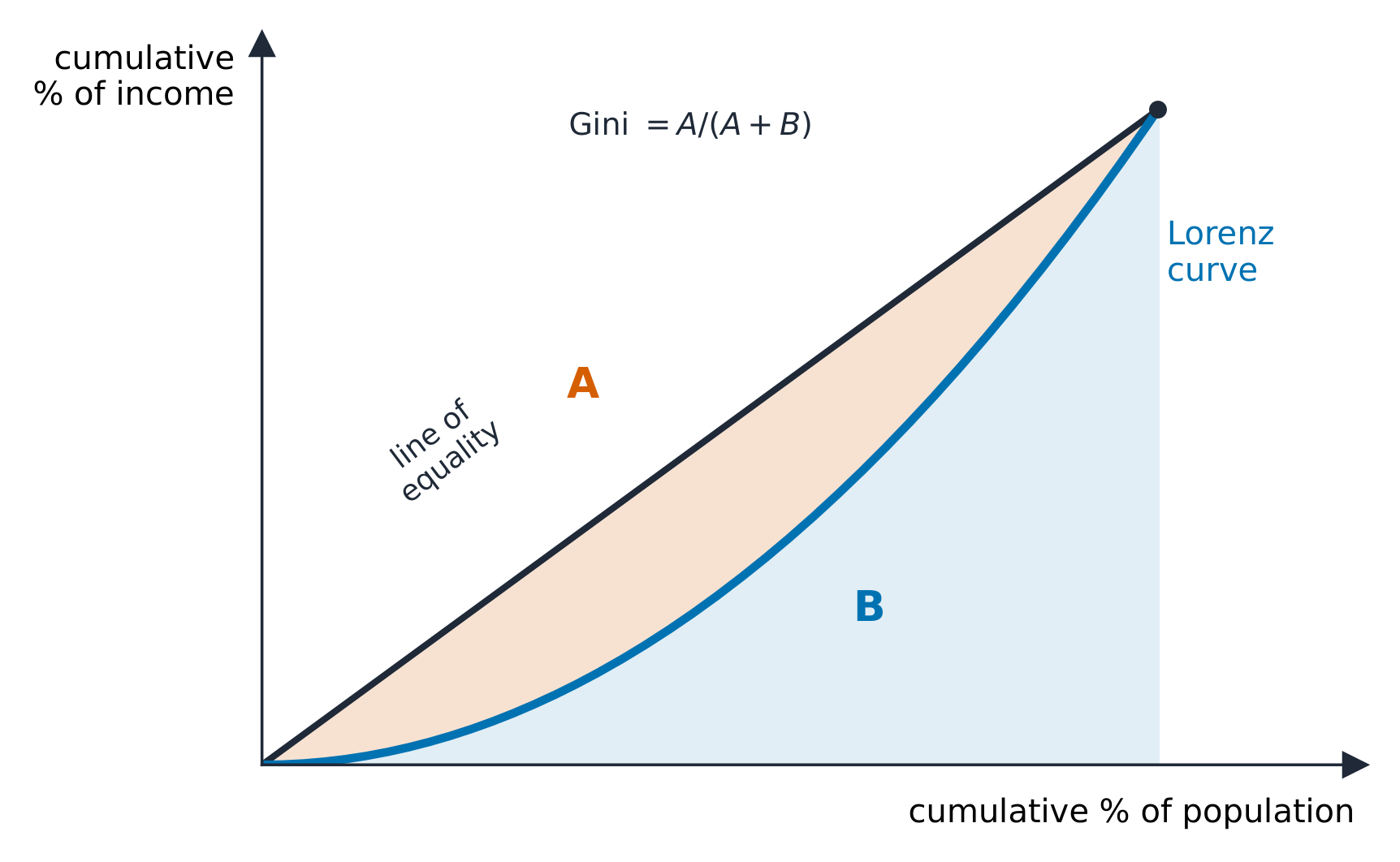
Markets reward productivity, but the resulting income distribution 收入分配 can be very unequal. Economists measure it with the Lorenz curve 洛伦兹曲线 (share of income against share of population; the further it bows from the 45° line, the more unequal) and the Gini coefficient 基尼系数 (0 = perfect equality, 1 = perfect inequality).

Worked example. Suppose the poorest $20\%$ of households earn just $5\%$ of income, while the richest $20\%$ earn $50\%$. Under perfect equality each $20\%$ would earn exactly $20\%$, so the Lorenz curve would be the $45°$ line. Because the bottom fifth is well below $20\%$ and the top fifth well above, the curve bows far beneath the diagonal – a large gap that means a high Gini coefficient and substantial inequality.

Sources of inequality include differences in human capital 人力资本 (skills, education), inheritance, and discrimination. Governments redistribute through progressive taxes 累进税 (higher rates on higher incomes) and transfer payments 转移支付 (welfare, subsidies). There is a debated efficiency–equity trade-off 效率与公平权衡: redistribution can reduce work incentives, so societies balance fairness against the size of the total pie.

العربية

تكافئ الأسواق الإنتاجية، لكن التوزيع الدخل الناتج قد يكون غير متساوٍ للغاية. يقيس الاقتصاديون ذلك باستخدام منحنى لورنز (حصة الدخل مقابل حصة السكان؛ كلما ابتعد أكثر عن خط 45°، كان التوزيع أكثر عدم مساواة) ومعامل جيني (0 = مساواة مثالية، 1 = عدم مساواة مثالية).

منحنى لورنز ومعامل جيني يقيسان عدم المساواة في الدخل

مثال محلل. افترض أن أفقر $20\%$ من الأسر تحقق دخلاً قدره $5\%$ فقط، بينما يحقق أغنى $20\%$ دخلاً قدره $50\%$. تحت المساواة المثالية، Would each $20\%$ achieving exactly $20\%$, therefore the Lorenz curve would be the $45°$ line. Because the bottom fifth is well below $20\%$ and the top fifth well above, the curve bows far beneath the diagonal – a large gap that means a high Gini coefficient and substantial inequality.

تشمل مصادر عدم المساواة الفروقات في رأس المال البشري (المهارات، التعليم)، والميراث، والتمييز. تعيد الحكومات توزيع الثروة من خلال الضرائب التصاعدية (معدلات أعلى للدخول الأعلى) والمدفوعات الانتقالية (الرفاهية، الإعانات). يوجد نقاش حول مفاضلة الكفاءة–العدالة: يمكن أن تقلل إعادة التوزيع من حافز العمل، لذلك تتوازن المجتمعات بين العدالة وحجم الكعكة الكلية.

الثروة والفقر جنبًا إلى جنب: الأسواق وحدها قد تترك عدم مساواة كبيرة في الدخل دون معالجة
Explore · ⁨استكشف⁩

Measure inequality with a Lorenz curve · ⁨قِس عدم المساواة بمنحنى لورنز⁩

A Lorenz curve plots cumulative income against cumulative population; the further it bows from the diagonal, the more unequal — summarised by the Gini coefficient. · ⁨يرسم منحنى لورنز الدخل التراكمي مقابل السكان التراكميين؛ كلما ابتعد المنحنى عن القطر الزائد، زادت عدم المساواة — ويُختصر ذلك بـمعامل جيني.⁩

Vocabulary · ⁨مفردات⁩ Train · ⁨تدريب⁩
English العربية
Lorenz curve/ˈlɒrənts kɜːv/ منحنى لورينز
Gini coefficient/ˈdʒiːni ˌkəʊɪˈfɪʃənt/ معامل جيني
human capital/ˈhjuːmən ˈkæpɪtl/ رأس المال البشري
progressive taxes/prəˈɡresɪv ˈtæksɪz/ الضرائب التقدمية
transfer payments/ˈtrænsfɜː ˈpeɪmənts/ الدفعات الانتقالية
efficiency–equity trade-off/ɪˈfɪʃənsi ˈekwɪti treɪd ɒf/ مفاضلة الكفاءة–الإنصاف
6.5

Exam tips · ⁨نصائح للامتحان⁩

English
  • A negative externality makes the market over-produce; correct with a Pigovian tax equal to the external cost. A positive externality under-produces; correct with a subsidy.
  • A public good is non-rival and non-excludable, so free-riding leads markets to under-provide it.
  • Classify goods by rivalry and excludability; common resources (rival, non-excludable) suffer the tragedy of the commons.
  • The same policy can help or hurt efficiency depending on whether the market was already efficient or failing.
  • Measure inequality with the Lorenz curve and Gini coefficient (0 = equality, 1 = inequality).
العربية
  • العواقب السلبية الخارجية تجعل السوق ينتج أكثر من اللازم؛ يتم تصحيحها بـ ضريبة بيغوفيان تساوي التكلفة الخارجية. أما العواقب الإيجابية فتنتج أقل من اللازم؛ يتم تصحيحها بإعانة.
  • السلعة العامة غير تنافسية وغير قابلة للاستبعاد، مما يؤدي إلى استغلالها مجاناً ويؤدي إلى أن توفر الأسواق لها بشكل أقل من اللازم.
  • صنف السلع بناءً على التنافسية والإستبعاد؛ تعاني الموارد المشتركة (تنافسية، غير قابلة للاستبعاد) من مأساة المشاعات.
  • نفس السياسة قد تساعد أو تضر بالكفاءة اعتماداً على ما إذا كان السوق كفؤاً بالفعل أو يفشل.
  • قِس عدم المساواة باستخدام منحنى لورنز ومعامل جيني (0 = مساواة، 1 = عدم مساواة).

Interactive lessons on this topic · ⁨دروس تفاعلية حول هذا الموضوع⁩

Work through it step by step, with instant-check exercises. · ⁨ا-working عليه خطوة بخطوة، مع تمارين تحقق فوري.⁩

Past Papers · ⁨أوراق الامتحانات السابقة⁩

More topics in AP Microeconomics · ⁨الاقتصاد الجزئي (AP)⁩ · ⁨المزيد من المواضيع في AP Microeconomics · ⁨الاقتصاد الجزئي (AP)⁩⁩

Log in or create account · ⁨تسجيل الدخول أو إنشاء حساب⁩

IGCSE, A-Level & AP