Skip to content · ⁨الانتقال إلى المحتوى⁩

Further Pure Mathematics 1 · ⁨رياضيات بحتة متقدمة 1⁩

A-Level Further Mathematics · ⁨A-Level رياضيات متقدمة⁩ · Topic 1 · ⁨الموضوع 1⁩

Video lesson for this topic · ⁨درس فيديو لهذا الموضوع⁩ Open the video page · ⁨افتح صفحة الفيديو⁩
14:28

رياضيات بحتة متقدمة 1

هناك معادلة تكعيبية، تتقاطع المحور عند ثلاث جذور. إيجاد تلك الجذور بدقة قد يكون صعباً — أو حتى مستحيلاً باليد. ولكن إليك جمالاً…

English narration · English + 中文 subtitles burned in · ⁨سرد باللغة الإنجليزية · ترجمة مدمجة بالإنجليزية + الصينية⁩

English

This handout covers Topic 1: Further Pure Mathematics 进阶纯数学 1. It adds new algebra, matrices, polar coordinates, more vectors, and proof by induction.

العربية

تغطي هذه الورقة الموضوع 1: رياضيات نقية إضافية 1. تضيف جبراً جديداً، ومصفوفات، وإحداثيات قطرية، ومتجهات أكثر، وإثباتاً بالاستقراء.
1.1

Roots of polynomial equations · ⁨جذور المعادلات كثيرات الحدود⁩

Syllabus · ⁨المنهج⁩
English
Candidates should be able to: Notes and examples
• recall and use the relations between the roots and coefficients of polynomial equations e.g. to evaluate symmetric functions of the roots or to solve problems involving unknown coefficients in equations; restricted to equations of degree 2, 3 or 4 only.
• use a substitution to obtain an equation whose roots are related in a simple way to those of the original equation Substitutions will not be given for the easiest cases, e.g. where the new roots are reciprocals or squares or a simple linear function of the old roots.
العربية
يجب أن يكون المرشحون قادرين على: ملاحظات وأمثلة
• استرجاع واستخدام العلاقات بين الجذور والمعاملات لمعادلات كثير الحدود مثلًا لتقييم الدوال المتماثلة للجذور أو لحل مسائل تتضمن معاملات غير معروفة في المعادلات؛ مقيدة بالمعادلات من الدرجة 2 أو 3 أو 4 فقط.
• استخدام التعويض للحصول على معادلة تكون جذورها مرتبطة بطريقة بسيطة بجذور المعادلة الأصلية لن يتم تقديم تعويضات للحالات الأسهل، مثلًا عندما تكون الجذور الجديدة مقلوبات أو مربعات أو دالة خطية بسيطة للجذور القديمة.

Source: Cambridge International syllabus · ⁨المصدر: منهج كامبريدج الدولي⁩

English

For a polynomial equation, the roots 根 are linked to the coefficients 系数. For $ax^2 + bx + c = 0$ with roots $\alpha, \beta$:

$$\alpha + \beta = -\frac{b}{a}, \qquad \alpha\beta = \frac{c}{a}.$$
For a cubic $ax^3 + bx^2 + cx + d = 0$ with roots $\alpha, \beta, \gamma$:
$$\sum\alpha = -\frac{b}{a}, \qquad \sum\alpha\beta = \frac{c}{a}, \qquad \alpha\beta\gamma = -\frac{d}{a}.$$
Sums like $\sum\alpha$ and $\sum\alpha\beta$ are symmetric functions 对称函数 of the roots (unchanged if the roots are swapped). To find an equation whose roots are changed in a simple way, use a substitution 代换 (for example, put $w = \alpha + 1$).

Worked example. The equation $x^2 - 5x + 6 = 0$ has roots $\alpha, \beta$. Find the equation with roots $\alpha + 1, \beta + 1$.

Here $\alpha + \beta = 5$ and $\alpha\beta = 6$. The new sum is $(\alpha + 1) + (\beta + 1) = 7$, and the new product is $(\alpha + 1)(\beta + 1) = \alpha\beta + \alpha + \beta + 1 = 6 + 5 + 1 = 12$. So the new equation is

$$x^2 - 7x + 12 = 0.$$

العربية

بالنسبة لمعادلة كثيرة حدود، ترتبط الجذور بـالمعاملات. بالنسبة لـ $ax^2 + bx + c = 0$ بجذور $\alpha, \beta$:

$$\alpha + \beta = -\frac{b}{a}, \qquad \alpha\beta = \frac{c}{a}.$$
بالنسبة لمعادلة مكعبة $ax^3 + bx^2 + cx + d = 0$ بجذور $\alpha, \beta, \gamma$:
$$\sum\alpha = -\frac{b}{a}, \qquad \sum\alpha\beta = \frac{c}{a}, \qquad \alpha\beta\gamma = -\frac{d}{a}.$$
المجموعات مثل $\sum\alpha$ و$\sum\alpha\beta$ هي دوال متماثلة للجذور (لا تتغير إذا تم تبديل الجذور). لإيجاد معادلة تكون جذورها متغيرة بطريقة بسيطة، استخدم تعويضاً (على سبيل المثال، ضع $w = \alpha + 1$).

مثال محلول. المعادلة $x^2 - 5x + 6 = 0$ لها جذور $\alpha, \beta$. أوجد المعادلة ذات الجذور $\alpha + 1, \beta + 1$.

هنا $\alpha + \beta = 5$ و$\alpha\beta = 6$. المجموع الجديد هو $(\alpha + 1) + (\beta + 1) = 7$، والجداء الجديد هو $(\alpha + 1)(\beta + 1) = \alpha\beta + \alpha + \beta + 1 = 6 + 5 + 1 = 12$. لذا المعادلة الجديدة هي

$$x^2 - 7x + 12 = 0.$$

Explore · ⁨استكشف⁩

Roots of a polynomial · ⁨جذور كثير حدود⁩

y = ax³ + bx² + cx + d

The roots are where the curve meets the x-axis — their sum and product link to the coefficients. · ⁨الجذور هي النقاط التي يلتقي فيها المنحنى مع محور x — ومجموعها وحاصل ضربها مرتبطان بالمعاملات.⁩

1.2

Rational functions and graphs · ⁨الدوال الكسرية والرسوم البيانية⁩

Syllabus · ⁨المنهج⁩
English
Candidates should be able to: Notes and examples
• sketch graphs of simple rational functions, including the determination of oblique asymptotes, in cases where the degree of the numerator and the denominator are at most 2 Including determination of the set of values taken by the function, e.g. by the use of a discriminant. Detailed plotting of curves will not be required, but sketches will generally be expected to show significant features, such as turning points, asymptotes and intersections with the axes.
• understand and use relationships between the graphs of $y = f(x)$, $y^2 = f(x)$, $y = \frac{1}{f(x)}$, $y = |f(x)|$ and $y = f(|x|)$ Including use of such sketch graphs in the course of solving equations or inequalities.
العربية
يجب أن يكون المرشحون قادرين على: ملاحظات وأمثلة
• رسم رسوم بيانية للدوال النسبية البسيطة، بما في ذلك تحديد المماسات المائلة، في الحالات التي يكون فيها درجة البسط والمقام 2 كحد أقصى بما في ذلك تحديد مجموعة القيم التي تأخذها الدالة، مثلًا باستخدام المميز. لن يكون الرسم التفصيلي للمنحنيات مطلوبًا، لكن يُتوقع عادةً أن تُظهر الرسومات السموية سمات مهمة، مثل نقاط الانعطاف والمماسات والتقاطعات مع المحاور.
• فهم واستخدام العلاقات بين الرسوم البيانية لـ $y = f(x)$، $y^2 = f(x)$، $y = \frac{1}{f(x)}$، $y = |f(x)|$ و $y = f(|x|)$ بما في ذلك استخدام مثل هذه الرسوم البيانية السموية أثناء حل المعادلات أو المتباينات.

Source: Cambridge International syllabus · ⁨المصدر: منهج كامبريدج الدولي⁩

English

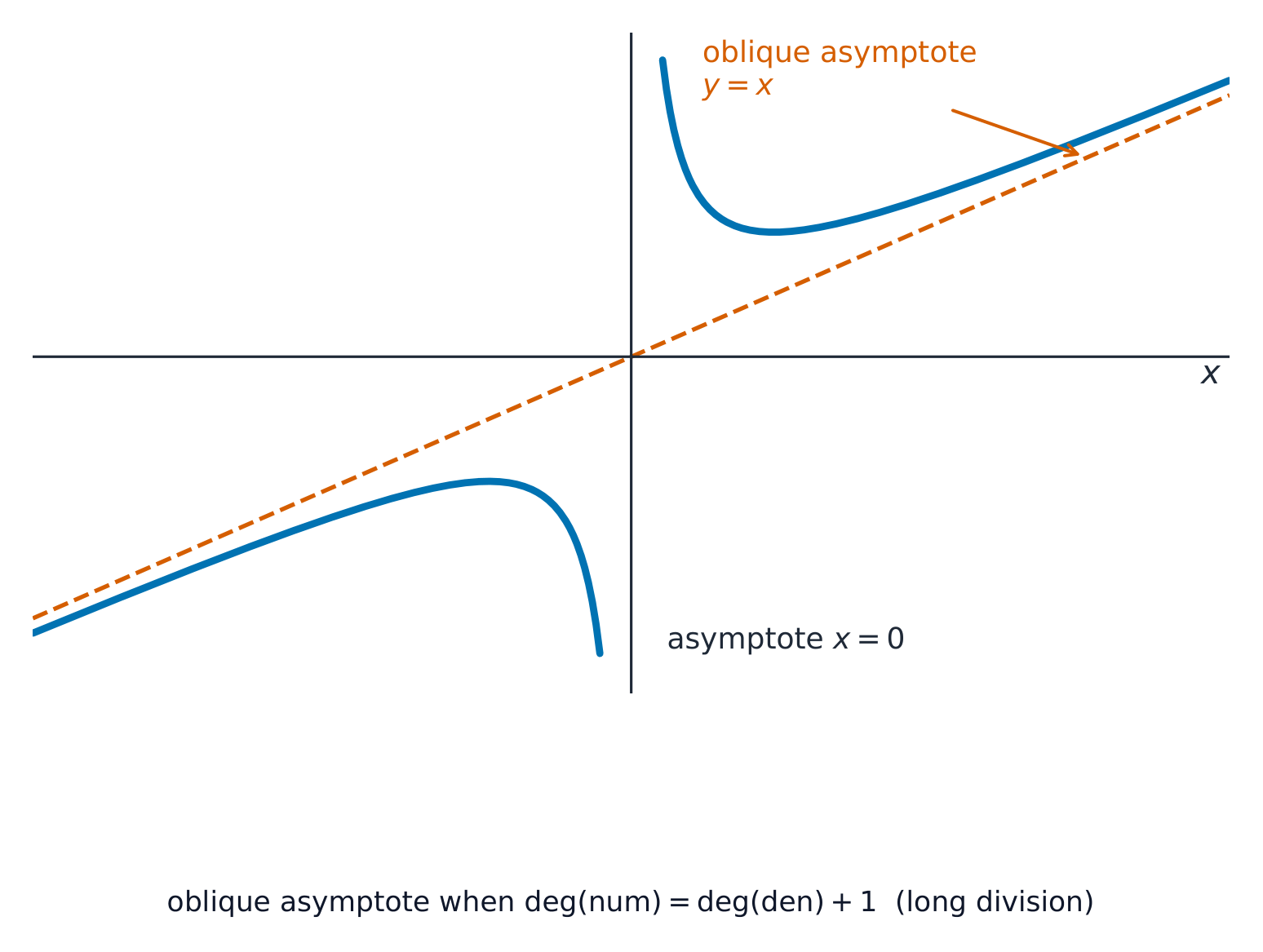
A rational function 有理函数 is a fraction of two polynomials. When the top has degree exactly one higher than the bottom, the graph has an oblique asymptote 斜渐近线 (a slanted line the curve approaches); find it by dividing out. You should also be able to relate the graph of $y = f(x)$ to those of $y^2 = f(x)$, $y = \dfrac{1}{f(x)}$, $y = |f(x)|$ and $y = f(|x|)$. Find the set of values the function can take using the discriminant 判别式, and locate its turning points 驻点.

Worked example. Find the oblique asymptote of $y = \dfrac{x^2 + x + 1}{x + 1}$.

Divide out the fraction: $\dfrac{x^2 + x + 1}{x + 1} = x + \dfrac{1}{x + 1}$. As $x \to \pm\infty$ the remainder $\dfrac{1}{x+1} \to 0$, so the curve approaches the line $y = x$ — the oblique asymptote.

العربية

الدالة الكسرية هي كسر لمكثفين كثيرتي حدود. عندما يكون أعلى المكثف درجة أعلى بمقدار واحد عن الأسفل تماماً، يحتوي الرسم البياني على مقارب مائل (خط مائل يقترب منه المنحنى)؛ يتم إيجادها بالقسمة. يجب عليك أيضاً أن تكون قادراً على ربط رسم $y = f(x)$ برسم $y^2 = f(x)$، $y = \dfrac{1}{f(x)}$، $y = |f(x)|$ و$y = f(|x|)$. أوجد مجموعة القيم التي يمكن أن تأخذها الدالة باستخدام المميز، وحدد نقاط الانعطاف.

منحنى كسري بذراعين يسير بجانب خط متقطع مائل
بعيداً عن نقطة الأصل يلتصق المنحنى بالخط المائل $y=x$؛ بالقرب من $x=0$ يتجه على طول المقارب الرأسي.

مثال محلول. أوجد المقارب المائل لـ $y = \dfrac{x^2 + x + 1}{x + 1}$.

قسّم الكسر: $\dfrac{x^2 + x + 1}{x + 1} = x + \dfrac{1}{x + 1}$. بما أن $x \to \pm\infty$ الباقي $\dfrac{1}{x+1} \to 0$، فإن المنحنى يقترب من الخط $y = x$ — وهو المقارب المائل.

Explore · ⁨استكشف⁩

Rational functions · ⁨الدوال الكسرية⁩

y = a/(x − b) + c

A rational function has asymptotes the curve approaches but never touches. · ⁨الدالة الكسرية لها مقارب يقترب منه المنحنى لكنه لم يلمسه أبداً.⁩

Vocabulary · ⁨مفردات⁩ Train · ⁨تدريب⁩
English العربية
Further Pure Mathematics/ˈfɜːðə pjʊə ˌmæθɪˈmætɪks/ رياضيات نقية إضافية
roots/ruːts/ الجذور
coefficients/ˌkəʊɪˈfɪʃənts/ المعاملات
substitution/ˌsʌbstɪˈtjuːʃn/ استبدال
rational function/ˈræʃənl ˈfʌŋkʃn/ دالة نسبية
oblique asymptote/əˈbliːk ˈæsɪmptəʊt/ قارب مائل
method of differences/ˈmeθəd ɒv ˈdɪfrənsɪz/ طريقة الفروق
convergent/kənˈvɜːdʒənt/ متقارب
sum to infinity/sʌm tʊ ɪnˈfɪnɪti/ المجموع إلى ما لا نهاية
1.3

Summation of series · ⁨مجموع المتتاليات⁩

Syllabus · ⁨المنهج⁩
English
Candidates should be able to: Notes and examples
• use the standard results for $\sum r$, $\sum r^2$, $\sum r^3$ to find related sums
• use the method of differences to obtain the sum of a finite series Use of partial fractions to express a general term in a suitable form may be required.
• recognise, by direct consideration of a sum to $n$ terms, when a series is convergent, and find the sum to infinity in such cases
العربية
يجب أن يكون المرشحون قادرين على: ملاحظات وأمثلة
• استخدام النتائج القياسية لـ $\sum r$، $\sum r^2$، $\sum r^3$ لإيجاد المجاميع ذات الصلة
• استخدام طريقة الاختلافات للحصول على مجموع متتالية محدودة قد يكون استخدام الكسور الجزئية للتعبير عن الحد العام بصيغة مناسبة مطلوبًا.
• التعرف، من خلال النظر المباشر إلى مجموع $n$ حدًا، على متى تكون المتسلسلة متقاربة، وإيجاد المجموع اللانهائي في مثل هذه الحالات

Source: Cambridge International syllabus · ⁨المصدر: منهج كامبريدج الدولي⁩

English

Learn the standard results:

$$\sum_{r=1}^{n} r = \tfrac12 n(n+1), \qquad \sum_{r=1}^{n} r^2 = \tfrac16 n(n+1)(2n+1), \qquad \sum_{r=1}^{n} r^3 = \tfrac14 n^2(n+1)^2.$$
The method of differences 差分法 sums a series by cancelling middle terms: if partial fractions 部分分式 write each term as $f(r) - f(r+1)$, almost everything cancels. From the sum to $n$ terms you can see whether a series is convergent 收敛 and, if so, find its sum to infinity 无穷和.

Worked example. Find $\displaystyle\sum_{r=1}^{n} (2r + 1)$.

$$\sum_{r=1}^{n}(2r + 1) = 2\sum_{r=1}^{n} r + \sum_{r=1}^{n} 1 = 2\cdot\tfrac12 n(n+1) + n = n(n+1) + n = n(n+2).$$

العربية

تعلم النتائج القياسية:

$$\sum_{r=1}^{n} r = \tfrac12 n(n+1), \qquad \sum_{r=1}^{n} r^2 = \tfrac16 n(n+1)(2n+1), \qquad \sum_{r=1}^{n} r^3 = \tfrac14 n^2(n+1)^2.$$
طريقة الفوارق تحسب مجموع متتالية عن طريق إلغاء الحدود الوسطى: إذا كانت الكسور الجزئية، اكتب كل حد على صورة $f(r) - f(r+1)$، ستختفي تقريبًا كل شيء. من خلال المجموع لـ $n$ حدًا، يمكنك تحديد ما إذا كانت المتتالية متقاربة، وإذا كانت كذلك، أوجد مجموعها إلى ما لا نهاية.

مثال محلّل. أوجد $\displaystyle\sum_{r=1}^{n} (2r + 1)$.

$$\sum_{r=1}^{n}(2r + 1) = 2\sum_{r=1}^{n} r + \sum_{r=1}^{n} 1 = 2\cdot\tfrac12 n(n+1) + n = n(n+1) + n = n(n+2).$$

Explore · ⁨استكشف⁩

Sequences and their sums · ⁨السلاسل ومجاميعها⁩

Step through the terms and the running total — the idea behind a series and its sum to n terms. · ⁨مرر الحدود والمجموع المتراكم — المبدأ وراء السلسلة ومجموعها لـ n حد.⁩

1.4

Matrices · ⁨المصفوفات⁩

Syllabus · ⁨المنهج⁩
English
Candidates should be able to: Notes and examples
carry out operations of matrix addition, subtraction and multiplication, and recognise the terms zero matrix and identity (or unit) matrix Including non-square matrices. Matrices will have at most 3 rows and columns.
recall the meaning of the terms singular and non-singular as applied to square matrices and, for $2 \times 2$ and $3 \times 3$ matrices, evaluate determinants and find inverses of non-singular matrices The notations $\det \mathbf{M}$ for the determinant of a matrix $\mathbf{M}$, and $\mathbf{I}$ for the identity matrix, will be used.
understand and use the result, for non-singular matrices, $(\mathbf{AB})^{-1} = \mathbf{B}^{-1}\mathbf{A}^{-1}$ Extension to the product of more than two matrices may be required.
understand the use of $2 \times 2$ matrices to represent certain geometric transformations in the $x$-$y$ plane, in particular: – understand the relationship between the transformations represented by $\mathbf{A}$ and $\mathbf{A}^{-1}$ – recognise that the matrix product $\mathbf{AB}$ represents the transformation that results from the transformation represented by $\mathbf{B}$ followed by the transformation represented by $\mathbf{A}$ – recall how the area scale factor of a transformation is related to the determinant of the corresponding matrix – find the matrix that represents a given transformation or sequence of transformations Understanding of the terms rotation, reflection, enlargement, stretch and shear for 2D transformations will be required. Other 2D transformations may be included, but no particular knowledge of them is expected.
understand the meaning of invariant as applied to points and lines in the context of transformations represented by matrices, and solve simple problems involving invariant points and invariant lines. e.g. to locate the invariant points of the transformation represented by $\begin{pmatrix} 6 & 5 \\ 2 & 3 \end{pmatrix}$, or to find the invariant lines through the origin for $\begin{pmatrix} 4 & -1 \\ 2 & 1 \end{pmatrix}$, or to show that any line with gradient 1 is invariant for $\begin{pmatrix} 2 & 0 \\ 1 & 1 \end{pmatrix}$.
العربية
يجب أن يكون المرشحون قادرين على: ملاحظات وأمثلة
إجراء عمليات جمع المصفوفات وطرحها وضربها، والتعرف على مصطلحي مصفوفة الصفر ومصفوفة الوحدة (أو المصفوفة الهوية) بما في ذلك المصفوفات غير المربعة. ستحتوي المصفوفات على ما لا يزيد عن 3 صفوف وأعمدة.
استحضار معنى المصطلحين singular (منفرد) وnon-singular (غير منفرد) كما ينطبقان على المصفوفات المربعة، وللمصفوفات $2 \times 2$ و$3 \times 3$، حساب المحددات وإيجاد المعكوسات للمصفوفات غير المنفردة سيتم استخدام الرموز $\det \mathbf{M}$ لمحدد المصفوفة $\mathbf{M}$، و$\mathbf{I}$ لمصفوفة الوحدة.
فهم واستخدام النتيجة، بالنسبة للمصفوفات غير المنفردة، $(\mathbf{AB})^{-1} = \mathbf{B}^{-1}\mathbf{A}^{-1}$ قد يكون مطلوبًا التوسع إلى حاصل ضرب أكثر من مصفوفتين.
فهم استخدام $2 \times 2$ المصفوفات لتمثيل بعض التحولات الهندسية في المستوى $x$-$y$، وتحديداً: – فهم العلاقة بين التحولات الممثلة بواسطة $\mathbf{A}$ و$\mathbf{A}^{-1}$ – إدراك أن حاصل ضرب المصفوفات $\mathbf{AB}$ يمثل التحول الناتج عن تطبيق التحول الممثل بواسطة $\mathbf{B}$ متبوعاً بالتحول الممثل بواسطة $\mathbf{A}$ – تذكر كيف يرتبط عامل مقياس المساحة للتحول بمحدد المصفوفة المقابلة – إيجاد المصفوفة التي تمثل تحولاً معيناً أو تسلسلاً من التحويلات سيتم مطلوب فهم مصطلحات الدوران، الانعكاس، التكبير، التمدد والشذوذ للتحويلات 2D. قد يتم تضمين تحويلات 2D أخرى، لكن لا يُتوقع معرفة خاصة بها.
فهم معنى ثابت كما ينطبق على النقاط والخطوط في سياق التحويلات الممثلة بالمصفوفات، وحل مسائل بسيطة تتضمن نقاط ثابتة وخطوط ثابتة. مثلًا: لتحديد النقاط الثابتة للتحويل الممثل بـ $\begin{pmatrix} 6 & 5 \\ 2 & 3 \end{pmatrix}$، أو لإيجاد الخطوط الثابتة المارة بنقطة الأصل لـ $\begin{pmatrix} 4 & -1 \\ 2 & 1 \end{pmatrix}$، أو لإظهار أن أي خط ميله 1 هو خط ثابت لـ $\begin{pmatrix} 2 & 0 \\ 1 & 1 \end{pmatrix}$.

Source: Cambridge International syllabus · ⁨المصدر: منهج كامبريدج الدولي⁩

English
A matrix moves the plane

A matrix 矩阵 is a rectangular block of numbers. Matrix addition adds entries in matching positions; you can also subtract and multiply matrices (multiplication is row $\times$ column). The zero matrix 零矩阵 has every entry $0$, and the identity matrix 单位矩阵 (or unit matrix) $I$ leaves any matrix unchanged under multiplication.

For a $2\times 2$ matrix $A = \begin{pmatrix} a & b \\ c & d \end{pmatrix}$, the determinant 行列式 is $\det A = ad - bc$. If $\det A \neq 0$ the matrix is non-singular (otherwise it is a singular matrix 奇异矩阵), and the inverse matrix 逆矩阵 is

$$A^{-1} = \frac{1}{ad - bc}\begin{pmatrix} d & -b \\ -c & a \end{pmatrix}.$$
For a product, $(AB)^{-1} = B^{-1}A^{-1}$. A $2\times 2$ matrix can represent a geometric transformation 几何变换 of the plane — a rotation 旋转, reflection 反射, enlargement 放大, stretch 拉伸 or shear 切变: the determinant gives the area scale factor, and a product $AB$ means "do $B$, then $A$". Points or lines that do not move are called invariant points 不变点 and invariant lines 不变直线.

Worked example. Find the inverse of $A = \begin{pmatrix} 3 & 1 \\ 2 & 4 \end{pmatrix}$.

$\det A = 3\times 4 - 1\times 2 = 10$, so

$$A^{-1} = \frac{1}{10}\begin{pmatrix} 4 & -1 \\ -2 & 3 \end{pmatrix}.$$

العربية
مصفوفة تنقل المستوي

المصفوفة هي كتلة مستطيلة من الأرقام. جمع المصفوفات يجمع المدخلات في المواقع المتطابقة؛ يمكن أيضًا طرح وضرب المصفوفات (الضرب هو صف $\times$ ضرب عمود). المصفوفة الصفرية تحتوي على كل مدخل $0$، والمصفوفة الوحدة (أو مصفوفة الوحدة) $I$ تترك أي مصفوفة دون تغيير عند الضرب.

لمصفوفة $2\times 2$ $A = \begin{pmatrix} a & b \\ c & d \end{pmatrix}$، فإن المحدد هو $\det A = ad - bc$. إذا كان $\det A \neq 0$ تكون المصفوفة غير مفردة (وإلا فهي مصفوفة مفردة)، والمصفوفة المعكوسة هي

$$A^{-1} = \frac{1}{ad - bc}\begin{pmatrix} d & -b \\ -c & a \end{pmatrix}.$$
للمنتج، $(AB)^{-1} = B^{-1}A^{-1}$. مصفوفة $2\times 2$ يمكن أن تمثل تحولاً هندسياً للمستوى — دوران، انعكاس، تكبير، تمدد أو إزاحة أفقية: يعطي المحدد معامل مقياس المساحة، والجداء $AB$ يعني "قم بـ $B$، ثم $A$". النقاط أو الخطوط التي لا تتحرك تسمى نقاط ثابتة وخطوط ثابتة.

مربع وحدة وموازٍ أكبر يحوله إليه مصفوفة
ترسل المصفوفة المربع الواحد إلى موازٍ مساحته تساوي المحدد.

مثال محلّل. أوجد معكوس $A = \begin{pmatrix} 3 & 1 \\ 2 & 4 \end{pmatrix}$.

$\det A = 3\times 4 - 1\times 2 = 10$، لذا

$$A^{-1} = \frac{1}{10}\begin{pmatrix} 4 & -1 \\ -2 & 3 \end{pmatrix}.$$

Explore · ⁨استكشف⁩

Matrices as transformations · ⁨المصفوفات كتحويلات⁩

Change the four entries and watch the unit square map to a new shape. The determinant is the area scale factor. · ⁨غيّر المدخلات الأربعة وراقب تحول المربع الوحدة إلى شكل جديد. المحدد هو عامل مقياس المساحة.⁩

Vocabulary · ⁨مفردات⁩ Train · ⁨تدريب⁩
English العربية
matrix/ˈmeɪtrɪks/ مصفوفة
zero matrix/ˈzɪərəʊ ˈmeɪtrɪks/ المصفوفة الصفرية
identity matrix/aɪˈdentɪti ˈmeɪtrɪks/ مصفوفة الوحدة
determinant/dɪˈtɜːmɪnənt/ المحدد
singular matrix/ˈsɪŋɡjʊlə ˈmeɪtrɪks/ المصفوفة المفردة
inverse matrix/ɪnˈvɜːs ˈmeɪtrɪks/ المصفوفة العكسية
geometric transformation/ˌdʒiːəʊˈmetrɪk trænsfɔːˈmeɪʃn/ التحويل الهندسي
invariant points/ɪnˈveərɪənt pɔɪnts/ نقاط ثابتة
invariant lines/ɪnˈveərɪənt laɪnz/ خطوط ثابتة
polar coordinates/ˈpəʊlə kəʊˈɔːdɪnəts/ الإحداثيات القطبية
Cartesian coordinates/kɑːˈtiːzɪən kəʊˈɔːdɪnəts/ الإحداثيات الديكارتية
polar curves/ˈpəʊlə kɜːvz/ المنحنيات القطبية
plane/pleɪn/ المستوى
Watch lesson · ⁨شاهد الدرس⁩
1.5

Polar coordinates · ⁨الإحداثيات القطبية⁩

Syllabus · ⁨المنهج⁩
English
Candidates should be able to: Notes and examples
understand the relations between Cartesian and polar coordinates, and convert equations of curves from Cartesian to polar form and vice versa The convention $r \geqslant 0$ will be used.
sketch simple polar curves, for $0 \leqslant \theta < 2\pi$ or $-\pi < \theta \leqslant \pi$ or a subset of either of these intervals Detailed plotting of curves will not be required, but sketches will generally be expected to show significant features, such as symmetry, coordinates of intersections with the initial line, the form of the curve at the pole and least/greatest values of $r$.
recall the formula $\frac{1}{2} \int r^2 \mathrm{d}\theta$ for the area of a sector, and use this formula in simple cases.
العربية
يجب أن يكون المرشحون قادرين على: ملاحظات وأمثلة
فهم العلاقات بين الإحداثيات الديكارتية والإحداثيات القطبية، وتحويل معادلات المنحنيات من الصورة الديكارتية إلى الصورة القطبية والعكس سيتم استخدام约定 $r \geqslant 0$.
رسم منحنيات قطبية بسيطة، لـ $0 \leqslant \theta < 2\pi$ أو $-\pi < \theta \leqslant \pi$ أو جزء من هذين الفترتين لن يكون الرسم التفصيلي للمنحنيات مطلوبًا، لكن عادةً ما يُتوقع أن تُظهر الرسومات السمعية ميزات مهمة، مثل التماثل، إحداثيات نقاط التقاطع مع الخط الابتدائي، شكل المنحنى عند القطب، وأقل/أكبر قيم لـ $r$.
استحضار الصيغة $\frac{1}{2} \int r^2 \mathrm{d}\theta$ لمساحة القطاع، واستخدام هذه الصيغة في حالات بسيطة.

Source: Cambridge International syllabus · ⁨المصدر: منهج كامبريدج الدولي⁩

English
Tracing a polar curve: the cardioid

Polar coordinates 极坐标 give a point by its distance $r$ from the origin and its angle $\theta$. They link to Cartesian coordinates 直角坐标 by

$$x = r\cos\theta, \qquad y = r\sin\theta, \qquad r^2 = x^2 + y^2.$$

You should sketch simple polar curves 极坐标曲线, and find the area of a sector with

$$\text{area} = \tfrac12\int r^2\,d\theta.$$

Worked example. Convert the polar equation $r = 4\cos\theta$ to Cartesian form.

Multiply both sides by $r$: $r^2 = 4r\cos\theta$, so $x^2 + y^2 = 4x$. Completing the square gives $(x - 2)^2 + y^2 = 4$, a circle of radius $2$ centred at $(2, 0)$.

العربية
تتبع منحنى قطبي: القلبية
النظر من الأعلى على درج حلزوني ضخم
درج حلزوني: تُوصف الحلزونات بشكل طبيعي باستخدام الإحداثيات القطبية.

الإحداثيات القطبية تحدد نقطة عن بعد $r$ عن نقطة الأصل وزاوية $\theta$. ترتبط بـالإحداثيات الديكارتية عبر

$$x = r\cos\theta, \qquad y = r\sin\theta, \qquad r^2 = x^2 + y^2.$$

نقطة تصل إليها مسافة r عند زاوية ثيتا، مع مركبات x و y الخاصة بها
الإحداثيات القطبية $(r,\theta)$ تتحول إلى ديكارتية عبر $x=r\cos\theta$ و$y=r\sin\theta$.

يجب عليك رسم منحنيات قطبية بسيطة وإيجاد مساحة قطاع مع

$$\text{area} = \tfrac12\int r^2\,d\theta.$$

كارديويد على شكل قلب مرسوم على شبكة قطبية
الكاردرويد $r=1+\cos\theta$، مخطط مباشرة من $r$ بدالة لـ $\theta$.

مثال محلّل. حوّل المعادلة القطبية $r = 4\cos\theta$ إلى صيغة ديكارتية.

اضرب كلا الطرفين في $r$: $r^2 = 4r\cos\theta$، لذا $x^2 + y^2 = 4x$. إكمال المربع يعطي $(x - 2)^2 + y^2 = 4$، وهي دائرة نصف قطرها $2$ ومركزها $(2, 0)$.

Explore · ⁨استكشف⁩

Polar curves · ⁨منحنيات قطبية⁩

Pick a curve and change a. In polar form a point is set by its distance r and angle θ — that draws roses, cardioids and spirals. · ⁨اختر منحنى وغيّر a. في الصيغة القطبية يُحدّد النقطة مسافتها r وزاويتها θ — مما يرسم الورود والقلوب والأبراج.⁩

Watch lesson · ⁨شاهد الدرس⁩
1.6

Vectors · ⁨المتجهات⁩

Syllabus · ⁨المنهج⁩
English
Candidates should be able to: Notes and examples
use the equation of a plane in any of the forms $ax + by + cz = d$ or $\mathbf{r.n} = p$ or $\mathbf{r} = \mathbf{a} + \lambda\mathbf{b} + \mu\mathbf{c}$ and convert equations of planes from one form to another as necessary in solving problems
recall that the vector product $\mathbf{a} \times \mathbf{b}$ of two vectors can be expressed either as $|\mathbf{a}||\mathbf{b}|\sin\theta\hat{\mathbf{n}}$, where $\hat{\mathbf{n}}$ is a unit vector, or in component form as $(a_2b_3 - a_3b_2)\mathbf{i} + (a_3b_1 - a_1b_3)\mathbf{j} + (a_1b_2 - a_2b_1)\mathbf{k}$
use equations of lines and planes, together with scalar and vector products where appropriate, to solve problems concerning distances, angles and intersections, including: – determining whether a line lies in a plane, is parallel to a plane or intersects a plane, and finding the point of intersection of a line and a plane when it exists – finding the foot of the perpendicular from a point to a plane – finding the angle between a line and a plane, and the angle between two planes – finding an equation for the line of intersection of two planes – calculating the shortest distance between two skew lines – finding an equation for the common perpendicular to two skew lines.
العربية
يجب أن يكون المرشحون قادرين على: ملاحظات وأمثلة
استخدام معادلة المستوى بأي من الأشكال $ax + by + cz = d$ أو $\mathbf{r.n} = p$ أو $\mathbf{r} = \mathbf{a} + \lambda\mathbf{b} + \mu\mathbf{c}$ وتحويل معادلات المستويات من شكل إلى آخر عند الضرورة لحل المسائل
استحضار أن الجداء الاتجاهي $\mathbf{a} \times \mathbf{b}$ لمتجهين يمكن التعبير عنه إما كـ $|\mathbf{a}||\mathbf{b}|\sin\theta\hat{\mathbf{n}}$، حيث $\hat{\mathbf{n}}$ هو متجه وحدة، أو بالصيغة المركبة كـ $(a_2b_3 - a_3b_2)\mathbf{i} + (a_3b_1 - a_1b_3)\mathbf{j} + (a_1b_2 - a_2b_1)\mathbf{k}$
استخدام معادلات الخطوط والمستويات، جنبًا إلى جنب مع الجداء القياسي والاتجاهي حيثما كان مناسبًا، لحل المسائل المتعلقة بالمسافات والزوايا والتقاطعات، بما في ذلك: – تحديد ما إذا كان خط يقع في مستوى، أو يوازي مستوى، أو يتقاطع معه، وإيجاد نقطة تقاطع الخط والمستوى عندما توجد – إيجاد قدم العمود من نقطة إلى مستوى – إيجاد الزاوية بين خط ومستوى، والزاوية بين مستويين – إيجاد معادلة لخط تقاطع مستويين – حساب أقصر مسافة بين خطين مائلين – إيجاد معادلة للعمود المشترك لخطين مائلين.

Source: Cambridge International syllabus · ⁨المصدر: منهج كامبريدج الدولي⁩

English

In three dimensions a plane 平面 can be written as $ax + by + cz = d$, or $\mathbf{r}\cdot\mathbf{n} = p$, or $\mathbf{r} = \mathbf{a} + \lambda\mathbf{b} + \mu\mathbf{c}$. Besides the scalar product, there is the vector product 向量积 of two vectors 向量:

$$\mathbf{a}\times\mathbf{b} = |\mathbf{a}|\,|\mathbf{b}|\sin\theta\;\hat{\mathbf{n}},$$
which gives a vector at right angles to both. With scalar and vector products you can find distances, angles, and where lines and planes meet — including the shortest distance between skew lines 异面直线.

Worked example. Find $\mathbf{a}\times\mathbf{b}$ for $\mathbf{a} = \mathbf{i} + \mathbf{j}$ and $\mathbf{b} = \mathbf{j} + \mathbf{k}$.

$$\mathbf{a}\times\mathbf{b} = \begin{vmatrix} \mathbf{i} & \mathbf{j} & \mathbf{k} \\ 1 & 1 & 0 \\ 0 & 1 & 1 \end{vmatrix} = \mathbf{i}(1) - \mathbf{j}(1) + \mathbf{k}(1) = \mathbf{i} - \mathbf{j} + \mathbf{k}.$$

العربية
قارب شراعي بشراع سبيناكر كامل
القوى مثل الرياح والمياه هي متجهات — لها حجم واتجاه.

في ثلاثة أبعاد يمكن كتابة مستوى على صورة $ax + by + cz = d$، أو $\mathbf{r}\cdot\mathbf{n} = p$، أو $\mathbf{r} = \mathbf{a} + \lambda\mathbf{b} + \mu\mathbf{c}$. بالإضافة إلى الضرب القياسي، يوجد الضرب الاتجاهي لمتجهين:

$$\mathbf{a}\times\mathbf{b} = |\mathbf{a}|\,|\mathbf{b}|\sin\theta\;\hat{\mathbf{n}},$$
والذي يعطي متجهًا عموديًا على الاثنين. باستخدام الضرب القياسي والاتجاهي يمكنك إيجاد المسافات والزاويات ونقاط تقاطع الخطوط والمستويات — بما في ذلك أقصر مسافة بين خطوط متقطعة.

متجهان يمددان موازياً وضربهما الاتجاهي يقف بشكل عمودي للأعلى
$\mathbf{a}\times\mathbf{b}$ عمودي على كلا المتجهين؛ طوله يساوي مساحة المثلث الذي يمدانه.

مثال محلول. أوجد $\mathbf{a}\times\mathbf{b}$ لـ $\mathbf{a} = \mathbf{i} + \mathbf{j}$ و$\mathbf{b} = \mathbf{j} + \mathbf{k}$.

$$\mathbf{a}\times\mathbf{b} = \begin{vmatrix} \mathbf{i} & \mathbf{j} & \mathbf{k} \\ 1 & 1 & 0 \\ 0 & 1 & 1 \end{vmatrix} = \mathbf{i}(1) - \mathbf{j}(1) + \mathbf{k}(1) = \mathbf{i} - \mathbf{j} + \mathbf{k}.$$

Explore · ⁨استكشف⁩

Vectors · ⁨المتجهات⁩

a · b = |a||b|cos θ

The dot product is zero exactly when two vectors are perpendicular. · ⁨الضرب النقطي يساوي صفراً بالضبط عندما يكون متجهان متعامدين.⁩

Vocabulary · ⁨مفردات⁩ Train · ⁨تدريب⁩
English العربية
vector product/ˈvektə ˈprɒdʌkt/ الجداء الاتجاهي
vectors/ˈvektəz/ متجهات.
skew lines/skjuː laɪnz/ خطوط مائلة
mathematical induction/ˌmæθɪˈmætɪkl ɪnˈdʌkʃn/ البرهان بالاستقراء الرياضي
conjecture/kənˈdʒektʃə/ فرضية
inductive proof/ɪnˈdʌktɪv pruːf/ الإثبات بالاستقراء
symmetric functions/sɪˈmetrɪk ˈfʌŋkʃnz/ الدوال المتماثلة
discriminant/dɪˈskrɪmɪnənt/ المميز
turning points/ˈtɜːnɪŋ pɔɪnts/ نقاط الانعطاف
partial fractions/ˈpɑːʃl ˈfrækʃnz/ الكسور الجزئية
rotation/rəʊˈteɪʃn/ دوراناً
reflection/rɪˈflekʃn/ انعكاس
enlargement/enˈlɑːdʒmənt/ تكبير
stretch/stretʃ/ تمدد
shear/ʃɪə/ التزيح
Watch lesson · ⁨شاهد الدرس⁩
1.7

Proof by induction · ⁨البرهان بالاستقراء الرياضي⁩

Syllabus · ⁨المنهج⁩
English
Candidates should be able to: Notes and examples
use the method of mathematical induction to establish a given result e.g. $\sum_{r=1}^{n} r^4 = \frac{1}{4}n^2(n+1)^2$, $u_n = \frac{1}{2}(1 + 3^{n-1})$ for the sequence given by $u_{n+1} = 3u_n - 1$ and $u_1 = 1$, $\begin{pmatrix} 4 & -1 \\ 6 & -1 \end{pmatrix}^n = \begin{pmatrix} 3 \times 2^n - 2 & 1 - 2^n \\ 3 \times 2^{n+1} - 6 & 3 - 2^{n+1} \end{pmatrix}$, $3^{2n} + 2 \times 5^n - 3$ is divisible by 8.
recognise situations where conjecture based on a limited trial followed by inductive proof is a useful strategy, and carry this out in simple cases. e.g. find the $n$th derivative of $x e^x$, find $\sum_{r=1}^{n} r \times r!$.
العربية
يجب أن يكون المرشحون قادرين على: ملاحظات وأمثلة
استخدام طريقة الاستقراء الرياضي لإثبات نتيجة معينة مثال: $\sum_{r=1}^{n} r^4 = \frac{1}{4}n^2(n+1)^2$، $u_n = \frac{1}{2}(1 + 3^{n-1})$ للمتتابعة المعطاة بـ $u_{n+1} = 3u_n - 1$ و$u_1 = 1$، $\begin{pmatrix} 4 & -1 \\ 6 & -1 \end{pmatrix}^n = \begin{pmatrix} 3 \times 2^n - 2 & 1 - 2^n \\ 3 \times 2^{n+1} - 6 & 3 - 2^{n+1} \end{pmatrix}$، $3^{2n} + 2 \times 5^n - 3$ يقبل القسمة على 8.
recognition situations where conjecture based on a limited trial followed by inductive proof is a useful strategy, and carry this out in simple cases. e.g. find the $n$th derivative of $x e^x$, find $\sum_{r=1}^{n} r \times r!$.

Source: Cambridge International syllabus · ⁨المصدر: منهج كامبريدج الدولي⁩

English
Induction: the domino proof

Mathematical induction 数学归纳法 proves a result for every positive integer $n$ in two steps:

  1. Base case: show the result is true for $n = 1$.
  2. Inductive step: assume it is true for $n = k$, then prove it for $n = k + 1$.

If both steps work, the result is true for all $n$. Often you first make a conjecture 猜想 (a sensible guess) from a few cases, then confirm it by inductive proof 归纳证明.

Worked example. Prove that $\displaystyle\sum_{r=1}^{n} r = \tfrac12 n(n+1)$.

Base case $n = 1$: the left side is $1$ and the right side is $\tfrac12(1)(2) = 1$. True. Inductive step: assume $\displaystyle\sum_{r=1}^{k} r = \tfrac12 k(k+1)$. Then

$$\sum_{r=1}^{k+1} r = \tfrac12 k(k+1) + (k+1) = (k+1)\left(\tfrac{k}{2} + 1\right) = \tfrac12 (k+1)(k+2).$$
This is the formula with $n = k + 1$, so by induction it holds for all $n$.

العربية
الاستقراء: برهان العظام

الاستقراء الرياضي يثبت نتيجة لكل عدد صحيح موجب $n$ في خطوتين:

  1. الحالة الأساسية: أثبت أن النتيجة صحيحة لـ $n = 1$.
  2. الخطوة الاستقرائية: افترض أنها صحيحة لـ $n = k$، ثم أثبتها لـ $n = k + 1$.

إذا نجحت كلتا الخطوتين، تكون النتيجة صحيحة لجميع $n$. غالبًا ما تضع أولاً فرضية (تخمين معقول) من بضعة حالات، ثم تؤكدها عبر برهان استقرائي.

صف من العظام: الأولى تسقط (الحالة الأساسية)، والأسهم تظهر كل واحدة تسقط التالية (الخطوة الاستقرائية)، لذا جميعها تسقط
الاستقراء يشبه العظام: الحالة الأساسية تقلع الأولى، والخطوة الاستقرائية تجعل كل واحدة تسقط التالية — لذا النتيجة صحيحة لكل n

مثال محلّل. أثبت أن $\displaystyle\sum_{r=1}^{n} r = \tfrac12 n(n+1)$.

الحالة الأساسية $n = 1$: الطرف الأيسر هو $1$ والطرف الأيمن هو $\tfrac12(1)(2) = 1$. صحيح. الخطوة الاستقرائية: افترض $\displaystyle\sum_{r=1}^{k} r = \tfrac12 k(k+1)$. إذن

$$\sum_{r=1}^{k+1} r = \tfrac12 k(k+1) + (k+1) = (k+1)\left(\tfrac{k}{2} + 1\right) = \tfrac12 (k+1)(k+2).$$
هذا هو الصيغة مع $n = k + 1$، لذا بالاستقراء فهو صالح لجميع $n$.

Explore · ⁨استكشف⁩

Proof by induction route · ⁨طريق البرهان بالاستقراء الرياضي⁩

See induction as a first domino plus a rule that pushes every next case. · ⁨اعتبر الاستقراء كدرع أولي واحد بالإضافة إلى قاعدة تدفع كل حالة تالية.⁩

Watch lesson · ⁨شاهد الدرس⁩
1.7

Exam tips · ⁨نصائح للامتحان⁩

English
  • Use the relationships between roots and coefficients (sum, sum of pairs, product) instead of solving the polynomial.
  • For proof by induction, set out the base case, assume the result for $n = k$, prove it for $n = k+1$, and write a clear closing statement.
  • Sketch rational-function graphs with their asymptotes and turning points; use the method of differences for a summation.
  • For matrices, know the determinant, inverse and invariant lines, and interpret each transformation geometrically.
العربية
  • استخدم العلاقات بين الجذور والمعاملات (المجموع، مجموع الأزواج، حاصل الضرب) بدلاً من حل كثير الحدود.
  • بالنسبة لـالبرهان بالاستقراء، رتب الحالة الأساسية، افترض النتيجة لـ $n = k$، أثبتها لـ $n = k+1$، واكتب خاتمة واضحة.
  • ارسم منحنيات الدوال الكسرية مع مقارباتها ونقاط انعطافها؛ استخدم طريقة الفوارق للمجموع.
  • بالنسبة لـالمصفوفات، تعرف المحدد والعكسي والخطوط الثابتة، وفسّر كل تحول هندسياً.

Interactive lessons on this topic · ⁨دروس تفاعلية حول هذا الموضوع⁩

Work through it step by step, with instant-check exercises. · ⁨ا-working عليه خطوة بخطوة، مع تمارين تحقق فوري.⁩

Past Papers · ⁨أوراق الامتحانات السابقة⁩

More topics in A-Level Further Mathematics · ⁨A-Level رياضيات متقدمة⁩ · ⁨المزيد من المواضيع في A-Level Further Mathematics · ⁨A-Level رياضيات متقدمة⁩⁩

Log in or create account · ⁨تسجيل الدخول أو إنشاء حساب⁩

IGCSE, A-Level & AP