A-Level Further Mathematics · A-Level رياضيات متقدمة
Tips
يتمثل امتحان رياضيات A-Level المتقدمة (9231) في الاستناد إلى 9709 والافتراض أن الطالب قد أتمه: الرياضيات البحتة المتقدمة 1 و2، الميكانيكا المتقدمة، واحتمالات وإحصاء متقدم. يُؤخذ الامتحان بجانب الرياضيات الأساسية، وليس بدلاً منها، ويعتمد تحديد المكونات التي سيخوضها الطالب على شروط القبول في مدرسته.
تحتوي الرياضيات البحتة المتقدمة على معظم الآليات الجديدة — المصفوفات والتحويلات الخطية، والأعداد المركبة بالصيغة القطبية والأسية، والمنحنيات القطبية، والدوال الزائدية، والمعادلات التفاضلية، والبرهان بالاستقراء. هذا محتوى جديد حقاً، وليس مجرد نسخ أصعب من المحتوى المألوف.
الصعوبة الواقعية تكمن في الوقت، وليس الأفكار. المعادلات الجبرية طويلة بما يكفي使得 أن خطأ في السطر الثاني يستمر حتى النهاية، لذا اكتب الطريقة بالكامل وتحقق عند نقطة المنتصف.
Roots of polynomial equations · جذور المعادلات كثيرات الحدود
Syllabus · المنهج
English
Candidates should be able to:
Notes and examples
• recall and use the relations between the roots and coefficients of polynomial equations
e.g. to evaluate symmetric functions of the roots or to solve problems involving unknown coefficients in equations; restricted to equations of degree 2, 3 or 4 only.
• use a substitution to obtain an equation whose roots are related in a simple way to those of the original equation
Substitutions will not be given for the easiest cases, e.g. where the new roots are reciprocals or squares or a simple linear function of the old roots.
العربية
يجب أن يكون المرشحون قادرين على:
ملاحظات وأمثلة
• استرجاع واستخدام العلاقات بين الجذور والمعاملات لمعادلات كثير الحدود
مثلًا لتقييم الدوال المتماثلة للجذور أو لحل مسائل تتضمن معاملات غير معروفة في المعادلات؛ مقيدة بالمعادلات من الدرجة 2 أو 3 أو 4 فقط.
• استخدام التعويض للحصول على معادلة تكون جذورها مرتبطة بطريقة بسيطة بجذور المعادلة الأصلية
لن يتم تقديم تعويضات للحالات الأسهل، مثلًا عندما تكون الجذور الجديدة مقلوبات أو مربعات أو دالة خطية بسيطة للجذور القديمة.
Source: Cambridge International syllabus · المصدر: منهج كامبريدج الدولي
English
For a polynomial equation, the roots 根 are linked to the coefficients 系数. For $ax^2 + bx + c = 0$ with roots $\alpha, \beta$:
Sums like $\sum\alpha$ and $\sum\alpha\beta$ are symmetric functions 对称函数 of the roots (unchanged if the roots are swapped). To find an equation whose roots are changed in a simple way, use a substitution 代换 (for example, put $w = \alpha + 1$).
Worked example. The equation $x^2 - 5x + 6 = 0$ has roots $\alpha, \beta$. Find the equation with roots $\alpha + 1, \beta + 1$.
Here $\alpha + \beta = 5$ and $\alpha\beta = 6$. The new sum is $(\alpha + 1) + (\beta + 1) = 7$, and the new product is $(\alpha + 1)(\beta + 1) = \alpha\beta + \alpha + \beta + 1 = 6 + 5 + 1 = 12$. So the new equation is
$$x^2 - 7x + 12 = 0.$$
العربية
بالنسبة لمعادلة كثيرة حدود، ترتبط الجذور بـالمعاملات. بالنسبة لـ $ax^2 + bx + c = 0$ بجذور $\alpha, \beta$:
المجموعات مثل $\sum\alpha$ و$\sum\alpha\beta$ هي دوال متماثلة للجذور (لا تتغير إذا تم تبديل الجذور). لإيجاد معادلة تكون جذورها متغيرة بطريقة بسيطة، استخدم تعويضاً (على سبيل المثال، ضع $w = \alpha + 1$).
مثال محلول. المعادلة $x^2 - 5x + 6 = 0$ لها جذور $\alpha, \beta$. أوجد المعادلة ذات الجذور $\alpha + 1, \beta + 1$.
هنا $\alpha + \beta = 5$ و$\alpha\beta = 6$. المجموع الجديد هو $(\alpha + 1) + (\beta + 1) = 7$، والجداء الجديد هو $(\alpha + 1)(\beta + 1) = \alpha\beta + \alpha + \beta + 1 = 6 + 5 + 1 = 12$. لذا المعادلة الجديدة هي
$$x^2 - 7x + 12 = 0.$$
Explore · استكشف
Roots of a polynomial · جذور كثير حدود
y = ax³ + bx² + cx + d
The roots are where the curve meets the x-axis — their sum and product link to the coefficients. · الجذور هي النقاط التي يلتقي فيها المنحنى مع محور x — ومجموعها وحاصل ضربها مرتبطان بالمعاملات.
1.2
Rational functions and graphs · الدوال الكسرية والرسوم البيانية
Syllabus · المنهج
English
Candidates should be able to:
Notes and examples
• sketch graphs of simple rational functions, including the determination of oblique asymptotes, in cases where the degree of the numerator and the denominator are at most 2
Including determination of the set of values taken by the function, e.g. by the use of a discriminant. Detailed plotting of curves will not be required, but sketches will generally be expected to show significant features, such as turning points, asymptotes and intersections with the axes.
• understand and use relationships between the graphs of $y = f(x)$, $y^2 = f(x)$, $y = \frac{1}{f(x)}$, $y = |f(x)|$ and $y = f(|x|)$
Including use of such sketch graphs in the course of solving equations or inequalities.
العربية
يجب أن يكون المرشحون قادرين على:
ملاحظات وأمثلة
• رسم رسوم بيانية للدوال النسبية البسيطة، بما في ذلك تحديد المماسات المائلة، في الحالات التي يكون فيها درجة البسط والمقام 2 كحد أقصى
بما في ذلك تحديد مجموعة القيم التي تأخذها الدالة، مثلًا باستخدام المميز. لن يكون الرسم التفصيلي للمنحنيات مطلوبًا، لكن يُتوقع عادةً أن تُظهر الرسومات السموية سمات مهمة، مثل نقاط الانعطاف والمماسات والتقاطعات مع المحاور.
• فهم واستخدام العلاقات بين الرسوم البيانية لـ $y = f(x)$، $y^2 = f(x)$، $y = \frac{1}{f(x)}$، $y = |f(x)|$ و $y = f(|x|)$
بما في ذلك استخدام مثل هذه الرسوم البيانية السموية أثناء حل المعادلات أو المتباينات.
Source: Cambridge International syllabus · المصدر: منهج كامبريدج الدولي
English
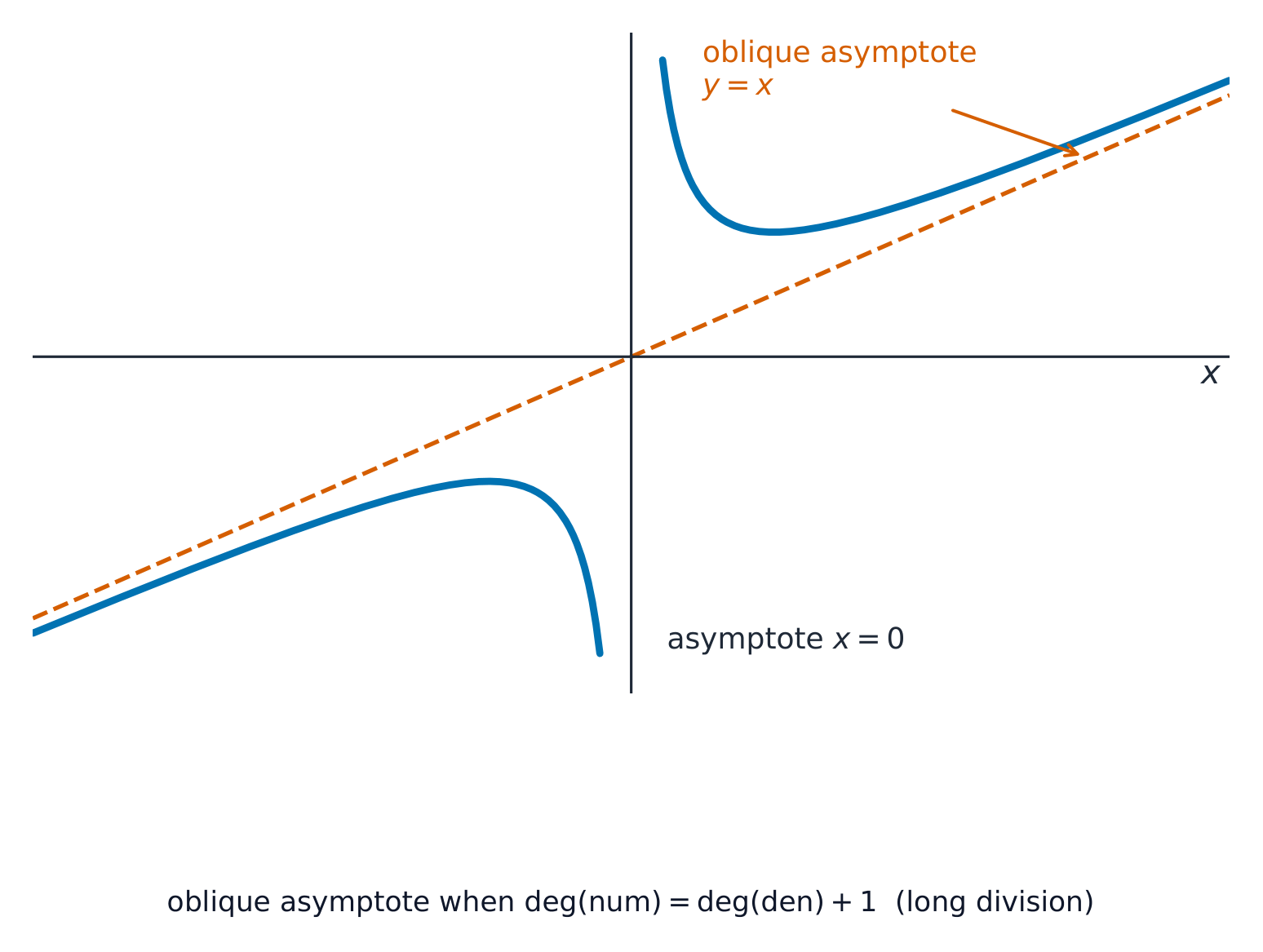
A rational function 有理函数 is a fraction of two polynomials. When the top has degree exactly one higher than the bottom, the graph has an oblique asymptote 斜渐近线 (a slanted line the curve approaches); find it by dividing out. You should also be able to relate the graph of $y = f(x)$ to those of $y^2 = f(x)$, $y = \dfrac{1}{f(x)}$, $y = |f(x)|$ and $y = f(|x|)$. Find the set of values the function can take using the discriminant 判别式, and locate its turning points 驻点.
Worked example. Find the oblique asymptote of $y = \dfrac{x^2 + x + 1}{x + 1}$.
Divide out the fraction: $\dfrac{x^2 + x + 1}{x + 1} = x + \dfrac{1}{x + 1}$. As $x \to \pm\infty$ the remainder $\dfrac{1}{x+1} \to 0$, so the curve approaches the line $y = x$ — the oblique asymptote.
العربية
الدالة الكسرية هي كسر لمكثفين كثيرتي حدود. عندما يكون أعلى المكثف درجة أعلى بمقدار واحد عن الأسفل تماماً، يحتوي الرسم البياني على مقارب مائل (خط مائل يقترب منه المنحنى)؛ يتم إيجادها بالقسمة. يجب عليك أيضاً أن تكون قادراً على ربط رسم $y = f(x)$ برسم $y^2 = f(x)$، $y = \dfrac{1}{f(x)}$، $y = |f(x)|$ و$y = f(|x|)$. أوجد مجموعة القيم التي يمكن أن تأخذها الدالة باستخدام المميز، وحدد نقاط الانعطاف.
بعيداً عن نقطة الأصل يلتصق المنحنى بالخط المائل $y=x$؛ بالقرب من $x=0$ يتجه على طول المقارب الرأسي.
مثال محلول. أوجد المقارب المائل لـ $y = \dfrac{x^2 + x + 1}{x + 1}$.
قسّم الكسر: $\dfrac{x^2 + x + 1}{x + 1} = x + \dfrac{1}{x + 1}$. بما أن $x \to \pm\infty$ الباقي $\dfrac{1}{x+1} \to 0$، فإن المنحنى يقترب من الخط $y = x$ — وهو المقارب المائل.
Explore · استكشف
Rational functions · الدوال الكسرية
y = a/(x − b) + c
A rational function has asymptotes the curve approaches but never touches. · الدالة الكسرية لها مقارب يقترب منه المنحنى لكنه لم يلمسه أبداً.
The method of differences 差分法 sums a series by cancelling middle terms: if partial fractions 部分分式 write each term as $f(r) - f(r+1)$, almost everything cancels. From the sum to $n$ terms you can see whether a series is convergent 收敛 and, if so, find its sum to infinity 无穷和.
Worked example. Find $\displaystyle\sum_{r=1}^{n} (2r + 1)$.
$$\sum_{r=1}^{n}(2r + 1) = 2\sum_{r=1}^{n} r + \sum_{r=1}^{n} 1 = 2\cdot\tfrac12 n(n+1) + n = n(n+1) + n = n(n+2).$$
طريقة الفوارق تحسب مجموع متتالية عن طريق إلغاء الحدود الوسطى: إذا كانت الكسور الجزئية، اكتب كل حد على صورة $f(r) - f(r+1)$، ستختفي تقريبًا كل شيء. من خلال المجموع لـ $n$ حدًا، يمكنك تحديد ما إذا كانت المتتالية متقاربة، وإذا كانت كذلك، أوجد مجموعها إلى ما لا نهاية.
مثال محلّل. أوجد $\displaystyle\sum_{r=1}^{n} (2r + 1)$.
$$\sum_{r=1}^{n}(2r + 1) = 2\sum_{r=1}^{n} r + \sum_{r=1}^{n} 1 = 2\cdot\tfrac12 n(n+1) + n = n(n+1) + n = n(n+2).$$
Explore · استكشف
Sequences and their sums · السلاسل ومجاميعها
Step through the terms and the running total — the idea behind a series and its sum to n terms. · مرر الحدود والمجموع المتراكم — المبدأ وراء السلسلة ومجموعها لـ n حد.
carry out operations of matrix addition, subtraction and multiplication, and recognise the terms zero matrix and identity (or unit) matrix
Including non-square matrices. Matrices will have at most 3 rows and columns.
recall the meaning of the terms singular and non-singular as applied to square matrices and, for $2 \times 2$ and $3 \times 3$ matrices, evaluate determinants and find inverses of non-singular matrices
The notations $\det \mathbf{M}$ for the determinant of a matrix $\mathbf{M}$, and $\mathbf{I}$ for the identity matrix, will be used.
understand and use the result, for non-singular matrices, $(\mathbf{AB})^{-1} = \mathbf{B}^{-1}\mathbf{A}^{-1}$
Extension to the product of more than two matrices may be required.
understand the use of $2 \times 2$ matrices to represent certain geometric transformations in the $x$-$y$ plane, in particular: – understand the relationship between the transformations represented by $\mathbf{A}$ and $\mathbf{A}^{-1}$ – recognise that the matrix product $\mathbf{AB}$ represents the transformation that results from the transformation represented by $\mathbf{B}$ followed by the transformation represented by $\mathbf{A}$ – recall how the area scale factor of a transformation is related to the determinant of the corresponding matrix – find the matrix that represents a given transformation or sequence of transformations
Understanding of the terms rotation, reflection, enlargement, stretch and shear for 2D transformations will be required. Other 2D transformations may be included, but no particular knowledge of them is expected.
understand the meaning of invariant as applied to points and lines in the context of transformations represented by matrices, and solve simple problems involving invariant points and invariant lines.
e.g. to locate the invariant points of the transformation represented by $\begin{pmatrix} 6 & 5 \\ 2 & 3 \end{pmatrix}$, or to find the invariant lines through the origin for $\begin{pmatrix} 4 & -1 \\ 2 & 1 \end{pmatrix}$, or to show that any line with gradient 1 is invariant for $\begin{pmatrix} 2 & 0 \\ 1 & 1 \end{pmatrix}$.
العربية
يجب أن يكون المرشحون قادرين على:
ملاحظات وأمثلة
إجراء عمليات جمع المصفوفات وطرحها وضربها، والتعرف على مصطلحي مصفوفة الصفر ومصفوفة الوحدة (أو المصفوفة الهوية)
بما في ذلك المصفوفات غير المربعة. ستحتوي المصفوفات على ما لا يزيد عن 3 صفوف وأعمدة.
استحضار معنى المصطلحين singular (منفرد) وnon-singular (غير منفرد) كما ينطبقان على المصفوفات المربعة، وللمصفوفات $2 \times 2$ و$3 \times 3$، حساب المحددات وإيجاد المعكوسات للمصفوفات غير المنفردة
فهم واستخدام النتيجة، بالنسبة للمصفوفات غير المنفردة، $(\mathbf{AB})^{-1} = \mathbf{B}^{-1}\mathbf{A}^{-1}$
قد يكون مطلوبًا التوسع إلى حاصل ضرب أكثر من مصفوفتين.
فهم استخدام $2 \times 2$ المصفوفات لتمثيل بعض التحولات الهندسية في المستوى $x$-$y$، وتحديداً: – فهم العلاقة بين التحولات الممثلة بواسطة $\mathbf{A}$ و$\mathbf{A}^{-1}$ – إدراك أن حاصل ضرب المصفوفات $\mathbf{AB}$ يمثل التحول الناتج عن تطبيق التحول الممثل بواسطة $\mathbf{B}$ متبوعاً بالتحول الممثل بواسطة $\mathbf{A}$ – تذكر كيف يرتبط عامل مقياس المساحة للتحول بمحدد المصفوفة المقابلة – إيجاد المصفوفة التي تمثل تحولاً معيناً أو تسلسلاً من التحويلات
سيتم مطلوب فهم مصطلحات الدوران، الانعكاس، التكبير، التمدد والشذوذ للتحويلات 2D. قد يتم تضمين تحويلات 2D أخرى، لكن لا يُتوقع معرفة خاصة بها.
فهم معنى ثابت كما ينطبق على النقاط والخطوط في سياق التحويلات الممثلة بالمصفوفات، وحل مسائل بسيطة تتضمن نقاط ثابتة وخطوط ثابتة.
مثلًا: لتحديد النقاط الثابتة للتحويل الممثل بـ $\begin{pmatrix} 6 & 5 \\ 2 & 3 \end{pmatrix}$، أو لإيجاد الخطوط الثابتة المارة بنقطة الأصل لـ $\begin{pmatrix} 4 & -1 \\ 2 & 1 \end{pmatrix}$، أو لإظهار أن أي خط ميله 1 هو خط ثابت لـ $\begin{pmatrix} 2 & 0 \\ 1 & 1 \end{pmatrix}$.
Source: Cambridge International syllabus · المصدر: منهج كامبريدج الدولي
English
A matrix moves the plane
A matrix 矩阵 is a rectangular block of numbers. Matrix addition adds entries in matching positions; you can also subtract and multiply matrices (multiplication is row $\times$ column). The zero matrix 零矩阵 has every entry $0$, and the identity matrix 单位矩阵 (or unit matrix) $I$ leaves any matrix unchanged under multiplication.
For a $2\times 2$ matrix $A = \begin{pmatrix} a & b \\ c & d \end{pmatrix}$, the determinant 行列式 is $\det A = ad - bc$. If $\det A \neq 0$ the matrix is non-singular (otherwise it is a singular matrix 奇异矩阵), and the inverse matrix 逆矩阵 is
$$A^{-1} = \frac{1}{ad - bc}\begin{pmatrix} d & -b \\ -c & a \end{pmatrix}.$$
For a product, $(AB)^{-1} = B^{-1}A^{-1}$. A $2\times 2$ matrix can represent a geometric transformation 几何变换 of the plane — a rotation 旋转, reflection 反射, enlargement 放大, stretch 拉伸 or shear 切变: the determinant gives the area scale factor, and a product $AB$ means "do $B$, then $A$". Points or lines that do not move are called invariant points 不变点 and invariant lines 不变直线.
Worked example. Find the inverse of $A = \begin{pmatrix} 3 & 1 \\ 2 & 4 \end{pmatrix}$.
المصفوفة هي كتلة مستطيلة من الأرقام. جمع المصفوفات يجمع المدخلات في المواقع المتطابقة؛ يمكن أيضًا طرح وضرب المصفوفات (الضرب هو صف $\times$ ضرب عمود). المصفوفة الصفرية تحتوي على كل مدخل $0$، والمصفوفة الوحدة (أو مصفوفة الوحدة) $I$ تترك أي مصفوفة دون تغيير عند الضرب.
لمصفوفة $2\times 2$$A = \begin{pmatrix} a & b \\ c & d \end{pmatrix}$، فإن المحدد هو $\det A = ad - bc$. إذا كان $\det A \neq 0$ تكون المصفوفة غير مفردة (وإلا فهي مصفوفة مفردة)، والمصفوفة المعكوسة هي
$$A^{-1} = \frac{1}{ad - bc}\begin{pmatrix} d & -b \\ -c & a \end{pmatrix}.$$
للمنتج، $(AB)^{-1} = B^{-1}A^{-1}$. مصفوفة $2\times 2$ يمكن أن تمثل تحولاً هندسياً للمستوى — دوران، انعكاس، تكبير، تمدد أو إزاحة أفقية: يعطي المحدد معامل مقياس المساحة، والجداء $AB$ يعني "قم بـ $B$، ثم $A$". النقاط أو الخطوط التي لا تتحرك تسمى نقاط ثابتة وخطوط ثابتة.
ترسل المصفوفة المربع الواحد إلى موازٍ مساحته تساوي المحدد.
Matrices as transformations · المصفوفات كتحويلات
Change the four entries and watch the unit square map to a new shape. The determinant is the area scale factor. · غيّر المدخلات الأربعة وراقب تحول المربع الوحدة إلى شكل جديد. المحدد هو عامل مقياس المساحة.
understand the relations between Cartesian and polar coordinates, and convert equations of curves from Cartesian to polar form and vice versa
The convention $r \geqslant 0$ will be used.
sketch simple polar curves, for $0 \leqslant \theta < 2\pi$ or $-\pi < \theta \leqslant \pi$ or a subset of either of these intervals
Detailed plotting of curves will not be required, but sketches will generally be expected to show significant features, such as symmetry, coordinates of intersections with the initial line, the form of the curve at the pole and least/greatest values of $r$.
recall the formula $\frac{1}{2} \int r^2 \mathrm{d}\theta$ for the area of a sector, and use this formula in simple cases.
العربية
يجب أن يكون المرشحون قادرين على:
ملاحظات وأمثلة
فهم العلاقات بين الإحداثيات الديكارتية والإحداثيات القطبية، وتحويل معادلات المنحنيات من الصورة الديكارتية إلى الصورة القطبية والعكس
سيتم استخدام约定 $r \geqslant 0$.
رسم منحنيات قطبية بسيطة، لـ $0 \leqslant \theta < 2\pi$ أو $-\pi < \theta \leqslant \pi$ أو جزء من هذين الفترتين
لن يكون الرسم التفصيلي للمنحنيات مطلوبًا، لكن عادةً ما يُتوقع أن تُظهر الرسومات السمعية ميزات مهمة، مثل التماثل، إحداثيات نقاط التقاطع مع الخط الابتدائي، شكل المنحنى عند القطب، وأقل/أكبر قيم لـ $r$.
استحضار الصيغة $\frac{1}{2} \int r^2 \mathrm{d}\theta$ لمساحة القطاع، واستخدام هذه الصيغة في حالات بسيطة.
Source: Cambridge International syllabus · المصدر: منهج كامبريدج الدولي
English
Tracing a polar curve: the cardioid
Polar coordinates 极坐标 give a point by its distance $r$ from the origin and its angle $\theta$. They link to Cartesian coordinates 直角坐标 by
You should sketch simple polar curves 极坐标曲线, and find the area of a sector with
$$\text{area} = \tfrac12\int r^2\,d\theta.$$
Worked example. Convert the polar equation $r = 4\cos\theta$ to Cartesian form.
Multiply both sides by $r$: $r^2 = 4r\cos\theta$, so $x^2 + y^2 = 4x$. Completing the square gives $(x - 2)^2 + y^2 = 4$, a circle of radius $2$ centred at $(2, 0)$.
العربية
تتبع منحنى قطبي: القلبيةدرج حلزوني: تُوصف الحلزونات بشكل طبيعي باستخدام الإحداثيات القطبية.
الإحداثيات القطبية تحدد نقطة عن بعد $r$ عن نقطة الأصل وزاوية $\theta$. ترتبط بـالإحداثيات الديكارتية عبر
الإحداثيات القطبية $(r,\theta)$ تتحول إلى ديكارتية عبر $x=r\cos\theta$ و$y=r\sin\theta$.
يجب عليك رسم منحنيات قطبية بسيطة وإيجاد مساحة قطاع مع
$$\text{area} = \tfrac12\int r^2\,d\theta.$$
الكاردرويد $r=1+\cos\theta$، مخطط مباشرة من $r$ بدالة لـ $\theta$.
مثال محلّل. حوّل المعادلة القطبية $r = 4\cos\theta$ إلى صيغة ديكارتية.
اضرب كلا الطرفين في $r$: $r^2 = 4r\cos\theta$، لذا $x^2 + y^2 = 4x$. إكمال المربع يعطي $(x - 2)^2 + y^2 = 4$، وهي دائرة نصف قطرها $2$ ومركزها $(2, 0)$.
Explore · استكشف
Polar curves · منحنيات قطبية
Pick a curve and change a. In polar form a point is set by its distance r and angle θ — that draws roses, cardioids and spirals. · اختر منحنى وغيّر a. في الصيغة القطبية يُحدّد النقطة مسافتها r وزاويتها θ — مما يرسم الورود والقلوب والأبراج.
use the equation of a plane in any of the forms $ax + by + cz = d$ or $\mathbf{r.n} = p$ or $\mathbf{r} = \mathbf{a} + \lambda\mathbf{b} + \mu\mathbf{c}$ and convert equations of planes from one form to another as necessary in solving problems
recall that the vector product$\mathbf{a} \times \mathbf{b}$ of two vectors can be expressed either as $|\mathbf{a}||\mathbf{b}|\sin\theta\hat{\mathbf{n}}$, where $\hat{\mathbf{n}}$ is a unit vector, or in component form as $(a_2b_3 - a_3b_2)\mathbf{i} + (a_3b_1 - a_1b_3)\mathbf{j} + (a_1b_2 - a_2b_1)\mathbf{k}$
use equations of lines and planes, together with scalar and vector products where appropriate, to solve problems concerning distances, angles and intersections, including: – determining whether a line lies in a plane, is parallel to a plane or intersects a plane, and finding the point of intersection of a line and a plane when it exists – finding the foot of the perpendicular from a point to a plane – finding the angle between a line and a plane, and the angle between two planes – finding an equation for the line of intersection of two planes – calculating the shortest distance between two skew lines – finding an equation for the common perpendicular to two skew lines.
العربية
يجب أن يكون المرشحون قادرين على:
ملاحظات وأمثلة
استخدام معادلة المستوى بأي من الأشكال $ax + by + cz = d$ أو $\mathbf{r.n} = p$ أو $\mathbf{r} = \mathbf{a} + \lambda\mathbf{b} + \mu\mathbf{c}$ وتحويل معادلات المستويات من شكل إلى آخر عند الضرورة لحل المسائل
استحضار أن الجداء الاتجاهي$\mathbf{a} \times \mathbf{b}$ لمتجهين يمكن التعبير عنه إما كـ $|\mathbf{a}||\mathbf{b}|\sin\theta\hat{\mathbf{n}}$، حيث $\hat{\mathbf{n}}$ هو متجه وحدة، أو بالصيغة المركبة كـ $(a_2b_3 - a_3b_2)\mathbf{i} + (a_3b_1 - a_1b_3)\mathbf{j} + (a_1b_2 - a_2b_1)\mathbf{k}$
استخدام معادلات الخطوط والمستويات، جنبًا إلى جنب مع الجداء القياسي والاتجاهي حيثما كان مناسبًا، لحل المسائل المتعلقة بالمسافات والزوايا والتقاطعات، بما في ذلك: – تحديد ما إذا كان خط يقع في مستوى، أو يوازي مستوى، أو يتقاطع معه، وإيجاد نقطة تقاطع الخط والمستوى عندما توجد – إيجاد قدم العمود من نقطة إلى مستوى – إيجاد الزاوية بين خط ومستوى، والزاوية بين مستويين – إيجاد معادلة لخط تقاطع مستويين – حساب أقصر مسافة بين خطين مائلين – إيجاد معادلة للعمود المشترك لخطين مائلين.
Source: Cambridge International syllabus · المصدر: منهج كامبريدج الدولي
English
In three dimensions a plane 平面 can be written as $ax + by + cz = d$, or $\mathbf{r}\cdot\mathbf{n} = p$, or $\mathbf{r} = \mathbf{a} + \lambda\mathbf{b} + \mu\mathbf{c}$. Besides the scalar product, there is the vector product 向量积 of two vectors 向量:
which gives a vector at right angles to both. With scalar and vector products you can find distances, angles, and where lines and planes meet — including the shortest distance between skew lines 异面直线.
Worked example. Find $\mathbf{a}\times\mathbf{b}$ for $\mathbf{a} = \mathbf{i} + \mathbf{j}$ and $\mathbf{b} = \mathbf{j} + \mathbf{k}$.
القوى مثل الرياح والمياه هي متجهات — لها حجم واتجاه.
في ثلاثة أبعاد يمكن كتابة مستوى على صورة $ax + by + cz = d$، أو $\mathbf{r}\cdot\mathbf{n} = p$، أو $\mathbf{r} = \mathbf{a} + \lambda\mathbf{b} + \mu\mathbf{c}$. بالإضافة إلى الضرب القياسي، يوجد الضرب الاتجاهي لمتجهين:
والذي يعطي متجهًا عموديًا على الاثنين. باستخدام الضرب القياسي والاتجاهي يمكنك إيجاد المسافات والزاويات ونقاط تقاطع الخطوط والمستويات — بما في ذلك أقصر مسافة بين خطوط متقطعة.
$\mathbf{a}\times\mathbf{b}$ عمودي على كلا المتجهين؛ طوله يساوي مساحة المثلث الذي يمدانه.
مثال محلول. أوجد $\mathbf{a}\times\mathbf{b}$ لـ $\mathbf{a} = \mathbf{i} + \mathbf{j}$ و$\mathbf{b} = \mathbf{j} + \mathbf{k}$.
recognition situations where conjecture based on a limited trial followed by inductive proof is a useful strategy, and carry this out in simple cases.
e.g. find the $n$th derivative of $x e^x$, find $\sum_{r=1}^{n} r \times r!$.
Source: Cambridge International syllabus · المصدر: منهج كامبريدج الدولي
English
Induction: the domino proof
Mathematical induction 数学归纳法 proves a result for every positive integer $n$ in two steps:
Base case: show the result is true for $n = 1$.
Inductive step: assume it is true for $n = k$, then prove it for $n = k + 1$.
If both steps work, the result is true for all $n$. Often you first make a conjecture 猜想 (a sensible guess) from a few cases, then confirm it by inductive proof 归纳证明.
Worked example. Prove that $\displaystyle\sum_{r=1}^{n} r = \tfrac12 n(n+1)$.
Base case$n = 1$: the left side is $1$ and the right side is $\tfrac12(1)(2) = 1$. True.
Inductive step: assume $\displaystyle\sum_{r=1}^{k} r = \tfrac12 k(k+1)$. Then
This is the formula with $n = k + 1$, so by induction it holds for all $n$.
العربية
الاستقراء: برهان العظام
الاستقراء الرياضي يثبت نتيجة لكل عدد صحيح موجب $n$ في خطوتين:
الحالة الأساسية: أثبت أن النتيجة صحيحة لـ $n = 1$.
الخطوة الاستقرائية: افترض أنها صحيحة لـ $n = k$، ثم أثبتها لـ $n = k + 1$.
إذا نجحت كلتا الخطوتين، تكون النتيجة صحيحة لجميع $n$. غالبًا ما تضع أولاً فرضية (تخمين معقول) من بضعة حالات، ثم تؤكدها عبر برهان استقرائي.
الاستقراء يشبه العظام: الحالة الأساسية تقلع الأولى، والخطوة الاستقرائية تجعل كل واحدة تسقط التالية — لذا النتيجة صحيحة لكل n
مثال محلّل. أثبت أن $\displaystyle\sum_{r=1}^{n} r = \tfrac12 n(n+1)$.
الحالة الأساسية$n = 1$: الطرف الأيسر هو $1$ والطرف الأيمن هو $\tfrac12(1)(2) = 1$. صحيح.
الخطوة الاستقرائية: افترض $\displaystyle\sum_{r=1}^{k} r = \tfrac12 k(k+1)$. إذن
This handout covers Topic 2: Further Pure Mathematics 进阶纯数学 2. It adds hyperbolic functions, eigenvalues, new differentiation and integration, de Moivre's theorem, and methods for differential equations.
العربية
يغطي هذا الملف الموضوع 2: رياضيات نقية متقدمة 2. يضيف الدوال الزائدية والقيم الذاتية والتفاضل والتكامل الجديد ونظرية دي مويفر وطرق المعادلات التفاضلية.
2.1
Hyperbolic functions · الدوال الزائدية
Syllabus · المنهج
English
Candidates should be able to:
Notes and examples
understand the definitions of the hyperbolic functions$\sinh x$, $\cosh x$, $\tanh x$, $\text{sech } x$, $\text{cosech } x$, $\text{coth } x$ in terms of the exponential function
sketch the graphs of hyperbolic functions
prove and use identities involving hyperbolic functions
e.g. $\cosh^2 x - \sinh^2 x \equiv 1$, $\sinh 2x \equiv 2 \sinh x \cosh x$, and similar results corresponding to the standard trigonometric identities.
understand and use the definitions of the inverse hyperbolic functions and derive and use the logarithmic forms
برهان واستخدام المتطابقات التي تتضمن الدوال الزائدية
مثلًا: $\cosh^2 x - \sinh^2 x \equiv 1$، $\sinh 2x \equiv 2 \sinh x \cosh x$، ونتائج مماثلة مقابلة للمتطابقات المثلثية القياسية.
فهم واستخدام تعريفات الدوال الزائدية العكسية واستنتاج واستخدام الأشكال اللوغاريتمية لها
Source: Cambridge International syllabus · المصدر: منهج كامبريدج الدولي
English
cosh and sinh built from exponentials
The hyperbolic functions 双曲函数 are built from the exponential function:
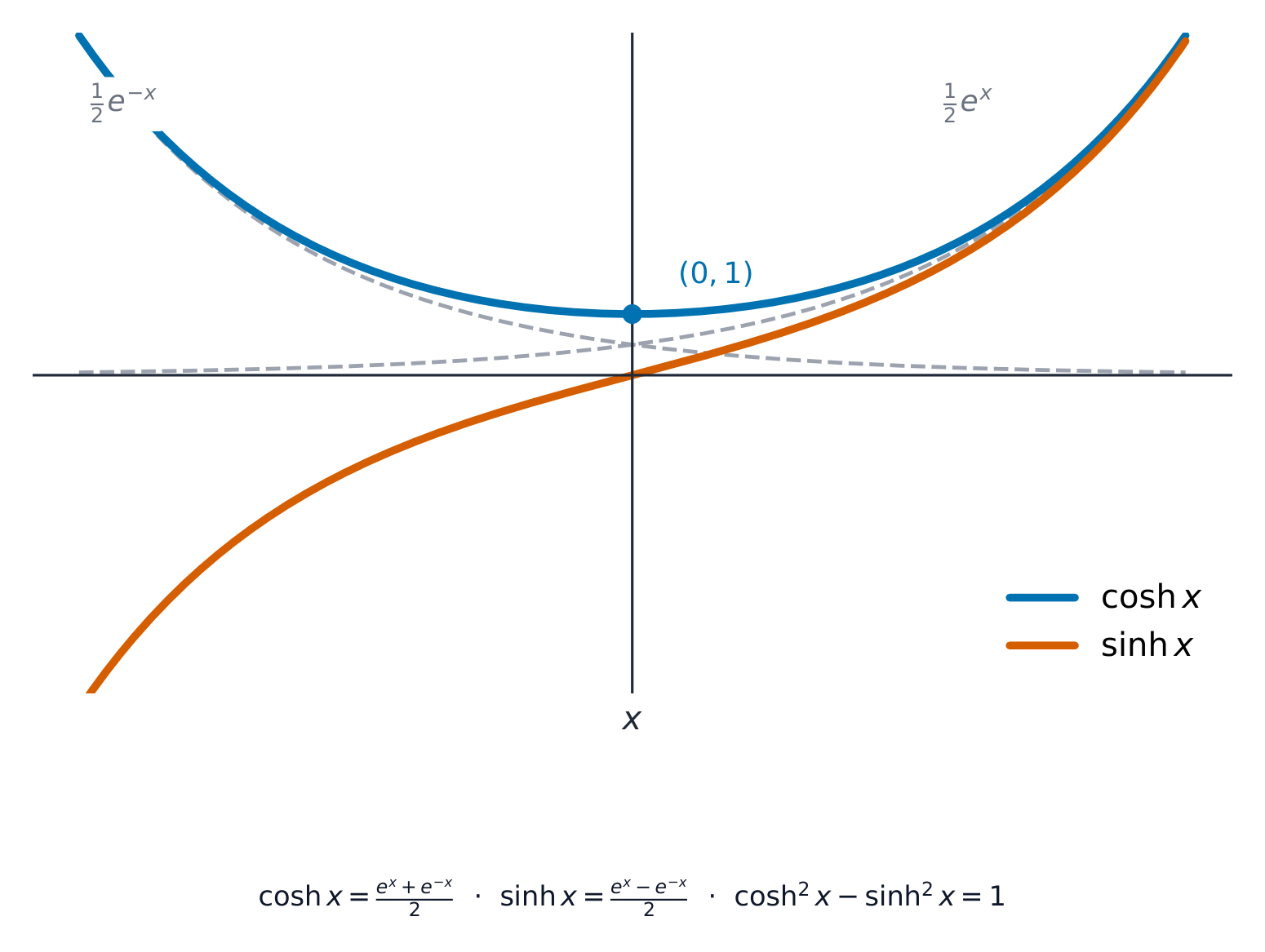
$$\cosh x = \frac{e^x + e^{-x}}{2}, \qquad \sinh x = \frac{e^x - e^{-x}}{2}, \qquad \tanh x = \frac{\sinh x}{\cosh x}.$$
They obey identities much like the trigonometric ones, the main one being $\cosh^2 x - \sinh^2 x = 1$. The three reciprocals complete the set: $\operatorname{sech} x = \dfrac{1}{\cosh x}$, $\operatorname{cosech} x = \dfrac{1}{\sinh x}$, and $\coth x = \dfrac{1}{\tanh x} = \dfrac{\cosh x}{\sinh x}$ – all built from $e^x$ too, and worth recognising in integrals and mark schemes. The inverse hyperbolic functions 反双曲函数 have a logarithmic form 对数形式, for example $\sinh^{-1} x = \ln\!\left(x + \sqrt{x^2 + 1}\right)$.
Worked example. Show that $\cosh^2 x - \sinh^2 x = 1$.
دوال cosh و sinh مبنية من الدوال الأسيةالسلك المعلق يشكل قوساً كاتينياً — وهو منحنى جيب التمام الزائدي.
الدوال الزائدية مبنية من الدالة الأسية:
$$\cosh x = \frac{e^x + e^{-x}}{2}, \qquad \sinh x = \frac{e^x - e^{-x}}{2}, \qquad \tanh x = \frac{\sinh x}{\cosh x}.$$
$\cosh$ هو المتوسط الحسابي لـ $e^x$ و $e^{-x}$؛ و $\sinh$ هو نصف الفرق بينهما.
تخضع لهويات مشابهة جداً للهويات المثلثية، وأهمها $\cosh^2 x - \sinh^2 x = 1$. المقلوبات الثلاث تكمل المجموعة: $\operatorname{sech} x = \dfrac{1}{\cosh x}$، $\operatorname{cosech} x = \dfrac{1}{\sinh x}$، و $\coth x = \dfrac{1}{\tanh x} = \dfrac{\cosh x}{\sinh x}$ — جميعها مبنية أيضاً من $e^x$، وهي تستحق التمييز في التكاملات ومخططات الدرجات. الدوال الزائدية العكسية لها صيغة لوغاريتمية، على سبيل المثال $\sinh^{-1} x = \ln\!\left(x + \sqrt{x^2 + 1}\right)$.
cosh is the catenary (a hanging chain) — even, with its minimum at (0, a). · cosh هو الكاتينار (سلسلة معلقة) — دالة زوجية، يكون فيها الحد الأدنى عند (0, a).
2.2
Matrices · المصفوفات
Syllabus · المنهج
English
Candidates should be able to:
Notes and examples
formulate a problem involving the solution of 3 linear simultaneous equations in 3 unknowns as a problem involving the solution of a matrix equation, or vice versa
understand the cases that may arise concerning the consistency or inconsistency of 3 linear simultaneous equations, relate them to the singularity or otherwise of the corresponding matrix, solve consistent systems, and interpret geometrically in terms of lines and planes
e.g. three planes meeting in a common point, or in a common line, or having no common points.
understand the terms 'characteristic equation', 'eigenvalue' and 'eigenvector', as applied to square matrices
Including use of the definition $\mathbf{Ae} = \lambda \mathbf{e}$ to prove simple properties, e.g. that $\lambda^n$ is an eigenvalue of $\mathbf{A}^n$.
find eigenvalues and eigenvectors of $2 \times 2$ and $3 \times 3$ matrices
Restricted to cases where the eigenvalues are real and distinct.
express a square matrix in the form $\mathbf{QDQ}^{-1}$, where $\mathbf{D}$ is a diagonal matrix of eigenvalues and $\mathbf{Q}$ is a matrix whose columns are eigenvectors, and use this expression
e.g. in calculating powers of $2 \times 2$ or $3 \times 3$ matrices.
use the fact that a square matrix satisfies its own characteristic equation.
e.g. in finding successive powers of a matrix or finding an inverse matrix; restricted to $2 \times 2$ or $3 \times 3$ matrices only.
العربية
يجب أن يكون المرشحون قادرين على:
ملاحظات وأمثلة
صياغة مسألة تتضمن حل 3 معادلات خطية متزامنة في 3 مجاهيل كمسألة تتعلق بحل معادلة مصفوفة، أو العكس
فهم الحالات التي قد تنشأ فيما يتعلق بتوافق أو عدم توافق 3 معادلات خطية متزامنة، وربطها بـ انفراد المصفوفة المقابلة أو عكسه، وحل الأنظمة المتوافقة، وتفسيرها هندسيًا بدلالة الخطوط والمستويات
مثال: ثلاثة مستويات تتقاطع في نقطة مشتركة، أو في خط مشترك، أو ليس لها نقاط مشتركة.
فهم مصطلحات 'المعادلة المميزة' و'قيمة ذاتية' و'متجه ذاتي'، كما تنطبق على المصفوفات المربعة
بما في ذلك استخدام التعريف $\mathbf{Ae} = \lambda \mathbf{e}$ لإثبات خصائص بسيطة، مثل أن $\lambda^n$ هي قيمة ذاتية لـ $\mathbf{A}^n$.
مقيد بحالات تكون فيها القيم الذاتية حقيقية ومختلفة.
التعبير عن مصفوفة مربعة على الصورة $\mathbf{QDQ}^{-1}$، حيث $\mathbf{D}$ هي مصفوفة قطرية للقيم الذاتية و$\mathbf{Q}$ هي مصفوفة أعمدتها متجهات ذاتية، واستخدام هذا التعبير
مثلًا في حساب قوى المصفوفات $2 \times 2$ أو $3 \times 3$.
استخدام حقيقة أن المصفوفة المربعة تحقق معادلتها المميزة.
مثلًا في إيجاد القوى المتتالية لمصفوفة ما أو إيجاد معكوسها؛ مقيد بمصفوفات $2 \times 2$ أو $3 \times 3$ فقط.
Source: Cambridge International syllabus · المصدر: منهج كامبريدج الدولي
English
A matrix moves the plane
You can write three linear equations in three unknowns as a single matrix equation 矩阵方程$A\mathbf{x} = \mathbf{b}$. If $A$ is non-singular there is one solution; if $A$ is singular the equations are either inconsistent (no solution) or have infinitely many.
For a square matrix $A$, the characteristic equation 特征方程 is $\det(A - \lambda I) = 0$. Its solutions are the eigenvalues 特征值$\lambda$, and for each one the vector $\mathbf{v}$ with $A\mathbf{v} = \lambda\mathbf{v}$ is an eigenvector 特征向量. You can then write $A = QDQ^{-1}$, where $D$ is a diagonal matrix 对角矩阵 of eigenvalues and the columns of $Q$ are the eigenvectors.
Worked example. Find the eigenvalues of $A = \begin{pmatrix} 2 & 1 \\ 1 & 2 \end{pmatrix}$.
So $\lambda = 1$ or $\lambda = 3$. (The eigenvector for $\lambda = 3$ is $\begin{pmatrix} 1 \\ 1 \end{pmatrix}$ and for $\lambda = 1$ is $\begin{pmatrix} 1 \\ -1 \end{pmatrix}$.)
العربية
مصفوفة تنقل المستوي
يمكنك كتابة ثلاثة معادلات خطية بثلاثة مجاهيل كمعادلة مصفوفة واحدة $A\mathbf{x} = \mathbf{b}$. إذا كانت $A$ غير صفرية (غير مفردة)، فستكون هناك حل واحد؛ وإذا كانت $A$ صفراً (مفردة)، فإما أن تكون المعادلات غير متسقة (لا حل) أو يكون لها لا نهائي من الحلول.
بالنسبة لمصفوفة مربعة $A$، المعادلة المميزة هي $\det(A - \lambda I) = 0$. حلولها هي القيم الذاتية$\lambda$، ولكل قيمة منها، المتجه $\mathbf{v}$ الذي يحقق $A\mathbf{v} = \lambda\mathbf{v}$ هو متجه ذاتي. يمكنك حينئذٍ كتابة $A = QDQ^{-1}$، حيث $D$ هي مصفوفة قطرية للقيم الذاتية وأعمدة $Q$ هي المتجهات الذاتية.
ضرب المتجه الذاتي في $A$ يمدده فقط؛ أما المتعامد العام فيتم تدويره لاتجاه جديد.
مثال محلول. أوجد القيم الذاتية لـ $A = \begin{pmatrix} 2 & 1 \\ 1 & 2 \end{pmatrix}$.
إذن $\lambda = 1$ أو $\lambda = 3$. (المتجه الذاتي المقابل لـ $\lambda = 3$ هو $\begin{pmatrix} 1 \\ 1 \end{pmatrix}$ والمقابل لـ $\lambda = 1$ هو $\begin{pmatrix} 1 \\ -1 \end{pmatrix}$.)
Explore · استكشف
Transformations and the determinant · التحويلات والمحدد
Change the matrix to rotate, stretch or shear the unit square; the determinant shows how area changes. · غيّر المصفوفة لتدوير أو تمديد أو إزاحة المربع الوحدة؛ يُظهر المحدد كيفية تغير المساحة.
• differentiate hyperbolic functions and differentiate $\sin^{-1}x$, $\cos^{-1}x$, $\sinh^{-1}x$, $\cosh^{-1}x$ and $\tanh^{-1}x$
• obtain an expression for $\frac{\text{d}^2y}{\text{d}x^2}$ in cases where the relation between $x$ and $y$ is defined implicitly or parametrically
• derive and use the first few terms of a Maclaurin's series for a function.
Derivation of a general term is not included, but successive 'implicit' differentiation steps may be required, e.g. for $y = \tan x$ following an initial differentiation rearranged as $y' = 1 + y^2$.
• الحصول على تعبير لـ $\frac{\text{d}^2y}{\text{d}x^2}$ في الحالات التي يكون فيها العلاقة بين $x$ و$y$ معرفة ضمنيًا أو بارامترية
• استنتاج واستخدام الحدود الأولى من متسلسلة ماكلورين لدالة ما.
لا يُشمل استنتاج الحد العام، ولكن قد تكون خطوات الاشتقاق الضمني المتتالية مطلوبة، مثلًا لـ $y = \tan x$ بعد إعادة الترتيب الابتدائي للاشتقاق كـ $y' = 1 + y^2$.
Source: Cambridge International syllabus · المصدر: منهج كامبريدج الدولي
English
You can now differentiate the hyperbolic functions and the inverse functions $\sin^{-1}x$, $\tan^{-1}x$, $\sinh^{-1}x$ and so on. You can also find $\dfrac{d^2y}{dx^2}$ for curves given implicitly or parametrically.
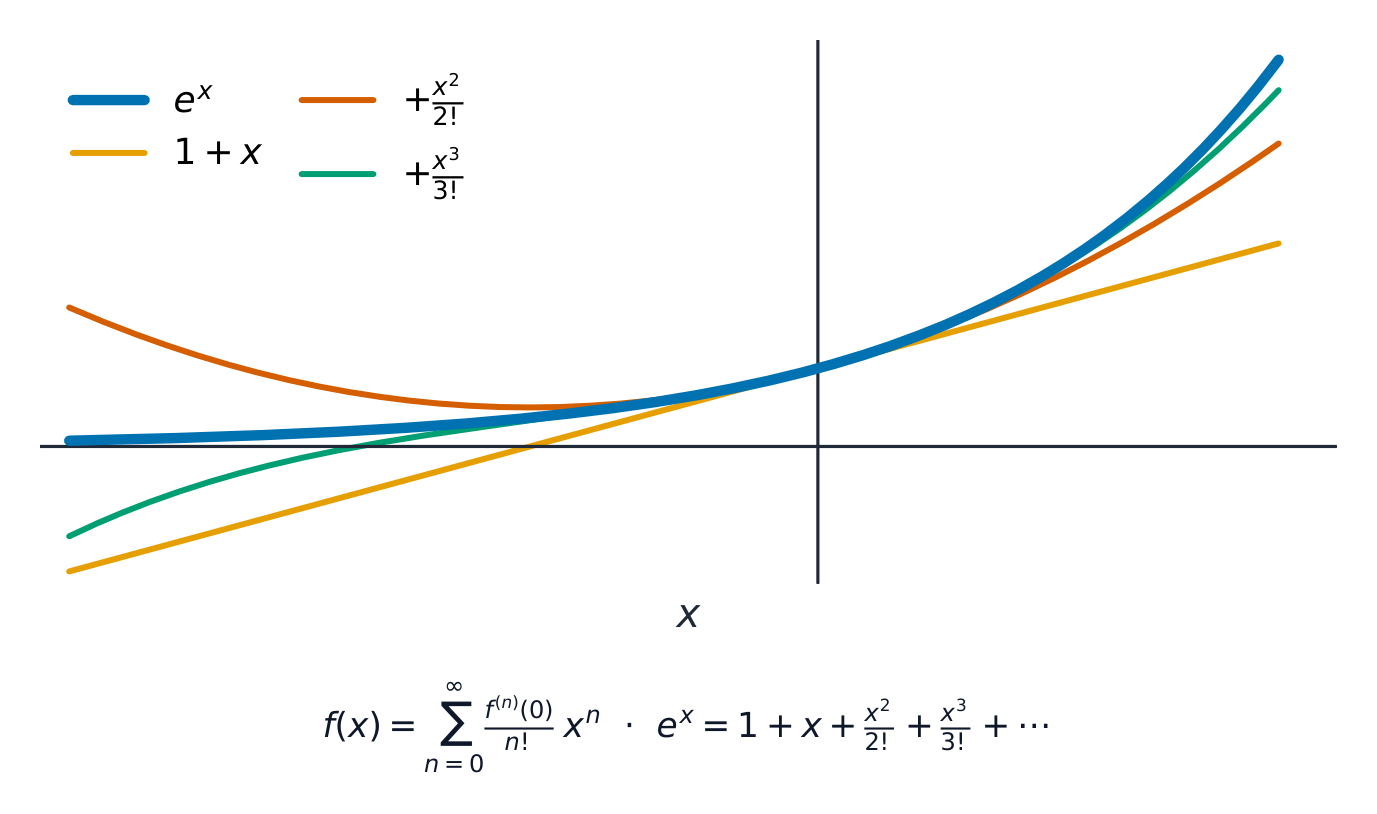
A Maclaurin's series 麦克劳林级数 writes a function as a power series:
على سبيل المثال $e^x = 1 + x + \dfrac{x^2}{2!} + \dfrac{x^3}{3!} + \cdots$إضافة المزيد من الحدود تجعل متعدد الحدود يطابق $e^x$ على نطاق أوسع حول $x=0$.
مثال محلول. أوجد متسلسلة ماكلورين لـ $f(x) = \ln(1+x)$ حتى الحد في $x^3$.
• integrate hyperbolic functions and recognise integrals of functions of the form $\frac{1}{\sqrt{a^2 - x^2}}$, $\frac{1}{\sqrt{x^2 + a^2}}$ and $\frac{1}{\sqrt{x^2 - a^2}}$, and integrate associated functions using trigonometric substitutions or hyperbolic substitutions as appropriate
Including use of completing the square where necessary, e.g. to integrate $\frac{1}{\sqrt{x^2 + x}}$.
• derive and use reduction formulae for the evaluation of definite integrals
e.g. $\int_0^{\frac{1}{2}\pi} \sin^n x \text{ d}x$, $\int_0^1 \text{e}^{-x}(1-x)^n \text{ d}x$. In harder cases hints may be given, e.g. $\int_0^{\frac{1}{4}\pi} \sec^n x \text{ d}x$ by considering $\frac{\text{d}}{\text{d}x}(\tan x \sec^n x)$.
• understand how the area under a curve may be approximated by areas of rectangles, and use rectangles to estimate or set bounds for the area under a curve or to derive inequalities or limits concerning sums
Questions may involve either rectangles of unit width or rectangles whose width can tend to zero, e.g. $1 + \ln n > \sum_{r=1}^n \frac{1}{r} > \ln(n+1)$, $\sum_{r=1}^n \frac{1}{n}\left(1 + \frac{r}{n}\right)^{-1} \approx \int_0^1 (1+x)^{-1} \text{ d}x$. continued
• use integration to find – arc lengths for curves with equations in Cartesian coordinates, including the use of a parameter, or in polar coordinates – surface areas of revolution about one of the axes for curves with equations in Cartesian coordinates, including the use of a parameter.
Any questions involving integration may require techniques from Cambridge International A Level Mathematics (9709) applied to more difficult cases, e.g. integration by parts for $\int e^x \sin x \mathrm{d}x$, or use of the substitution $t = \tan \frac{1}{2}x$. Surface areas of revolution for curves with equations in polar coordinates will not be required.
العربية
يجب أن يكون المرشحون قادرين على:
ملاحظات وأمثلة
• تكامل الدوال الزائدية والتعرف على تكاملات الدوال من الشكل $\frac{1}{\sqrt{a^2 - x^2}}$، $\frac{1}{\sqrt{x^2 + a^2}}$ و$\frac{1}{\sqrt{x^2 - a^2}}$، وتكامل الدوال المرتبطة باستخدام التعويضات المثلثية أو التعويضات الزائدية حسب الاقتضاء
بما في ذلك استخدام إكمال المربع عند الحاجة، مثلًا لتكامل $\frac{1}{\sqrt{x^2 + x}}$.
• استنتاج واستخدام قوانين التناقص لتقييم التكاملات المحددة
مثلًا $\int_0^{\frac{1}{2}\pi} \sin^n x \text{ d}x$، $\int_0^1 \text{e}^{-x}(1-x)^n \text{ d}x$. في الحالات الأصعب قد تُعطى إشارات، مثلًا $\int_0^{\frac{1}{4}\pi} \sec^n x \text{ d}x$ عن طريق النظر في $\frac{\text{d}}{\text{d}x}(\tan x \sec^n x)$.
• فهم كيفية تقريب المساحة تحت المنحنى بواسطة مساحات المستطيلات، واستخدام المستطيلات لتقدير أو وضع حدود للمساحة تحت منحنى ما أو لاستنتاج متباينات أو حدود تتعلق بالمجموع
قد تتضمن الأسئلة مستطيلات بعرض وحدة واحدة أو مستطيلات يتجه عرضها إلى الصفر، مثلًا $1 + \ln n > \sum_{r=1}^n \frac{1}{r} > \ln(n+1)$، $\sum_{r=1}^n \frac{1}{n}\left(1 + \frac{r}{n}\right)^{-1} \approx \int_0^1 (1+x)^{-1} \text{ d}x$. استمرار
• استخدام التكامل لإيجاد – أطوال الأقواس للمنحنيات ذات المعادلات الإحداثيات الديكارتية، بما في ذلك استخدام معلم، أو في الإحداثيات القطبية – مساحات الأسطح الناتجة عن الدوران حول أحد المحاور للمنحنيات ذات المعادلات الإحداثيات الديكارتية، بما في ذلك استخدام معلم.
أي أسئلة تتضمن التكامل قد تتطلب تقنيات من منهج كامبريدج الدولي رياضيات المستوى أ (9709) مطبقة على حالات أصعب، مثلًا التكامل بالتجزئة لـ $\int e^x \sin x \mathrm{d}x$، أو استخدام التعويض $t = \tan \frac{1}{2}x$. لن يُطلب مساحات الأسطح الناتجة عن الدوران للمنحنيات ذات المعادلات في الإحداثيات القطبية.
Source: Cambridge International syllabus · المصدر: منهج كامبريدج الدولي
A trigonometric substitution, a hyperbolic substitution, or completing the square 配方法 in the denominator handles related forms. A reduction formula 递推公式 links an integral $I_n$ to $I_{n-1}$, so you can work down step by step. Integration also gives the arc length 弧长 of a curve and the surface area of revolution 旋转曲面面积 when a curve is turned about an axis.
Worked example. Find $\displaystyle\int \frac{1}{\sqrt{4 - x^2}}\,dx$.
Bounding a sum by an integral. Draw rectangles of unit width under, or over, a decreasing curve such as $y=\frac1x$. Each rectangle of height $\frac1r$ is trapped between two integral strips, so summing gives
$$\ln(n+1) < \sum_{r=1}^{n}\frac1r < 1 + \ln n.$$
Shrinking the rectangle width to $\frac1n\to 0$ turns such a sum into a Riemann sum 黎曼和 that equals the integral in the limit, e.g. $\displaystyle\lim_{n\to\infty}\frac1n\sum_{r=1}^{n}f\!\left(\frac{r}{n}\right)=\int_0^1 f(x)\,dx$.
تعامل التعويضات المثلثية، والتعويضات الزائدية، أو إكمال المربع في المقام الأشكال ذات الصلة. قانون التناقص يربط تكاملاً $I_n$ بتكاملاً $I_{n-1}$، بحيث يمكنك العمل خطوة بخطوة نحو الأسفل. كما يعطي التكامل أيضاً طول القوس للمنحنى ومساحة السطح الناتج عن الدوران عندما يدور المنحنى حول محور.
مثال محلّل. أوجد $\displaystyle\int \frac{1}{\sqrt{4 - x^2}}\,dx$.
تحديد حد لمجموع باستخدام تكامل. ارسم مستطيلات بعرض وحدة تحت أو فوق منحنٍ تنازلي مثل $y=\frac1x$. كل مستطيل ارتفاعه $\frac1r$ محبوس بين شريطي تكامل، لذا فإن المجموع يعطي
$$\ln(n+1) < \sum_{r=1}^{n}\frac1r < 1 + \ln n.$$
تقليص عرض المستطيل إلى $\frac1n\to 0$ يحول هذا المجموع إلى مجموع ريمان يساوي التكامل في النهاية، مثال: $\displaystyle\lim_{n\to\infty}\frac1n\sum_{r=1}^{n}f\!\left(\frac{r}{n}\right)=\int_0^1 f(x)\,dx$.
Explore · استكشف
The area under the curve · المساحة تحت المنحنى
area = ∫ f(x) dx · المساحة = ∫ f(x) dx
Every integral measures the area under the curve — drag the limits. · كل تكامل يقيس المساحة تحت المنحنى — اسحب حدود التكامل.
• understand de Moivre’s theorem, for a positive or negative integer exponent, in terms of the geometrical effect of multiplication and division of complex numbers
• prove de Moivre’s theorem for a positive integer exponent
e.g. by induction.
• use de Moivre’s theorem for a positive or negative rational exponent
e.g. expressing $\cos 5\theta$ in terms of $\cos \theta$ or $\tan 5\theta$ in terms of $\tan \theta$.
– to express trigonometrical ratios of multiple angles in terms of powers of trigonometrical ratios of the fundamental angle
e.g. expressing $\sin^6 \theta$ in terms of $\cos 2\theta$, $\cos 4\theta$ and $\cos 6\theta$.
– to express powers of $\sin \theta$ and $\cos \theta$ in terms of multiple angles
– in the summation of series
e.g. using the '$C + \mathrm{i}S$' method to sum series such as $\sum_{r=1}^{n} \binom{n}{r} \sin r\theta$.
– in finding and using the $n$th roots of unity.
العربية
يجب أن يكون المرشحون قادرين على:
ملاحظات وأمثلة
• فهم نظرية دي مويفر، لأس موجب أو سالب، من حيث التأثير الهندسي لضرب وقسم الأعداد المركبة
• إثبات نظرية دي مويفر لأس موجب
مثلًا بالاستقراء.
• استخدم نظرية ديموافر لأسس نسبية موجبة أو سالبة
مثال: التعبير عن $\cos 5\theta$ بدلالة $\cos \theta$ أو $\tan 5\theta$ بدلالة $\tan \theta$.
– للتعبير عن نسب مثلثية لزوايا متعددة بدلالة قوى النسب المثلثية للزاوية الأساسية
مثلًا التعبير عن $\sin^6 \theta$ بدلالة $\cos 2\theta$، $\cos 4\theta$ و$\cos 6\theta$.
– للتعبير عن قوى $\sin \theta$ و$\cos \theta$ بدلالة زوايا متعددة
– في مجموع المتتاليات
مثال: استخدام طريقة '$C + \mathrm{i}S$' لحساب متتاليات مثل $\sum_{r=1}^{n} \binom{n}{r} \sin r\theta$.
– في إيجاد واستخدام الجذور الـ $n$th لوحدات الجذر.
Source: Cambridge International syllabus · المصدر: منهج كامبريدج الدولي
English
The nth roots of unity form a polygonMultiplying complex numbers: lengths multiply, angles addMultiplying by i is a rotation
A complex number 复数 in polar form is $z = r(\cos\theta + i\sin\theta)$. De Moivre's theorem 棣莫弗定理 says that for any integer $n$,
It is used to expand $\cos n\theta$ and $\sin n\theta$ in powers, to sum series, and to find the $n$roots of unity 单位根 (the solutions of $z^n = 1$, equally spaced around the unit circle).
Worked example. Use de Moivre's theorem to express $\cos 3\theta$ in terms of $\cos\theta$.
Take the real part of $(\cos\theta + i\sin\theta)^3 = \cos 3\theta + i\sin 3\theta$:
الجذور النونية للوحدة تشكل مضلعًاضرب الأعداد المركبة: الأطوال تُضرب والزوايا تُجمعالضرب في i هو دورانأنماط ذاتية التشابه مثل بروكلي رومانيسكو تنشأ عن تكرار الدوال في المستوى المركب.
العدد المركب بالصيغة القطبية هو $z = r(\cos\theta + i\sin\theta)$. نظرية دي مويفر تنص على أنه لأي عدد صحيح $n$،
يُستخدم لتوسيع $\cos n\theta$ و $\sin n\theta$ بدلالة القوى، ولجمع المتسلسلات، ولإيجاد $n$جذور الوحدة (وهي حلول $z^n = 1$، موزعة بالتساوي حول دائرة الوحدة).
الحلول الخمسة لـ $z^5=1$ موزعة بالتساوي بمسافة $72^\circ$ على دائرة الوحدة.
مثال محلول. استخدم نظرية دي مويفر للتعبير عن $\cos 3\theta$ بدلالة $\cos\theta$.
خذ الجزء الحقيقي من $(\cos\theta + i\sin\theta)^3 = \cos 3\theta + i\sin 3\theta$:
Drag the point to explore modulus and argument — the language of complex numbers in polar (modulus–argument) form. · اسحب النقطة لاستكشاف القيمة المطلقة والحجة — لغة الأعداد المركبة بالصيغة القطبية (القيمة المطلقة–الحجة).
• find an integrating factor for a first order linear differential equation, and use an integrating factor to find the general solution
e.g. $\frac{\mathrm{d}y}{\mathrm{d}x} - 2y = x^2$, $x\frac{\mathrm{d}y}{\mathrm{d}x} - y = x^4$, $\frac{\mathrm{d}y}{\mathrm{d}x} + y\coth x = \cosh x$.
• recall the meaning of the terms 'complementary function' and 'particular integral' in the context of linear differential equations, and recall that the general solution is the sum of the complementary function and a particular integral
find the complementary function for a first or second order linear differential equation with constant coefficients
For second order equations, including the cases where the auxiliary equation has distinct real roots, a repeated real root or conjugate complex roots.
recall the form of, and find, a particular integral for a first or second order linear differential equation in the cases where a polynomial or $ae^{bx}$ or $a\cos px + b\sin px$ is a suitable form, and in other simple cases find the appropriate coefficient(s) given a suitable form of particular integral
e.g. evaluate $k$ given that $kx \cos 2x$ is a particular integral of
use a given substitution to reduce a differential equation to a first or second order linear equation with constant coefficients or to a first order equation with separable variables
e.g. the substitution $x = e^t$ to reduce to linear form a differential equation with terms of the form
use initial conditions to find a particular solution to a differential equation, and interpret a solution in terms of a problem modelled by a differential equation.
العربية
يجب أن يكون المرشحون قادرين على:
ملاحظات وأمثلة
• إيجاد عامل تكامل لمعادلة تفاضلية خطية من الرتبة الأولى، واستخدام عامل تكامل لإيجاد الحل العام
مثلًا $\frac{\mathrm{d}y}{\mathrm{d}x} - 2y = x^2$، $x\frac{\mathrm{d}y}{\mathrm{d}x} - y = x^4$، $\frac{\mathrm{d}y}{\mathrm{d}x} + y\coth x = \cosh x$.
• تذكر معنى حددي 'الدالة التكميلية' و'المكامل الخاص' في سياق المعادلات التفاضلية الخطية، وتذكر أن الحل العام هو مجموع الدالة التكميلية والمكامل الخاص
إيجاد الدالة التكميلية لمعادلة تفاضلية خطية من الرتبة الأولى أو الثانية بمعاملات ثابتة
للمعادلات من الرتبة الثانية، بما في ذلك الحالات التي يكون فيها المعادلة المساعدة جذورها الحقيقية المختلفة، جذر حقيقي مكرر أو جذور مركبة مرافقة.
تذكر شكل ويجاد مكامل خاص لمعادلة تفاضلية خطية من الرتبة الأولى أو الثانية في الحالات التي يكون فيها كثير حدود أو $ae^{bx}$ أو $a\cos px + b\sin px$ شكلاً مناسبًا، وفي حالات بسيطة أخرى إيجاد المعامل(ات) المناسبة مع给定 شكل مناسب للمكامل الخاص
مثلًا تقييم $k$ مع العلم أن $kx \cos 2x$ مكامل خاص لـ
استخدام تعويض معطى لتبسيط معادلة تفاضلية إلى معادلة خطية من الرتبة الأولى أو الثانية بمعاملات ثابتة أو إلى معادلة من الرتبة الأولى بـ متغيرات قابلة للفصل
مثلًا التعويض $x = e^t$ لتبسيط معادلة تفاضلية ذات حدود من الشكل
استخدام الشروط الأولية لإيجاد حل خاص لمعادلة تفاضلية، وتفسير حل بدلالة نموذج مشكلة نمذجتها معادلة تفاضلية.
Source: Cambridge International syllabus · المصدر: منهج كامبريدج الدولي
English
For a first order linear equation $\dfrac{dy}{dx} + P(x)\,y = Q(x)$, multiply by the integrating factor 积分因子$\mu = e^{\int P\,dx}$. The left side then becomes $\dfrac{d}{dx}(\mu y)$, so you can integrate directly.
For a linear equation with constant coefficients, the general solution 通解 is the sum of two parts: the complementary function 余函数 (the solution of the equation with the right side set to $0$, found from the auxiliary equation) and a particular integral 特积分 (any one solution of the full equation). Initial conditions then fix the constants to give the particular solution 特解; simpler equations with separable variables 可分离变量 are integrated directly.
Worked example. Solve $\dfrac{dy}{dx} + 2y = e^x$.
The integrating factor is $\mu = e^{\int 2\,dx} = e^{2x}$. Multiplying through gives $\dfrac{d}{dx}\!\left(y\,e^{2x}\right) = e^{3x}$, so
$$y\,e^{2x} = \tfrac13 e^{3x} + C \;\Rightarrow\; y = \tfrac13 e^x + C e^{-2x}.$$
Second order, constant coefficients. For $\dfrac{d^2y}{dx^2}+b\dfrac{dy}{dx}+cy=f(x)$, solve the auxiliary equation 辅助方程$m^2+bm+c=0$. The complementary function depends on its roots:
two distinct real roots $m_1,m_2$: $y=Ae^{m_1x}+Be^{m_2x}$;
Then add a particular integral by trying a form matching $f(x)$ (a polynomial, $ae^{bx}$, or $a\cos px+b\sin px$); if that trial already appears in the complementary function, multiply it by $x$.
Worked example. Solve $\dfrac{d^2y}{dx^2}-4\dfrac{dy}{dx}+4y=0$. The auxiliary equation $m^2-4m+4=(m-2)^2=0$ has a repeated root $m=2$, so $y=(A+Bx)e^{2x}$.
العربية
بالنسبة لمعادلة خطية من الرتبة الأولى $\dfrac{dy}{dx} + P(x)\,y = Q(x)$، اضرب في عامل التكامل$\mu = e^{\int P\,dx}$. يصبح الطرف الأيسر حينئذٍ $\dfrac{d}{dx}(\mu y)$، sehingga يمكنك التكامل مباشرة.
بالنسبة لمعادلة خطية بمعاملات ثابتة، الحل العام هو مجموع جزأين: الدالة المكملة (حل المعادلة مع جعل الطرف الأيمن مساوياً لـ $0$، يُوجد من المعادلة المساعدة) وتكامل خاص (أي حل واحد من المعادلة الكاملة). ثم تحدد الشروط الابتدائية الثوابت للحصول على الحل الخاص؛ المعادلات البسيطة ذات المتغيرات القابلة للفصل تُكامل مباشرة.
منحنى الحل يتبع حقل الميل، ويبقى مماساً للمقاطع الصغيرة في كل مكان.
مثال محلول. حل $\dfrac{dy}{dx} + 2y = e^x$.
عامل التكامل هو $\mu = e^{\int 2\,dx} = e^{2x}$. بالضرب في الطرفين نحصل على $\dfrac{d}{dx}\!\left(y\,e^{2x}\right) = e^{3x}$، لذا
$$y\,e^{2x} = \tfrac13 e^{3x} + C \;\Rightarrow\; y = \tfrac13 e^x + C e^{-2x}.$$
من الدرجة الثانية، معاملات ثابتة. بالنسبة لـ $\dfrac{d^2y}{dx^2}+b\dfrac{dy}{dx}+cy=f(x)$، حل المعادلة المساعدة$m^2+bm+c=0$. تعتمد الدالة التكميلية على جذورها:
ثم أضف تكاملاً خاصاً بتجربة شكل يطابق $f(x)$ (كثير حدود، $ae^{bx}$، أو $a\cos px+b\sin px$)؛ إذا كان هذا التجريب موجوداً بالفعل في الدالة التكميلية، اضربه في $x$.
مثال محلول. حل $\dfrac{d^2y}{dx^2}-4\dfrac{dy}{dx}+4y=0$. المعادلة المساعدة $m^2-4m+4=(m-2)^2=0$ لها جذر مكرر $m=2$، لذا $y=(A+Bx)e^{2x}$.
Explore · استكشف
Differential equations · المعادلات التفاضلية
dy/dx = a y
The equation sets the slope everywhere; the solution follows those slopes. · تحديد المعادلة الميل في كل نقطة؛ يتبع الحل تلك الميل.
This handout covers Topic 3: Further Mechanics 进阶力学. It extends mechanics to projectiles, rigid bodies, circular motion, elastic strings, variable forces and collisions. Take $g = 10\ \text{m s}^{-2}$.
العربية
يغطي هذه الورقة الموضوع 3: ميكانيكا متقدمة. يتم توسيع نطاق الميكانيكا لتشمل المقذوفات، الأجسام الصلبة، الحركة الدائرية، الخيوط المرنة، القوى المتغيرة، والتصادمات. خذ $g = 10\ \text{m s}^{-2}$.
3.1
Motion of a projectile · حركة المقذوف
Syllabus · المنهج
English
Candidates should be able to:
Notes and examples
• model the motion of a projectile as a particle moving with constant acceleration and understand any limitations of the model
Vector methods are not required
• use horizontal and vertical equations of motion to solve problems on the motion of projectiles, including finding the magnitude and direction of the velocity at a given time or position, the range on a horizontal plane and the greatest height reached
• derive and use the Cartesian equation of the trajectory of a projectile, including problems in which the initial speed and/or angle of projection may be unknown.
Knowledge of the 'bounding parabola' for accessible points is not included.
العربية
يجب أن يكون المرشحون قادرين على:
ملاحظات وأمثلة
• نمذجة حركة المقذوف كجسيم يتحرك بتسارع ثابت وفهم أي قيود للنموذج
طرق المتجهات غير مطلوبة
• استخدام معادلات الحركة الأفقية والعمودية لحل مسائل حركة المقذوفات، بما في ذلك إيجاد مقدار واتجاه السرعة عند وقت أو موقع معين، والمدى على مستوى أفقي وأقصى ارتفاع مُحرَّج
• اشتق واستخدم المعادلة الديكارتية لمسار مقذوف، بما في ذلك المسائل التي قد تكون فيها السرعة الابتدائية و/أو زاوية الإطلاق غير معروفة.
لا يُدرج معرفة 'القطع المكافئ المحاط' للنقاط التي يمكن الوصول إليها.
Source: Cambridge International syllabus · المصدر: منهج كامبريدج الدولي
English
Dropped vs thrown: falling together
A projectile 抛射体 moves freely under gravity, so it has constant acceleration 匀加速$g$ downwards and no horizontal acceleration. Treat the horizontal and vertical motions separately. If it is launched at speed $u$ and angle $\alpha$:
$$\text{horizontal: } x = u\cos\alpha\,\cdot t, \qquad \text{vertical: } y = u\sin\alpha\,\cdot t - \tfrac12 g t^2.$$
Eliminating $t$ gives the Cartesian equation 直角坐标方程 of the trajectory 轨迹 (the path), which is a parabola. For a fixed launch speed, all the trajectories lie under a bounding parabola 包络抛物线 (the envelope of reachable points). The range on level ground is $\dfrac{u^2\sin 2\alpha}{g}$ and the greatest height is $\dfrac{u^2\sin^2\alpha}{2g}$.
Worked example. A ball is thrown at $u = 20\ \text{m s}^{-1}$ at $30^\circ$ to the horizontal. Find the range and greatest height.
السقوط مقابل الرمي: السقوط معاًتتبع أشعة الماء مسارات قطع مكافئ — وهي حركة المقذوف الكلاسيكية تحت الجاذبية.
يتحرك المقذوف بحرية تحت تأثير الجاذبية، لذا له تسارع ثابت$g$ لأسفل ولا يوجد تسارع أفقي. تعامل مع الحركتين الأفقية والعمودية بشكل منفصل. إذا تم إطلاقه بسرعة $u$ وزاوية $\alpha$:
$$\text{horizontal: } x = u\cos\alpha\,\cdot t, \qquad \text{vertical: } y = u\sin\alpha\,\cdot t - \tfrac12 g t^2.$$
باستبعاد $t$ نحصل على المعادلة الديكارتية للـ مسار (المسار)، وهو قطع مكافئ. بالنسبة لسرعة إطلاق ثابتة، جميع المسارات تقع داخل قطع مكافئ محدود (غلاف النقاط التي يمكن الوصول إليها). المدى على الأرض المستوية هو $\dfrac{u^2\sin 2\alpha}{g}$ وأقصى ارتفاع هو $\dfrac{u^2\sin^2\alpha}{2g}$.
المسار هو قطع مكافئ؛ تنقسم سرعة الإطلاق $u$ إلى جزء أفقي ثابت وجزء عمودي يُبطؤه الجاذبية.
مثال محلول. رُمي كرة بسرعة $u = 20\ \text{m s}^{-1}$ بزاوية $30^\circ$ فوق الأفق. أوجد المدى وأقصى ارتفاع.
Fire the ball, then change the angle and speed. The horizontal motion is steady while gravity pulls it down — together they trace a parabola. Find the angle for the longest range, and try the Moon. · أطلق الكرة، ثم غيّر الزاوية والسرعة. الحركة الأفقية منتظمة بينما تجرها الجاذبية لأسفل — معاً يرسمان قطعاً مكافئاً. جد الزاوية لأبعد مدى، وحاول على القمر.
For questions involving coplanar forces only; understanding of the vector nature of moments is not required.
• use the result that the effect of gravity on a rigid body is equivalent to a single force acting at the centre of mass of the body, and identify the position of the centre of mass of a uniform body using considerations of symmetry
• use given information about the position of the centre of mass of a triangular lamina and other simple shapes
Proofs of results given in the MF19 List of formulae are not required.
• determine the position of the centre of mass of a composite body by considering an equivalent system of particles
Simple cases only, e.g. a uniform L-shaped lamina, or a uniform cone joined at its base to a uniform hemisphere of the same radius.
• use the principle that if a rigid body is in equilibrium under the action of coplanar forces then the vector sum of the forces is zero and the sum of the moments of the forces about any point is zero, and the converse of this
• solve problems involving the equilibrium of a single rigid body under the action of coplanar forces, including those involving toppling or sliding.
العربية
يجب أن يكون المرشحون قادرين على:
ملاحظات وأمثلة
• احسب عزم قوة حول نقطة
للأسئلة المتعلقة بـ القوى المستوية فقط؛ لا يُشترط فهم الطبيعة المتجهية للعزوم.
• استخدم النتيجة القائلة بأن تأثير الجاذبية على جسم صلب يكافئ قوة واحدة تؤثر في مركز كتلة الجسم، وحدد موقع مركز كتلة جسم منتظم باستخدام اعتبارات التماثل
• استخدم المعلومات المعطاة حول موقع مركز كتلة صفائح مثلثة وأشكال بسيطة أخرى
لا يُشترط إثبات النتائج الواردة في قائمة الصيغ MF19.
• حدد موقع مركز كتلة جسم مركب عن طريق النظر في نظام جسيمات مكافئ
الحالات البسيطة فقط، مثلاً: صفائح L الشكل المنتظمة، أو مخروط منتظم متصل بقاعدته بهemisphere منتظم من نفس نصف القطر.
• استخدم المبدأ القائلاً بأنه إذا كان جسم صلب في توازن تحت تأثير قوى مستوية فإن المجموع المتجهي للقوى يساوي صفراً والمجموع الجبري لعزوم القوى حول أي نقطة يساوي صفراً، والعكس صحيح
• حل المسائل المتعلقة بتوازن جسم صلب واحد تحت تأثير قوى مستوية، بما في ذلك المسائل المتعلقة بـ الإطاحة أو الانزلاق.
Source: Cambridge International syllabus · المصدر: منهج كامبريدج الدولي
English
The moment 力矩 of a force about a point is force $\times$ perpendicular distance; it measures turning effect. The weight of a body acts at its centre of mass 质心, which you can find using symmetry 对称 for a uniform flat shape (a lamina 薄片), or by treating a composite body as a set of particles.
A rigid body under coplanar forces 共面力 is in equilibrium 平衡 when two conditions both hold: the vector sum of the forces is zero, and the sum of the moments about any point is zero. A body may also be on the edge of toppling 翻倒 (turning over) or sliding 滑动 (slipping).
Worked example. A uniform beam $AB$ of length $4\ \text{m}$ and weight $100\ \text{N}$ rests on a pivot at $A$. A vertical force $F$ at $B$ keeps it horizontal. Find $F$.
Take moments about $A$ (the weight acts at the centre, $2\ \text{m}$ from $A$):
$$F\times 4 = 100\times 2 \;\Rightarrow\; F = 50\ \text{N}.$$
العربية
عزم القوة بالنسبة لنقطة هو قوة $\times$ مضروبة في المسافة العمودية؛ وهو يقيس تأثير الدوران. وزن الجسم يعمل في مركز كتلته، والذي يمكنك إيجاده باستخدام التناظر للشكل المستوي المتجانس (وهو صفيحة رقيقة)، أو بمعالجة الجسم المركب كمجموعة من الجسيمات.
يكون الجسم الصلب تحت تأثير قوى مستوية في حالة توازن عندما يتحقق شرطان معاً: المجموع الشعاعي للقوى يساوي صفراً، والمجموع للعزوم حول أي نقطة يساوي صفراً. قد يكون الجسم أيضاً على حافة الانهيار (التقلّب) أو الانزلاق.
أخذ العزوم حول المحور $A$ يوازن التأثيرات الدورانية: $F\times4 = 100\times2$.
مثال محلول. عارضة موحدة $AB$ طولها $4\ \text{m}$ ووزنها $100\ \text{N}$ تستند على نقطة ارتكاز عند $A$. قوة رأسية $F$ عند $B$ تبقيها أفقية. أجد $F$.
خذ العزوم حول $A$ (يعمل الوزن في المركز، على بُعد $2\ \text{m}$ من $A$):
$$F\times 4 = 100\times 2 \;\Rightarrow\; F = 50\ \text{N}.$$
Explore · استكشف
Equilibrium of forces · اتزان القوى
resultant = 0 · المحصلة = 0
A body is in equilibrium when the forces add tip-to-tail back to zero. · يكون الجسم في اتزان عندما تتجمع القوى رأساً لذيل لتعود إلى الصفر.
understand the concept of angular speed for a particle moving in a circle, and use the relation $v = r\omega$
understand that the acceleration of a particle moving in a circle with constant speed is directed towards the centre of the circle, and use the formulae $r\omega^2$ and $\frac{v^2}{r}$.
Proof of the acceleration formulae is not required.
solve problems which can be modelled by the motion of a particle moving in a horizontal circle with constant speed
solve problems which can be modelled by the motion of a particle in a vertical circle without loss of energy.
Including finding a normal contact force or the tension in a string, locating points at which these are zero, and conditions for complete circular motion.
العربية
يجب أن يكون المرشحون قادرين على:
ملاحظات وأمثلة
افهم مفهوم السرعة الزاوية لجسيم يتحرك في دائرة، واستخدم العلاقة $v = r\omega$
افهم أن التسارع لجسيم يتحرك في دائرة بسرعة ثابتة يكون موجهاً نحو مركز الدائرة، واستخدم الصيغ $r\omega^2$ و$\frac{v^2}{r}$.
لا يُشترط إثبات صيغ التسارع.
حل المسائل التي يمكن نمذجتها بحركة جسيم يتحرك في دائرة أفقية بسرعة ثابتة
حل المسائل التي يمكن نمذجتها بحركة جسيم في دائرة رأسية بدون فقدان الطاقة.
بما في ذلك إيجاد قوة التلامس العمودية أو الشدة في حبل، وتحديد النقاط التي تكون فيها هذه القوى صفراً، وشروط الحركة الدائرية الكاملة.
Source: Cambridge International syllabus · المصدر: منهج كامبريدج الدولي
English
For a particle moving in a circle of radius $r$, the angular speed 角速度$\omega$ links to the speed by $v = r\omega$. The acceleration points towards the centre — the centripetal acceleration 向心加速度 — with size
$$a = r\omega^2 = \frac{v^2}{r}.$$
In a horizontal circle 水平圆 the speed is constant — as in a conical pendulum 圆锥摆 (a mass swung on a string). In a vertical circle 竖直圆 use energy conservation, because the speed changes with height; the normal contact force 法向接触力 or string tension provides the centripetal force.
Worked example. A particle moves in a horizontal circle of radius $2\ \text{m}$ with angular speed $3\ \text{rad s}^{-1}$. Find its speed and acceleration.
بالنسبة لجسيم يتحرك في دائرة نصف قطرها $r$، يرتبط السرعة الزاوية$\omega$ بالسرعة الخطية عبر $v = r\omega$. يشير التسارع نحو المركز — وهو التسارع المركزي — بمقدار
$$a = r\omega^2 = \frac{v^2}{r}.$$
السرعة تشير على طول المماس؛ التسارع يشير للداخل نحو المركز.مدفع المطرقة هو رسم متحرك لهذه الصفحة. السلك المشدود يسحب الكرة نحو المركز — ذلك السحب الداخلي هو القوة المركزية — بينما تشير سرعة الكرة على طول المماس. اتركها، وبعدم وجود قوة داخلية متبقية، تطير الكرة في خط مستقيم على طول المماس
في الدائرة الأفقية تكون السرعة ثابتة — كما في البندول المخروطي (كتلة تُرمى بخيط). في الدائرة الرأسية استخدم حفظ الطاقة، لأن السرعة تتغير مع الارتفاع؛ توفر قوة التلامس الطبيعية أو شد الخيط القوة المركزية.
مثال محلول. جسيم يتحرك في دائرة أفقية نصف قطرها $2\ \text{m}$ بسرعة زاوية $3\ \text{rad s}^{-1}$. أوجد سرعته وتسارعه.
Circular motion is measured in radians: drag the angle θ and radius r to see the arc swept — angular speed ω turns this into v = rω. · تُقاس الحركة الدائرية بالراديان: اسحب الزاوية θ ونصف القطر r لرؤية القوس المشطوف — السرعة الزاوية ω تحول ذلك إلى v = rω.
3.4
Hooke's law · قانون هوك
Syllabus · المنهج
English
Candidates should be able to:
Notes and examples
use Hooke’s law as a model relating the force in an elastic string or spring to the extension or compression, and understand the term modulus of elasticity
use the formula for the elastic potential energy stored in a string or spring
Proof of the formula is not required.
solve problems involving forces due to elastic strings or springs, including those where considerations of work and energy are needed.
e.g. a particle moving horizontally or vertically or on an inclined plane while attached to one or more strings or springs, or a particle attached to an elastic string acting as a 'conical pendulum'.
العربية
يجب أن يكون المرشحون قادرين على:
ملاحظات وأمثلة
استخدم قانون هوك كنموذج يربط القوة في خيط مرن أو نابض بالتمدد أو الانضغاط، وافهم مصطلح معامل المرونة
استخدم الصيغة الخاصة بـ الطاقة الكامنة المرنة المخزنة في خيط أو نابض
لا يُشترط إثبات الصيغة.
حل المسائل المتعلقة بالقوى الناتجة عن أشرطة مرنة أو نوابض، بما في ذلك المسائل التي تتطلب اعتبارات الشغل والطاقة.
مثال: جسيم يتحرك أفقياً أو عمودياً أو على مستوى مائل وهو مربوط بخيط أو أكثر من الخيوط أو النوابض، أو جسيم مربوط بخيط مرن يعمل كـ 'نابض مخروطي'.
Source: Cambridge International syllabus · المصدر: منهج كامبريدج الدولي
English
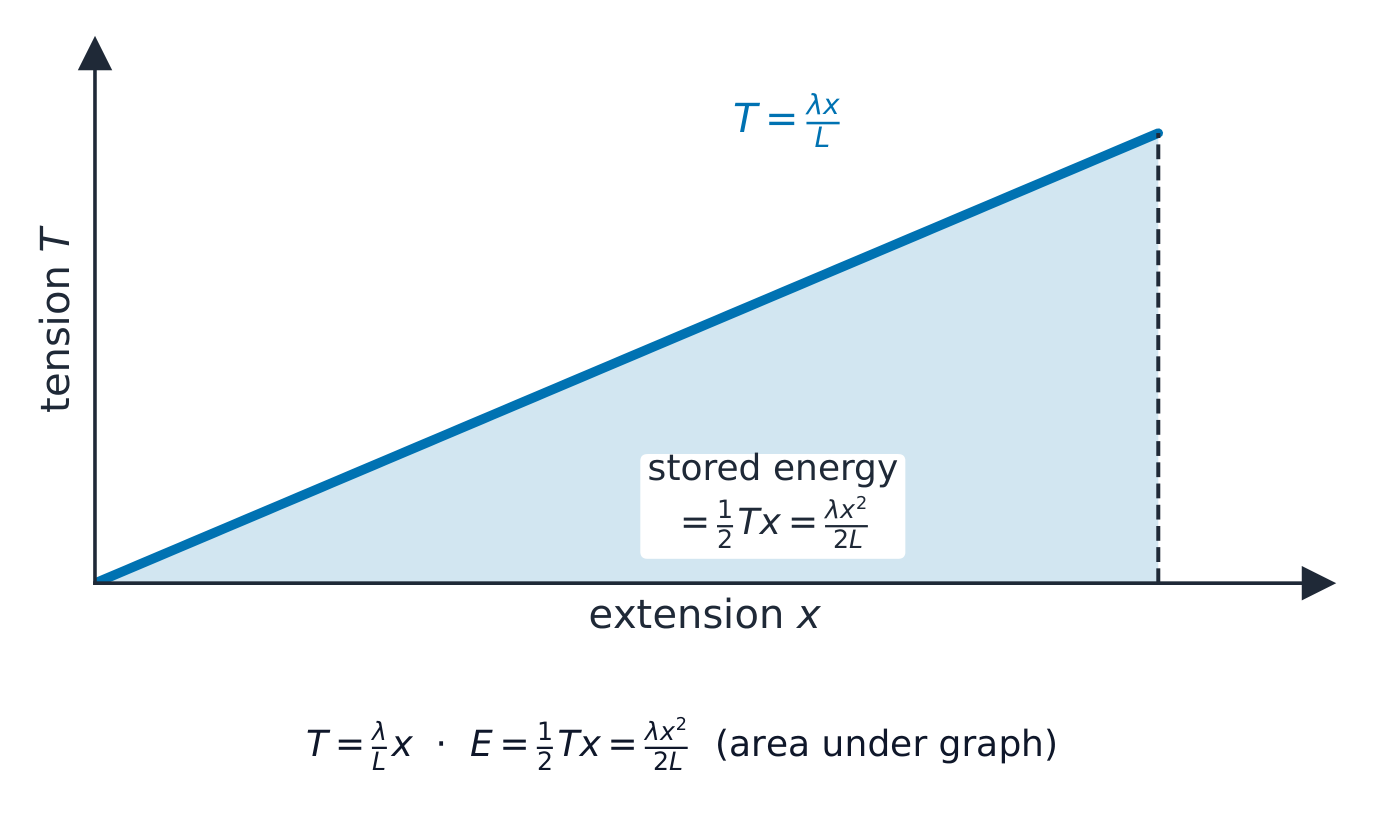
Hooke's law 胡克定律 says the tension in an elastic string or spring is proportional to its extension $x$:
$$T = \frac{\lambda x}{L},$$
where $L$ is the natural length and $\lambda$ is the modulus of elasticity 弹性模量. Stretching stores elastic potential energy 弹性势能:
$$E = \frac{\lambda x^2}{2L}.$$
Worked example. An elastic string of natural length $2\ \text{m}$ and modulus $50\ \text{N}$ is stretched by $0.5\ \text{m}$. Find the tension and the stored energy.
Force is proportional to extension — the gradient is the stiffness k. · القوة متناسبة مع الاستطالة — الميل هو الصلابة k.
3.5
Linear motion under a variable force · الحركة الخطية تحت قوة متغيرة
Syllabus · المنهج
English
Candidates should be able to:
Notes and examples
solve problems which can be modelled as the linear motion of a particle under the action of a variable force, by setting up and solving an appropriate differential equation.
Including use of $v \frac{\mathrm{d}v}{\mathrm{d}x}$ for acceleration, where appropriate. Calculus required is restricted to content from Pure Mathematics 3 in Cambridge International A Level Mathematics (9709). Only differential equations in which the variables are separable are included.
العربية
يجب أن يكون المرشحون قادرين على:
ملاحظات وأمثلة
حل المسائل التي يمكن نمذجتها كحركة خطية لجسيم تحت تأثير قوة متغيرة، عن طريق وضع وحل معادلة تفاضلية مناسبة.
بما في ذلك استخدام $v \frac{\mathrm{d}v}{\mathrm{d}x}$ للتسارع، حيثما كان مناسباً. calculus المطلوب مقيد بمحتوى Pure Mathematics 3 في منهج كامبريدج الدولي A Level Mathematics (9709). يتم تضمين المعادلات التفاضلية التي تكون فيها المتغيرات قابلة للفصل فقط.
Source: Cambridge International syllabus · المصدر: منهج كامبريدج الدولي
English
When the force depends on position $x$, use acceleration in the form $a = v\dfrac{dv}{dx}$, which turns Newton's law into a differential equation 微分方程 relating $v$ and $x$.
Worked example. A particle of mass $8\ \text{kg}$ moves along a line under a variable force 变力 of size $(x^3 + 4x)\ \text{N}$ acting in the direction of motion. When $x = 0$, $v = 1$. Find $v$ in terms of $x$.
Newton's law gives $8v\dfrac{dv}{dx} = x^3 + 4x$. Separating and integrating:
عندما تعتمد القوة على الموقع $x$، استخدم التسارع بصيغة $a = v\dfrac{dv}{dx}$، مما يحول قانون نيوتن إلى معادلة تفاضلية تربط بين $v$ و$x$.
استخدم dv/dt عندما تعتمد القوة على الزمن، وv·dv/dx عندما تعتمد على الموقع
مثال محلول. جسيم كتلته $8\ \text{kg}$ يتحرك على طول خط تحت تأثير قوة متغيرة مقدارها $(x^3 + 4x)\ \text{N}$ تعمل في اتجاه الحركة. عندما $x = 0$، $v = 1$. أوجد $v$ بدلالة $x$.
عند $x = 0$، تُعطي $v = 1$$C = 4$، إذن $4v^2 = \tfrac14 x^4 + 2x^2 + 4 = 4\left(\tfrac{x^2}{4} + 1\right)^2$. وبالتالي $v = \tfrac14 x^2 + 1$.
تتحول القوة المعتمدة على الموضع إلى معادلة تفاضلية بدلالة v وx
Explore · استكشف
Work from a variable force · الشغل من قوة متغيرة
W = ∫ F dx
When the force changes, the work done is the area under the force–distance graph. · عندما تتغير القوة، يكون الشغل المبذول هو المساحة تحت منحنى القوة–المسافة.
coefficient of restitution/ˌkəʊɪˈfɪʃənt ɒv rɪstɪˈtjuːʃn/
معامل الارتداد
bounding parabola/ˈbaʊndɪŋ pəˈræbələ/
القطع المكافئ المحدد
lamina/ˈlæmɪnə/
رقاقة رقيقة
coplanar forces/ˌkəʊˈpleɪnə ˈfɔːsɪz/
قوات مستوية
conical pendulum/ˈkɒnɪkl ˈpendjʊləm/
البندول المخروطي
normal contact force/ˈnɔːml ˈkɒntækt fɔːs/
قوة التلامس العمودية
oblique impact/əˈbliːk ˈɪmpækt/
اصطدام مائل
3.6
Momentum · الزخم
Syllabus · المنهج
English
Candidates should be able to:
Notes and examples
recall Newton’s experimental law and the definition of the coefficient of restitution, the property $0 \leqslant e \leqslant 1$, and the meaning of the terms ‘perfectly elastic’ ($e = 1$) and ‘inelastic’ ($e = 0$)
use conservation of linear momentum and/or Newton’s experimental law to solve problems that may be modelled as the direct or oblique impact of two smooth spheres, or the direct or oblique impact of a smooth sphere with a fixed surface.
استخدم حفظ الزخم الخطي و/أو قانون نيوتن التجريبي لحل المسائل التي يمكن نمذجتها كـ اصطدام مباشر أو مائل لكرتين أملسيتين، أو اصطدام مباشر أو مائل لكرة أملسة بسطح ثابت.
Source: Cambridge International syllabus · المصدر: منهج كامبريدج الدولي
English
In a collision, total linear momentum is conserved — the conservation of linear momentum 动量守恒. The bounciness is measured by Newton's experimental law 牛顿实验定律, which defines the coefficient of restitution 恢复系数$e$:
$$e = \frac{\text{speed of separation}}{\text{speed of approach}}, \qquad 0 \leqslant e \leqslant 1.$$
Here $e = 1$ is perfectly elastic (no energy lost) and $e = 0$ is inelastic (the bodies stay together). In an oblique impact 斜碰撞, resolve the velocities along and perpendicular to the line of impact, applying restitution along it.
Worked example. A sphere $A$ of mass $2\ \text{kg}$ moving at $5\ \text{m s}^{-1}$ hits a stationary sphere $B$ of mass $3\ \text{kg}$, with $e = 0.5$. Find the speeds afterwards.
في التصادم، يُحفظ الزخم الخطي الكلي — حفظ الزخم الخطي. يقاس المرونة بـ قانون نيوتن التجريبي، الذي يُعرّف معامل الاسترداد$e$:
$$e = \frac{\text{speed of separation}}{\text{speed of approach}}, \qquad 0 \leqslant e \leqslant 1.$$
هنا $e = 1$ تصادم مرن تماماً (لا فقدان للطاقة) و$e = 0$ غير مرن (تبقى الأجسام ملتصقة). في التصادم المائل، حلل السرعات على امتداد عمودي على خط التصادم، وطبق الاسترداد على امتداده.
معامل الاسترداد $e$ يقارن سرعة تباعد الأجسام بسرعة اقترابها.
مثال محلول. كرة $A$ كتلتها $2\ \text{kg}$ تتحرك بسرعة $5\ \text{m s}^{-1}$ تصطدم بكرة ثابتة $B$ كتلتها $3\ \text{kg}$، مع $e = 0.5$. أوجد السرعات بعد الاصطدام.
Set each mass and speed, then collide them. Total momentum is conserved — see how the velocities come out. · ضبط كتلة وسرعة كل جسم ثم تصادمهما. كمية التحرك الكلية محفوظة — شاهد كيف تظهر السرعات الناتجة.
3.6
Exam tips · نصائح للامتحان
English
For projectiles, resolve into horizontal (constant velocity) and vertical ($a = g$) motion, linked by the same time.
For a rigid body in equilibrium, take moments about a point that removes an unknown force.
For circular motion, use $F = mv^2/r = m\omega^2 r$ towards the centre; in a vertical circle check the minimum speed at the top.
With a variable force, use $a = v\,\frac{dv}{dx}$ and integrate; elastic PE $= \frac{\lambda x^2}{2L}$.
العربية
بالنسبة للـ القذائف، حلل الحركة إلى أفقي (سرعة ثابتة) وعمودي ($a = g$)، مرتبطة بنفس الزمن.
لجسم صلب في اتزان، خذ العزوم حول نقطة تُلغي قوة مجهولة.
للحركة الدائرية، استخدم $F = mv^2/r = m\omega^2 r$ نحو المركز؛ في دائرة رأسية تحقق السرعة الدنيا في الأعلى.
مع قوة متغيرة، استخدم $a = v\,\frac{dv}{dx}$ وكامل؛ الطاقة الكامنة المرنة $= \frac{\lambda x^2}{2L}$.
4
Further Probability & Statistics · احتمالات وإحصاء متقدم
This handout covers Topic 4: Further Probability & Statistics 进阶概率统计. It adds continuous distributions, small-sample inference, the chi-squared and non-parametric tests, and probability generating functions.
Continuous random variables · متغيرات عشوائية مستمرة
Syllabus · المنهج
English
Candidates should be able to:
Notes and examples
use a probability density function which may be defined piecewise
use the general result $\text{E}(g(X)) = \int f(x)g(x) \, \mathrm{d}x$ where $f(x)$ is the probability density function of the continuous random variable $X$ and $g(X)$ is a function of $X$
understand and use the relationship between the probability density function (PDF) and the cumulative distribution function (CDF), and use either to evaluate probabilities or percentiles
use cumulative distribution functions (CDFs) of related variables in simple cases.
e.g. given the CDF of a variable $X$, find the CDF of a related variable $Y$, and hence its PDF, e.g. where $Y = X^3$.
العربية
يجب أن يكون المرشحون قادرين على:
ملاحظات وأمثلة
استخدم دالة كثافة الاحتمال التي قد تكون معرفة بشكل مجزأ
استخدم النتيجة العامة $\text{E}(g(X)) = \int f(x)g(x) \, \mathrm{d}x$ حيث $f(x)$ هي دالة كثافة الاحتمال للمتغير العشوائي المستمر $X$ و$g(X)$ هي دالة لـ $X$
افهم واستخدم العلاقة بين دالة كثافة الاحتمال (PDF) ودالة التوزيع التراكمي (CDF)، واستخدم أحدهما لتقييم احتمالات أو百分يلات
استخدم دوال التوزيع التراكمي (CDFs) للمتغيرات ذات الصلة في حالات بسيطة.
مثال: معطى CDF لمتغير $X$، أوجد CDF لمتغير مرتبط $Y$، ومنه PDF له، مثال: عندما $Y = X^3$.
Source: Cambridge International syllabus · المصدر: منهج كامبريدج الدولي
English
A continuous variable $X$ is described by a probability density function 概率密度函数$f(x)$, which may be defined piecewise. The probability over a range is the area under $f$, and the mean of any function of $X$ is
$$E(g(X)) = \int g(x)\,f(x)\,dx.$$
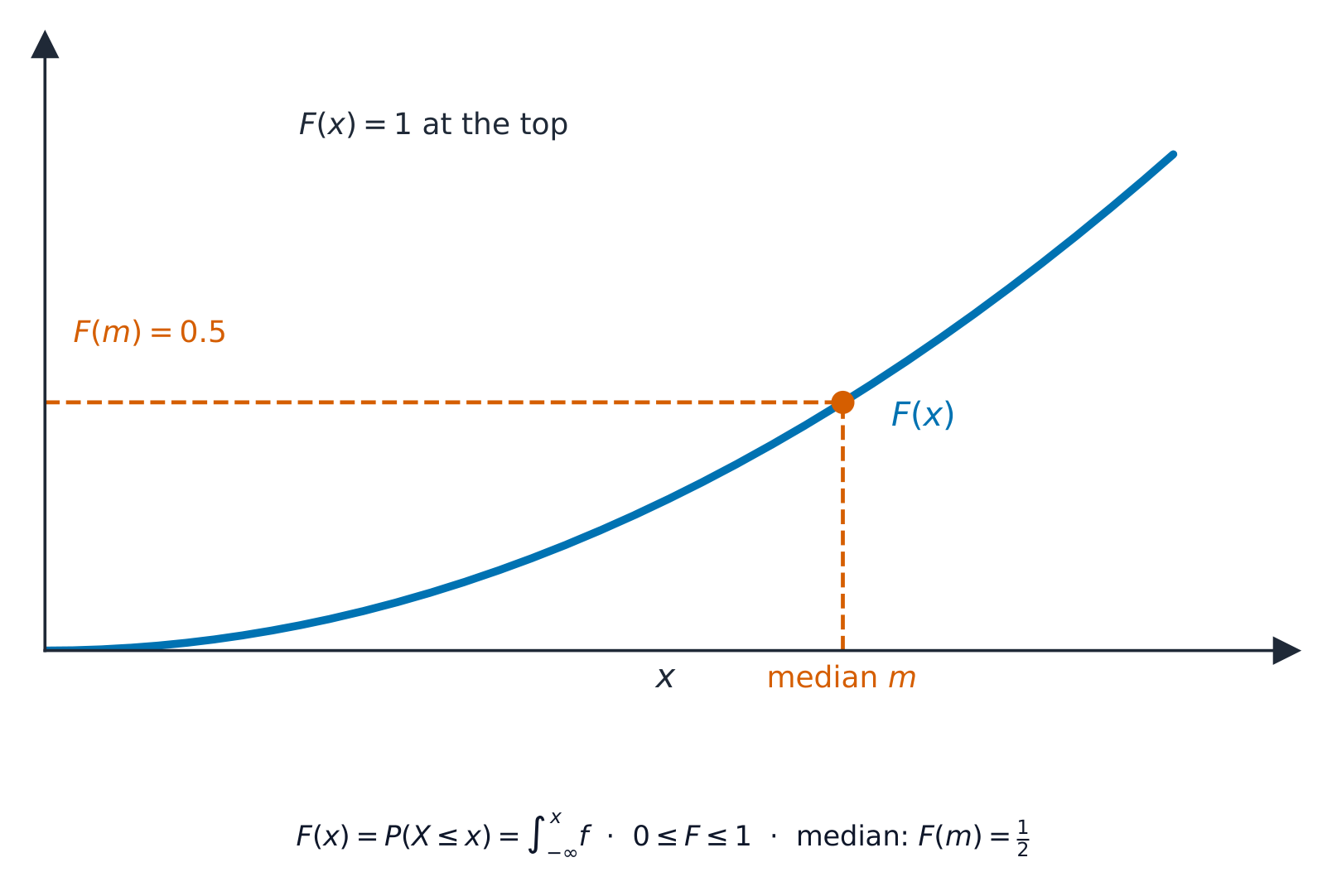
The cumulative distribution function 累积分布函数$F(x) = P(X \leqslant x)$ is the running total: $F(x) = \displaystyle\int_{-\infty}^{x} f(t)\,dt$, and $f(x) = F'(x)$. Use $F$ to find probabilities and percentiles 百分位数 (for example, the median 中位数 solves $F(x) = 0.5$).
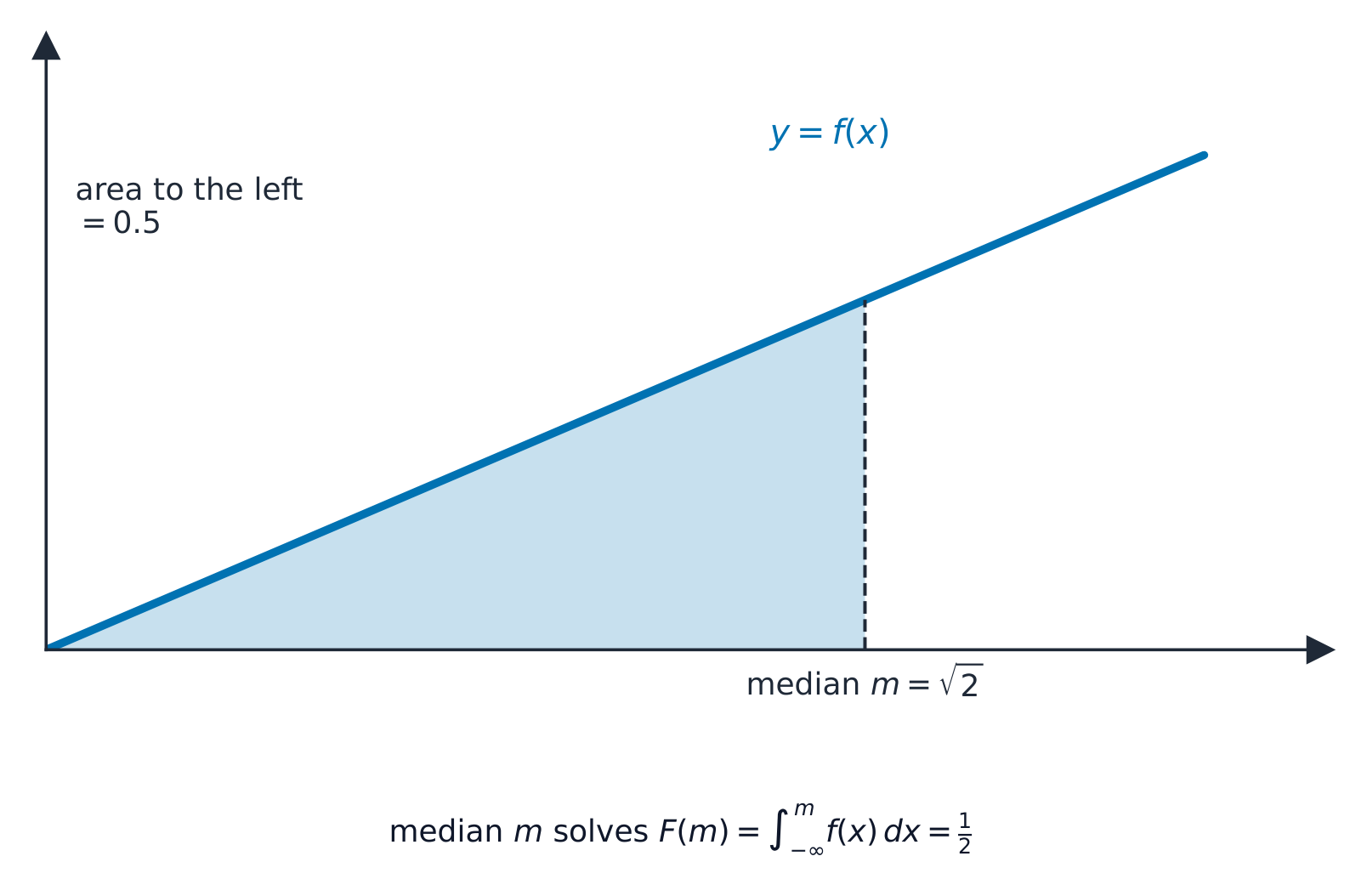
Worked example. A variable has $f(x) = \tfrac12 x$ for $0 \leqslant x \leqslant 2$. Find the median.
The cumulative distribution function is $F(x) = \displaystyle\int_0^x \tfrac12 t\,dt = \tfrac14 x^2$. Set $F(m) = 0.5$:
The distribution of a related variable. If $Y=g(X)$, find $Y$'s distribution through its cumulative function. For $Y=X^2$: $F_Y(y)=P(X^2\leqslant y)=P(-\sqrt y\leqslant X\leqslant\sqrt y)=F_X(\sqrt y)-F_X(-\sqrt y)$, then differentiate for $f_Y=F_Y'$. When $g$ is monotonic increasing there is a shortcut, $F_Y(y)=F_X\big(g^{-1}(y)\big)$.
Worked example. With $f_X(x)=\tfrac12 x$ on $[0,2]$ (so $F_X(x)=\tfrac14 x^2$), let $Y=X^2$. For $0\leqslant y\leqslant 4$, $F_Y(y)=F_X(\sqrt y)=\tfrac14 y$, so $f_Y(y)=F_Y'(y)=\tfrac14$ – that is, $Y$ is uniform on $[0,4]$.
العربية
متغير مستمر $X$ يُوصف بـ دالة كثافة احتمال$f(x)$، قد تكون معرفة جزئياً. احتمال وجوده في نطاق هو المساحة تحت $f$، ومتوسط أي دالة من $X$ هو
$$E(g(X)) = \int g(x)\,f(x)\,dx.$$
يقع الوسيط حيث مساحة ما تحت $f(x)$ يساره تساوي بالضبط $0.5$.
دالة التوزيع التراكمي$F(x) = P(X \leqslant x)$ هي المجموع المتراكم: $F(x) = \displaystyle\int_{-\infty}^{x} f(t)\,dt$، و$f(x) = F'(x)$. استخدم $F$ لإيجاد الاحتمالات والنسب المئوية (على سبيل المثال، الوسيط يحل $F(x) = 0.5$).
الرسم البياني التراكمي $F(x)$ يرتفع من $0$ إلى $1$؛ الارتفاع $0.5$ يُستوفى عند الوسيط.
مثال محلول. متغير له $f(x) = \tfrac12 x$ لـ $0 \leqslant x \leqslant 2$. أوجد الوسيط.
توزيع متغير مرتبط. إذا $Y=g(X)$، أوجد توزيع $Y$ عبر دالة التوزيع التراكمي. لـ $Y=X^2$: $F_Y(y)=P(X^2\leqslant y)=P(-\sqrt y\leqslant X\leqslant\sqrt y)=F_X(\sqrt y)-F_X(-\sqrt y)$، ثم اشتق لإيجاد $f_Y=F_Y'$. عندما يكون $g$ متزايداً بشكل رتيب، هناك طريقة مختصرة، $F_Y(y)=F_X\big(g^{-1}(y)\big)$.
مثال محلول. مع $f_X(x)=\tfrac12 x$ على $[0,2]$ (أي $F_X(x)=\tfrac14 x^2$)، ليكن $Y=X^2$. لـ $0\leqslant y\leqslant 4$، $F_Y(y)=F_X(\sqrt y)=\tfrac14 y$، إذن $f_Y(y)=F_Y'(y)=\tfrac14$ – أي أن $Y$ موزعة بانتظام على $[0,4]$.
Explore · استكشف
Continuous random variables · المتغيرات العشوائية المستمرة
P(a < X < b) = ∫ f(x) dx
For a continuous variable, probability is the area under the density curve. · بالنسبة لمتغير مستمر، الاحتمالية هي المساحة تحت منحنى الكثافة.
Inference using normal and t-distributions · الاستدلال باستخدام التوزيع الطبيعي وتوزيع t
Syllabus · المنهج
English
Candidates should be able to:
Notes and examples
formulate hypotheses and apply a hypothesis test concerning the population mean using a small sample drawn from a normal population of unknown variance, using a t-test
calculate a pooled estimate of a population variance from two samples
Calculations based on either raw or summarised data may be required.
formulate hypotheses concerning the difference of population means, and apply, as appropriate: - a 2-sample t-test - a paired sample t-test - a test using a normal distribution
The ability to select the test appropriate to the circumstances of a problem is expected.
determine a confidence interval for a population mean, based on a small sample from a normal population with unknown variance, using a t-distribution
determine a confidence interval for a difference of population means, using a t-distribution or a normal distribution, as appropriate.
العربية
يجب أن يكون المرشحون قادرين على:
ملاحظات وأمثلة
صياغة فرضيات وتطبيق اختبار فرضية يتعلق بمتوسط المجتمع باستخدام عينة صغيرة مستخرجة من مجتمع طبيعي ذات تباين غير معروف، باستخدام اختبار t
حساب تقدير مجمّع لتباين المجتمع من عينةتين
قد تكون الحسابات مبنية على بيانات خام أو ملخصة مطلوبة.
صياغة فرضيات حول فرق متوسطات المجموعات السكانية، وتطبيق ما يناسب: - اختبار t لعينة واحدة 2 - اختبار t لعينات مترابطة - اختبار يستخدم توزيعاً طبيعياً
يُتوقع القدرة على اختيار الاختبار المناسب لظروف المسألة.
تحديد فترة ثقة لمتوسط مجتمع، بناءً على عينة صغيرة من مجتمع طبيعي ذات تباين غير معروف، باستخدام توزيع t
تحديد فترة ثقة لفارق متوسطات المجتمعات، باستخدام توزيع t أو توزيع طبيعي، حسب المناسبة.
Source: Cambridge International syllabus · المصدر: منهج كامبريدج الدولي
English
When a sample is small and the population variance is unknown, base your hypothesis test 假设检验 on the $t$-distribution instead of the normal. The same idea gives a confidence interval 置信区间 for the mean:
$$\bar{x} \pm t\,\frac{s}{\sqrt{n}},$$
where $t$ comes from the $t$-tables with $n - 1$ degrees of freedom. To compare two populations, use a two-sample (2-sample) or paired-sample$t$-test, after finding a pooled estimate 合并估计 of the shared variance when appropriate.
Worked example. A sample of $n = 10$ has mean $\bar{x} = 50$ and standard deviation $s = 4$. Find a $95\%$ confidence interval for the mean (use $t = 2.262$ for $9$ degrees of freedom).
لوحة غالتون: كرات تسقط عبر دبابيس وتتكدس لتشكل التوزيع الطبيعي على شكل جرس.
عندما تكون العينة صغيرة وتكون تباين المجتمع غير معروف، استند إلى اختبار الفرضيات الخاص بك على توزيع $t$ بدلاً من الطبيعي. نفس الفكرة تعطي فترة ثقة للمتوسط:
$$\bar{x} \pm t\,\frac{s}{\sqrt{n}},$$
حيث $t$ مأخوذ من جداول $t$ مع $n - 1$ درجة حرية. لمقارنة مجتمعين، استخدم اختبار $t$ ثنائي العينة (2-sample) أو عينة مزدوجة، بعد إيجاد تقدير مشترك للتباين المشترك عند الحاجة.
لعينة صغيرة، توزيع $t$ أكثر تسطحاً وذيل أثقل، لذا قيمه الحرجة أكبر.
مثال محلول. عينة من $n = 10$ لها متوسط $\bar{x} = 50$ والانحراف المعياري $s = 4$. أوجد فترة ثقة $95\%$ للمتوسط (استخدم $t = 2.262$ لـ $9$ درجات حرية).
Why small samples need t instead of z · لماذا تتطلب العينات الصغيرة t بدلاً من z
With $\sigma$ unknown you use $t$, and $t$ has heavier tails than the normal (drawn dashed behind it) — so its critical values are larger and the interval is wider. At the worked example's $9$ degrees of freedom the widget reads $t^* = 2.262$, exactly the table value used above. Sweep df up and $t$ collapses onto the normal. · مع $\sigma$ غير معروف نستخدم $t$، ولدي $t$ ذيول أثقل من التوزيع الطبيعي (مرسوم بخط متقطع خلفه) — لذا فإن قيمها الحرجة أكبر والفاصل أوسع. عند $9$ درجة حرية في المثال المحلول يقرأ الويدجت $t^* = 2.262$، وهي تماماً القيمة الجدولية المستخدمة أعلاه. اسحب df لأعلى وينهار $t$ فوق التوزيع الطبيعي.
Explore · استكشف
The normal distribution · التوزيع الطبيعي
Shade a tail to find a probability — the basis of confidence intervals and hypothesis tests. · ظلل الذيل لإيجاد احتمال — وهو أساس فترات الثقة واختبارات الفرضيات.
4.3
Chi-squared tests · اختبارات تشي-مربع
Syllabus · المنهج
English
Candidates should be able to:
Notes and examples
fit a theoretical distribution, as prescribed by a given hypothesis, to given data
Questions will not involve lengthy calculations.
use a $\chi^2$-test, with the appropriate number of degrees of freedom, to carry out the corresponding goodness of fit analysis
Classes should be combined so that each expected frequency is at least 5.
use a $\chi^2$-test, with the appropriate number of degrees of freedom, for independence in a contingency table.
Yates’ correction is not required. Where appropriate, either rows or columns should be combined so that the expected frequency in each cell is at least 5.
العربية
يجب أن يكون المرشحون قادرين على:
ملاحظات وأمثلة
ملاءمة توزيع نظري، كما هو منصوص عليه بفرضية معينة، لبيانات معطاة
لن تتضمن الأسئلة حسابات مطولة.
استخدام اختبار $\chi^2$، مع العدد المناسب من درجات الحرية، لإجراء تحليل ملاءمة التوزيع
يجب دمج الفئات بحيث يكون التردد المتوقع لكل فئة على الأقل 5.
استخدام اختبار $\chi^2$، مع العدد المناسب من درجات الحرية، للاختبار الاستقلالية في جدول الطوارئ.
لا يلزم تصحيح يتس. حيثما كان ذلك مناسباً، يجب دمج الصفوف أو الأعمدة بحيث يكون التردد المتوقع في كل خلية على الأقل 5.
Source: Cambridge International syllabus · المصدر: منهج كامبريدج الدولي
English
A $\chi^2$-test (chi-squared test 卡方检验) compares observed counts $O$ with expected counts $E$ from a theoretical distribution 理论分布:
$$\chi^2 = \sum \frac{(O - E)^2}{E}.$$
Compare this with a table value for the right number of degrees of freedom 自由度. Two uses: a goodness of fit 拟合优度 test (does the data follow the proposed model?), and a test for independence 独立性 of two variables in a contingency table 列联表.
Worked example. Four equally likely categories give observed counts $20, 30, 25, 25$ (so each expected count is $25$). Test the fit at the $5\%$ level.
With $4 - 1 = 3$ degrees of freedom the table value is $7.815$. Since $2 < 7.815$, do not reject the model.
العربية
اختبار $\chi^2$ (اختبار تشي-مربع) يقارن عدداً مشاهدًا $O$ مع عدداً متوقعًا $E$ من توزيع نظري:
$$\chi^2 = \sum \frac{(O - E)^2}{E}.$$
قارن هذه القيمة بقيمة الجدول لعدد صحيح من درجات الحرية. استخدامان: اختبار جودة المطابقة (هل تتبع البيانات النموذج المقترح؟)، واختبار الاستقلال لمتغيرين في جدول تكرارات.
يرفض الاختبار النموذج عندما يتجاوز $\chi^2$ القيمة الحرجة، مما يضعه في الذيل المظلل $5\%$.
مثال محلول. أربعة فئات متساوية الاحتمال تعطي عدداً مشاهداً $20, 30, 25, 25$ (إذن كل عدد متوقع هو $25$). اختبر المطابقة عند مستوى $5\%$.
مع $4 - 1 = 3$ درجة حرية، القيمة الجدولية هي $7.815$. بما أن $2 < 7.815$، لا نرفض النموذج.
Explore · استكشف
The chi-squared distribution and its 5% tail · توزيع كاي-مربع وذيله بنسبة 5%
The worked example on this page gives $\chi^2 = 2$ with $3$ degrees of freedom against a table value of $7.815$ — the widget reproduces both. Drag df to see why the critical value changes with the number of categories. · يعطي المثال المحلول في هذه الصفحة $\chi^2 = 2$ بدرجة حرية $3$ مقابل قيمة جدول $7.815$ — يعيد الويدجت كلاهما. اسحب df لترى لماذا تتغير القيمة الحرجة مع عدد الفئات.
Explore · استكشف
Chi-squared test route · مسار اختبار Chi-squared
Follow observed and expected counts to a test decision. · اتبع counts المرصودة والمتوقعة للوصول إلى قرار الاختبار.
4.4
Non-parametric tests · الاختبارات اللامعلمية
Syllabus · المنهج
English
Candidates should be able to:
Notes and examples
understand the idea of a non-parametric test and appreciate situations in which such a test might be useful
e.g. when sampling from a population which cannot be assumed to be normally distributed.
understand the basis of the sign test, the Wilcoxon signed-rank test and the Wilcoxon rank-sum test
Including knowledge that Wilcoxon tests are valid only for symmetrical distributions.
use a single-sample sign test and a single-sample Wilcoxon signed-rank test to test a hypothesis concerning a population median
Including the use of normal approximations where appropriate. Questions will not involve tied ranks or observations equal to the population median value being tested.
use a paired-sample sign test, a Wilcoxon matched-pairs signed-rank test and a Wilcoxon rank-sum test, as appropriate, to test for identity of populations.
Including the use of normal approximations where appropriate. Questions will not involve tied ranks or zero‑difference pairs.
العربية
يجب أن يكون المرشحون قادرين على:
ملاحظات وأمثلة
فهم مفهوم الاختبار غير البارامتري وإدراك المواقف التي قد يكون فيها مثل هذا الاختبار مفيداً
مثلاً عند أخذ عينة من مجتمع لا يمكن افتراض أنه يتبع التوزيع الطبيعي.
فهم أساس اختبار الإشارة، واختبار رتب ويلكوكسون المزدوجة الإشارية واختبار مجموع رتب ويلكوكسون
بما في ذلك معرفة أن اختبارات ويلكوكسون صالحة فقط للتوزيعات المتماثلة.
استخدام اختبار إشارة العينة الواحدة واختبار رتب ويلكوكسون المزدوجة الإشارية للعينة الواحدة لاختبار فرضية تتعلق بـ الوسيط للمجتمع
بما في ذلك استخدام التقديرات الطبيعية حيثما كان ذلك مناسباً. لن تتضمن الأسئلة رتباً متساوية أو مشاهدات مساوية لقيمة وسيط المجتمع المختبر.
استخدام اختبار إشارة العينتين المرتبطتين، واختبار رتب ويلكوكسون المزدوجة الإشارية للعينات المرتبطة، واختبار مجموع رتب ويلكوكسون، حسب الاقتضاء، لاختبار تطابق المجتمعات.
بما في ذلك استخدام التقديرات الطبيعية حيثما كان ذلك مناسباً. لن تتضمن الأسئلة رتباً متساوية أو أزواج ذات فرق صفري.
Source: Cambridge International syllabus · المصدر: منهج كامبريدج الدولي
English
A non-parametric test 非参数检验 makes no assumption that the data is normal, so it is useful when that assumption fails. The basic ones are:
the sign test 符号检验: count how many values fall above and below a proposed median, and test those counts with a binomial model;
the Wilcoxon signed-rank test 威尔科克森符号秩检验 (the matched-pairs test for paired data), which also uses the sizes of the differences, not just their signs;
the Wilcoxon rank-sum test 威尔科克森秩和检验, for comparing two separate samples.
Worked example. Test whether a median is $5$. In a sample of $10$ values (none equal to $5$), $9$ lie above$5$ and $1$ lies below. Test at the $5\%$ level (two-tailed).
Under $H_0$ (median $= 5$) the number above follows $B(10, 0.5)$. The observed result ($9$ above) is extreme, so find $P(X \geq 9) = \binom{10}{9}(0.5)^{10} + (0.5)^{10} = \dfrac{11}{1024} = 0.0107$. For a two-tailed test compare with $\tfrac{1}{2}(5\%) = 0.025$. Since $0.0107 < 0.025$, reject $H_0$: there is evidence the median is not $5$.
العربية
الـاختبار غير البارامترية لا يفترض أن البيانات تتبع التوزيع الطبيعي، لذا فهي مفيدة عندما تفشل هذا الافتراض. الأساسية منها:
اختبار الإشارة: احسب كم عدد القيم التي تقع فوق وتحت الوسيط المقترح، ثم اختبر تلك العدادات باستخدام نموذج ثنائي الحد؛
اختبار رتبWilcoxon الموقعة (اختبار الأزواج المتطابقة للبيانات المترابطة)، والذي يستخدم أيضًا أحجام الفروقات، ليس فقط إشاراتها؛
اختبار مجموع رتب Wilcoxon، لمقارنة عينتين منفصلتين.
يُعد اختبار الإشارة كم عدد القيم التي تقع فوق وتحت الوسيط المقترح، ثم يختبر تلك العدادات باستخدام نموذج ثنائي الحد
مثال محلول. اختبر ما إذا كان الوسيط يساوي $5$. في عينة من $10$ قيمة (لا تساوي $5$)، تقع $9$أعلى$5$ وتقع $1$ أسفلها. اختبر عند مستوى $5\%$ (ذات الذيلين).
تحت $H_0$ (الوسيط $= 5$) يتبع العدد الذي يقع أعلى $B(10, 0.5)$. النتيجة المرصودة ($9$ أعلى) متطرفة، لذا أوجد $P(X \geq 9) = \binom{10}{9}(0.5)^{10} + (0.5)^{10} = \dfrac{11}{1024} = 0.0107$. لاختبار ذات الذيلين قارن مع $\tfrac{1}{2}(5\%) = 0.025$. بما أن $0.0107 < 0.025$، افرض $H_0$: هناك دليل على أن الوسيط لا يساوي $5$.
Explore · استكشف
Non-parametric test chooser · مختار الاختبارات غير المعلمية
Choose the rank-based test that matches the data situation. · اختر الاختبار القائم على الرتب الذي يطابق وضع البيانات.
probability generating function/ˌprɒbəˈbɪlɪti ˈdʒenəreɪtɪŋ ˈfʌŋkʃn/
دالة توليد الاحتمالات
Further Probability & Statistics/ˈfɜːðə ˌprɒbəˈbɪlɪti ænd stəˈtɪstɪks/
احتمالات وإحصاء متقدم
4.5
Probability generating functions · دوال توليد الاحتمالات
Syllabus · المنهج
English
Candidates should be able to:
Notes and examples
understand the concept of a probability generating function (PGF) and construct and use the PGF for given distributions
Including the discrete uniform, binomial, geometric and Poisson distributions.
use formulae for the mean and variance of a discrete random variable in terms of its PGF, and use these formulae to calculate the mean and variance of a given probability distribution
use the result that the PGF of the sum of independent random variables is the product of the PGFs of those random variables.
العربية
يجب أن يكون المرشحون قادرين على:
ملاحظات وأمثلة
فهم مفهوم دالة توليد الاحتمالات (PGF) وبناء واستخدام PGF للتوزيعات المعطاة
بما في ذلك التوزيع المنتظم المنفصل، والتوزيع الثنائي، والتوزيع الهندسي، وتوزيع بواسون.
استخدام الصيغ للمتوسط والتباين للمتغير العشوائي المنفصل بدلالة PGF الخاصة به، واستخدام هذه الصيغ لحساب المتوسط والتباين لتوزيع احتمالي معين
استخدام النتيجة القائلة بأن PGF لمجموع متغيرات عشوائية مستقلة هو حاصل ضرب PGFs لهذه المتغيرات.
Source: Cambridge International syllabus · المصدر: منهج كامبريدج الدولي
English
The probability generating function 概率母函数 of a discrete variable $X$ is
$$G(t) = E(t^X) = \sum_x P(X = x)\,t^x.$$
It packs the whole distribution into one function. The mean and variance come from its derivatives at $t = 1$: $E(X) = G'(1)$ and $\mathrm{Var}(X) = G''(1) + G'(1) - \big(G'(1)\big)^2$. Also, the PGF of a sum of independent variables is the product of their PGFs.
Worked example.$X$ has $P(X=0) = 0.5$, $P(X=1) = 0.3$, $P(X=2) = 0.2$. Find $E(X)$ using the PGF.
Here $G(t) = 0.5 + 0.3t + 0.2t^2$, so $G'(t) = 0.3 + 0.4t$ and
$$E(X) = G'(1) = 0.3 + 0.4 = 0.7.$$
العربية
النرد: نقطة انطلاق للاحتمالات والمتغيرات العشوائية المتقطعة.
دالة توليد الاحتمالات للمتغير المتقطع $X$ هي
$$G(t) = E(t^X) = \sum_x P(X = x)\,t^x.$$
إنها تدمج التوزيع بأكمله في دالة واحدة. يأتي المتوسط والتباين من مشتقاتها عند $t = 1$: $E(X) = G'(1)$ و$\mathrm{Var}(X) = G''(1) + G'(1) - \big(G'(1)\big)^2$. أيضًا، دالة PGF لمجموع متغيرات مستقلة هي حاصل ضرب دوال PGF الخاصة بها.
مثال محلول. يمتلك $X$$P(X=0) = 0.5$، $P(X=1) = 0.3$، $P(X=2) = 0.2$. أوجد $E(X)$ باستخدام PGF.
هنا $G(t) = 0.5 + 0.3t + 0.2t^2$، إذن $G'(t) = 0.3 + 0.4t$ و
$$E(X) = G'(1) = 0.3 + 0.4 = 0.7.$$
PGF لنرد عادل يجمع كتلًا متساوية عند 1 إلى 6 في G(t)
Explore · استكشف
Probability generating function lab · مختبر دالة توليد الاحتمالات
G(x) = p0 + p1 x + p2 x^2 + ...
Change x and see how a PGF stores probabilities in powers of x. · غيّر x ولاحظ كيف تخزن PGF الاحتمالات في قوى x.
4.5
Exam tips · نصائح للامتحان
English
For a continuous random variable, the pdf integrates to $1$ over its range, and $E(X) = \int x f(x)\,dx$.
Use the $t$-distribution when the sample is small and the population variance is unknown; state the degrees of freedom.
For a chi-squared test compute $\sum (O-E)^2/E$, compare with the critical value at the right degrees of freedom, and combine classes with $E < 5$.
State $H_0$ and $H_1$ and give the conclusion in context for every test.
العربية
بالنسبة لـمتغير عشوائي مستمر، يتكامل الدالة الكثافة الاحتمالية إلى $1$ عبر نطاقه، و$E(X) = \int x f(x)\,dx$.
استخدم توزيع$t$ عندما تكون العينة صغيرة وتكون تباين المجتمع غير معروف؛ حدد درجات الحرية.
لاختبار chi-squared احسب $\sum (O-E)^2/E$، قارنه بالقيمة الحرجة عند درجات الحرية اليمنى، واجمع الفئات ذات $E < 5$.
حدد $H_0$ و$H_1$ وقدم الاستنتاج في السياق لكل اختبار.
Pick one and the site follows you — notes, papers, videos and practice all open on it. · اختر واحدًا وسيتبعك الموقع — الملاحظات، الأوراق، الفيديوهات والتدريب جميعها تفتح عليه.
Type to search notes, lessons, code, vocabulary and past-paper questions across every subject. · اكتب للبحث عن ملاحظات، دروس، أكواد، مفردات وأسئلة امتحانات سابقة عبر جميع المواد.