Price elasticity of supply (PES) · 供给价格弹性(PES)
| English | 中文 | Pinyin · 拼音 |
|---|---|---|
| price elasticity of supply/praɪs ɪlæˈstɪsɪti ɒv səˈplaɪ/ | 供给价格弹性 | gōng jǐ jià gé tán xìng |
| inelastic/ɪnɪˈlæstɪk/ | 缺乏弹性 | quē fá tán xìng |
| elastic/ɪˈlæstɪk/ | 富有弹性 | fù yǒu tán xìng |
| spare capacity/speə kəˈpæsɪti/ | 闲置产能 | xián zhì chǎn néng |
| short run/ʃɔːt rʌn/ | 短期 | duǎn qī |
| perishable/ˈperɪʃəbl/ | 易腐的 | yì fǔ de |
Can sellers react fast?
- When strawberry prices jump, a farmer can't grow more overnight — the crop takes months. A factory can add a shift tomorrow.
- Price elasticity of supply 供给价格弹性 measures how quickly and easily sellers respond.
卖方能快速反应吗?
- 当草莓价格跳升时,一个农民无法一夜之间种更多——作物需要几个月。一个工厂明天就能增加一个班次。
- 供给价格弹性(price elasticity of supply)衡量卖方反应多快、多容易。
Price rises 20% and quantity supplied rises 10%. What is PES? · 价格上升 20% 而供给量上升 10%。PES 是多少?
PES = 10% / 20% = 0.5 — inelastic. · PES = 10% / 20% = 0.5——缺乏弹性。
PES is normally positive because supply curves slope upward. · PES 通常是正的,因为供给曲线向上倾斜。
Higher price → more supplied, so PES is positive. · 更高的价格 → 供给更多,所以 PES 是正的。
Defining PES
- PES = how much quantity supplied responds to a price change.
- $\text{PES} = \dfrac{\%\ \text{change in quantity supplied}}{\%\ \text{change in price}}$ — normally positive.
Worked example. Price rises 10% and quantity supplied rises 5%. $\text{PES} = \dfrac{5\%}{10\%} = 0.5$. Supply is inelastic 缺乏弹性.
定义 PES
- PES = 供给量对一个价格变化反应多少。
- $\text{PES} = \dfrac{\%\ \text{change in quantity supplied}}{\%\ \text{change in price}}$——通常是正的。
例题。 价格上升 10% 而供给量上升 5%。$\text{PES} = \dfrac{5\%}{10\%} = 0.5$。供给是缺乏弹性的(inelastic)。
Demand & supply · 需求与供给
Supply elasticity is how quantity responds to price. · 供给弹性是数量如何对价格反应。
Which makes supply more elastic? · 哪个使供给更富有弹性?
Spare capacity lets firms raise output quickly. · 闲置产能让企业快速提高产出。
What makes supply elastic 富有弹性
- Elastic supply (PES > 1): firms can change output easily — spare capacity 闲置产能, stock, quick production.
- Inelastic supply (PES < 1): output is hard to change — farming, mining, skilled labour.
Steep = inelastic supply; shallow = elastic supply.
什么使供给富有弹性
- 富有弹性的供给(PES > 1):企业能容易地改变产出——闲置产能、库存、快速生产。
- 缺乏弹性的供给(PES < 1):产出难以改变——农业、采矿、技术劳动。
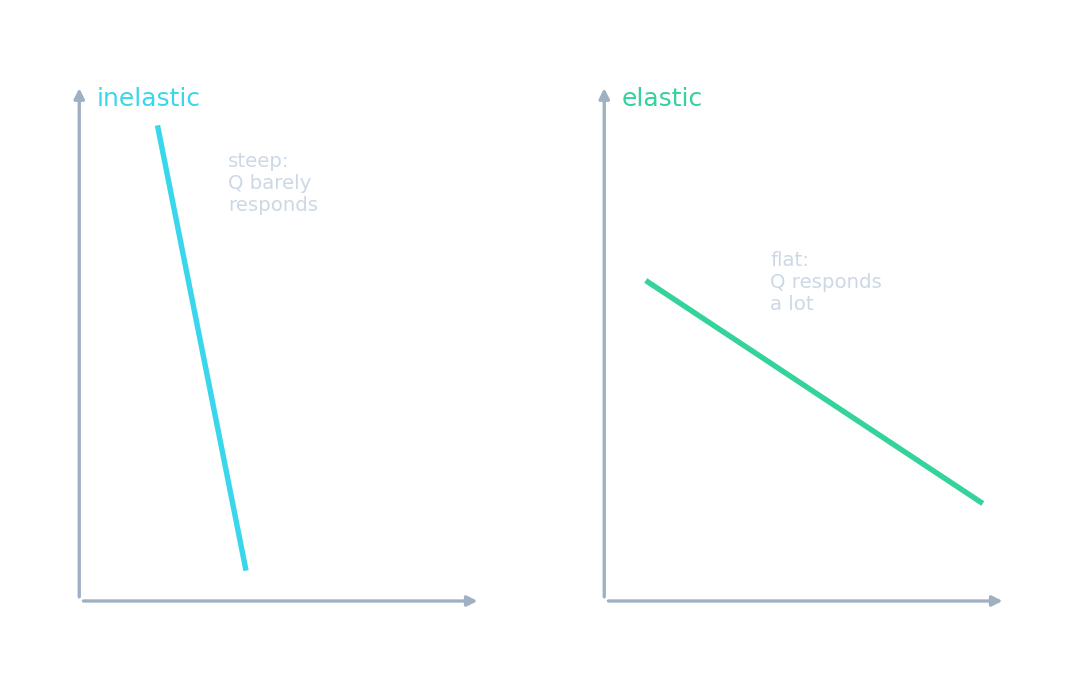
陡峭 = 缺乏弹性的供给;平缓 = 富有弹性的供给。
Supply tends to be most inelastic: · 供给倾向于最缺乏弹性:
In the short run firms cannot easily change output, so supply is inelastic. · 在短期企业无法容易地改变产出,所以供给缺乏弹性。
Given more , firms can build capacity and supply becomes more elastic. · 给定更多,企业能建造产能,供给变得更富有弹性。
Time lets fixed factors be varied, raising elasticity. · 时间让固定要素被改变,提高弹性。
Time matters most
- In the short run 短期, supply is usually inelastic — factors are fixed.
- Given time, firms build capacity and supply becomes more elastic.
Perishable 易腐的 or slow-to-grow goods are supply-inelastic. Fresh fruit and minerals can't be produced quickly, so a price rise brings little extra supply at first.
时间最重要
- 在短期(short run),供给通常缺乏弹性——要素是固定的。
- 给定时间,企业建造产能,供给变得更富有弹性。
易腐或生长缓慢的物品在供给上缺乏弹性。 新鲜水果和矿物无法快速生产,所以一次价格上升起初带来很少额外的供给。
You've got it
- $\text{PES} = \dfrac{\%\Delta Q_s}{\%\Delta P}$ — its size measures supply responsiveness
- elastic supply needs spare capacity, stocks or quick production
- supply is more inelastic in the short run, more elastic over time
你掌握了
- $\text{PES} = \dfrac{\%\Delta Q_s}{\%\Delta P}$——它的大小衡量供给的反应灵敏度
- 富有弹性的供给需要闲置产能、库存或快速生产
- 供给在短期更缺乏弹性,随时间更富有弹性