| English | 释义 | 拼音 |
|---|---|---|
| price elasticity of demand/praɪs ɪlæˈstɪsɪti ɒv dɪˈmænd/ | 需求价格弹性 | xū qiú jià gé tán xìng |
| elastic/ɪˈlæstɪk/ | 富有弹性 | fù yǒu tán xìng |
| inelastic/ɪnɪˈlæstɪk/ | 缺乏弹性 | quē fá tán xìng |
| substitutes/ˈsʌbstɪtjuːts/ | 替代品 | tì dài pǐn |
| necessities/nəˈsesɪtiz/ | 必需品 | bì xū pǐn |
| luxuries/ˈlʌkʃəriz/ | 奢侈品 | shē chǐ pǐn |
| revenue/ˈrevənjuː/ | 收益 | shōu yì |
A peso on every litre, Mexico 2014
- In January 2014 Mexico added a tax of one peso per litre to sugary drinks, which raised their price by about 10%. In the first year, purchases of taxed drinks fell by about 6% on average, and by more in poorer households. People kept buying most of their usual drinks, but fewer of them.
- Economists measure this response with the price elasticity of demand 需求价格弹性 (PED).
Mexico's tax raised drink prices by 10% and purchases fell by 6%. What is the PED?
难度 2/5 · 今日首次完成可获 140 金币及少量额外奖励
−6 ÷ 10.
Calculating PED
- $\text{PED} = \dfrac{\%\ \text{change in quantity demanded}}{\%\ \text{change in price}}$.
- Mexico: $-6\% \div 10\% = -0.6$. The minus sign shows that quantity falls when price rises.
百分比反应与收入
用初始值为基准比较价格上涨与数量下降。课文只给百分比的例子将两项初始指数均设为100;参考例子使用其给出的价格与数量。
Price rises by 5% and quantity demanded falls by 15%. What is PED?
难度 2/5 · 今日首次完成可获 140 金币及少量额外奖励
−15 ÷ 5.
Elastic and inelastic
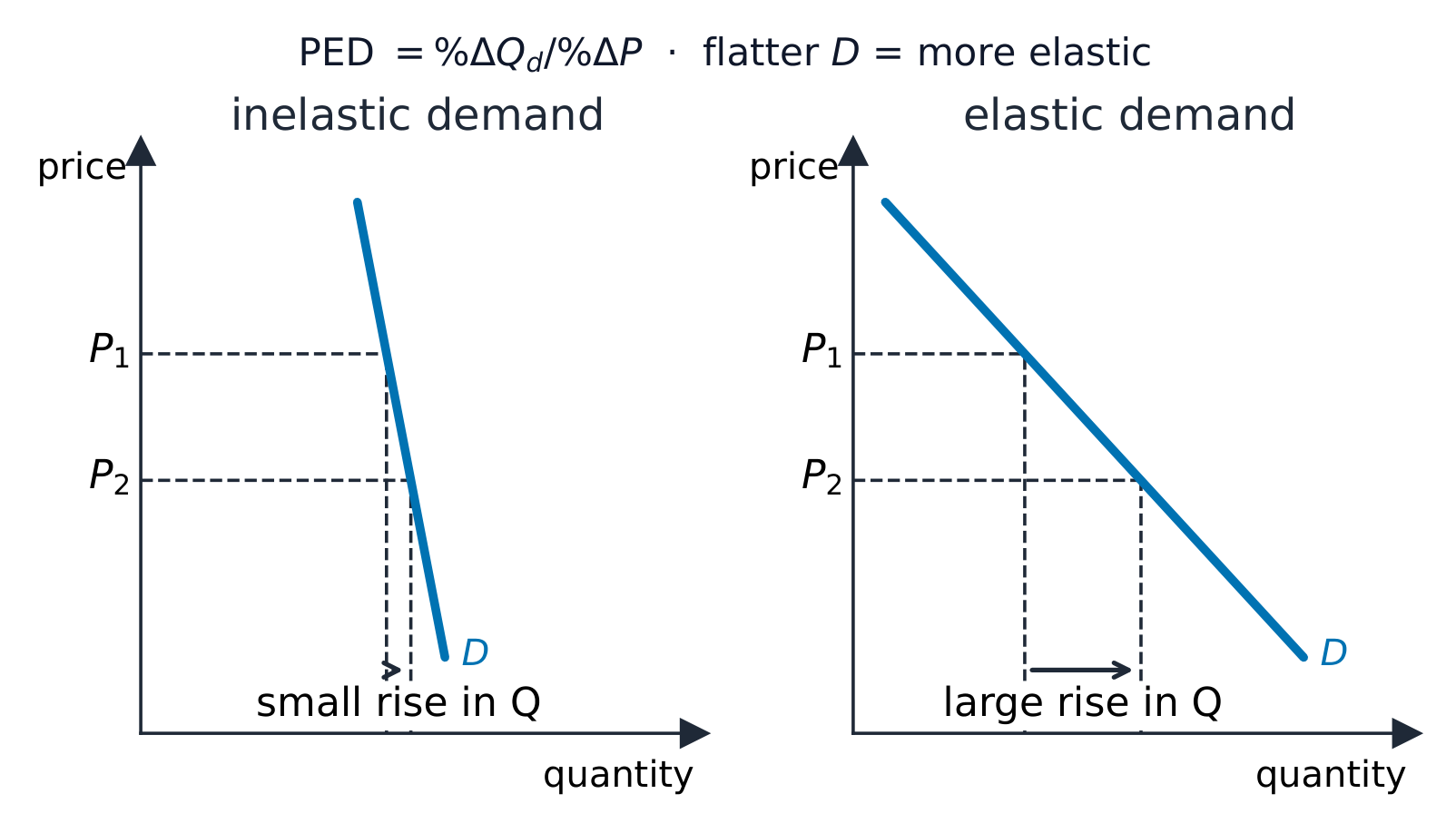
- Elastic 富有弹性 demand: PED above 1 (ignoring the sign) — quantity changes by a bigger percentage than price.
- Inelastic 缺乏弹性 demand: PED below 1 — quantity changes by a smaller percentage. Mexico's sugary drinks were inelastic.

Match each PED to its type.
难度 2/5 · 今日首次完成可获 140 金币及少量额外奖励
Compare with 1.
What decides PED?
- Close substitutes 替代品 make demand elastic (one brand of crisps); few substitutes make it inelastic. Necessities 必需品 are inelastic; luxuries 奢侈品 are more elastic.
- A large share of income, and more time to find alternatives, make demand more elastic.
Which product probably has the most elastic demand?
难度 1/5 · 今日首次完成可获 100 金币及少量额外奖励
Many close substitutes.
Worked example: what happens to revenue?
A café sells 400 cakes a week at $2. It raises the price to$2.50 and sells 360.
- % change in price: $\dfrac{0.50}{2} \times 100 = 25\%$. % change in quantity: $\dfrac{-40}{400} \times 100 = -10\%$.
- PED: $-10 \div 25 = -0.4$ → inelastic.
- Revenue 收益: before $2 \times 400 = \$800$; after $2.50 \times 360 = \$900$. With inelastic demand, the price rise increased revenue.
A shop sells 200 pens at $1. It raises the price to$1.20 and sells 190. What is the new revenue in dollars?
难度 2/5 · 今日首次完成可获 140 金币及少量额外奖励
1.20 × 190; up from 200.
Who uses PED?
- Firms: raise prices for inelastic products; cut prices for elastic ones to win more customers and revenue.
- Governments: taxes on goods with inelastic demand raise a lot of money, but they reduce consumption only a little — as Mexico found.
Taxing a good with inelastic demand raises a lot of tax revenue.
难度 1/5 · 今日首次完成可获 100 金币及少量额外奖励
Quantity falls only a little.
A fall in quantity does not mean demand is elastic. Compare the percentages: Mexico's purchases fell, but by less than the price rose, so demand was inelastic.
If quantity falls after a price rise, demand must be elastic.
难度 1/5 · 今日首次完成可获 100 金币及少量额外奖励
Compare the percentages.
PED = % change in quantity demanded ÷ % change in price. Above 1 is elastic, below 1 inelastic. Substitutes, luxuries, share of income and time make demand more elastic. For inelastic goods, a price rise increases revenue.
A cinema is the only one in a small town. Explain whether it should raise its ticket prices to increase revenue.
Applying PED.