Classifying living things · 生物分类
| English | 中文 | Pinyin · 拼音 |
|---|---|---|
| classify/ˈklæsɪfaɪ/ | 分类 | fēn lèi |
| species/ˈspiːsiːz/ | 物种 | wù zhǒng |
| fertile/ˈfɜːtaɪl/ | 可育的 | kě yù de |
| binomial system/baɪˈnəʊmɪəl ˈsɪstəm/ | 双名法 | shuāng míng fǎ |
| genus/ˈdʒenəs/ | 属 | shǔ |
| kingdom/ˈkɪŋdəm/ | 界 | jiè |
| dichotomous key/daɪˈkɒtəməs kiː/ | 二歧检索表 | èr qí jiǎn suǒ biǎo |
Bringing order to millions
- Scientists have named over a million kinds of living thing — and there are millions more.
- To make sense of them, we classify 分类: sort them into groups by shared features.
给数百万带来秩序
- 科学家已经命名了超过一百万种活的东西——而还有数百万种。
- 为了理解它们,我们分类(classify):按共享的特征把它们分组。
Classification rank lab · 分类等级实验
Place examples at the right level in the biological hierarchy. · 在生物层级中定位示例至适当等级。
A species is a group of organisms that can: · 物种是一类能:
Members of a species breed to give fertile offspring. · 同物种成员交配产生可育后代。
Members of the same species breed to produce ______ offspring. · 同一物种的成员交配产生______后代。
Fertile offspring can themselves reproduce. · 可育后代自身也能繁殖。
Species 物种 and naming
- A species is a group of organisms that can breed together to make fertile 可育的 offspring.
- Each species has a two-word Latin name (the binomial system 双名法): genus 属 then species, e.g. Homo sapiens.
Living organisms are sorted into five kingdoms 界 by their main features
物种与命名
- 一个物种(species)是一群能一起繁殖以产生可育(fertile)后代的生物体。
- 每个物种有一个两词的拉丁名(双名法,binomial system):属然后种,例如 Homo sapiens。
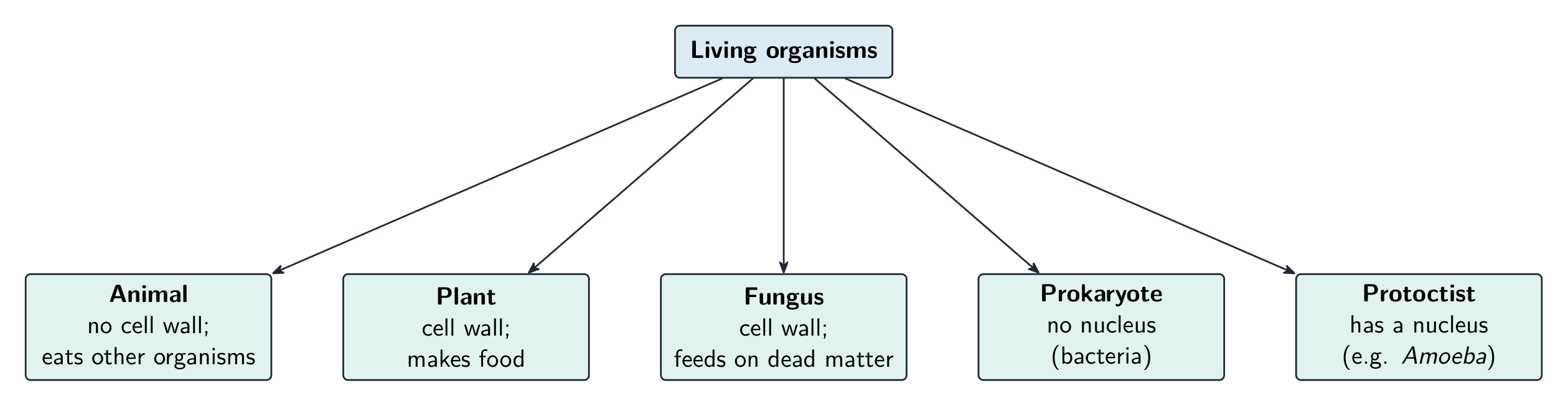
活的生物体按它们的主要特征被分成五个界
In the binomial system, the first word of the name is the: · 双名法中名称首词是:
The binomial is genus then species, e.g. Homo sapiens. · 二名法为属名加种名,例如 Homo sapiens ⟦Homo sapiens⟧。
Put these classification groups in order from largest to smallest. · 将这些分类等级从大到小排序。
Kingdom → phylum → class → order → family → genus → species. · 界 → 门 → 纲 → 目 → 科 → 属 → 种。
The classification hierarchy
- Organisms are sorted into ever-smaller groups: kingdom → phylum → class → order → family → genus → species.
- The more features two organisms share, the more groups they share — and the more closely related they are.
A fungus: the fly agaric, a mushroom
分类层次
- 生物体被分成越来越小的组:界 → 门 → 纲 → 目 → 科 → 属 → 种(kingdom → phylum → class → order → family → genus → species)。
- 两个生物体共享的特征越多,它们共享的组越多——它们的亲缘关系越近。

一个真菌:毒蝇伞,一种蘑菇
A dichotomous key identifies an organism using: · 二分检索表通过以下哪种方式鉴定生物:
Each step offers two choices, narrowing down the organism. · 每一步提供两个选项,逐步缩小生物范围。
Using a dichotomous key 二歧检索表
- A dichotomous key identifies an organism through a series of paired (either/or) questions.
- Each answer leads to the next question, until the organism is named.
Worked example. The binomial name Panthera leo (lion) shares its genus (Panthera) with Panthera tigris (tiger) — telling you at a glance that lions and tigers are closely related.
使用二歧检索表
- 一个二歧检索表(dichotomous key)通过一系列成对(非此即彼)的问题识别一个生物体。
- 每个答案引向下一个问题,直到生物体被命名。
例题。 双名 Panthera leo(狮)与 Panthera tigris(虎)共享它的属(Panthera)——一眼告诉你狮和虎的亲缘关系近。
You've got it
- a species can breed to make fertile offspring; named by the binomial system (genus + species)
- classification hierarchy: kingdom → phylum → class → order → family → genus → species
- a dichotomous key identifies organisms through paired questions
你掌握了
- 一个物种能繁殖以产生可育后代;由双名法(属 + 种)命名
- 分类层次:界 → 门 → 纲 → 目 → 科 → 属 → 种
- 一个二歧检索表通过成对的问题识别生物体