| English | 释义 | 拼音 |
|---|---|---|
| kingdoms/ˈkɪŋdəmz/ | 界 | jiè |
| photosynthesis/ˌfəʊtəʊˈsɪnθəsɪs/ | 光合作用 | guāng hé zuò yòng |
| fungi/ˈfʌŋɡi/ | 真菌 | zhēn jūn |
| bacteria/bækˈtɪərɪə/ | 细菌 | xì jūn |
| protoctists/ˈprəʊtəʊktɪsts/ | 原生生物 | yuán shēng shēng wù |
| vertebrates/ˈvɜːtɪbreɪts/ | 脊椎动物 | jǐ zhuī dòng wù |
| invertebrates/ɪnˈvɜːtɪbreɪts/ | 无脊椎动物 | wú jǐ zhuī dòng wù |
| prokaryotes/ˈprɒkərɪəʊts/ | 原核生物 | yuán hé shēng wù |
| eukaryotes/ˈjuːkərɪəʊts/ | 真核生物 | zhēn hé shēng wù |
The great kingdoms 界 of life
- A mushroom, an oak tree, a tiger and the germs that make you ill are all living — but profoundly different.
- Biologists sort all life into a few huge groups called kingdoms.
Groups of organisms lab
Compare organism groups by the feature that identifies them.
Which of these are kingdoms of living things? (Select all that apply.)
难度 2/5 · 今日首次完成可获 140 金币及少量额外奖励
Rocks are not living. The kingdoms include animals, plants, fungi, bacteria and protoctists.
The five kingdoms
- Animals: many cells, no cell walls, feed on other organisms.
- Plants: many cells, cell walls, make food by photosynthesis 光合作用.
- Fungi 真菌, bacteria 细菌 and protoctists 原生生物 make up the rest.
- Viruses fit no kingdom: they are not made of cells and can only reproduce inside a living cell.
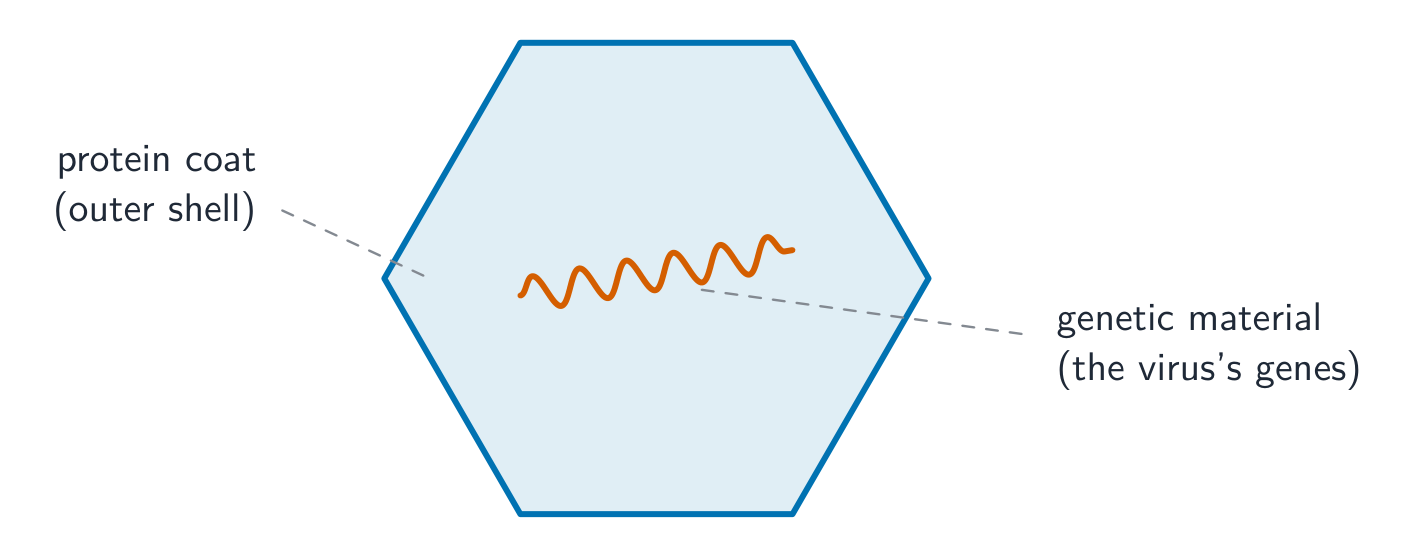
A virus has just two parts: a protein coat around its genetic material
Which feature do plant cells have that animal cells do not?
难度 1/5 · 今日首次完成可获 100 金币及少量额外奖励
Plant cells have a cell wall, chloroplasts and a large vacuole.
Plants make their own food by the process of ______.
难度 1/5 · 今日首次完成可获 100 金币及少量额外奖励
Plants are producers; animals must eat other organisms.
Animals vs plants
- Plant cells have a cell wall, chloroplasts and a large vacuole; animal cells do not.
- Plants make their own food (photosynthesis); animals must eat other organisms.
Which group are vertebrates?
难度 1/5 · 今日首次完成可获 100 金币及少量额外奖励
Mammals have a backbone; insects, spiders and worms do not.
Bacteria are prokaryotes, meaning their cells have no proper nucleus.
难度 1/5 · 今日首次完成可获 100 金币及少量额外奖励
Bacteria lack a nucleus; the other kingdoms are eukaryotes.
Vertebrates 脊椎动物 and invertebrates 无脊椎动物
- Vertebrates have a backbone: fish, amphibians, reptiles, birds, mammals.
- Invertebrates have no backbone: insects, spiders, worms, molluscs.
Bacteria are different from the rest. Bacteria are prokaryotes 原核生物 — their cells have no proper nucleus. Animals, plants, fungi and protoctists are eukaryotes 真核生物, with a nucleus. This is a fundamental divide.
Worked example: use a dichotomous key
Use this key to identify an animal with six legs, wings and no hard wing cases. 1: six legs → go to 2; eight legs → spider. 2: has wings → go to 3; no wings → ant (worker). 3: hard wing cases cover the back → beetle; no hard wing cases → fly.
- Six legs: go to 2. Wings: go to 3. No hard wing cases: it is a fly.
- Each step offers two choices about a feature you can see (dichotomous means "cutting in two"). Good keys use fixed features, like leg number, not size or colour, which can vary between individuals.
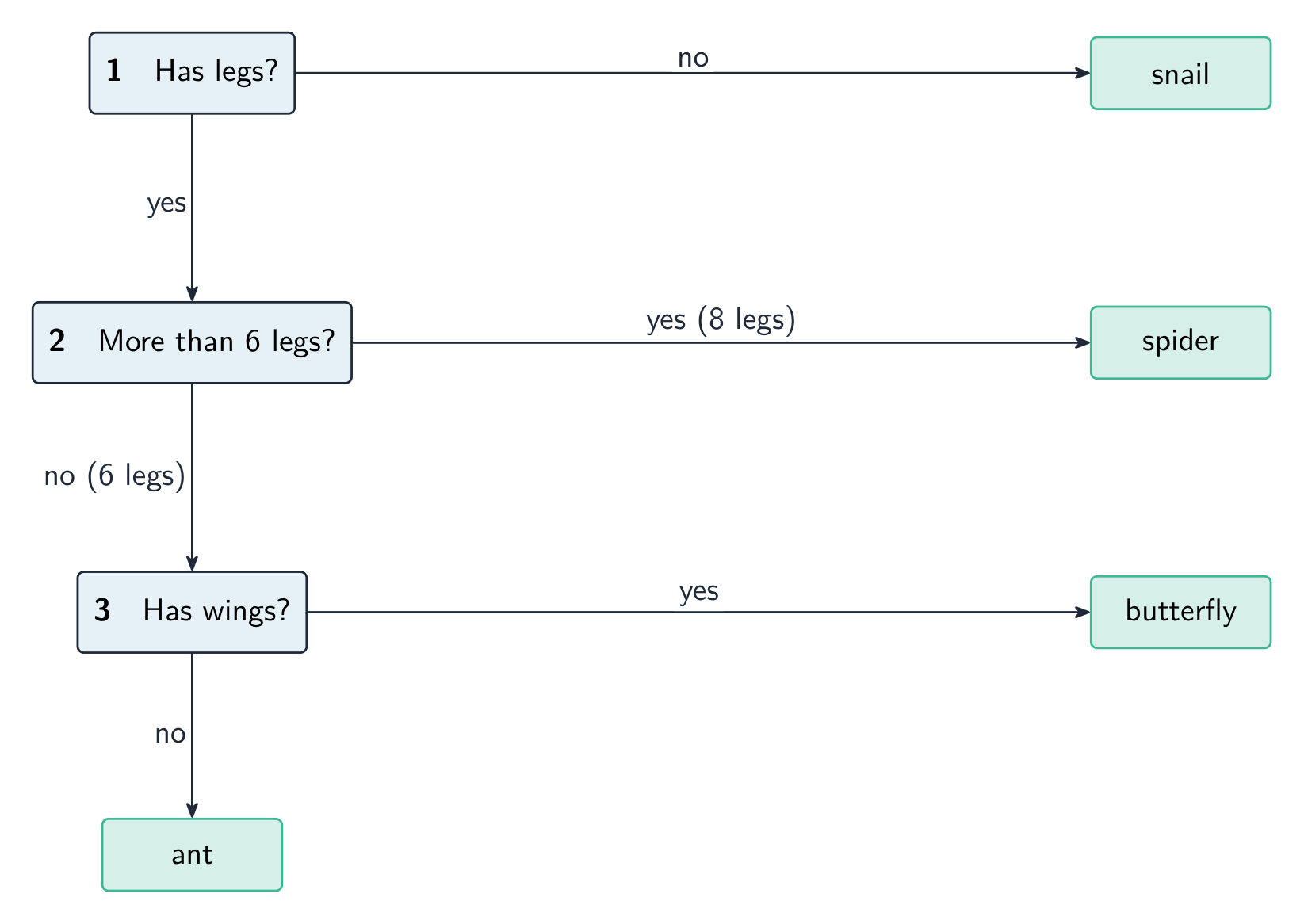
A dichotomous key: each step gives two choices until you reach the organism
Using the same key, what is an animal with eight legs?
难度 1/5 · 今日首次完成可获 100 金币及少量额外奖励
Step 1 sends eight legs straight to spider.
"Is it brown?" is a good question for a dichotomous key.
难度 1/5 · 今日首次完成可获 100 金币及少量额外奖励
Colour varies between individuals and with age; keys should use fixed features.
Vertebrate classes and arthropod groups
| Vertebrate class | Key features |
|---|---|
| fish | scales, gills, fins |
| amphibians | moist skin with no scales; eggs laid in water |
| reptiles | dry scaly skin; eggs with leathery shells |
| birds | feathers, beak, wings; hard-shelled eggs |
| mammals | fur or hair; mammary glands make milk; external ears |
| Arthropod group | Legs | Body |
|---|---|---|
| insects | 6 | 3 parts; usually 2 pairs of wings; 1 pair of antennae |
| arachnids | 8 | 2 parts; no antennae |
| crustaceans | 10 or more | hard shell; 2 pairs of antennae |
| myriapods | many | many segments; 1 or 2 pairs of legs per segment |
An arthropod has eight legs, two body parts and no antennae. Which group is it in?
难度 1/5 · 今日首次完成可获 100 金币及少量额外奖励
Eight legs, two body parts and no antennae are the features of arachnids, such as spiders.
Which feature is found only in mammals?
难度 1/5 · 今日首次完成可获 100 金币及少量额外奖励
All vertebrates have a backbone, and birds and reptiles also have lungs. Only mammals feed young on milk.
You've got it
- life is sorted into kingdoms: animals, plants, fungi, bacteria, protoctists
- plant cells have a cell wall, chloroplasts and a vacuole; animal cells don't
- vertebrates have a backbone, invertebrates don't; bacteria have no nucleus
Write from a cell with no nucleus
- One cell has a cell wall, chloroplasts and a large vacuole.
- Another cell has no nucleus and is much smaller.
Which kingdom fits each cell?
A nucleus is absent in bacteria, not in plant cells.
Which cell has no nucleus?
难度 1/5 · 今日首次完成可获 100 金币及少量额外奖励
Bacteria have no nucleus.