| English | 释义 | 拼音 |
|---|---|---|
| apportionment | 议席分配 | yì xí fēn pèi |
| undocumented immigrant | 无证移民 | wú zhèng yí mín |
Legal status for 2.7 million, November 1986
- On 6 November 1986, President Reagan signed the Immigration Reform and Control Act. It gave legal status to people who had lived in the US without papers since before 1982 — about 2.7 million people, most from Mexico — and made it illegal for employers to hire workers without papers knowingly. It was meant to settle the question of illegal immigration, but it did not.
- After 1980, Americans moved to the South and West, and immigrants came mainly from Latin America and Asia.
About how many million people got legal status under the 1986 act?
难度 2/5 · 今日首次完成可获 140 金币及少量额外奖励
Most from Mexico.
The South and West kept growing
- Jobs, cheaper housing and warm weather drew people to the Sun Belt. Texas, Florida and Arizona grew fast, while the Northeast and Midwest lost industrial jobs — the "Rust Belt".
- After each census, these states gained seats in Congress and votes for president.
Why did people move to the Sun Belt?
难度 1/5 · 今日首次完成可获 100 金币及少量额外奖励
Domestic migration.
Migration from two regions
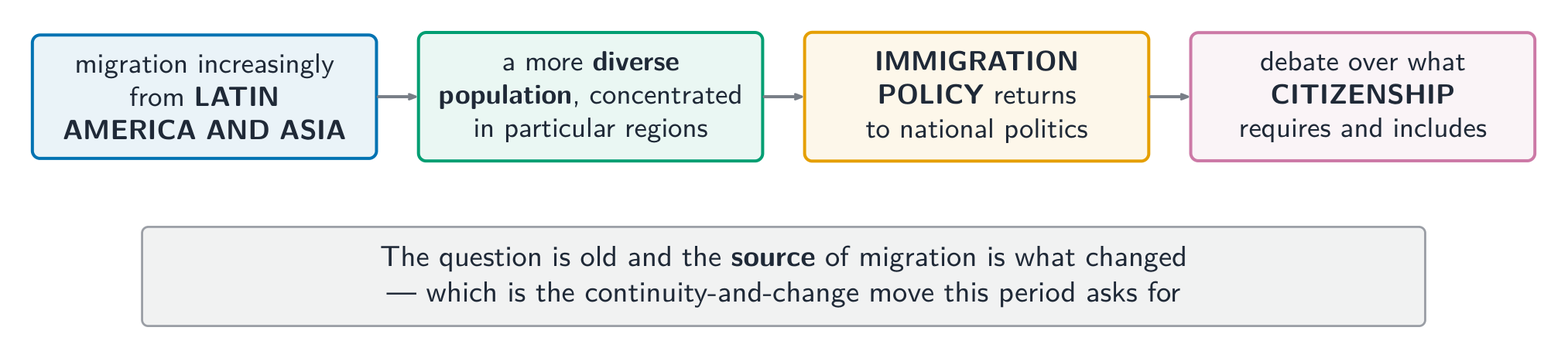
- After the 1965 immigration act, most immigrants came from Latin America and Asia, not Europe.
- The foreign-born share of the population rose from about 6% in 1980 to about 13% in 2010.
Domestic movement, international migration, or the contest over it?
Sort each element of post-1980 migration.
The foreign-born share rose from about 6% in 1980 to about 13% in 2010. By how many percentage points?
难度 2/5 · 今日首次完成可获 140 金币及少量额外奖励
13 − 6.
Worked example: seats in Congress
- Known: after the 2010 census, Texas gained 4 seats in the House of Representatives, and New York and Ohio each lost 2.
- Why: seats are shared out by population, so faster-growing states gain them.
- Result: the South and West gained political influence, and the apportionment 议席分配 of seats moved power away from the Northeast.
Why did Texas gain 4 House seats after the 2010 census?
难度 1/5 · 今日首次完成可获 100 金币及少量额外奖励
Apportionment.
Migrants as workers
- Immigrants supplied an important labour force in farming, building, services and technology.
- Undocumented immigrants 无证移民 — about 11 million by the 2010s — did many low-paid jobs.
Migration was contested
- Americans debated border security, a path to citizenship and diversity. In 1994, California's Proposition 187 tried to deny public services to undocumented immigrants; courts blocked it.
- Congress failed to pass broad immigration reform in 2007 and 2013.
Match each example to its type.
难度 2/5 · 今日首次完成可获 140 金币及少量额外奖励
Two migrations and a contest.
The 1986 law did not end illegal immigration. Employer checks were weak, and the number of undocumented immigrants grew again in the 1990s and 2000s.
The 1986 law ended illegal immigration.
难度 1/5 · 今日首次完成可获 100 金币及少量额外奖励
Numbers grew again.
After 1980, Americans moved to the Sun Belt, giving the South and West more seats and votes. Immigrants came mainly from Latin America and Asia, raising the foreign-born share to about 13% and supplying labour — while laws like the 1986 act and Proposition 187 showed how contested migration remained.
Explain the political effects of migration after 1980.
Effects.