| English | 释义 | 拼音 |
|---|---|---|
| Noise pollution/nɔɪz pəˈluːʃn/ | 噪声污染 | zào shēng wū rǎn |
| decibels/ˈdesɪblz/ | 分贝 | fēn bèi |
| hearing/ˈhɪərɪŋ/ | 听力 | tīng lì |
| whale/weɪl/ | 鲸 | jīng |
A pollutant that leaves no trace
- In 2001, scientists in the Bay of Fundy, Canada, measured stress hormones in right whales. Just after the 9/11 attacks, ship traffic stopped for a few days, underwater noise dropped, and the whales' stress hormones dropped with it.
- Noise pollution 噪声污染 is sound at levels high enough to cause physical stress and hearing loss. It leaves no residue, but its harm to people and animals is real.
Noise pollution is…
难度 1/5 · 今日首次完成可获 100 金币及少量额外奖励
Noise pollution is unwanted, harmful sound — from traffic, machines, aircraft, and more.
Where urban noise comes from
- Transportation: road traffic, trains, aircraft and ships. Construction: drills, pile drivers, heavy machines.
- Industrial activity (factories, mines) and domestic activity (loud music, lawn mowers, air conditioners). Cities are noisiest because all these sources crowd together.
Select 所有 the sources of urban noise pollution named in the AP course.
难度 2/5 · 今日首次完成可获 140 金币及少量额外奖励
Transportation, construction, and domestic and industrial activity are the urban sources the course names.
Decibels: a scale that multiplies
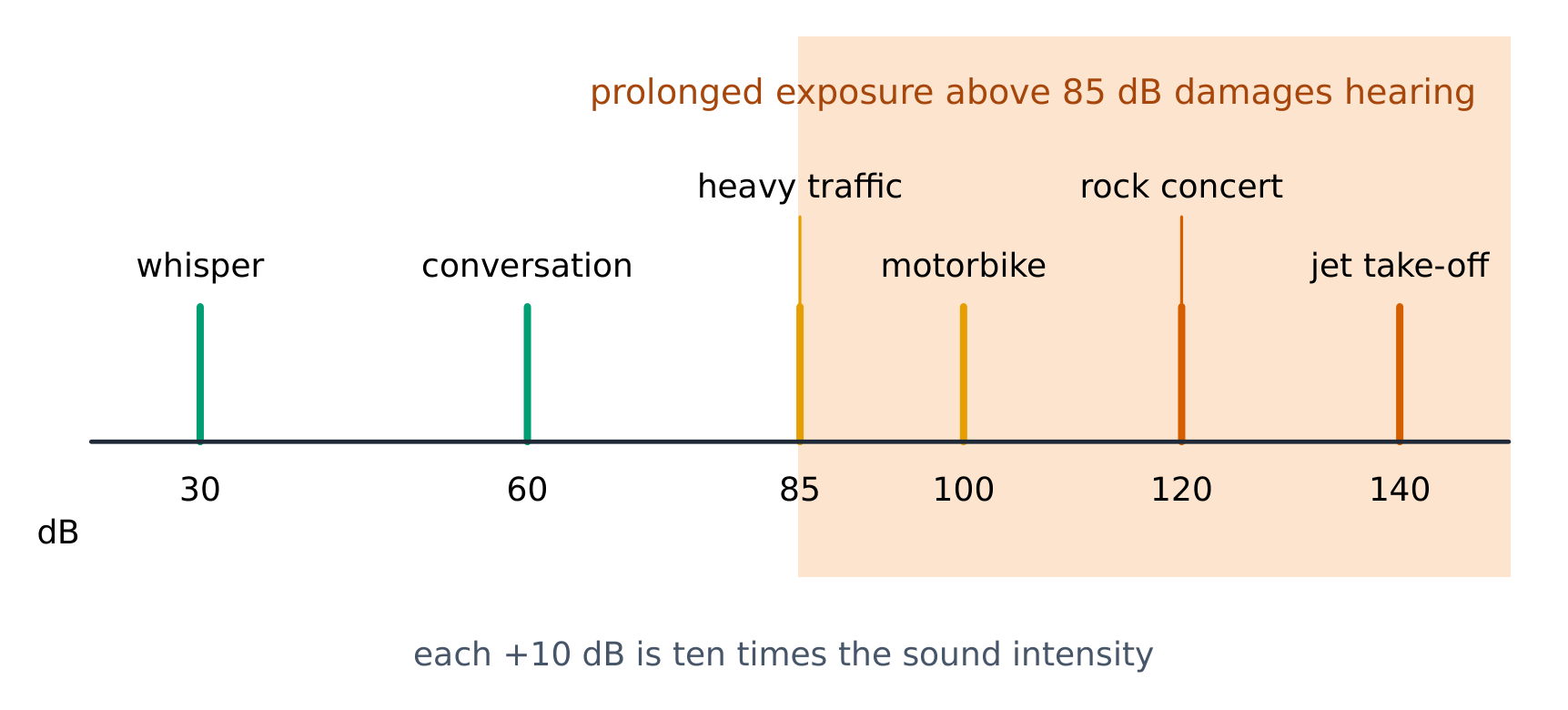
- Sound level is measured in decibels 分贝 (dB). The scale is logarithmic 对数的: each +10 dB means 10 times the sound intensity.
- So 80 dB is not "a bit more" than 60 dB: it is 10 × 10 = 100 times as intense. Long exposure above about 85 dB damages hearing.
Loudness of sound is measured in…
难度 1/5 · 今日首次完成可获 100 金币及少量额外奖励
Sound level is measured in decibels (dB) — the higher the number, the louder and more damaging.
Worked calculation
A street has 70 dB of traffic noise. A new highway raises it to 90 dB. How many times more intense is the sound?
- Difference: 90 − 70 = 20 dB.
- 20 dB = two steps of 10 dB.
- Each step multiplies intensity by 10: 10 × 10 = 100 times as intense.
- Shortcut: intensity ratio = 10^(difference ÷ 10). A 30 dB difference gives 10³ = 1000 times.
A factory floor is at 95 dB. Ear protection lowers the sound at the worker's ear to 65 dB. How many times 小于 intense is the sound?
难度 2/5 · 今日首次完成可获 140 金币及少量额外奖励
95 − 65 = 30 dB = three steps of 10 dB, so 10 × 10 × 10 = 1000 times less intense.
Sound A is 60 dB and sound B is 70 dB. Which statement is correct?
难度 1/5 · 今日首次完成可获 100 金币及少量额外奖励
The decibel scale is logarithmic. +10 dB means 10 times the intensity.
Harm to people
- Hearing loss: loud sound damages the hair cells of the inner ear, and they do not grow back, so the loss is permanent.
- Physiological stress 生理压力: constant noise raises stress hormones and blood pressure and breaks sleep, which is linked to heart disease.
Years of loud noise can cause permanent ____ loss.
难度 1/5 · 今日首次完成可获 100 金币及少量额外奖励
Long exposure to loud noise damages the ear, causing permanent hearing loss.
Select 所有 effects of noise pollution.
难度 2/5 · 今日首次完成可获 140 金币及少量额外奖励
Noise causes hearing loss, stress, and poor sleep. It has nothing to do with air quality.
Harm to animals
| Effect | Example |
|---|---|
| Stress | right whales' stress hormones rise with ship noise |
| Masking 掩蔽 of sounds used to communicate or hunt | bats and owls hunt by sound; traffic noise hides the sounds of prey; city birds must sing louder or at a higher pitch |
| Damaged hearing | loud sonar and seismic surveys can injure marine mammals' ears |
| Changed migratory routes | whales and birds avoid noisy shipping lanes, roads and building sites, and move to poorer habitat |
Source or effect of noise pollution?
Sort each item into a source of noise or an effect it causes.
Noise pollution can harm wildlife, such as whales that rely on sound to communicate.
难度 1/5 · 今日首次完成可获 100 金币及少量额外奖励
Ship and sonar noise drowns out the sounds whales use to navigate and find each other.
City great tits (a songbird) sing at a higher pitch than forest birds of the same species. The best explanation is that…
难度 1/5 · 今日首次完成可获 100 金币及少量额外奖励
Traffic noise is mostly low-pitched. It masks low notes, so birds that sing higher are heard by mates and rivals.
Reducing noise
- Block the path: noise barriers along highways, double-glazed windows, trees and earth banks.
- Quiet the source or the time: quieter engines and road surfaces, slower ships, zoning that keeps airports and factories away from homes, night-time limits on construction and flights.
Worked FRQ answer
(A) Identify ONE source of noise pollution in a city. Construction (also accepted: traffic, aircraft, industry, domestic activity).
(B) Describe ONE effect of noise pollution on wild animals. Noise masks the sounds animals use to communicate, so birds may fail to attract mates or warn each other of predators.
(C) Propose ONE way to reduce the noise from a busy highway, and explain how it works. Build a noise barrier wall beside the highway: it reflects and absorbs sound waves, so less sound reaches the homes behind it.
- Why it scores: (B) names the effect and the consequence for the animal. (C) gives a specific solution and how it reduces noise; "pass laws" alone would not score.
A report claims: "Ship noise increases stress in whales." Its evidence: after 9/11, ship traffic stopped, underwater noise fell, and whale stress hormones fell at the same time. Which extra finding would 最好的 support the claim?
难度 1/5 · 今日首次完成可获 100 金币及少量额外奖励
If stress goes down when noise stops and back up when noise returns, the link between noise and stress is much stronger. The other options do not connect noise to stress.
- The decibel scale is not linear. 100 dB is not "twice" 50 dB; it is 10⁵ = 100 000 times as intense.
- Noise harms more than hearing. Stress, high blood pressure and lost sleep happen at levels below those that damage the ear.
- For animals, give the mechanism: masking calls, avoiding habitat, changing routes. "It scares them" is too vague.
Noise pollution is sound loud enough to cause physiological stress and hearing loss. Urban sources: transportation, construction, industry and domestic activity. Sound is measured in decibels; each +10 dB is 10 times the intensity, and long exposure above about 85 dB damages hearing. In animals, noise causes stress, masks sounds used to communicate or hunt, damages hearing and changes migratory routes. Barriers, quieter sources and zoning reduce it.