| English | 释义 | 拼音 |
|---|---|---|
| Air pollution/eə pəˈluːʃn/ | 空气污染 | kōng qì wū rǎn |
| fossil fuels/ˈfɒsl ˈfjuːəlz/ | 化石燃料 | huà shí rán liào |
| primary/ˈpraɪməri/ | 一次 | yī cì |
| secondary/ˈsekəndəri/ | 二次 | èr cì |
| ozone/ˈəʊzəʊn/ | 臭氧 | chòu yǎng |
The pollutant that almost disappeared
- Until the 1970s, most gasoline in the USA contained lead 铅 to help engines run smoothly. Every car breathed lead into the air, and children's blood lead levels were high.
- Under the Clean Air Act 清洁空气法, the EPA phased lead out of gasoline (fully banned for cars by 1996). Lead in US air fell by about 98% from 1980 to 2014. Air pollution can be cut when we know where it comes from.
Burning fossil fuels is a major source of air pollution.
难度 1/5 · 今日首次完成可获 100 金币及少量额外奖励
Cars, power plants, and factories burning fossil fuels are the biggest sources of air pollution.
Primary and secondary pollutants
- Air pollution 空气污染 is any harmful gas, particle or droplet added to the air. Most of it comes from burning fossil fuels 化石燃料: coal, oil and natural gas.
- A primary pollutant 一次污染物 is emitted directly from a source (CO from a tailpipe, SO₂ from a smokestack). A secondary pollutant 二次污染物 forms in the air when primary pollutants react, often with sunlight or water (ground-level ozone 臭氧, acid rain).
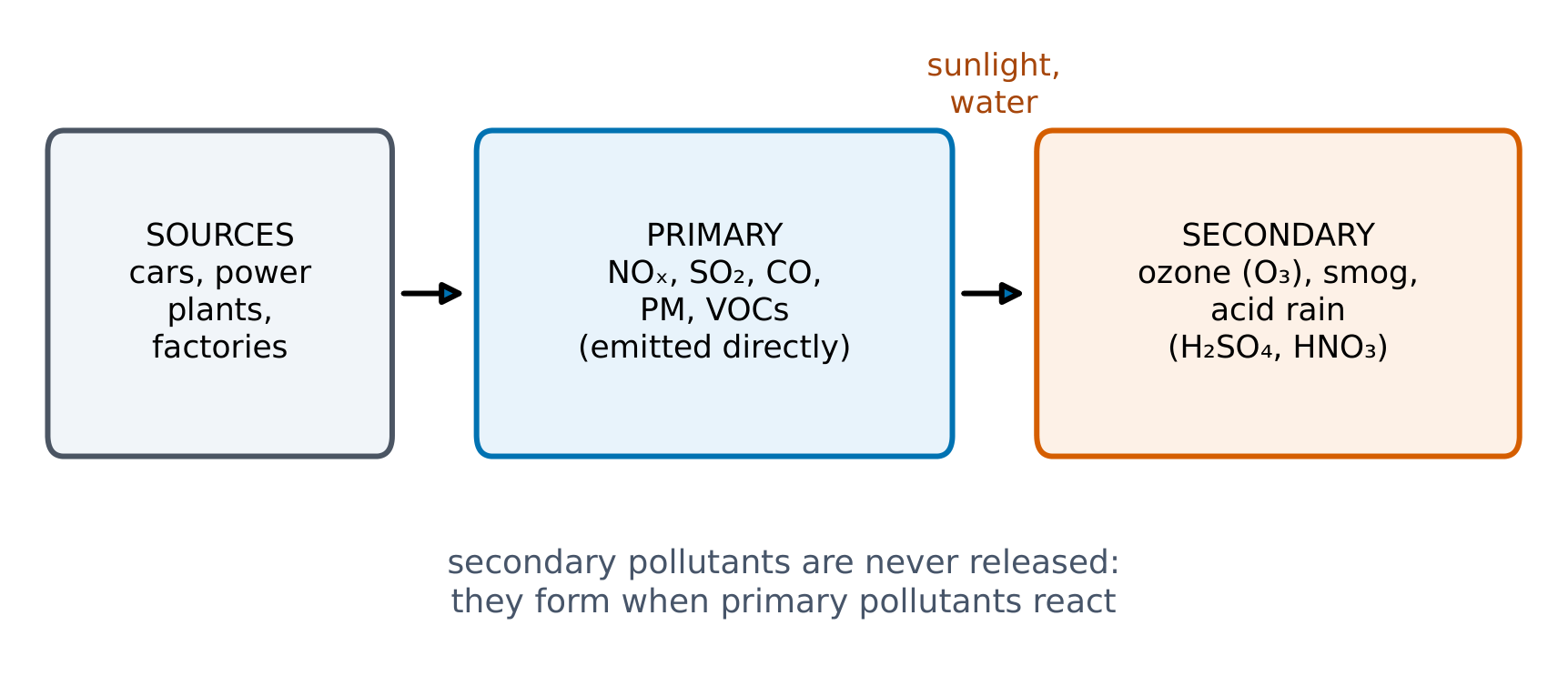
Secondary pollutants are never released: they form when primary pollutants react
一次污染物还是二次污染物?
Sort each pollutant by whether it is emitted directly or forms later in the air.
Air pollution is…
难度 1/5 · 今日首次完成可获 100 金币及少量额外奖励
Air pollution is any harmful substance added to the air — gases, particles, or droplets.
A 第一产业 (primary) pollutant is one that…
难度 1/5 · 今日首次完成可获 100 金币及少量额外奖励
A 第一产业 (primary) pollutant comes straight from the source — like CO from a tailpipe or SO2 from a smokestack.
A ____ pollutant forms in the air when primary pollutants react, like ozone in smog.
难度 1/5 · 今日首次完成可获 100 金币及少量额外奖励
A 第二产业 (secondary) pollutant is not emitted directly — it forms in the atmosphere, like ground-level ozone.
The pollutants you must know
- All of these are primary except ground-level ozone, which is secondary. (Some particulates also form in the air.)
| Pollutant | Main source | Main harm |
|---|---|---|
| Carbon dioxide, CO₂ | all fossil-fuel burning, especially coal | greenhouse gas: climate change |
| Sulfur dioxide, SO₂ | coal (sulfur in it); diesel fuel | irritates lungs; forms sulfuric acid → acid rain |
| Nitrogen oxides, NO$_x$ | any high-temperature burning: car engines, power plants | forms ozone, smog and nitric acid |
| Carbon monoxide, CO | incomplete burning: car exhaust, fires | blocks oxygen transport in the blood |
| Particulate matter, PM 颗粒物 | coal, diesel, fires, dust | lung and heart disease; haze |
| Toxic metals (mercury, lead) | coal burning; leaded gasoline (in the past) | nerve and brain damage |
| Hydrocarbons / VOCs | unburned fuel, gasoline vapour | react with NO$_x$ to make ozone |
| Ground-level ozone, O₃ (secondary) | NO$_x$ + VOCs + sunlight | lung damage; harms crops |
Select 所有 primary pollutants (emitted directly).
难度 2/5 · 今日首次完成可获 140 金币及少量额外奖励
CO, SO2, and soot are emitted directly. Ground-level ozone is secondary — it forms in the air.
Coal and cars release different mixes
- Coal combustion releases CO₂, SO₂, toxic metals such as mercury, and particulates. Coal is the biggest source of SO₂ and mercury, because these are impurities inside the coal itself.
- Vehicle engines burn hot, so nitrogen and oxygen from the air combine to make NO$_x$. Engines also release CO, hydrocarbons and particulates; diesel engines also release SO₂, because diesel fuel can contain sulfur.
Match each pollutant to its main source.
难度 2/5 · 今日首次完成可获 140 金币及少量额外奖励
SO₂ and mercury come from impurities in the fuel; NO$_x$ comes from the heat of burning; CO comes from burning without enough oxygen.
Where NO$_x$ goes next
- NO$_x$ is a primary pollutant, but much of its harm comes from the secondary pollutants it makes.
- With VOCs and sunlight it forms ozone and photochemical smog 光化学烟雾. With water vapour it forms nitric acid, which falls as acid rain 酸雨.
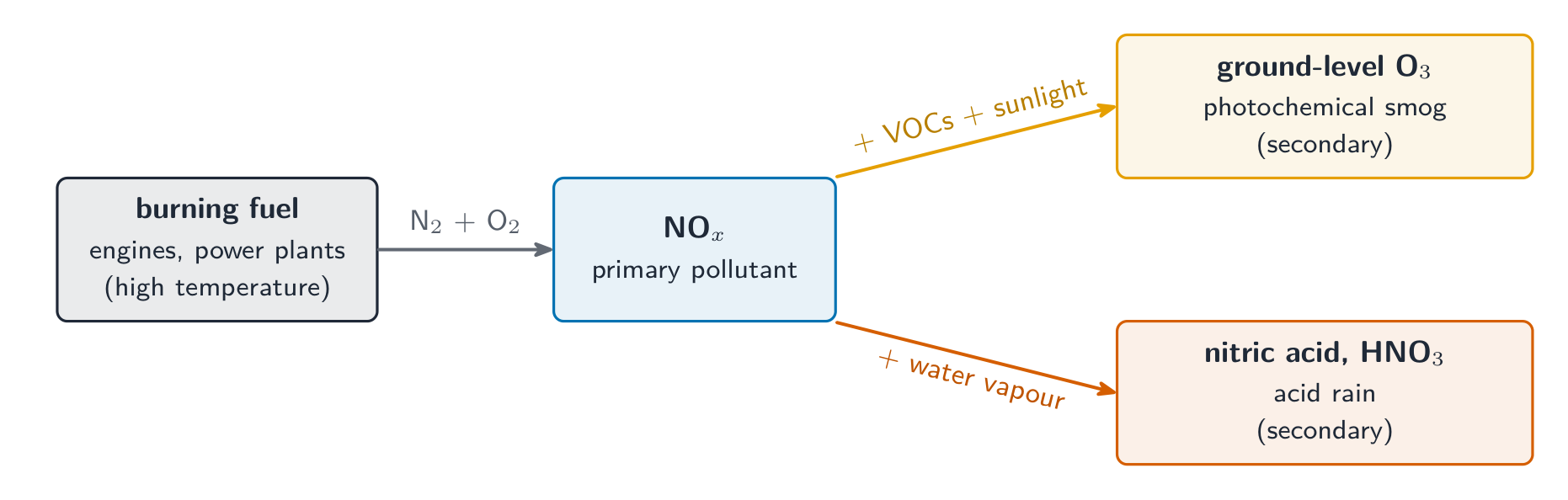
Nitrogen oxides lead to acid rain because in the atmosphere they…
难度 1/5 · 今日首次完成可获 100 金币及少量额外奖励
NO$_x$ + water → nitric acid. Sulfuric acid comes from SO₂, not NO$_x$.
The Clean Air Act
- The Clean Air Act (1970, strengthened in 1990) lets the EPA (US Environmental Protection Agency) set limits for six criteria pollutants 标准污染物: CO, lead, NO₂, ozone, particulate matter and SO₂.
- The lead story shows how regulation works: the EPA removed lead from fuel at the source, so lead in the atmosphere dropped dramatically. CO₂ is not one of the six criteria pollutants.
Which of these is 不 one of the six criteria pollutants under the Clean Air Act?
难度 1/5 · 今日首次完成可获 100 金币及少量额外奖励
The six are CO, lead, NO₂, ozone, particulate matter and SO₂. CO₂ is a greenhouse gas but not a criteria pollutant.
Lead in US air fell sharply because the EPA removed lead from gasoline.
难度 1/5 · 今日首次完成可获 100 金币及少量额外奖励
Cars burning leaded gasoline were the main source. Removing lead from fuel removed the source.
Worked FRQ answer
(A) Identify ONE air pollutant, other than CO₂, released when coal is burned. Sulfur dioxide (also accepted: mercury or another toxic metal, particulate matter).
(B) Describe how nitrogen oxides from car exhaust can lead to acid rain. NO$_x$ reacts with water vapour in the atmosphere to form nitric acid, which falls to the ground in rain or snow.
(C) Explain why the amount of lead in US air fell sharply after the 1970s. Under the Clean Air Act, the EPA phased lead out of gasoline, so cars, the main source, stopped emitting it.
- Why it scores: (A) names one specific pollutant (not "smoke" or "gases"). (B) gives the chain pollutant → reaction → acid. (C) links the drop to its cause: the source was removed by a law.
Worked multiple-choice question
Which of the following is a secondary pollutant? (A) carbon monoxide (B) sulfur dioxide (C) ground-level ozone (D) particulate matter from a wildfire
Answer: C. Ozone is not emitted by any source; it forms when NO$_x$ and VOCs react in sunlight. A, B and D all come straight out of a source, so they are primary.
- CO is not CO₂. Carbon monoxide comes from incomplete burning and poisons blood; carbon dioxide comes from complete burning and warms the climate.
- NO$_x$ comes from heat, not from the fuel. The nitrogen is from the air, so even "clean" fuels make NO$_x$ when they burn hot. SO₂ and mercury, in contrast, come from impurities in the fuel.
- Ozone high up protects us; ozone at ground level is a pollutant. On an FRQ, say "ground-level" or "tropospheric" ozone.
A car engine runs short of oxygen. Which pollutant does this increase most?
难度 1/5 · 今日首次完成可获 100 金币及少量额外奖励
Burning without enough oxygen is incomplete combustion, which makes CO instead of CO₂.
Burning fossil fuels causes most air pollution. Coal releases CO₂, SO₂, toxic metals and particulates; vehicles release NO$_x$, CO, hydrocarbons and particulates; diesel also releases SO₂. Primary pollutants come straight from a source; secondary pollutants (ozone, smog, acid rain) form in the air. The Clean Air Act lets the EPA regulate six criteria pollutants, and removing lead from gasoline cut lead in the air dramatically.