| English | 释义 | 拼音 |
|---|---|---|
| solubility/ˌsɒljuːˈbɪlɪti/ | 溶解度 | róng jiě dù |
Acid eats limestone but not salt
- Acid rain slowly dissolves marble statues ($\text{CaCO}_3$), and acid from sugar-eating bacteria dissolves tooth enamel. Yet acid does not make silver chloride any more soluble.
- The difference is the anion. If the anion of a salt is a base, acid removes it, and more solid dissolves. This lesson shows how much.
Basic anions respond to pH
- Anions that come from weak acids are weak bases: $\text{CO}_3^{2-}$, $\text{OH}^-$, $\text{F}^-$, $\text{PO}_4^{3-}$, $\text{S}^{2-}$. Added $\text{H}^+$ reacts with them.
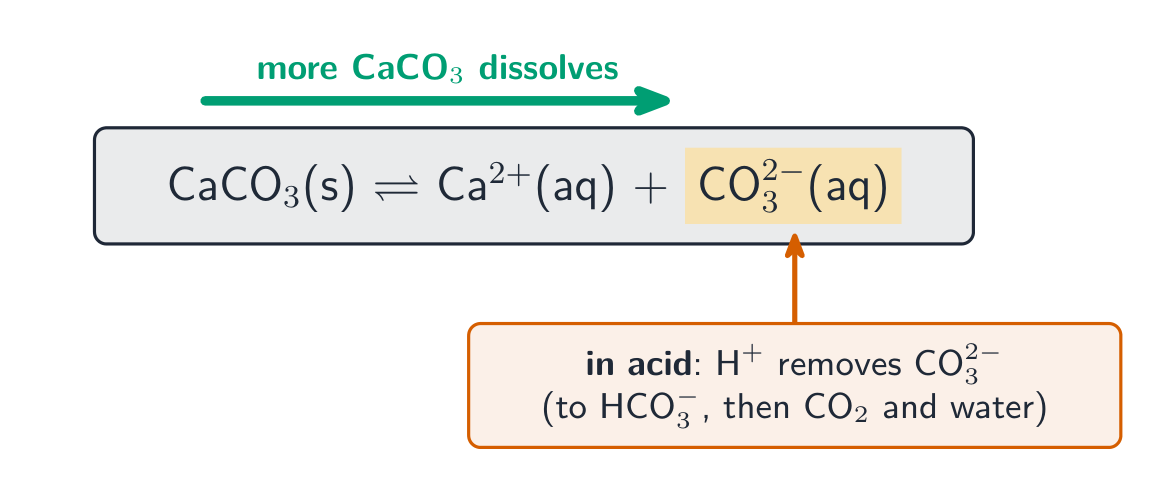
- Removing the anion lowers $Q$ below $K_{sp}$, so more solid dissolves. This is Le Chatelier acting on the solubility 溶解度 equilibrium.
Which solids become more soluble when acid is added? Select all that apply.
难度 2/5 · 今日首次完成可获 140 金币及少量额外奖励
Carbonate, hydroxide and phosphate are basic anions. Chloride and iodide come from strong acids.
Explain why $\text{CaCO}_3$ dissolves in hydrochloric acid but hardly at all in water.
- In water: $\text{CaCO}_3(s)\rightleftharpoons\text{Ca}^{2+}+\text{CO}_3^{2-}$, $K_{sp}=4.8\times10^{-9}$, so very little dissolves.
- In acid: $\text{CO}_3^{2-}+2\text{H}^+\to\text{H}_2\text{O}+\text{CO}_2(g)$. Carbonate is removed and $\text{CO}_2$ escapes, so $Q$ stays below $K_{sp}$.
- The solid keeps dissolving until the acid is used up. You see fizzing.
Why does more $\text{BaCO}_3$ dissolve when HCl is added?
难度 1/5 · 今日首次完成可获 100 金币及少量额外奖励
$K_{sp}$ is unchanged; removing the anion keeps $Q$ 低于 $K_{sp}$.
Hydroxides: solubility from the pH
- For a metal hydroxide, $[\text{OH}^-]$ is set by the pH. Put it into $K_{sp}$ and solve for the metal ion, which equals the molar solubility.
- For $\text{Mg(OH)}_2$: $K_{sp}=[\text{Mg}^{2+}][\text{OH}^-]^2$, so $s=[\text{Mg}^{2+}]=\dfrac{K_{sp}}{[\text{OH}^-]^2}$.
$\text{Mg(OH)}_2$ has $K_{sp}=5.6\times10^{-12}$. Find its molar solubility in solutions buffered at pH 9.00 and pH 11.00.
- pH 9.00: pOH 5.00, $[\text{OH}^-]=1.0\times10^{-5}$. $s=\dfrac{5.6\times10^{-12}}{(1.0\times10^{-5})^2}=5.6\times10^{-2}\ \text{M}$.
- pH 11.00: $[\text{OH}^-]=1.0\times10^{-3}$. $s=\dfrac{5.6\times10^{-12}}{(1.0\times10^{-3})^2}=5.6\times10^{-6}\ \text{M}$.
- Two pH units changed the solubility by a factor of $10^4$, because $[\text{OH}^-]$ is squared.
$\text{Mg(OH)}_2$ ($K_{sp}=5.6\times10^{-12}$) is in a solution buffered at pH 10.00. Find its molar solubility, in units of $10^{-4}\ \text{M}$.
难度 2/5 · 今日首次完成可获 140 金币及少量额外奖励
$[\text{OH}^-]=1.0\times10^{-4}$. $s=\dfrac{5.6\times10^{-12}}{(1.0\times10^{-4})^2}=5.6\times10^{-4}\ \text{M}$.
By what factor does the solubility of $\text{Fe(OH)}_3$ change when the pH falls by 1 unit?
难度 2/5 · 今日首次完成可获 140 金币及少量额外奖励
$s=K_{sp}/[\text{OH}^-]^3$. $[\text{OH}^-]$ falls 10 times, so $s$ rises $10^3=1000$ times.
Anions of strong acids do not respond
- $\text{Cl}^-$, $\text{Br}^-$, $\text{I}^-$, $\text{NO}_3^-$ and $\text{ClO}_4^-$ come from strong acids. They are too weak as bases to take up $\text{H}^+$.
- So the solubility of AgCl, AgBr or $\text{PbI}_2$ is almost unaffected by pH.
Does pH change solubility?
Sort each salt by whether lowering the pH makes it more soluble.
Adding nitric acid makes AgCl noticeably more soluble.
难度 1/5 · 今日首次完成可获 100 金币及少量额外奖励
$\text{Cl}^-$ is the anion of a strong acid and is not protonated, so pH has almost no effect.
How weak is the anion? Compare pH with pKa
- An anion is removed only when the pH is low enough to protonate it. $\text{F}^-$ (HF $\text{p}K_a$ 3.17) is protonated noticeably only below about pH 4, so $\text{CaF}_2$ dissolves more only in fairly strong acid.
- Carbonate and hydroxide are much stronger bases, so even mild acid increases the solubility of $\text{CaCO}_3$ and $\text{Mg(OH)}_2$ a lot.
At roughly which pH does $\text{CaF}_2$ start to dissolve noticeably more? (HF $\text{p}K_a=3.17$)
难度 1/5 · 今日首次完成可获 100 金币及少量额外奖励
$\text{F}^-$ is a very weak base; it is protonated in significant amounts only when the pH approaches its $\text{p}K_a$.
Teeth and fluoride
- Tooth enamel is mostly hydroxyapatite, $\text{Ca}_5(\text{PO}_4)_3\text{OH}$. Acid from bacteria removes its $\text{OH}^-$ and $\text{PO}_4^{3-}$, and the enamel slowly dissolves.
- Fluoride replaces some $\text{OH}^-$ to form fluorapatite, $\text{Ca}_5(\text{PO}_4)_3\text{F}$. $\text{F}^-$ is a much weaker base than $\text{OH}^-$, so this mineral resists acid better.
Fluoride makes enamel more resistant to acid by forming fluor____, which contains the weakly basic $\text{F}^-$ ion.
难度 1/5 · 今日首次完成可获 100 金币及少量额外奖励
Fluorapatite, $\text{Ca}_5(\text{PO}_4)_3\text{F}$, resists acid better than hydroxyapatite.
Only salts with a basic anion become more soluble in acid. Do not say "all salts dissolve more in acid". And for hydroxides, remember to square $[\text{OH}^-]$ when the formula has two OH groups.
Lowering the pH increases the solubility of salts whose anion is a weak base (carbonates, hydroxides, phosphates, fluorides), because $\text{H}^+$ removes the anion and keeps $Q<K_{sp}$. For hydroxides, $s=K_{sp}/[\text{OH}^-]^n$. Salts of strong-acid anions such as chlorides are not affected.