| English | 释义 | 拼音 |
|---|---|---|
| common-ion effect/ˈkɒmən ˈaɪɒn ɪˈfekt/ | 同离子效应 | tóng lí zǐ xiào yìng |
Crowding out a dissolving salt
- A salt dissolves less in water that already holds one of its ions.
- Add extra chloride, and silver chloride dissolves even less.
- The shared ion pushes the balance backward.
- It is Le Chatelier at work in a beaker.
The common-ion effect
- The common-ion effect 同离子效应 lowers a salt's solubility.
- It happens when the solution already contains one of its ions.
- The extra ion shifts the dissolving equilibrium backward.
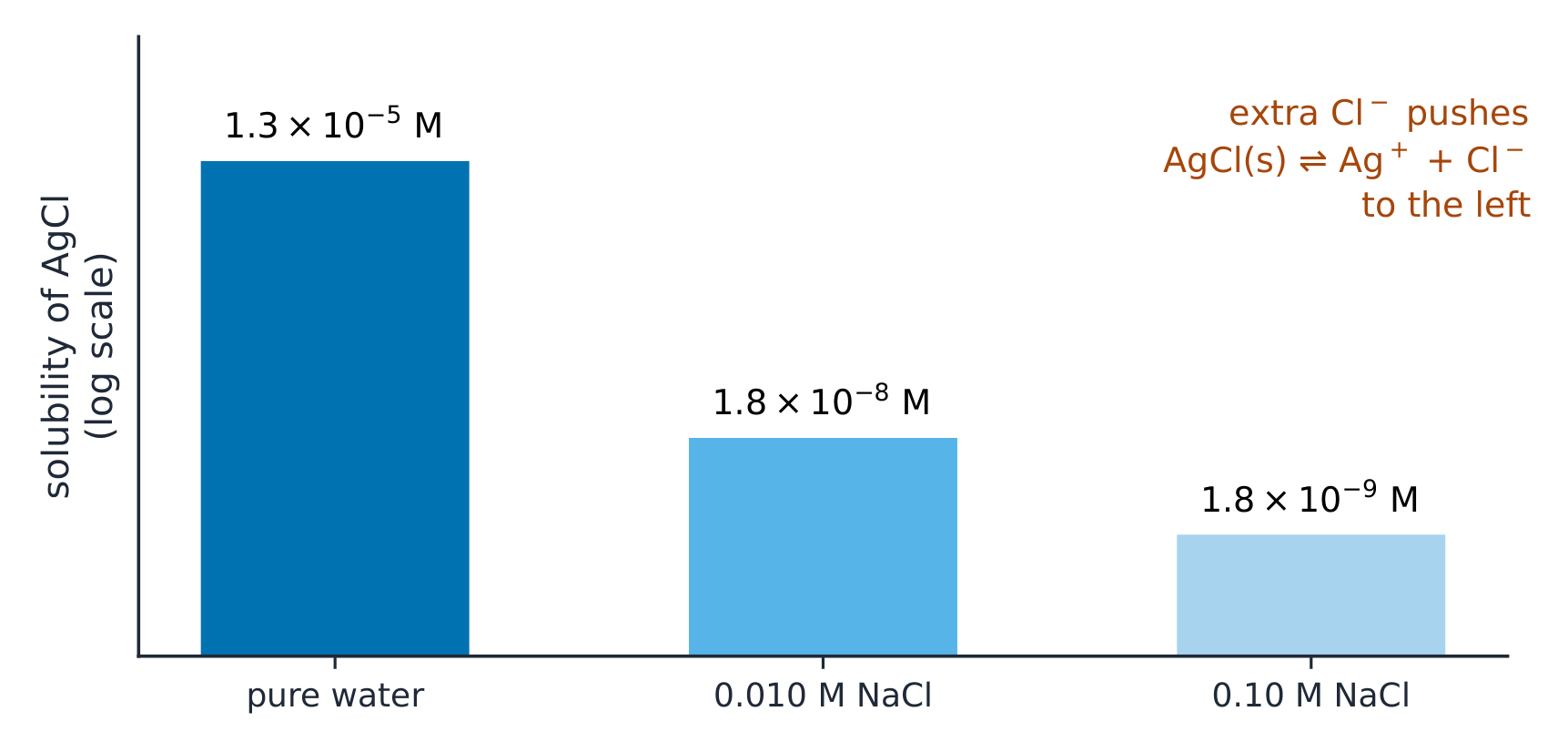
Adding a common ion lowers the solubility of a salt
Adding a common ion to a saturated salt solution makes the salt...
难度 1/5 · 今日首次完成可获 100 金币及少量额外奖励
The common ion shifts the dissolving equilibrium backward.
The common-ion effect is a direct application of ____ Chatelier's principle.
难度 1/5 · 今日首次完成可获 100 金币及少量额外奖励
It is Le Chatelier's principle applied to a solubility equilibrium.
Le Chatelier explains it
- Starting from a saturated solution, increasing a product-ion concentration raises $Q$ above $K_{sp}$.
- The system shifts back, precipitating some solid.
- So less of the salt stays dissolved.
Adding a common product ion to a saturated solution raises $Q$ 高于 $K_{sp}$, so the system...
难度 1/5 · 今日首次完成可获 100 金币及少量额外奖励
With $Q > K_{sp}$, the reaction reverses, forming solid.
Putting it to use
- Chemists add a common ion to force a salt out of solution.
- It is how you purify or recover a dissolved compound.
- Solubility drops sharply as the shared ion's concentration rises.
Chemists can add a common ion to force a dissolved salt to precipitate.
难度 1/5 · 今日首次完成可获 100 金币及少量额外奖励
The common-ion effect is used to recover or purify compounds.
In the simple dissolution model, neglecting complex formation, does $\text{AgCl}$ dissolve more in pure water or dilute $\text{NaCl}$ solution?
- $\text{NaCl}$ adds extra $\text{Cl}^-$, a common ion.
- So $\text{AgCl}$ dissolves less in the $\text{NaCl}$ solution.
The common-ion effect
For AgCl -> Ag+ + Cl-, sort each addition by its effect on solubility.
$\text{AgCl}$ dissolves less in $\text{NaCl}$ solution than in pure water because $\text{NaCl}$ adds...
难度 1/5 · 今日首次完成可获 100 金币及少量额外奖励
The shared $\text{Cl}^-$ pushes the equilibrium back toward solid.
The common-ion effect changes the value of $K_{sp}$.
难度 1/5 · 今日首次完成可获 100 金币及少量额外奖励
At fixed temperature, $K_{sp}$ is unchanged; the new ion concentrations must still satisfy it at saturation.
In the simple dissolution model at fixed temperature, without complex formation or other ion reactions, a common ion decreases solubility — it shifts the dissolving equilibrium backward. $K_{sp}$ itself does not change; only the amount that dissolves does. And the effect grows stronger the more of the shared ion is already present.
The common-ion effect lowers a salt's solubility when the solution already holds one of its ions. That extra ion raises $Q$ above $K_{sp}$, shifting the dissolving equilibrium backward so less dissolves. $K_{sp}$ stays the same; only the solubility falls.