| English | 释义 | 拼音 |
|---|---|---|
| proton/ˈprəʊtɒn/ | 质子 | zhì zǐ |
| Brønsted–Lowry | 布朗斯特–劳里 | bù lǎng sī tè – láo lǐ |
| conjugate base/ˈkɒndʒuːɡeɪt beɪs/ | 共轭碱 | gòng è jiǎn |
| conjugate acid/ˈkɒndʒuːɡeɪt ˈæsɪd/ | 共轭酸 | gòng è suān |
| amphoteric/ˌæmfəʊˈterɪk/ | 两性 | liǎng xìng |
Acids give protons, bases take them
- Vinegar, stomach acid and battery acid all hand out the same particle: $\text{H}^+$, a bare proton 质子. Ammonia cleaners and baking soda take protons in.
- In the Brønsted–Lowry 布朗斯特–劳里 model, an acid is a proton donor and a base is a proton acceptor. Every acid–base reaction is a proton moving from one particle to another.
In the Brønsted–Lowry model, a base is a proton ____.
难度 1/5 · 今日首次完成可获 100 金币及少量额外奖励
Acids donate protons; bases accept them.
Conjugate pairs differ by one H⁺
- When an acid gives away $\text{H}^+$, what is left is its conjugate base 共轭碱. When a base takes $\text{H}^+$, it becomes its conjugate acid 共轭酸.
- So each reaction has two pairs: $\text{HA}/\text{A}^-$ and $\text{B}/\text{BH}^+$. The two members of a pair differ by exactly one $\text{H}^+$.
What is the conjugate base of $\text{H}_2\text{PO}_4^-$?
难度 1/5 · 今日首次完成可获 100 金币及少量额外奖励
Remove one $\text{H}^+$ and lower the charge by one, giving $\text{HPO}_4^{2-}$.
Label the pairs in $\text{NH}_3(aq)+\text{H}_2\text{O}(l)\rightleftharpoons\text{NH}_4^+(aq)+\text{OH}^-(aq)$.
- $\text{H}_2\text{O}$ gives $\text{H}^+$ to $\text{NH}_3$: water is the acid, ammonia is the base.
- Pair 1: $\text{NH}_3$ (base) / $\text{NH}_4^+$ (conjugate acid).
- Pair 2: $\text{H}_2\text{O}$ (acid) / $\text{OH}^-$ (conjugate base).
Acid or base?
Sort each species by whether it donates or accepts a proton.
In $\text{HF}+\text{H}_2\text{O}\rightleftharpoons\text{F}^-+\text{H}_3\text{O}^+$, match each species with its role.
难度 2/5 · 今日首次完成可获 140 金币及少量额外奖励
HF gives its proton to water. HF/F$^-$ and H$_2$O/H$_3$O$^+$ are the two pairs.
Some species can do both
- An amphoteric 两性 species can act as an acid or as a base. Water gives $\text{H}^+$ to $\text{NH}_3$, but takes $\text{H}^+$ from HCl to make $\text{H}_3\text{O}^+$.
- Ions such as $\text{HCO}_3^-$ and $\text{HSO}_4^-$ are also amphoteric: they still have an H to give and a lone pair to accept one.
Which species are amphoteric? Select all that apply.
难度 2/5 · 今日首次完成可获 140 金币及少量额外奖励
Each can give an $\text{H}^+$ and also accept one. $\text{Cl}^-$ has no H to donate.
Water ionizes itself: Kw
- In pure water, a few molecules swap protons: $2\text{H}_2\text{O}(l)\rightleftharpoons\text{H}_3\text{O}^+(aq)+\text{OH}^-(aq)$. We write $\text{H}^+$ as shorthand for $\text{H}_3\text{O}^+$.
- Its constant is $K_w=[\text{H}^+][\text{OH}^-]=1.0\times10^{-14}$ at $25^\circ\text{C}$. This holds in every aqueous solution, not only pure water.
A solution has $[\text{H}^+]=2.0\times10^{-3}\ \text{M}$ at $25^\circ\text{C}$. Find $[\text{OH}^-]$ and decide whether it is acidic.
- $[\text{OH}^-]=\dfrac{K_w}{[\text{H}^+]}=\dfrac{1.0\times10^{-14}}{2.0\times10^{-3}}=5.0\times10^{-12}\ \text{M}$
- $[\text{H}^+]>[\text{OH}^-]$, so the solution is acidic.
在……时 $25^\circ\text{C}$, a solution has $[\text{OH}^-]=4.0\times10^{-4}\ \text{M}$. Find $[\text{H}^+]$, in units of $10^{-11}\ \text{M}$.
难度 2/5 · 今日首次完成可获 140 金币及少量额外奖励
$[\text{H}^+]=\dfrac{1.0\times10^{-14}}{4.0\times10^{-4}}=2.5\times10^{-11}\ \text{M}$.
Neutral means equal, not "pH 7"
- A solution is neutral when $[\text{H}^+]=[\text{OH}^-]$. At $25^\circ\text{C}$ each is $1.0\times10^{-7}\ \text{M}$, so neutral pH is $7.00$.
- Water's ionization is endothermic, so $K_w$ grows with temperature. At $50^\circ\text{C}$, $K_w=5.5\times10^{-14}$: neutral water has $[\text{H}^+]=2.3\times10^{-7}\ \text{M}$ and pH $6.63$, yet it is still neutral.
Pure water at $50^\circ\text{C}$ has a pH below 7, so it is acidic.
难度 1/5 · 今日首次完成可获 100 金币及少量额外奖励
$[\text{H}^+]$ still equals $[\text{OH}^-]$, so it is neutral. Neutral pH is below 7 because $K_w$ is larger at higher temperature.
Strong acids and bases to know
- Strong acids ionize completely in water: HCl, HBr, HI, $\text{HNO}_3$, $\text{HClO}_4$ and $\text{H}_2\text{SO}_4$ (first proton). Any other acid you meet is weak unless the question says otherwise.
- Strong bases are the soluble metal hydroxides: Group 1 hydroxides (LiOH, NaOH, KOH) and $\text{Ca(OH)}_2$, $\text{Sr(OH)}_2$, $\text{Ba(OH)}_2$.
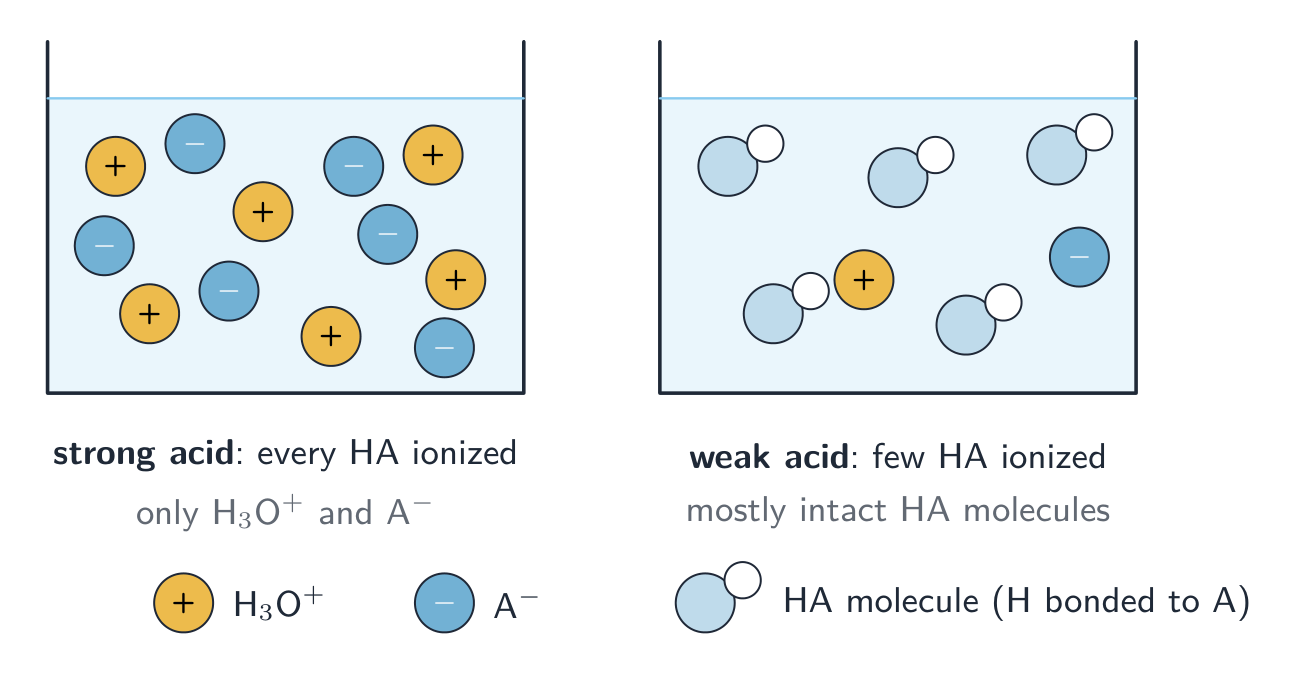
Which are strong acids in water? Select all that apply.
难度 2/5 · 今日首次完成可获 140 金币及少量额外奖励
HF and ethanoic acid are weak. $\text{HNO}_3$, $\text{HClO}_4$ and HBr are on the strong-acid list.
The conjugate base of HCl is $\text{Cl}^-$, not $\text{OH}^-$: remove exactly one $\text{H}^+$ and lower the charge by one. "Neutral" means $[\text{H}^+]=[\text{OH}^-]$; pH 7 is neutral only at $25^\circ\text{C}$. And $K_w$ applies to every aqueous solution, acidic or basic.
Brønsted–Lowry: acids donate $\text{H}^+$, bases accept it; conjugate pairs differ by one $\text{H}^+$. Water is amphoteric and self-ionizes with $K_w=[\text{H}^+][\text{OH}^-]=1.0\times10^{-14}$ at $25^\circ\text{C}$. Neutral means $[\text{H}^+]=[\text{OH}^-]$. Learn the six strong acids and the strong hydroxide bases.