| English | 释义 | 拼音 |
|---|---|---|
| filtration/fɪlˈtreɪʃn/ | 过滤 | guò lǜ |
| evaporation/ɪˌvæpəˈreɪʃn/ | 蒸发 | zhēng fā |
| chromatography/krəʊməˈtɒɡrəfi/ | 色谱法 | sè pǔ fǎ |
| distillation/dɪstɪˈleɪʃn/ | 蒸馏 | zhēng liú |
Pulling a blend apart
- Drinking water from the sea, petrol from crude oil and a drug test from a urine sample all depend on separating a mixture.
- Each method uses one property that differs between the parts: particle size, boiling point, or how strongly each part is attracted to a surface.
Filtration and evaporation
- Filtration 过滤 separates by particle size: solids are caught, liquid passes.
- Evaporation 蒸发 leaves a dissolved solid behind as solvent escapes from the surface; boiling is not required.
- Use filtration for undissolved solids, evaporation for dissolved ones.
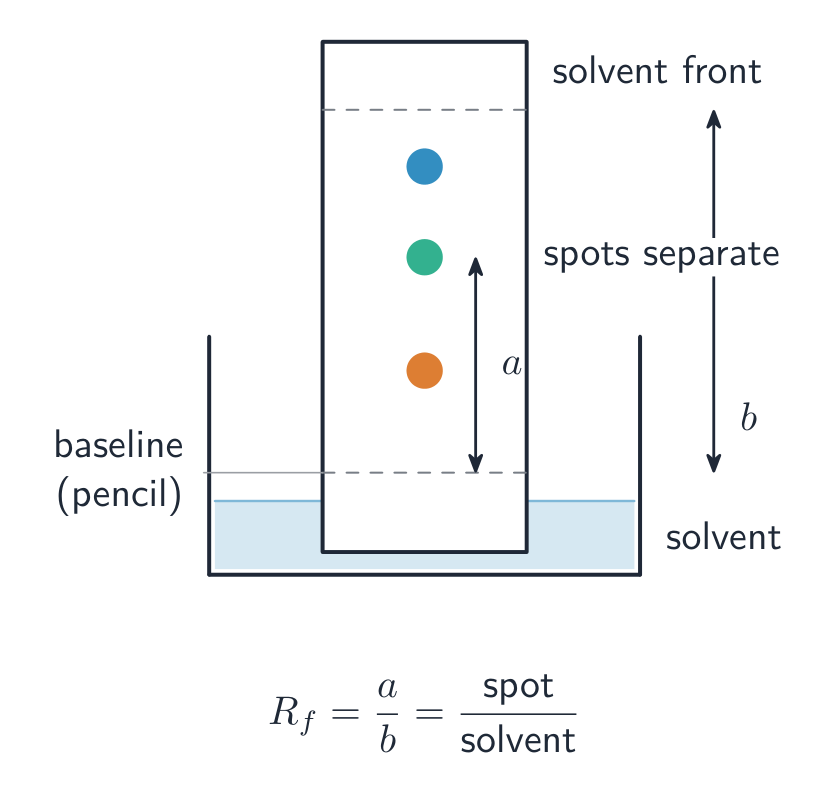
Paper chromatography 色谱法 separates a mixture as the solvent rises up the paper
Filtration separates a mixture based on differences in...
难度 1/5 · 今日首次完成可获 100 金币及少量额外奖励
Large solids are trapped while liquid passes through the filter.
To recover dissolved salt from salt water while discarding the water, use...
难度 1/5 · 今日首次完成可获 100 金币及少量额外奖励
Boiling off the water leaves the solid salt behind.
Distillation
- Distillation 蒸馏 separates liquids by their boiling points.
- For many mixtures, vapour is richer in the more volatile component; condensation collects an enriched distillate, not necessarily a pure liquid.
- Fractional distillation improves separation through repeated vaporization and condensation; an azeotrope limits ethanol–water separation by ordinary distillation.
To separate pure water from salt water, you would use...
难度 1/5 · 今日首次完成可获 100 金币及少量额外奖励
Distillation boils off the water and re-condenses it, leaving salt behind.
Chromatography
- Chromatography separates by the relative attractions of each component to the stationary and mobile phases.
- The components travel at different speeds and spread out.
- Ink's dyes separate into a rainbow of bands.
Pick the separation method
Match each mixture to the technique that separates it, and the property it exploits.
Match each method to the property it uses.
难度 2/5 · 今日首次完成可获 140 金币及少量额外奖励
Distillation = boiling point, filtration = size, chromatography = affinity.
Chromatography separates ink dyes because each travels at a different ____.
难度 1/5 · 今日首次完成可获 100 金币及少量额外奖励
A component that interacts more strongly with the stationary phase relative to the mobile phase travels more slowly, so the dyes separate.
How would you get pure water from salt water?
- Distil it: boil the water off and re-condense the vapour.
- The salt stays behind, and the collected liquid is pure water.
Filtration can separate a dissolved solute from its solvent.
难度 1/5 · 今日首次完成可获 100 金币及少量额外奖励
Dissolved particles pass through the filter; use evaporation or distillation.
Choosing a method
| Method | Separates by | Example |
|---|---|---|
| filtration | particle size (undissolved solid) | sand from water |
| evaporation | volatile solvent leaves a dissolved solid | salt from seawater |
| distillation | boiling point | water from salt water; ethanol from water |
| chromatography | attraction to stationary vs mobile phase | dyes in ink |
How do you get dry salt from a mixture of sand, salt and water?
难度 1/5 · 今日首次完成可获 100 金币及少量额外奖励
Filtration removes the undissolved sand; the salt is dissolved, so it passes through and is recovered by evaporation.
Paper chromatography and $R_f$. A dye travels 3.0 cm while the solvent front travels 6.0 cm. The paper is polar; the solvent is less polar.
- $R_f = \dfrac{\text{distance moved by the dye}}{\text{distance moved by the solvent}} = \dfrac{3.0}{6.0} = 0.50$.
- A dye with $R_f = 0.20$ stays nearer the start: it is more strongly attracted to the polar paper, so it is more polar than the first dye.
A spot moves 2.4 cm while the solvent front moves 8.0 cm. What is its Rf value?
难度 2/5 · 今日首次完成可获 140 金币及少量额外奖励
Rf = 2.4 ÷ 8.0 = 0.30.
- A dissolved solid passes through a filter: use evaporation or distillation instead.
- $R_f$ is always between 0 and 1 and has no unit.
- In chromatography, the component more attracted to the stationary phase moves the shorter distance.
Separation methods each exploit a property difference: filtration by particle size, evaporation to recover a dissolved solid, distillation by boiling point, and chromatography by surface affinity. A dissolved solute passes through a filter, so recover it by evaporation or distillation instead.