| English | 释义 | 拼音 |
|---|---|---|
| valence electrons/ˈveɪləns ɪˈlektrɒnz/ | 价电子 | jià diàn zǐ |
| cations/ˈkætaɪənz/ | 阳离子 | yáng lí zǐ |
| anions/ˈænaɪənz/ | 阴离子 | yīn lí zǐ |
| ionic compound/aɪˈɒnɪk ˈkɒmpaʊnd/ | 离子化合物 | lí zǐ huà hé wù |
The outermost few
- An atom's chemistry is decided by just its outer few partners.
- The deep inner ones barely take part.
- Atoms swap or share these outer partners to become stable.
- Count them, and you can predict what an atom will do.
Valence electrons
- For main-group atoms, valence electrons 价电子 are the outermost electrons; transition-metal bonding can also involve d electrons.
- They decide how an atom bonds and reacts.
- A full outer shell — an octet of 8 — is especially stable.
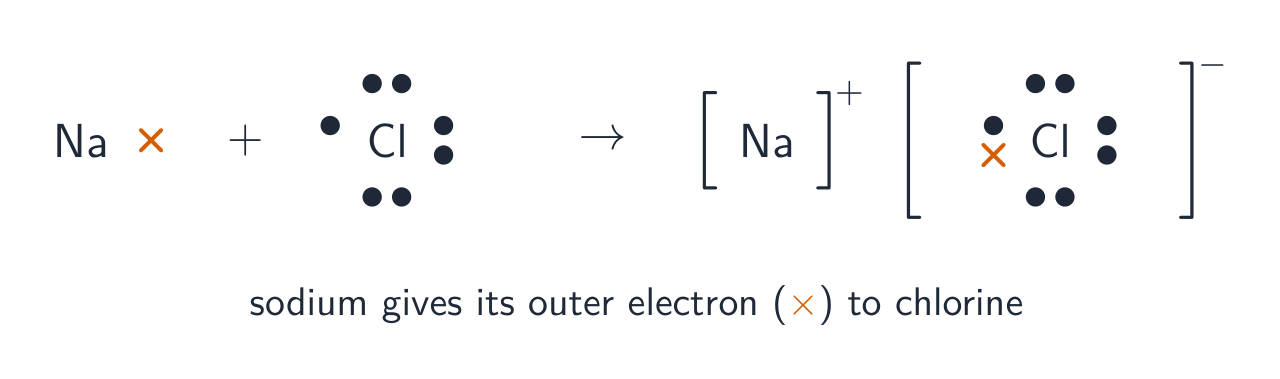
Ionic bonding in NaCl: sodium transfers its outer electron to chlorine
For a main-group atom, valence electrons are the electrons in the...
难度 1/5 · 今日首次完成可获 100 金币及少量额外奖励
Valence electrons are the outermost ones and drive bonding.
Atoms tend to gain or lose electrons to reach a full outer shell (an octet).
难度 1/5 · 今日首次完成可获 100 金币及少量额外奖励
A full octet is a low-energy, stable arrangement.
Gaining and losing to become stable
- Metals lose valence electrons to form positive cations 阳离子.
- Nonmetals gain electrons to form negative anions 阴离子.
- Each aims for a full, noble-gas outer shell.
A metal atom that loses electrons becomes a...
难度 1/5 · 今日首次完成可获 100 金币及少量额外奖励
Losing negative electrons leaves a net positive charge -- a cation.
Match each ion to its type.
难度 2/5 · 今日首次完成可获 140 金币及少量额外奖励
A plus sign marks a cation; a minus sign marks an anion.
Balancing the charges
- An ionic compound 离子化合物 is neutral overall.
- Combine cations and anions so the charges cancel.
- $\text{Na}^+$ with $\text{Cl}^-$ gives $\text{NaCl}$; $\text{Mg}^{2+}$ with $\text{Cl}^-$ gives $\text{MgCl}_2$.
Form an ionic compound
Transfer the metal's valence electron to the non-metal, making a cation and an anion.
What is the neutral formula from $\text{Mg}^{2+}$ and $\text{Cl}^-$?
难度 1/5 · 今日首次完成可获 100 金币及少量额外奖励
一 $2+$ needs two $1-$ ions to balance, giving $\text{MgCl}_2$.
How many $\text{Cl}^-$ ions balance one $\text{Al}^{3+}$ ion?
难度 2/5 · 今日首次完成可获 140 金币及少量额外奖励
Three $1-$ ions cancel one $3+$, giving $\text{AlCl}_3$.
Write the formula from magnesium ($\text{Mg}^{2+}$) and oxide ($\text{O}^{2-}$).
- The $2+$ and $2-$ cancel one-to-one.
- The formula is $\text{MgO}$.
For main-group atoms, count the outer-shell electrons as valence; transition metals can also use d electrons. Metals form cations (lose electrons), nonmetals form anions (gain electrons); do not mix these up. And an ionic formula must be electrically neutral, so choose the smallest whole-number subscripts that make the total positive charge equal the total negative. Criss-crossing must be followed by simplification, as in MgO.
Valence electrons are the outermost electrons that drive bonding, and atoms gain or lose them to reach a stable octet. Metals form cations and nonmetals form anions. An ionic compound balances these charges to stay neutral, so $\text{Mg}^{2+}$ and $\text{Cl}^-$ combine as $\text{MgCl}_2$.