| English | 释义 | 拼音 |
|---|---|---|
| degenerate/dɪˈdʒenəreɪt/ | 简并 | jiǎn bìng |
| octahedral/ˌɒktəˈhiːdrəl/ | 八面体形 | bā miàn tǐ xíng |
| tetrahedral/ˌtetrəˈhiːdrəl/ | 四面体形 | sì miàn tǐ xíng |
| complementary colour/ˌkɒmplɪˈmentəri ˈkʌlə/ | 互补色 | hù bǔ sè |
| spectrochemical series/ˌspektrəʊˈkemɪkl ˈsɪəriːz/ | 光谱化学序列 | guāng pǔ huà xué xù liè |
颜色从哪里来
- 在一个自由离子中,五个 d 轨道是简并的(degenerate)(相同能量)。
- 配体把它们分裂成两组。
- 吸收跨越能隙的光给出我们看到的颜色。
Complex colour route
Follow light absorption from d-orbital splitting to observed colour.
In a free transition-metal ion, the five d orbitals are:
难度 1/5 · 今日首次完成可获 100 金币及少量额外奖励
They are degenerate until ligands approach and split them into two sets.
Transition-metal complexes are coloured because d-electrons absorb part of the ______ spectrum.
难度 1/5 · 今日首次完成可获 100 金币及少量额外奖励
The complementary colour is transmitted.
分裂 d 轨道
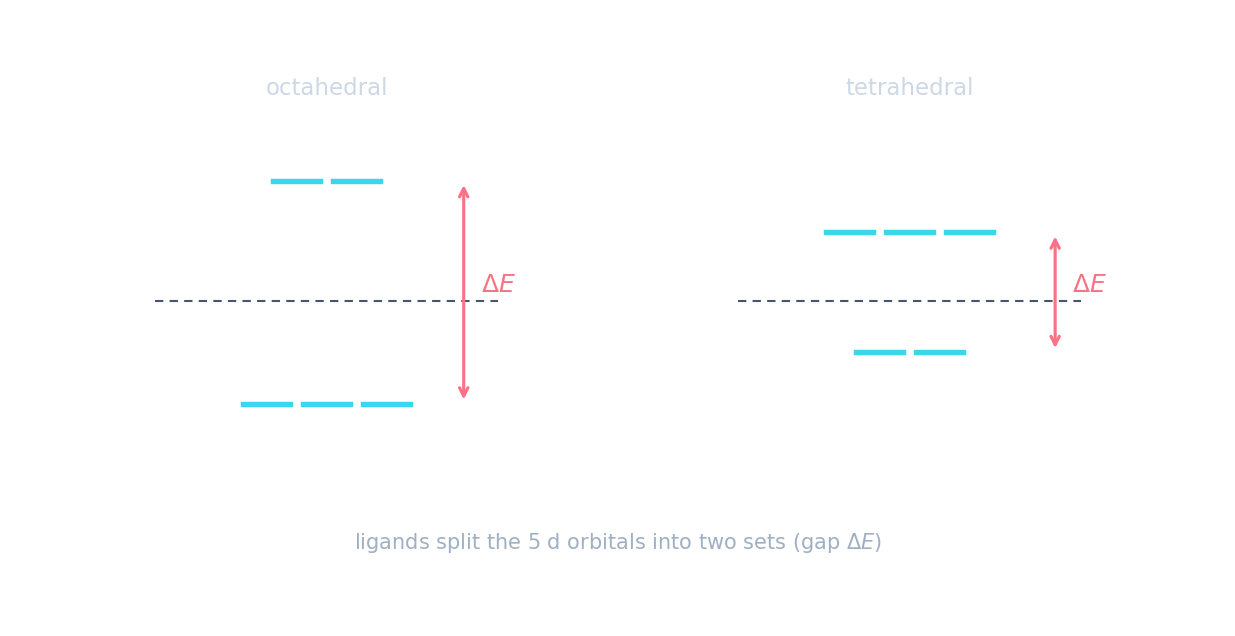
- 配体分裂 d 轨道,由一个能隙 $\Delta E$ 分隔:
- 八面体:三个较低 + 两个较高。
- 四面体:两个较低 + 三个较高。
In an octahedral complex, the d orbitals split into:
难度 1/5 · 今日首次完成可获 100 金币及少量额外奖励
Octahedral: 3 lower + 2 upper; tetrahedral is the reverse (2 lower + 3 upper).
Match each colour-theory idea.
难度 2/5 · 今日首次完成可获 140 金币及少量额外奖励
Each item links the term to its correct meaning.
我们看到的颜色
- 一个配合物吸收频率匹配 $\Delta E$ 的光,把一个电子提升到一个更高的 d 轨道。
- 我们看到被吸收的光的互补色(complementary colour)。
- (一个 d⁰ 或 d¹⁰ 离子——像 Zn²⁺——没有可能的跃迁,所以它是无色的。)
The colour we see for a complex is:
难度 1/5 · 今日首次完成可获 100 金币及少量额外奖励
The complex absorbs light of energy ΔE; we see the complementary colour of what was absorbed.
Ligand exchange changes the colour because different ligands:
难度 1/5 · 今日首次完成可获 100 金币及少量额外奖励
A different ligand changes the size of the d-orbital splitting (ΔE), so a different colour is seen.
什么改变颜色
- 改变 $\Delta E$ 你就改变颜色。三件事改变 $\Delta E$:
- 配体(一个光化学序:CN⁻ > NH₃ > H₂O > Cl⁻);
- 金属的氧化态(更高的电荷 → 更大的 $\Delta E$);
- 配位数 / 几何形状(八面体 vs 四面体)。
向浅蓝色 [Cu(H₂O)₆]²⁺ 加氨 → 深蓝色 [Cu(NH₃)₄(H₂O)₂]²⁺。
把 H₂O 换成更强场的 NH₃ 拓宽了 $\Delta E$,所以一个不同颜色的光被吸收——溶液明显改变颜色。
你掌握了
- 一个自由离子的五个 d 轨道是简并的;配体把它们分裂一个能隙 $\Delta E$
- 八面体 = 3 个较低 + 2 个较高;四面体 = 2 个较低 + 3 个较高
- 配合物吸收匹配 $\Delta E$ 的光;我们看到互补色
- $\Delta E$(和颜色)随配体、氧化态和几何形状改变