Identifying groups and the reaction map · 识别基团和反应图
| English | 中文 | Pinyin · 拼音 |
|---|---|---|
| organic synthesis/ɔːˈɡænɪk ˈsɪnθəsɪs/ | 有机合成 | yǒu jī hé chéng |
| functional group/ˈfʌŋkʃənl ɡruːp/ | 官能团 | guān néng tuán |
| bromine water/ˈbrəʊmaɪn ˈwɔːtə/ | 溴水 | xiù shuǐ |
| silver nitrate/ˈsɪlvə ˈnaɪtreɪt/ | 硝酸银 | xiāo suān yín |
| nitrile/ˈnaɪtraɪl/ | 腈 | jīng |
Reading a molecule's reactions
- Organic synthesis 有机合成 doesn't add new reactions — it joins the ones you know.
- First, identify the functional groups 官能团 present.
- Then use a map of reactions to get from one to another.
读懂一个分子的反应
- 有机合成(organic synthesis)不增加新反应——它连接你知道的那些。
- 首先,识别存在的官能团。
- 然后用一个反应的图(map)从一个到达另一个。
Reaction map lab · 反应图实验室
Classify clues that identify functional groups and reaction pathways. · 对识别官能团和反应途径的线索分类。
A reaction map links functional groups by the reactions that interconvert them. · 一个反应图通过相互转化它们的反应把官能团链接起来。
Used to plan and identify reactions. · 用于规划和识别反应。
Functional group tests
- decolourises bromine water 溴水 → a C=C (alkene).
- precipitate with silver nitrate 硝酸银 → a halogenoalkane.
- orange dichromate → green → a primary/secondary alcohol.
- orange precipitate with 2,4-DNPH → an aldehyde or ketone.
- fizzes with a carbonate → a carboxylic acid.
Identification tests for the AS functional groups
官能团检验
- 使溴水褪色 → 一个 C=C(烯烃)。
- 与硝酸银沉淀 → 一个卤代烷。
- 橙色重铬酸盐 → 绿色 → 一个伯/仲醇。
- 与 2,4-DNPH 橙色沉淀 → 一个醛或酮。
- 与一个碳酸盐冒泡 → 一个羧酸。

AS 官能团的鉴定检验
A compound that decolourises bromine water contains: · 一个使溴水褪色的化合物含有:
Decolourising bromine water is the test for a C=C double bond. · 使溴水褪色是 C=C 双键的检验。
An orange precipitate with 2,4-DNPH indicates: · 与 2,4-DNPH 的一个橙色沉淀表明:
2,4-DNPH detects the carbonyl group (aldehyde or ketone). · 2,4-DNPH 检测羰基基团(醛或酮)。
Match each test to what it shows. · 把每个检验匹配到它显示什么。
Each item links the term to its correct meaning. · 每一项把术语链接到它正确的含义。
The reaction map
| Start | Reagent | Product |
|---|---|---|
| alkene | steam, $\text{H}_3\text{PO}_4$ | alcohol |
| halogenoalkane | NaOH(aq) | alcohol |
| halogenoalkane | KCN in ethanol | nitrile 腈 (+1 carbon) |
| alcohol | dichromate (distil/reflux) | aldehyde / carboxylic acid |
| aldehyde/ketone | $\text{NaBH}_4$ | alcohol |
| nitrile | dilute acid | carboxylic acid |
| acid + alcohol | conc. $\text{H}_2\text{SO}_4$ | ester |
A map of the AS organic reactions to plan a synthesis
反应图
| 起点 | 试剂 | 产物 |
|---|---|---|
| 烯烃 | 蒸汽,$\text{H}_3\text{PO}_4$ | 醇 |
| 卤代烷 | NaOH(aq) | 醇 |
| 卤代烷 | KCN 在乙醇中 | 腈(+1 碳) |
| 醇 | 重铬酸盐(蒸馏/回流) | 醛 / 羧酸 |
| 醛/酮 | $\text{NaBH}_4$ | 醇 |
| 腈 | 稀酸 | 羧酸 |
| 酸 + 醇 | 浓 $\text{H}_2\text{SO}_4$ | 酯 |
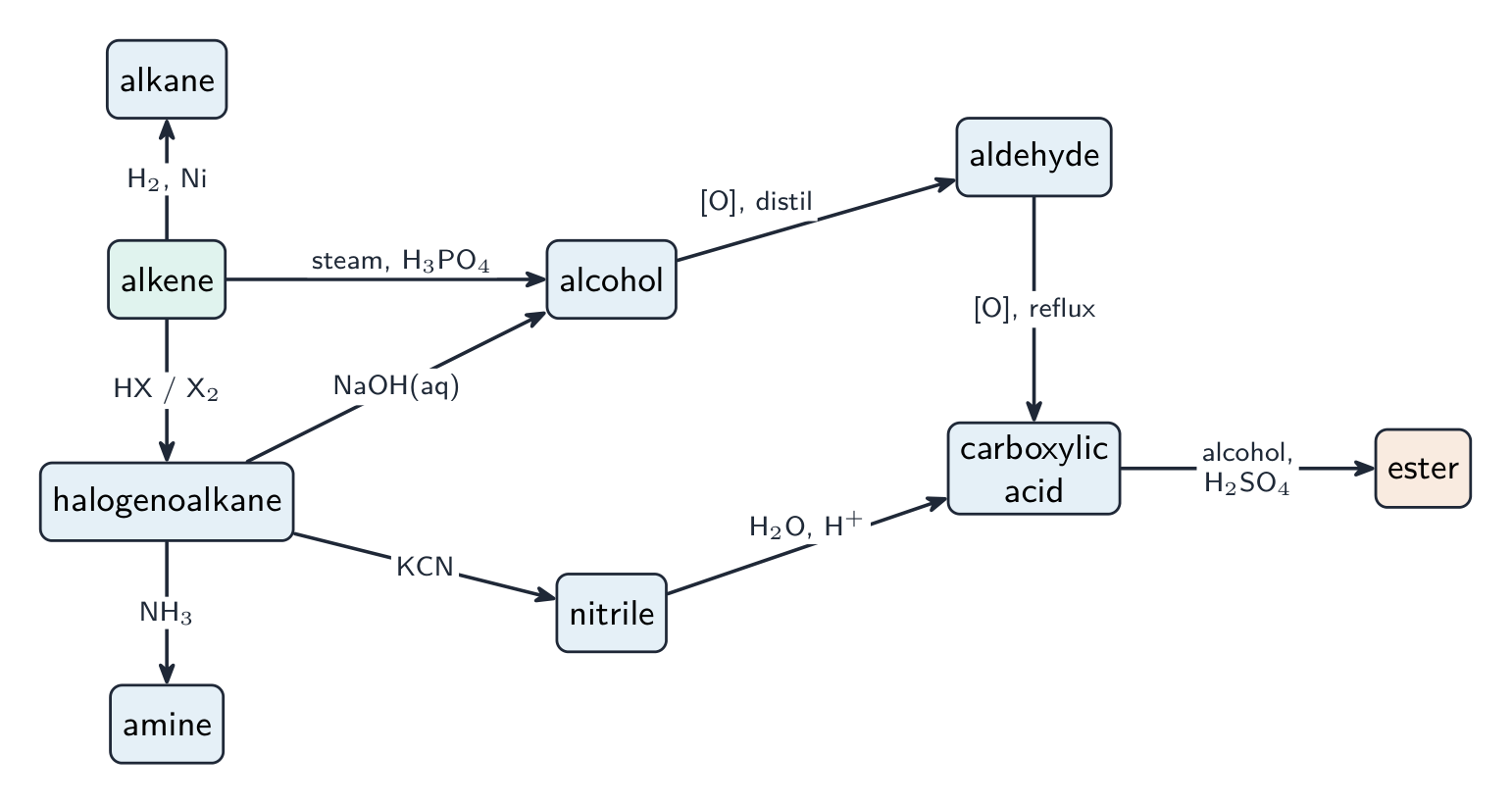
一个 AS 有机反应的图,用于规划一个合成
According to the reaction map, an alkene + steam (H₃PO₄) gives: · 根据反应图,一个烯烃 + 蒸汽(H₃PO₄)给出:
Electrophilic addition of water across the C=C gives an alcohol. · 水跨 C=C 的亲电加成给出一个醇。
Which step lengthens the carbon chain by one? · 哪一步把碳链延长一个?
KCN adds a CN group (a carbon) — the only AS reaction that lengthens the chain. · KCN 加一个 CN 基团(一个碳)——唯一延长链的 AS 反应。
Worked example: a two-step synthesis
- Plan by working backwards from the target, then check each step's reagents.
Make propanoic acid (3 C) from bromoethane (2 C). You need to add a carbon, so use KCN:
- Bromoethane + KCN (in ethanol) → propanenitrile (CH₃CH₂CN) — chain lengthened by one carbon.
- Propanenitrile + dilute acid (hydrolysis) → propanoic acid (CH₃CH₂COOH).
The KCN step is the key — it's the only one here that adds a carbon.
例题:一个两步合成
- 通过从目标向后工作来规划,然后检查每一步的试剂。
从溴乙烷(2 C)制造丙酸(3 C)。 你需要加一个碳,所以用 KCN:
- 溴乙烷 + KCN(在乙醇中)→ 丙腈(CH₃CH₂CN)——链延长一个碳。
- 丙腈 + 稀酸(水解)→ 丙酸(CH₃CH₂COOH)。
KCN 步骤是关键——它是这里唯一加一个碳的。
You've got it
- synthesis joins known reactions to build a target — plan it backwards from the target
- tests: bromine water (alkene), AgNO₃ (halogenoalkane), dichromate (1°/2° alcohol), 2,4-DNPH (carbonyl), carbonate fizz (acid)
- the reaction map converts group to group; KCN is the only step that adds a carbon
- each arrow needs its reagents and conditions
你掌握了
- 合成连接已知反应来构建一个目标——从目标向后规划它
- 检验:溴水(烯烃)、AgNO₃(卤代烷)、重铬酸盐(1°/2° 醇)、2,4-DNPH(羰基)、碳酸盐冒泡(酸)
- 反应图把基团转换成基团;KCN 是唯一加一个碳的步骤
- 每个箭头都需要它的试剂和条件