Planning a synthetic route · 规划一条合成路线
| English | 中文 | Pinyin · 拼音 |
|---|---|---|
| target molecule/ˈtɑːɡɪt ˈmɒlɪkjuːl/ | 目标分子 | mù biāo fèn zǐ |
| starting material/ˈstɑːtɪŋ məˈtɪərɪəl/ | 起始材料 | qǐ shǐ cái liào |
| reagent/rɪˈeɪdʒənt/ | 试剂 | shì jì |
| by-product/baɪ ˈprɒdʌkt/ | 副产物 | fù chǎn wù |
| yield/jiːld/ | 产率 | chǎn lǜ |
From start to target
- A target molecule 目标分子 is built in several steps.
- The trick is to work backwards from the target.
- You also analyse a given route step by step.
从起点到目标
- 一个目标分子在几个步骤中构建。
- 诀窍是从目标向后工作。
- 你也一步步分析一个给定的路线。
Synthetic route planning lab · 合成路线规划实验室
Follow how a target molecule is planned backwards then made forwards. · 跟踪一个目标分子如何向后规划然后向前制造。
A good synthetic route uses few steps and gives a high overall yield. · 一条好的合成路线使用少的步骤并给出高的总产率。
Fewer steps means less loss of product. · 更少的步骤意味着更少的产物损失。
Planning a route
- compare the target with the starting material 起始材料 — what changed (the group, the number of carbons)?
- work backwards: which single reaction could make the target, and from what?
- repeat until you reach the starting material.
- write each step with its reagent 试剂 and conditions.
- To add a carbon, the KCN step is the key (the only chain-lengthening AS reaction).
Plan a synthesis backwards — from the target, step by step, to the starting material
Medicines are built up by multi-step organic synthesis.
规划一条路线
- 把目标与起始材料比较——什么改变了(基团、碳的数目)?
- 向后工作:哪个单一反应能制造目标,以及从什么?
- 重复直到你到达起始材料。
- 用它的试剂和条件写下每一步。
- 要加一个碳,KCN 步骤是关键(唯一延长链的 AS 反应)。
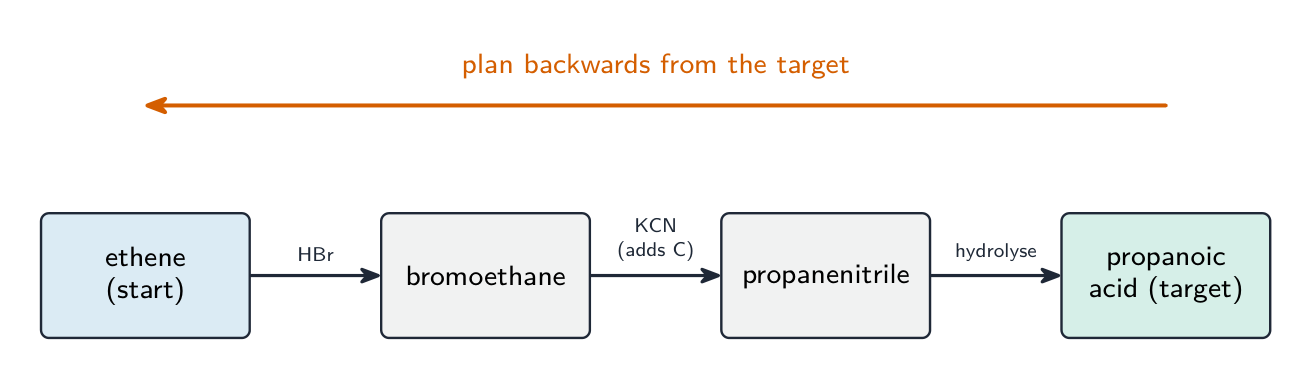
向后规划合成——从目标,一步步,到起始材料

药物由多步有机合成构建。
The best way to plan a multi-step synthesis is to: · 规划一个多步合成的最好方式是:
Working backwards from the target finds which reaction makes it, and from what, step by step. · 从目标向后工作一步步找出哪个反应制造它,以及从什么。
If your route needs to add a carbon atom, the key step is: · 如果你的路线需要加一个碳原子,关键步骤是:
KCN is the only AS reaction that lengthens the carbon chain. · KCN 是唯一延长碳链的 AS 反应。
Match each synthesis idea. · 匹配每个合成概念。
Each item links the term to its correct meaning. · 每一项把术语链接到它正确的含义。
Analysing a route
- For each step, state the type of reaction (oxidation, reduction, substitution, addition, elimination) and the reagent.
- Think about by-products 副产物 — e.g. making an amine from a halogenoalkane also gives further-substituted amines, so the yield 产率 of the simple amine is low.
分析一条路线
- 对每一步,陈述反应的类型(氧化、还原、取代、加成、消除)和试剂。
- 想想副产物——例如从一个卤代烷制造一个胺也给出进一步取代的胺,所以简单胺的产率低。
When analysing each step of a given route, you should state: · 当分析一个给定路线的每一步时,你应该陈述:
Identify the reaction type (oxidation, substitution, etc.) and the reagent/conditions for each step. · 识别反应类型(氧化、取代等)和每一步的试剂/条件。
Why is the yield of a simple amine from a halogenoalkane low? · 为什么从一个卤代烷得到一个简单胺的产率低?
The amine is itself a nucleophile, so it reacts again — a by-product mixture lowers the yield. · 胺本身是一个亲核试剂,所以它再次反应——一个副产物混合物降低产率。
Judging a route
- Prefer routes with few steps and high yield, using safe, cheap reagents.
- Each extra step loses product, so the overall yield falls quickly.
评判一条路线
- 偏好步骤少且产率高的路线,使用安全、便宜的试剂。
- 每个额外的步骤损失产物,所以总产率快速下降。
You've got it
- plan by working backwards from the target (compare groups and carbon count)
- write each step's reagent + conditions; use KCN to add a carbon
- to analyse a route, give each step's reaction type and reagent, and watch for by-products
你掌握了
- 通过从目标向后工作来规划(比较基团和碳数)
- 写下每一步的试剂 + 条件;用 KCN 加一个碳
- 要分析一条路线,给出每一步的反应类型和试剂,并留意副产物