| English | 释义 | 拼音 |
|---|---|---|
| amine/ˈæmaɪn/ | 胺 | àn |
| halogenoalkane/ˈheɪləʊdʒnəʊlkeɪn/ | 卤代烷 | lǔ dài wán |
| nucleophilic substitution/ˌnjuːklɪəˈfɪlɪk ˌsʌbstɪˈtjuːʃn/ | 亲核取代 | qīn hé qǔ dài |
| lone pair/ləʊn peə/ | 孤对电子 | gū duì diàn zi |
| nucleophile/ˈnjuːklɪɒfaɪl/ | 亲核试剂 | qīn hé shì jì |
Organic bases
- An amine 胺 has an –NH₂ group (nitrogen in place of a hydrogen of ammonia).
- We can make a primary amine from a halogenoalkane 卤代烷.
- It happens by nucleophilic substitution 亲核取代.
Amine reaction lab
Classify amine examples by basicity and nucleophilic behaviour.
An amine contains the:
难度 1/5 · 今日首次完成可获 100 金币及少量额外奖励
An amine has an –NH₂ group, where nitrogen replaces a hydrogen of ammonia.
Amines act as bases because the nitrogen lone pair can accept a ______.
难度 1/5 · 今日首次完成可获 100 金币及少量额外奖励
R–NH₂ + H⁺ → R–NH₃⁺.
Making a primary amine
- Heat a halogenoalkane with ammonia dissolved in ethanol, under pressure:
$$\text{C}_2\text{H}_5\text{Br} + \text{NH}_3 \rightarrow \text{C}_2\text{H}_5\text{NH}_2 + \text{HBr}$$
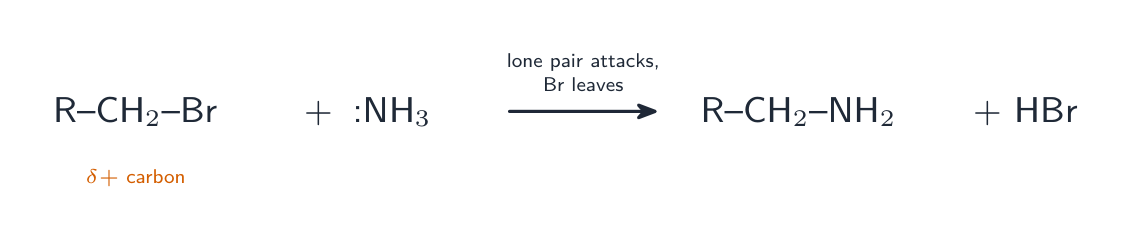
Ammonia's lone pair substitutes for the halogen of a halogenoalkane, giving a primary amine
A primary amine is made by heating a halogenoalkane with:
难度 1/5 · 今日首次完成可获 100 金币及少量额外奖励
Ammonia (in ethanol, under pressure) substitutes the halogen to give the amine.
Match each amine fact.
难度 2/5 · 今日首次完成可获 140 金币及少量额外奖励
Each item links the term to its correct meaning.
The mechanism
- This is a nucleophilic substitution: the lone pair 孤对电子 on ammonia's nitrogen attacks the slightly positive carbon and pushes out the halogen.
- Use an excess of ammonia, or the amine formed reacts again.
The reaction is a nucleophilic substitution because:
难度 1/5 · 今日首次完成可获 100 金币及少量额外奖励
Ammonia is the nucleophile; its nitrogen lone pair attacks the C–X carbon and pushes out the halogen.
Why is an excess of ammonia used?
难度 1/5 · 今日首次完成可获 100 金币及少量额外奖励
The amine is itself a nucleophile and could react again; excess ammonia favours the primary amine.
Worked example: why use excess ammonia?
Bromoethane is heated with ammonia in ethanol. Explain why a mixture of amines can form.
- The product, ethylamine, $\text{C}_2\text{H}_5\text{NH}_2$, still has a lone pair on N, so it is a nucleophile too. It attacks more bromoethane: $\text{C}_2\text{H}_5\text{NH}_2 + \text{C}_2\text{H}_5\text{Br} \rightarrow (\text{C}_2\text{H}_5)_2\text{NH} + \text{HBr}$, then on to $(\text{C}_2\text{H}_5)_3\text{N}$ and a quaternary salt.
- A large excess of $\text{NH}_3$ makes a bromoethane molecule far more likely to meet ammonia than an amine, so the primary amine is the main product. The extra $\text{NH}_3$ also takes up the HBr: $\text{C}_2\text{H}_5\text{Br} + 2\text{NH}_3 \rightarrow \text{C}_2\text{H}_5\text{NH}_2 + \text{NH}_4\text{Br}$.
Which product forms when ethylamine reacts with a second molecule of bromoethane?
难度 1/5 · 今日首次完成可获 100 金币及少量额外奖励
The N lone pair of ethylamine substitutes for Br, so N now carries two ethyl groups.
You've got it
- an amine has the –NH₂ group
- made by heating a halogenoalkane with NH₃ in ethanol, under pressure
- it is a nucleophilic substitution (ammonia's lone pair attacks); use excess NH₃