Inventory management · 库存管理
| English | 中文 | Pinyin · 拼音 |
|---|---|---|
| just-in-time/dʒʌst ɪn taɪm/ | 准时制 | zhǔn shí zhì |
| stock/stɒk/ | 存货 | cún huò |
| inventory/ˈɪnvəntri/ | 库存 | kù cún |
| delivery/dɪˈlɪvəri/ | 交货 | jiāo huò |
| re-order level/riː ˈɔːdə ˈlevl/ | 再订货水平 | zài dìng huò shuǐ píng |
| buffer stock/ˈbʌfə stɒk/ | 缓冲库存 | huǎn chōng kù cún |
| lead time/liːd taɪm/ | 交货周期 | jiāo huò zhōu qī |
| just-in-case/dʒʌst ɪn keɪs/ | 备货制 | bèi huò zhì |
| suppliers/səˈplaɪəz/ | 供应商 | gōng yìng shāng |
Just enough, just in time 准时制
- Too little stock 存货 and production halts; too much and cash is tied up in a warehouse.
- Inventory 库存 (stock) management walks this tightrope.
刚好足够,刚好及时
- 库存太少,生产停止;太多,现金被困在一个仓库里。
- 库存(存货)管理(inventory / stock management)走这条钢丝。
Leadership style lab · 领导风格实验室
Pick the management style that fits each situation. · 选择适合每种情况的管理风格。
On a stock control chart, the re-order level is the stock level at which: · 在库存控制图上,再订货水平是指库存量达到该水平时:
Reaching the re-order level triggers a new order. · 达到再订货水平会触发新订单。
The stock control chart
- As stock is used up, it falls; when a delivery 交货 arrives, it jumps back to the maximum.
- Key levels: maximum, re-order level 再订货水平 (place an order), and buffer stock 缓冲库存 (the safety minimum).
Stock falls as it is used, then deliveries return it to the maximum, never falling below the buffer.
库存控制图
- 随着库存被用完,它下降;当一次交付到达时,它跳回最大值。
- 关键水平:最大值(maximum)、再订货水平(re-order level,下一个订单)和缓冲库存(buffer stock,安全最低值)。
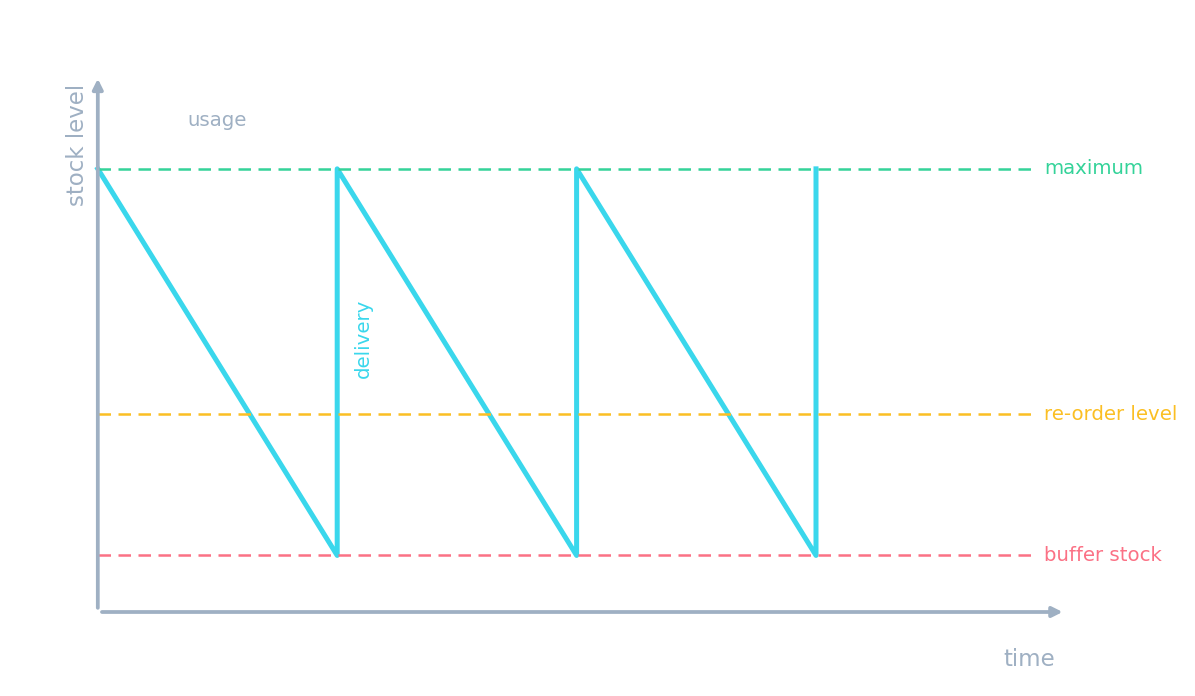
库存随被使用而下降,然后交付把它返回到最大值,从不跌破缓冲。
Buffer stock is held to: · 缓冲库存用于:
Buffer stock is a safety minimum. · 缓冲库存是一种安全最低限度。
Lead time is the gap between placing an order and receiving the delivery. · 提前期是指下订单与收到货物之间的时间间隔。
Longer lead times require higher buffer stock. · 较长的提前期需要更高的缓冲库存。
Lead time 交货周期 and buffer stock
- Lead time is the gap between ordering and delivery.
- Buffer stock is the minimum held to cope with delays or demand spikes.
提前期与缓冲库存
- 提前期(lead time)是订货与交付之间的间隔。
- 缓冲库存(buffer stock)是为应对延误或需求高峰而持有的最低值。
A benefit of just-in-time (JIT) is that it: · 准时制(JIT)的一个好处是它能:
JIT minimises stock and frees cash, but relies on reliable supply. · JIT(准时制)减少库存并释放现金,但依赖可靠的供应链。
Holding extra stock for safety, in case of problems, is the just-in-______ approach. · 为应对问题而额外持有库存以备不时之需,是 just-in-______ 方法。
Just-in-case holds buffer stock; just-in-time holds almost none. · Just-in-case(备用法)持有缓冲库存;just-in-time(准时制)几乎不持有库存。
JIT vs JIC
- Just-in-time (JIT): hold almost no stock; materials arrive as needed. Frees cash, but risky if supply fails.
- Just-in-case 备货制 (JIC): hold buffer stock for safety. Reliable, but ties up cash.
Just-in-time holds almost no stock; just-in-case keeps a buffer for safety
JIT saves cash but removes the safety net. With no buffer stock, a single late delivery stops production. JIT needs very reliable suppliers 供应商 — its strength is also its weakness.
JIT 对 JIC
- 准时制(just-in-time,JIT):几乎不持有库存;材料按需到达。释放现金,但如果供给失败则冒险。
- 以防万一(just-in-case,JIC):为安全持有缓冲库存。可靠,但占用现金。

准时制几乎不持有库存;以防万一为安全保留一个缓冲
JIT 省现金但移除安全网。 没有缓冲库存,一次延迟交付就停止生产。JIT 需要非常可靠的供应商——它的优点也是它的弱点。
You've got it
- the stock control chart shows usage, re-order level, deliveries and buffer stock
- lead time = order-to-delivery gap; buffer stock = safety minimum
- JIT (no stock) frees cash but is risky; JIC (buffer stock) is safer but ties up cash
你掌握了
- 库存控制图显示使用、再订货水平、交付和缓冲库存
- 提前期 = 订货到交付的间隔;缓冲库存 = 安全最低值
- JIT(无库存)释放现金但冒险;JIC(缓冲库存)更安全但占用现金